
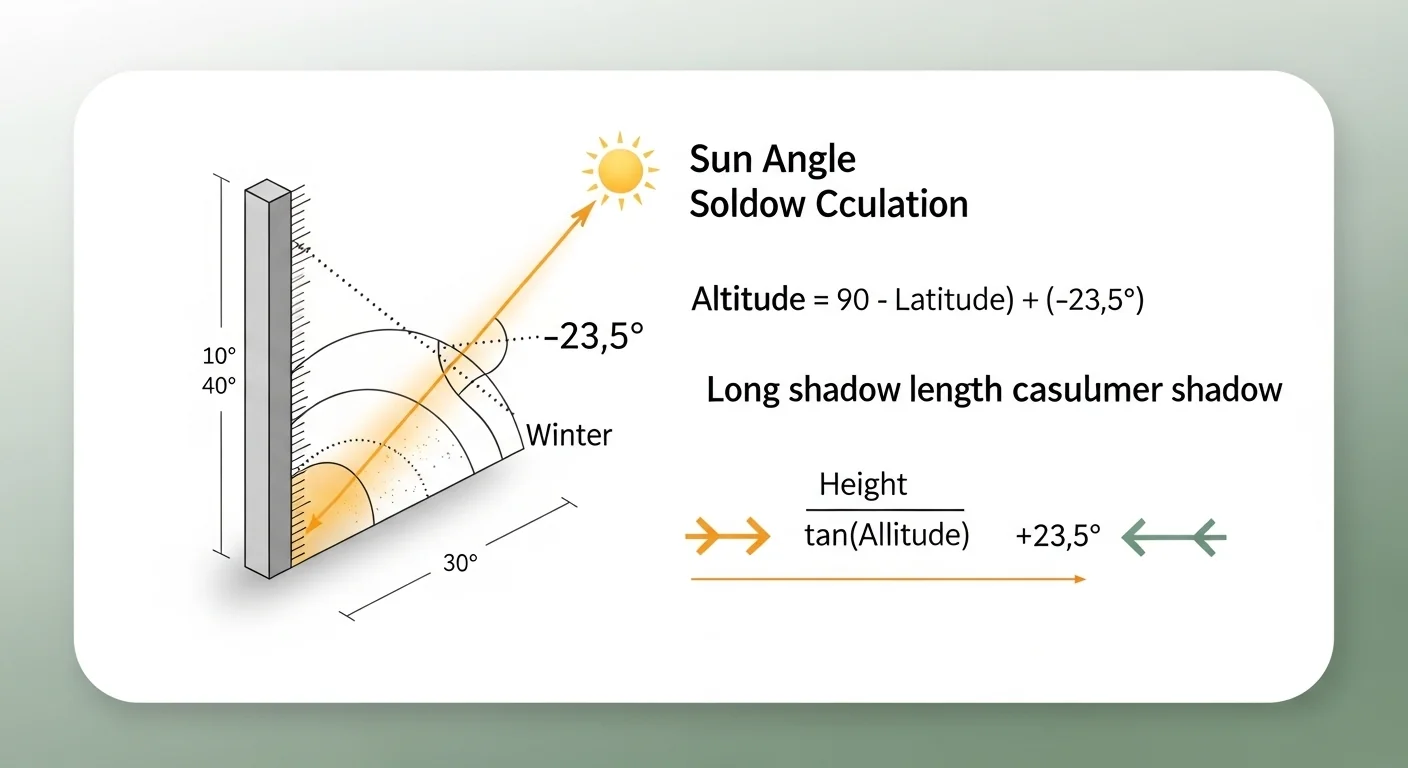
Sun Angle & Shadow Calculator
Calculate seasonal solar-noon elevation and geometric shadow length.
| Object Height | ☀ Summer Shadow | ❄ Winter Shadow | Winter ÷ Summer |
|---|
How this calculator works
Step 1 — Solar Declination
This simplified model uses rounded solstice declinations. June uses +23.5°; December uses −23.5°. Local summer is June in the Northern Hemisphere and December in the Southern Hemisphere. Local winter is the opposite.
Step 2 — Solar-Noon Elevation
Use signed latitude and the selected solstice declination. At solar noon, the hour angle is zero:
Example at +45° in June: 90 − |45 − 23.5| = 68.5°.
Example at −45° in December: 90 − |−45 − (−23.5)| = 68.5°.
Step 3 — Geometric Shadow Length
For a vertical object on level ground, when the Sun is above the geometric horizon:
For 0° < elevation < 90°, the shadow is finite. At 90°, its horizontal length is 0. At exactly 0°, the ideal shadow is unbounded. Below 0°, a direct-shadow calculation is not applicable.
Units: Height in feet gives shadow length in feet. Signed latitude spans −90° to +90°. The code converts the elevation from degrees to radians before using tan().
A higher positive solar elevation gives a shorter geometric shadow. Only the selected solstice’s solar-noon snapshot is modeled; daily sun-hours and shadow duration are not calculated.
Assumptions & Limits
- The model assumes local solar noon, which is not necessarily 12:00 on a clock. It does not calculate that clock time.
- Declinations are fixed at approximately ±23.5°; exact values and solstice dates depend on the year.
- June and December are two snapshots. Within the tropics, they do not necessarily include the year’s highest noon elevation or shortest noon shadow.
- Latitude may be anywhere from −90° to +90°. At 0°, summer means June and winter means December solely as a labeling convention.
- The shadow formula models a vertical height above flat, level ground. Object width and irregular silhouettes are not modeled.
- Terrain, other obstacles, atmospheric refraction and the Sun’s finite disk are excluded. Near the horizon, these limitations are especially important.
- No daily sun-hours, sunrise/sunset times, compass direction, crop suitability or year-round exposure is calculated.
- The SVG is a schematic, not a scaled site plan or compass-oriented sun path.
- Object height must be between 0.1 ft and 500 ft.
Original Sources & Calculation Limitations
- NOAA General Solar Position Calculations — solar declination, hour angle and zenith equations. The noon relation used here follows by setting the hour angle to zero.
- NOAA calculation limitations — approximations and atmospheric-refraction effects. NOAA also states that its calculator is no longer actively maintained.
- U.S. Naval Observatory Altitude/Azimuth service — date-, time- and location-specific solar positions. Its apparent altitudes include standard refraction above the horizon.
This widget uses a simplified geometric noon model with rounded solstice declinations, not NOAA’s full date/time algorithm. USNO’s apparent-altitude results are not exact equality checks for this uncorrected geometric model.
Technical Review Record
Reviewed by: Not supplied
Qualification: Solar-energy engineer – pending verification
Independent technical review: Pending. No qualified reviewer is represented as having approved this calculator.
Code regression checks: Six listed cases passed on 2026-09-07. This records software checks, not an engineering review or field validation.
Test model: Height = 20 ft for all six cases; declination = ±23.5°; geometric solar noon with no refraction.
| Case | Latitude | Local season / month | Declination | Expected elevation | Expected shadow |
|---|---|---|---|---|---|
| 1 — North summer | +45° | Summer / June | +23.5° | 68.5° | 7.88 ft |
| 2 — North winter | +45° | Winter / December | −23.5° | 21.5° | 50.77 ft |
| 3 — South summer | −45° | Summer / December | −23.5° | 68.5° | 7.88 ft |
| 4 — Zenith | +23.5° | Summer / June | +23.5° | 90° | 0.00 ft |
| 5 — Geometric horizon | +66.5° | Winter / December | −23.5° | 0° | Unbounded ideal limit |
| 6 — Below horizon | −70° | Winter / June | +23.5° | −3.5° | N/A — Sun below horizon |
Finite test shadows are shown to two decimals; the main display uses one decimal. Automated checks compare unrounded values with fixed numerical references.
Shadow length is not a fixed property of an object. It changes by season, latitude, and time of day -- and the difference between a summer shadow and a winter shadow is not small. At 45 degrees north latitude, a 20-foot house casts roughly an 8-foot shadow at solar noon in June. By December, that same house casts a shadow past 50 feet. Garden beds that get full sun in July can be in deep shade for four consecutive months without the gardener ever realizing it until the crops fail.
This sun path calculator computes the solar altitude angle at solar noon for either the Summer or Winter Solstice, then derives the theoretical shadow length for any vertical object at any latitude between 0 and 90 degrees. It does not calculate time-of-day shadow movement, cloud cover effects, or terrain obstructions. The result represents the worst-case (longest) or best-case (shortest) shadow for that solstice day -- the planning anchors that matter most for garden layout decisions. Understanding your vegetable yield potential starts well before seeds go in the ground; it starts with knowing what light your beds actually receive in December.
After using this calculator, you will know the maximum extent of shade cast by any house, tree, or fence on your property during winter and summer -- giving you the spatial information needed to place garden beds where they will actually perform.
Use the Tool
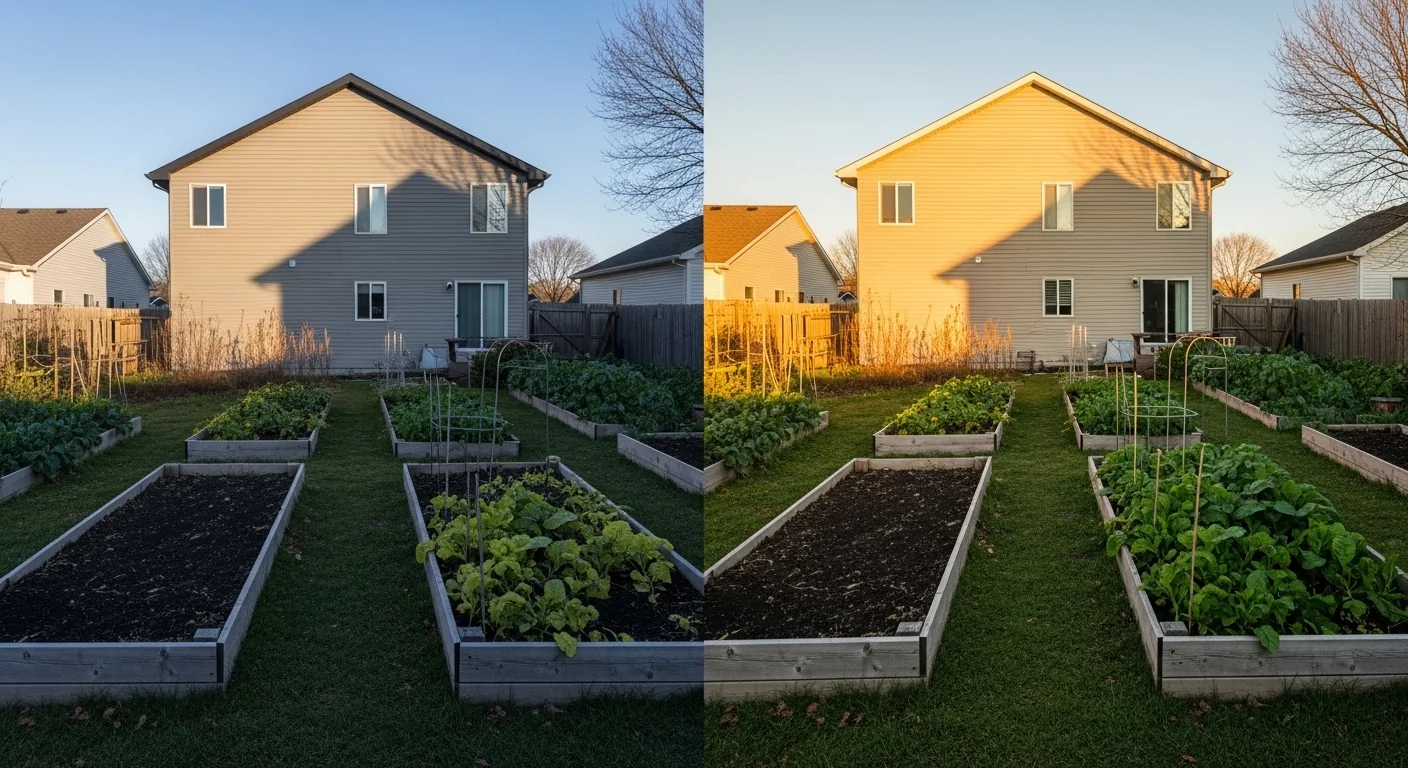
Before you calculate, have three numbers ready: the measured height of the object casting the shadow (in feet), your approximate latitude (findable in your phone's maps app or GPS settings), and the season you are planning for. Height is the single most impactful variable -- measure it or estimate conservatively; rounding down on a tree height will underestimate the shadow reach. If you are planning a new bed and want to evaluate both seasons in one session, run the calculator twice.
Quick Start (60 Seconds)
- Object Height (ft): Enter the vertical height of the structure or plant casting the shadow. Measure from ground level to the topmost point. A two-story house is typically 20 to 25 feet; a mature oak may reach 60 feet or more. Acceptable range: 0.1 to 500 ft.
- Latitude: Enter your latitude in decimal degrees (not degrees/minutes/seconds). The United States spans roughly 25 to 49 degrees. Canada ranges from 45 to 60+ degrees. The UK sits between 50 and 59 degrees. Entering 0 assumes the equator; entering 90 assumes the North Pole.
- Season: Select Summer Solstice (June 21) for the shortest shadows of the year, or Winter Solstice (December 21) for the longest. These are planning extremes -- actual daily shadows fall somewhere between these two values.
- Common mistake with height: Measuring to the roof peak but forgetting a chimney, dormer, or tree crown that extends higher. The highest point is what counts for maximum shadow length.
- Common mistake with latitude: Confusing latitude with longitude. Latitude runs east-west (horizontal lines on a globe). Use the "coordinates" feature in Google Maps to retrieve both values; the first number is latitude.
- After calculating: The results panel shows both summer and winter shadow lengths simultaneously. The winter figure is the one that matters for garden bed siting.
Inputs and Outputs (What Each Field Means)
| Field | Unit | What It Represents | Common Mistake | Safe Entry Guidance |
|---|---|---|---|---|
| Object Height | Feet | Vertical height from grade to the highest point of the shadow-casting object | Using roof height but ignoring chimneys, antennae, or crown spread | Round up to nearest foot; if unsure, overestimate |
| Latitude | Decimal degrees (0-90) | Your north-south position on Earth; determines how high the sun climbs at solar noon | Entering longitude instead of latitude, or using degrees-minutes-seconds format | Use Google Maps coordinates; first number is latitude |
| Season | Solstice (Summer/Winter) | Sets the solar declination: +23.5 degrees (summer) or -23.5 degrees (winter) | Only checking summer when planning a garden bed that will be used year-round | Run both seasons; use the winter result for critical shade analysis |
| Sun Altitude Angle (output) | Degrees above horizon | The elevation angle of the sun above the horizon at solar noon for the chosen solstice | Treating this as an all-day average; it is a solar-noon maximum only | A negative result indicates polar night conditions; no shadow calculation applies |
| Summer Shadow (output) | Feet | Minimum midday shadow length of the year, calculated at Summer Solstice solar noon | Assuming this represents the shadow at all hours; shadows are much longer at dawn and dusk | Use as the best-case figure; actual shadows during growing season are often longer |
| Winter Shadow (output) | Feet | Maximum midday shadow length of the year, calculated at Winter Solstice solar noon | Ignoring this figure when placing raised beds or cold frames | This is the critical planning figure; use it as the minimum clearance from any structure |
Planning a garden around seasonal sun angles pairs directly with timing decisions. The growing degree days calculator can help you align your shade analysis with actual crop heat accumulation windows.
Worked Examples (Real Numbers)
Example 1: 20-foot house at 45 degrees north latitude
- Object Height: 20 ft
- Latitude: 45 degrees
- Summer Solstice sun angle: (90 - 45) + 23.5 = 68.5 degrees
- Winter Solstice sun angle: (90 - 45) - 23.5 = 21.5 degrees
Result: Summer shadow = 20 / tan(68.5°) = 7.9 ft. Winter shadow = 20 / tan(21.5°) = 50.8 ft.
A garden bed placed 15 feet north of this house sits outside its summer shadow entirely -- but in nearly full winter shade. Any winter greens, cold frames, or overwintering crops within 50 feet need supplemental light or relocation.
Example 2: 40-foot oak tree at 35 degrees north latitude
- Object Height: 40 ft
- Latitude: 35 degrees
- Summer Solstice sun angle: (90 - 35) + 23.5 = 78.5 degrees
- Winter Solstice sun angle: (90 - 35) - 23.5 = 31.5 degrees
Result: Summer shadow = 40 / tan(78.5°) = 8.1 ft. Winter shadow = 40 / tan(31.5°) = 65.3 ft.
Even at the relatively sunny 35-degree latitude, a mature tree creates a 65-foot shadow corridor in December. Any bed within that radius that is being used for winter gardening will receive little to no direct midday sun.
Example 3: 6-foot wooden fence at 55 degrees north latitude
- Object Height: 6 ft
- Latitude: 55 degrees (central UK, northern Germany, southern Canada)
- Summer Solstice sun angle: (90 - 55) + 23.5 = 58.5 degrees
- Winter Solstice sun angle: (90 - 55) - 23.5 = 11.5 degrees
Result: Summer shadow = 6 / tan(58.5°) = 3.7 ft. Winter shadow = 6 / tan(11.5°) = 29.5 ft.
A standard garden fence that barely shades anything in summer creates a shadow nearly the length of a full allotment bed in winter. At high latitudes, even low structures like cold frames, compost bins, or trellises deserve a winter shadow check.
Reference Table (Fast Lookup)
Shadow lengths for a 10-foot object at solar noon on each solstice, by latitude. The final column shows how many times longer the winter shadow is than the summer shadow -- a ratio useful for quick site comparisons.
| Latitude | Summer Sun Angle | Winter Sun Angle | Summer Shadow (10 ft) | Winter Shadow (10 ft) | Winter / Summer Ratio |
|---|---|---|---|---|---|
| 25 degrees N | 88.5 degrees | 41.5 degrees | 0.3 ft | 11.3 ft | 37.7x |
| 30 degrees N | 83.5 degrees | 36.5 degrees | 1.1 ft | 13.5 ft | 12.3x |
| 35 degrees N | 78.5 degrees | 31.5 degrees | 2.0 ft | 16.3 ft | 8.1x |
| 40 degrees N | 73.5 degrees | 26.5 degrees | 3.0 ft | 20.1 ft | 6.7x |
| 45 degrees N | 68.5 degrees | 21.5 degrees | 4.0 ft | 25.4 ft | 6.4x |
| 50 degrees N | 63.5 degrees | 16.5 degrees | 5.0 ft | 33.8 ft | 6.8x |
| 55 degrees N | 58.5 degrees | 11.5 degrees | 6.1 ft | 49.1 ft | 8.0x |
| 60 degrees N | 53.5 degrees | 6.5 degrees | 7.4 ft | 87.8 ft | 11.9x |
| 65 degrees N | 48.5 degrees | 1.5 degrees | 8.8 ft | 382 ft (near polar) | 43.4x |
Note: All shadow values in this table assume a 10-foot object. Scale linearly for any other height (e.g., a 30-foot object at 45 degrees N casts 3x these values).
How the Calculation Works (Formula + Assumptions)
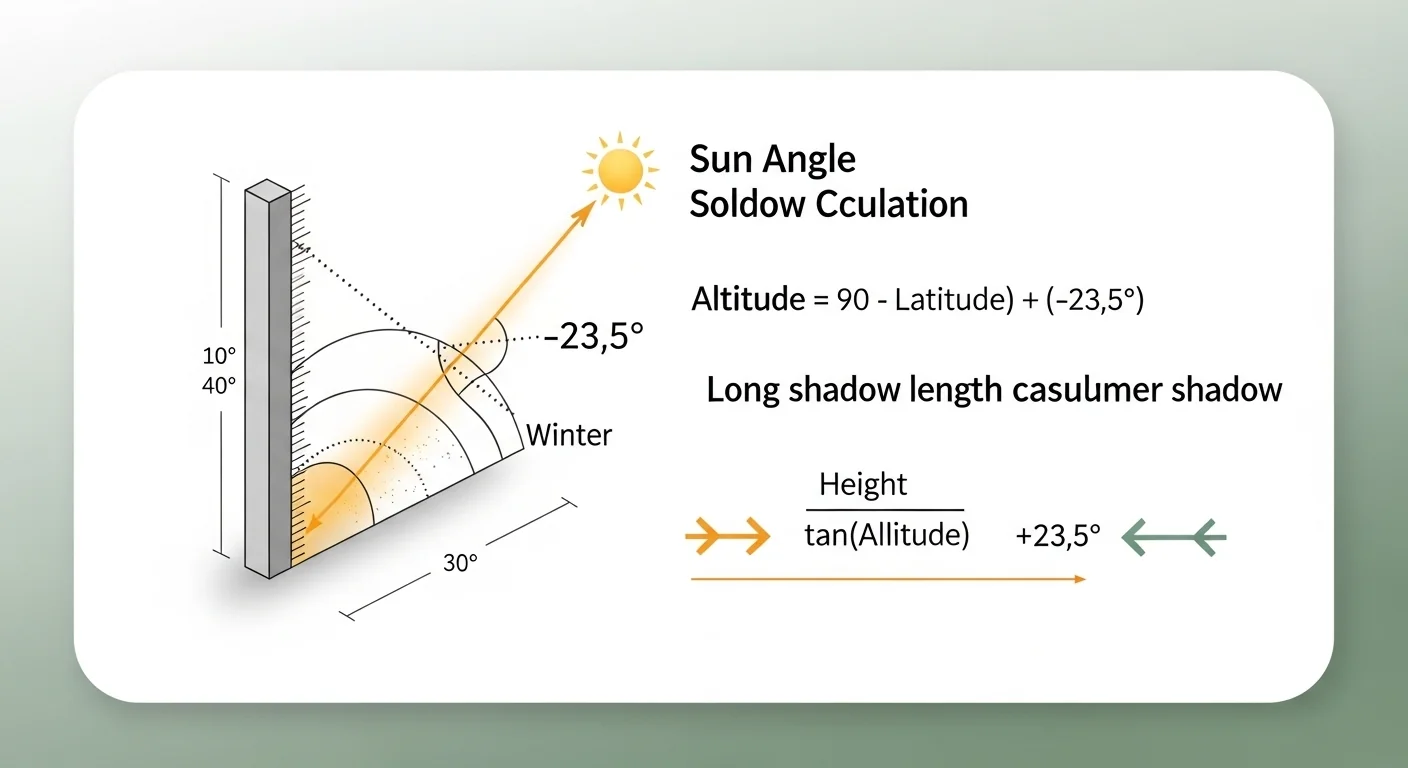
Show the calculation steps
Step 1: Determine solar declination. The sun's declination is the angle between the sun and Earth's equatorial plane. It reaches its maximum positive value (+23.5 degrees) at the Summer Solstice (approximately June 21) and its maximum negative value (-23.5 degrees) at the Winter Solstice (approximately December 21). This calculator uses these solstice extremes only.
Declination = +23.5 degrees (Summer Solstice) or -23.5 degrees (Winter Solstice)
Step 2: Calculate the sun altitude angle at solar noon. The altitude angle is how high the sun sits above the horizon at its highest point of the day. The formula:
Altitude = (90 - Latitude) + Declination
At 45 degrees north, Winter Solstice: (90 - 45) + (-23.5) = 21.5 degrees above the horizon.
Step 3: Calculate shadow length using trigonometry. For a vertical object on flat ground at solar noon:
Shadow Length = Height / tan(Altitude)
The tangent function relates the angle to the ratio of object height to shadow length. As the angle approaches 90 degrees (sun directly overhead), the shadow approaches zero. As the angle approaches 0 degrees, the shadow approaches infinity.
Rounding: Results are displayed to one decimal place in feet. The intermediate angle calculation retains full floating-point precision.
Unit note: Height is entered in feet and output is in feet. The calculation is unit-agnostic -- entering height in meters produces shadow length in meters.
Assumptions and Limits
- All results represent solar noon conditions only -- the moment when the sun is at its daily maximum elevation. Shadows at any other time of day are longer.
- The solstice dates used are June 21 (summer) and December 21 (winter). These are planning extremes; actual shadow lengths vary daily.
- The formula assumes the object is vertical and the ground is flat and level. Sloped terrain will alter shadow reach in ways this calculator does not model.
- At latitudes above approximately 66.5 degrees (the Arctic Circle), the Winter Solstice sun angle may fall at or below zero, indicating polar night. The shadow length formula does not apply in this condition; the calculator flags this case.
- Solar declination is simplified to exactly +/-23.5 degrees for solstice dates. The actual value is approximately 23.44 degrees, introducing a rounding difference of less than 0.1 degree.
- The calculator does not account for atmospheric refraction, which can make the sun appear slightly higher than its geometric position suggests. This effect is most significant near the horizon (low winter angles) and can add roughly 0.5 to 1 degree in apparent altitude.
- Surrounding objects, topography, and tree canopy are not modeled. The shadow calculated is for a single isolated object.
Standards, Safety Checks, and Secret Sauce Warnings
The core value of a sun angle and shadow calculator is not the summer result -- it is the winter result. Most gardening shade decisions are made in summer, when everything looks bright and promising. The critical check is: what happens in December?
Critical Warnings:
- The summer shadow is not representative. At 45 degrees north latitude, winter shadows are typically 6 to 7 times longer than summer shadows for the same object. A tree that barely shades anything in July may cast a shadow well past your furthest raised bed in January.
- Polar and near-polar conditions invalidate the formula. Above 66.5 degrees north latitude, the Winter Solstice sun angle drops below zero degrees, meaning the sun does not rise above the horizon. Shadow length becomes undefined -- not very long, but nonexistent. Gardeners at high latitudes relying only on summer shade analysis are missing this entirely.
- Solar noon is not representative of all-day light. This calculator gives you the minimum shadow length for the day (at solar noon). In the early morning and late afternoon, even in summer, shadows from the same object extend far longer. For beds used in shoulder seasons, account for the full arc.
- Structures grow. A 10-foot shrub planted near a garden today may be a 25-foot shrub in five years. Factor in expected mature height, not current height, when making permanent bed placement decisions.
Minimum Standards for Garden Bed Placement:
- Place vegetable beds at least as far from any structure as the structure's winter shadow length, measured from the north-facing side. This ensures they clear the maximum midday shadow of the year.
- For year-round production beds, the clearance buffer should be the full winter shadow length plus an additional margin for morning and afternoon shadow sweep.
Competitor Trap: Many online shadow calculators and articles provide only a static shadow length for "typical" conditions without specifying the solar angle assumptions or whether the result is a solstice extreme or an equinox midpoint. This makes the output look precise while being operationally useless for planning: a gardener who does not know whether they are looking at a June 21 noon figure or an October 15 average figure cannot make a reliable bed-placement decision. A sun path calculator that does not expose its solstice versus equinox assumptions is answering the wrong question.
If you are also evaluating your garden's capacity after determining sun exposure, the square foot gardening planner integrates well as a next layer of spatial planning. For gardeners working with chill-dependent crops in shaded microclimates, the chill hours calculator can help quantify winter cold accumulation in those areas.
Common Mistakes and Fixes
Mistake: Only checking the summer sun angle when siting a new garden
Summer is when you are outside, planning, and feeling optimistic. The sun is high, shadows are short, and a spot next to the house looks perfectly sunny. But that same spot in November receives a fraction of the midday light because the sun drops significantly lower in the sky. The plant spacing calculator can help you optimize density within beds you have correctly placed, but bed placement has to come first.
Fix: Always run the winter solstice calculation before committing to a garden bed location. The winter result is your binding constraint.
Mistake: Treating solar noon shadow length as an all-day figure
The formula used in this calculator -- Height / tan(Altitude) -- produces the shadow at solar noon only, which is the shortest shadow of the day. Before 10 AM and after 2 PM, shadow lengths in the same location are considerably longer, even in summer. Gardeners who measure shadows mid-morning and assume they represent the worst case are systematically underestimating shade exposure.
Fix: Use the solar noon result as your baseline minimum. Add a clearance buffer for early and late-day shadow movement if the bed needs sun during morning or afternoon hours.
Mistake: Using current tree height rather than mature tree height
A tree planted adjacent to a garden bed will grow. A 6-foot sapling that casts a 20-foot winter shadow today will cast a 50-foot winter shadow at 15 feet tall. Planting decisions made without accounting for mature height create shade problems that take a decade to manifest.
Fix: Look up the expected mature height of any tree within 50 to 100 feet of your garden and run the calculator with that figure.
Mistake: Entering degrees-minutes-seconds latitude instead of decimal
degrees
GPS coordinates and older maps often express latitude as degrees, minutes, and seconds (for example, 45°30'00" N). Entering "4530" or "45.3000" without converting correctly produces an inaccurate sun angle and therefore an incorrect shadow length.
Fix: Convert DMS to decimal degrees before entering: Decimal Degrees = Degrees + (Minutes / 60) + (Seconds / 3600). Google Maps displays coordinates in decimal format by default when you tap a location.
Mistake: Assuming the shadow falls directly north of the object
The shadow length output from this calculator represents the straight-line distance from the base of the object to the shadow tip at solar noon. At solar noon, this shadow does point roughly north in the northern hemisphere -- but only at true solar noon, which is not the same as 12:00 PM on the clock due to daylight saving time and longitude offset within your time zone.
Fix: Use the shadow length as a radial clearance buffer around the object, not as a strictly northward figure. The sun's azimuth at true solar noon is approximately due south from any northern hemisphere location, but morning and afternoon shadows sweep east and west respectively.
Next Steps in Your Workflow
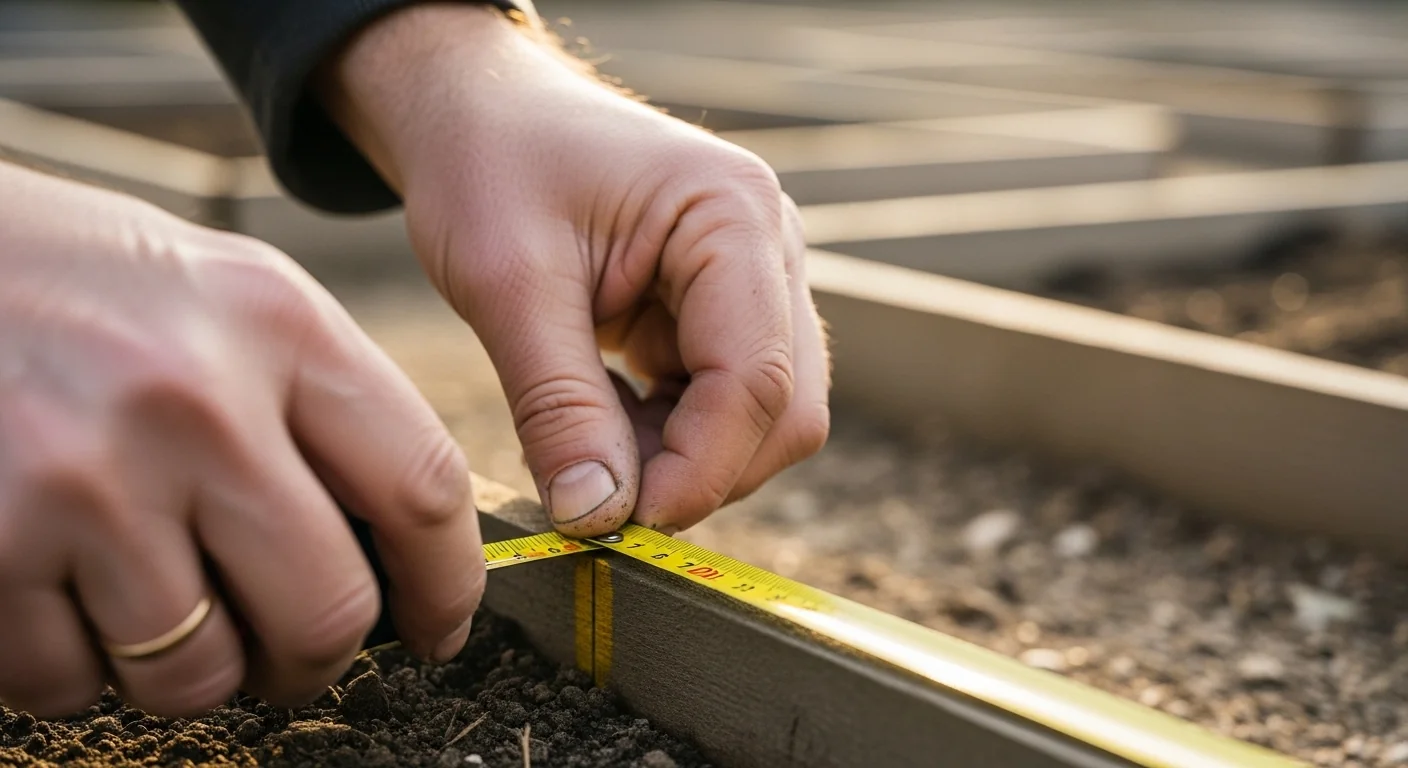
Once you have the winter shadow length for each major structure on your property, map it onto your garden layout. The most practical method is to use a tape measure or rope laid directly on the ground to mark the shadow's maximum reach from each object. Mark these zones with stakes. Beds that fall within those zones need either relocation, shade-tolerant crop selection, or supplemental lighting for any winter or early-spring production. The clearance distances are non-negotiable -- the sun will not move to accommodate your raised bed location. At this stage, the succession planting chart becomes useful for sequencing what goes where and when, especially if your sun-access windows shift across the growing season.
If you are also planning which crops to grow given your confirmed sun exposure, tie the shadow analysis to your harvest timeline. Beds in partial winter shade can still support cold-hardy crops like spinach, kale, and mache, but their days-to-harvest extend. The harvest date calculator can help you adjust expected timing for crops grown in lower-light winter conditions by working backward from your last frost or target harvest date.
FAQ
What is a sun path calculator and how is it different from a shadow calculator?
A sun path calculator maps the sun's position across the entire arc of the sky throughout the day and year, often as an interactive diagram. A shadow calculator computes a specific output: the length of shadow cast by a defined object at a specific moment. This tool does the latter, focused on solstice solar noon, which is the most useful planning anchor for garden design decisions.
Why does the winter shadow length matter more than the summer one?
Most vegetable gardening decisions are made in summer, when shadows are shortest and the problem is invisible. But overwintering crops, cold frames, and spring succession plantings are heavily affected by winter sun angles. A structure that appears harmless in July can block direct light from adjacent beds for six or more hours per day in December.
Can I use this calculator for the southern hemisphere?
The formula works for the southern hemisphere with one adjustment: Summer Solstice occurs around December 21, and Winter Solstice around June 21 -- opposite to northern hemisphere conventions. Enter your latitude as a positive number and select the season that corresponds to your southern hemisphere reality. The sun angles and shadow lengths will be mathematically correct.
What does it mean if my sun angle comes back as a negative number?
A negative sun altitude angle indicates polar night conditions: the sun does not rise above the horizon on that solstice at your latitude. This typically occurs above 66.5 degrees north (or south) at the Winter Solstice. In this case, no shadow is cast because there is no direct sunlight. The shadow length formula does not apply.
How accurate is this calculator compared to professional solar path software?
For solstice planning purposes, the formula is highly accurate. The simplified solar declination of plus or minus 23.5 degrees introduces less than 0.1 degree of error. Professional software adds azimuth tracking, hourly angle computation, terrain shading, and atmospheric refraction modeling -- useful for solar panel installation or architectural shading analysis, but not necessary for garden bed siting decisions.
Does shadow length change based on where I am within a time zone?
The solar altitude angle at true solar noon does not change based on your longitude within a time zone -- only your latitude affects it. However, the time on your clock when solar noon occurs does vary by longitude. This calculator computes the solar noon shadow only; it does not tell you what time solar noon happens at your specific location. For clock-time solar noon, use a sun position app with your precise coordinates.
Conclusion
The most common and costly mistake is siting a bed based on its summer sun exposure without ever running the winter number. If your beds are already in the ground, the calculation still tells you which ones to prioritize for shade-tolerant crops in winter and which ones to protect with row cover rather than glass, since a glass cold frame in full shade provides warmth but not photosynthetically useful light. For beds that have room to grow, the bulb planting depth chart can help you take full advantage of cleared sun zones for fall-planted spring bulbs that do their growth before the canopy fills in.