
Every ebb and flow failure that does not involve a nutrient imbalance can be traced to one moment: the water rose too slowly. When a pump is undersized for the tray it is filling, roots at the bottom of the medium sit submerged in oxygen-depleted water while roots at the top stay bone dry. That oxygen gap is what triggers Pythium (root rot), not the flood itself. The flood is supposed to happen. The pace of the flood is the variable most growers never measure.
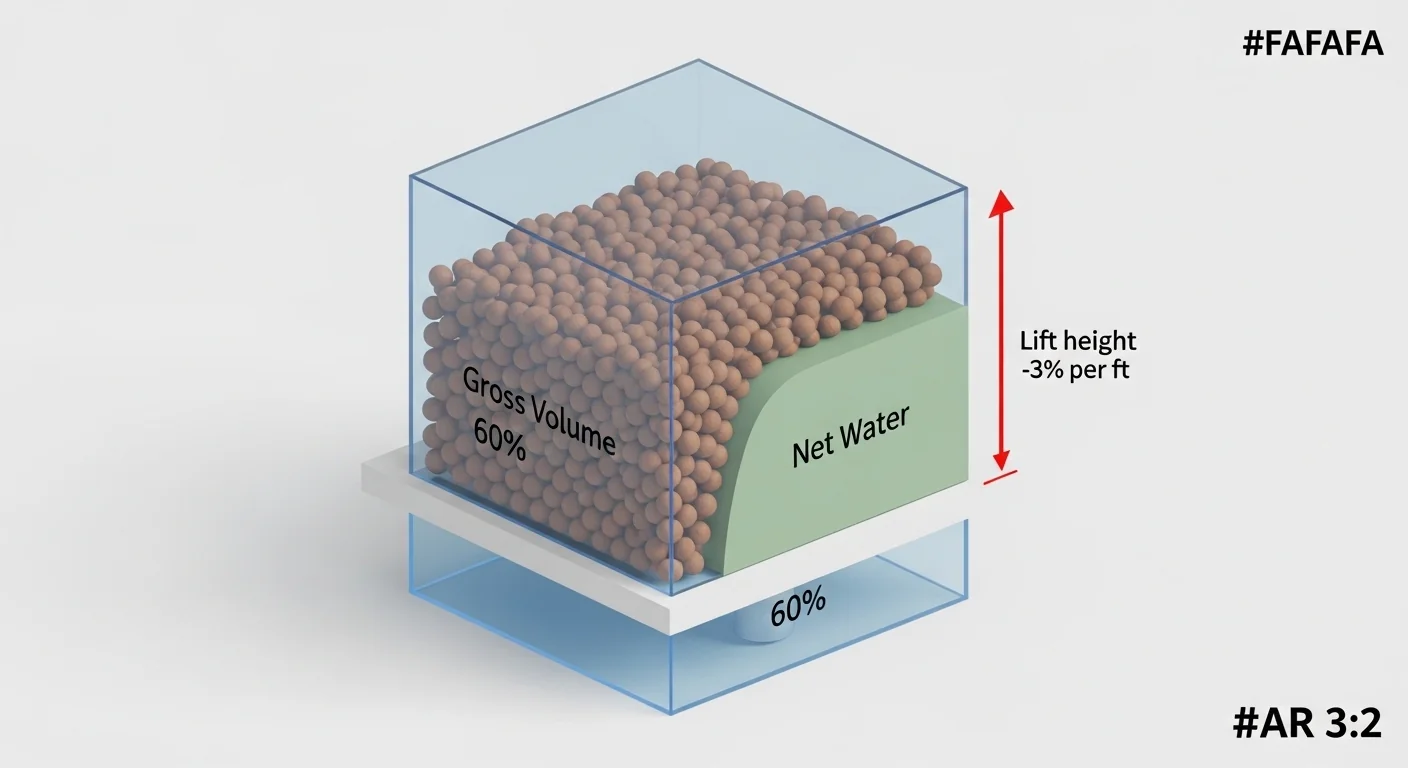
This flood and drain pump calculator takes five physical measurements of your system and returns the minimum pump rating (in gallons per hour) required to fill your tray within the five-minute biological limit. It accounts for media volume displacement using the 60% porosity standard for expanded clay pebbles, and it applies a lift-height correction to the rated GPH so the number reflects actual delivery, not the pump’s label. What it does not do: it does not model friction losses from fittings or bends, and it does not account for pump degradation over time. The output is a minimum starting point, not a final specification.
After using this tool, you will know the exact GPH floor your pump must meet. If your current pump falls below that number, root rot is a matter of when, not if.
Use the Tool
Ebb & Flow Tray Pump Sizer
Calculate the exact GPH your flood & drain system needs — avoid root rot, guaranteed.
Your Flood & Drain Pump Results
Step-by-Step Calculation Breakdown
| Step | Formula | Your Result |
|---|
Common Tray Size Reference (3″ Flood Depth, No Media)
| Tray Size | Tray Volume (gal) | Min Pump GPH | Fill Time @GPH | Status |
|---|---|---|---|---|
| 2×4 ft (24×48″) | 9.4 gal | 113 GPH | 5 min | ✓ Easy |
| 3×3 ft (36×36″) | 10.6 gal | 127 GPH | 5 min | ✓ Easy |
| 4×4 ft (48×48″) | 18.8 gal | 225 GPH | 5 min | ✓ Standard |
| 4×8 ft (48×96″) | 37.6 gal | 450 GPH | 5 min | ⚠ High-cap pump |
| 5×10 ft (60×120″) | 58.7 gal | 705 GPH | 5 min | ⚠ High-cap pump |
| 4×8 ft + 40L Hydroton | 30.6 gal net | 368 GPH | 5 min | ✓ Media adjusted |
How This Calculator Works
This flood & drain pump calculator solves a critical biological requirement: your tray must fill completely within 5 minutes to prevent the “Dry Top, Drowned Bottom” root rot disaster (Pythium). It calculates exactly how many GPH your pump must deliver.
Step-by-Step Formulas
231 cubic inches = 1 US gallon
Clay pebbles displace ~60% of their stated volume in water
Pump GPH Required = Net Water × 12 (= fills 60 min ÷ 5 min per hour)
Every foot of lift reduces pump output ~3%
Assumptions & Limits
- Clay pebble media displaces exactly 60% of stated volume (varies ±5% by brand)
- Target fill time is a fixed 5-minute biological maximum — never extend this
- Lift penalty assumes smooth 1″ ID tubing; use 1.5″ for higher GPH
- Does not account for pipe friction losses beyond head height
- Assumes reservoir surface is the pump baseline for lift calculation
- Valid for flood depths between 0.5″ and 8″ and trays up to 300″ in any dimension
- Reservoir minimum = 1.5× net water required to prevent pump cavitation
The “Flash Flood” Biological Standard — Why 5 Minutes?
Cannabis and most hydroponic crops need an oxygen-rich root zone. In ebb & flow, the flood cycle temporarily submerges roots — which is fine if brief. The critical threshold is 5 minutes total submersion per cycle.
The “Dry Top, Drowned Bottom” Failure Mode
If your pump is undersized, the tray fills slowly. Roots at the tray bottom sit in oxygen-depleted water for 20–40+ minutes while top roots stay bone dry. This guarantees Pythium (root rot) within 1–2 weeks even with perfect pH and nutrients.
Flash Flood Protocol
- Fill in ≤5 min — non-negotiable biological limit
- Drain completely in ≤10 min — size your drain bulkhead to match (use 1″ min)
- Cycle frequency: 2–4× per light cycle during veg; 1–2× during late flower
- Never flood within 1 hour of lights-off — roots need air during dark phase
- Reservoir minimum: 1.5× flood volume to prevent pump cavitation on large trays
Pump Selection Tip
Always buy a pump rated 20–30% above your calculated GPH. Pump output degrades over time, and you never want to rerun this calculation after root rot sets in. Active Aqua submersible pumps are commonly used because they publish actual head-loss curves at rated pressure.
Before you start, have these on hand: a tape measure for interior tray dimensions (not the outer frame), the flood depth you intend to run, the total volume of grow media you plan to place in the tray in liters, and the vertical distance from the surface of your reservoir water to the bottom edge of your tray. All distance inputs use inches or feet as noted on each field. If you run a bare tray with no media, enter zero for the media volume.
Quick Start (60 Seconds)
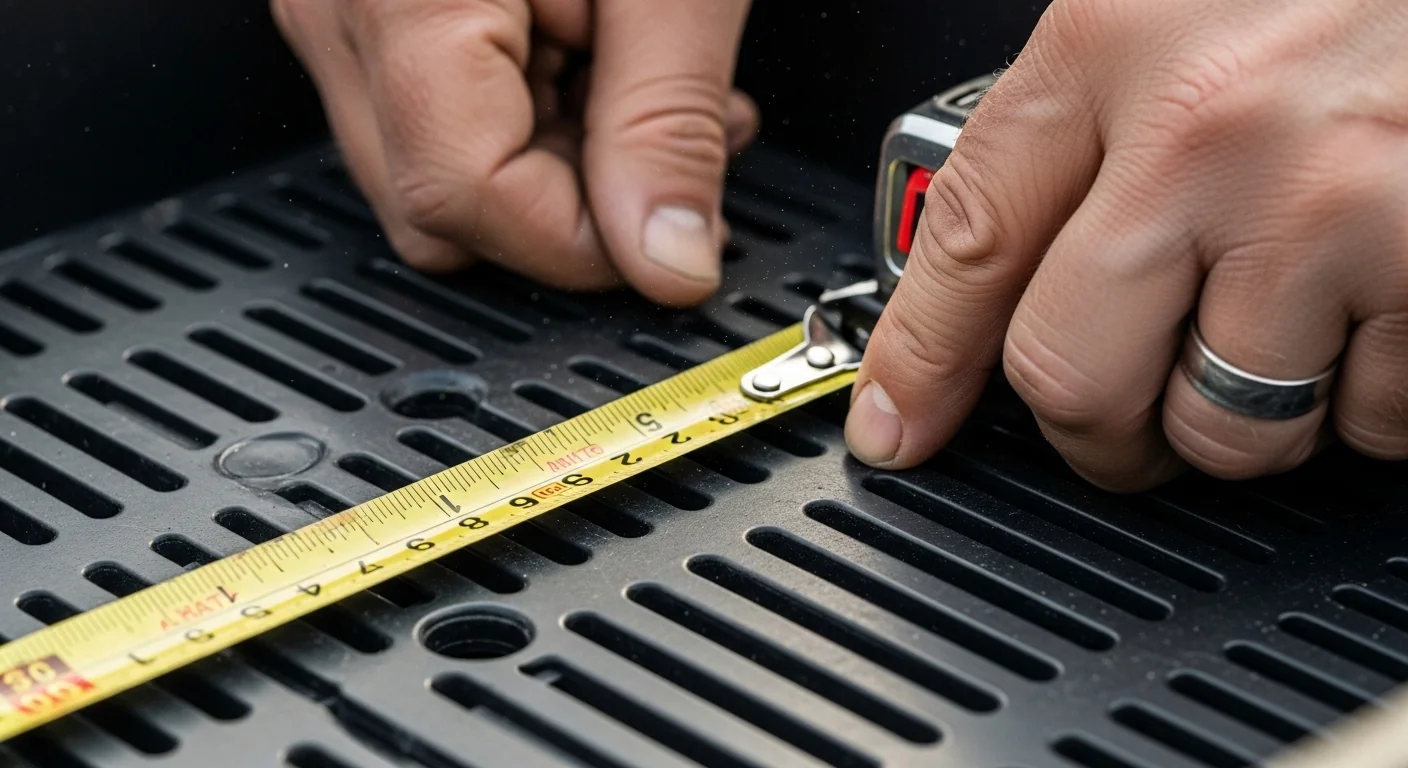
- Tray Length (inches): Measure the inside bottom of the tray, not the outside frame. A nominal “4×8” tray often measures 45 or 46 inches wide, not 48. Use the real number.
- Tray Width (inches): Same rule. Measure inside edge to inside edge. Do not use the manufacturer’s listed footprint.
- Desired Flood Depth (inches): This is how high the water will rise in the tray, typically 3 to 4 inches for established plants in clay pebbles. Do not confuse this with tray wall height.
- Grow Media Volume (liters): Check the bag. A standard 50-liter bag of Hydroton is a common starting point. If you use multiple bags, add them together. Enter zero for bare trays or rockwool slabs sitting directly on the tray floor.
- Vertical Lift Height (feet): Measure from the water surface in your reservoir to the bottom edge of your tray. The pump has to push water upward this full distance. A 1-foot error here changes your calculated GPH requirement by roughly 3 GPH per 100 GPH of base demand.
- Click Calculate: The tool returns your minimum required GPH already corrected for lift. Round up to the next commercially available pump size.
- If the fill-time gauge shows red: your current or planned pump is undersized. Do not proceed until you select a higher-capacity unit.
Inputs and Outputs (What Each Field Means)
| Field | Unit | What It Measures | Common Mistake | Safe Entry Guidance |
|---|---|---|---|---|
| Tray Length | inches | Interior length of the flood tray floor | Using the outer frame dimension instead of inside measurement | 6 to 300 in; most commercial trays are 24 to 120 in |
| Tray Width | inches | Interior width of the flood tray floor | Assuming nominal size matches actual interior; 4×8 is rarely 48×96 inside | 6 to 300 in; always measure, never assume |
| Desired Flood Depth | inches | Target water height inside the tray during a flood cycle | Flooding too shallow (under 2 in) and failing to saturate deeper root zones | 0.5 to 8 in; standard recommendation is 3 to 4 in for clay pebble media |
| Grow Media Volume | liters | Total volume of expanded clay pebbles (or similar porous media) placed in the tray | Entering the weight in kg instead of the bag’s stated volume in liters | 0 to 2000 L; bare trays and rockwool slabs use 0 |
| Vertical Lift Height | feet | Vertical distance from reservoir water surface to tray inlet | Measuring from the reservoir floor or pump position rather than the water surface | 0 to 20 ft; most benchtop setups are 1 to 4 ft |
| Pump GPH Required (output) | gallons per hour | Minimum pump flow rate, corrected for lift, to achieve a 5-minute fill | Buying a pump rated exactly at this number with no safety margin | Add 20 to 30% when selecting the actual pump to account for wear and fitting losses |
| Min. Reservoir Volume (output) | gallons | Minimum reservoir capacity to prevent pump cavitation during a full flood cycle | Sizing the reservoir to exactly equal net water volume, leaving no buffer | Always use a reservoir at least 1.5x this number; 2x is better for large trays |
Worked Examples (Real Numbers)
Scenario 1: Beginner 2×3 Tray, No Media, Shallow Lift
- Tray Length: 24 in
- Tray Width: 36 in
- Flood Depth: 2.5 in
- Grow Media: 0 L
- Vertical Lift: 1 ft
Result: 116 GPH required
Tray volume is 9.35 gallons with no media displacement. Base GPH calculates to 112 (9.35 x 12). After the 1-foot lift correction (divide by 0.97), the minimum rises to 116 GPH. This is within reach of many entry-level submersible pumps, but buy a unit rated at 150 GPH or above to maintain the 5-minute limit as the pump ages.
Scenario 2: Standard 4×4 Tray, 40 Liters of Hydroton, Mid-Height Reservoir
- Tray Length: 48 in
- Tray Width: 48 in
- Flood Depth: 3.5 in
- Grow Media: 40 L
- Vertical Lift: 2 ft
Result: 365 GPH required
Gross tray volume is 34.9 gallons. The 40 liters of clay pebbles displaces 6.3 gallons (40 x 0.60 / 3.785), leaving a net water requirement of 28.6 gallons. Base GPH is 343. The 2-foot lift correction (divide by 0.94) brings the final requirement to 365 GPH. Minimum reservoir size is 42.9 gallons. A 400 to 500 GPH rated pump with a 55-gallon reservoir is the practical match for this system.
Scenario 3: Commercial 4×8 Tray, 80 Liters of Hydroton, Elevated Bench
- Tray Length: 96 in
- Tray Width: 48 in
- Flood Depth: 4 in
- Grow Media: 80 L
- Vertical Lift: 3 ft
Result: 885 GPH required
Gross tray volume reaches 79.8 gallons. The 80 liters of Hydroton displaces 12.7 gallons, yielding a net water requirement of 67.1 gallons. Base GPH is 805. The 3-foot lift (divide by 0.91) pushes the minimum to 885 GPH. Minimum reservoir is 100.7 gallons. Standard aquarium-style pumps will not reach this output. This system requires a commercial-grade high-flow pump with 1 to 1.5 inch inlet and outlet fittings, and the drain bulkhead must also be sized accordingly to evacuate 67 gallons within 10 minutes.
Reference Table (Fast Lookup)
All rows below use 3-inch flood depth unless noted. Media displacement is calculated at 0.60 porosity converted to gallons. Min Pump GPH includes a 2-foot vertical lift correction. “Practical Pump” column is the next commercially common rating above the minimum, with a margin built in.
| Tray Size | Media (L) | Net Water (gal) | Base GPH (no lift) | Min GPH (2 ft lift) | Practical Pump Rating | Min Reservoir (gal) |
|---|---|---|---|---|---|---|
| 24×36 in (2×3 ft) | 0 | 9.4 | 113 | 120 | 150 GPH | 14.1 |
| 24×48 in (2×4 ft) | 0 | 14.9 | 179 | 190 | 225 GPH | 22.4 |
| 36×36 in (3×3 ft) | 20 | 13.0 | 156 | 166 | 200 GPH | 19.5 |
| 48×48 in (4×4 ft) | 40 | 28.6 | 343 | 365 | 400 GPH | 42.9 |
| 48×48 in (4×4 ft) | 0 | 28.4 | 341 | 362 | 400 GPH | 42.6 |
| 48×96 in (4×8 ft) | 0 | 59.8 | 718 | 764 | 800 GPH | 89.7 |
| 48×96 in (4×8 ft) | 80 | 47.1 | 565 | 601 | 650 GPH | 70.7 |
| 60×120 in (5×10 ft) | 100 | 79.2 | 950 | 1011 | 1100 GPH | 118.8 |
| 48×48 in (4×4 ft), 4 in depth | 40 | 31.5 | 378 | 402 | 450 GPH | 47.3 |
How the Calculation Works (Formula + Assumptions)
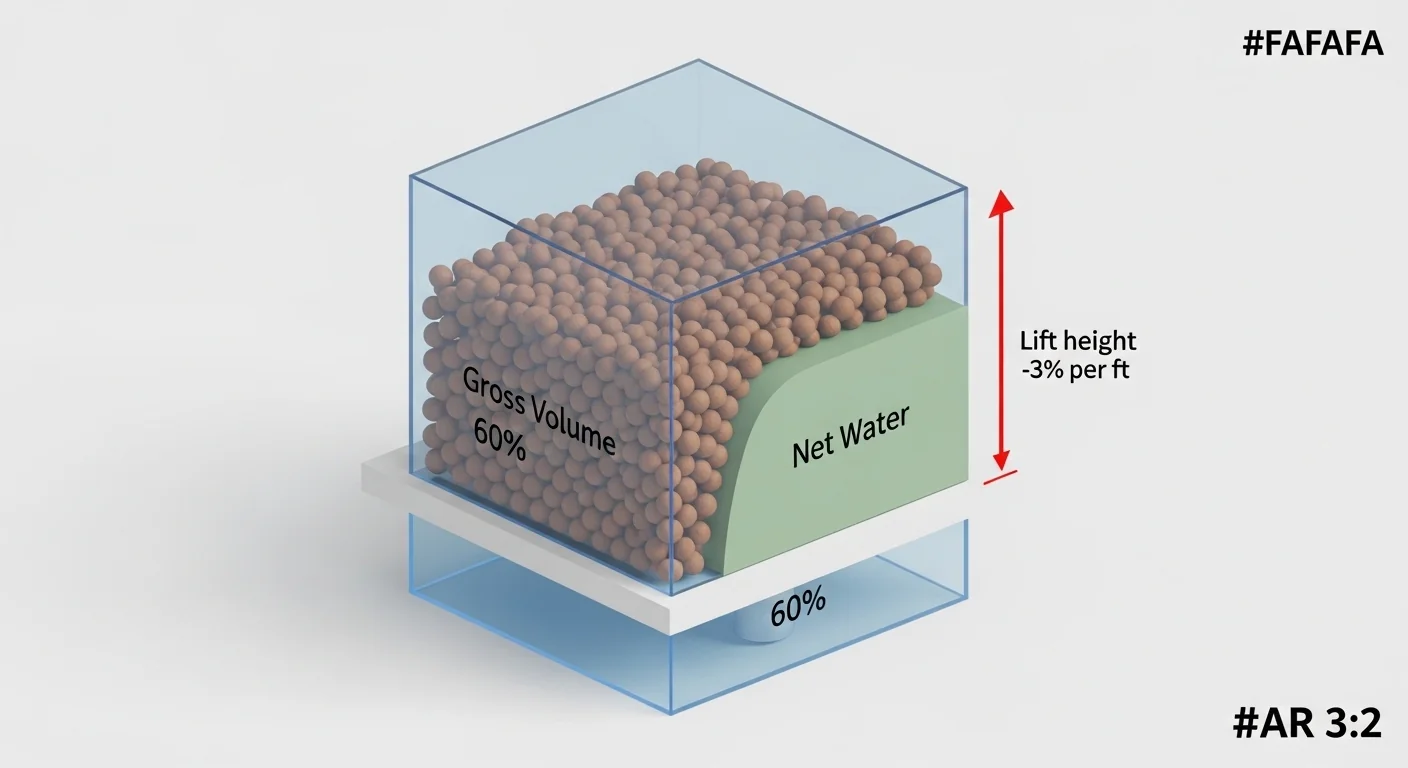
Show the calculation steps
Step 1: Gross Tray Volume
Tray Volume (gal) = (Length x Width x Flood Depth) / 231
231 cubic inches equals one US liquid gallon. This converts the tray’s interior flood zone into gallons.
Step 2: Media Volume Displacement
Media Displacement (gal) = (Media Volume in liters x 0.60) / 3.785
Expanded clay pebbles (Hydroton) have approximately 60% porosity, meaning roughly 60% of the stated bag volume is void space that water will fill. The remaining 40% is actual clay structure that displaces water. Dividing by 3.785 converts liters to gallons.
Step 3: Net Water Required
Net Water (gal) = Gross Tray Volume – Media Displacement
This is the actual volume of water the pump must move in one flood cycle.
Step 4: Base GPH Calculation
Base GPH = Net Water (gal) x 12
The multiplier of 12 equals 60 minutes divided by the 5-minute target fill time. A pump rated at the base GPH will, under zero-head conditions, fill the tray in exactly 5 minutes. This is the biological ceiling, not a suggestion.
Step 5: Lift-Height Correction
Adjusted GPH = Base GPH / (1 – Lift x 0.03)
Every foot of vertical lift reduces a pump’s effective output by approximately 3% of its rated GPH. This correction adjusts the required minimum so the pump delivers the base GPH after fighting gravity. The result is rounded up to the nearest whole number.
Rounding rules: Net Water and displacement values are displayed to 2 decimal places internally. The output GPH is always rounded up (ceiling), never down. Min reservoir is rounded to 1 decimal place.
Assumptions and Limits
- Clay pebble porosity is fixed at 60%. Actual porosity varies by brand, age, and how media is packed; expect plus or minus 5% variance.
- The lift correction assumes smooth, straight tubing with a 1-inch inner diameter. Additional bends, elbows, and undersized tubing increase friction losses beyond what the formula captures.
- Pump output is treated as linear with head height. Real pump head curves are non-linear; this tool uses a conservative linear approximation. Check the actual pump curve at your specific lift when buying a high-stakes system.
- The 5-minute fill limit is treated as absolute. Some published protocols allow up to 10 minutes for systems with particularly well-oxygenated media, but that is outside the scope of this tool’s safety standard.
- The formula does not model drain rate. A correctly sized pump paired with an undersized drain fitting will still produce a slow effective cycle. Drain bulkhead sizing is a separate, companion calculation.
- Reservoir volume output is a minimum for preventing pump cavitation (1.5x net water). For systems where reservoir water also maintains temperature stability, a larger reservoir is almost always preferable.
- The tool does not account for multiple trays drawing from one reservoir or one pump. Multi-tray calculations require summing net water demand across all trays.
Standards, Safety Checks, and “Secret Sauce” Warnings
Critical Warnings
- The 5-minute fill limit is biological, not mechanical. Below the cutoff, roots tolerate intermittent submersion because water recedes before dissolved oxygen is fully depleted at the root surface. Above 5 minutes, dissolved oxygen in the standing water at the tray bottom drops below the threshold for aerobic root respiration. Pythium thrives in exactly that low-oxygen window. No nutrient solution adjustment compensates for this.
- A pump sized to the bare-tray volume will be undersized once media is added. Media reduces the water volume needed, which sounds like it helps the pump. In practice, growers who add media partway through a grow cycle find that their initially adequate pump is now slightly above the new requirement, and they never recheck. The problem occurs in reverse: growers who run the number for a media-filled tray and then add more bags mid-grow move the threshold back up without recalculating.
- Lift height is the most ignored variable. A pump rated at 400 GPH at zero head may deliver only 300 GPH at 4 feet of lift. If you do not account for lift, your calculated minimum will be based on a flow rate the pump physically cannot achieve at your installation height. Always verify against the pump’s published head-loss curve.
- Reservoir sizing failures cascade. A reservoir sized to exactly match one flood cycle provides no thermal mass, encourages pH and EC drift between cycles, and forces the pump to run dry if a flood cycle does not fully drain. If your root zone oxygenation strategy depends on cycling frequency, undersizing the reservoir defeats the entire system.
Minimum Standards
- Fill time: 5 minutes maximum per flood cycle, every cycle, for the life of the system.
- Drain time: Full tray drainage within 10 minutes of pump shutoff. If the tray retains standing water beyond 10 minutes, the drain bulkhead or drain line is undersized.
- Minimum pump purchase margin: Buy a pump rated at 120 to 130% of the calculated GPH requirement. Pump output degrades over months of use, and you want the margin to remain compliant through a full growing season without rebuying.
- Reservoir minimum: 1.5x net water volume. For systems exceeding 50 gallons of net water per cycle, a 2x reservoir volume provides meaningful buffering against temperature spikes and between-cycle pH drift.
Competitor Trap: Most flood and drain guides give a single rule such as “use a 250 GPH pump for a 4×4 tray.” That number assumes a specific flood depth, no grow media, a specific reservoir height, and a new pump at full rated capacity. None of those assumptions are stated, and none apply to your system unless you happen to match all four conditions exactly. A generic recommendation ignores the difference between a bare tray and one loaded with 40 liters of Hydroton (which changes the net water volume and therefore the GPH floor), ignores the lift penalty from reservoir-to-tray height, and ignores the safety margin required for pump wear. Use a number derived from your actual measurements, not a category approximation. If you run other hydroponic systems, the NFT hydroponics calculator applies a similar specificity to nutrient film technique flow requirements, where the failure mode is also invisible until the plants show it.
Common Mistakes and Fixes
Mistake: Ignoring the Fill Timer During Setup
Growers connect the pump, run a test flood, and judge by eye whether the tray is filling “quickly enough.” Eye estimates in a 4×8 tray are notoriously inaccurate. Sixty gallons rising two inches across 32 square feet of tray surface looks slow even when it is fast enough.
Fix: Use a stopwatch. Time from pump-on to water reaching the overflow tube inlet. If that duration exceeds 5 minutes, the pump is undersized regardless of how vigorous the flow looks at the inlet.
Mistake: Calculating for the Tray, Not the Net Water Volume
The pump does not fill the tray with air. If you have 40 liters of Hydroton in a 4×4 tray set to flood 3.5 inches, those pebbles displace roughly 6.3 gallons of the 34.9-gallon gross volume. Calculating pump requirement against the gross volume overstates the needed GPH, which sounds conservative but wastes money and can overpressure 1-inch bulkhead fittings not rated for high-flow applications.
Fix: Always enter your media volume and let the calculator apply the 60% porosity correction. If you do not know the exact media volume, weigh empty bags and look up stated liter capacity per bag on the product label.
Mistake: Using Rated GPH Instead of Actual GPH at Head Height
Pump labels show maximum GPH at zero feet of head. A pump rated at 500 GPH that must push water 3 feet upward may only deliver 415 GPH at that height. Growers who skip this correction and buy exactly the calculated minimum will consistently run 10 to 20% below what the system requires. Tracking EC levels might reveal uneven nutrient uptake that is actually a symptom of incomplete flood coverage caused by an underpowered pump.
Fix: Look up the pump’s GPH output at your specific lift height from the manufacturer’s head-loss table. Match that number to your minimum GPH, not the label rating.
Mistake: Sizing the Pump Without Sizing the Drain
A pump capable of filling the tray in 4 minutes means nothing if the drain bulkhead can only evacuate the tray in 25 minutes. The effective cycle length is determined by whichever is slower, fill or drain. Roots that are submerged during a slow drain experience the same oxygen deprivation as a slow fill. Monitoring PPM to EC values in the reservoir post-drain can reveal whether incomplete drainage is leaving residual solution and altering the concentration cycle to cycle.
Fix: Use a 1-inch minimum drain bulkhead for any tray under 4×6. For 4×8 and larger trays, use a 1.5-inch or dual 1-inch drain configuration. Run a drainage timing test independently of the fill test.
Mistake: Setting Flood Depth Below 2 Inches for Established Plants
A shallow flood does not saturate the full depth of the media column. Roots at the base of a 6-inch Hydroton layer may never receive adequate moisture during a 1.5-inch flood, even if the cycle runs frequently. This manifests as tip burn, slow growth, or nutrient lockout symptoms that do not respond to pH or EC adjustment because the problem is physical distribution, not solution chemistry.
Fix: Set flood depth to at least 3 inches for established plants in clay pebble media. Seedlings and clones in small net pots may tolerate 1.5 to 2 inches during the first two weeks, but deepen the flood as root mass increases.
Next Steps in Your Workflow
Once you have your minimum GPH number, the immediate next step is drain sizing, not pump purchasing. Select a pump and drain fitting simultaneously, because a high-output pump paired with a 3/4-inch drain creates a pressurized tray that can leak fittings, warp tray walls, and overflow inlet connections. Confirm your drain configuration can clear the full net water volume in under 10 minutes using a simple timed drainage test with plain water before your first nutrient run. With VPD dialed in at the canopy level and your flood cycle confirmed, the mechanical side of your grow environment is essentially characterized.
The variables that remain after pump sizing involve your nutrient solution and the aerial environment. Flood cycle frequency should be tuned to media moisture retention, not set by a fixed timer. During late flower, many growers reduce flood frequency and find that the reduced wet/dry cycles improve terpene expression. Tracking ambient conditions alongside your irrigation events gives you a full picture of how the system responds. Tools like the DLI calculator can help synchronize your lighting schedule with flood timing so roots have adequate oxygen during the dark period when flood events should generally be avoided.
FAQ
What GPH pump do I need for a 4×8 flood tray?
It depends on flood depth, media volume, and how high your reservoir sits below the tray. A bare 4×8 tray flooded to 3 inches with a 2-foot lift requires approximately 764 GPH. Add 80 liters of Hydroton and that drops to around 600 GPH. Use the calculator with your actual measurements rather than applying a flat rule to your tray size.
Why is 5 minutes the maximum fill time?
Root cells require dissolved oxygen to perform aerobic respiration. Water that sits at the bottom of a flood tray without circulating depletes dissolved oxygen within a few minutes. At that point, anaerobic conditions favor Pythium and other water molds. The 5-minute limit is the practical cutoff below which most healthy root systems can tolerate a flood event without oxygen stress.
Does grow media make my pump need to be bigger or smaller?
Smaller. Media displaces water volume, so less water needs to be moved per cycle. However, the reduction is not as large as most growers assume. Forty liters of Hydroton only reduces net water by about 6 gallons in a 4×4 tray. The pump requirement drops proportionally, but a significant portion of the gross tray volume remains water.
How do I find the actual GPH at my lift height?
Reputable pump manufacturers publish head-loss curves: a graph or table showing GPH output at various feet of head. Look for this in the product specification sheet, not the retail listing. If it is not available, contact the manufacturer directly. As a rule, subtract roughly 3% of rated GPH for each foot of vertical lift as a conservative baseline estimate.
Can I run two trays from one pump?
Yes, but the pump must supply the combined GPH requirement for both trays simultaneously if they flood at the same time, or the full GPH requirement of the larger tray if you alternate cycles. Summing net water volumes across both trays and applying the 5-minute limit gives you the combined minimum GPH. The reservoir must also scale proportionally.
What size reservoir do I need for an ebb and flow system?
The calculator outputs a minimum reservoir volume equal to 1.5 times the net water required per flood cycle. This prevents pump cavitation as the reservoir empties. For systems with large trays or multiple flood zones, a 2x ratio provides meaningful buffering. Reservoir volume also affects temperature stability and pH drift between cycles, so larger is almost always better when space allows.
Conclusion
The flood and drain pump calculator exists because the failure mode it prevents is invisible until it is too late. Root rot from a slow-filling tray does not announce itself the way a nutrient deficiency does. Plants can look healthy through week two or three of a crop, and then the infection that has been building in the low-oxygen zone at the tray bottom surfaces all at once. By that point, the damage to the root system is rarely recoverable. Sizing the pump correctly from day one is the simplest insurance policy available in an ebb and flow system.
The single most important number this tool gives you is not the GPH itself but the fill-time gauge. If that gauge sits in the green zone with your planned pump, you are compliant. If it edges into amber or red, no other optimization you make to nutrients, lighting, or climate will fully compensate. Get the mechanics right first, then refine everything else. If you run other precision irrigation systems alongside your ebb and flow setup, the aeroponic timer calculator applies the same deterministic approach to misting cycle timing, where a similar root-zone oxygen principle governs the failure mode.