
Aeroponic Accumulator & Duty Cycle Calculator
Aeroponic timer calculator — The Yield Grid
| On (sec) | Off (min) | Duty Cycle % | Mist Events/Day | Root Risk |
|---|
How This Calculator Works
Duty Cycle % — The fraction of time nozzles are actively misting:
Example: 3 sec ON / 5 min OFF → 3 / (3 + 300) × 100 = 0.98%
Water per Misting Cycle — Volume dispensed in one mist burst:
Converts GPH to GPS (gallons per second), then multiplies by the burst duration.
Pump Cycle Count — How many times the pump pressurizes the system per day:
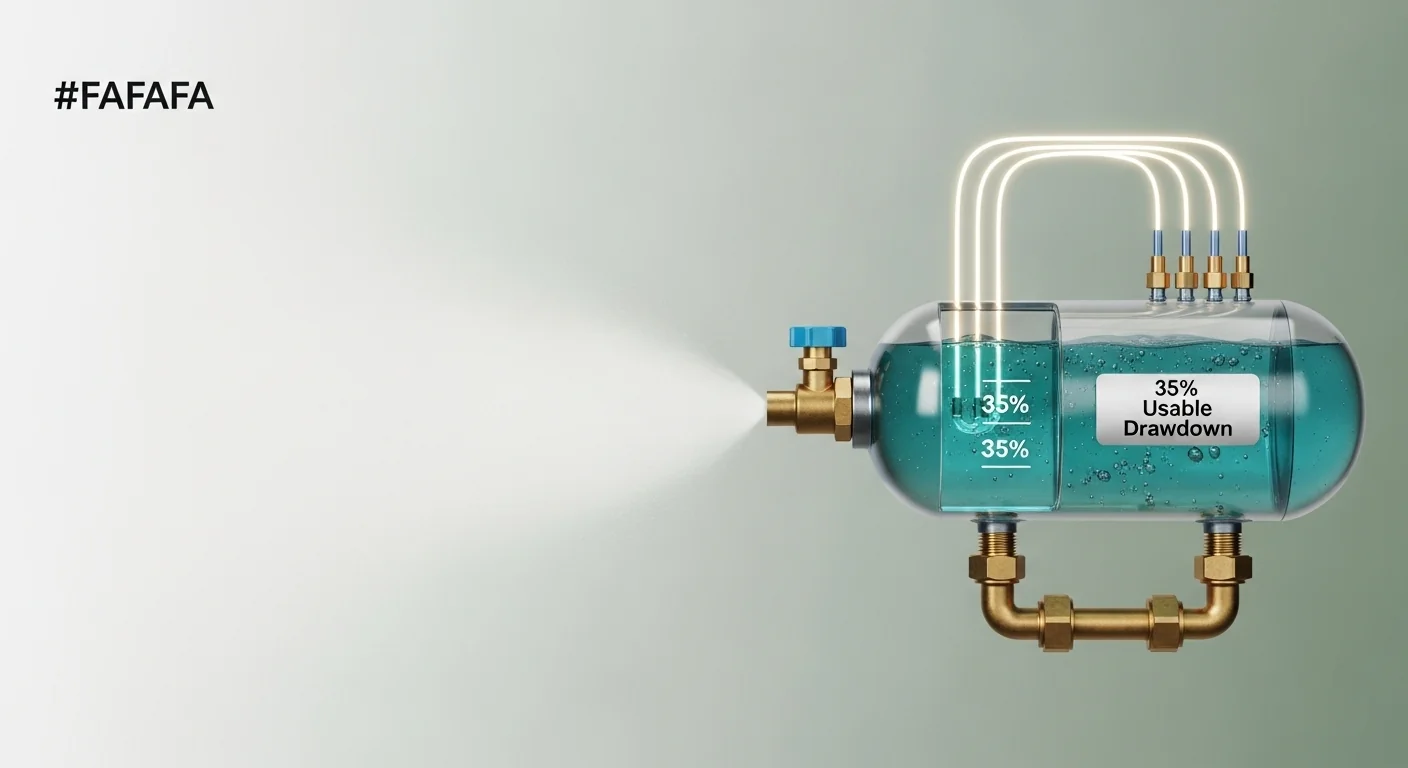
Accumulator drawdown factor = how many mist events the tank can supply from one pump charge. Drawdown = Tank Size × 0.35 (usable drawdown at 80–100 PSI). Mist Events/Day = 86,400 ÷ (On-Timesec + Off-Timemin × 60).
Root Desiccation Trigger — If Off-Time > 10 minutes, bare roots in HPA begin drying. This calculator flags that threshold as a critical warning regardless of duty cycle.
Key Assumptions: Nozzle GPH rated at 100 PSI; accumulator drawdown = 35% of tank volume (conservative for bladder tanks at 80–100 PSI operating pressure); pump direct-cycle safe limit set at 72 start/stop events per day to protect motor windings.
Assumptions & Limits
This tool is designed for True High-Pressure Aeroponics (HPA) operating at 80–100 PSI with 50-micron droplets on bare roots (no growing medium).
Accumulator drawdown factor: 35% of rated tank volume. Actual drawdown depends on pre-charge pressure and system operating pressure. RO-type bladder tanks at 80 PSI pre-charge provide approximately this usable volume.
Pump cycle safety threshold: 72 starts/day is a conservative limit for typical 1/4 HP–1/2 HP booster pumps (e.g. Aquatec 8800). Heavy-duty pumps may tolerate more; cheap diaphragm pumps fewer.
Root desiccation: Bare roots in an aeroponic chamber can begin to dry within 10–15 minutes depending on humidity, temperature, and plant size. The 10-minute threshold is conservative and appropriate for established plants. Seedlings and clones are more sensitive.
Not applicable to: Low-Pressure Aeroponics (LPA), NFT, DWC, or soil/coco systems. Not for use with emitters < 80 PSI.
True high-pressure aeroponics is built on one mechanical premise: a pump must never cycle directly against a timer. The instant a grower connects a high-pressure booster pump to a cyclic interval timer and walks away, the countdown to a stator failure begins. The physics are unforgiving. Every start event draws a surge of current, heats the motor windings, and shortens winding insulation life. Do that 285 times in a day and the pump is scrap inside a week. This is not a product-specific quirk. It is a thermal fatigue problem inherent to any motor under repeated short-cycle loading.
This aeroponic timer calculator determines your misting duty cycle, the volume of water dispensed per burst, how many times your pump must pressurize the system each day, and whether your accumulator tank is large enough to reduce that count to a safe range. It does not predict plant growth outcomes, it does not simulate root zone humidity gradients, and it does not account for nozzle wear or pressure drop across long manifolds. For misting applications outside of true HPA root chambers, the greenhouse misting calculator handles evaporative cooling and humidity control scenarios where operating pressures and nozzle types differ substantially.
After running the numbers, you will know whether your accumulator tank is correctly sized to keep pump cycle counts below the safe threshold, and whether your off-time interval is short enough to prevent root desiccation on bare roots.
Use the Tool
Before you start, have your nozzle spec sheet open. You need the rated flow in GPH at 100 PSI, not at line pressure or a different test pressure. Pull the accumulator tank label for the rated gallon capacity. Set your cyclic interval timer’s on-time and off-time before entering values, since the calculation depends on the exact cycle you intend to run. If you are still choosing timer hardware, note that near-second precision is required for HPA; cheap mechanical timers with 1-minute minimum increments cannot achieve a 3-second on-time.
Quick Start (60 Seconds)
- Misting On-Time (seconds): Enter your timer’s active misting duration. For true HPA with 50-micron nozzles, 3 to 5 seconds is the target range. Do not enter this field in minutes by mistake, a common data entry error that produces wildly incorrect duty cycle figures.
- Misting Off-Time (minutes): Enter the rest period between mist bursts. This field is in minutes, not seconds. Values above 10 minutes trigger a root desiccation warning regardless of any other setting.
- Total Misting Nozzles: Count every nozzle in your root chamber, including any that share the same manifold branch. A missed nozzle underestimates water volume per cycle and inflates the calculated mist events per accumulator charge.
- Flow Rate per Nozzle (GPH at 100 PSI): Use the manufacturer’s rated flow at 100 PSI. Anti-drip ceramic nozzles for HPA typically rate between 0.2 and 0.5 GPH. If your spec sheet only shows mL/min, divide by 63.09 to convert.
- Accumulator Tank Size (gallons): Enter the rated total volume of the bladder tank. The calculator uses 35% of this as usable drawdown, which is a conservative estimate for tanks pre-charged to 80 PSI and operating between 80 and 100 PSI.
- Read the pump cycle output first: The most decision-critical number on the results panel is not the duty cycle percentage but the calculated pump cycles per day. That number determines whether your system will survive a growing season.
- Check the warnings box: The traffic-light warnings translate your inputs into pass/fail checks against HPA standards. A yellow or red result requires hardware changes, not software tweaks.
Inputs and Outputs (What Each Field Means)
| Field | Unit | What it means | Common mistake | Safe entry guidance |
|---|---|---|---|---|
| Misting On-Time | Seconds | Duration of each active mist burst; determines droplet contact time with root surfaces | Entering the value in minutes instead of seconds, making the computed duty cycle 60 times too high | 3 to 5 seconds for established HPA; 1 to 2 seconds during propagation when roots are shorter |
| Misting Off-Time | Minutes | Rest interval between bursts; roots absorb oxygen during this window | Choosing a long off-time to “save water” without realizing bare roots begin drying after 10 minutes | 3 to 5 minutes for mature HPA plants; never exceed 10 minutes with bare roots in a sealed chamber |
| Total Misting Nozzles | Count | All nozzles across the entire manifold; determines total flow rate for volume calculations | Counting nozzle bodies on the manifold but forgetting capped or partial ports | Physically count active, uncapped nozzles; include any test nozzles that remain open |
| Flow Rate per Nozzle | GPH at 100 PSI | Volumetric output of a single nozzle at operating pressure; must be rated at 100 PSI for HPA accuracy | Using a flow rate from a low-pressure spec sheet (e.g., 40 PSI), which overstates flow and inflates water-per-cycle estimates. Unlike flow rates in NFT channel sizing, HPA nozzle flow is highly pressure-sensitive. | Check the nozzle manufacturer’s pressure-flow table. Use the column for 100 PSI specifically. |
| Accumulator Tank Size | Gallons (total rated) | The pressurized bladder tank that buffers pump output; the calculator computes 35% as usable drawdown volume | Confusing a standard pressure tank with an RO accumulator; only bladder-type tanks provide consistent drawdown pressure | Use a bladder-type pressure tank rated for at least 100 PSI working pressure; pre-charge to 80 PSI before filling |
| Duty Cycle % | Percent | Fraction of total cycle time when nozzles are actively misting | Assuming a lower duty cycle is always better; extremely short on-times can fail to fully atomize the stream | True HPA targets below 2%; values above 5% suggest on-time is too long relative to off-time |
| Water per Misting Cycle | Gallons per mist event | Volume dispensed in one burst; used internally to calculate accumulator drawdown capacity | Interpreting this number as daily consumption; multiply by mist events per day for the daily total | Small systems with 6 to 8 nozzles and a 3-second burst typically dispense 0.001 to 0.003 gallons per cycle |
| Pump Cycles per Day | Pump start events per 24 hours | How often the booster pump must pressurize the accumulator; the key motor longevity metric | Ignoring this output entirely and focusing only on duty cycle percentage | Below 72 start events per day for typical 1/4 HP to 1/2 HP booster pumps; below 24 is conservative |
| Mist Events per Day | Mist bursts per 24 hours | Total number of active misting cycles in a full day, derived from the combined cycle period | Assuming this equals pump cycles; with an accumulator, one pump charge covers many mist events | For 3 sec on / 5 min off, this calculates to approximately 285 events per day |
| Daily Water Consumption | Gallons per day | Total water volume used across all mist events in 24 hours | Sizing reservoir volume from this number alone; add at least 20% safety margin for evaporation and spillage | Small HPA systems typically consume 0.3 to 1.5 gallons per day depending on nozzle count and plant stage |
Worked Examples (Real Numbers)
Example 1: Ideal Small HPA System (8 Plants, 2-Gallon Accumulator)
- On-Time: 3 seconds
- Off-Time: 5 minutes
- Nozzles: 8
- Flow Rate per Nozzle: 0.26 GPH at 100 PSI
- Accumulator Tank: 2 gallons
Result: Duty Cycle = 0.99%. Water per cycle = 0.00173 gallons. Mist events per day = 285. Usable drawdown = 0.70 gallons. Mist events per pump charge = 403. Pump cycles per day = 1 (less than one full pressurization needed per day). Daily water consumption = 0.49 gallons.
This is the target profile for a mature HPA build. The 2-gallon accumulator is so oversized relative to the tiny per-cycle volume that the pump pressurizes the system once a day or less, effectively removing it from cycling stress entirely. The 0.99% duty cycle keeps roots in oxygenated air for 99 out of every 100 seconds.
Example 2: Extended Rest Period Triggering Root Desiccation Risk (12
Nozzles, 1-Gallon Tank)
- On-Time: 5 seconds
- Off-Time: 12 minutes
- Nozzles: 12
- Flow Rate per Nozzle: 0.35 GPH at 100 PSI
- Accumulator Tank: 1 gallon
Result: Duty Cycle = 0.69%. Water per cycle = 0.00583 gallons. Mist events per day = 119. Usable drawdown = 0.35 gallons. Mist events per pump charge = 60. Pump cycles per day = 2. Daily water consumption = 0.69 gallons.
The pump load is acceptably low, but the 12-minute off-time crosses the critical desiccation threshold. Even though the duty cycle appears conservative, bare roots in a sealed HPA chamber at typical grow room temperatures will show moisture stress within the off period. The fix is reducing off-time to 5 minutes, not changing the accumulator.
Example 3: Large System with Undersized Tank (30 Nozzles, 0.3-Gallon
Tank)
- On-Time: 5 seconds
- Off-Time: 3 minutes
- Nozzles: 30
- Flow Rate per Nozzle: 0.40 GPH at 100 PSI
- Accumulator Tank: 0.3 gallons
Result: Duty Cycle = 2.70%. Water per cycle = 0.0222 gallons. Mist events per day = 467. Usable drawdown = 0.105 gallons. Mist events per pump charge = 4. Pump cycles per day = 117. Daily water consumption = 10.4 gallons.
117 pump start events per day is well above the safe threshold. With a 0.3-gallon tank, each pump charge covers only 4 mist events before the pump must cycle again. Upgrading to a 2-gallon accumulator would reduce pump cycles from 117 to approximately 14 per day on this same schedule, a dramatic reduction from a single hardware change.
Reference Table (Fast Lookup)
| On-Time (sec) | Off-Time (min) | Duty Cycle % | Mist Events / Day | Root Risk | Accumulator Benefit |
|---|---|---|---|---|---|
| 1 | 3 | 0.55% | 477 | Low | Critical (477 direct-pump cycles without tank) |
| 3 | 3 | 1.64% | 472 | Low | Critical (high mist frequency demands large tank) |
| 3 | 5 | 0.99% | 285 | Low | High (HPA ideal; tank makes pump nearly idle) |
| 5 | 5 | 1.64% | 283 | Low | High (slightly elevated duty cycle but safe) |
| 5 | 10 | 0.83% | 143 | Borderline | Moderate (off-time at the desiccation boundary) |
| 5 | 12 | 0.69% | 119 | Desiccation Risk | Low pump load, but off-time is the real problem |
| 10 | 5 | 3.23% | 279 | Low | Moderate (duty cycle elevated; reduce on-time) |
| 10 | 10 | 1.64% | 142 | Borderline | Moderate (long on-time can oversaturate roots) |
| 3 | 15 | 0.33% | 96 | Desiccation Risk | Low (tank almost irrelevant; fix off-time first) |
| 5 | 30 | 0.28% | 48 | Severe Desiccation Risk | None needed (off-time is the critical failure) |
The “Accumulator Benefit” column reflects how the tank interacts with each schedule. Schedules with very long off-times have low pump loads regardless of tank size, meaning the tank cannot solve the root problem that exists there. Schedules with high mist frequencies (above 400 events per day) will cause pump burnout without a tank sized to provide at least 10 to 20 mist events per charge.
How the Calculation Works (Formula + Assumptions)
Show the calculation steps
Step 1: Duty Cycle Percentage
Convert both times to seconds. Add them to get the full cycle period. Divide on-time by cycle period and multiply by 100.
Duty Cycle % = ( On-Time sec / (On-Time sec + Off-Time min x 60) ) x 100
Example: 3 sec on, 5 min off = 3 / (3 + 300) x 100 = 0.99%
Step 2: Water per Misting Cycle
Convert GPH to gallons per second (GPS) by dividing by 3600. Multiply by nozzle count to get system GPS. Multiply by on-time in seconds.
Water/Cycle (gal) = (Nozzles x GPH / 3600) x On-Time sec
Rounding: carry at least 6 decimal places through intermediate steps. The final result is very small (often 0.001 to 0.01 gallons) and rounding early produces significant relative error.
Step 3: Mist Events per Day
Mist Events/Day = 86,400 / (On-Time sec + Off-Time min x 60)
86,400 is the number of seconds in 24 hours. No rounding is applied until the final displayed integer.
Step 4: Accumulator Drawdown and Pump Cycle Count
Drawdown Volume (gal) = Tank Size (gal) x 0.35
Mist Events per Pump Charge = floor( Drawdown / Water-per-Cycle )
Pump Cycles/Day = Mist Events/Day / Mist Events per Pump Charge
The floor function ensures partial charges are not counted as full charges. A result of 0 mist events per charge means the tank is too small to supply even one burst, which the calculator flags as a critical failure.
Step 5: Daily Water Consumption
Daily Water (gal) = Water/Cycle x Mist Events/Day
Assumptions and Limits
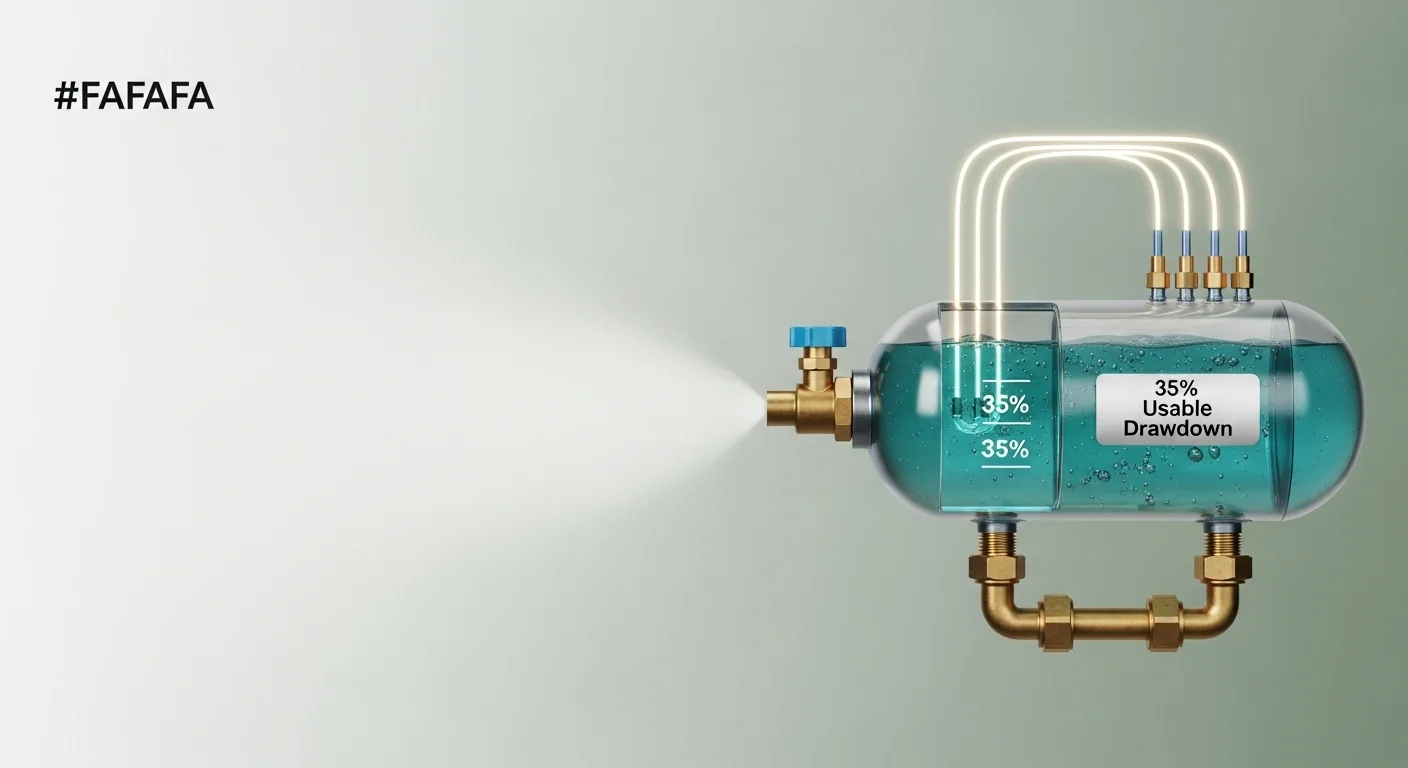
- The 35% drawdown factor assumes a properly pre-charged bladder accumulator operating between 80 and 100 PSI. Diaphragm-style tanks, waterlogged tanks, or tanks pre-charged to low pressure will have significantly less usable drawdown, sometimes below 10%.
- Nozzle flow rates are taken as constant at 100 PSI. Real systems experience pressure drop across long manifolds, partially blocked nozzle orifices from mineral buildup, and transient pressure fluctuations during pump start and cutoff. Actual water per cycle may be 10 to 20% lower than calculated.
- The 72 pump starts per day safety threshold is conservative for 1/4 HP to 1/2 HP booster pumps such as the Aquatec 8800. Industrial-grade diaphragm pumps or pump-and-motor assemblies with soft-start electronics may tolerate significantly more; low-cost imported pumps may fail at lower cycle counts.
- Root desiccation is flagged at off-times above 10 minutes. This threshold is appropriate for mature plants in a sealed chamber at typical growing temperatures. Clones, seedlings, and high-temperature environments are more sensitive and may show moisture stress at off-times above 5 to 7 minutes.
- The calculator does not account for multiple zones with staggered timers, solenoid valve dead-time, or manifold fill time. In multi-zone systems, actual nozzle on-time may be shorter than the timer setting if the solenoid response is slow.
- Daily water consumption assumes continuous 24-hour operation. If lights-off periods use a different schedule or the system pauses, actual consumption will differ.
Standards, Safety Checks, and “Secret Sauce” Warnings
Critical Warnings
- The Burnt Pump failure mode: Without an accumulator tank, a pump connected directly to a cyclic timer on a 3-second-on / 5-minute-off schedule must start 285 times per day. Motor start events are the highest-stress moments in a pump’s operating life. High-current inrush on every start deposits heat in the stator windings faster than it can dissipate. The winding insulation degrades. The pump fails. This is not a fringe risk; it is the expected outcome for a direct-connect HPA setup within days to a few weeks. An accumulator tank, sized correctly, reduces that 285 daily start count to single digits.
- Root desiccation is a silent failure: Because HPA roots are entirely in air with no medium to hold residual moisture, a timer malfunction or an off-time setting above 10 minutes can cause visible root tip damage within a single growing period. Unlike substrate systems where an overlong irrigation gap is forgiving, aeroponics has no moisture buffer. Monitoring root color and tip turgor in the first 48 hours of operation is the only reliable early warning system.
- Duty cycle tells you almost nothing about pump health: A 0.5% duty cycle sounds extremely efficient, but if you achieve it with a 2-second on-time and a 6-minute off-time and no accumulator, you still have 238 pump starts per day. Duty cycle is a root zone metric. Pump cycle count is the hardware metric. This calculator produces both, and the pump cycle number demands equal attention. Monitoring root zone conditions alongside environment data from a VPD calculator helps confirm that low duty cycles are actually producing the dry, oxygenated root environment HPA is designed to create.
- High chamber humidity can mask root desiccation signs: In an enclosed HPA chamber, high ambient humidity slows surface evaporation from root tissue. A grower may observe no visible wilting even as root tip cells undergo water stress at the cellular level. If the chamber operates above 85% relative humidity, extended off-times may appear safe visually when they are not. Using a dehumidifier sizing tool to manage root zone humidity is part of a complete HPA environment strategy.
Minimum Standards
- On-time: 3 to 5 seconds at 80 to 100 PSI for 50-micron droplet formation. Below 1 second, the manifold may not reach full operating pressure before the solenoid closes.
- Off-time: 3 to 5 minutes for established vegetative plants. 5 to 7 minutes maximum for flowering plants with large root masses that retain surface moisture longer.
- Pump cycles: Below 72 starts per 24 hours for standard booster pumps. An appropriately sized accumulator is the only hardware solution to this constraint; timer adjustments alone cannot fix an undersized tank.
- Accumulator pre-charge pressure: 80 PSI with nitrogen or dry air (not water) before the bladder is exposed to system water. An improperly charged tank functions like a solid-walled vessel with near-zero drawdown.
Competitor Trap: Most aeroponic guides published by nutrient brands, timer manufacturers, and grow-shop blogs describe duty cycle as an on-time-to-off-time ratio and leave it at that. They do not calculate pump cycle counts, they do not specify tank sizing math, and they do not explain why the pump in a “set it and forget it” direct-connect HPA build fails within its first week of operation. The result is that growers follow technically correct timer settings that mechanically destroy the pump. This calculator was built specifically to surface that blind spot.
Common Mistakes and Fixes
Mistake: Entering Off-Time in Seconds Instead of Minutes
The off-time field expects minutes. Entering 300 when you mean a 5-minute rest period (300 seconds) tells the calculator you want a 300-minute off period, which produces a duty cycle below 0.01% and suggests 3 mist events per day. The results will look plausible in isolation because the duty cycle number appears low and “efficient,” making this error easy to miss. Always cross-check mist events per day against your expected schedule to catch unit errors before they propagate.
Fix: Convert your off-time to minutes before entering it. A 5-minute rest = enter 5, not 300.
Mistake: Assuming the Pump Handles the Same Load as in a Flood-and-
Drain System
Flood-and-drain and recirculating systems cycle pumps infrequently, often 2 to 6 times per day, with long run durations per event. HPA without an accumulator cycles a pump up to 285 times per day in brief bursts. A pump that lasts years on a flood-and-drain schedule can fail in days on a direct HPA timer. The mechanical stress profile is fundamentally different, and transfer assumptions from one system type to another are dangerous. Growers coming from systems like flood-and-drain who want to compare pump specifications across system types can use the flood and drain pump calculator to see how dramatically the cycle count and run duration differ.
Fix: Treat HPA pump selection as a separate engineering problem from all other hydroponic system types and size the accumulator before purchasing the pump.
Mistake: Using a Pressure Tank Instead of a Bladder Accumulator
Standard pressure tanks found in residential plumbing use an internal air pocket separated from the water by a steel diaphragm or no barrier at all. Over time, the air dissolves into the water, the tank waterloggs, and usable drawdown approaches zero. Only bladder-type accumulators with a flexible rubber bladder sealed against the pre-charge air maintain consistent drawdown volume over time. Waterlogged tanks appear to work initially but provide no buffering within a few weeks, returning pump cycle counts to the same level as a direct-connect system.
Fix: Specify a bladder accumulator explicitly when purchasing; confirm the pre-charge air is isolated from the water side by a full bladder, not just an air pocket.
Mistake: Ignoring Nozzle Clogging When Sizing the Accumulator
Anti-drip nozzles for HPA use orifice sizes that produce 50-micron droplets at 100 PSI. These same tiny orifices clog readily with mineral scale, biofilm, or debris from a dirty reservoir. A partially clogged nozzle reduces per-nozzle flow rate, meaning less water is dispensed per mist event, meaning the accumulator tank lasts longer per charge than calculated. This sounds beneficial, but it also means some roots receive inadequate misting. The calculated accumulator size is based on all nozzles flowing at full rated output.
Fix: Filter all nutrient solution before it reaches the high-pressure manifold using an inline sediment filter rated for your operating pressure, and flush nozzles with clean water monthly. This is directly analogous to maintaining oxygenation equipment in other hydroponic systems, similar to how air pump sizing in a DWC system depends on all diffusers flowing freely.
Mistake: Running the Same Schedule Through Lights-Off Without
Adjustment
Root respiration rates drop during dark periods, and plant water demand decreases substantially. Running identical misting intervals through lights-off is not harmful in HPA from a root health standpoint, but it wastes water and accumulates unnecessary pump cycles. Some growers double the off-time during dark periods to reduce daily pump starts and daily water consumption without any root stress consequences.
Fix: Program a separate dark-period schedule on your cyclic timer with an off-time 50 to 100% longer than the lights-on setting, then recalculate your pump cycle total to confirm it remains within safe limits.
Next Steps in Your Workflow
Once you have confirmed that your pump cycle count is below the safe threshold and your off-time is within the non-desiccation range, the next hardware question is reservoir and nutrient management. An HPA system with 285 mist events per day and a small water volume per event consumes relatively little solution daily, but the roots strip nutrients at a rate that can shift electrical conductivity significantly between reservoir top-ups. Pairing your timing setup with an EC monitoring workflow catches nutrient depletion or salt accumulation before it affects plant health.
The other variable that changes as your system matures is plant root mass. A large root mass holds more residual surface moisture between mist events, which means the desiccation threshold effectively extends slightly as plants grow. During propagation and early vegetative growth, shorter off-times are protective. Dialing those intervals back correctly as canopy develops is part of what separates reactive growing from a planned strategy. Tools like the crop steering calculator bring that broader irrigation and environmental logic into a single decision framework for growers ready to move beyond basic timer setup.
FAQ
What duty cycle is correct for true high-pressure aeroponics?
True HPA targets below 2%, with most optimal setups landing between 0.9% and 1.7%. This corresponds to roughly 3 to 5 seconds of misting every 3 to 5 minutes. Duty cycle above 5% typically indicates that on-time is longer than necessary for full root coverage at 100 PSI, which increases water consumption without proportional benefit to root oxygenation.
How large does my accumulator tank need to be?
Size the tank so that each pump charge covers at least 10 mist events. Divide your usable drawdown (tank size in gallons multiplied by 0.35) by your water-per-cycle value (calculated by this tool) to get mist events per charge. For small systems with 6 to 10 nozzles at 3 seconds on, a 2-gallon bladder accumulator typically provides hundreds of mist events per charge, keeping the pump nearly idle.
Can I use a standard RO holding tank as an accumulator?
Yes, reverse osmosis storage tanks are bladder-type accumulators and work well for HPA provided they are rated for at least 100 PSI working pressure. Confirm the pre-charge pressure is set to 80 PSI before water exposure. RO storage tanks are commonly available in 2-gallon and 4-gallon sizes, which are appropriate for most small to mid-size HPA builds.
What happens if the off-time exceeds 10 minutes?
Bare roots in an HPA chamber begin losing surface moisture to evaporation once misting stops. At typical grow room temperatures, this process can cause root tip wilting and cell damage within a 10 to 15 minute window. The calculator triggers a desiccation warning at any off-time above 10 minutes, regardless of all other settings. The fix is always reducing off-time, not adjusting any other variable.
Does a solenoid valve reduce pump wear in HPA?
Yes, significantly. With a solenoid valve, the pump runs continuously and the solenoid opens and closes to deliver timed mist bursts. The pump stays pressurized without cycling on and off, eliminating motor start stress entirely. This architecture removes the burnt pump failure mode but requires a pump rated for continuous operation and an accumulator or pressure switch to maintain system pressure within a safe band when the solenoid is closed.
How do I convert mL per minute nozzle flow to GPH?
Multiply mL/min by 60 to get mL/hour, then divide by 3785.4 to convert to gallons per hour. For example, a nozzle rated at 16 mL/min calculates as 16 x 60 = 960 mL/hr, divided by 3785.4 = 0.254 GPH. Always confirm the mL/min rating corresponds to your target operating pressure of 100 PSI, as nozzle manufacturers sometimes publish flow at lower test pressures.
Conclusion
The aeroponic timer calculator addresses the specific failure point that converts a technically correct misting schedule into a hardware-destruction event: the direct-connect pump cycle count. Getting the duty cycle right is a root biology question. Getting the pump cycle count right is a mechanical engineering question. Both numbers matter, and neither answers the other. The most common path to a failed HPA build is fixing the first without ever calculating the second.
Size your accumulator before you finalize your timer settings, confirm your off-time is below the 10-minute desiccation threshold, and run your pump cycle calculation as a final check. If your environment setup is still in progress, the grow tent fan size calculator handles the airflow side of root chamber design, where ambient humidity and temperature interact with the misting intervals you have just calculated.