
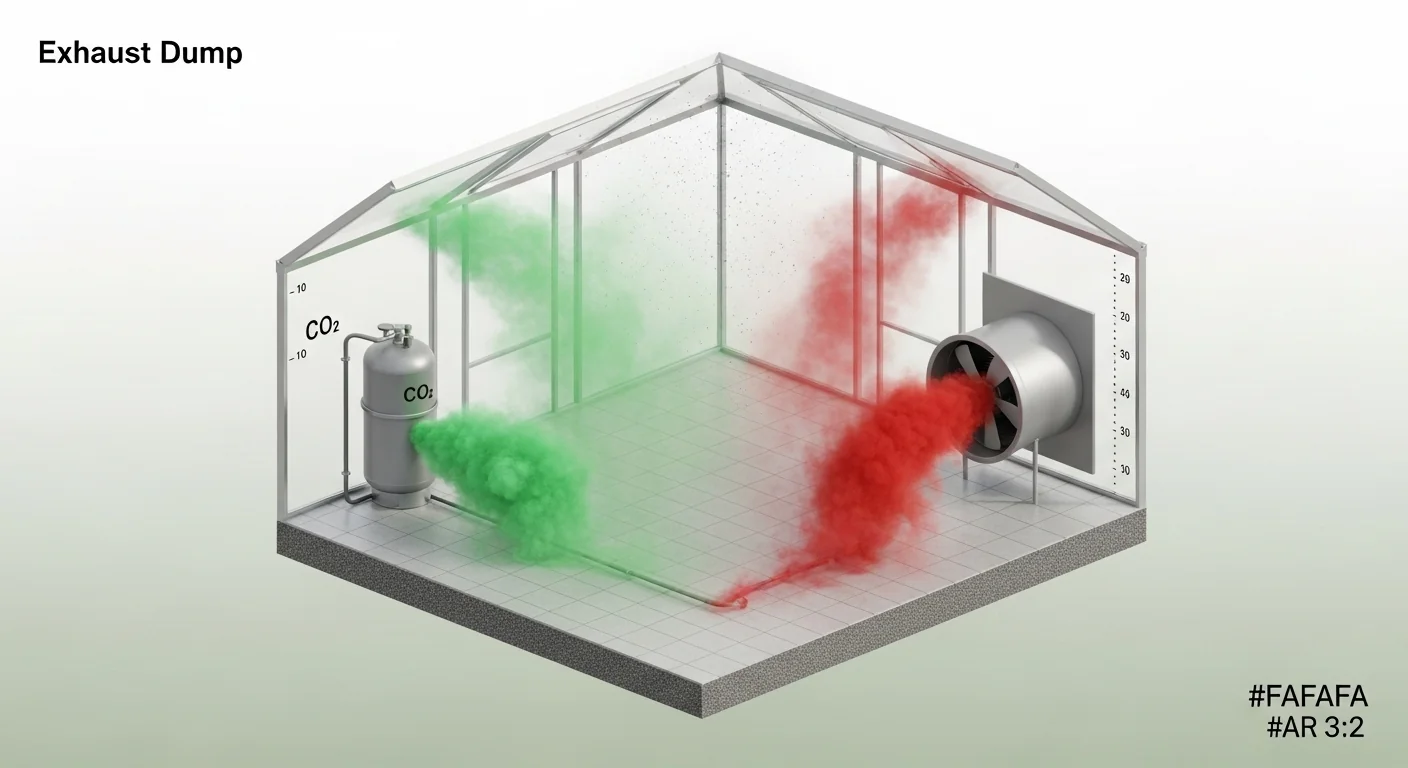
CO2 Enrichment Flow Rate & Exhaust Waste
Greenhouse CO2 Calculator — The Yield Grid
| Room Vol. (ft³) | Target PPM | Deficit (PPM) | Flow Rate (CFH) | Status |
|---|
How this calculator works
Formula Steps
-
Room Volume:
Room_Volume (ft³) = Length × Width × HeightCalculates the total cubic feet of air in the grow room.
-
CO2 Deficit:
CO2_Deficit = (Target_PPM − Ambient_PPM) ÷ 1,000,000Converts the PPM difference into a dimensionless fraction of gas needed per cubic foot of air.
-
Base Flow Rate (fan off):
Base_CFH = Room_Volume × CO2_DeficitHow much CO2 (cubic feet) you need to inject to raise the room from ambient to target PPM in one hour with the fan off.
-
Exhaust-Adjusted Flow Rate:
CFH_Required = Room_Volume × CO2_Deficit × (1 + Exchanges_per_Hour)Each air exchange dumps a full room-volume of enriched air to the outside. You must replenish that lost CO2 on top of the baseline fill. When exchanges > 0, costs multiply directly with exhaust rate.
Assumptions & Limits
- CO2 is assumed to mix instantly and uniformly throughout the room (ideal mixing). Real rooms may have stratification; vertical circulation fans reduce this error.
- The formula treats each exhaust cycle as a complete displacement of CO2-enriched air. Actual loss depends on fan CFM, room leakage, and injection timing.
- Ambient CO2 is held constant (fresh outside air at 400 PPM). If your building has elevated CO2, adjust the ambient input accordingly.
- Tank sizing assumes CO2 is a gas at standard temperature/pressure: 1 lb CO2 ≈ 8.7 ft³ at STP.
- PPM values above 5,000 are outside OSHA safe exposure limits and are blocked. Do not operate enrichment without a CO2 alarm system.
- This calculator does not account for plant uptake, door infiltration, or CO2 off-gassing from grow media.
- The “Exhaust Dump” check is triggered any time Exchanges per Hour > 0. An environmental controller with solenoid valve is the only safe mitigation.
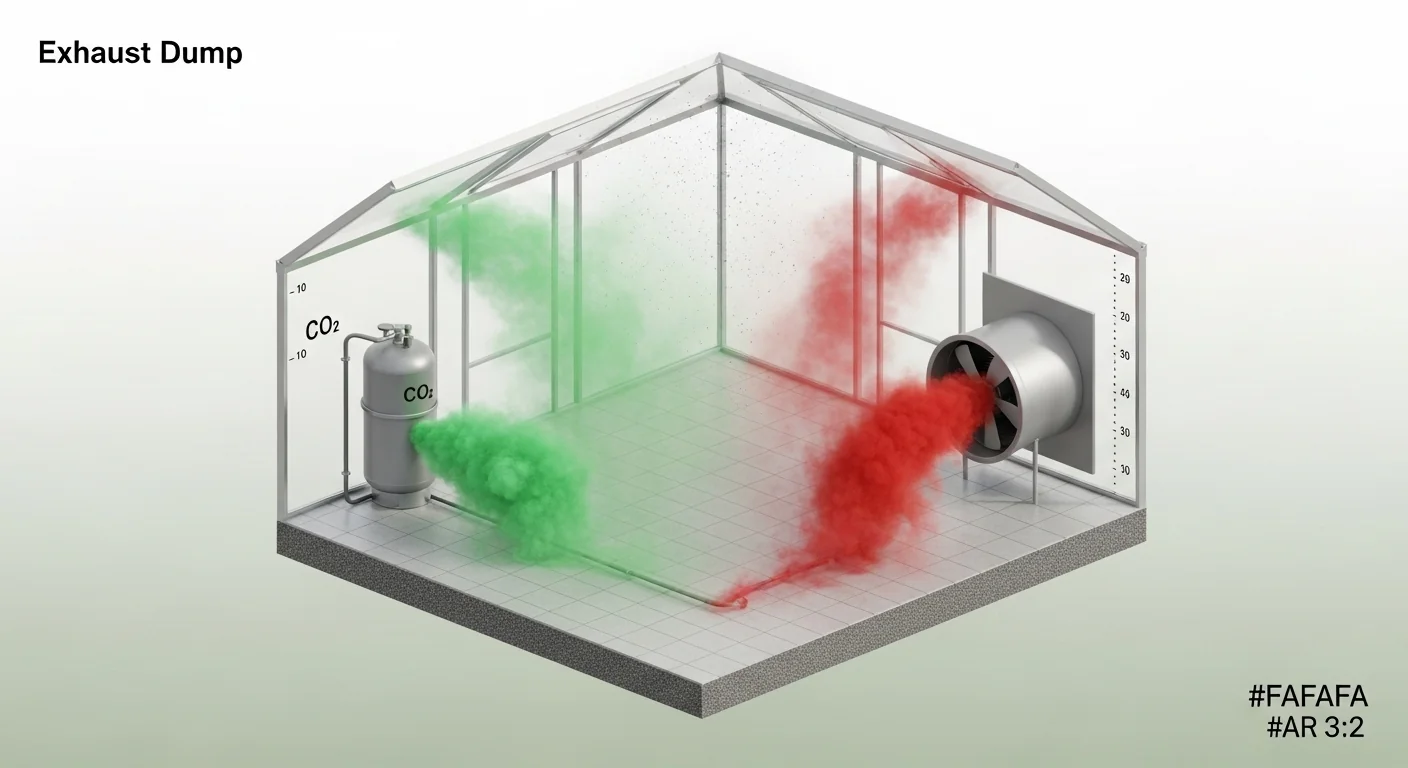
Secret Sauce: The “Exhaust Dump” Money Burner
- A 400 CFM exhaust fan in a 400 ft³ room completes one full air exchange every 60 seconds (60 ACH). At 2 CFH injection, a 20 lb tank depletes in ~2 days — all into the neighborhood, not into your plants.
- The fluid-dynamics principle: CO2 is slightly heavier than air (density 1.96 kg/m³ vs. 1.29 kg/m³ for air), but turbulent exhaust fans overcome density stratification instantly, expelling enriched air without discrimination.
- Environmental controllers (TrolMaster, Titan Controls) solve this by cutting exhaust fan power when CO2 injection is active — the only OSHA-and-wallet-safe solution.
The Yield Grid — Greenhouse CO2 Calculator

CO2 enrichment fails quietly. A grower sets a regulator to 2 CFH, watches the tank gauge, and assumes the plants are thriving at 1,200 PPM. What the gauge does not show is that a continuously running exhaust fan can replace the entire room’s air volume every few minutes, expelling every molecule of injected CO2 before it reaches a single stomatal opening. The calculation is not just about how much CO2 to add. It is about how much you are simultaneously throwing away.
This greenhouse CO2 calculator computes the cubic feet per hour (CFH) of CO2 required to raise a grow room from an ambient baseline to a target enrichment level, then adjusts that figure upward for every air exchange your exhaust fan performs each hour. It calculates flow rate and exhaust-adjusted demand only. It does not model plant uptake rates, CO2 diffusion speed, or photosynthetic saturation curves, which depend on light intensity, crop type, and canopy density.
After running your numbers, you will know whether your current injection rate can physically sustain your target PPM given your exhaust schedule, or whether you are injecting gas that leaves the building faster than it enters.
Use the Tool
Before calculating, have three measurements ready: the interior dimensions of your grow room or greenhouse in feet (length, width, height), your target CO2 concentration in PPM, and your exhaust fan’s air change rate per hour (CFM divided by room volume gives ACH). If you do not know your exhaust ACH, use your fan’s rated CFM and divide by room cubic footage. Enter zero for ACH only if the fan is physically off or controlled to pause during CO2 injection cycles. For context on sizing your exhaust ventilation correctly, the greenhouse fan calculator can help you verify your actual ACH before plugging it in here.
Quick Start (60 Seconds)
- Room Length (ft): Measure interior wall-to-wall, not exterior. For irregular shapes, use the longest dimension and treat it as a rectangle; the formula assumes a rectangular prism.
- Room Width (ft): Perpendicular to length, interior measurement. Do not include attached hallways or adjacent spaces unless CO2 is injected into those areas too.
- Room Height (ft): Floor to ceiling, interior. Peaked greenhouse roofs should use average height (ridge height plus sidewall height, divided by 2) as an approximation.
- Ambient Base CO2 (PPM): Outdoor air is approximately 400-420 PPM. If your facility recirculates indoor air without fresh-air exchange, measure with an NDIR sensor, as CO2 can accumulate above ambient. The default of 400 PPM is a conservative outdoor baseline.
- Target CO2 Level (PPM): Most enriched grow operations target 1,000-1,500 PPM. Higher targets require proportionally more gas and are only productive when matched by high light intensity. Do not enter values above 5,000 PPM; that range crosses OSHA exposure ceilings.
- Exhaust Fan Air Exchanges per Hour (ACH): This is the most commonly miscalculated field. ACH = Fan CFM x 60 / Room Volume (ft³). A 400 CFM fan in a 400 ft³ room = 60 ACH. Entering zero means the fan is fully off during the injection window.
- CO2 Tank Size (lb) [optional]: Filling this field activates the tank duration estimate. A standard 20 lb aluminum tank contains approximately 174 ft³ of CO2 gas at standard temperature and pressure (using the 8.7 ft³ per lb conversion). Leave blank if using a propane CO2 generator.
Inputs and Outputs (What Each Field Means)
| Field | Unit | What it means | Common mistake | Safe entry guidance |
|---|---|---|---|---|
| Room Length | ft | Interior horizontal dimension of the grow space | Using exterior building dimension instead of interior grow area | 1 to 9,999 ft; must be > 0 |
| Room Width | ft | Interior dimension perpendicular to length | Including adjacent hallways or non-enriched zones | 1 to 9,999 ft; must be > 0 |
| Room Height | ft | Floor-to-ceiling interior clearance | Using ridge height for peaked roofs instead of average height | 1 to 99 ft; must be > 0 |
| Ambient Base CO2 | PPM | Starting CO2 concentration before enrichment begins | Assuming 400 PPM when building CO2 is already elevated from people or equipment | 300 to 1,000 PPM; default 400 PPM |
| Target CO2 Level | PPM | Desired enrichment concentration during the injection cycle | Setting 1,500+ PPM without adequate light intensity to utilize it | 401 to 5,000 PPM; must exceed ambient |
| Exhaust Fan ACH | ACH (air changes/hr) | How many full room-air-volume replacements the exhaust fan performs per hour | Entering 0 when the fan is actually on a timer that overlaps with CO2 injection | 0 to 300 ACH; enter 0 only when fan is off during injection |
| CO2 Tank Size | lb | Physical weight of CO2 in the tank, used to estimate how long the supply lasts | Using the total cylinder weight instead of the net CO2 fill weight printed on the label | 1 to 9,999 lb; optional field |
| CFH Required (output) | ft³/hr | Total cubic feet of CO2 gas that must be injected per hour to reach target PPM given current exhaust rate | Treating this number as a regulator set-point without accounting for injection time windows | Compare against your regulator’s adjustable CFH range |
| Efficiency Rating (output) | ratio | Fraction of injected CO2 that stays in the room vs. what is expelled by the exhaust fan | Assuming efficiency is acceptable when the exhaust fan runs 24/7 | 100 = fan off; lower values indicate increasing waste |
| Tank Duration (output) | hours | Estimated time before a given tank size is depleted at the calculated flow rate | Assuming a 20 lb tank lasts weeks when exhaust-adjusted CFH is high | Treat as a planning estimate, not a precision forecast |
Worked Examples (Real Numbers)
Example 1: Small Grow Tent, Exhaust Off During Injection
- Room: 8 ft x 4 ft x 7 ft = 224 ft³
- Ambient CO2: 400 PPM
- Target CO2: 1,200 PPM
- Exhaust ACH: 0 (fan paused during CO2 cycle)
CO2 Deficit = (1,200 – 400) / 1,000,000 = 0.0008
CFH = 224 x 0.0008 x (1 + 0) = 0.18 CFH
Result: 0.18 CFH required. With a 20 lb tank (approximately 174 ft³), this setup runs for roughly 967 hours at this flow rate, assuming the tank is used only during injection windows. Turning the exhaust off during enrichment makes a small tank viable for months of consistent operation.
Example 2: Mid-Size Grow Room, Exhaust Running at 5 ACH
- Room: 12 ft x 10 ft x 8 ft = 960 ft³
- Ambient CO2: 400 PPM
- Target CO2: 1,500 PPM
- Exhaust ACH: 5
CO2 Deficit = (1,500 – 400) / 1,000,000 = 0.0011
Base CFH = 960 x 0.0011 x 1 = 1.06 CFH
Exhaust-Adjusted CFH = 960 x 0.0011 x (1 + 5) = 6.34 CFH
Result: 6.34 CFH required. The exhaust multiplier increases CO2 demand sixfold compared to a sealed injection window. A 20 lb tank at this rate lasts approximately 27 hours. Without a solenoid valve cutting exhaust power during injection, this room burns through a tank in just over one day.
Example 3: Commercial Greenhouse, Fan Off, Elevated Baseline
- Room: 30 ft x 20 ft x 10 ft = 6,000 ft³
- Ambient CO2: 420 PPM (slightly elevated from adjacent building activity)
- Target CO2: 1,200 PPM
- Exhaust ACH: 0 (enrichment during sealed daytime period)
CO2 Deficit = (1,200 – 420) / 1,000,000 = 0.00078
CFH = 6,000 x 0.00078 x (1 + 0) = 4.68 CFH
Result: 4.68 CFH required. At this scale, a 20 lb tank lasts approximately 37 hours. For a 6,000 ft³ greenhouse operating 8-hour enrichment days, a propane CO2 generator becomes economically preferable to compressed tank gas, which would require a refill every four to five enrichment sessions.
Reference Table (Fast Lookup)
| Room Volume (ft³) | Ambient (PPM) | Target (PPM) | CO2 Deficit (PPM) | Exhaust (ACH) | CFH Required | 20 lb Tank Duration (hrs) |
|---|---|---|---|---|---|---|
| 200 | 400 | 1,000 | 600 | 0 | 0.12 | ~1,450 |
| 400 | 400 | 1,000 | 600 | 0 | 0.24 | ~725 |
| 400 | 400 | 1,200 | 800 | 0 | 0.32 | ~544 |
| 400 | 400 | 1,200 | 800 | 2 | 0.96 | ~181 |
| 800 | 400 | 1,500 | 1,100 | 0 | 0.88 | ~198 |
| 800 | 400 | 1,500 | 1,100 | 5 | 5.28 | ~33 |
| 1,500 | 400 | 1,200 | 800 | 0 | 1.20 | ~145 |
| 1,500 | 400 | 1,200 | 800 | 3 | 4.80 | ~36 |
| 3,000 | 400 | 1,500 | 1,100 | 0 | 3.30 | ~53 |
| 3,000 | 400 | 1,500 | 1,100 | 2 | 9.90 | ~18 |
Tank duration assumes 1 lb CO2 = 8.7 ft³ at standard temperature and pressure (20 lb tank = 174 ft³ total). Figures are rounded to the nearest whole hour. ACH of 0 assumes the exhaust fan is fully off during the entire injection window.
How the Calculation Works (Formula + Assumptions)
Show the calculation steps
Step 1: Room Volume
Room Volume (ft³) = Length (ft) x Width (ft) x Height (ft)
This produces the total cubic footage of air that must be enriched. No conversion factor is needed; the formula works natively in imperial units when all dimensions are in feet.
Step 2: CO2 Deficit Fraction
CO2 Deficit = (Target PPM – Ambient PPM) / 1,000,000
Dividing by 1,000,000 converts the PPM difference into a dimensionless volume fraction. For a deficit of 800 PPM, the fraction is 0.0008, meaning 0.0008 ft³ of pure CO2 gas must be added per ft³ of room air to raise concentration by that amount.
Step 3: Base Flow Rate (Sealed Room)
Base CFH = Room Volume (ft³) x CO2 Deficit
This is the minimum CFH if the room were perfectly sealed with no exhaust running. It answers: how many cubic feet of CO2 gas must enter the room per hour to hit the target, assuming nothing leaves.
Step 4: Exhaust-Adjusted Flow Rate
CFH Required = Room Volume (ft³) x CO2 Deficit x (1 + Air Changes per Hour)
Each complete air exchange flushes one full room-volume of enriched air to the outside. To maintain the target concentration, the injection system must replace both the baseline deficit and the volume lost through each exchange. At 5 ACH, the multiplier is 6x the sealed-room rate. At 20 ACH, it is 21x. Rounding: CFH values below 10 are shown to two decimal places; values of 10 and above are rounded to one decimal place.
Step 5: Tank Duration Estimate
Tank ft³ = Tank Weight (lb) x 8.7
Tank Duration (hrs) = Tank ft³ / CFH Required
The 8.7 ft³/lb conversion is based on CO2 gas density at standard temperature (20 C) and pressure (1 atm). Actual yield varies slightly with ambient temperature and tank fill state.
Assumptions and Limits
- The formula assumes instantaneous, uniform mixing of CO2 throughout the room volume. Real rooms experience stratification, especially in tall spaces without vertical circulation fans. CO2 is denser than air (1.96 kg/m³ vs. 1.29 kg/m³ for air), so it settles without active mixing.
- Each exhaust exchange is treated as a complete displacement of the room’s enriched air. Actual CO2 loss per exchange depends on fan placement, room leakage, and injection timing relative to the exhaust cycle. This formula produces a conservative (higher) flow rate estimate.
- Plant CO2 uptake is not modeled. During active photosynthesis, plants consume CO2, so actual flow demand may be higher than the formula output during peak light periods.
- Ambient CO2 is assumed constant at the entered value. If fresh outdoor air enters continuously, ambient stays near 400 PPM. If the space is tightly sealed, exhaled CO2 or decomposition can raise the baseline.
- The 8.7 ft³/lb CO2 conversion applies to gas-phase CO2 at standard conditions. Liquid CO2 tanks deliver gas at a higher density; the 8.7 figure is a practical approximation within normal operating ranges.
- This tool does not account for door infiltration, wall permeability, or CO2 off-gassing from grow media, organic matter, or compost. Those sources typically contribute negligible volume compared to injection rates at enrichment PPM levels.
- PPM values above 5,000 are outside the OSHA 8-hour TWA ceiling of 5,000 PPM and are blocked by the calculator. Operating above 3,000 PPM requires CO2 alarm systems and automatic ventilation failsafes regardless of occupancy frequency.
- Tank duration is a planning estimate only. Actual consumption depends on regulator precision, ambient temperature effects on gas density, and whether the injection system runs continuously or in timed cycles.
Standards, Safety Checks, and “Secret Sauce” Warnings
Critical Warnings
- The Exhaust Dump: Any exhaust fan operating during CO2 injection creates a direct loss channel. CO2 gas, though slightly heavier than air, is rapidly entrained by turbulent airflow and expelled with the bulk air mass. There is no injection rate high enough to overcome a continuously running exhaust fan in a normal grow room; the physics of the exchange rate will always exceed the injection rate at practical regulator settings.
- Tank Depletion Rates at High ACH: A 20 lb CO2 tank contains roughly 174 ft³ of gas. At 5 ACH in a 800 ft³ room targeting 1,500 PPM, the required rate exceeds 5 CFH. That tank empties in approximately 33 hours of continuous operation. Many growers assume tanks last weeks; at typical exhaust rates, they last days.
- High-PPM Safety: CO2 above 3,000 PPM causes measurable cognitive impairment and dizziness. Above 5,000 PPM (OSHA Ceiling Limit), exposure creates serious physiological risk. NDIR sensors with alarm outputs and automated ventilation override are not optional at these enrichment levels.
- Enrichment Without Adequate Light: CO2 enrichment above 1,000 PPM is only productive when photosynthetically active radiation (PAR) is sufficient to drive the additional carbon fixation. At low light intensity, elevated CO2 does not increase yield and wastes supply. The DLI calculator can help confirm whether your lighting delivers enough daily light integral to justify enrichment above 1,200 PPM.
Minimum Standards
- An environmental controller with a solenoid valve wired to cut exhaust fan power during CO2 injection is the baseline minimum for any enrichment setup. Controllers from TrolMaster and Titan Controls handle this automatically using NDIR CO2 feedback.
- NDIR (non-dispersive infrared) CO2 sensors are required for accurate PPM measurement. Electrochemical sensors degrade and drift significantly within 12-18 months; NDIR sensors are calibrated against a known reference gas spectrum and are the industry standard for grow room control.
- CO2 injection should be timed to the light cycle only. Plants do not photosynthesize in darkness, and nighttime enrichment is pure waste. Most environmental controllers have a light-sensing input or timer integration for this purpose.
- For greenhouse volumes above 2,000 ft³, propane or natural gas CO2 generators are typically more cost-effective than compressed tank gas on a per-ft³ basis. The heat output of propane generators must be accounted for in climate calculations; for heat load planning, the CO2 burner heat calculator provides the thermal output estimate.
Competitor Trap: Most CO2 flow rate calculators online return a single CFH number based on room volume and PPM deficit only. They solve the sealed-room case and stop. A grower who trusts that number and then runs their exhaust fan continuously will under-inject by a factor equal to 1 plus their ACH. At 5 ACH, the sealed-room estimate is off by 6x. The exhaust adjustment is not a refinement; it is the dominant variable in any real grow room, and calculators that omit it produce numbers that are operationally useless.
Common Mistakes and Fixes
Mistake: Using CFM Directly as ACH
Exhaust fan ratings are given in CFM (cubic feet per minute), not ACH (air changes per hour). A 400 CFM fan in a 400 ft³ room produces 60 ACH, not 400. Entering raw CFM as ACH overstates exhaust impact by a factor of 60 and produces an absurdly high required flow rate. Convert first: ACH = (Fan CFM x 60) / Room Volume (ft³).
Fix: Always convert fan CFM to ACH before entering the value, or use the grow tent fan size calculator to verify your fan’s actual ACH for your specific room volume.
Mistake: Measuring Room Volume from Exterior Dimensions
Wall thickness in concrete or insulated grow rooms can reduce interior volume by several hundred cubic feet compared to exterior dimensions, particularly in retrofitted shipping container or prefabricated panel builds. The formula enriches the air inside the walls, not the walls themselves.
Fix: Measure interior wall-to-wall dimensions only. For racks, tables, and equipment occupying floor space, those volumes can optionally be subtracted from the calculated room volume for a more precise figure, though the typical impact is minor.
Mistake: Treating ACH as Zero When the Fan Runs on a Timer
A fan that runs 30 minutes per hour at 400 CFM in a 400 ft³ room produces 30 ACH during its on-time, not zero. If that on-time overlaps with CO2 injection, the exhaust dump is active for that entire window. Many growers enter 0 ACH because the fan is “on a timer,” without checking whether injection and exhaust cycles overlap.
Fix: Map your injection and exhaust schedules side by side. If they overlap at any point, use the ACH value for the fan’s operating state during that overlap, not zero.
Mistake: Setting Target PPM Without Matching Light Intensity
Targeting 1,500 PPM in a room lit with low-output fluorescents or LED strips at low PPFD produces no measurable yield improvement. The photosynthetic machinery is already light-limited, and additional CO2 has no substrate to fix. The cost of gas is spent with no return.
Fix: Confirm your lighting delivers adequate intensity before running enrichment above ambient. Room-level climate planning should consider VPD alongside CO2; the VPD calculator helps confirm whether your temperature and humidity environment is set up to take advantage of elevated CO2.
Mistake: Using Tank Net Weight for Duration Instead of CO2 Fill Weight
An aluminum CO2 cylinder has a tare weight (the empty cylinder) printed on the collar alongside the CO2 fill weight. A “20 lb CO2 tank” contains 20 lb of CO2 but the full assembly weighs 30-35 lb. Using the full assembly weight inflates the tank duration estimate and causes growers to miss refill windows.
Fix: Use the CO2 net fill weight only, printed on the cylinder label (typically “20 lb CO2” for a standard aluminum tank). For scale-based monitoring, subtract the tare weight from the total assembly weight to get the remaining CO2 in pounds. Pairing a grow room dehumidifier with a tank scale is common in sealed rooms; for sizing the dehumidifier in that sealed environment, the grow room dehumidifier calculator accounts for the added humidity from a sealed enrichment cycle.
Next Steps in Your Workflow
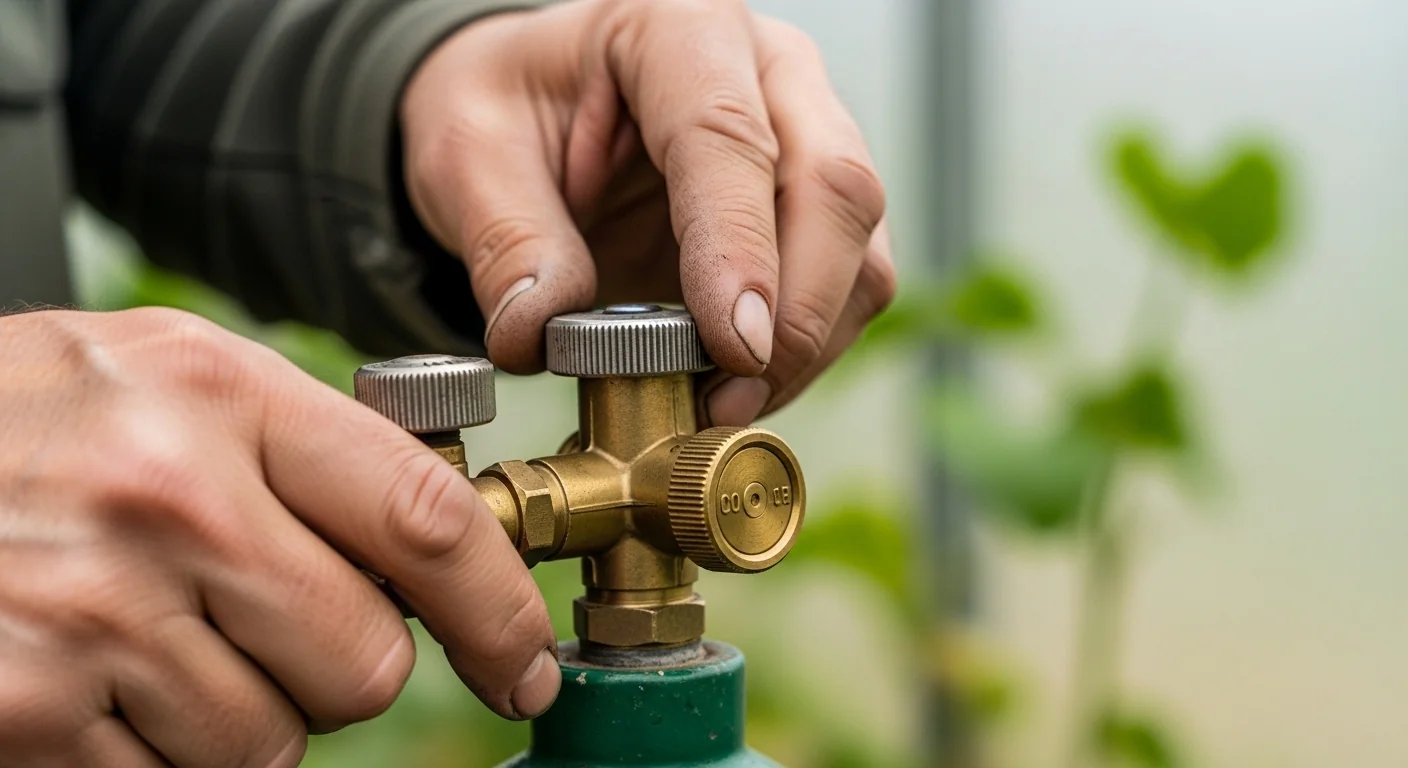
Once you have the CFH Required from this calculator, the immediate action is to verify that your CO2 regulator can deliver that flow rate at your target injection pressure, and that the regulator has a solenoid valve input for environmental controller integration. Most standard CO2 regulators for grow rooms are adjustable from 0.5 to 15 CFH, which covers most scenarios up to mid-size rooms. For large greenhouses where the required CFH exceeds 10 or more, a propane CO2 generator is typically more practical than compressed gas. To accurately size the generator’s heat contribution to the room’s cooling load, run those numbers through the grow room AC sizing calculator before purchasing.
The second step is to map your injection schedule to your light schedule and confirm there is zero overlap between exhaust-on and CO2-injection-on windows. Environmental controllers from TrolMaster and Titan Controls handle this via NDIR CO2 feedback, automatically holding exhaust fans off when PPM is below target and releasing them when target is reached or when a CO2 alarm threshold is approached. If you plan to expand the grow space in the future, also factor in the total CFH scaling: doubling room volume doubles CFH demand proportionally, while adding exhaust ACH multiplies demand non-linearly. Running this calculator again for the planned future room dimensions before investing in a fixed regulator size can prevent costly equipment mismatches. For long-running sealed setups, tank duration estimates from this tool pair directly with the CO2 tank duration calculator to help plan delivery schedules and avoid unexpected supply gaps.
FAQ
What is a good target PPM for CO2 enrichment in a greenhouse?
Most crops show measurable photosynthesis increases between 1,000 and 1,500 PPM. Below 1,000 PPM, enrichment benefits are minor. Above 1,500 PPM, returns diminish unless light intensity is very high. Levels above 2,000 PPM are rarely justified on a cost basis and introduce OSHA exposure monitoring requirements. The practical target for most indoor growers is 1,200 to 1,500 PPM during peak light hours.
Can I run my exhaust fan and inject CO2 at the same time?
Operating the exhaust fan during CO2 injection directly expels enriched air before plants can absorb it. The exhaust-adjusted CFH formula shows the scale of this waste: every air change per hour adds one full room-volume equivalent of CO2 demand. In practice, the fan must be physically cut during the injection window, which requires a solenoid valve on the regulator and an environmental controller to automate the interlock.
What is NDIR and why does it matter for CO2 control?
NDIR stands for non-dispersive infrared, a measurement method that detects CO2 by its specific infrared absorption wavelength. Unlike electrochemical sensors, NDIR sensors do not degrade through chemical consumption and maintain calibration accuracy over years of use. For automated grow room CO2 control, NDIR is the required sensor type; cheaper electrochemical alternatives drift substantially and produce unreliable controller trigger points within months.
How do I calculate ACH from my fan’s CFM rating?
Air Changes per Hour (ACH) = (Fan CFM x 60) / Room Volume in cubic feet. For a 400 CFM fan in a 10 x 10 x 8 ft room (800 ft³): ACH = (400 x 60) / 800 = 30 ACH. This means the fan replaces the entire room’s air volume 30 times per hour, or once every two minutes. At that rate, no practical CO2 injection rate can maintain enrichment without a full exhaust lockout during the injection cycle.
Is CO2 enrichment dangerous for people in the grow room?
CO2 becomes physiologically concerning above 1,000 PPM with prolonged exposure and causes noticeable symptoms (headache, elevated breathing rate) above 2,000-3,000 PPM. OSHA’s ceiling limit is 5,000 PPM. Grow rooms running enrichment to 1,500 PPM should have a functional CO2 alarm system with automatic ventilation activation. Workers should never enter a sealed, enriched room without confirming ventilation is active and CO2 has dropped to safe levels.
Why does my 20 lb CO2 tank empty so much faster than I expected?
The most common cause is an exhaust fan running during or overlapping with the CO2 injection window. At 5 ACH, the required flow rate is six times the sealed-room baseline. A 20 lb tank that would last over 100 hours in a sealed room may last under two days when the fan runs continuously. The second cause is regulator set-point error: if the regulator is set higher than the calculated CFH, gas flows faster than needed and the tank depletes proportionally faster.
Conclusion
The single most important mistake to avoid is running an exhaust fan concurrently with CO2 injection without an automated interlock. No other error wastes more money per grow cycle, and no other correction produces a faster, more measurable return. For sealed-room setups where both humidity and CO2 need active management, proper sequencing of dehumidifier cycles, exhaust cycles, and CO2 injection is the core environmental control challenge. The greenhouse heater sizing calculator is a useful companion for operators managing sealed or semi-sealed enrichment environments where heating demand increases as ventilation is reduced to protect CO2 levels.