
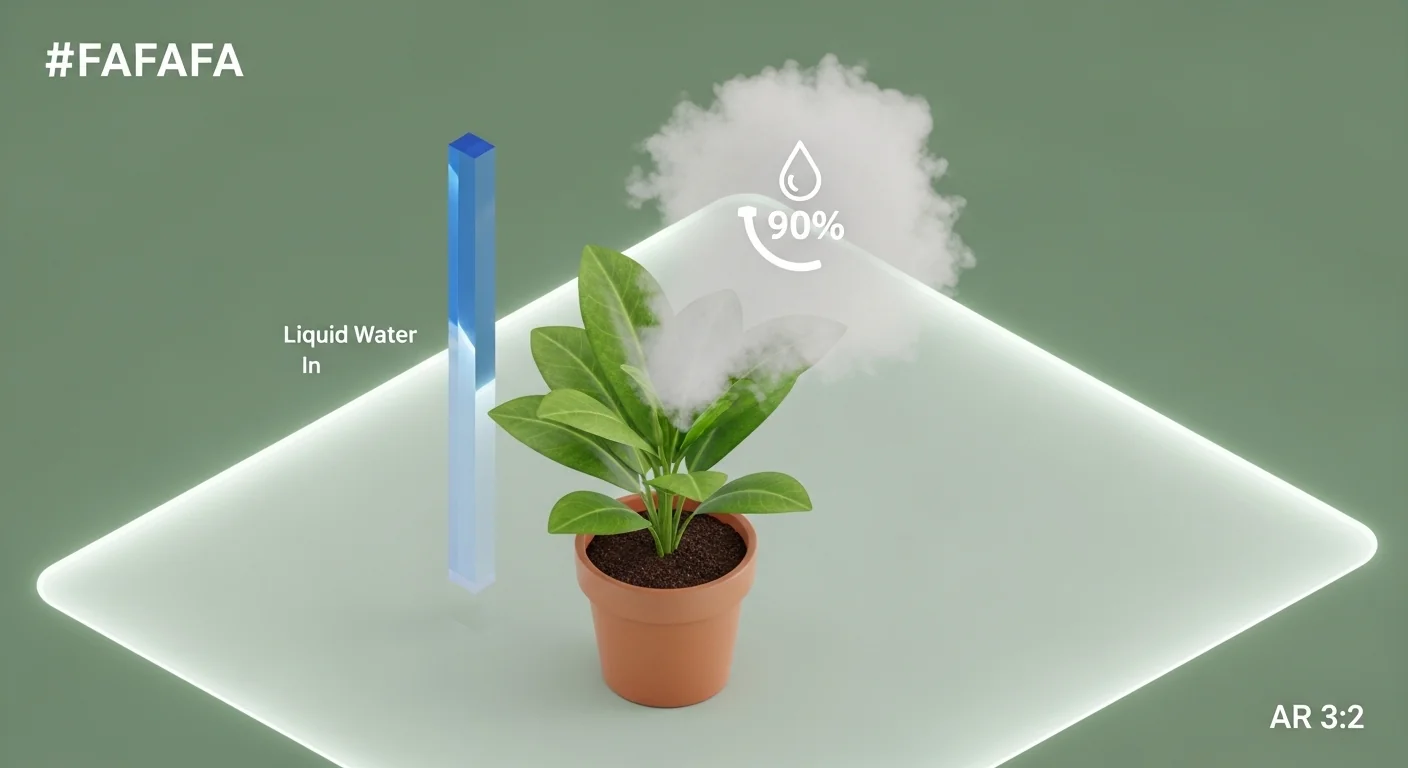

Plant transpiration is the hidden variable that breaks most dehumidifier sizing decisions. A grower measures their room dimensions, checks a BTU-per-square-foot chart, and buys a unit that looks right on paper. Then lights go off, the room cools, and 90% of every gallon of water they fed their plants that day materializes as airborne humidity all at once. The ceiling weeps. The canopy gets wet. Powdery Mildew appears within 48 hours.
This calculator converts your actual daily watering volume into a Pints Per Day (PPD) dehumidifier requirement using the 90% transpiration rule from horticultural science. It does not predict your exact ambient RH at any given hour, model temperature-dependent vapor pressure, or account for HVAC contributions. What it does produce is the minimum continuous moisture extraction rate your dehumidifier must sustain to prevent moisture accumulation. Understanding vapor pressure deficit is the next layer of precision once you have this baseline number locked in.
After running this calculator, you will know whether your current or planned dehumidifier is physically capable of keeping pace with your plant count, or whether you need to look at commercial-grade equipment before your next grow cycle begins.
Use the Tool
| Plants | Gal/Plant/Day | Total Gal | PPD Required | Assessment |
|---|
- Quest Dehumidifiers
- Anden Commercial Units
- Govee Wi-Fi Hygrometers
- Heavy-Duty Condensate Pumps
- Sulfur Vaporizers (PM Prevention)
How This Calculator Works — Formula & Assumptions
- Total Water Applied:
Plants × Volume Per Plant (gal/day)
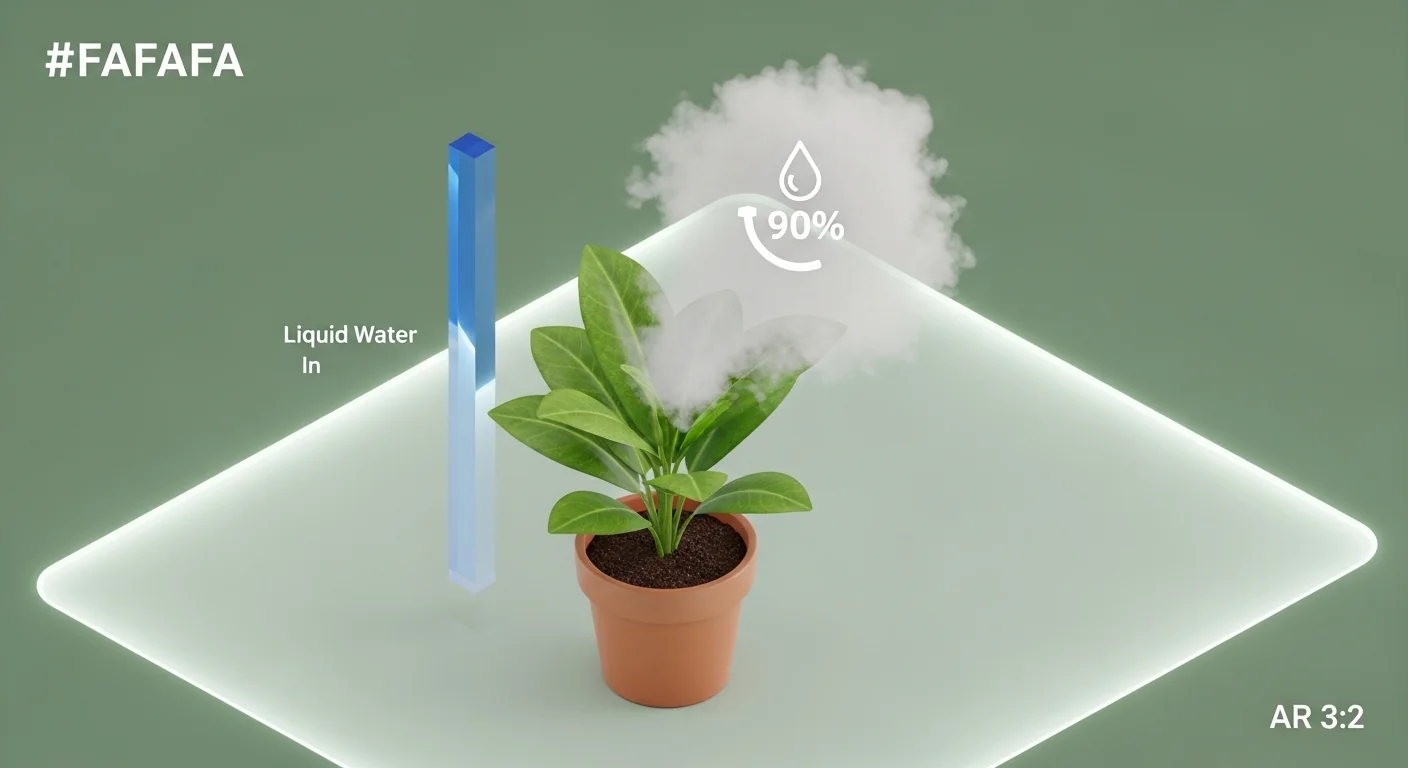
Calculates the total gallons of water introduced to the grow environment daily. - Transpiration Rate — 90% Rule: Plants do not retain the water they absorb. Approximately 90% of all water fed is released back into the air as water vapor (evapotranspiration). Only ~10% is used for plant biomass.
- Water Evaporated:
Total Water Applied × 0.90
This is the actual moisture load your dehumidifier must remove every day. - PPD Required:
Water Evaporated (gal) × 8.34
One US gallon of water weighs 8.34 lbs, and one pint weighs 1.043 lbs. The standard conversion:gallons × 8.34 ≈ pintsgives the Pints Per Day your dehumidifier must handle. - Lights-Out Rainstorm Warning: If your calculated PPD exceeds 50 PPD (home-grade unit threshold), a danger alert is triggered. Standard home dehumidifiers are rated 30–70 PPD but cannot sustain that continuously. Any PPD above the unit’s capacity will result in condensation accumulating during the lights-off cooling cycle.
- Target Nighttime RH: Used as a risk modifier. RH targets above 60% during lights-off dramatically increase Botrytis/Powdery Mildew risk, compounding the rainstorm effect.
Assumptions: Transpiration rate fixed at 90% per ASHRAE/horticultural standards. Water weight = 8.34 lbs/gal (US gallon, 20°C). Room air volume is used as a context reference; actual dehumidifier capacity requirements are based on moisture load, not room volume alone. Liter inputs are converted at 0.2642 gal/L.
Before you start, have three numbers ready: your total plant count, the average volume of water you apply per plant per day (in gallons or liters), and your grow room or greenhouse cubic footage (length times width times ceiling height). Your target nighttime RH is the fourth input. If you track watering with a pump timer or drip system, pull your daily totals from that log rather than estimating. Imprecise watering volume is the most common source of undersized results. For rooms where airflow and ventilation interact with humidity, the greenhouse fan calculator covers that side of the climate equation.
Quick Start (60 Seconds)
- Total Number of Plants: Count every actively growing plant in the space. Do not subtract plants that were recently harvested or not yet watered. Enter a whole number between 1 and 10,000.
- Average Daily Watering Volume per Plant: Use your per-plant daily average, not a weekly total divided down. Toggle the unit button to Gallons or Liters before entering the value. A common mistake is entering total reservoir volume rather than the amount actually delivered to the root zone each day.
- Room Size in Cubic Feet: Multiply length by width by ceiling height, all in feet. A 10 x 10 room with an 8-foot ceiling is 800 cubic feet. Do not use square footage alone.
- Target Nighttime RH: This is the maximum RH you want during the dark cycle, not the daytime setpoint. Safe range is 45 to 55 percent. Entering a value above 60 percent will trigger an additional mold-risk warning in the results.
- Unit Toggle (Gallons/Liters): Select your preferred volume unit before entering the watering value. The calculator converts internally; you do not need to convert manually.
- Calculate button: All four fields must be filled before results appear. The button will not fire on empty or invalid inputs.
- Reset: Use the Reset button to clear all fields and start a new scenario without refreshing the page.
Inputs and Outputs (What Each Field Means)
| Field | Unit | What It Means | Common Mistake | Safe Entry Guidance |
|---|---|---|---|---|
| Total Number of Plants | Count (integer) | Every plant currently being watered in the grow space | Excluding seedlings or clones that are also being watered | Minimum 1; include all stages receiving daily water |
| Avg. Daily Water per Plant | Gallons or Liters | Mean volume delivered to each individual plant per day | Entering total system water use divided by day count instead of per-plant volume | Use drip system logs; 0.5 to 2 gallons is typical for established plants |
| Room Size | Cubic Feet | Total air volume of the sealed grow environment | Using square footage instead of cubic footage; forgetting to multiply by ceiling height | L x W x H in feet; minimum 10 cubic feet accepted |
| Target Nighttime RH | Percent (%) | The maximum relative humidity acceptable during the lights-off period | Setting this to a daytime VPD target rather than a worst-case lights-off ceiling | 45 to 55 percent is the standard safe zone; values above 60 trigger PM warnings |
| PPD Required (output) | Pints Per Day | The minimum continuous moisture extraction rate your dehumidifier must sustain | Treating this as a peak rating rather than a continuous sustained requirement | Size your unit at least 20 percent above this number for operational safety margin |
| Water Transpired (output) | Gallons | Total moisture released into the room air daily (90% of water applied) | Assuming plants “drink” most of the water they receive | Reference only; this is the actual moisture load, not the water fed |
The relationship between your dew point and the lights-off humidity spike is closely tied to this number. The dew point calculator can help you determine at what temperature your room air will begin to condense if humidity is not controlled.
Worked Examples (Real Numbers)
Scenario 1: Small Tent Grow (4 Plants, 0.5 Gal/Day Each)
- Plants: 4
- Daily water per plant: 0.5 gallons
- Room size: 120 cubic feet (4 x 5 x 6 ft tent)
- Target nighttime RH: 55%
Total water applied: 4 x 0.5 = 2.0 gallons
Water evaporated via transpiration: 2.0 x 0.90 = 1.8 gallons
PPD required: 1.8 x 8.34 = 15.0 PPD
Result: 15.0 PPD required. This is within the comfortable range of a quality home dehumidifier. A 30-PPD unit provides a sufficient buffer. The low room volume means humidity can spike quickly if the dehumidifier cycles off overnight, so continuous run mode is still advisable.
Scenario 2: Medium Grow Room (20 Plants, 1 Gal/Day Each)
- Plants: 20
- Daily water per plant: 1.0 gallon
- Room size: 800 cubic feet (10 x 10 x 8 ft)
- Target nighttime RH: 50%
Total water applied: 20 x 1.0 = 20.0 gallons
Water evaporated via transpiration: 20.0 x 0.90 = 18.0 gallons
PPD required: 18.0 x 8.34 = 150.1 PPD
Result: 150.1 PPD required. This is three times the rated capacity of a standard home dehumidifier. Any unit under 150 PPD will fall behind the moisture load, guaranteeing humidity accumulation and Lights-Out Rainstorm conditions during the dark cycle. A commercial unit rated at minimum 180 PPD (with 20% safety margin) is the minimum acceptable option.
Scenario 3: Large Commercial Greenhouse (50 Plants, 2 Gal/Day Each)
- Plants: 50
- Daily water per plant: 2.0 gallons
- Room size: 3,000 cubic feet (20 x 25 x 6 ft greenhouse bay)
- Target nighttime RH: 45%
Total water applied: 50 x 2.0 = 100.0 gallons
Water evaporated via transpiration: 100.0 x 0.90 = 90.0 gallons
PPD required: 90.0 x 8.34 = 750.6 PPD
Result: 750.6 PPD required. No single home or light-commercial unit approaches this figure. This scenario requires either multiple commercial dehumidifiers operating in tandem or a purpose-built climate control system. At this scale, condensate drain management becomes a secondary engineering challenge.
Reference Table (Fast Lookup)
| Plants | Gal/Plant/Day | Total Gal Applied | Gal Transpired (90%) | PPD Required | Minimum Unit Type |
|---|---|---|---|---|---|
| 4 | 0.5 | 2.0 | 1.8 | 15.0 | 30-PPD home unit |
| 8 | 0.5 | 4.0 | 3.6 | 30.0 | 50-PPD home unit |
| 10 | 1.0 | 10.0 | 9.0 | 75.1 | 100-PPD light commercial |
| 20 | 1.0 | 20.0 | 18.0 | 150.1 | 180+ PPD commercial |
| 20 | 2.0 | 40.0 | 36.0 | 300.2 | 360+ PPD commercial |
| 50 | 1.0 | 50.0 | 45.0 | 375.3 | 450+ PPD commercial |
| 50 | 2.0 | 100.0 | 90.0 | 750.6 | Multiple large commercial units |
| 100 | 1.0 | 100.0 | 90.0 | 750.6 | Multiple large commercial units |
| 100 | 2.0 | 200.0 | 180.0 | 1,501.2 | Full HVAC dehumidification system |
The “Minimum Unit Type” column assumes a 20% safety buffer above the calculated PPD. Dehumidifiers are typically rated under ideal laboratory conditions; real-world performance in hot grow rooms is lower. Always size above the calculated number, not at it.
How the Calculation Works (Formula + Assumptions)
Show the calculation steps
Step 1: Total Water Applied
Multiply plant count by the daily volume delivered per plant.
Formula: Water Applied (gal) = Plants x Volume Per Plant (gal)
Liters are converted to gallons at the rate of 1 liter = 0.26417 gallons before this step.
Step 2: Apply the 90% Transpiration Rate
Plants absorb water through their root systems and release approximately 90% of it back into the surrounding air as water vapor through a process called evapotranspiration. The remaining 10% is used in photosynthesis and plant tissue growth.
Formula: Water Evaporated (gal) = Water Applied x 0.90
Step 3: Convert Gallons to Pints Per Day
One US gallon of water weighs 8.34 pounds. One pint of water weighs approximately 1.043 pounds. The standard dehumidifier industry unit of measure is PPD (Pints Per Day). The conversion is:
Formula: PPD Required = Water Evaporated (gal) x 8.34
This is not a rounded estimate; it reflects actual water weight at standard temperature (20 degrees Celsius).
Step 4: Threshold Check
If PPD Required exceeds 50, the Lights-Out Rainstorm warning is triggered. This threshold corresponds to the upper practical range of standard home-grade dehumidifiers. If target nighttime RH exceeds 60, an additional mold-risk warning is displayed. These thresholds are logic gates in the calculator, not style choices.
Rounding rules: Results are displayed to one decimal place. Internal calculations use full floating-point precision before display rounding. The reference table rounds to one decimal for all computed columns.
Assumptions and Limits
- The 90% transpiration rate is a commonly cited horticultural approximation. Actual rates vary by species, growth stage, light intensity, VPD, and canopy density. Late-flowering plants in high-VPD environments may transpire at rates closer to 80%; water-stressed plants may transpire less.
- The formula treats all water fed as if it reaches the root zone. Runoff, evaporation from growing media surfaces, and irrigation system inefficiency are not accounted for and would increase actual moisture load above the calculated value.
- Room size (cubic feet) is captured as context and used for display in the results breakdown. The PPD calculation itself is driven by moisture load, not room volume. Two rooms of identical size but different plant counts will have identical cubic footage but very different PPD requirements.
- The calculator does not model temperature fluctuation, HVAC heat rejection, or the contribution of outdoor air infiltration to humidity. In mixed-climate or poorly sealed spaces, additional moisture sources exist beyond transpiration.
- Water weight is assumed at 8.34 lbs/gallon, corresponding to water at approximately 20 degrees Celsius. Water at 25 degrees Celsius weighs slightly less (8.33 lbs/gallon), a difference that is negligible at grow-room scales.
- The 20% safety margin recommendation embedded in the warning text is a conservative operational guideline, not a derived calculation. Actual required buffer depends on dehumidifier rated conditions versus real-world grow room conditions.
- This tool produces a steady-state moisture load estimate. It does not model dynamic spikes, such as the humidity surge immediately after a large irrigation event or the condensation cascade at lights-off temperature transition.
Standards, Safety Checks, and “Secret Sauce” Warnings
Critical Warnings
- The Lights-Out Rainstorm is not theoretical. When grow lights shut off, radiant heat drops sharply. Air temperature falls. Cooler air holds less water vapor than warm air. If your dehumidifier has not removed the day’s transpired moisture before lights go off, that moisture reaches saturation point rapidly and condenses as liquid water on the coolest surfaces in the room: the ceiling, the walls, and the top of the canopy. This is not “high humidity.” It is physical precipitation inside your grow space, and Powdery Mildew spores activate within hours of a wetting event.
- PPD ratings on home dehumidifiers are measured under standard conditions (80 degrees Fahrenheit, 60% RH). In a warm grow room running at 75 to 85 degrees and higher humidity levels during lights-on, actual extraction rates differ. A unit marketed as 50 PPD may deliver 35 to 40 PPD under your specific conditions. Treat rated PPD as an optimistic ceiling, not a guaranteed floor.
- Nighttime RH above 60 percent is a pathogen activation threshold. Botrytis cinerea (bud rot) and Podosphaera xanthii (Powdery Mildew) both colonize actively when surface moisture and sustained high humidity align. A single night above this threshold during late flower can initiate visible PM within 72 hours.
- Running one dehumidifier for a space requiring two is not a partial solution. A unit operating above capacity runs continuously without achieving setpoint, overheats, and fails prematurely. Moisture load is additive. Two units at half the required PPD each is a functional configuration; one unit at half the required PPD is not.
Minimum Standards
- Size your dehumidifier at a minimum of 20 percent above your calculated PPD to account for rated-condition inflation and real-world performance degradation.
- Any PPD requirement above 70 should be fulfilled by a purpose-built horticultural or commercial dehumidifier (Quest, Anden, or equivalent), not a consumer appliance.
- Install a Wi-Fi hygrometer (such as Govee Pro or similar) to log RH continuously, not just at spot-check intervals. You need overnight data, not a morning reading.
- Condensate drainage must be gravity-fed or handled by an appropriately rated condensate pump. A unit that shuts off because its reservoir is full stops dehumidifying. In high-PPD scenarios, reservoirs fill within hours.
Competitor Trap: Most online grow-room humidity guides instruct growers to size a dehumidifier based on room square footage or cubic footage alone. This is the same logic used for sizing basement dehumidifiers in uninhabited spaces. A basement has no transpiring plants adding moisture continuously. A grow room with 20 actively watered plants is a completely different moisture environment. Room volume tells you how fast humidity concentrates in the air once moisture is released; it does not tell you how much moisture is being released. Growers who follow square-footage charts end up buying units that are architecturally plausible but agronomically useless.
Humidity management does not operate in isolation from your other climate systems. Properly sizing your dehumidifier alongside your grow room AC unit is essential, since both heat load and latent moisture interact. If you are also running CO2 supplementation, the sealed environment makes dehumidification even more critical because fresh air exchanges that would otherwise dilute humidity are minimized.
Common Mistakes and Fixes
Mistake: Sizing by Room Volume Instead of Moisture Load
Growers calculate their cubic footage, find a humidity-per-cubic-foot recommendation online, and buy accordingly. Room volume influences how quickly humidity accumulates, but the source of that humidity is the plants themselves. Two identical rooms with different plant counts have identical volumes but completely different dehumidification requirements. Fix: always calculate PPD from watering volume first, then cross-reference room size as a secondary check.
Mistake: Using a Daytime RH Target as the Nighttime Setpoint
Daytime VPD targets often allow RH in the 55 to 65 percent range during the lights-on period because canopy temperature is elevated and actual vapor pressure is manageable. At lights-off, canopy temperature drops toward room air temperature, and the effective saturation point drops with it. Entering a lights-on RH target as your nighttime ceiling will consistently underestimate risk. Fix: set the nighttime RH target 10 to 15 percent lower than your daytime ceiling as a starting point, and verify with overnight logging. Understanding the airflow dynamics inside your tent or room also affects how evenly humidity is distributed and detected.
Mistake: Treating Rated PPD as Real-World PPD
Manufacturer PPD ratings use AHAM (Association of Home Appliance Manufacturers) standard conditions: 80 degrees Fahrenheit and 60 percent relative humidity. Many grow rooms operate warmer than 80 degrees during lights-on and significantly cooler during lights-off. At cooler temperatures, dehumidifier capacity drops substantially. A 70-PPD unit in a 65-degree lights-off room may extract 45 to 50 PPD. Fix: apply a real-world derating factor and size at 20 to 30 percent above the calculated requirement.
Mistake: Calculating Weekly Instead of Daily Watering Volume
Some growers water on a 2- or 3-day cycle and mentally average their weekly totals. The formula requires the actual volume delivered on any given watering day, because transpiration happens every day regardless of whether watering occurred that day. If plants were fed 2 gallons every other day, the effective daily transpiration load is still calculated from what they received, distributed across the full growth period. Fix: use the per-watering volume divided by the irrigation interval in days as your daily per-plant figure.
Mistake: Ignoring Condensate Drainage Capacity
At 150 PPD, a dehumidifier is extracting roughly 18 to 19 gallons of liquid water per day. Most home units have 1 to 2 gallon reservoirs, which means they would need to be emptied 10 or more times daily to keep operating. Units that shut off when full stop dehumidifying, which creates exactly the conditions growers were trying to prevent. At high PPD requirements, heating and cooling the space correctly also matters; the greenhouse heater sizing tool is useful for understanding temperature recovery after lights-off, which directly affects condensation risk. Fix: connect commercial units to a continuous gravity drain or install a rated condensate pump sized for the extraction volume.
Next Steps in Your Workflow
Once you have your PPD requirement, the next decision is choosing the right physical unit. For anything above 70 PPD, the grow-specific commercial market (Quest, Anden, Dehumidifier Corporation of America) is the only practical tier. These units are engineered to run continuously in elevated-temperature environments, come with built-in condensate pumps or drain connections, and carry warranties structured for commercial use rather than occasional residential operation. Cross-reference your required PPD against actual model specs, and look for units tested at conditions closer to your actual operating temperature range, not just the AHAM standard.
After installation, live monitoring is non-negotiable. A single hygrometer reading at the beginning of a lights-off cycle tells you almost nothing about what happens over the following 8 to 12 hours. Wireless sensors with logging capability let you review the overnight humidity curve and catch saturation events before they become crop failures. If you are managing a high-moisture environment, the greenhouse misting system and humidity controls work as paired systems: you need to know your total moisture inputs to manage outputs. For growers using data-driven crop protocols, the crop steering calculator integrates irrigation strategy with environmental targets in a way that directly affects your daily transpiration load going forward.
FAQ
What does PPD mean for a dehumidifier?
PPD stands for Pints Per Day, the standard industry measure of how much moisture a dehumidifier can extract from the air in a 24-hour period under rated test conditions. Higher PPD means more water extracted. Grow room applications require matching the dehumidifier’s PPD to the actual daily moisture load produced by plant transpiration, not to room square footage.
How accurate is the 90% transpiration rate used in this calculator?
The 90% figure is a widely cited approximation for healthy plants in active vegetative or flowering growth under adequate light. Actual rates vary by species, growth stage, light intensity, VPD, and irrigation method. It is a conservative upper estimate appropriate for sizing purposes. Using 90% means you are planning for maximum moisture output, which is the correct approach for dehumidifier sizing.
Can I use a regular home dehumidifier in my grow room?
For very small setups of 4 to 6 plants watering at half a gallon per day or less, a home unit in the 30 to 50 PPD range may be sufficient. Beyond that threshold, home appliances are not built for continuous high-temperature operation, their PPD ratings are optimistic under real grow room conditions, and they lack the drainage infrastructure needed for the volume of condensate a loaded grow room produces.
Does room size affect how much dehumidification I need?
Room volume affects how quickly moisture concentrates in the air, but it does not change the total moisture load your plants generate. A smaller room will reach a high RH faster from the same plant count, but the source of the moisture is identical. Dehumidifier sizing must be driven by moisture load (PPD), not cubic footage. Room size is a useful secondary factor for estimating humidity spike speed.
What is the Lights-Out Rainstorm and why does it happen?
During lights-on, heat from the lighting system keeps air temperature elevated and its moisture-holding capacity high. When lights shut off, temperature drops and the air’s capacity to hold water vapor drops with it. If the dehumidifier has not already removed that day’s transpired moisture, the excess reaches dew point rapidly and condenses as liquid water on surfaces. This is called the Lights-Out Rainstorm effect and it is a leading cause of sudden Powdery Mildew outbreaks.
How do I convert liters to gallons for the calculator?
The calculator handles this conversion automatically when you select the “L” unit button. If you need the manual conversion: 1 liter equals 0.26417 US gallons. For example, 3.8 liters is approximately 1 gallon. Using the built-in toggle is the simplest approach and avoids rounding errors from manual conversion.
Conclusion
Plant transpiration is not an optional variable in grow room climate design. Every gallon of water delivered to your plants returns to your room air, and it does so on a schedule set by the lights, not your preferences. Sizing a dehumidifier by room square footage is the single most common and most consequential mistake in indoor horticulture at every scale, from a hobbyist tent to a commercial greenhouse bay. This calculator makes the actual moisture load visible before it becomes a crop loss.
The core takeaway is straightforward: calculate your PPD from watering volume first, then verify your current or planned unit can sustain that extraction rate continuously, not just intermittently. If the number lands above 50 PPD, step into the commercial equipment tier before your next cycle. For growers managing water temperature alongside humidity, the hydroponic water chiller calculator addresses the temperature side of the root zone equation, which indirectly affects transpiration rates and daily moisture load.