
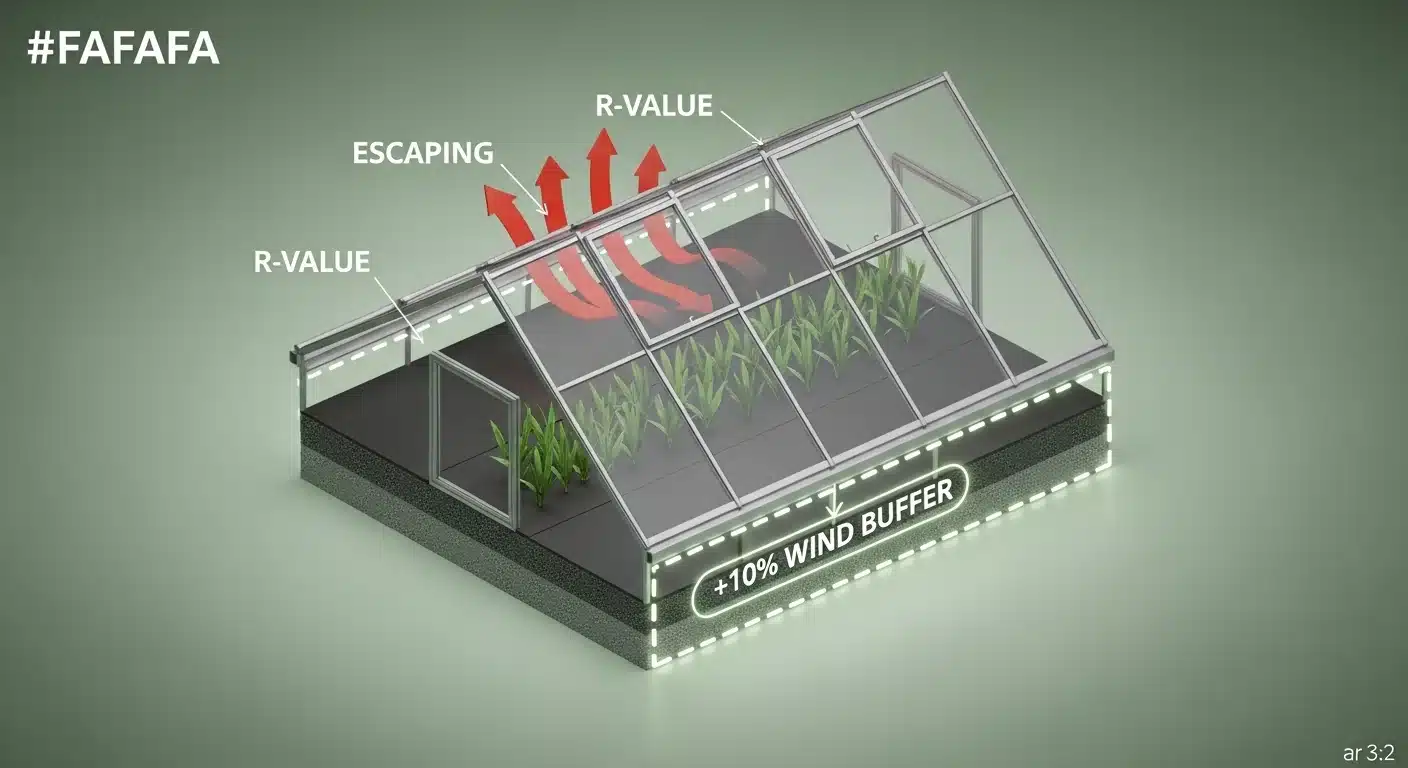
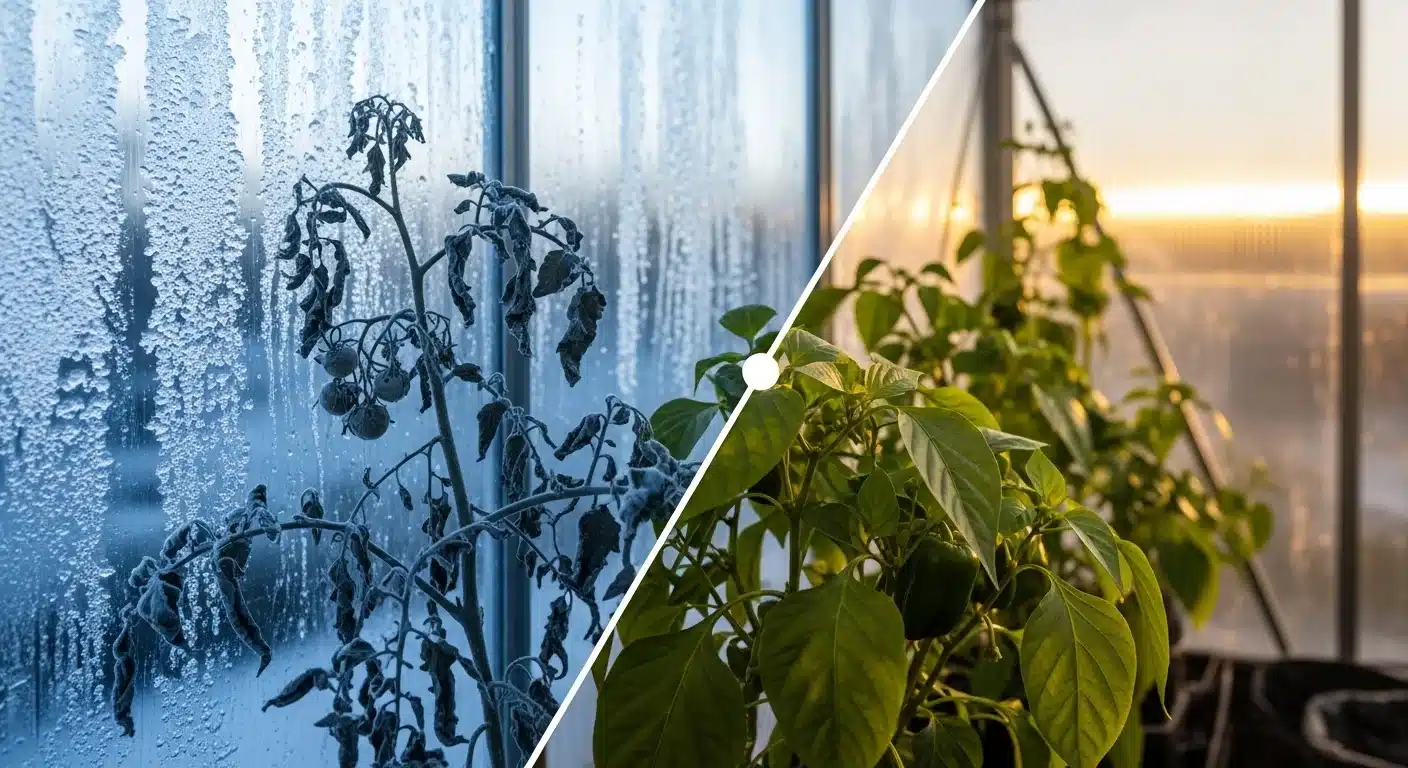
Sizing a greenhouse heater is not simply a matter of matching square footage to a product label. Heat escapes through every surface simultaneously: glazing panels, end walls, vents, and the seams between them. The rate of loss depends on how well your covering material resists heat transfer, which is measured by its R-value, and on the temperature gap your heater has to bridge. Get either variable wrong and you either freeze crops on the coldest night of the year or buy far more heater than the structure needs.
This tool calculates the total BTU per hour your greenhouse requires to maintain a target temperature under your chosen design conditions. It applies the standard heat-loss formula (surface area multiplied by temperature differential, divided by R-value), then adds a 10% wind buffer to account for infiltration losses that static R-value calculations ignore. The tool does not model solar gain, thermal mass, or multi-zone heating; it produces the worst-case nighttime heating demand, which is the correct number to size against.
After running the calculator you will know the minimum BTU/hr rating to specify when selecting a heater, whether that load is better served by an electric or propane unit, and whether your glazing choice is limiting your efficiency more than your climate is.
Use the Tool
Greenhouse Heater Size Calculator
Greenhouse Heater BTU Calculator — by The Yield Grid
Warnings & Standards
| Area (sq ft) | Heat Loss (BTU/hr) | +10% Wind Buffer | Electric (W) |
|---|
How this calculator works
Greenhouse Heater Size Calculator uses industry-standard BTU heat-loss math:
The 1.10 wind buffer accounts for infiltration and wind-driven heat loss not captured by the static R-value. Electric equivalent (Watts) = Total BTU ÷ 3.412. Propane burns at ~91,500 BTU/gallon at 80% efficiency → gallons/hr = Total BTU ÷ 73,200.
Assumptions & Limits
- Formula assumes single-zone, steady-state heat loss (no thermal mass storage).
- R-values are standard industry presets; actual values vary by brand and installation quality.
- Wind buffer (10%) covers typical infiltration; add 15–20% for drafty or older structures.
- Propane efficiency assumed at 80% (typical vented heater). Unvented heaters may be higher.
- Solar gain during daylight hours is not modeled — night-time sizing is the safe design case.
- Ground heat loss through soil is not included; add 10% if growing directly in ground beds.
- Surface area should include all exposed walls, roof panels, and end walls, not just floor area.
- Valid input range: Area 1–100,000 sq ft; Temps −60 to 120°F; Inside must exceed Outside.
Before you start, collect four pieces of information: the total exposed surface area of your greenhouse in square feet (all walls plus the roof, not just the floor), the glazing material so the calculator can set the correct R-value, the lowest overnight temperature recorded at your site, and the minimum temperature your crops require. If you are unsure of your design low temperature, The Yield Grid's first frost date calculator can help you identify your seasonal temperature floor based on location data.
Quick Start (60 Seconds)
- Surface Area (sq ft): Enter the total exposed area of all walls and roof panels combined. A 10 ft x 20 ft greenhouse with 8 ft side walls and an arched roof typically has 30 to 40 percent more surface area than its footprint. Measure every glazed panel.
- Glazing Type: Select from the dropdown. Each option auto-fills the R-value used in the formula. Do not type an R-value manually; the preset prevents common errors like confusing R-value with U-value.
- Lowest Outside Temp (°F): Use the coldest expected overnight low for your climate zone, not the average winter low. This is called the design temperature. Using averages underestimates your peak load.
- Desired Inside Temp (°F): Enter the minimum temperature your crops can tolerate, not your preferred daytime growing temperature. Most cool-season crops need at least 40°F; warm-season crops generally require 50 to 55°F or above.
- Inside must exceed outside: The calculator blocks the calculation if inside temp is equal to or lower than outside temp. Check both fields if you see a validation error.
- Units are Fahrenheit throughout: Do not mix Celsius readings into the form. Convert before entering.
- Click Calculate: Results appear below the form showing total BTU/hr, electric watt equivalent, propane consumption per hour, and a load-scale bar.
Inputs and Outputs (What Each Field Means)
| Field | Unit | What It Means | Common Mistake | Safe Entry Guidance |
|---|---|---|---|---|
| Surface Area | sq ft | Total exposed area of all glazed surfaces: side walls, end walls, and roof panels combined | Entering floor area (length x width) instead of the actual surface area, which undercounts by 50% or more in arch-roof structures | Measure each panel face and sum them; add end walls separately |
| Glazing Type | R-value (auto-filled) | The insulating material covering the greenhouse frame; the selector sets the thermal resistance value used in the heat-loss formula | Choosing single glass when the structure actually has double-wall poly; this overstates heat loss and leads to an oversized heater | Match to the actual installed material, not the material you plan to install later |
| Lowest Outside Temp | °F | The design-day temperature: the coldest overnight low the heater must overcome | Using average winter temperatures instead of record or design-day lows, which causes undersizing | Check NOAA climate normals or use your local 99% design temperature from ASHRAE data |
| Desired Inside Temp | °F | The minimum crop-safe temperature the heater must maintain continuously | Entering a comfortable daytime temperature instead of the nighttime crop minimum, which leads to oversizing | Set to the lowest acceptable crop survival temperature, typically 40 to 55°F depending on species |
| Delta T (output) | °F | Calculated temperature differential between inside and outside; the primary driver of heating load | Not a user input, but misread as such; it is computed from the two temperature fields | Review this value to sanity-check your input temperatures |
| Total BTU/hr (output) | BTU/hr | Total heating capacity required, including the 10% wind infiltration buffer | Comparing this directly to heater nameplate BTU without checking that the heater is rated for continuous output at that level | Select a heater rated at or above this number for continuous-duty operation |
| Electric Equiv. (output) | Watts | The electric heater capacity needed to deliver the same heat output (BTU / 3.412) | Confusing kilowatts with watts; a 5,000W heater is 5 kW, not 5,000 kW | Divide by 1,000 to get kilowatts; verify your circuit amperage can support the load |
| Propane/hr (output) | gal/hr | Estimated propane consumption rate assuming 80% combustion efficiency and 91,500 BTU per gallon of propane | Treating this as a daily figure; multiply by hours of expected runtime per night for tank planning | For a 100-lb propane tank (approximately 23.6 gallons), divide tank capacity by this rate to estimate hours of runtime |
Worked Examples (Real Numbers)
Example 1: Small Hobby Greenhouse, Mild Winter Climate
- Surface Area: 120 sq ft (10 ft x 8 ft gothic arch, measured panels)
- Glazing: Single Poly Film (R-1.1)
- Lowest Outside Temp: 25°F
- Desired Inside Temp: 50°F
Delta T = 50 - 25 = 25°F
Heat Loss = 120 x 25 / 1.1 = 2,727 BTU/hr
Total BTU = 2,727 x 1.10 = 3,000 BTU/hr
Electric equivalent = 3,000 / 3.412 = 879 W
Result: 3,000 BTU/hr (879 W electric)
A single 1,000-watt electric fan heater comfortably covers this load with headroom. This is a low-demand application where electric heating is practical and avoids combustion fumes.
Example 2: Mid-Size Production Greenhouse, Cold Winter Region
- Surface Area: 500 sq ft (20 ft x 16 ft Venlo-style, all panels included)
- Glazing: Double-Wall Poly (R-1.5)
- Lowest Outside Temp: 15°F
- Desired Inside Temp: 60°F
Delta T = 60 - 15 = 45°F
Heat Loss = 500 x 45 / 1.5 = 15,000 BTU/hr
Total BTU = 15,000 x 1.10 = 16,500 BTU/hr
Electric equivalent = 16,500 / 3.412 = 4,836 W
Propane = 16,500 / 73,200 = 0.23 gal/hr
Result: 16,500 BTU/hr (4,836 W electric or 0.23 gal/hr propane)
At this load, electric heating requires a dedicated 240V circuit at roughly 20 amps. A small propane unit rated at 20,000 BTU/hr is a practical alternative and gives useful combustion heat without the wiring upgrade.
Example 3: Large Commercial Greenhouse, Severe Cold Climate
- Surface Area: 2,000 sq ft (a 30 ft x 48 ft gutter-connected structure, full panel measurement)
- Glazing: Polycarbonate Twin-Wall (R-2.5)
- Lowest Outside Temp: -10°F
- Desired Inside Temp: 65°F
Delta T = 65 - (-10) = 75°F
Heat Loss = 2,000 x 75 / 2.5 = 60,000 BTU/hr
Total BTU = 60,000 x 1.10 = 66,000 BTU/hr
Propane = 66,000 / 73,200 = 0.90 gal/hr
Result: 66,000 BTU/hr (0.90 gal/hr propane)
This is a high-load application. The warning threshold in the calculator flags a 75°F delta as a severe condition and notes that the heater should be specified at 120% capacity for safety margin. A unit rated at 80,000 BTU/hr or a redundant dual-heater setup is appropriate here.
Reference Table (Fast Lookup)
All rows below use a Delta T of 40°F (a common mid-latitude design condition representing a 15°F outside temperature and a 55°F inside target). The wind buffer of 10% is included in the Total BTU column.
| Area (sq ft) | Glazing (R-value) | Heat Loss (BTU/hr) | Total + 10% Buffer (BTU/hr) | Electric Equiv. (W) | Propane (gal/hr) |
|---|---|---|---|---|---|
| 200 | Single Glass (0.9) | 8,889 | 9,778 | 2,866 | 0.13 |
| 200 | Single Poly Film (1.1) | 7,273 | 8,000 | 2,345 | 0.11 |
| 200 | Double-Wall Poly (1.5) | 5,333 | 5,867 | 1,719 | 0.08 |
| 200 | Polycarbonate Twin-Wall (2.5) | 3,200 | 3,520 | 1,031 | 0.05 |
| 500 | Double-Wall Poly (1.5) | 13,333 | 14,667 | 4,297 | 0.20 |
| 500 | Polycarbonate Twin-Wall (2.5) | 8,000 | 8,800 | 2,579 | 0.12 |
| 1,000 | Double-Wall Poly (1.5) | 26,667 | 29,333 | 8,596 | 0.40 |
| 1,000 | Polycarbonate Twin-Wall (2.5) | 16,000 | 17,600 | 5,157 | 0.24 |
| 1,000 | Triple-Wall Polycarbonate (3.5) | 11,429 | 12,571 | 3,684 | 0.17 |
| 2,000 | Polycarbonate Twin-Wall (2.5) | 32,000 | 35,200 | 10,316 | 0.48 |
| 2,000 | Triple-Wall Polycarbonate (3.5) | 22,857 | 25,143 | 7,368 | 0.34 |
To adjust for a different Delta T, multiply the Total BTU column by (your Delta T / 40). For a Delta T of 60°F, multiply by 1.5; for 20°F, multiply by 0.5.
How the Calculation Works (Formula + Assumptions)
Show the calculation steps
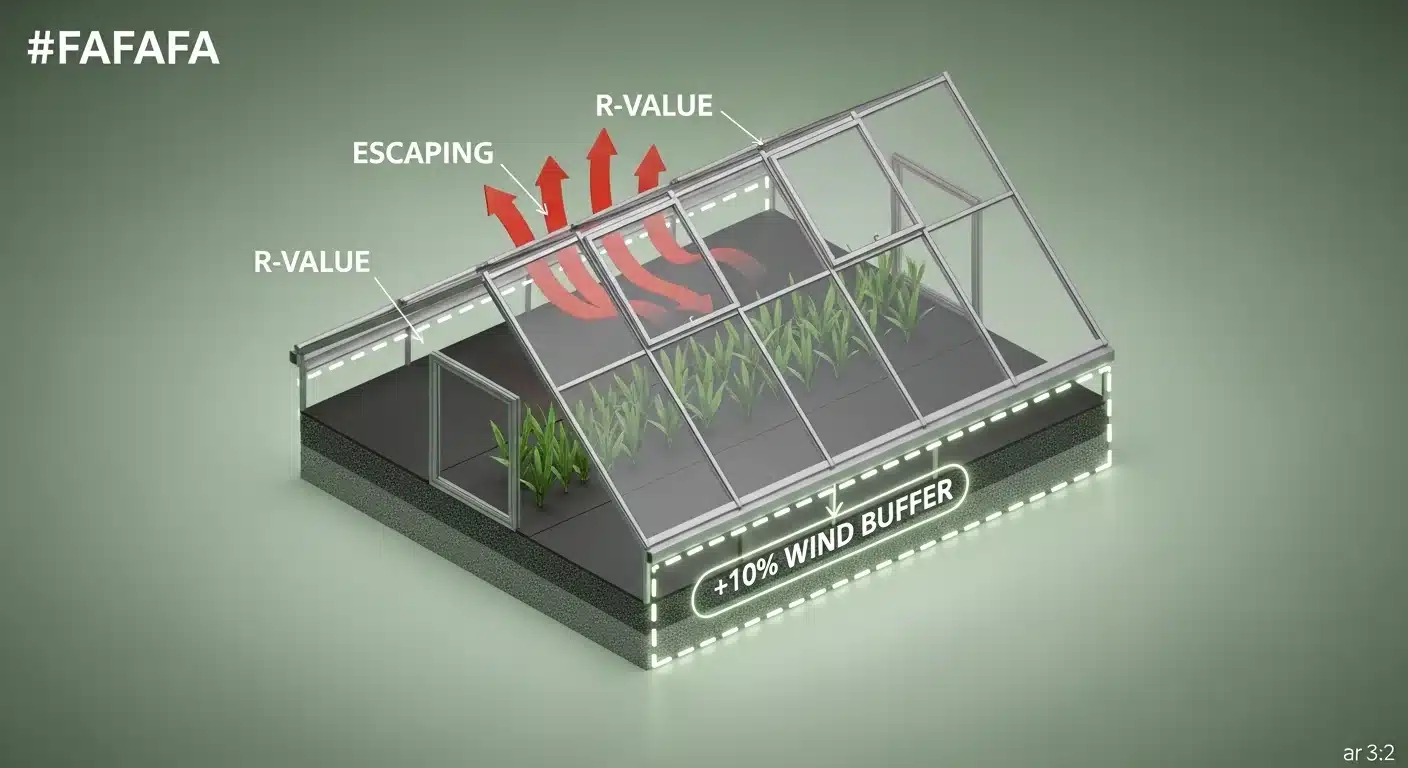
The greenhouse heat-loss formula follows three sequential steps:
- Step 1 - Delta T: Subtract the lowest outside temperature from the desired inside temperature. Units are degrees Fahrenheit. This is the temperature differential the heating system must overcome continuously under worst-case conditions.
- Step 2 - Heat Loss: Multiply surface area (sq ft) by Delta T (°F), then divide by the R-value of the glazing material. The result is in BTU per hour. Mathematically: Heat Loss = (Area x Delta T) / R-value. A higher R-value reduces heat loss proportionally; doubling R-value halves the load.
- Step 3 - Wind Buffer: Multiply the heat loss figure by 1.10 to add a 10% buffer. This accounts for infiltration through seams, vents, and door gaps that the static R-value does not capture. The result is Total BTU/hr, the number used to select a heater.
Unit conversions applied in the results panel:
- Electric watts = Total BTU/hr divided by 3.412 (the BTU equivalent of one watt-hour)
- Propane gal/hr = Total BTU/hr divided by 73,200 (approximate usable BTU per gallon of propane at 80% combustion efficiency)
Rounding: BTU/hr and watts are rounded to the nearest whole number. Propane consumption is displayed to two decimal places because the hourly figure is often a fraction of a gallon.
Assumptions and Limits
- The formula assumes single-zone, steady-state heat loss with no thermal mass storage. Concrete floors, water barrels, and soil beds absorb heat during the day and release it at night, reducing real-world heater runtime. This model ignores that effect, making the result conservative.
- R-values in the dropdown are standard industry reference values. Actual installed performance varies by brand, age, cleanliness of panels, and installation quality. Dirty or aged glazing can perform significantly below its rated R-value.
- The 10% wind buffer covers typical infiltration for a well-sealed structure. Older greenhouses, or those with single-layer film, multiple vent penetrations, or poorly gasketed doors, may require a 15 to 20% manual add-on beyond the calculator output.
- Solar gain is not modeled. During daylight hours in winter, passive solar can contribute substantial heat, reducing the heater's effective duty cycle. The calculation represents a nighttime worst-case scenario.
- Ground heat loss through soil-bed floors is not included. Add approximately 10% to the result for structures where crops are grown directly in ground beds without an insulated floor or perimeter insulation.
- Propane efficiency is fixed at 80%, which is typical for properly installed vented combustion heaters. Direct-fired or unvented units may achieve higher apparent efficiency, but they also introduce humidity and CO2 concerns that affect crop health.
- The tool is valid for surface areas between 1 and 100,000 sq ft, outside temperatures between -60°F and 80°F, and inside temperatures between 32°F and 120°F. Inputs outside these ranges will fail validation.
Standards, Safety Checks, and "Secret Sauce" Warnings
Critical Warnings
- Delta T above 60°F triggers a severe-load flag. When your inside-minus-outside gap reaches 60°F or more, the calculator flags this as a severe climate condition. At that margin, the recommendation is to specify a heater at 120% of the calculated BTU/hr, not the exact figure. Equipment cycling at continuous maximum output under sustained cold degrades faster and loses effective capacity. Size with reserve.
- Single glass (R-0.9) produces the highest heat loss of any common glazing. The calculator flags this choice with a recommendation to upgrade. A switch from single glass to double-wall poly reduces the required BTU/hr by roughly one-third for identical conditions, which can move a high-cost propane unit into the range where electric heating becomes practical. If you are upgrading an existing structure, light transmission differences between glazing materials are also worth evaluating before committing to a replacement.
- Inside temperatures below 40°F are flagged as frost-risk targets. Most warm-season crops suffer chilling injury or frost damage below 50°F. The calculator does not prevent a low target temperature from being entered, but it warns when the set-point is below the threshold where most crop damage begins. If you are keeping seedlings alive through winter, review temperature requirements by species before setting this value.
- Outside temperatures below 0°F trigger a propane storage warning. Liquid propane can lose pressure at very low tank temperatures, reducing usable output before the tank empties. The calculator flags this condition and notes the need for tank insulation or placement of the tank in a heated space above grade.
Minimum Standards
- Select a heater with a BTU/hr nameplate rating at or above the Total BTU output from this calculator, rated for continuous-duty operation, not intermittent or supplemental use.
- For electric heaters, verify the circuit amperage. A 5,000W load on a standard 120V circuit exceeds the safe capacity of a 15-amp breaker. Loads above approximately 1,440W require a 15-amp 120V dedicated circuit; loads above 1,800W should use 240V wiring.
- Ensure the heater type matches the structure's ventilation. Combustion heaters (propane or natural gas) produce water vapor and CO2. While CO2 can benefit plant growth at moderate levels, unvented combustion also raises humidity, which increases disease pressure. After sizing for heat, check the relationship between heating load and moisture management using a dehumidifier sizing tool to confirm your ventilation plan handles both simultaneously.
Competitor Trap: Most greenhouse heating guides present a simplified BTU table based solely on floor area and a fixed "leakage factor." They omit the R-value of the glazing material entirely, treating all greenhouses as having the same heat-loss rate per square foot regardless of whether the covering is single poly film or triple-wall polycarbonate. The actual BTU/hr difference between these two materials for the same structure and climate can exceed 60%. A table built without R-value is not a sizing tool; it is a rough approximation that frequently leads to purchasing a heater two to three sizes too large. This calculator uses the actual steady-state heat-loss formula with glazing-specific R-values to avoid that error.
For frost-sensitive crops during early-season transitions, pairing your heater sizing with seedling heat mat temperature guidance helps define the lower boundary of your inside temperature target more precisely than guessing.
Common Mistakes and Fixes
Mistake: Using Floor Area Instead of Surface Area
This is the most frequently observed input error. A 12 ft x 24 ft greenhouse has a floor area of 288 sq ft, but the glazed surface area of the walls and arched or peaked roof can exceed 550 sq ft. The heat-loss formula applies to the surfaces through which heat actually escapes, not the footprint on the ground. Entering floor area produces a calculated BTU figure that can be less than half the actual requirement.
Fix: Measure each panel individually (height x width for each wall section and each roof face), sum all panels, and enter that total.
Mistake: Using Average Winter Temperature Instead of Design Low
A site with an average January overnight low of 28°F may experience nights of 10°F or colder several times per winter. If the heater is sized for the average, it will be insufficient on the coldest nights, which are precisely the nights when crops are most vulnerable. Heat loss scales linearly with Delta T, so a 10°F underestimate in the outside temperature can represent a meaningful shortfall in heater output.
Fix: Use the historical record low or the ASHRAE 99% design temperature for your location. Your local agricultural extension office or NOAA climate station data is the correct source.
Mistake: Ignoring the Relationship Between Heating and Ventilation
A heater sized correctly for BTU output can still fail to maintain temperature if the greenhouse has significant air exchange through open ridge vents, roll-up sides, or leaky end walls. Every cubic foot of cold outside air that infiltrates must be reheated. The 10% wind buffer in this calculator covers a sealed, well-maintained structure; a greenhouse with passive venting kept open at night needs a higher buffer applied manually. Poor sealing also allows the actual thermal performance of the glazing to fall below its rated R-value.
Fix: Seal all vent openings intended to be closed at night. For structures with active ventilation, consult a greenhouse fan calculator to quantify the air exchange rate and adjust the infiltration allowance accordingly.
Mistake: Specifying a Heater at Exactly the Calculated BTU with No Reserve
A heater running continuously at 100% of its rated output under the coldest conditions has no margin for colder-than-design nights, equipment degradation, or heat-up time at the start of the heating cycle. A heater that must warm a greenhouse from ambient temperature after a power interruption requires substantially more BTU/hr during the recovery period than the steady-state maintenance load the calculator produces.
Fix: Add at least 15 to 20% to the calculated BTU when selecting the actual unit, or use the calculator's severe-condition recommendation (120% when Delta T exceeds 60°F) as the minimum specification.
Mistake: Selecting Glazing Based on Current Plans Rather Than Current Installation
Entering the R-value of glazing you intend to install next season while the current covering is single poly film produces a result that assumes insulation you do not yet have. The heater sized from projected glazing will be undersized for the actual structure this winter. This mistake is common when growers are planning an upgrade and modeling future heating costs alongside current costs simultaneously. When you grow with CO2 supplementation, this disparity also affects how the CO2 load interacts with your current heat output, since combustion-based CO2 generators add heat that your current glazing does not retain as efficiently as the upgraded version would.
Fix: Run the calculator twice: once with the current glazing for this season's heater sizing, and once with the planned glazing for future cost and sizing projections. Label each result clearly.
Next Steps in Your Workflow
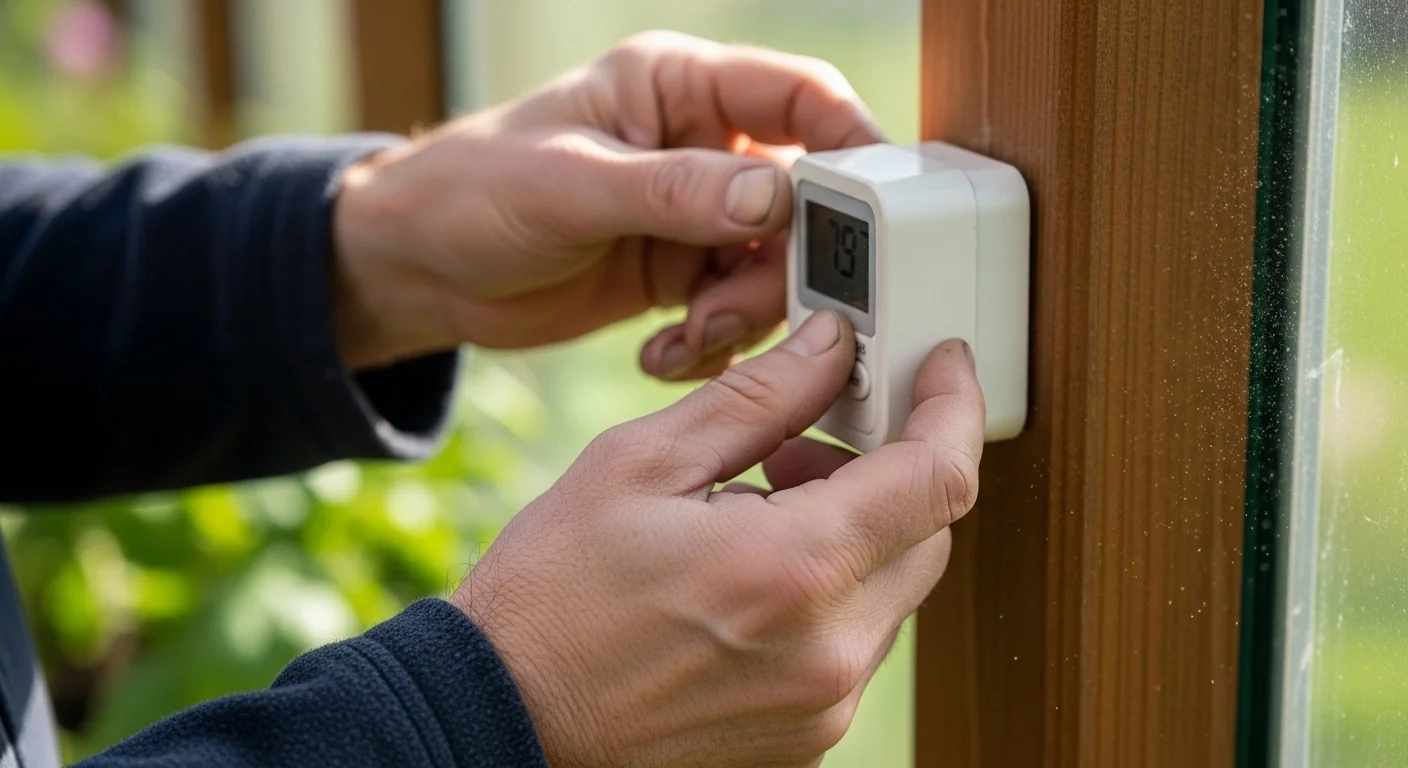
Once you have a confirmed BTU/hr figure, the next decision is fuel type and circuit planning. The calculator's electric and propane equivalents give you the numbers needed for a direct cost comparison using your local utility rate and propane price. For large structures where the electric load exceeds what a standard panel can support, propane is often the practical default rather than a preference. After specifying the heater, verify your thermostat placement: sensors located near the floor or near the heater itself give inaccurate readings that cause the unit to cycle improperly. Place the temperature sensor at canopy height in the center of the growing zone, away from any direct heating airflow. For summer planning, your greenhouse will also need cooling capacity; the grow room AC sizing calculator uses the same BTU framework and can be run for the opposite season.
Heating sets the temperature; temperature and humidity together determine vapor pressure deficit, which drives transpiration rate and crop stress. After confirming your heater size, use the VPD calculator to model how your target inside temperature interacts with expected relative humidity at night. This step catches situations where the correct temperature is being maintained but the humidity is either too high (disease risk) or too low (excessive plant water stress), both of which affect yield more than a 2 to 3°F temperature variance would.
FAQ
What is the difference between BTU and BTU/hr for greenhouse heaters?
BTU (British Thermal Unit) is a quantity of heat. BTU/hr is the rate at which a heater delivers that heat. Heater specifications are always in BTU/hr because heating is a continuous process: a greenhouse loses heat constantly, and the heater must match or exceed that rate of loss. The calculator outputs BTU/hr, which is the correct unit for heater selection.
Why does this calculator add 10% to the basic heat-loss formula?
The standard heat-loss formula using surface area and R-value accounts for conductive heat loss through the glazing material under still-air laboratory conditions. In a real greenhouse, infiltration through seams, vents, doors, and structural gaps adds additional heat loss that the R-value alone does not capture. The 10% wind buffer is a standard engineering add-on for greenhouse applications under normal sealing conditions.
Can I use this calculator for a grow tent or indoor grow room?
The formula and R-value approach are correct for any enclosed structure, but grow tents and indoor rooms have different R-values, typically much higher for insulated walls, and different infiltration characteristics than glazed greenhouse structures. The glazing options in the dropdown correspond to greenhouse-specific materials. For an indoor grow room, you would need to enter the actual R-value of your wall construction and select the closest matching option, which may not precisely represent your setup.
How do I find my greenhouse surface area if it has an arch or curved roof?
For a gothic or Quonset arch, the curved roof area can be approximated by multiplying the arc length of the cross-section by the length of the structure. The arc length of a semicircle is approximately 1.57 times the diameter. For a 14 ft wide arch, the arc is roughly 22 ft per cross-section. Multiply by structure length, then add end wall areas. When in doubt, measure each panel directly and sum the measurements.
Does propane heater efficiency vary with outdoor temperature?
Combustion efficiency at the burner itself does not vary significantly with outdoor temperature for indoor-mounted heaters. However, propane in the tank loses pressure as ambient temperature around the tank drops. A tank stored outdoors at very low temperatures may not deliver adequate gas pressure for the heater to operate at full rated output. The calculator flags temperatures below 0°F as a condition requiring attention to tank temperature management.
What R-value should I use if my greenhouse has two different glazing materials?
The most accurate approach is to calculate heat loss separately for each material zone, sum the results, and add the 10% buffer to the combined total. As a single-field approximation, calculate the area-weighted average R-value: multiply each zone's area by its R-value, sum those products, then divide by total area. Enter that weighted average as a custom comparison using the closest preset option. This is less precise than separate calculations but avoids large errors when materials differ significantly.
Conclusion
Greenhouse heater sizing is driven by three variables that most simplified guides collapse into one: the surface area of glazed material (not the floor), the R-value of that material (not a generic loss factor), and the actual design-day temperature differential, not a seasonal average. Running all three through the heat-loss formula with a 10% infiltration buffer produces a minimum BTU/hr figure that reflects the real thermal demand of the structure on the coldest nights it will face. The glazing R-value is consistently the most influential variable that gets ignored; upgrading from single glass to twin-wall polycarbonate on the same structure and climate can reduce the required heater capacity enough to change the viable fuel type entirely.
The single mistake with the most operational consequence is sizing to the exact calculated BTU with no reserve capacity. Heaters operating at 100% output continuously under peak load conditions cannot recover from power interruptions, do not accommodate colder-than-design nights, and degrade faster than units running with headroom. Specify at least 15 to 20% above the calculated figure when selecting the actual unit. For further reading on the electrical operating cost side of greenhouse climate control, the grow light cost calculator applies the same hourly consumption approach to lighting loads, making it straightforward to model total electrical demand across your climate control and lighting systems together.