
| Tree Type | Typical Height (ft) | Fall Radius (ft) |
|---|---|---|
| Small Ornamental | 15 – 25 | 15 – 25 |
| Dogwood / Redbud | 20 – 35 | 20 – 35 |
| Maple / Birch | 40 – 60 | 40 – 60 |
| Oak / Elm | 60 – 80 | 60 – 80 |
| Pine / Spruce | 60 – 100 | 60 – 100 |
| Douglas Fir | 100 – 150 | 100 – 150 |
| Redwood / Sequoia | 150 – 300+ | 150 – 300+ |
How This Calculator Works
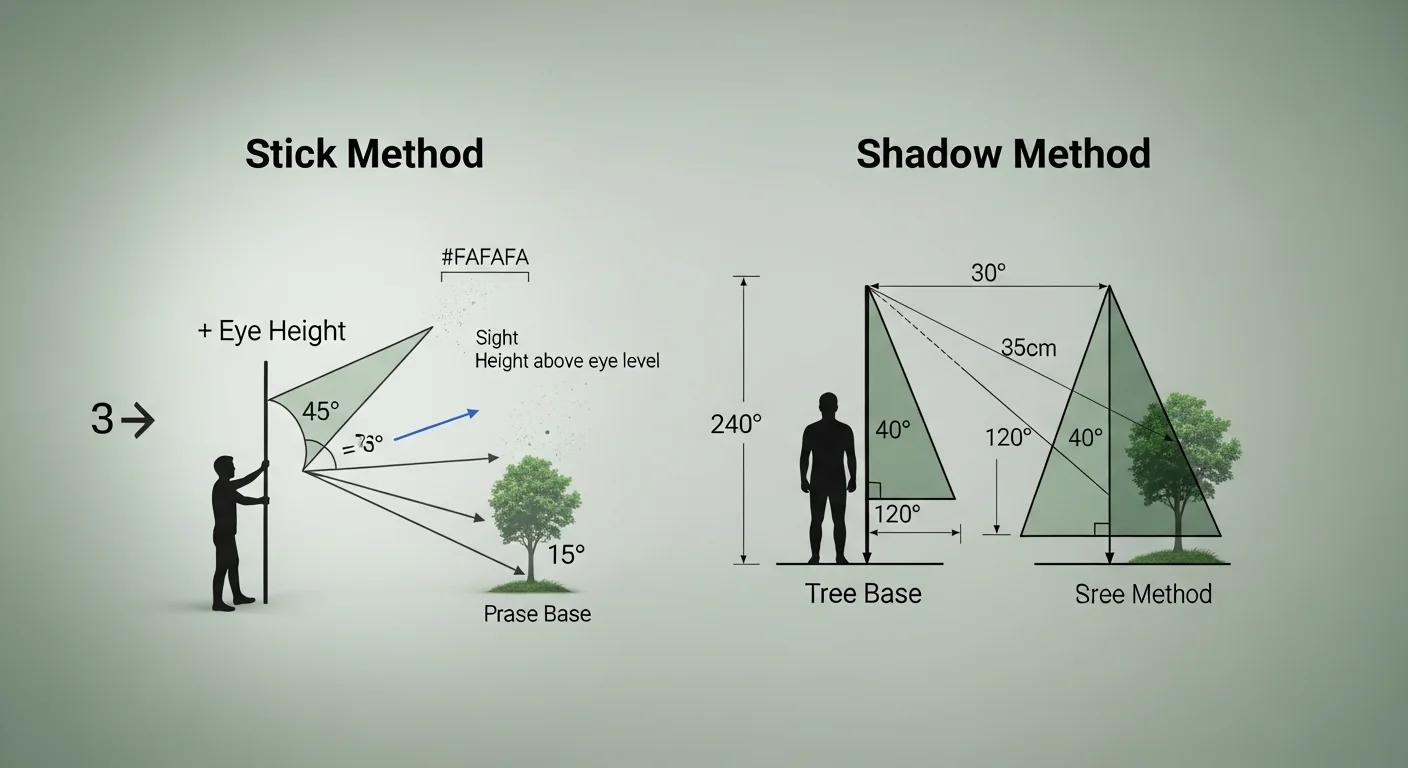
Stick Method (45° Isosceles Triangle):
1. Hold a stick vertically at arm’s length so the visible stick length equals the distance from your hand to your eye.
2. Walk backward until the top of the stick aligns with the treetop and the bottom aligns with the tree base.
3. At this point, you form a 45° angle, creating an isosceles right triangle. The horizontal distance from you to the tree equals the vertical height above your eye level.
Formula: Tree Height = Distance to Tree + Your Eye Height
Shadow Method (Similar Triangles):
1. Measure the tree’s shadow length from the base of the tree to the tip of the shadow.
2. Measure your own height and your shadow length at the same time of day.
3. The ratio of your height to your shadow equals the ratio of the tree’s height to the tree’s shadow.
Formula: Tree Height = (Tree Shadow Length × Your Height) ÷ Your Shadow Length
Assumptions & Limits:
• Ground is relatively flat between you and the tree.
• For the Stick Method, the stick angle must be approximately 45°.
• For the Shadow Method, measurements should be taken within minutes of each other (sun angle changes).
• These are estimates; accuracy is ± 5–15% depending on terrain and technique.
• Does not account for leaning trees or irregular crowns.
Assumptions & Limits
• Results are estimates with ± 5–15% accuracy under ideal conditions.
• Flat, level ground is assumed between observer and tree base.
• The Stick Method requires a true 45° sighting angle.
• The Shadow Method requires both shadows measured simultaneously.
• Leaning trees, sloped terrain, or dense canopies may reduce accuracy.
• Maximum practical measurable height with these methods: ~300 ft.
• For professional arborist applications, use a clinometer or laser rangefinder.
A tree's height is not just a number for the curious. It sets the fall radius, which is the circle of potential destruction if a trunk goes down uncontrolled. Every branch, structure, utility line, and neighbor's fence within that radius is at risk. Before scheduling removal, trimming a leader, or even deciding whether to park a truck nearby, you need a reliable height estimate grounded in geometry, not guesswork.
This tool applies two physics-based field techniques: the Stick Method, which uses the 45-degree isosceles triangle principle, and the Shadow Method, which uses proportional similar triangles. Both methods require nothing more than a stick, a tape measure, and a sunny day. The calculator does not evaluate structural integrity, detect disease, assess lean angle, or replace a certified arborist's inspection. If you also want to understand a tree's approximate age before making removal decisions, the tree age calculator can complement this measurement with a growth-rate estimate.
Once you have the estimated height, you know the minimum safe clearance radius and whether any structure, fence, or utility line falls inside it. That single number is what determines whether this is a DIY project or a call to a licensed arborist.
Use the Tool
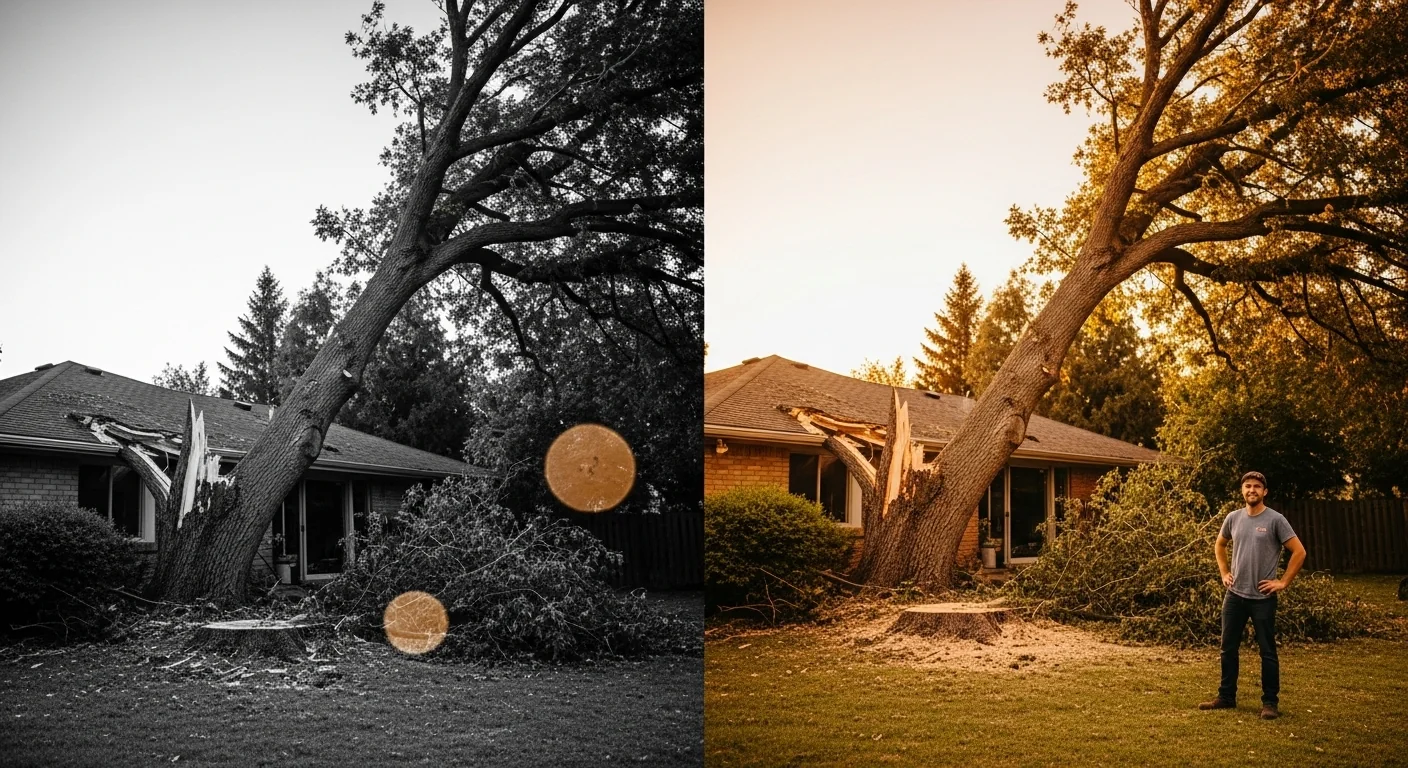
Before you start, gather two things: a straight stick or rigid ruler, and a tape measure long enough to cover your distance from the tree base. For the Stick Method, you need to know your eye height above the ground (your total height minus roughly 6 inches). For the Shadow Method, take both shadow measurements within minutes of each other, since the sun's angle shifts continuously and a 10-minute gap can introduce meaningful error. All inputs are in feet.
Quick Start (60 Seconds)
- Select your method first. Stick Method requires flat ground with a clear sightline to the treetop. Shadow Method requires direct sunlight and a defined shadow tip for both you and the tree.
- For the Stick Method, measure your distance to the tree in feet. Walk in a straight line from the tree base to the spot where the treetop, the tip of your stick, and the base all align at 45 degrees. Measure that straight-line distance, not a diagonal.
- Enter your eye height, not your full height. A common mistake is entering total standing height. Your eye height is typically 4 to 6 inches less than your full height. Use a tape measure against a wall to confirm.
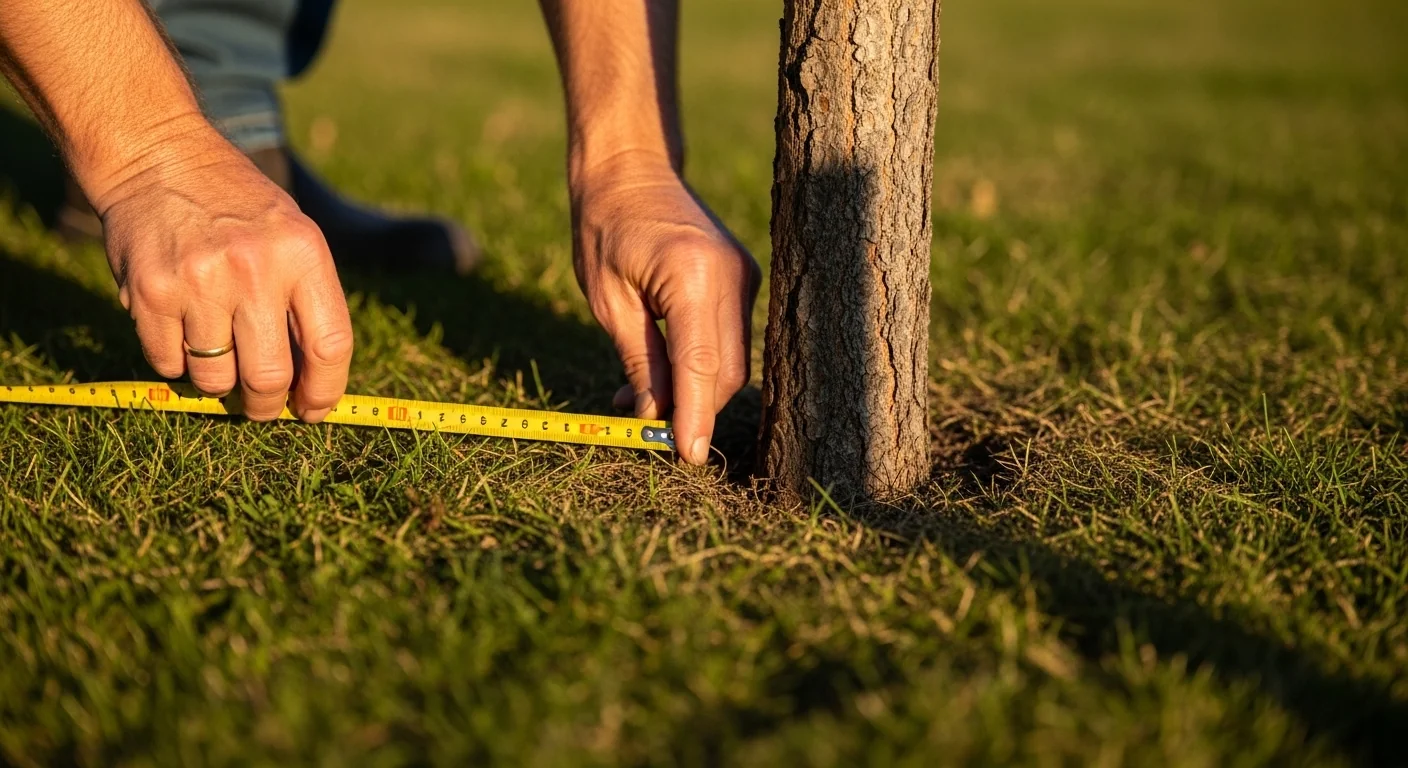
- For the Shadow Method, measure the tree's shadow from trunk base to shadow tip. The base is the center of the trunk at ground level, not the outer root flare.
- Measure your own shadow immediately after measuring the tree's. Stand upright on the same flat surface. Have a second person mark your shadow tip if possible.
- Check that your shadow is visible and well-defined. Hazy or overcast conditions scatter light and produce indistinct shadow edges. Results under those conditions can be off by 15 percent or more.
- Enter your full standing height for the Shadow Method, not eye height. The shadow formula uses your total height as the known reference.
Inputs and Outputs (What Each Field Means)
| Field Name | Unit | What It Represents | Common Mistake | Safe Entry Guidance |
|---|---|---|---|---|
| Method | N/A | Which geometric technique to apply | Choosing Stick Method on sloped ground | Use Shadow Method if the ground tilts more than a few degrees between you and the tree |
| Distance to Tree (Stick) | ft | Horizontal distance from your position to the tree base at the 45-degree sighting point | Measuring along sloped ground instead of true horizontal distance | Use a string level or laser level for accuracy on uneven terrain |
| Eye Height (Stick) | ft | Vertical distance from the ground to your eyes while standing upright | Entering total body height, which overstates the eye level reference | Measure against a wall: stand straight, mark eye level, measure from floor to mark |
| Tree Shadow Length (Shadow) | ft | Distance from center of trunk base to the tip of the tree's shadow on flat ground | Measuring from the outer root flare or from where the shadow starts, not the trunk center | Find the darkest, sharpest point of the shadow tip; avoid partial shade from surrounding canopy |
| Your Height (Shadow) | ft | Full standing height, used as the known proportional reference | Confusing this with eye height (which is used in the Stick Method, not the Shadow Method) | Use your total height; 5.75 ft equals 5 feet 9 inches |
| Your Shadow Length (Shadow) | ft | Length of your own shadow measured at the same moment as the tree's shadow | Measuring your shadow minutes after the tree's, when the sun angle has shifted | Have a second person measure your shadow while you measure the tree's, or move quickly between both |
| Estimated Tree Height (output) | ft (and meters) | Computed vertical height from tree base to treetop | Treating this as an exact measurement rather than an estimate with 5 to 15 percent variance | Round to the nearest foot for planning purposes; use the higher end when calculating safety clearances |
Tree height directly informs decisions about root zone disturbance, which becomes relevant when construction or excavation is planned nearby. The critical root zone calculator uses trunk diameter to estimate the protected soil area around any tree, a number that often surprises property owners planning hardscape projects close to mature trees.
Worked Examples (Real Numbers)
Scenario 1: Backyard Oak, Stick Method
- Method: Stick Method
- Distance to Tree: 52 ft
- Eye Height: 5.5 ft
Result: Tree Height = 52 + 5.5 = 57.5 ft (17.5 m)
A 57.5 ft oak carries a fall radius of 57.5 ft from the trunk base. If a detached garage is 50 ft away, it sits inside the fall zone. A professional risk assessment is warranted before any work begins on this tree.
Scenario 2: Roadside Pine, Shadow Method
- Method: Shadow Method
- Tree Shadow Length: 64 ft
- Your Height: 5.75 ft
- Your Shadow Length: 9 ft
Result: Tree Height = (64 x 5.75) / 9 = 368 / 9 = 40.9 ft (12.5 m)
This is consistent with a mature pitch pine or young red oak. At roughly 41 ft, the fall radius clears a typical 30 ft driveway from the trunk, but utility lines at 35 ft from the tree would fall inside the zone.
Scenario 3: Tall Conifer at Property Line, Stick Method
- Method: Stick Method
- Distance to Tree: 88 ft
- Eye Height: 5.5 ft
Result: Tree Height = 88 + 5.5 = 93.5 ft (28.5 m)
A tree of this height sitting on or near a property line creates a 93.5 ft fall circle. Structures on both properties may fall inside that radius. Municipal permit requirements for removal of trees this large vary by jurisdiction and are worth confirming before scheduling any work.
Reference Table (Fast Lookup)
| Stick Method Distance (ft) | Eye Height (ft) | Estimated Tree Height (ft) | Approximate Tree Category | Fall Radius (ft) | Risk Level |
|---|---|---|---|---|---|
| 15 | 5.5 | 20.5 | Small ornamental (dogwood, crape myrtle) | 20.5 | Low |
| 25 | 5.5 | 30.5 | Medium understory (redbud, serviceberry) | 30.5 | Low |
| 35 | 5.5 | 40.5 | Mid-size deciduous (ornamental pear, birch) | 40.5 | Moderate |
| 50 | 5.5 | 55.5 | Large deciduous (maple, ash, hackberry) | 55.5 | Moderate |
| 65 | 5.5 | 70.5 | Large canopy (oak, elm, beech) | 70.5 | High |
| 80 | 5.5 | 85.5 | Tall conifer (white pine, Norway spruce) | 85.5 | High |
| 100 | 5.5 | 105.5 | Very tall conifer (Douglas fir, larch) | 105.5 | High |
| 125 | 5.5 | 130.5 | Old-growth range (ponderosa pine, sequoia) | 130.5 | Extreme |
Risk level reflects fall radius relative to typical residential setbacks and utility line heights, not structural condition. A 40 ft tree with severe trunk decay may carry higher real-world risk than the Moderate rating suggests.
How the Calculation Works (Formula + Assumptions)
Show the calculation steps
Stick Method
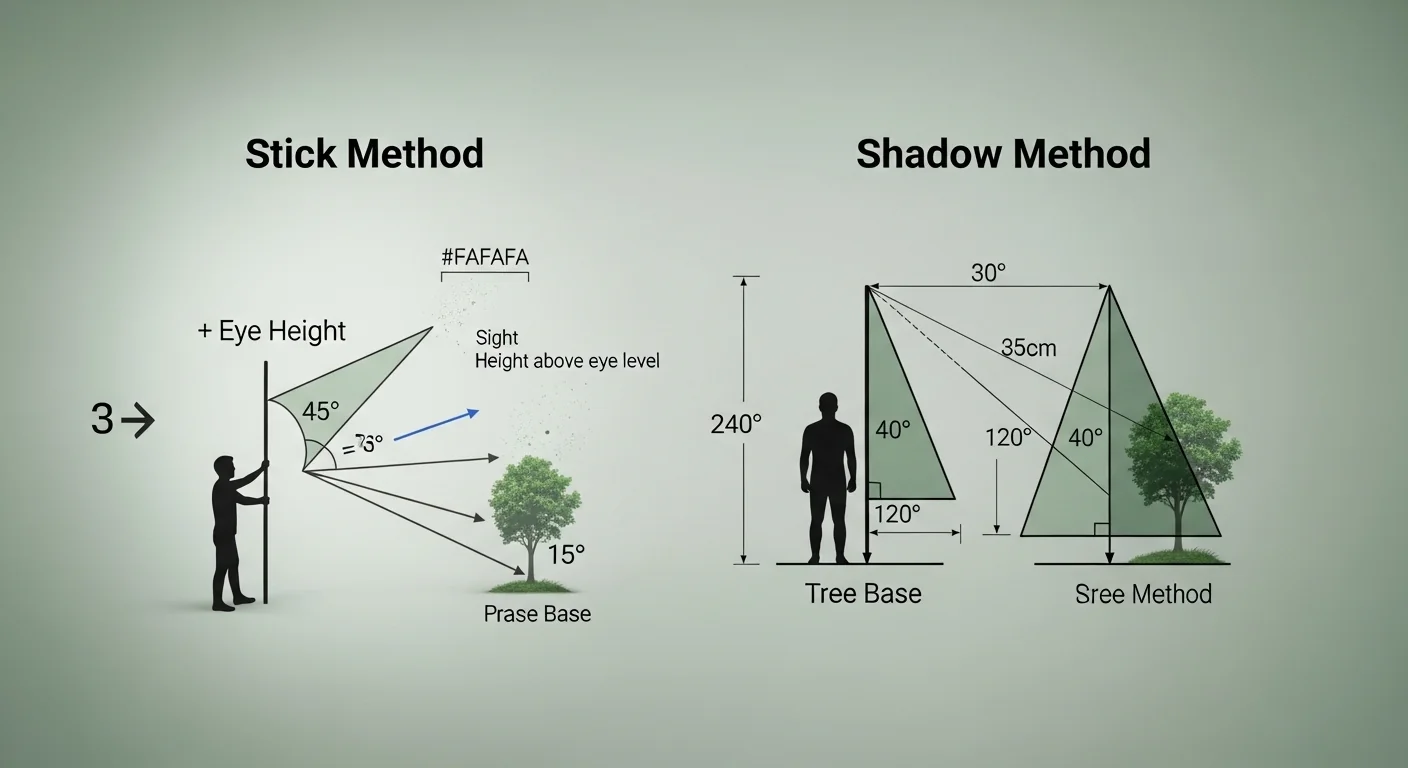
The Stick Method exploits the geometry of a 45-degree isosceles right triangle. When you hold a stick vertically at arm's length so that the stick's apparent length equals the arm's length (the distance from your eye to your hand), you create a sighting instrument with a built-in 45-degree angle.
- Walk backward from the tree while looking over the top of the stick, keeping the stick's base aligned with the tree's base.
- Stop when the tip of the stick visually aligns with the top of the tree.
- At this point, by the properties of isosceles right triangles, the horizontal distance from your eye to the tree base equals the vertical height above your eye level.
- Add your eye height to account for the portion of the tree below your line of sight.
Formula: Tree Height = Distance to Tree + Eye Height
Rounding rule: Round the final result to one decimal place (e.g., 57.5 ft). For safety planning, always round up to the nearest whole foot.
Shadow Method
The Shadow Method applies the similar triangles principle. Two objects in the same sunlight cast shadows proportional to their heights.
- Measure the length of the tree's shadow from the trunk center to the shadow tip.
- Measure your own height (full standing height in the same units).
- Measure your shadow length at the same moment, on flat ground, from your heel to your shadow tip.
- Divide your height by your shadow length to get the sun's height-to-shadow ratio.
- Multiply that ratio by the tree's shadow length to get the tree's height.
Formula: Tree Height = (Tree Shadow Length x Your Height) / Your Shadow Length
Rounding rule: Same as Stick Method. Round to one decimal place, then round up for clearance calculations.
Assumptions and Limits
- Ground is flat and level between the observer and the tree base. Slope in any direction introduces proportional error.
- For the Stick Method, the stick must create a true 45-degree angle. A slight tilt toward or away from vertical causes the distance-to-height ratio to deviate from 1:1.
- For the Shadow Method, the sun must be unobstructed and high enough in the sky to cast clear shadows. Low-angle winter sun produces very long shadows that amplify small measurement errors.
- Both shadows in the Shadow Method must be measured within a few minutes of each other. The sun moves approximately 0.25 degrees per minute, which is enough to shift shadow length meaningfully over longer gaps.
- The tree must have a single, identifiable apex (top). Multi-leader trees, heavily pruned crowns, or trees with broken tops require marking the highest visible point before sighting.
- These methods estimate the height of the treetop as seen from ground level. They do not measure the true structural height of a leaning tree, which may have a lower center of gravity than a plumb tree of the same apparent height.
- Expected accuracy under ideal conditions is plus or minus 5 to 15 percent, depending on technique, terrain, and measurement precision.
Standards, Safety Checks, and "Secret Sauce" Warnings
Critical Warnings
- The fall radius equals the tree height. This is not a worst-case estimate; it is the geometric minimum. A falling tree can reach any point within a circle whose radius equals the tree's full height. No buffer is built into that number. Anything inside the circle, including structures, vehicles, power lines, and people, is at risk.
- Height alone does not determine removal difficulty. A 50 ft tree with a 36-inch DBH (diameter at breast height) presents substantially more debris volume, root complexity, and rigging demand than a 50 ft tree with a 12-inch DBH. Use the height result to establish fall clearance, then consult an arborist about scope.
- Trees near utility lines require utility company coordination regardless of height. Most municipalities prohibit work within 10 ft of energized lines without utility involvement, regardless of who owns the tree.
- Slope multiplies effective fall radius. On a hillside, a tree falling downslope can travel significantly farther than its height would suggest on flat ground. The calculator assumes flat terrain; add a safety margin for any site with perceptible grade.
Minimum Standards
- Clearance planning should use the full calculated height, not a rounded-down value. Always plan for the worst-case fall direction.
- For trees over 60 ft, the International Society of Arboriculture (ISA) recommends a certified arborist assessment before any significant work, including crown reduction or removal.
- For trees with any visible trunk decay, split crotches, or fungal growth at the base, height is secondary to structural hazard. A structural assessment overrides height-based risk classification.
Competitor Trap: Many online tree height guides present the Stick Method without mentioning that the 45-degree angle only holds if the stick's visible length exactly equals your arm's length from eye to hand. If you hold the stick farther or closer, or tilt it even slightly off vertical, the triangle is no longer isosceles and the distance-to-height relationship breaks down. The result looks plausible but may underestimate or overestimate height by 20 ft or more on tall trees. Check your arm-to-stick ratio before walking back.
If the tree in question is a recent planting that was staked after installation, understanding the lateral load forces involved is also relevant for assessing trunk taper and long-term stability. The tree staking tension calculator can help estimate the support forces applied during the establishment phase. Once you have the height measurement, protecting the root system during any nearby grading or excavation becomes a priority, and the tree root protection calculator provides the protected zone radius for trees of known trunk size.
Common Mistakes and Fixes
Mistake: Measuring Distance Along Sloped Ground Instead of Horizontal
Distance
When the ground between you and the tree slopes, the tape measure follows the surface, not the horizontal plane. On a 10-degree slope over 50 ft, the horizontal distance is roughly 49.2 ft, a difference small enough to ignore. On steeper slopes, the discrepancy grows fast. The Stick Method is built on horizontal distance; feeding it a slope distance produces a height that is systematically too high or too low depending on the grade direction.
Fix: On sloped ground, use the Shadow Method instead, or use a string level or laser to establish a true horizontal distance.
Mistake: Using Total Height Instead of Eye Height in the Stick Method
The Stick Method's formula adds eye height to the distance because the 45-degree sightline measures height above the observer's eye, not above the ground. If you enter your full height of 6 ft instead of your eye height of 5.5 ft, the result is off by 0.5 ft, which is negligible on a 30 ft tree but can be a meaningful error when planning clearance for structures.
Fix: Measure your eye height specifically before going to the field. A quick check against a wall takes 30 seconds and eliminates this error entirely.
Mistake: Taking Shadow Measurements at the Wrong Time of Day
The Shadow Method requires a well-defined shadow with a clear tip. In the first two hours after sunrise and the last two before sunset, solar angle is so low that tree shadows can extend hundreds of feet, often onto uneven terrain or into areas obstructed by other objects. Errors in shadow-tip placement at that scale are amplified by the formula into large height miscalculations.
Fix: Measure between 9 a.m. and 3 p.m. local time on a clear day. The closer to solar noon, the shorter and crisper the shadows will be.
Mistake: Treating the Result as a Precise Measurement for Permit
Applications
These field estimation methods carry an inherent variance of 5 to 15 percent under ideal conditions. Some municipal tree ordinances require removal permits for trees exceeding a specific height, and an estimate from a stick or shadow measurement is not a surveyed figure. Submitting an estimated height on a permit application without noting the measurement method and its tolerance can create compliance problems.
Fix: For permit and legal purposes, use the calculated height as a planning guide and hire a certified arborist or surveyor to provide a documented measurement. If you are also planning hardscape near the tree, note that structures like fence posts near roots create their own complications; the fence post depth calculator can help plan footings that avoid major root zones.
Mistake: Applying the Fall Radius to Only the Most Likely Fall Direction
Property owners frequently assume a tree will fall in the direction it leans, or toward the most open space. Wind, internal decay patterns, crown weight distribution, and the cutting technique all influence fall direction, and none of these factors are predictable enough to reduce the safety planning radius. Assuming a preferred fall direction and placing equipment or people on the "safe" side has caused serious accidents.
Fix: Treat the full fall radius as a 360-degree exclusion zone until the actual cut is planned by a professional who can assess fall direction control options for that specific site.
Next Steps in Your Workflow
With the estimated height in hand, the immediate decision is whether the fall radius intersects any structure, utility, or boundary. Draw the radius on a property sketch or satellite image overlay and identify what falls inside. If the answer is nothing within a 10 ft buffer zone beyond the radius, the site geometry is likely manageable. If any structure, line, or fence falls inside the circle, that determines the removal approach, not the preference of the homeowner. After removal, if the stump needs treatment before grinding or replanting, the stump killer mixture ratio tool can help size the chemical treatment correctly for the trunk diameter left behind.
Tree removal almost always changes a planting bed's light and moisture conditions. Once a large canopy is gone, surrounding beds receive more sun and surface roots may no longer compete for water. Adjusting mulch depth and coverage after a removal is a practical next step, and the mulch calculator makes it straightforward to estimate how much material the refreshed beds will need based on area and desired depth.
FAQ
How accurate is the Stick Method for measuring tree height?
Under ideal conditions (flat ground, clear sightline, correct 45-degree stick angle), the Stick Method is accurate to within roughly 5 to 10 percent of the actual height. On sloped terrain or with an imprecise stick angle, error can reach 15 to 20 percent. It is a field estimation technique, not a survey measurement, and should be used as a planning reference rather than a precise figure.
Can the Shadow Method work on an overcast day?
No. The Shadow Method requires direct sunlight to cast well-defined shadows with a clear tip. Overcast or partly cloudy conditions scatter light and produce diffuse, indistinct shadow edges that cannot be measured reliably. Even thin high clouds can soften shadow tips enough to introduce significant error. Reserve this method for clear, direct-sun conditions.
What if the tree leans significantly toward me or away from me?
Both methods measure apparent height from the observer's perspective, which may not equal the true vertical height of a leaning tree. A tree leaning toward you will appear taller than it is; one leaning away will appear shorter. For leaning trees, use the Shadow Method and stand perpendicular to the lean direction to reduce this distortion. A clinometer provides a more reliable result for severely leaning specimens.
Is the fall radius always equal to the tree's height?
The fall radius is at minimum equal to the full tree height on flat ground. On sloped terrain, a tree falling downhill can travel beyond that distance as momentum carries the crown further. Wind and root plate size also influence how far debris spreads. For safety planning, use the full height as the radius and add a buffer on any sloped site.
Can I use these methods for a tree on a hill above or below me?
The Stick Method is not reliable when there is significant elevation difference between the observer and the tree base, because the horizontal distance and the height measurement no longer correspond cleanly. The Shadow Method is more forgiving as long as both you and the tree are on surfaces where the shadows fall on relatively flat ground. For trees on significant grades, a clinometer or laser rangefinder with angle measurement is a better tool.
Do I need a permit to remove a tree based on its height?
Permit requirements vary by municipality, species protection status, and proximity to protected areas. Many jurisdictions trigger permit requirements based on trunk diameter (DBH), not height. Some also have heritage or protected species lists that apply regardless of size. Check with your local planning or public works department before removing any mature tree, particularly those exceeding 40 ft or located in protected buffer zones near waterways or streets.
Conclusion
The single most common error is treating the result as more precise than the method allows. Both the Stick Method and the Shadow Method carry inherent measurement variance. For safety planning, always round the result up and treat the fall radius as a full 360-degree exclusion zone, not a directional preference. If you want to build a more complete picture of a tree's condition and history on your property, the tree age calculator provides an estimate of how long a tree has been growing, which informs decisions about root depth, structural maturity, and long-term management strategy.