
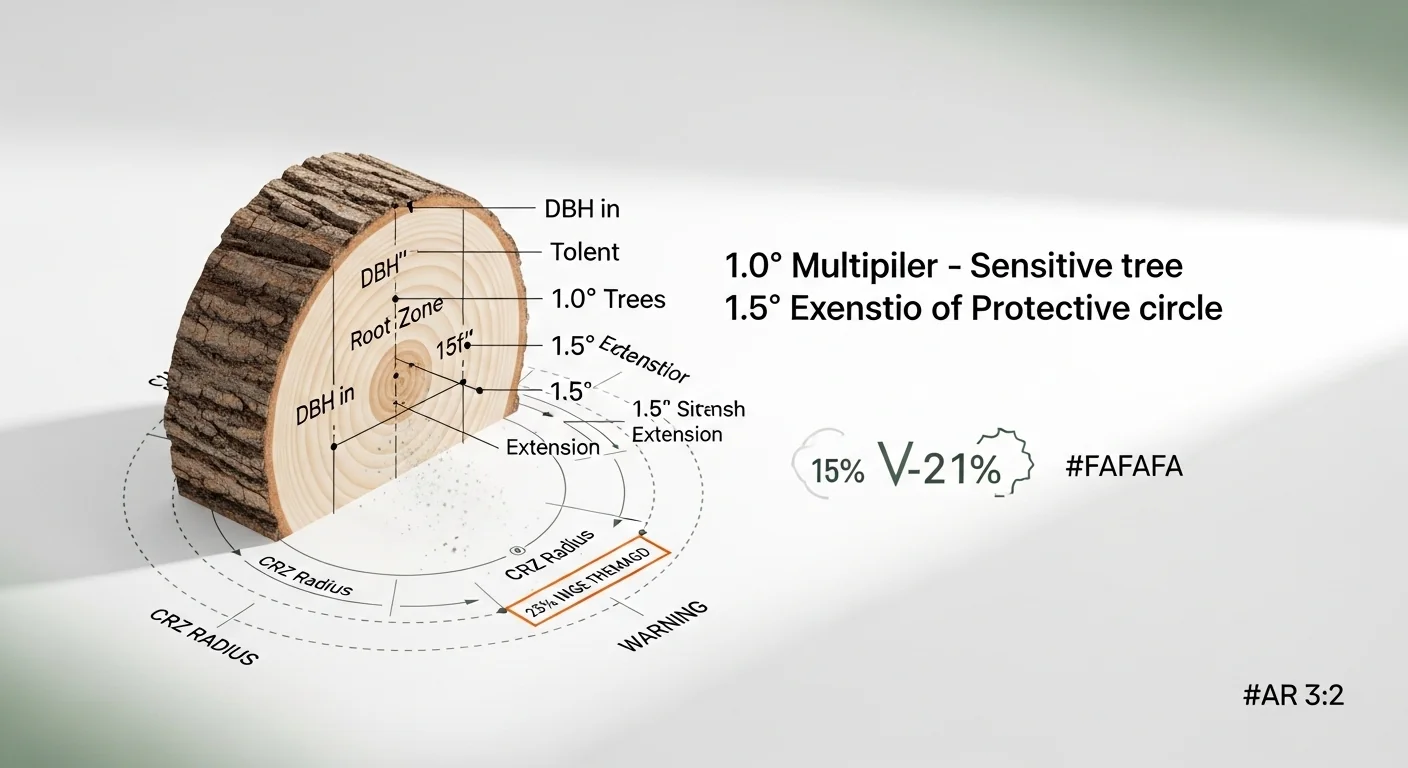
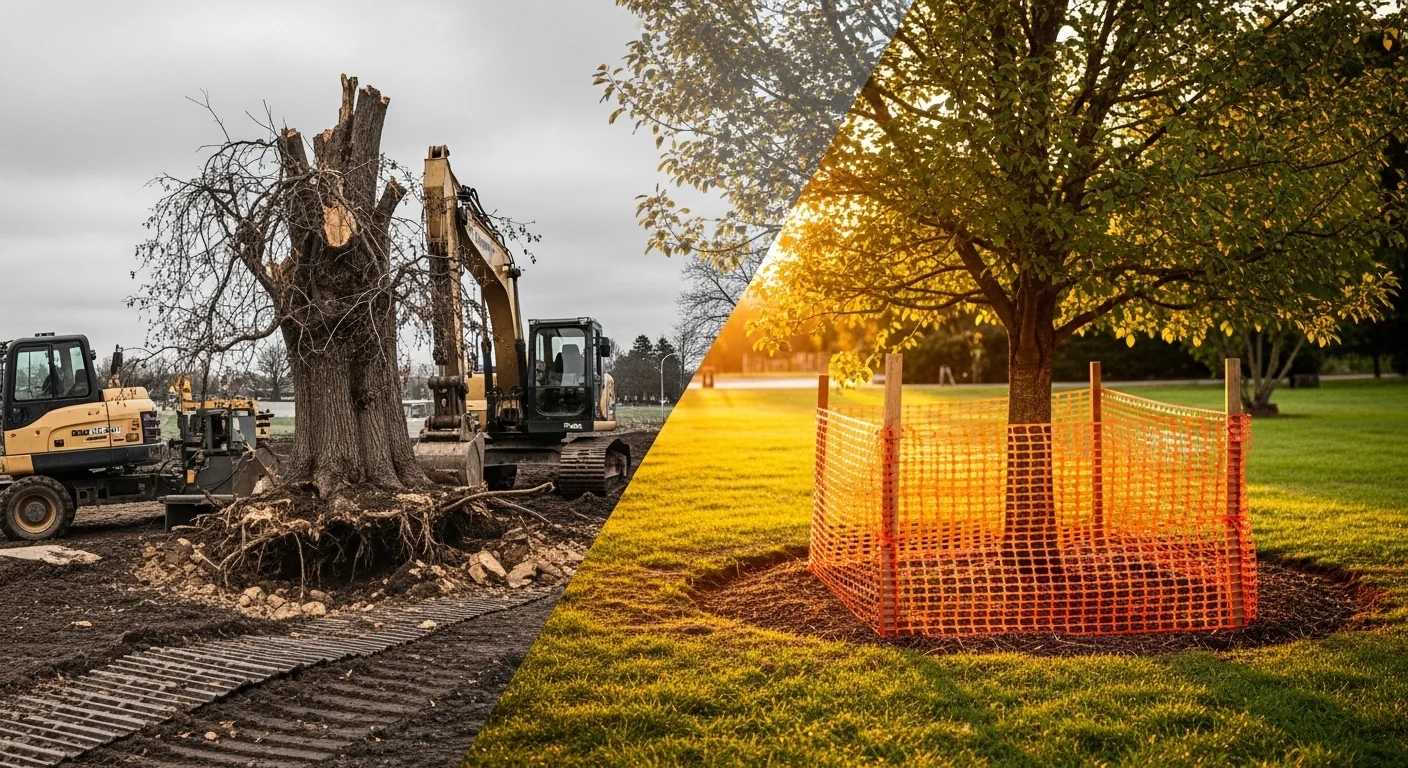
The trunk is the most visible part of a tree, but the root system underneath determines survival. During construction, heavy equipment, trenching, and soil compaction routinely damage root zones that extend far beyond what anyone assumes by looking at the canopy or the trunk alone. A 24-inch DBH oak carries roots that may occupy more than 1,800 square feet of ground. Treating that as a small, ignorable zone is how mature trees die within one to three growing seasons after a project closes. Knowing the tree’s estimated age helps you assign the right sensitivity class before running this calculation.
This tree root protection calculator takes two inputs, the trunk’s Diameter at Breast Height and the tree’s sensitivity class, and returns the Critical Root Zone (CRZ) radius, total protection diameter, and ground area that must stay clear of excavation. It does not predict whether a specific tree will survive disturbance, diagnose root diseases, or account for asymmetric root spread caused by soil layers or nearby hardscape. The outputs are planning numbers, not field-verification substitutes.
After running this calculator, you will know the minimum radius around any tree trunk that should be physically fenced off before ground disturbance begins, separated by sensitivity class.
Use the Tool
| DBH (in) | Tolerant CRZ (ft) | Sensitive CRZ (ft) | Sensitive Area (ft²) |
|---|
How This Calculator Works
Step 1: Measure the tree’s Diameter at Breast Height (DBH) — the trunk diameter measured at 4.5 feet above ground, in inches.
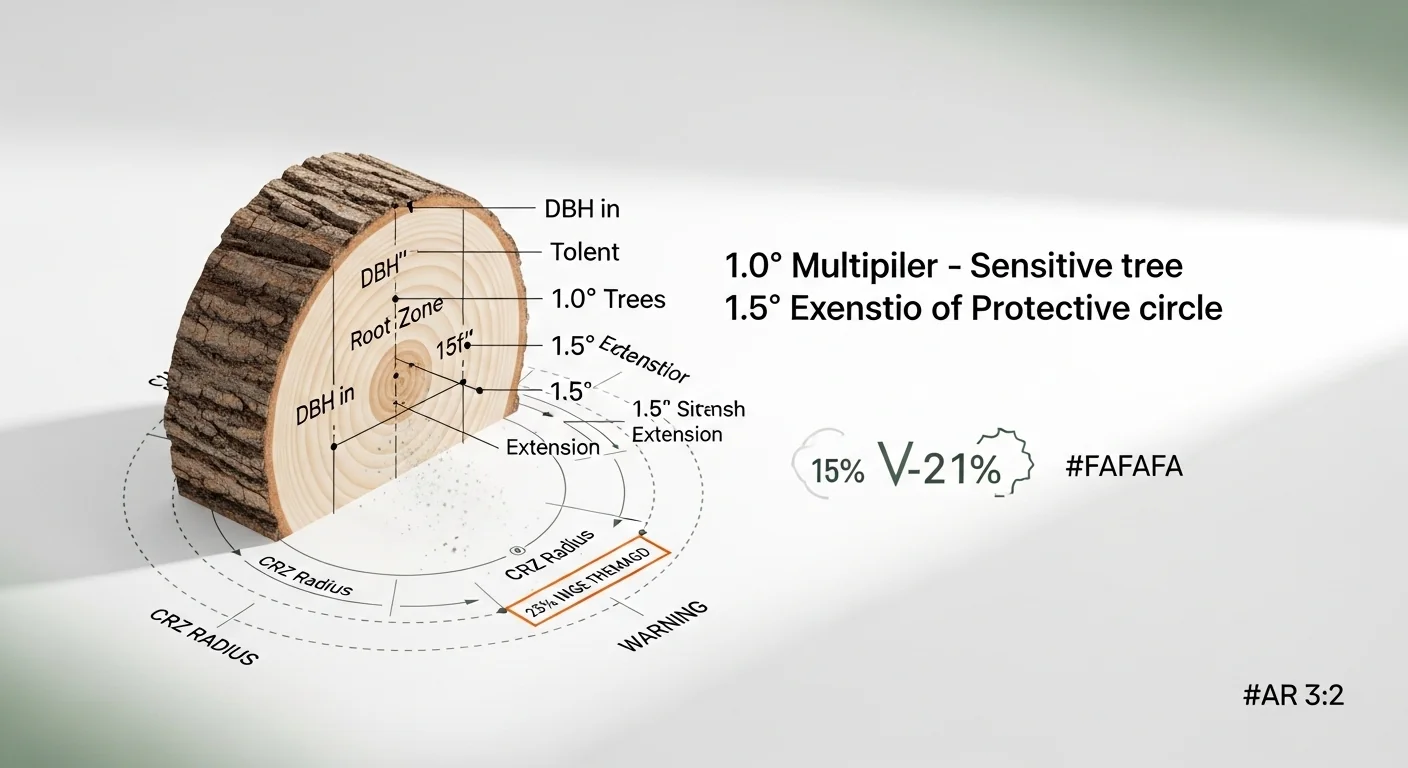
Step 2: Determine the tree’s sensitivity. Young or tolerant species use a 1.0× multiplier. Old or sensitive species use a 1.5× multiplier for extra protection.
Step 3: Calculate the Critical Root Zone radius: CRZ Radius (ft) = DBH (in) × Multiplier
Step 4: Total Protection Diameter = CRZ Radius × 2
Step 5: Protection Area = π × Radius²
This method is derived from the ISA (International Society of Arboriculture) standard for tree protection during construction projects.
Assumptions & Limits
This calculator assumes a circular root zone centered on the trunk. Actual root spread may be asymmetric depending on soil conditions, slope, and nearby structures.
The 1.0× and 1.5× multipliers are general guidelines. Some species and local regulations may require larger protection zones.
DBH values are expected between 1 and 200 inches. Extremely large values may indicate multi-trunk or unusual specimens that require arborist assessment.
This tool provides estimates for planning purposes. Always consult a certified arborist for high-value trees or complex construction scenarios.
The 25% root damage threshold is a widely cited survival guideline, but tolerance varies by species, health, and age.
Before entering values, have a tape measure or diameter tape ready to measure the trunk at exactly 4.5 feet above ground on the uphill side of the tree. That measurement, taken in inches, is the DBH. You will also need to make a judgment on tree sensitivity: younger trees and species with high root regeneration capacity fall in the tolerant class; old trees, rare species, and species with low tolerance to soil disturbance belong in the sensitive class. If uncertain, choosing the sensitive setting adds a 50% buffer and is the conservative default for high-value specimens. For evaluating canopy proportion relative to trunk size, the tree height calculator can provide useful context.
Quick Start (60 Seconds)
- Measure DBH in inches, not centimeters. Place the measuring tape at exactly 4.5 feet above ground. On sloped terrain, measure from the uphill side. DBH in centimeters divided by 2.54 converts to inches.
- Do not estimate DBH visually. Trunks appear smaller than they measure. A trunk that looks like 12 inches often measures 16 to 20 inches around the circumference. Use a tape. Circumference in inches divided by 3.14159 gives DBH.
- Select the sensitivity class before calculating. Young or tolerant class applies a 1.0 multiplier. Old or sensitive class applies a 1.5 multiplier. When in doubt, use sensitive.
- The result is a radius, not a diameter. If the calculator returns 24 feet, that means 24 feet from the trunk center in all directions, giving a total fence diameter of 48 feet.
- Record the protection area in square feet. This figure is useful when calculating mulch coverage or flagging the zone on a site plan.
- Run the calculation separately for each tree on the site. Trees within 10 feet of each other may have overlapping CRZs that should be treated as one combined exclusion zone.
- Recheck after any plan revision. If grading plans shift even 5 feet, recalculate the overlap between the proposed work boundary and the CRZ.
Inputs and Outputs (What Each Field Means)
| Field | Unit | What It Means | Common Mistake | Safe Entry Guidance |
|---|---|---|---|---|
| Tree Diameter (DBH) | inches | Trunk diameter measured at 4.5 ft above ground. This single number drives the entire CRZ calculation. | Using trunk circumference instead of diameter, or measuring at ground level where the trunk flares. | Enter 1 to 200 inches. Values below 1 inch indicate a sapling; values above 120 inches indicate a champion-class specimen and should be field-verified. |
| Tree Age / Sensitivity | category | Determines the multiplier. Tolerant species or young trees use 1.0x. Old trees or sensitive species use 1.5x. | Defaulting all trees to tolerant to get a smaller, more convenient fence footprint. | When species or age is unknown, choose Sensitive. The additional fencing cost is far less than tree removal and replacement. |
| CRZ Radius | feet | Primary output. The minimum distance from the trunk center that should remain free of all ground disturbance. | Treating the radius as the fence diameter. The fence perimeter must be set at this radius from the trunk center. | Verify against local municipality or project arborist specs. Some jurisdictions require a minimum CRZ of 10 feet regardless of DBH. |
| Protection Diameter | feet | Total width of the protected circle (radius x 2). Useful for drawing exclusion zones on site plans. | Reading this as a radius and fencing only half the required zone. | This value equals twice the CRZ Radius. Use it to set stakes directly across from each other through the trunk center. |
| Protection Area | square feet | Ground area inside the CRZ circle. Used for mulch calculations and site plan notation. | Ignoring this figure when calculating material needs for the protected zone. | Multiply by your mulch depth in feet to get cubic feet of mulch needed inside the zone. |
Worked Examples (Real Numbers)
Scenario 1: Mid-Size Red Maple, Residential Driveway Expansion
- DBH: 18 inches
- Sensitivity class: Tolerant (young, planted 12 years ago)
- Multiplier: 1.0
Result: CRZ Radius = 18 ft, Protection Diameter = 36 ft, Protection Area = 1,018 ft²
A driveway expansion stopping 20 feet from the trunk still crosses this tree’s CRZ by 2 feet. The grade change and compaction within that strip is enough to sever a significant portion of the feeder roots on the south side of the tree.
Scenario 2: Large Heritage Oak, Commercial Site Clearing
- DBH: 30 inches
- Sensitivity class: Sensitive (estimated 80-plus years old, designated heritage tree)
- Multiplier: 1.5
Result: CRZ Radius = 45 ft, Protection Diameter = 90 ft, Protection Area = 6,362 ft²
A 45-foot exclusion radius on a commercial lot can consume a significant portion of buildable area. Identifying this requirement before site plan submission avoids costly redesigns mid-permit.
Scenario 3: Small Ornamental Cherry, Utility Line Installation
- DBH: 10 inches
- Sensitivity class: Tolerant (younger specimen, healthy canopy)
- Multiplier: 1.0
Result: CRZ Radius = 10 ft, Protection Diameter = 20 ft, Protection Area = 314 ft²
A 10-foot CRZ looks manageable until a utility trench runs parallel to the tree at 8 feet from the trunk. The trench still falls within the protected zone and requires hand-digging or directional boring under current ISA guidelines.
Reference Table (Fast Lookup)
| DBH (in) | Sensitivity | Multiplier | CRZ Radius (ft) | Protection Diameter (ft) | Protection Area (ft²) |
|---|---|---|---|---|---|
| 6 | Tolerant | 1.0 | 6.0 | 12.0 | 113 |
| 6 | Sensitive | 1.5 | 9.0 | 18.0 | 254 |
| 12 | Tolerant | 1.0 | 12.0 | 24.0 | 452 |
| 12 | Sensitive | 1.5 | 18.0 | 36.0 | 1,018 |
| 18 | Tolerant | 1.0 | 18.0 | 36.0 | 1,018 |
| 18 | Sensitive | 1.5 | 27.0 | 54.0 | 2,290 |
| 24 | Tolerant | 1.0 | 24.0 | 48.0 | 1,810 |
| 24 | Sensitive | 1.5 | 36.0 | 72.0 | 4,072 |
| 36 | Tolerant | 1.0 | 36.0 | 72.0 | 4,072 |
| 36 | Sensitive | 1.5 | 54.0 | 108.0 | 9,161 |
| 48 | Tolerant | 1.0 | 48.0 | 96.0 | 7,238 |
| 48 | Sensitive | 1.5 | 72.0 | 144.0 | 16,286 |
How the Calculation Works (Formula + Assumptions)
Show the calculation steps
Step 1 – Measure DBH in inches. DBH is the trunk diameter at exactly 4.5 feet above grade on level ground. On slopes, measure on the uphill face. If you have the circumference in inches, divide by 3.14159 to convert to diameter.
Step 2 – Select the sensitivity multiplier. Young or tolerant trees use a multiplier of 1.0. Old or sensitive trees use a multiplier of 1.5. This multiplier reflects the difference in root density, regeneration capacity, and structural reliance on intact root mass.
Step 3 – Calculate CRZ Radius. CRZ Radius (ft) = DBH (in) x Multiplier. The unit conversion is built into the formula: inches of trunk diameter directly produce feet of root zone radius.
Step 4 – Calculate Protection Diameter. Diameter (ft) = CRZ Radius x 2. This is the side-to-side width of the full exclusion circle.
Step 5 – Calculate Protection Area. Area (ft²) = 3.14159 x Radius x Radius. Round to the nearest whole square foot for site plan notation.
Assumptions and Limits
- The formula assumes a circular root zone centered directly on the trunk. Real root spread is rarely circular; prevailing soil moisture, slope, hardscape, and neighboring trees all shift root distribution asymmetrically.
- The 1.0x and 1.5x multipliers are derived from widely used ISA tree protection guidelines. Local ordinances and project-specific arborist reports may mandate larger multipliers or absolute minimum distances.
- DBH values between 1 and 200 inches are accepted. Multi-trunk specimens or trees with significant trunk flare at breast height require special measurement technique and may need field arborist evaluation.
- This calculator does not account for root conflicts with existing utilities, hardscape, or subsurface structures that physically limit actual root spread.
- The 25% root damage threshold is a planning guideline, not a guaranteed survival guarantee. Species, overall tree health, drought stress, and soil conditions all affect true tolerance.
- The tool does not model cumulative damage from multiple construction activities occurring sequentially in the same zone. Each separate project phase should be evaluated independently.
Standards, Safety Checks, and “Secret Sauce” Warnings
Critical Warnings
- Cutting more than 25% of the roots within the Critical Root Zone will, in most cases, cause the tree to die. This threshold is not a wide safety margin. At 26%, structural stability can also become a concern for larger specimens, creating a safety hazard separate from aesthetic loss.
- Soil compaction inside the CRZ causes slow root suffocation. Even equipment that does not touch the tree or excavate the soil can compact root zones to lethal levels if repeatedly driven over them. A single pass by a loaded concrete truck at 8 tons can destroy pore space in the top 12 inches of soil permanently without any visible excavation.
- Grade changes of as little as 4 inches of fill inside the CRZ restrict oxygen exchange to roots. Adding soil inside the exclusion zone is not a neutral act. Raising grade is often as damaging as cutting.
Minimum Standards
- Physical protective fencing must be installed at the CRZ boundary before any ground disturbance, equipment staging, or material storage begins on site.
- A 4-to-6-inch layer of wood chip mulch inside the CRZ reduces compaction risk from foot traffic and helps retain soil moisture during construction. The mulch calculator can size that material order precisely.
- Utilities crossing the CRZ should be installed via directional boring below the active root layer rather than open trenching wherever possible.
- Fence post installation at the CRZ boundary should use removable steel stakes driven to a shallow depth, not augered concrete footings. The fence post depth calculator can help plan minimal-impact stake placement on perimeter fencing.
Competitor Trap: A widespread but misleading shorthand treats the CRZ as a fixed 12-foot radius regardless of trunk size. That number comes from a misapplied rule-of-thumb for small ornamental trees and consistently underprotects mature specimens. A 36-inch DBH sensitive oak has a CRZ of 54 feet under the correct ISA-derived formula, not 12 feet. Using the shorthand on a large tree means up to 80% of the actual root zone receives no protection at all.
Common Mistakes and Fixes
Mistake: Using the Same Sensitivity Class for Every Tree on Site
Applying the tolerant (1.0x) multiplier to every tree on a construction site is the single most common CRZ underestimation error. A mature 40-inch DBH bur oak with the wrong class gets a 40-foot CRZ. With the correct sensitive class, that becomes 60 feet. The 20-foot gap is exactly where the grading contractor planned the haul road.
Fix: Assign sensitivity class per tree, and document the rationale in the tree protection plan.
Mistake: Measuring Trunk Circumference and Entering It as Diameter
Circumference and diameter are not the same unit. A 63-inch circumference trunk is only 20 inches in diameter. Entering 63 as the DBH produces a CRZ radius of 63 feet for a tolerant tree, vastly inflating the exclusion zone and potentially flagging construction as impossible when it is not.
Fix: Always divide circumference by pi (3.14159) before entering the value. The calculator expects diameter in inches.
Mistake: Treating the CRZ as a No-Entry Zone Only for Excavation
Many site managers correctly avoid trenching inside the CRZ but allow material staging, equipment parking, and concrete washout within the same area. All three activities compact soil, alter drainage, and introduce chemical contaminants. The exclusion zone applies to all ground disturbance, not just digging. Soil disturbance from heavy staging is one reason to consult the topsoil calculator if remediation soil replacement is planned after construction.
Fix: Make the CRZ fencing physically impassable. Orange construction fence collapses under contact; rigid panel fencing holds.
Mistake: Installing the Fence at the Trunk Rather Than the CRZ Boundary
Drip-line fencing (fencing at the canopy edge) and trunk-ring fencing (a small ring of stakes around the base) both fail to protect the actual root mass. Roots routinely extend well beyond the drip line and the CRZ formula accounts for structural and feeder roots in all directions.
Fix: Stake out the CRZ radius from the trunk center using the calculator’s radius output, then install fencing at that perimeter before any other work begins on site.
Mistake: Skipping the CRZ Check for Trees at the Site Edge
Trees positioned at a property boundary are often assumed to be unaffected because work is focused in the interior. Root systems do not respect property lines. A neighbor’s large tree 15 feet from the fence can have roots 30 or more feet into the work site depending on its DBH and sensitivity class.
Fix: Measure DBH and calculate CRZ for all trees within the calculated radius distance of the work boundary, including those on adjacent properties.
Next Steps in Your Workflow
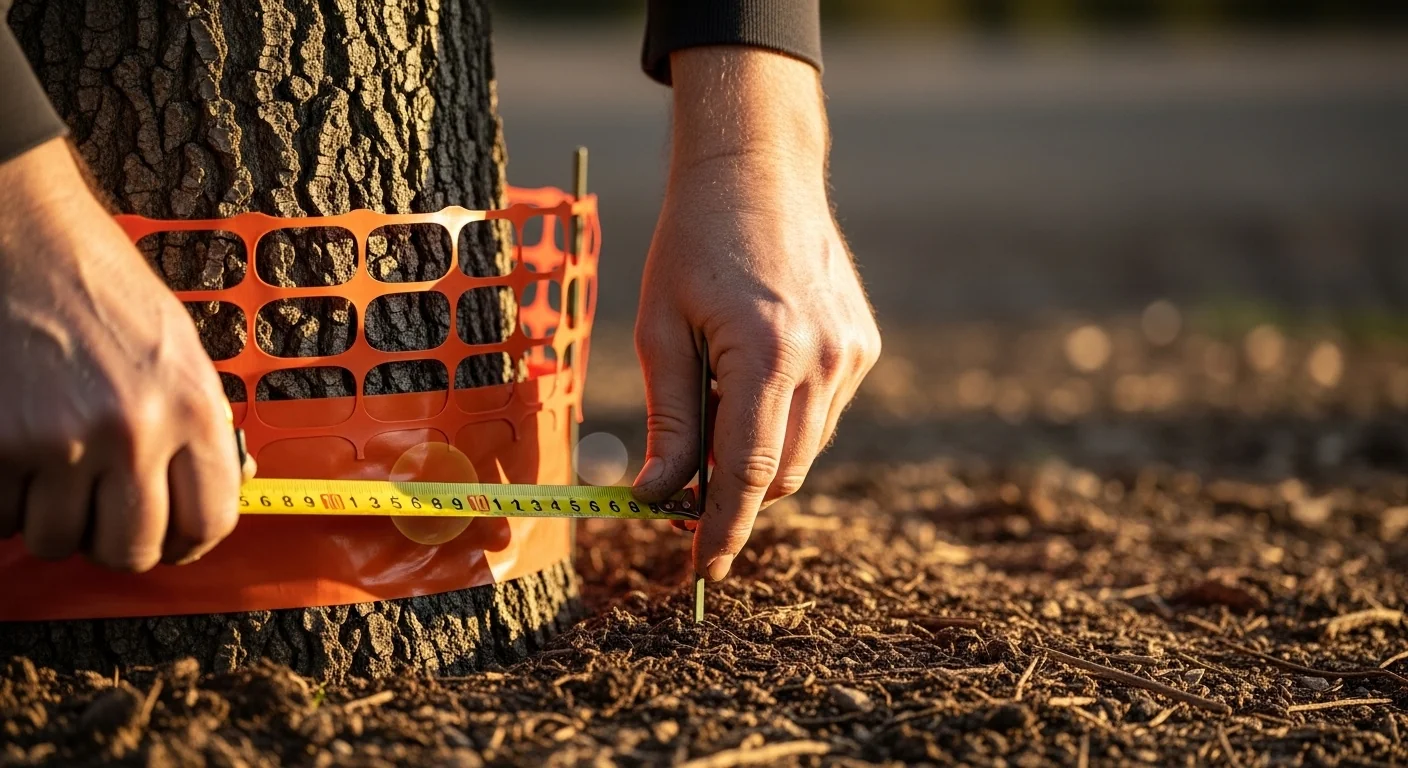
Once you have the CRZ radius for each tree, the next action is translating those numbers into physical site markings before equipment arrives. Flag each tree’s center, measure the radius in at least four compass directions, and install visible fencing at the perimeter. If multiple trees have overlapping CRZ boundaries, treat the union of those zones as a single continuous exclusion area. For projects where new tree plantings are planned after construction closes, the tree staking tension calculator helps size the support system for replacement specimens correctly from the start.
Post-construction, the ground inside the CRZ benefits from aeration and organic matter restoration to reverse compaction damage caused by any incidental foot traffic during the build. A deep layer of coarse wood chip mulch spread immediately after fence removal jump-starts soil recovery. If any retaining walls were built near the tree zone during the project, verify that drainage behind those structures does not concentrate runoff into the root mass; the retaining wall calculator helps size drainage and backfill layers for wall systems near tree-sensitive areas.
FAQ
What is the Critical Root Zone and why does it matter for construction?
The Critical Root Zone is the ground area directly surrounding a tree trunk where the majority of structurally and functionally important roots are located. During construction, disturbance inside this zone through excavation, compaction, or grade changes cuts off the root system’s ability to supply water and nutrients, leading to decline or death of the tree within one to three growing seasons.
How is DBH measured correctly?
DBH stands for Diameter at Breast Height, taken at exactly 4.5 feet above ground on level terrain. On a slope, measure from the uphill side of the trunk. If you have the circumference measured by a tape wrapped around the trunk, divide that number by pi (3.14159) to get the diameter in the same unit of measurement.
What is the difference between tolerant and sensitive tree classes?
Tolerant trees are generally younger specimens or species with a strong capacity to regenerate roots after disturbance. Sensitive trees are older or belong to species known to suffer significantly from construction impacts. The calculator applies a 1.0x multiplier for tolerant trees and a 1.5x multiplier for sensitive trees, increasing the required protection zone by 50% for higher-risk specimens.
Can I reduce the CRZ if the full zone conflicts with the project footprint?
The CRZ is a minimum protection standard, not a negotiating floor. Reducing it without a certified arborist’s involvement and documentation of mitigation measures significantly increases the risk of tree failure. On projects where the full CRZ cannot be honored, a root pruning barrier installed by an arborist may mitigate some damage on the side facing construction, but this does not replace full-zone protection.
How does this formula relate to the ISA standard?
The DBH-based multiplier approach is widely recognized in the arboriculture industry and consistent with International Society of Arboriculture (ISA) Best Management Practices for Tree Protection During Construction. The specific multipliers of 1.0 and 1.5 are applied based on tree sensitivity, which aligns with ISA guidance that recommends larger buffers for old-growth, heritage, or structurally significant trees.
Does this calculator work for multi-trunk trees?
Multi-trunk trees require a different measurement approach. One common method is to calculate the DBH of each trunk, then use the formula: combined DBH equals the square root of the sum of each trunk’s squared diameter. Enter that combined value as the DBH. For complex specimens, a site arborist should verify the measurement and may set a custom protection radius based on species and site conditions.
Conclusion
The tree root protection calculator turns two straightforward inputs into a defensible, formula-based exclusion zone that construction teams can stake, fence, and reference throughout a project. The radius output is not a suggestion. It represents the boundary below which root loss, soil compaction, and grade change accumulate toward a 25% damage threshold that typically proves fatal to the tree. Getting that number right before mobilization is the difference between a tree that recovers and one that fails three years after the job site closes.
The single most avoidable error is applying a uniform, underscaled protection zone to every tree regardless of size or sensitivity. A 6-inch sapling and a 48-inch heritage oak are not the same planning problem. Run each tree separately, use the sensitive class when in doubt, and install physical fencing before any other site activity begins. For additional tree care planning on the same property, the critical root zone calculator offers a complementary approach to validating protection boundaries across different project contexts.