
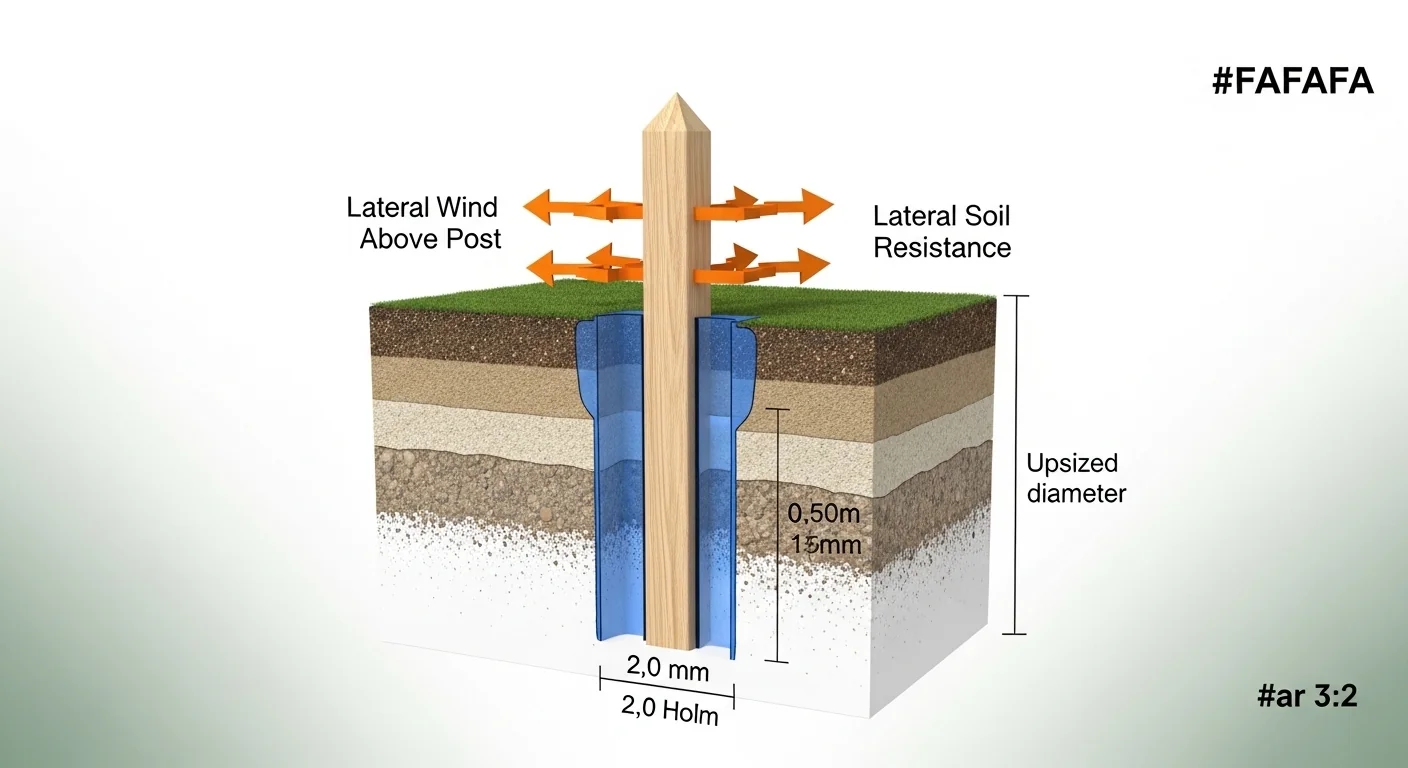
A solid 6-foot privacy fence panel spanning 8 feet presents 48 square feet of unbroken surface to the wind. At 70 miles per hour, the lateral force pressing against that single panel exceeds 600 pounds. The post does not feel that force uniformly. It acts as a lever arm, with the soil line as the fulcrum. A post buried only 2 feet gives that lever arm almost no counter-resistance, which is why shallow posts do not simply lean over time. Under a genuine wind gust, they rip out of the ground in seconds.
This tool calculates recommended burial depth and post-hole diameter using the ASCE 7 simplified wind-pressure formula, the structural 1/3 burial rule, and soil-type lateral resistance values. It flags when wind force exceeds soil shear capacity and when the hole diameter must be increased to compensate. What it does not do: it cannot factor in post wood species, post cross-section size, gate hardware loading, or site exposure category adjustments required by a licensed structural engineer. For permit-required or high-value installations, treat these results as a grounded starting point rather than a permit-ready specification. If you are planning fencing near other property structures, the tree staking tension calculator demonstrates how the same wind-load lever arm logic applies to any vertical element anchored in soil.
After entering your fence height, panel length, fence type, local peak wind speed, and soil type, you will know the minimum burial depth and post-hole diameter to specify before purchasing concrete or renting an auger.
Use the Tool
Wood Fence Wind Load & Post Burial Depth Calculator
Calculate required fence post depth based on wind forces, soil type, and fence dimensions
| Parameter | Value |
|---|
| Fence Size | Type | 50 mph | 70 mph | 90 mph |
|---|
How This Calculator Works
- Effective Area: Fence Height × Panel Length × Porosity Factor (1.0 for solid, 0.5 for picket) = wind-catching area in sq ft.
- Wind Force: 0.00256 × Wind Speed² × Effective Area = lateral force in pounds (ASCE 7 simplified).
- Minimum Depth (1/3 Rule): Total post length × 0.33. For a 6 ft above-ground fence, the post is at least 9 ft total, so minimum burial = ~3 ft.
- Soil Shear Check: If wind force exceeds soil lateral bearing capacity at minimum depth, the calculator upsizes the hole diameter or increases depth.
- Concrete Volume: Estimated from the final hole diameter and burial depth for each post.
Assumptions & Limits
This calculator uses a simplified ASCE 7 wind-pressure formula for flat surfaces. Real-world wind loads vary with terrain exposure, nearby structures, and fence orientation.
Soil bearing values are generalized: Sand ≈ 100 lbs/sq ft, Loam ≈ 200 lbs/sq ft, Hard Clay ≈ 300 lbs/sq ft of projected post-hole wall area.
Post spacing is assumed at 8 ft on-center (one post per panel). Actual spacing may differ.
Results are for wood posts set in concrete. Metal posts, helical anchors, or bracketed posts have different performance characteristics.
Frost line depth is not included. In cold climates, burial depth must also exceed local frost line (often 36–48 inches).
Always consult local building codes and a structural engineer for critical or permit-required fence installations.
Recommended Products
Fast-Setting Concrete Mix: Quikrete Fast-Setting Concrete Mix — sets in 20–40 minutes, no mixing required for post holes.
Earth Auger: A gas-powered earth auger (e.g., Earthquake or Toro) dramatically speeds up digging, especially in hard clay.
Post Bases: Simpson Strong-Tie galvanized steel post bases — protect against ground moisture and simplify post replacement.
Post Leveler: A magnetic post level tool ensures plumb alignment on every post.
Before calculating, have four measurements ready: fence height above grade in feet, panel length in feet, your area's peak wind gust speed in miles per hour (available from ASCE wind maps or your local building department), and the dominant soil type in the post locations. Select solid for board-on-board or tongue-and-groove privacy panels; select picket only for fence styles that allow wind to pass through roughly half the panel face. Entering the wrong fence type is the single most common source of underestimation in manual fence-post calculations.
Quick Start (60 Seconds)

- Fence Height Above Ground: Measure from finished grade to the top of the fence board, in feet. Do not include the post height above the fence line. Range: 1 to 12 feet.
- Fence Length: Enter the length of one panel span between posts, not the total fence run. Standard panel spans are 6 or 8 feet. Range: 1 to 20 feet.
- Fence Type: Solid means any panel where boards are touching or overlapping with no visible gaps. Picket or 50% open means spaced pickets where at least half the panel face is open air. If you are unsure, choose solid for a conservative result.
- Local Peak Wind Speed: This is the design wind speed for your area, not average wind. Check ASCE 7 wind hazard maps or your local jurisdiction's building code. Coastal and hurricane-prone regions often require 130 mph or higher. Midwest residential zones are typically 90 to 115 mph.
- Soil Type: Choose the soil type at post-hole depth, not at the surface. Sandy loam topsoil often gives way to clay subsoil at 12 to 18 inches. When in doubt, select sand for a conservative result.
- Common input mistake: Using the total fence run as panel length. The calculator uses one post's tributary wind area, not the full fence length.
- Unit reminder: All lengths are in feet, all speeds in miles per hour. The output depth is in decimal feet; multiply by 12 to convert to inches.
Inputs and Outputs (What Each Field Means)
| Field | Unit | What It Represents | Common Mistake | Safe Entry Guidance |
|---|---|---|---|---|
| Fence Height Above Ground | feet | Vertical dimension of the fence panel above finished grade; drives the effective wind area and lever arm length | Including post cap height or above-panel trellis height in this measurement | Measure board height only; round up to the nearest 0.5 ft |
| Fence Length | feet | Horizontal span of one panel between two posts; determines the width of the wind sail | Entering total fence run instead of single-panel span | Standard panels are 6 or 8 ft; measure center-to-center of adjacent posts |
| Fence Type | selection | Controls porosity factor: solid = 1.0, picket = 0.5; doubles the wind force calculation for solid panels | Selecting "picket" for a fence with decorative gaps that are actually narrow and do not meaningfully reduce wind pressure | When panel gaps are narrower than 1 inch, treat as solid |
| Local Peak Wind Speed | mph | Design gust speed used in the ASCE 7 pressure formula; squared in the calculation, so small increases have large force effects | Using average annual wind speed or airport average data instead of the design gust speed from local building code | Source from ASCE 7 wind hazard tool or local building department; coastal areas often exceed 130 mph |
| Soil Type | selection | Determines lateral bearing capacity of the hole wall; sand = 100 lb/sq ft, loam = 200 lb/sq ft, hard clay = 300 lb/sq ft | Using surface soil appearance to classify subsoil; disturbed fill around a foundation is not native loam | Dig a test hole to 18 inches before selecting; sandy soil at the post bottom is the relevant condition |
| Recommended Depth (output) | feet | Minimum burial depth for the post to resist the calculated lateral wind force at the selected safety margin | Treating this as a final permit specification without verifying local frost line requirements | Add frost depth if your region requires it; always use whichever depth is greater |
| Recommended Hole Diameter (output) | inches | Minimum hole diameter needed so that soil wall area provides sufficient lateral resistance; upsized automatically when wind load exceeds resistance at the standard 10-inch diameter | Assuming a standard 10-inch auger bit is always sufficient | Rent the correct auger diameter before starting; retrofitting a wider hole around a set post is not practical |
| Safety Factor (output) | ratio (x) | Ratio of soil lateral resistance to wind force; values below 1.2 indicate a high-risk configuration | Ignoring a yellow or red safety rating and proceeding with the minimum depth | Target a safety factor of 2.0 or greater for privacy fences; increase depth or hole diameter to improve it |
| Concrete Volume / Bags (output) | cu ft / count | Estimated concrete volume per post based on hole diameter and depth; given for 60 lb and 80 lb bag formats | Buying a single bag per post regardless of hole size | Always round up by one bag per post to account for irregular hole walls and spillage |
Worked Examples (Real Numbers)
Example 1: Standard 6-Foot Privacy Fence in Average Soil, 70 mph Wind
Zone
- Fence Height: 6 ft
- Panel Length: 8 ft
- Fence Type: Solid Privacy (porosity factor 1.0)
- Wind Speed: 70 mph
- Soil Type: Loam (200 lb/sq ft lateral resistance)
Effective Area = 6 x 8 x 1.0 = 48 sq ft
Wind Force = 0.00256 x 702 x 48 = 0.00256 x 4,900 x 48 = 601 lbs
Total Post Length = 6 / 0.667 = 9.0 ft; Minimum Depth = 9.0 x 0.33 = 3.0 ft
Hole Wall Area (10-inch hole) = (10/12) x pi x 3.0 = 7.85 sq ft
Soil Resistance = 7.85 x 200 = 1,570 lbs; Safety Factor = 1,570 / 601 = 2.6x
Result: 3.0 ft burial depth, 10-inch hole, safety factor 2.6 (green). At 70 mph in loam, a standard installation comfortably clears the 2x safety threshold with a 10-inch auger.
Example 2: 8-Foot Privacy Fence in Sandy Soil, 90 mph Coastal Wind
Zone
- Fence Height: 8 ft
- Panel Length: 8 ft
- Fence Type: Solid Privacy (porosity factor 1.0)
- Wind Speed: 90 mph
- Soil Type: Sand (100 lb/sq ft lateral resistance)
Effective Area = 8 x 8 x 1.0 = 64 sq ft
Wind Force = 0.00256 x 8,100 x 64 = 1,327 lbs
Minimum Depth = (8 / 0.667) x 0.33 = 4.0 ft
Soil Resistance at 10-inch hole = (10/12) x pi x 4.0 x 100 = 1,047 lbs; insufficient (1,047 < 1,327)
Hole upsized to 14 inches: Wall Area = (14/12) x pi x 4.0 = 14.66 sq ft; Resistance = 1,466 lbs
Safety Factor = 1,466 / 1,327 = 1.1x (yellow)
Result: 4.0 ft burial, 14-inch hole required. The safety factor of 1.1 remains marginal even with the upsized hole. An 8-foot solid fence in sandy coastal soil is the most demanding configuration this tool addresses, and a structural engineer review is advisable before installation.
Example 3: 4-Foot Picket Fence, Moderate Wind, Any Soil
- Fence Height: 4 ft
- Panel Length: 8 ft
- Fence Type: Picket / 50% Open (porosity factor 0.5)
- Wind Speed: 50 mph
- Soil Type: Loam (200 lb/sq ft)
Effective Area = 4 x 8 x 0.5 = 16 sq ft
Wind Force = 0.00256 x 2,500 x 16 = 102 lbs
Minimum Depth = (4 / 0.667) x 0.33 = 2.0 ft
Soil Resistance = (10/12) x pi x 2.0 x 200 = 1,047 lbs; Safety Factor = 1,047 / 102 = 10.3x
Result: 2.0 ft burial, standard 10-inch hole. Open picket fencing at this height captures so little wind force that even sandy soil would clear the minimum threshold comfortably at moderate wind speeds.
Reference Table (Fast Lookup)
| Fence Height | Panel Length | Type | Wind (mph) | Soil | Wind Force (lbs) | Rec. Depth (ft) | Hole Dia. (in) | Safety Factor | Risk Level |
|---|---|---|---|---|---|---|---|---|---|
| 4 ft | 8 ft | Solid | 70 | Loam | 401 | 2.0 | 10" | 2.6x | Green |
| 6 ft | 8 ft | Solid | 50 | Sand | 307 | 3.0 | 10" | 2.6x | Green |
| 6 ft | 8 ft | Solid | 70 | Loam | 601 | 3.0 | 10" | 2.6x | Green |
| 6 ft | 8 ft | Solid | 90 | Loam | 995 | 3.0 | 10" | 1.6x | Yellow |
| 6 ft | 8 ft | Solid | 90 | Sand | 995 | 3.0 | 14" | 1.1x | Yellow |
| 6 ft | 8 ft | Picket | 90 | Sand | 498 | 3.0 | 10" | 1.6x | Yellow |
| 8 ft | 8 ft | Solid | 70 | Loam | 802 | 4.0 | 10" | 2.6x | Green |
| 8 ft | 8 ft | Solid | 90 | Loam | 1,327 | 4.0 | 10" | 1.6x | Yellow |
| 8 ft | 8 ft | Solid | 90 | Sand | 1,327 | 4.0 | 14" | 1.1x | Yellow |
| 8 ft | 8 ft | Solid | 110 | Clay | 1,980 | 4.0 | 10" | 1.6x | Yellow |
Wind force scales with the square of speed, so moving from 70 mph to 90 mph increases lateral force by approximately 65 percent. The safety factor column above is derived directly from the formula, not general guidance. Any configuration showing yellow should be reviewed against your local frost line requirement and, for 8-foot fences, a structural engineer's sign-off is advisable.
How the Calculation Works (Formula + Assumptions)
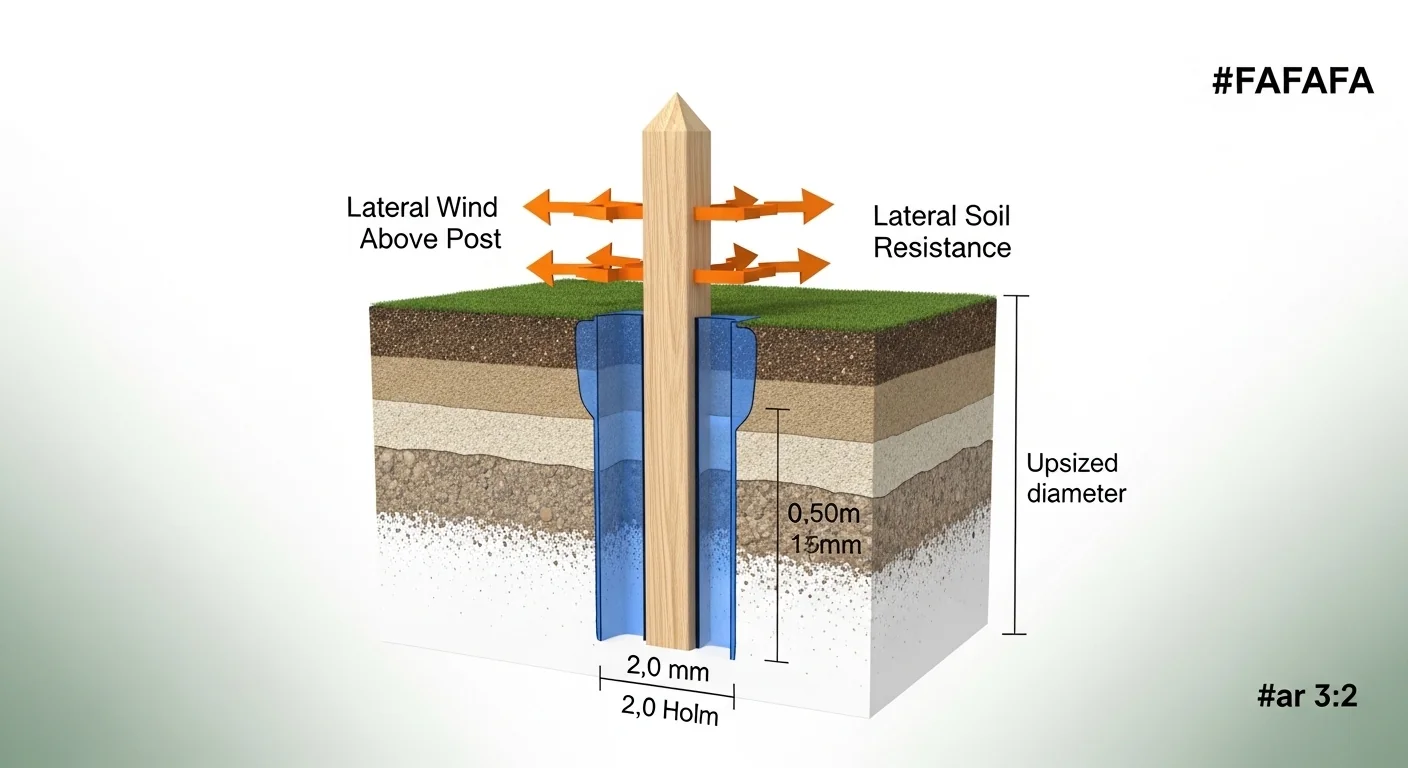
Show the calculation steps
Step 1: Effective Wind Area
Area (sq ft) = Fence Height (ft) x Panel Length (ft) x Porosity Factor
Porosity Factor = 1.0 for solid panels; 0.5 for picket or 50% open panels.
This is the surface area the wind actually acts against, not the total fence face.
Step 2: Lateral Wind Force
Wind Force (lbs) = 0.00256 x Wind Speed2 (mph) x Effective Area (sq ft)
The constant 0.00256 is derived from the ASCE 7 simplified wind pressure equation for flat surfaces at standard air density. This produces force in pounds directly when speed is in mph and area is in square feet.
Rounding: results rounded to the nearest whole pound.
Step 3: Minimum Burial Depth (1/3 Rule)
Total Post Length = Fence Height / 0.667
Minimum Depth = Total Post Length x 0.33
This is the industry-standard rule: one-third of the total post length must be in the ground. For a 6-foot fence, total post = 9 ft, minimum burial = 3.0 ft.
Rounding: depth rounded to one decimal place; hard minimum of 2.0 ft applied regardless of formula result.
Step 4: Soil Lateral Resistance Check
Hole Wall Area (sq ft) = (Hole Diameter / 12) x pi x Burial Depth
Soil Resistance (lbs) = Hole Wall Area x Soil Bearing Value (lb/sq ft)
Soil bearing values used: Sand = 100, Loam = 200, Hard Clay = 300 lb/sq ft of projected hole wall area.
If Wind Force exceeds Soil Resistance at a 10-inch hole, the hole diameter is automatically increased using the soil's upsize multiplier (sand: 1.4x, loam: 1.15x, clay: 1.0x) and the resistance is recalculated.
If resistance still falls short, burial depth is increased until resistance equals wind force.
Step 5: Concrete Volume
Volume (cu ft) = pi x (Hole Radius in ft)2 x Burial Depth
Bags per post: 60 lb bag = 0.45 cu ft; 80 lb bag = 0.6 cu ft. Results rounded up to the nearest whole bag.
Assumptions and Limits
- Post spacing is assumed at one post per panel (8-foot on-center maximum). Closer post spacing reduces the tributary wind area per post and reduces required depth.
- Soil bearing values are generalized averages for undisturbed native soil. Disturbed, filled, or saturated soils have significantly lower resistance and are not represented by these values.
- The formula applies to flat vertical surfaces. Curved, louvered, or lattice-top fence panels have different aerodynamic behavior and may not be accurately represented.
- Frost line depth is not incorporated. In regions with seasonal ground freeze, burial depth must also clear the local frost depth, which can exceed 48 inches in northern climates. Use whichever depth value is greater.
- Post cross-section size is not a variable. The calculator does not differentiate between 4x4 and 6x6 posts; larger post sections add rotational resistance that the model does not credit.
- The ASCE 7 simplified formula does not account for terrain exposure category, topographic effects, or wind channeling between structures. Open, flat sites and the downwind side of buildings experience materially different gust factors.
- Gate hardware, pergola attachments, or planter boxes attached to the fence add vertical and horizontal loads not captured here.
Standards, Safety Checks, and "Secret Sauce" Warnings
Critical Warnings
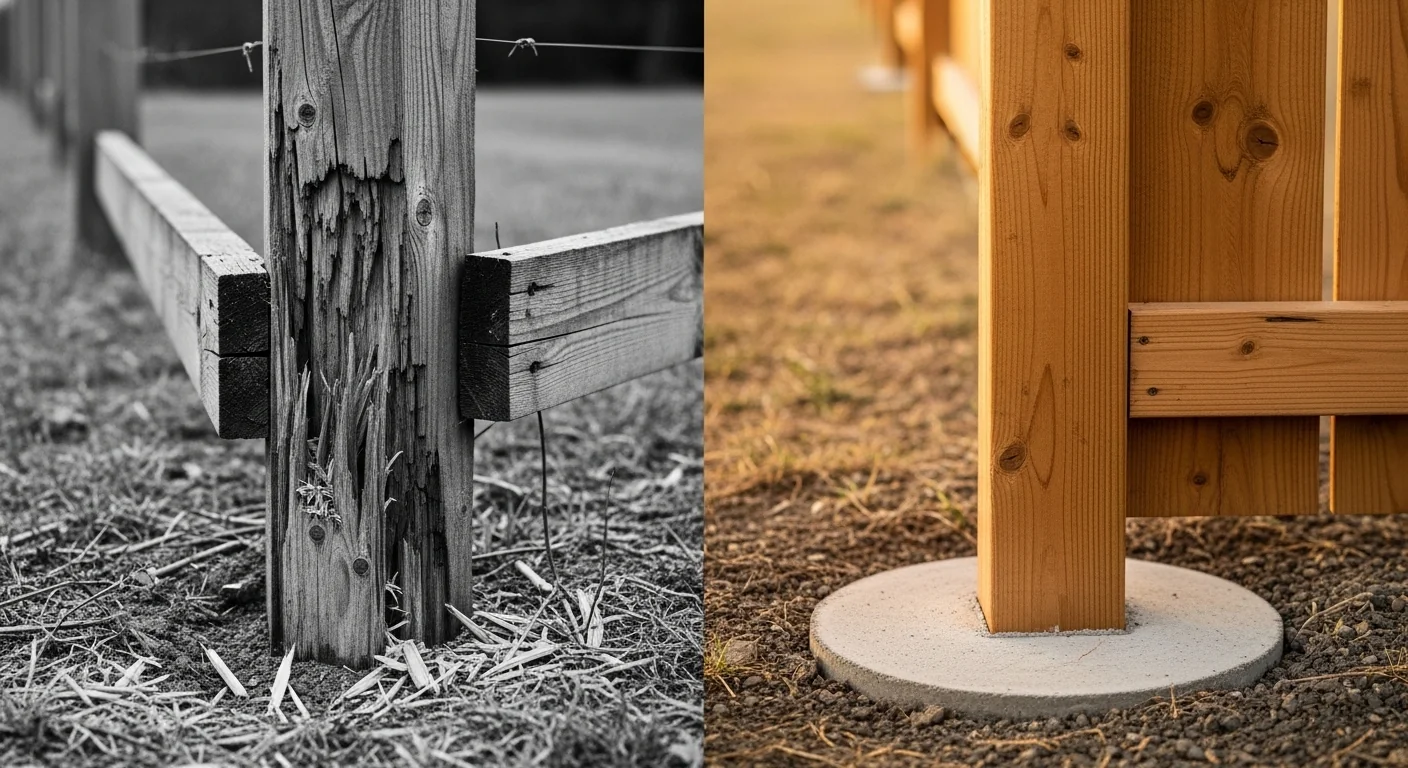
- The 2-Foot Snap: A solid 6x8-foot fence panel acts as a rigid sail. At 50 mph wind, the calculated lateral force on that single panel exceeds 300 pounds. At 70 mph, it exceeds 600 pounds. A post buried only 2 feet provides insufficient counter-leverage at the fulcrum (the soil line), and the fence will either rip out or snap at grade under a sustained gust. The 1/3 rule is not conservative for solid panels in high-wind zones; it is the absolute minimum.
- Sandy Soil is Not a Substitute for Depth: Sand provides roughly one-third the lateral resistance of hard clay. Many residential fence failures occur where builders use loam-based depth guidelines in sandy coastal or desert soils. The calculator automatically upsizes the hole diameter in sandy soil, but even a 14-inch hole may yield a marginal safety factor for tall solid fences. Augmenting with compacted gravel backfill around the bottom 12 inches of the post provides additional resistance not captured in the concrete-only model.
- Wind Force Scales with the Square of Speed: The difference between a 70 mph and 90 mph design wind is not a 29-percent increase in force. It is closer to 65 percent. Underestimating your local design wind speed by 20 mph dramatically changes whether your posts hold.
- Frost Heave and Burial Depth: In freeze-thaw climates, posts buried above the frost line will heave vertically over repeated winters, loosening the concrete collar and reducing lateral resistance. This is a slow failure mode that looks like settling but is structurally identical to using insufficient depth from day one.
Minimum Standards
- Minimum burial depth: 1/3 of total post length, no less than 2 feet for any post regardless of load.
- Minimum hole diameter: 10 inches for posts up to 6 feet above grade in loam or clay; 12 to 14 inches for sand or wind speeds above 80 mph.
- Concrete encasement: all posts supporting solid panels in wind-exposed locations should be set in concrete, not compacted soil alone. Fast-setting concrete is acceptable if water is added per manufacturer specifications.
- Safety factor target: 2.0 or above for fence configurations that include a locked gate or an attached structure. The calculator flags anything below 1.2 as high-risk.
If you are building a retaining wall in the same project, the retaining wall calculator uses the same soil bearing categories applied here and can help you determine whether the soil conditions that constrain your fence posts also affect your wall footing design. For post-hole backfill that uses a gravel base layer below the concrete collar, the gravel calculator can estimate the volume of drainage gravel needed before concrete placement.
Competitor Trap: Most online fence post depth guides state "bury the post one-third of its length" and stop there. That rule is derived from average-soil, average-wind conditions and says nothing about the hole diameter required when wind force outpaces soil resistance. For a tall solid privacy fence in sandy soil at 90 mph, the standard 1/3 depth with a 10-inch hole produces a safety factor well below 1.0 at the soil resistance calculation. The post meets the rule on paper and fails in a storm. The safety check and hole-diameter adjustment in this tool exist specifically to catch those configurations.
Common Mistakes and Fixes
Mistake: Using Total Fence Run as Panel Length
Entering 60 feet (total fence length) instead of 8 feet (panel span between posts) inflates the calculated wind force by a factor of 7.5 and produces an impossibly large recommended depth. The tool calculates the load on one post, not the entire fence. Each post handles the wind load from half the panel on each side of it, but since the calculator treats a single span, the panel length input should reflect one post's tributary width. Fix: always enter the center-to-center distance between two adjacent posts.
Mistake: Selecting the Wrong Soil Type for the Post Bottom
Topsoil visible at grade looks like loam but is irrelevant. The post is anchored by the soil at depth, which is often a different material. In many residential lots, 6 to 18 inches of placed topsoil overlies clay subsoil; in coastal areas, clay subsoil often gives way to saturated sand below 24 inches. Digging a test hole before running this calculation prevents a systematic underestimate of required hole diameter. Fix: inspect the soil at the planned post-hole depth, not at grade.
Mistake: Treating Picket and Solid Fences Identically
Some fence contractors apply a single depth standard to all wood fences regardless of panel type. A 6x8-foot solid panel captures twice the wind force of a comparably sized picket fence with 50% open spacing. Using a picket-derived depth rule on a solid panel in the same conditions is a systematic underdesign. Fix: always classify fence type honestly; when in doubt, calculate as solid.
Mistake: Ignoring the Hole Diameter and Buying a Single 10-Inch Auger
Bit
Rental augers are typically available in 6-inch, 10-inch, 12-inch, and 14-inch diameters. Many installers rent a 10-inch bit regardless of soil type and fence height. For tall solid fences in sandy soil, the calculator may require a 14-inch hole, which changes which auger to rent before the project starts. Retrofitting a wider hole around a post already set in concrete is not practical. Fix: run the calculation before renting equipment and confirm hole diameter first. For property improvements that also involve base material planning, see the paver base calculator for how hole and trench sizing decisions affect material quantities in adjacent hardscape work.
Mistake: Skipping the Frost Line Check After Calculating Wind Depth
The calculated wind-load depth may be 3.0 feet, but the frost line in Chicago is 42 inches (3.5 feet). These two requirements operate independently and do not automatically stack in most online calculators. Using the wind-derived depth without verifying that it also clears the frost line leads to frost heave failures that appear gradually over 2 to 3 winters. Fix: look up your local frost penetration depth from local building codes or USDA frost depth maps, and use whichever depth is greater.
Next Steps in Your Workflow
Once you have a confirmed burial depth and hole diameter, the next decision is concrete volume. The calculator provides an estimate per post, but always round up by at least one bag to account for irregular hole walls and aggregate displacement. Fast-setting concrete mixes are appropriate for post holes when the hole is dry or can be kept dry during curing; saturated sandy soil requires a different approach where the post is braced for 24 to 48 hours while the concrete sets. If your fence installation connects to an outdoor stair or landing structure, see the outdoor stair riser calculator to coordinate post layout with riser height before finalizing post locations.
After the concrete cures, the remaining planning step is material quantity for the fence run itself. Landscape edging along the fence line helps define the border, contain mulch beds, and protect fence bases from lawn mower contact, which is one of the more common causes of accelerated wood rot at grade. The landscape edging calculator can size that material once your total fence run and layout are confirmed.
FAQ
What is the standard rule for fence post depth?
The structural industry standard is to bury one-third of the total post length. For a fence that is 6 feet above grade, the total post is approximately 9 feet and the minimum burial is 3 feet. This is a minimum baseline, not a target. Wind speed, soil type, and hole diameter all determine whether that depth is actually adequate for the specific installation conditions.
Does fence type really change the depth required?
Fence type changes the wind force calculation, not the burial rule directly. A solid privacy panel captures twice the lateral force of a 50% open picket panel under identical wind conditions. That force feeds into the soil resistance check, which is what triggers a depth or hole-diameter increase. Two otherwise identical fences in the same soil can require different hole diameters based entirely on whether the panels are solid or open.
How does soil type affect post depth?
Soil type determines how much lateral resistance the hole wall provides per square foot. Sandy soil resists only 100 lbs per square foot; hard clay resists 300 lbs per square foot. To compensate for lower resistance in sandy soil, either hole diameter or burial depth must increase. Sandy soil does not change the 1/3 rule, but it often triggers a hole upsize to 12 or 14 inches on tall solid fence panels in moderate-to-high wind zones.
Should I use concrete for all fence posts?
For solid privacy panels in wind-exposed locations, concrete encasement is the appropriate choice. Compacted gravel backfill without concrete can be adequate for shorter picket fences in sheltered locations with good-quality soil, but it provides significantly less resistance against lateral rotation under peak gusts. Any fence configuration that returns a yellow or red safety factor should be set in concrete.
What is the 2-foot snap failure mode?
The 2-foot snap describes the failure pattern where a post buried only 2 feet acts as a short lever arm. The wind force on a tall solid panel applies as a lateral load at the midpoint of the panel height. With only 2 feet of burial, the soil cannot provide enough counter-moment to resist rotation at the grade line. The post either pivots out of the ground or fractures at grade. This failure mode is fast under a gust and does not give warning signs beforehand.
Does this calculator account for frost heave?
Frost heave is not incorporated into the depth formula. The tool calculates wind-load depth only. In freeze-thaw climates, posts must be buried below the local frost line to prevent vertical heaving that loosens the concrete collar over time. Check your local building code for the required frost depth and use whichever value is greater: the wind-load result or the frost penetration depth for your region.
Conclusion
The single most common mistake is assuming that a standard 10-inch hole is always sufficient. For tall solid fences in wind zones above 80 mph or in sandy soils, a 12 to 14-inch hole is often required before the safety factor reaches an acceptable level. Running this calculation before renting equipment and pouring concrete costs nothing and prevents the most expensive outcome: resetting posts after a storm. If your project also involves tree plantings near the fence line, the tree root protection calculator can help you plan appropriate setback distances to avoid long-term root interference with fence footings.