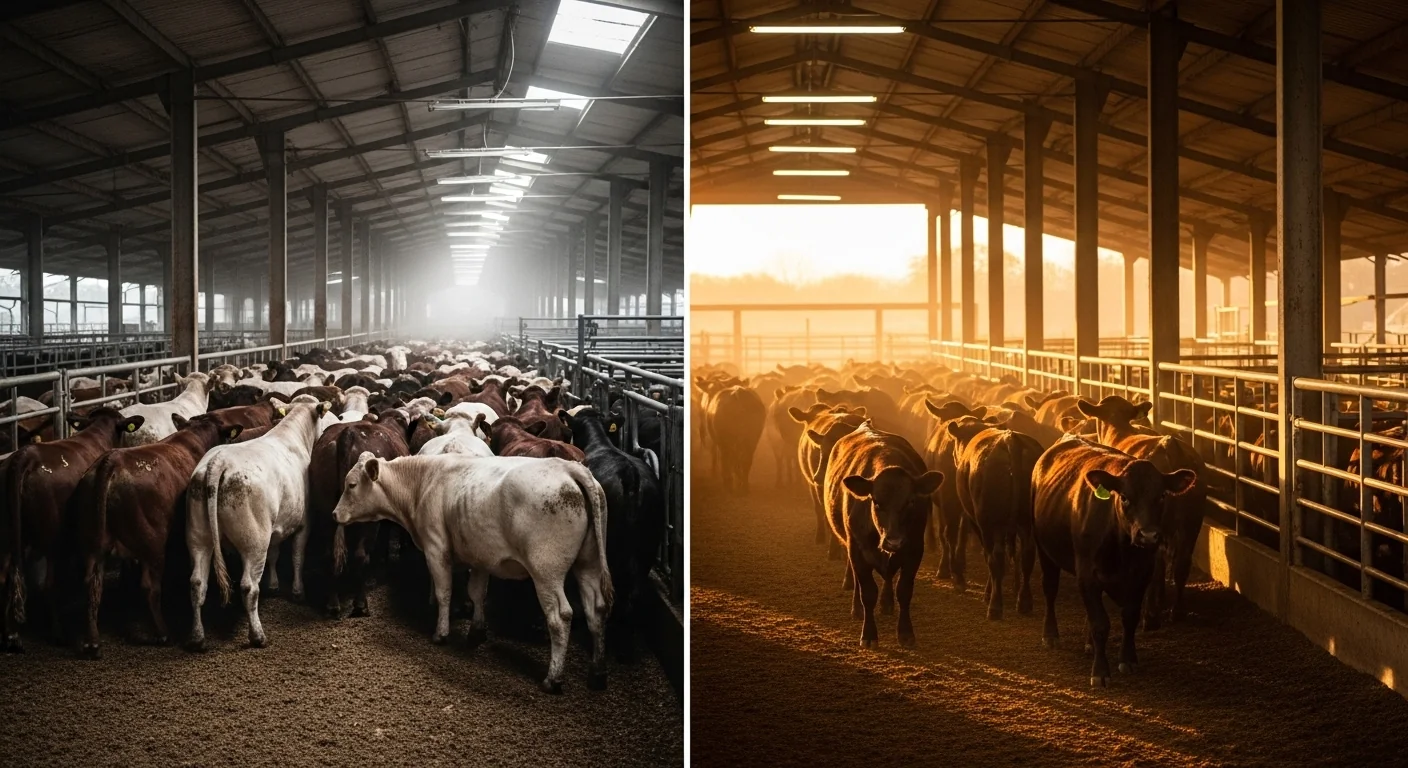
A sweep tub that is too full does not just slow your cattle down. It removes their ability to see an exit. Cattle are prey animals with nearly 330-degree panoramic vision, but they have a blind spot directly behind them. When a crowding pen is packed past its safe geometric threshold, animals begin moving into each other’s rear blind zones. The instinctive response is not to move forward. It is to turn, balk, and attempt to escape vertically, which puts handlers in serious danger.
This calculator computes the usable capacity of a sweep tub or Bud Box based on the quarter-circle geometry of the tub, the weight class of your cattle, and the facility style you have chosen. It identifies the 50% fill threshold below which cattle retain enough visual access to exit paths to move calmly. It does not replace a facility layout plan, soil engineering assessment, or chute brand specifications. The output is a capacity and safety-zone number, not a full facility design.
After running this calculator, you will know exactly how many head you can crowd into your sweep tub or Bud Box per batch before crossing into the panic threshold, and how many batches your herd will require to process safely.
Use the Tool
How This Calculator Works
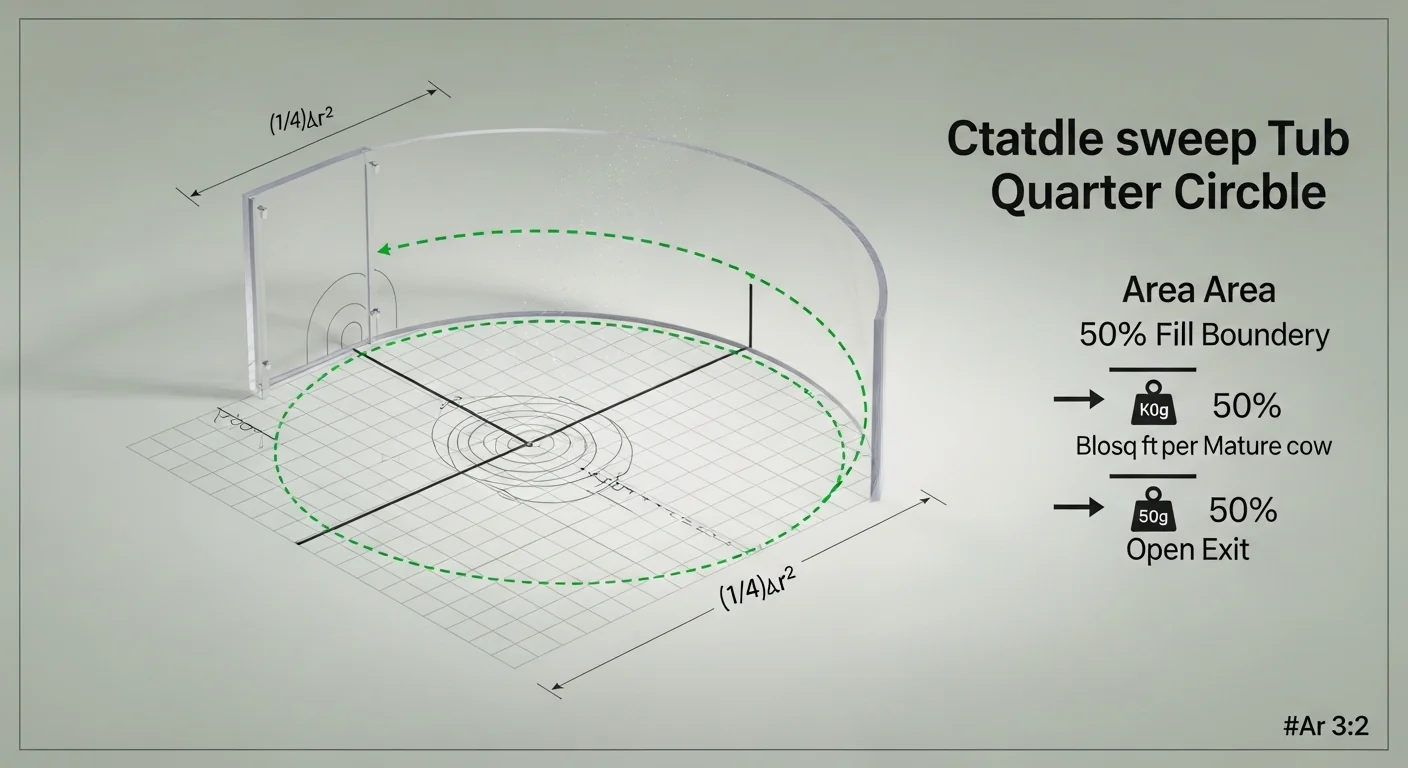
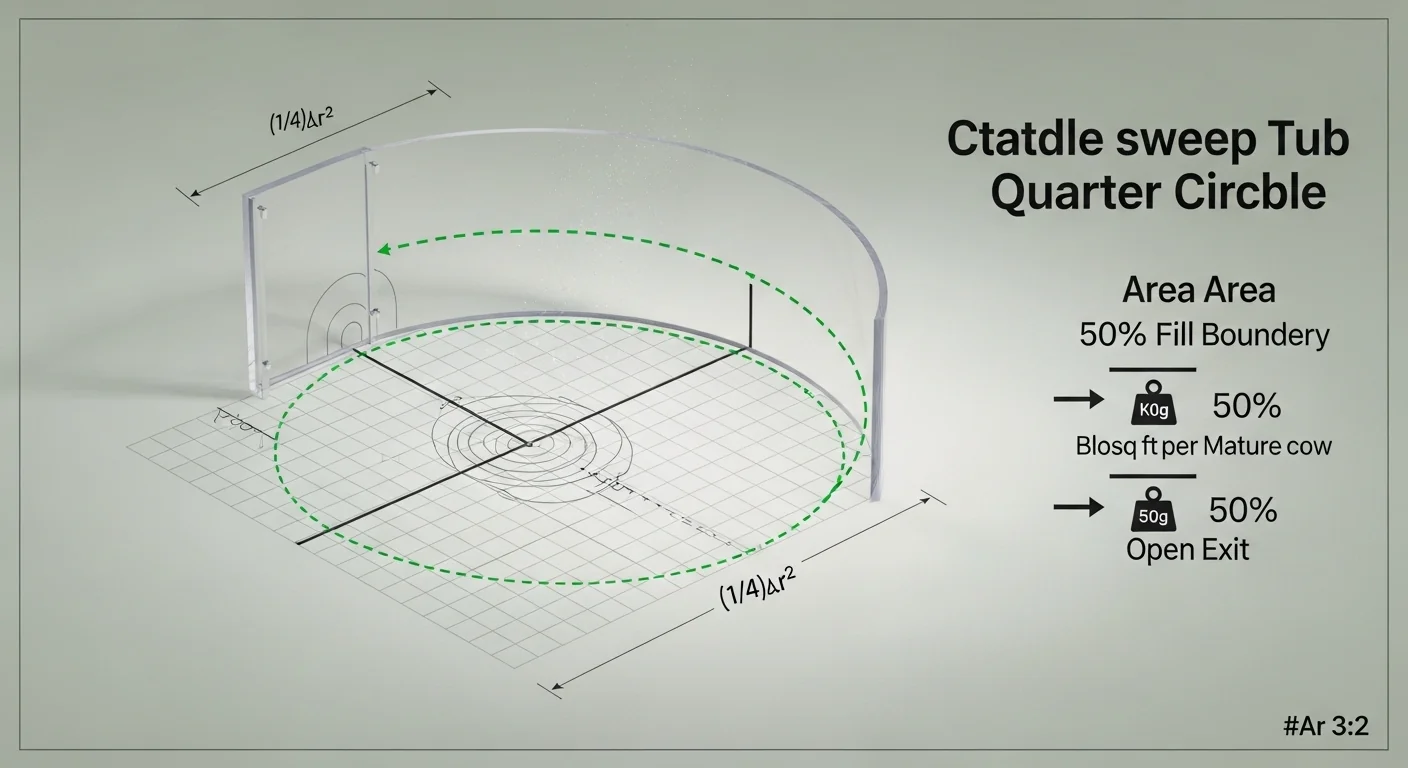
Sweep Tub Capacity: The tub area is calculated as a quarter-circle (90-degree arc):
Tub Area (sq ft) = (1/4) × π × Radius²
Space Per Animal: A mature cow needs roughly 20 sq ft of space in a crowding pen. Lighter cattle (under 700 lbs) need approximately 14 sq ft.
Max Cows in Tub = Tub Area ÷ Space Per Animal
Fill Percentage: We calculate how full the tub is relative to safe capacity:
Fill % = (Herd Size ÷ Max Cows in Tub) × 100
Flight Zone Geometry: Cattle are prey animals with nearly 330° panoramic vision, but have a blind spot directly behind them (~30° arc). When the tub curve places animals in each other’s blind spots or blocks the view of exits, panic escalates. The critical threshold is 50% fill — above this, cattle cannot see an exit path and balking/panic behavior triggers.
Bud Box Mode: A Bud Box uses a rectangular pen (typically 12 ft × 20–24 ft). Cattle enter, see the handler, and naturally turn back toward the alley entrance. Space requirement stays the same — 20 sq ft per mature cow.
Assumptions: Quarter-circle sweep tub geometry. 20 sq ft per head for cattle over 700 lbs; 14 sq ft for lighter stock. Panic threshold at 50% fill is based on Temple Grandin’s handling research. Bud Box dimensions assume a standard 12 ft × 20 ft layout.
Assumptions & Limits
Space allowance: 20 sq ft per head is a widely accepted guideline from livestock handling standards (Temple Grandin). Actual needs vary by breed, temperament, and horned vs. polled cattle.
Tub geometry: Assumes a standard quarter-circle (90°) sweep tub. Some facilities use 180° or 270° designs — multiply the area formula accordingly.
Flight zone: The 50% panic threshold is a conservative safety baseline. Acclimated, docile cattle may tolerate higher fills; wild or Bos indicus breeds may panic at lower densities.
Bud Box: Standard dimensions are 12×20 ft. Larger operations may use 14×24 ft. This tool uses 12×20 ft as the default.
Weight classes: Under 700 lbs = 14 sq ft/head; 700 lbs and above = 20 sq ft/head. These are approximate and should be adjusted for specific breeds.
Quick Reference: Sweep Tub Sizes
| Radius (ft) | Tub Area (sq ft) | Safe Max (mature) | Safe Max (calves) |
|---|
Before you run the calculation, have three measurements ready: your estimated maximum working group size (not the full herd, just the batch you plan to process at once), the average weight of those animals in pounds, and the inner radius of your sweep tub in feet. If you are comparing facility styles, run the calculator once for a sweep tub and once with the Bud Box option selected. The Bud Box uses a fixed standard footprint of 12 feet by 20 feet. For quick context on how your facility integrates into a broader livestock management plan, the pasture stocking rate calculator is a useful companion tool for understanding group sizing at the pasture level.
Quick Start (60 Seconds)
- Max Herd Size Processed at Once: Enter the working group, not your total herd. If you process 20 head at a time from a herd of 200, enter 20. Acceptable range is 1 to 200 head.
- Average Cattle Weight: Use pounds. The calculator applies 20 square feet per head for animals at or above 700 lbs and 14 square feet per head for lighter stock. If your group is mixed, use a weighted average or enter the dominant weight class.
- Facility Style: Choose Sweep Tub / Crowding Pen if you have a round or curved crowding pen with a central pivot. Choose Bud Box if you use a rectangular forcing pen where cattle reverse direction to enter the alley.
- Sweep Tub Radius: Measure the inner radius of the curved wall from the pivot point to the inside of the panel, in feet. Common sizes are 10 feet and 12 feet. This field is disabled when Bud Box is selected. Do not confuse diameter with radius.
- Run the calculation: Click Calculate only after all required fields are filled. The tool will not run on incomplete inputs.
- Read the traffic-light indicator first: Green means your group size is within the safe fill zone. Yellow means you are approaching balking territory. Red means your group exceeds the safe threshold and must be split into batches.
- Check the batch count: The result panel shows how many batches are needed to safely process your full group. Build that number into your time estimate before sorting day.
Inputs and Outputs (What Each Field Means)
| Field Name | Unit | What It Means | Common Mistake | Safe Entry Guidance |
|---|---|---|---|---|
| Max Herd Size Processed at Once | head (count) | The number of animals you intend to push into the sweep tub or Bud Box in a single working group | Entering total herd size instead of working group size, which inflates fill calculations | Enter 1 to 200; use the actual batch size, not the entire pen count |
| Average Cattle Weight | lbs | Controls the space allowance per head: 14 sq ft for animals under 700 lbs, 20 sq ft for animals at or above 700 lbs | Using a target weight rather than current body weight, underestimating space needs | Enter 300 to 2500 lbs; use weigh tickets or visual estimate rounded conservatively |
| Facility Style | selection | Determines the geometry model: quarter-circle for sweep tubs, fixed 12×20 ft rectangle for Bud Boxes | Selecting Sweep Tub when the pen is actually a straight-sided forcing pen, inflating capacity estimates | If the pen has a curved wall and a central pivot gate, choose Sweep Tub; if it is four straight walls with a reverse-flow alley entry, choose Bud Box |
| Sweep Tub Radius | feet | The inner radius of the curved panel wall measured from the central pivot point | Measuring the outer panel diameter and dividing by two, which overstates the effective working radius | Enter 6 to 20 ft; stand at the pivot and measure to the inside face of the curved panel |
| Safe Maximum per Fill (output) | head | The number of cattle that fills the tub to exactly 50% of its physical capacity, the threshold below which exit-path visibility is maintained | Treating physical maximum as the working target, which is the most common handler injury scenario | Never plan to push in more animals than this number in a single fill |
| Total Area (output) | sq ft | The geometric area of the sweep tub quarter-circle or Bud Box rectangle available to cattle | None: this is a derived output | Verify this matches your facility drawing before relying on the capacity outputs |
| Batches Needed (output) | count | How many sequential fills are required to process your entire working group at the safe fill level | Ignoring this number and trying to process in fewer, larger batches | Build this number into your workday schedule; each batch adds handling and sorting time |
| Fill Level Gauge (output) | % of physical max | Visual representation of tub density relative to physical capacity, color-coded at 50% and 75% thresholds | Reading a yellow or red gauge as acceptable because cattle “seem fine” | Target green; yellow is a warning zone, not an operational target |
Worked Examples (Real Numbers)
Example 1: Small Cow-Calf Operation, 12-Foot Sweep Tub
- Max herd size processed at once: 8 head
- Average cattle weight: 950 lbs
- Facility style: Sweep Tub
- Sweep tub radius: 12 ft
Tub Area = (1/4) x pi x 12 squared = (1/4) x 3.1416 x 144 = 113.1 sq ft
Space per head: 950 lbs is above 700 lbs, so 20 sq ft per head applies.
Physical max: floor(113.1 / 20) = 5 head
Safe maximum (50% threshold): floor(5 x 0.5) = 2 head
Fill level: (8 / 5) x 100 = 160% — DANGER zone
Result: Pushing 8 head into this 12-foot tub puts it at 160% of physical capacity. The safe batch size is 2 head. Processing this group safely requires 4 sequential batches of 2 head each.
This is the most common scenario where ranchers underestimate how few cattle a sweep tub actually holds safely. The 12-foot tub sounds large, but its quarter-circle geometry gives you only 113 square feet of working floor, supporting just 5 animals physically and 2 safely per fill at standard mature body weights.
Example 2: Mid-Size Operation, 16-Foot Tub, Approaching Caution Zone
- Max herd size processed at once: 9 head
- Average cattle weight: 1,200 lbs
- Facility style: Sweep Tub
- Sweep tub radius: 16 ft
Tub Area = (1/4) x pi x 256 = 201.1 sq ft
Space per head: 1,200 lbs, so 20 sq ft per head.
Physical max: floor(201.1 / 20) = 10 head
Safe maximum: floor(10 x 0.5) = 5 head
Fill level: (9 / 10) x 100 = 90% — DANGER zone
Result: Despite a 16-foot radius tub, 9 head at 1,200 lbs pushes fill to 90% of physical capacity. The safe batch size remains 5 head. Two batches of 5 and 4 head respectively would be the safe processing plan.
This scenario illustrates that larger tubs do not linearly scale safe working capacity. The 50% threshold is the controlling constraint regardless of facility size.
Example 3: Standard Bud Box, Correctly Sized Group
- Max herd size processed at once: 6 head
- Average cattle weight: 1,400 lbs
- Facility style: Bud Box (12 ft x 20 ft)
Bud Box area = 12 x 20 = 240 sq ft
Space per head: 1,400 lbs, so 20 sq ft per head.
Physical max: floor(240 / 20) = 12 head
Safe maximum: floor(12 x 0.5) = 6 head
Fill level: (6 / 12) x 100 = 50% — exactly at the safe threshold
Result: Six head in a standard Bud Box at 1,400 lbs lands exactly at the 50% threshold. One batch. Handler positioning at the point of balance is critical here; pushing the entry panel too aggressively at exactly 50% fill can still cause a surge if cattle sense a rear threat.
The Bud Box’s larger rectangular footprint generally accommodates more cattle per fill than an equivalently sized sweep tub, making it a strong choice for operations where the working alley entry faces the pen door.
Reference Table (Fast Lookup)
All values below assume mature cattle at 1,000 lbs or above (20 sq ft per head). For cattle under 700 lbs, apply 14 sq ft per head and recalculate columns B, C, and D by substituting 14 for 20.
| Tub Radius (ft) | Quarter-Circle Area (sq ft) | Physical Max (mature head) | Safe Fill at 50% (head) | Warning Zone at 75% (head) | Batches to Process 20 Head Safely |
|---|---|---|---|---|---|
| 6 | 28.3 | 1 | 0 | 0 | 20+ |
| 8 | 50.3 | 2 | 1 | 1 | 20 |
| 10 | 78.5 | 3 | 1 | 2 | 20 |
| 12 | 113.1 | 5 | 2 | 3 | 10 |
| 14 | 153.9 | 7 | 3 | 5 | 7 |
| 16 | 201.1 | 10 | 5 | 7 | 4 |
| 18 | 254.5 | 12 | 6 | 9 | 4 |
| 20 | 314.2 | 15 | 7 | 11 | 3 |
| Bud Box 12×20 | 240.0 | 12 | 6 | 9 | 4 |
Key observation: A commonly installed 10-foot radius sweep tub has a physical maximum of just 3 mature cows. Its 50% safe fill is 1 head per batch. Operations using this size tub to process large groups will require many sequential fills and should evaluate whether upgrading to a 16-foot or 18-foot design is economically justified. To compare how that decision interacts with your overall pasture and stocking infrastructure, the rotational grazing calculator can help contextualize herd group sizes against your land base.
How the Calculation Works (Formula + Assumptions)
Show the calculation steps
Step 1 — Compute tub area. For a sweep tub, the working floor is modeled as a quarter-circle (90-degree arc). The area formula is:
Tub Area (sq ft) = (1/4) x pi x Radius squared
For example, a 12-foot radius tub: (1/4) x 3.14159 x 144 = 113.1 sq ft. No rounding is applied to the area itself; rounding occurs only at the floor() step below.
Step 2 — Assign space per head. If average cattle weight is 700 lbs or above, the tool assigns 20 sq ft per head. If average weight is below 700 lbs, 14 sq ft per head is used. There is no graduated scale between these two values; the threshold is a hard cutoff.
Step 3 — Compute physical maximum. Physical max = floor(Tub Area / Space Per Head). The floor function means fractional cattle are always rounded down. A tub area of 113.1 sq ft at 20 sq ft per head gives floor(5.655) = 5 head maximum.
Step 4 — Compute safe fill at 50%. Safe Max = floor(Physical Max x 0.5). This is the number of animals that can enter the tub while every animal retains a visual line to an exit path. Exceeding this number enters the blind-spot panic territory documented in livestock behavior research.
Step 5 — Compute fill percentage. Fill % = (Herd Size / Physical Max) x 100. This is capped visually at 100% in the gauge but the numeric percentage can exceed 100% if the user enters a herd larger than physical max.
Step 6 — Batches needed. Batches = ceiling(Herd Size / Safe Max). If Safe Max is zero (which occurs for very small tubs with large cattle), batches defaults to the herd size itself.
Bud Box mode: When Bud Box is selected, the area is fixed at 240 sq ft (12 ft x 20 ft). Steps 3 through 6 proceed identically using this fixed area.
Rounding rules: Area uses full decimal precision. Physical max and safe max both use floor() rounding (always round down, never up). Batches use ceiling() rounding (always round up). Fill percentage retains one decimal place in the output display.
Assumptions and Limits
- The quarter-circle model assumes the sweep tub is exactly 90 degrees. Many real facilities range from 60 to 270 degrees. For non-standard arc lengths, the 90-degree formula will either underestimate or overestimate usable area significantly.
- The 20 sq ft per head standard applies to mature cattle under typical handling conditions. Heavily horned breeds, highly excitable temperaments (Bos indicus or first-time handlers), or wet conditions may require more space per animal.
- The Bud Box is modeled at the most common standard dimension of 12 feet by 20 feet. Larger operations sometimes use 14 feet by 24 feet. If your Bud Box is larger, this calculator will understate your capacity.
- The 50% fill threshold is a behavioral safety baseline. It is not a regulatory standard. Acclimated, low-stress cattle may tolerate higher densities without balking in some handler-specific conditions.
- This calculator does not account for alley width, squeeze chute approach angle, gate swing geometry, or panel height. All of these factors affect actual flow rates.
- Weight class affects space allowance but not geometry. Two animals at 600 lbs each occupy the same floor space in this model as two at 1,100 lbs when the cutoff is crossed, which is a simplification of a continuous relationship.
- The tool assumes a single-file alley exit from the tub. Dual-exit designs or Y-alleys change the effective exit visibility geometry and may allow slightly higher fill rates in practice.
Standards, Safety Checks, and “Secret Sauce” Warnings
Critical Warnings
- The 50% fill rule is not conservative caution, it is geometric fact. When a sweep tub is filled past 50% of physical capacity, cattle at the rear of the group can no longer see the chute entry or any opening. Their flight zone collapses onto other animals. The behavioral result is pressure buildup, backward turning, and surge events. The tool flags this as a danger zone, not merely as suboptimal.
- Tight curve radius amplifies blind-spot risk. A tub with a 6-foot or 8-foot radius places the curved wall in a much sharper arc relative to cattle body length. As a result, animals enter each other’s rear blind zones at lower fill percentages than they would in a wider-radius tub. The calculator warns explicitly when radius is below 10 feet.
- Very large cattle require re-evaluation of space assumptions. At 1,800 lbs or above, the 20 sq ft standard may need to be increased to 24 to 28 sq ft per head depending on breed frame. The calculator flags this weight class with a dedicated warning in the results panel.
- Exceeding physical capacity is not just inefficient, it is a structural hazard. When herd size surpasses physical maximum, panels and pivot hardware are subjected to compressive force from multiple animals pressing against them simultaneously. This is independent of the panic threshold and represents a hardware failure risk.
Minimum Standards
- Minimum 20 sq ft per head for cattle at or above 700 lbs in a crowding pen or sweep tub (consistent with livestock handling standards developed from behavioral research).
- Minimum 14 sq ft per head for calves and lightweight stocker cattle below 700 lbs.
- Safe working fill should not exceed 50% of physical capacity to maintain exit-path visibility for all animals in the group.
- Sweep tub radius should be no less than 10 feet for mature cattle operations. Smaller radii are appropriate only for light stocker or calf handling where body length-to-radius ratios are more favorable.
Competitor Trap
Nearly every generic crowding pen sizing guide on the internet provides a single number, such as “a 12-foot tub holds up to 8 cows,” without distinguishing between physical maximum and safe working capacity. That number is the physical maximum. Working at physical maximum is the direct cause of the balking, turning, and fence-jumping incidents that injure handlers. The critical figure is not physical max; it is the 50% threshold. A 12-foot sweep tub safely holds 2 mature cows per fill, not 5 or 8. Any guide that omits the panic threshold is giving you the wrong number for the only decision that matters on sorting day.
For operations that also run electric perimeter or working-pen fencing, the electric fence calculator covers energizer sizing and fence line planning, and the H-brace fence calculator is useful for ensuring perimeter corners and gate posts can withstand the lateral loads that cattle handling generates at peak pressure events.
Common Mistakes and Fixes
Mistake: Using the Diameter Instead of the Radius
The quarter-circle area formula requires the radius, which is the distance from the central pivot point to the inner wall. If a tub is described by its manufacturer as having a “20-foot sweep,” that may refer to the diameter of the full circle, making the radius 10 feet. Entering 20 as the radius instead of 10 overstates area by a factor of four, making the tub appear to hold far more cattle than it actually does.
Fix: Stand at the pivot point and measure straight to the inside face of the curved panel. That measurement is the radius to enter in the tool.
Mistake: Equating Physical Maximum With Safe Working Capacity
The physical maximum is the number of animals that fit in the tub when packed wall-to-wall. No experienced livestock handler works at physical maximum because the resulting blind-spot conditions are what cause cattle to balk and surge. Many online guides and even some equipment manufacturer charts list physical capacity as the usable capacity.
Fix: Always use the 50% safe fill number from this tool as your working batch size. Process more batches rather than more animals per fill. For context on how batch processing affects your overall livestock water and feeding logistics, the cattle water requirement calculator helps you plan accordingly around processing days.
Mistake: Applying Calf Space Standards to Mature Cattle
Some older facility planning resources use 14 to 16 sq ft per head as a universal standard. This figure is appropriate for lightweight calves under 700 lbs. Applying it to 1,200-pound cows underestimates the space requirement, which causes the calculator, and any manual calculation, to overstate how many animals fit safely.
Fix: Use the weight input accurately. When processing mixed groups, enter the average weight of the heaviest animals in the batch, not the group average, to ensure the space standard is set conservatively.
Mistake: Selecting Sweep Tub for a Straight-Sided Forcing Pen
A forcing pen with straight walls and no pivot point is not a sweep tub, even if it feeds into a curved alley. Selecting Sweep Tub in the calculator for a rectangular forcing pen will apply the quarter-circle area formula to what is actually a square or rectangular floor plan, producing a wildly inaccurate area estimate.
Fix: If the crowding pen has four straight walls and the gate swings to push cattle into a chute, use the Bud Box setting. If there is a central pivot around which a curved gate rotates, use the Sweep Tub setting with the measured inner radius. The livestock trailer weight calculator is a related tool where similar geometry mismatches in floor space estimation are also common.
Mistake: Ignoring the Radius Warning for Tubs Under 10 Feet
Small-radius sweep tubs are frequently built from repurposed panels at lower cost. A 6-foot or 8-foot radius tub places the curved wall very close to the pivot, creating a tight arc that falls directly into the rear blind zones of cattle standing near the wall. The calculator issues a specific warning for sub-10-foot radii, and many operators dismiss it as a generic caution rather than a geometric consequence of their design choice.
Fix: Take the radius warning seriously. For mature cattle operations, a minimum 10-foot radius is the threshold below which the curve geometry begins to systematically compromise exit-path visibility even at low fill levels.
Next Steps in Your Workflow
Once you have your safe batch size and batch count, the logical next step is building that into your full processing schedule. Batch processing cattle through a sweep tub takes longer than many operators plan for, especially when accounting for catch-gate time, individual procedures, and re-sorting between batches. If your operation includes routine pregnancy checking or calving work, the gestation calculator for cattle can help you time processing days around reproduction events rather than around facility convenience.
After sorting day, your cattle feeding and cost picture shifts as groups are separated into different management classes. The hay cost calculator is a practical tool for re-estimating winter feed expenditures once you have confirmed the final composition of each group post-processing. Running the numbers on batch separation, feed allocation, and grazing rotation together gives a cleaner picture of your operating cost going into the next season.
FAQ
What is the 50% fill rule in a sweep tub?
The 50% fill rule states that a sweep tub should be loaded to no more than half its physical capacity during a working fill. Below 50%, cattle in the back of the group can still see the exit opening ahead. Above 50%, their line of sight to any exit is blocked by other animals, which triggers instinctive prey-animal panic behavior including balking, turning, and attempting to escape over or through fence panels.
What is the difference between a sweep tub and a Bud Box?
A sweep tub uses a curved, quarter-circle floor plan with a central pivot gate that rotates to push cattle forward into the chute. A Bud Box is a rectangular pen where cattle enter from the back, face the handler, and reverse direction to exit through the alley entry point. Both work on low-stress handling principles, but the geometry is different, and this calculator applies the correct area model for each design type.
Why does the tool use a quarter-circle formula for the sweep tub?
The standard commercial sweep tub sweeps through 90 degrees of arc, which is one quarter of a full circle. The working floor area is therefore one quarter of the full circle area calculated from the inner radius. Some custom-built tubs use different arc lengths; if your tub sweeps through more or less than 90 degrees, the tool’s area output will not match your actual floor plan.
How much space does a cow need in a crowding pen?
The standard space allowance used in this tool is 20 square feet per head for cattle at or above 700 lbs. For lighter stocker cattle and calves below 700 lbs, 14 square feet per head applies. These figures are based on space standards used in livestock handling facility design guidance. Highly excitable breeds, horned cattle, or crowded conditions may justify increasing the allowance beyond the standard minimums.
Can I use this calculator for a 180-degree sweep tub?
Not directly. The tool models a 90-degree quarter-circle. A 180-degree sweep tub has exactly twice the floor area of the equivalent quarter-circle design. To approximate the capacity of a 180-degree tub using this calculator, you could double the tub area output manually, but the tool does not currently accept arc angle as an input. For non-standard arc lengths, compute the area as (arc degrees / 360) x pi x radius squared and use the space-per-head standards from the Inputs and Outputs section.
Is the Bud Box harder to operate than a sweep tub?
The Bud Box requires precise handler positioning relative to the cattle’s point of balance, which is roughly the shoulder. When the handler stands ahead of that point, cattle move backward toward the alley. When the handler stands too far back, cattle crowd forward and the system fails. The technique has a learning curve. Sweep tubs are generally considered more forgiving for inexperienced crews because the gate physically limits where cattle can move. Neither system is universally superior; both depend on handler discipline.
Conclusion
The capacity of a sweep tub is not the number printed on the equipment specifications sheet. It is the 50% fill threshold, derived from the geometry of the tub and the space requirements of the cattle you are processing. Every number this calculator produces flows directly from that principle: how much floor area exists, how many animals that supports at 20 square feet per head, and how many of those animals can be present simultaneously before exit-path visibility collapses into blind-spot panic territory.
The single most important mistake to avoid is treating physical maximum as your operating target. That number belongs to engineers, not to handlers. The safe fill number is your working tool. Build your batch count around it, not around how many animals you feel like sorting in a single push. For operations looking to connect cattle handling logistics with the broader picture of fence infrastructure and livestock management, the woven wire fence calculator is a useful next stop for perimeter planning around handling areas where corral panels and permanent fencing intersect.