
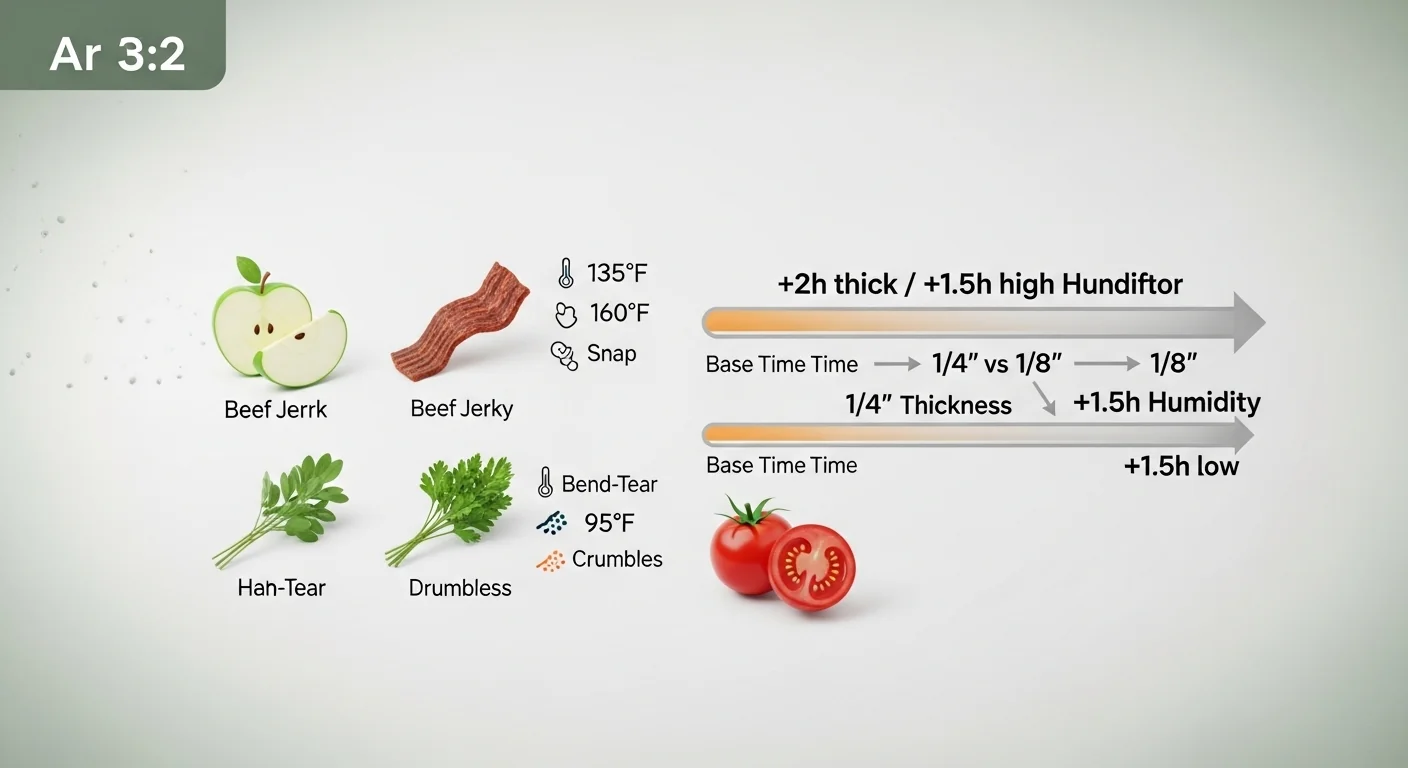
Drying time is not a fixed number on a chart. It is the result of at least three interacting variables: the food’s base moisture content, how thick each slice is, and how much ambient moisture the dehydrator must compete with in the surrounding air. An apple at 1/8” on a dry October afternoon dries in a fraction of the time the same apple needs in a humid August kitchen, even at identical thermostat settings.
This tool calculates an estimated drying time for four common food types, Apples, Beef Jerky, Herbs, and Tomatoes, by applying thickness and humidity modifiers to empirically grounded base times. It outputs a specific number in hours along with the required temperature setting for that food category. What it does not do: it does not account for altitude, food density variation within a batch, or the thermal characteristics of a specific dehydrator brand. The result is a calibrated starting point, not a guaranteed finish line.
After running your combination through the calculator, you will know precisely which temperature to set, how many hours to plan for, and which doneness test to apply before pulling the trays. If you preserve food through multiple methods, the canning calculator covers the pressure and time variables for heat-processed preservation as a complementary workflow.
Use the Tool
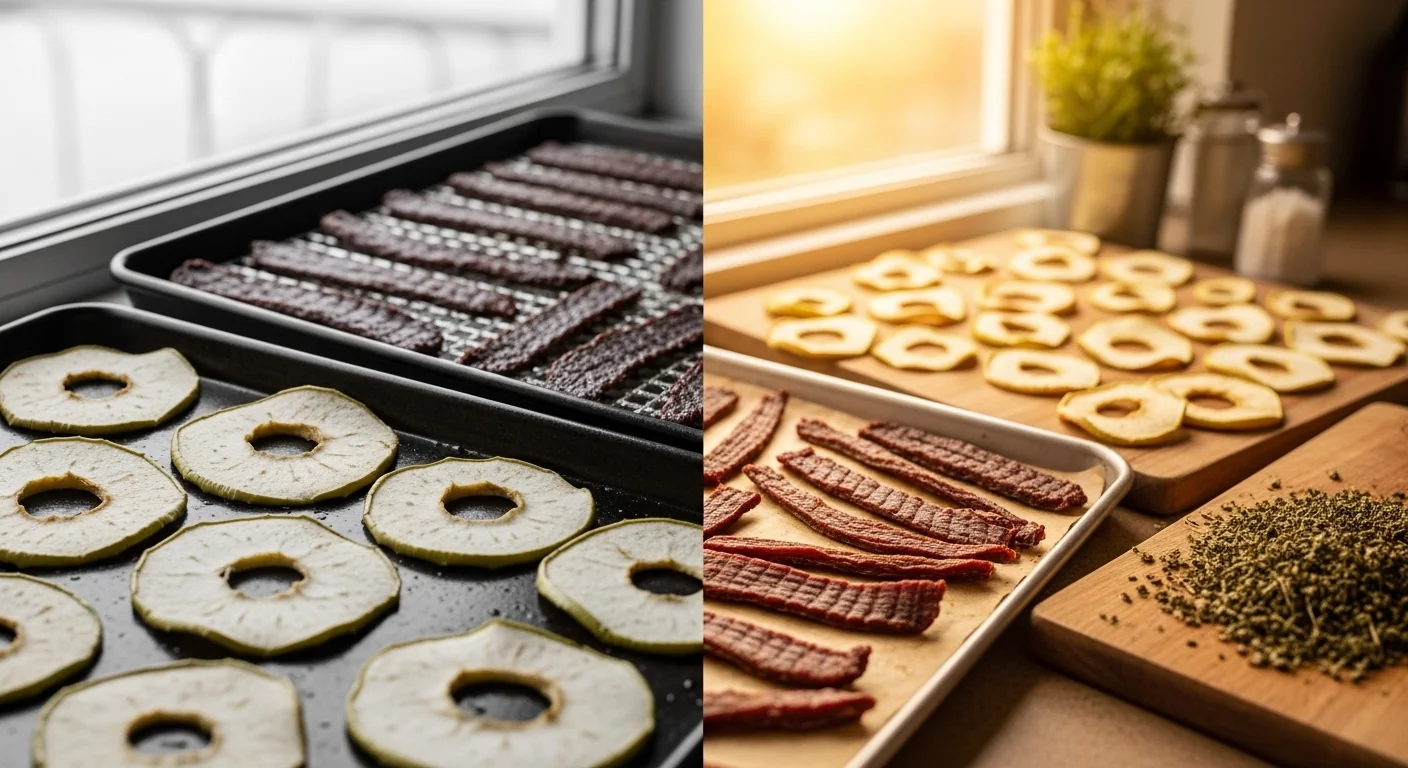
Dehydrator Time Estimator
The Yield Grid — Homesteading & Livestock Tools
| Food | Thin / Low Humidity | Thick / High Humidity | Temp Setting |
|---|---|---|---|
| Apple | 6.0 h | 9.5 h | 135°F |
| Beef Jerky | 4.0 h | 7.5 h | 160°F |
| Herbs | 2.0 h | 5.5 h | 95°F |
| Tomatoes | 8.0 h | 11.5 h | 135°F |
How this calculator works
- Base Time: Look up the base drying time for the selected food type from our reference table (Apple 6h, Beef Jerky 4h, Herbs 2h, Tomatoes 8h).
- Thickness Modifier: If you selected Thick (1/4″), add +2 hours to the base time. Thin slices (1/8″) use the base time with no addition.
- Humidity Modifier: If you are in a High Humidity environment, add +1.5 hours to account for slower moisture extraction. Low humidity adds nothing.
- Result: Total = Base Time + Thickness Modifier + Humidity Modifier
Assumptions & Limits:
- Times assume a tray dehydrator operating at the specified temperature setting.
- Food is sliced uniformly and laid in a single layer without overlap.
- Estimates are a starting guide — always perform a doneness test before removing food.
- Results do not account for altitude, which can further extend drying time at elevations above 3,500 ft.
- Meat (Beef Jerky) must reach an internal temperature of 160°F for food safety.
Before running the estimator, know your slice thickness in inches (1/8” or 1/4” measured before drying), the food type you are processing, and whether your drying space has elevated humidity. If you are drying multiple food types simultaneously, run the calculator separately for each, since temperature settings differ and some combinations are unsafe to co-process at the same dehydrator temperature.
Quick Start (60 Seconds)
- Food Type: Select from Apple, Beef Jerky, Herbs, or Tomatoes. Beef Jerky requires a different temperature than all plant-based options; selecting the wrong category skips a safety-critical check.
- Slice Thickness: Measure the raw slice before drying. Thin is 1/8” and Thick is 1/4”. Using a ruler or mandoline thickness guide eliminates guesswork. Thickness adds exactly 2 hours to the base estimate.
- Ambient Humidity: This is the humidity of the room, not the food. If your space feels muggy, windows are fogging, or a weather app shows outdoor relative humidity above 60%, select High. High humidity adds 1.5 hours.
- Click Calculate: All three fields must be filled. The button will not process a partial entry, and the results panel will not update until validation passes.
- Read the temperature pill first: The orange temperature indicator in the results is not a suggestion. It is the required dehydrator setting for food safety compliance with that food category.
- Run the doneness test: The estimated hours tell you when to start checking. The hover tooltip on the doneness field tells you exactly how to confirm the food is finished.
Inputs and Outputs (What Each Field Means)
| Field | Type / Unit | What It Means | Common Mistake | Safe Entry Guidance |
|---|---|---|---|---|
| Food Type | Dropdown (4 options) | Determines base drying time and required temperature setting | Selecting a fruit setting when drying meat; misses the 160°F safety threshold | Match exactly to what is on the trays; never approximate across categories |
| Slice Thickness | Radio (1/8” or 1/4”) | Adds 2 hours to total when Thick is selected | Estimating by eye instead of measuring; slices marketed as “thin” on packaging are often 1/4” | Measure with calipers or a mandoline stop; measure before drying begins |
| Ambient Humidity | Radio (Low or High) | Adds 1.5 hours when High is selected | Using the outdoor humidity reading; the relevant value is inside the drying room | Check indoor conditions; basements and summer kitchens typically run High |
| Total Estimated Time | Hours (output) | Sum of base time, thickness modifier, and humidity modifier | Treating the number as guaranteed done time; it is a check-start marker | Begin doneness testing at the calculated hour, continue checking every 30 minutes |
| Temperature Setting | °F (output) | Required dehydrator temperature for the selected food category | Using a lower temperature to “go slower” on meat; creates food safety risk | Set dehydrator temperature before loading trays, verify with a thermometer probe |
| Doneness Test | Text tooltip (output) | The physical test appropriate to the food type that confirms moisture removal | Skipping the doneness test and relying on color alone; color changes before moisture is fully removed | Always cool one piece to room temperature before testing; warm food feels dryer than it is |
Worked Examples (Real Numbers)
Scenario 1: Apple Rings, Thin, Dry Fall Day
- Food Type: Apple
- Slice Thickness: Thin (1/8”)
- Humidity: Low
Result: 6.0 hours at 135°F
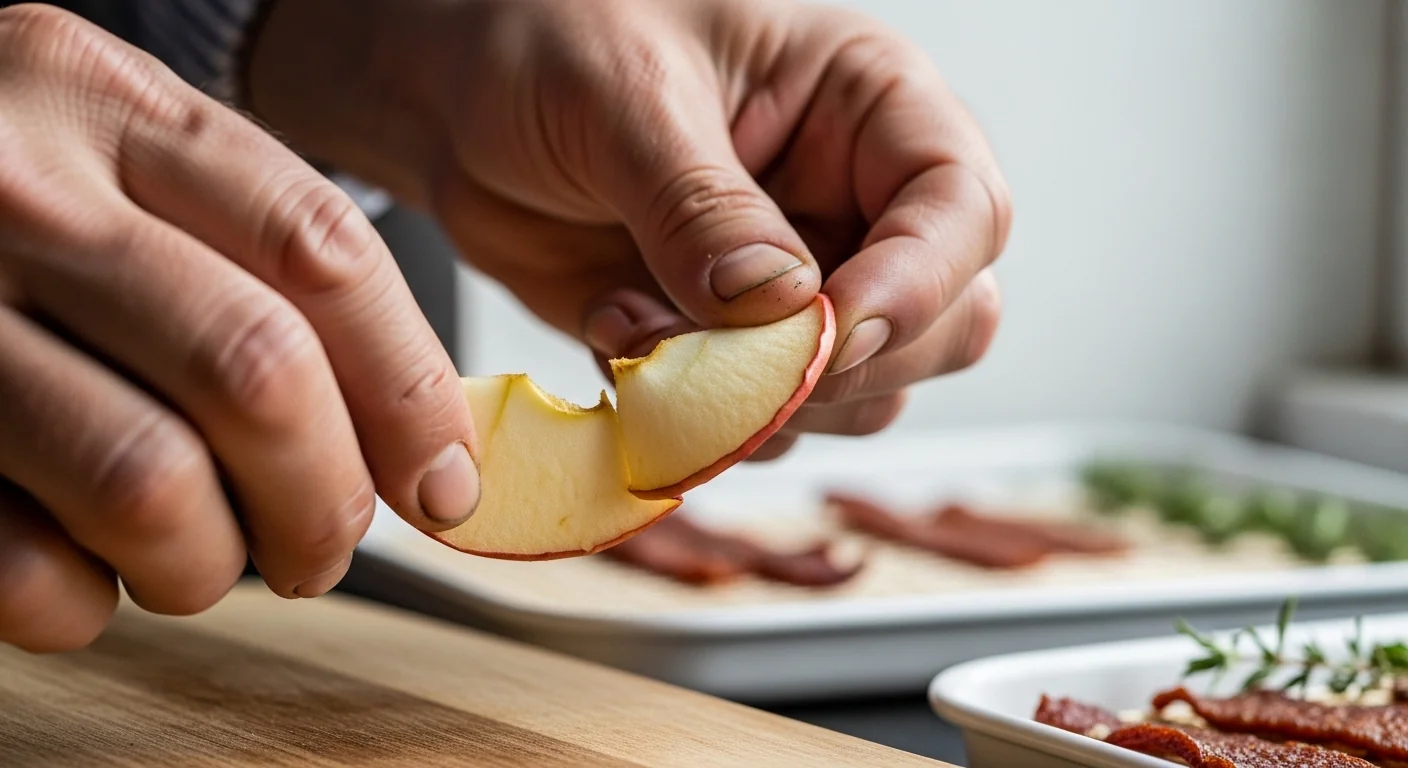
Base time for apples is 6 hours. No modifiers apply. Begin snap testing at hour 6: a finished piece bends then snaps cleanly with no soft center. Apple rings that pass the snap test at this stage can be stored immediately without conditioning.
Scenario 2: Beef Jerky, Thick Cut, Humid Summer Conditions
- Food Type: Beef Jerky
- Slice Thickness: Thick (1/4”)
- Humidity: High
Result: 7.5 hours at 160°F
Base time of 4 hours, plus 2 hours for thickness, plus 1.5 hours for high ambient humidity. At 7.5 hours, start the bend and tear test. A properly dried strip bends under pressure, begins to crack along the surface, but does not snap in two. No liquid should appear when the torn interior is examined.
Scenario 3: Roma Tomatoes, Thin Slices, High Humidity
- Food Type: Tomatoes
- Slice Thickness: Thin (1/8”)
- Humidity: High
Result: 9.5 hours at 135°F
Tomatoes carry the highest water content of the four food types in this tool, producing a long base time of 8 hours even at thin slices. The 1.5-hour humidity modifier brings the estimate to 9.5. Begin the pliability test at the calculated hour: squeeze a cooled slice; it should feel leather-dry with no tackiness and no detectable moisture when pressed between fingers.
Reference Table (Fast Lookup)
| Food | Thickness | Humidity | Base (h) | Modifiers (h) | Total Estimate | Temp (°F) | Doneness Test |
|---|---|---|---|---|---|---|---|
| Apple | Thin (1/8”) | Low | 6.0 | +0.0 | 6.0 h | 135 | Snap Test |
| Apple | Thin (1/8”) | High | 6.0 | +1.5 | 7.5 h | 135 | Snap Test |
| Apple | Thick (1/4”) | Low | 6.0 | +2.0 | 8.0 h | 135 | Snap Test |
| Apple | Thick (1/4”) | High | 6.0 | +3.5 | 9.5 h | 135 | Snap Test |
| Beef Jerky | Thin (1/8”) | Low | 4.0 | +0.0 | 4.0 h | 160 | Bend & Tear |
| Beef Jerky | Thin (1/8”) | High | 4.0 | +1.5 | 5.5 h | 160 | Bend & Tear |
| Beef Jerky | Thick (1/4”) | Low | 4.0 | +2.0 | 6.0 h | 160 | Bend & Tear |
| Beef Jerky | Thick (1/4”) | High | 4.0 | +3.5 | 7.5 h | 160 | Bend & Tear |
| Herbs | Thin (1/8”) | Low | 2.0 | +0.0 | 2.0 h | 95 | Crumble Test |
| Herbs | Thin (1/8”) | High | 2.0 | +1.5 | 3.5 h | 95 | Crumble Test |
| Herbs | Thick (1/4”) | Low | 2.0 | +2.0 | 4.0 h | 95 | Crumble Test |
| Herbs | Thick (1/4”) | High | 2.0 | +3.5 | 5.5 h | 95 | Crumble Test |
| Tomatoes | Thin (1/8”) | Low | 8.0 | +0.0 | 8.0 h | 135 | Pliability Test |
| Tomatoes | Thin (1/8”) | High | 8.0 | +1.5 | 9.5 h | 135 | Pliability Test |
| Tomatoes | Thick (1/4”) | Low | 8.0 | +2.0 | 10.0 h | 135 | Pliability Test |
| Tomatoes | Thick (1/4”) | High | 8.0 | +3.5 | 11.5 h | 135 | Pliability Test |
How the Calculation Works (Formula and Assumptions)
Show the calculation steps
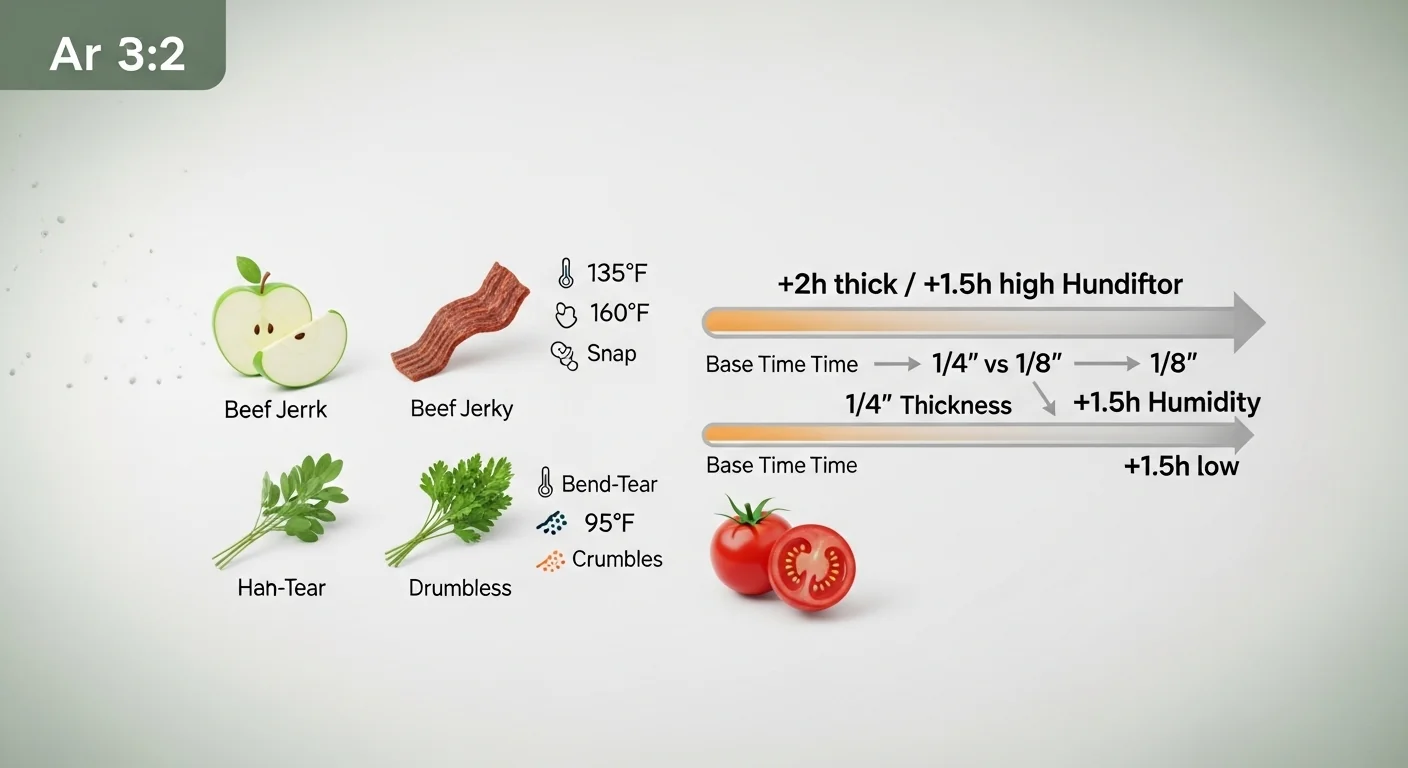
Step 1 — Look up Base Time: The formula begins with a food-specific base time derived from established drying ranges for each food category. Apple = 6 hours, Beef Jerky = 4 hours, Herbs = 2 hours, Tomatoes = 8 hours. These values represent ideal conditions: single-layer trays, uniform slicing, and a properly functioning dehydrator at the correct temperature.
Step 2 — Apply Thickness Modifier: If the selected thickness is Thick (1/4”), add 2.0 hours. If Thin (1/8”), add 0. The modifier is flat and does not scale with food type.
Step 3 — Apply Humidity Modifier: If ambient humidity is High, add 1.5 hours. If Low, add 0. The modifier reflects the additional time required for the dehydrator to overcome competing moisture in the surrounding air.
Step 4 — Sum to Total:
Total Hours = Base Time + Thickness Modifier + Humidity Modifier
Results are presented to one decimal place. No rounding occurs until the final output display.
Assumptions and Limits
- Times assume a tray-style dehydrator (stacked or shelf) operating at the specified temperature setting continuously from the start of the drying session.
- Food is sliced uniformly and placed in a single layer without overlapping or stacking. Overlapping pieces dramatically extend actual drying time beyond this estimate.
- Humidity inputs are binary (Low or High) and do not model the full range of relative humidity. Users in extreme conditions above 80% relative humidity should extend check intervals beyond the estimate.
- Altitude is not modeled. At elevations above 3,500 feet, reduced air pressure slows moisture evaporation and may add time beyond the tool output.
- The tool does not account for dehydrator brand or model variation. Machines with different watt ratings, airflow patterns, or thermostat accuracy will produce different results for the same inputs.
- Meat category (Beef Jerky) outputs the minimum safe temperature, not a guarantee of pathogen elimination. Dehydrators with hot spots or cold trays may not achieve uniform temperature across all pieces simultaneously.
- The four food types represent common general categories. Results for less common varieties within each category (e.g., Asian pear vs. Gala apple) may differ from the estimates.
- Pre-treatment steps such as blanching, sulfuring, or brining are not factored into the time estimate, though some treatments can reduce base drying time for certain foods.
Standards, Safety Checks, and “Secret Sauce” Warnings
The calculator surfaces two categories of information that most generic dehydrator guides omit: temperature standards by food category and the correct doneness verification method for each food type. Both matter for safety and shelf life.
Critical Warnings
- Beef jerky and all meat products must reach an internal temperature of 160°F during processing. A dehydrator set to 160°F does not guarantee that every piece of meat on every tray reaches that temperature throughout its thickness. The USDA recommends a pre-heating step in an oven at 275°F for 10 minutes after dehydrating meat to ensure pathogen elimination, particularly for Salmonella and E. coli O157:H7.
- Declaring food “done” by color or by elapsed time alone creates a spoilage and safety risk. Color changes (browning of apple rings, darkening of tomato flesh) occur well before moisture is fully removed. Always use the physical doneness test specific to that food type and always test a cooled piece, not a warm one.
- High ambient humidity does not just slow drying; it can cause “case hardening” on the food surface if the dehydrator temperature is set too high. The outer surface dries and seals before interior moisture can escape, trapping water inside a dry shell. The correct response is not to raise temperature further, but to rotate trays and allow longer drying at the specified temperature.
- Do not mix meat and plant-based foods in the same dehydrator load when meat requires 160°F. Most herbs, for example, will over-dry, lose volatile oils, and degrade significantly at temperatures above 95°F.
Minimum Standards
- Fruit and vegetable dehydration: 135°F minimum temperature setting for effective drying within a predictable time window.
- Herb dehydration: 95°F maximum temperature to preserve essential oils; exceeding this threshold causes flavor and color degradation before drying is complete.
- Meat (jerky): 160°F minimum; confirm with a calibrated instant-read thermometer at multiple points across the thickest pieces, not just at the surface.
- Doneness confirmation: Cool one test piece to room temperature before applying the snap, bend-and-tear, crumble, or pliability test. Testing warm food consistently produces false positives due to residual heat masking surface moisture.
Competitor Trap: Most food drying time charts online list a single time range per food type with no mention of humidity, thickness, or temperature specificity. A reader following a chart that says “apples: 6 to 12 hours” has no decision framework for knowing when their situation is closer to 6 or closer to 12. This tool replaces that range with a computed output derived from the two variables that actually determine where on that range your batch lands. The temperature output is equally important: a chart that lists time without specifying required temperature leaves a safety-critical gap for anyone processing meat.
For homesteaders who also preserve food through fermentation or salt curing, the brine calculator handles the salt-to-water ratio math for wet cures, which is a common companion process to jerky and tomato preservation. If you are evaluating freeze drying as an alternative to dehydrating for long-term storage, the freeze dryer calculator covers batch capacity and cycle time estimation for that method.
Common Mistakes and Fixes
Mistake: Using the “dark enough” color test instead of a physical
doneness test
Caramelization and Maillard browning cause color changes in dehydrated food long before sufficient moisture is removed for safe storage. Apple rings that look golden and finished can still contain enough water to support mold growth within days of storage. The physical state of the cooled food is the only reliable doneness indicator.
Fix: Cool one piece completely to room temperature, then apply the snap test (apples, herbs), the bend-and-tear test (jerky), or the pliability test (tomatoes) before pulling the batch.
Mistake: Running the dehydrator at a lower temperature to “be safe”
with meat
A lower temperature for meat does not reduce pathogen risk; it increases it. The combination of warm temperature and slow moisture removal creates ideal conditions for bacterial growth during the extended drying window. The 160°F standard for meat exists precisely because it must be reached quickly enough to prevent bacterial multiplication during the drying process.
Fix: Set the dehydrator to 160°F for all meat products from the start. Use a post-dehydration oven step at 275°F for 10 minutes if your dehydrator has known cold spots.
Mistake: Stacking or overlapping slices to fit more product per tray
Dehydrator airflow is directional. Overlapping slices block airflow to the contact surface, creating wet zones that will not dry at the same rate as exposed surfaces. The outer slices may pass doneness testing while inner or bottom contact points remain under-dried. This is a particularly serious problem for meat and for any food intended for long-term storage.
Fix: Arrange all slices in a single layer with visible gaps between pieces. Reduce batch size rather than layering. Rotate trays halfway through the estimated drying time to compensate for temperature variation between tray positions.
Mistake: Selecting “Low” humidity because the outdoor forecast looks
dry
Ambient humidity relevant to this calculator is the indoor humidity of the space where the dehydrator is operating, not the outdoor reading from a weather app. Basements, enclosed pantries, and kitchens in warm months often run significantly higher relative humidity than outdoor conditions. A dehumidified room in a dry climate and a basement kitchen in August are at opposite ends of the spectrum regardless of what the weather app shows.
Fix: Place an inexpensive hygrometer in the drying room and check the reading immediately before entering your inputs. If it reads above 60%, select High.
Mistake: Starting the doneness test while the food is still warm
Heat softens the structure of dehydrated food and masks residual surface moisture. A jerky strip tested directly off the tray at 160°F will bend and flex convincingly even when it contains more moisture than it should. The same strip tested 20 minutes later at room temperature may feel tacky or pliable in a way that reveals incomplete drying. This error leads to under-dried batches entering storage and developing mold within weeks.
Fix: Pull one test piece and set it on a cool plate or countertop for at least 15 minutes before applying any doneness test. Apply the test appropriate to the food type, not a general squeeze or color check.
Next Steps in Your Workflow
Once you have your time estimate and temperature setting, the practical workflow is to set the dehydrator to temperature before loading the trays, measure and verify that temperature with a probe thermometer at the tray level rather than trusting the dial, then set a timer for the calculated duration. When the timer ends, begin the physical doneness test on the coolest-position tray, which is typically the bottom tray on vertical-flow units and the outermost tray on horizontal-flow units. If that tray passes, spot-check two or three pieces from other positions before declaring the batch complete. Homesteaders who are also calculating feed efficiency or input cost across their food production operations may find the feed cost calculator useful for tracking the full economic picture of raising and processing livestock.
Storage immediately follows drying and is where many otherwise successful batches fail. Fully dehydrated food should be conditioned in a glass jar for one week before final storage: fill jars three-quarters full, seal loosely, and shake once daily. If condensation forms on the inside of the glass, the batch needs additional drying time. Fruit preservation through dehydration pairs naturally with other preservation methods; the pectin calculator handles the pectin-to-sugar ratios for jam and jelly processing if you are working fresh fruit alongside your dehydrating operation.
FAQ
Can this dehydrator time estimator work for foods not listed, like
zucchini or mushrooms?
The calculator is calibrated for the four listed food types. Applying it to unlisted foods will produce an output based on whichever food type you select as a substitute, which may not reflect the actual moisture content of the unlisted food. Mushrooms, for example, have a very different moisture profile than tomatoes despite both being vegetables. Use the reference table as a cross-check and prioritize a physical doneness test over the time estimate for any substituted food.
Why does the tool add 1.5 hours for high humidity instead of more?
The 1.5-hour modifier is a calibrated adjustment representing a moderate high-humidity condition in an otherwise functional drying setup. It is not designed to model severe conditions such as a dehydrator operating in an outdoor shelter during rain or in a space above 80% relative humidity. In those cases, the estimate will be conservative and actual drying time will likely extend further. The modifier is a planning number, not a ceiling.
What is the difference between the snap test and the bend-and-tear
test?
The snap test applies to fully rigid foods like dried apple rings or crackers: a properly dried piece should fracture cleanly without bending. The bend-and-tear test applies to jerky, which retains deliberate flexibility when properly dried: the strip bends under pressure, surface fibers begin to crack, but the piece does not snap in two. Testing a warm piece will produce misleading results for both methods; always cool to room temperature first.
Does slice thickness matter more than humidity?
Both matter, but thickness has a larger impact on total time in this model: 2 hours added for thick vs. 1.5 hours for high humidity. In practice, however, humidity is more variable and harder to control, particularly in seasonal climates. A processor who consistently uses a mandoline for uniform thin slicing eliminates the thickness variable entirely, leaving humidity as the primary uncontrolled factor in estimating drying time.
Is 160°F safe enough for all types of jerky, including poultry?
The 160°F standard in this tool applies specifically to beef jerky, the food type in the calculator. Poultry requires 165°F internal temperature per food safety guidelines and is not within the scope of this tool. Applying the beef jerky settings to poultry strips would understate the required temperature and create a safety gap. This tool should not be used as a temperature reference for poultry, game birds, or pork products.
Why do warm food doneness tests give false results?
Heat temporarily changes the physical properties of dehydrated food: residual warmth softens the food matrix and evaporates surface moisture, making the piece feel dryer and firmer than it actually is at room temperature. Once cooled, any remaining water redistributes from the interior to the surface, revealing the true moisture state. The 15-minute cooling period is the minimum needed for this redistribution to occur in most food types.
Conclusion
The single most consequential mistake in food dehydration is declaring doneness by elapsed time or color instead of by a physical test on a cooled piece. That error affects both shelf life and safety. Run the calculator, set the temperature before loading, check at the estimated time using the correct test, and condition before sealing for storage. For additional homestead food planning tools, the firewood calculator covers heat and cord requirements for the winter season if your food preservation operation is part of a broader self-sufficiency setup.