
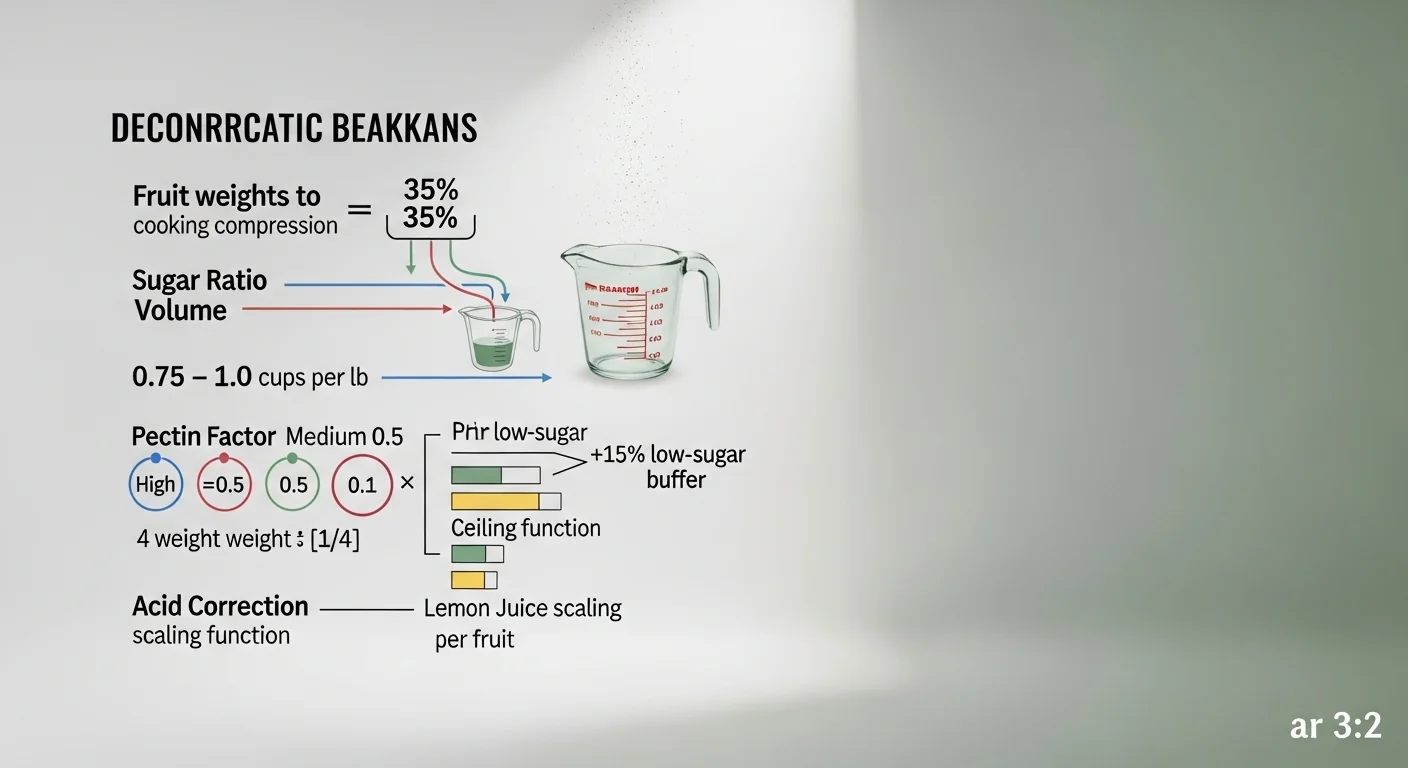
Gel failure is almost never random. It follows a pattern: low-pectin fruit cooked with insufficient acid, or a regular-pectin recipe applied to a low-sugar setup that demands a different product entirely. The fruit type, prepared weight, and sugar category are the three variables that determine whether your batch yields firm, shelf-stable jam or a runny syrup that no amount of re-cooking will fully rescue. Getting these numbers right before you touch the stove is the entire problem this tool solves.
This pectin calculator computes the sugar quantity (in cups), commercial pectin packages, lemon juice correction, and estimated jar yield for any combination of 18 common jam fruits across regular and low-sugar recipe formats. It flags low-acid fruits automatically and adjusts the pectin requirement for low-sugar pectin formulations. What it does not do: it cannot account for altitude adjustments to processing time, sugar substitutes like honey or artificial sweeteners, or jam recipes that rely on long-boil set without any added pectin. Those are separate decisions requiring tested recipes. If you work with raw honey as a sweetener, the honey yield calculator covers yield planning on that side of the pantry.
After running your fruit and weight through this tool, you will know exactly how much sugar to measure, which pectin product to buy (and how many packages), whether your fruit needs an acid correction, and how many half-pint jars to sterilize before you start.
Use the Tool
Jam Sugar & Pectin Calculator
Precise ratios for perfect-set homemade jam — every batch.
Your Jam Recipe
| Fruit | Sugar (cups) | Pectin (pkgs) | Lemon Juice | Pectin Level |
|---|---|---|---|---|
| Strawberry | 4.0 | 1 | 2 Tbsp | Low |
| Peach | 3.5 | 1 | 2 Tbsp | Low |
| Raspberry | 4.0 | 0.5 | 1 Tbsp | Medium |
| Blackberry | 3.75 | 0.5 | 1 Tbsp | Medium |
| Apple | 3.0 | 0 | 0 Tbsp | High |
| Plum | 3.0 | 0 | 0 Tbsp | High |
| Apricot | 3.5 | 0.5 | 1 Tbsp | Medium |
How This Calculator Works
Sugar Calculation
- Each fruit has a base sugar ratio (cups of sugar per lb of fruit), derived from standard tested canning recipes.
- For regular sugar: ratio ranges from
0.75(high-pectin fruits like apple) to1.0(low-pectin like strawberry). - For low-sugar pectin: the ratio is reduced by
40–50%— typically0.45–0.60cups per lb. - Formula:
Sugar (cups) = Fruit Weight (lbs) × Sugar Ratio
Pectin Calculation
- Fruits are classified as High / Medium / Low natural pectin based on their cellular pectin content and acidity (pH).
- High-pectin fruits (apple, plum, quince) need 0 added pectin for regular batches.
- Medium-pectin fruits need 0.5 packages per 4 lbs of fruit.
- Low-pectin fruits need 1 full package (1.75 oz) per 4 lbs of fruit.
- Formula:
Pectin Pkgs = ceil( (Pectin Factor × Weight) / 4 )
Lemon Juice (Acid Correction)
- Low-acid fruits (peach, fig, mango, pear, blueberry) need 2 Tbsp lemon juice per batch to ensure gel set.
- Medium-acid / medium-pectin fruits need 1 Tbsp per batch.
- High-acid / high-pectin fruits need 0 Tbsp (sufficient natural acid).
- Lemon juice lowers pH into the optimal gel range (2.8–3.5).
Estimated Yield
- Raw fruit breaks down by ~35% by volume during cooking.
- Sugar adds volume: roughly 1 cup sugar → 0.8 cups in final jam.
- Formula:
Yield (cups) ≈ (Weight × 0.65 × 1.5) + (Sugar × 0.8)— rounded to nearest half-pint jar (1 cup).
Assumptions & Limits
- Fruit weight entered is prepared weight (hulled, pitted, peeled as needed).
- Standard pectin package = 1.75 oz (49g), such as Ball or Sure-Jell.
- Results are calibrated for water-bath canning at altitudes below 1,000 ft. Add 1 min processing time per 1,000 ft above.
- Sugar quantities are for granulated white sugar; honey substitution requires a different ratio (consult a tested recipe).
- Yield estimate assumes normal fruit water content and full sugar addition; actual yield may vary ±15%.
- This calculator does not substitute for tested, approved canning recipes from USDA, Ball, or NCHFP.
Before calculating, have your prepared fruit weight ready — hulled, pitted, or peeled as the recipe requires, not raw off-the-vine weight. Entering unprepared weight is the most common source of over-estimation. Select your sugar type first, since low-sugar mode changes both the sugar ratio and the pectin product you will need to purchase. For yields and jar counts, plan on having a few extra sterilized jars on hand; actual yield varies with fruit water content. If you are also planning your water-bath processing times, the canning calculator handles headspace and processing duration once your jam is ready to fill.
Quick Start (60 Seconds)
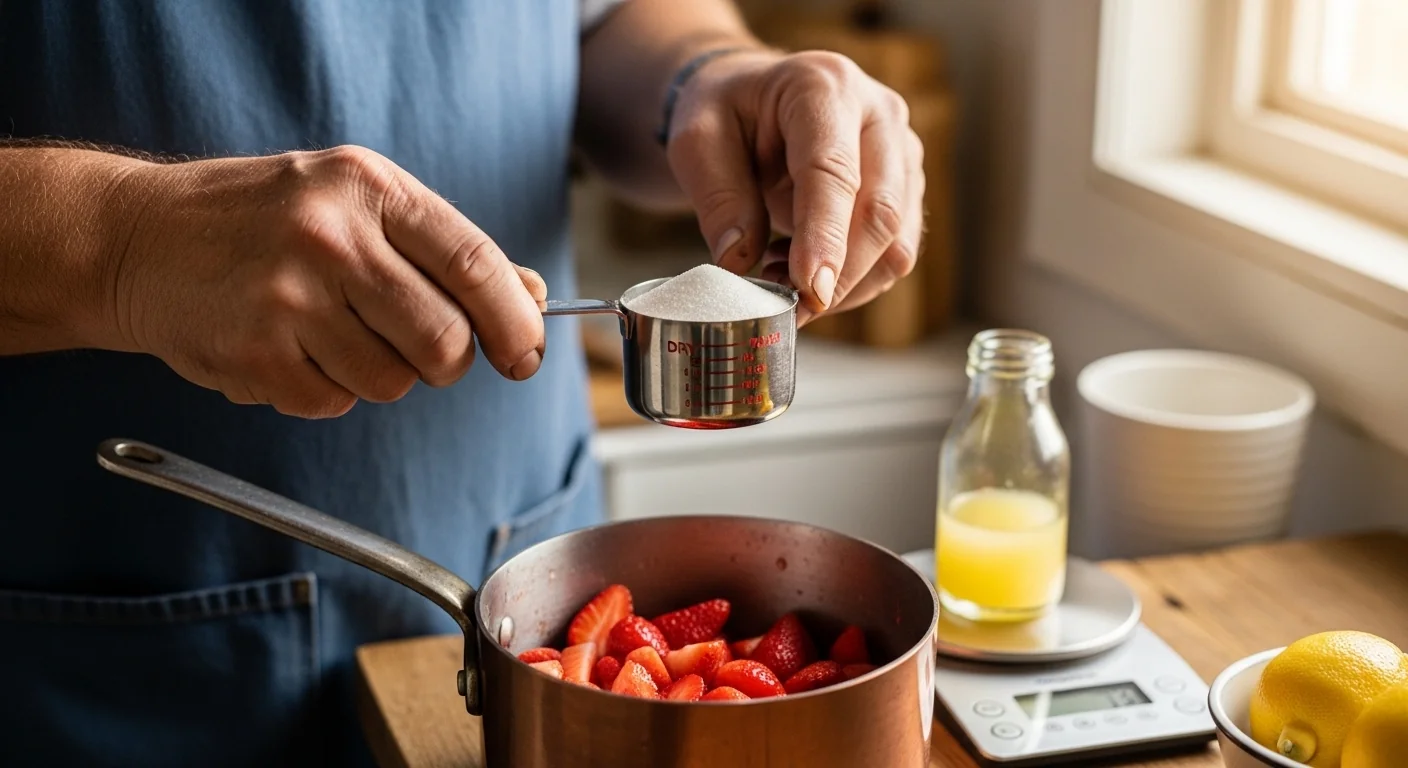
- Fruit Type: Select from the dropdown. Fruits are grouped by natural pectin level (High, Medium, Low). If your variety is not listed, choose the closest match by family — crabapple for wild apples, blackberry for boysenberry.
- Fruit Weight: Enter your prepared weight — after hulling, coring, or pitting. Do not use raw picked weight. A common mistake is entering the weight of a full flat of strawberries before removing stems and soft spots.
- Weight Unit: Switch to kilograms if you weigh on a metric scale. The calculator converts internally before running any formula.
- Sugar Type: Choose “Regular White Sugar” for standard recipes. Choose “Low-Sugar / Reduced Sugar” only if you are using a pectin product specifically labeled for low-sugar use. Standard pectin will not gel at reduced sugar concentrations.
- Read the Lemon Juice output carefully: For low-acid fruits (peach, pear, fig, mango, blueberry), the tool will output a non-zero lemon juice value. This is a safety correction, not optional flavor adjustment.
- Gel-Set Confidence gauge: A gauge below the main results shows estimated set reliability. Orange or red means you have a fruit-acid or fruit-pectin mismatch that the lemon juice and pectin recommendations are designed to correct — do not skip those additions.
- Jar count: The estimated yield assumes average fruit water content. Add two or three extra sterilized jars to your setup as a buffer.
Inputs and Outputs (What Each Field Means)
| Field | Unit | What It Means | Common Mistake | Safe Entry Guidance |
|---|---|---|---|---|
| Fruit Type | — | Determines natural pectin level (high/medium/low) and base acid classification, which controls the sugar ratio, pectin factor, and lemon juice recommendation. | Selecting “Apple” when using crabapple or a high-pectin wild variety; both are correct, but knowing the group matters more than the exact variety. | Match by fruit family, not exact cultivar. When unsure, choose the lower-pectin option to avoid under-adding pectin. |
| Fruit Weight | lbs or kg | The weight of fruit after preparation — hulled, pitted, peeled as needed. This is the number that drives every other calculation. | Entering raw, unprepared weight. A 5 lb flat of strawberries may yield only 4 lbs after hulling. | Weigh after prep. Use 0.25–50 lb range. Batches over 12 lbs should be split for even heat and reliable gel. |
| Weight Unit | lbs / kg | Selects the unit for your weight entry. The calculator converts kg to lbs before applying formulas. | Forgetting to switch units and entering kilograms as if they were pounds, resulting in roughly double the actual weight. | Match whatever your kitchen scale displays. The conversion factor used is 1 kg = 2.20462 lbs. |
| Sugar Type | — | Determines which sugar ratio and pectin coefficient to apply. Low-sugar mode uses a reduced ratio (roughly 42–58 cups per lb) and assumes you are using a low-sugar-specific pectin product. | Selecting “Low-Sugar” while planning to use standard Sure-Jell or similar. Standard pectin will not gel at reduced sugar levels. | Only select “Low-Sugar” if your pectin package explicitly says it works for low-sugar or no-sugar recipes. |
| Sugar Needed (output) | cups | Cups of granulated white sugar for the batch. Based on fruit weight times the fruit-specific sugar ratio. | Reducing sugar to “taste” without switching to a low-sugar recipe and pectin. Under-sugaring a standard-pectin recipe breaks the gel. | Measure level cups with a proper dry measuring cup. Do not pack. |
| Pectin Packages (output) | 1.75 oz pkgs | Number of standard commercial pectin packages needed. Computed from the fruit’s pectin factor applied to the batch weight, scaled to 4 lb increments. | Using a different package size (e.g., bulk pectin by the pound) without adjusting the dose. One standard package equals 1.75 oz or about 49g. | Check your brand’s label — some liquid pectins use a different concentration than powdered. |
| Lemon Juice (output) | Tbsp | Bottled lemon juice added to correct pH in low-acid fruits. Drives the jam into the optimal gel pH range of 2.8 to 3.5. For medium and high-acid fruits at small batch sizes, this may be zero. | Substituting fresh lemon juice for bottled. Fresh juice has inconsistent acidity; bottled is standardized for food safety applications. | Always use commercially bottled lemon juice when the tool outputs a non-zero value. |
| Estimated Yield (output) | half-pint jars (8 oz) | Projected number of filled half-pint jars. Accounts for fruit volume reduction during cooking (approximately 35%) and sugar volume contribution. | Expecting exact jar counts. Actual yield varies with fruit water content, cooking time, and how much foam is skimmed. | Sterilize two to three extra jars beyond the estimate. A short jar is better than a dirty one. |
Worked Examples (Real Numbers)
Example 1: Classic Strawberry Jam, 4 lbs, Regular Sugar
- Fruit: Strawberry (Low Pectin, Medium Acid)
- Prepared weight: 4 lbs
- Sugar type: Regular white sugar
- Sugar ratio: 1.00 cups per lb
Result: 4.0 cups sugar, 1 pectin package (1.75 oz), 2 Tbsp bottled lemon juice, approximately 7 half-pint jars.
Strawberry sits at the difficult end of the pectin spectrum. The full 1:1 sugar ratio and complete pectin package are not conservative choices — they are the minimum for reliable gel. Skipping the lemon juice here is low-risk given strawberry’s medium acid level, but the tool still recommends it for batch-to-batch consistency.
Example 2: Apple Jam, 6 lbs, Regular Sugar
- Fruit: Apple (High Pectin, High Acid)
- Prepared weight: 6 lbs (cored, peeled)
- Sugar type: Regular white sugar
- Sugar ratio: 0.75 cups per lb
Result: 4.5 cups sugar, 0 pectin packages, 0 Tbsp lemon juice, approximately 9 half-pint jars.
Apple is among the easiest jam fruits to set. Its natural pectin and acid profile handle gel formation without commercial additives. The lower 0.75 ratio reflects that apple’s structure contributes more body to the finished product than a low-pectin fruit at the same weight.
Example 3: Peach Jam, 3 lbs, Low-Sugar
- Fruit: Peach (Low Pectin, Low Acid)
- Prepared weight: 3 lbs (peeled, pitted)
- Sugar type: Low-sugar / reduced sugar
- Sugar ratio: 0.50 cups per lb (low-sugar coefficient)
Result: 1.5 cups sugar, 2 pectin packages (low-sugar formula), 2 Tbsp bottled lemon juice, approximately 4 half-pint jars.
Peach is the highest-risk combination: low natural pectin, low acidity, and a reduced-sugar format that strains standard pectin chemistry. The tool outputs two low-sugar pectin packages — 15% more than the base calculation — and mandates the full lemon juice correction. Using standard pectin at 1.5 cups of sugar will not produce a firm gel regardless of cook time.
Reference Table (Fast Lookup)
All values below are computed using the calculator’s formula at exactly 4 lbs prepared fruit weight with regular white sugar. The Gel Confidence column reflects the tool’s internal scoring based on pectin level and acid classification.
| Fruit | Pectin Level | Sugar (cups) | Pectin Pkgs | Lemon Juice | Est. Jars (8 oz) | Gel Confidence |
|---|---|---|---|---|---|---|
| Apple | High | 3.0 | 0 | 0 Tbsp | ~6 | High (95) |
| Plum | High | 3.0 | 0 | 0 Tbsp | ~6 | High (95) |
| Currant (Black/Red) | High | 3.2 | 0 | 0 Tbsp | ~6 | High (95) |
| Apricot | Medium | 3.5 | 1 | 1 Tbsp | ~7 | Moderate (80) |
| Raspberry | Medium | 4.0 | 1 | 1 Tbsp | ~7 | Moderate (80) |
| Blackberry | Medium | 3.5 | 1 | 1 Tbsp | ~7 | Moderate (80) |
| Strawberry | Low | 4.0 | 1 | 2 Tbsp | ~7 | Lower (70) |
| Peach | Low | 3.5 | 1 | 2 Tbsp | ~7 | Lower (78) |
| Blueberry | Low | 3.5 | 1 | 2 Tbsp | ~7 | Lower (78) |
| Fig | Low | 3.5 | 1 | 2 Tbsp | ~7 | Lower (78) |
How the Calculation Works (Formula + Assumptions)
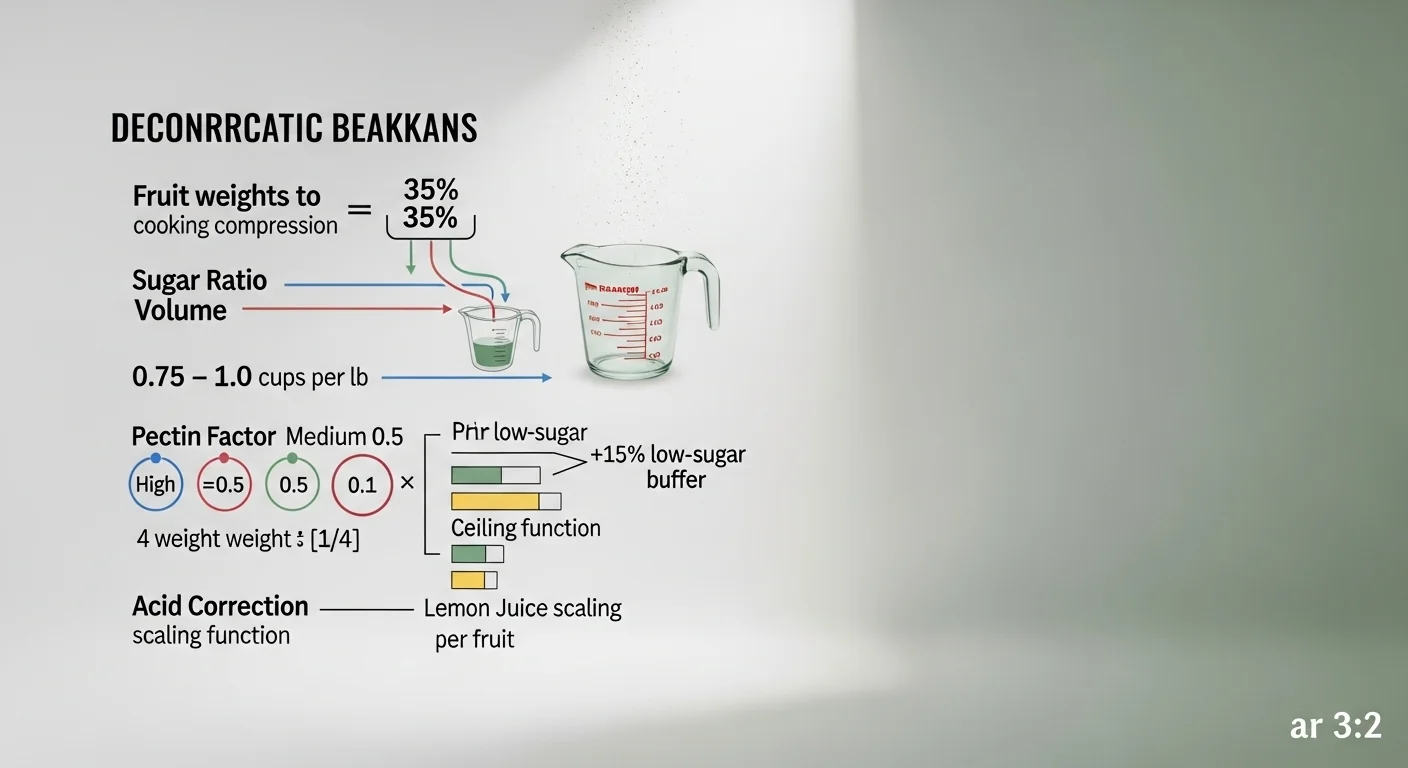
Show the calculation steps
Step 1: Sugar Quantity
The tool multiplies prepared fruit weight (in lbs) by a fruit-specific sugar ratio:
Sugar (cups) = Fruit Weight (lbs) x Sugar Ratio
Sugar ratios range from 0.75 cups/lb for high-pectin, high-acid fruits like apple, to 1.00 cups/lb for low-pectin fruits like strawberry. Low-sugar mode applies a reduced coefficient: 0.42 to 0.58 cups/lb depending on fruit type. Results are rounded to one decimal place.
Step 2: Commercial Pectin Packages
Each fruit carries a pectin factor: 0 (high natural pectin), 0.5 (medium), or 1 (low). The formula is:
Pectin Pkgs = ceiling( (Pectin Factor x Weight) / 4 )
The divisor of 4 reflects a standard tested batch of 4 lbs. Ceiling ensures you always have enough rather than under-dosing. In low-sugar mode, the package count receives an additional 15% buffer and is floored at a minimum of 1 package for any fruit with non-zero pectin factor.
Step 3: Lemon Juice (Acid Correction)
Fruits are classified by acid level: high, medium, or low. Low-acid fruits (peach, pear, fig, mango, blueberry) require 2 Tbsp of bottled lemon juice per 4 lbs of fruit as a base. Medium-acid fruits require 1 Tbsp. For batches over 4 lbs, the lemon juice amount scales proportionally:
Lemon Juice (Tbsp) = ceiling( Base Tbsp x (Weight / 4) )
This keeps the pH correction consistent as batch size grows.
Step 4: Estimated Yield
Yield (cups) = (Weight x 0.65 x 1.5) + (Sugar x 0.8)
The 0.65 factor accounts for the approximately 35% volume loss during cooking. The 1.5 multiplier converts pound-weight to approximate cup volume for prepared fruit pulp. Sugar contribution is discounted by 0.8 because dissolved sugar reduces the total volume relative to its dry measure. The result is rounded to the nearest whole number to give an estimated half-pint jar count.
Assumptions and Limits
- Fruit weight is prepared weight only — after hulling, pitting, coring, or peeling. Raw picked weight will overstate the batch and produce excess sugar and pectin quantities.
- One standard pectin package = 1.75 oz (approximately 49g) of powdered pectin. Liquid pectin brands use different concentrations; check label conversion before substituting.
- Results are calibrated for standard water-bath canning at altitudes below 1,000 feet. Processing times increase at higher altitudes; consult the USDA Complete Guide or NCHFP tables.
- The yield formula assumes average fruit water content. High-moisture batches (very ripe fruit, frozen and thawed fruit) may produce slightly more; low-moisture batches (dry-season stone fruit) slightly less. Variance of plus or minus 15% is normal.
- Low-sugar results assume use of a pectin specifically formulated for low-sugar or no-sugar use. Standard Sure-Jell, Ball RealFruit Classic, or equivalent will not gel at the reduced sugar levels output by the low-sugar mode.
- Honey, maple syrup, and artificial sweeteners are not supported. Each requires a separate tested recipe because their gel chemistry differs fundamentally from granulated sugar.
- The gel-set confidence score is a guidance indicator derived from fruit classification. It is not a guarantee. Always perform a gel test (chilled plate or thermometer at 220 degrees F at sea level) before filling jars.
Standards, Safety Checks, and “Secret Sauce” Warnings
These checks are built directly into the calculator’s warning logic and are displayed automatically when the relevant conditions are detected. They are documented here as reference standards.
Critical Warnings
- Low-Acid Fruit: Peach, pear, fig, mango, and blueberry all fall below the pH threshold needed for reliable gel formation. The tool automatically outputs a lemon juice correction for these fruits. Skipping this addition does not merely risk a soft set — it can prevent gel entirely, regardless of how long the batch is cooked.
- Standard Pectin in Low-Sugar Mode: Commercial pectin requires a minimum sugar concentration to activate properly. Standard powdered pectin formulations are calibrated for sugar concentrations well above what a “low-sugar” recipe provides. Using the wrong product will produce a fluid result that cannot be fixed by re-boiling.
- Large Batch Warning (over 12 lbs): Batches exceeding 12 lbs take significantly longer to reach the gel point across the full volume. Uneven heat distribution causes partial scorching near the pan bottom before the center sets. Split into multiple smaller batches.
- Fresh vs. Bottled Lemon Juice: Fresh lemon juice has variable acidity between fruits and seasons. For pH-sensitive applications like jam canning, bottled lemon juice has standardized acidity and is the only form that reliably drives the correction this calculator assumes.
Minimum Standards
- Optimal jam gel occurs at a pH between 2.8 and 3.5. High-pectin, high-acid fruits typically fall in range naturally; low-acid fruits do not without correction.
- Prepared fruit weight — not raw weight — is the required input. If your recipe lists “2 quarts hulled strawberries,” convert to weight on a kitchen scale before entering.
- Always verify set with a chilled plate test or an accurate jam thermometer before canning. A 220 degree F reading at sea level indicates gel point in a standard-sugar recipe.
Competitor Trap: Most online pectin guides treat lemon juice as optional flavor enhancement or a catch-all fix for any batch. This misses the underlying chemistry. Lemon juice is an acid correction tool — it is relevant only when the fruit’s natural pH is too high for pectin to form a firm gel network. Adding it to high-acid, high-pectin fruits like apple or currant does nothing for gel and slightly increases tartness without benefit. The value is in knowing which fruits need it and why, not in applying it universally. This calculator evaluates each fruit’s acid classification separately rather than issuing a blanket recommendation.
For food preservation projects beyond jam, the brine concentration calculations behind fermented vegetables and pickles follow a similar logic of pH and salt ratios. The brine calculator covers that side of the homestead pantry using the same precision-first approach.
Common Mistakes and Fixes
Mistake: Entering Raw Picked Weight Instead of Prepared Weight
A full flat of strawberries weighs roughly 12 lbs. After hulling and removing soft spots, the same flat may yield 9 to 10 lbs of usable fruit. Entering 12 lbs as the input overstates your batch by 20% or more, causing the calculator to recommend excess sugar and pectin that will push your batch toward over-set or a cloyingly sweet product.
Fix: Weigh fruit after all preparation is complete, just before it goes into the pot.
Mistake: Reducing Sugar Without Switching Pectin Products
Sugar is not just a sweetener in jam — it is a structural component of the gel network. Standard commercial pectin depends on high sugar concentrations to set. Cutting sugar by 25% in a standard recipe while keeping the same pectin simply results in a softer, potentially liquid product with longer cook times that still do not rescue the batch.
Fix: If you want less sugar, switch to a low-sugar pectin formulation first, then use the low-sugar mode in this calculator to get the correct quantities. The freeze dryer calculator is worth referencing if you are interested in alternative long-term preservation formats that do not rely on sugar concentration at all.
Mistake: Using Fresh Lemon Juice for Acid Correction
Fresh lemon juice varies significantly in acidity between lemon varieties, ripeness stages, and seasons. A recipe that assumes a standardized acid correction cannot reliably hit the target pH range when the lemon juice itself is a variable. In canning applications, inconsistent acid levels create safety and gel-quality issues simultaneously.
Fix: Use commercially bottled lemon juice whenever the calculator outputs a non-zero lemon juice value. The standardized acidity is what makes the pH correction predictable.
Mistake: Cooking a Single Oversized Batch
The gel-forming reaction requires the full batch to reach the gel point temperature simultaneously. In a very large pot, the surface heats and evaporates faster than the interior equilibrates. This creates a scenario where portions of the batch are over-reduced before the gel point is officially reached, and the finished product is uneven in texture and color.
Fix: Keep batches at or under 8 lbs for consistent results. The calculator will flag batches over 12 lbs with a large-batch warning.
Mistake: Skipping the Gel Test Before Canning
Assuming the jam has set because it looks thick in the pot is a common source of disappointment. Jam that appears firm at 212 degrees F boiling temperature may be fluid once cooled to jar temperature. The gel test — either the chilled plate method or a candy thermometer reading of 220 degrees F at sea level — is the only reliable on-the-spot confirmation.
Fix: Keep three or four chilled plates in the freezer during cooking. Drop a small spoonful on a cold plate and observe whether it firms and wrinkles when pushed with a finger. If it flows, continue cooking in two-minute increments and re-test.
Next Steps in Your Workflow
Once you have your sugar, pectin, and lemon juice quantities confirmed, the next step is jars. Sterilize two to three more than the estimated yield, because running short mid-fill means either overflow or a partial jar that has to be refrigerated and used immediately. Label your sterilized jars before filling — a wax pencil on the lid is faster and more legible than adhesive labels applied to hot glass. After filling to the correct headspace (typically a quarter inch for jam), process in a boiling water bath for the time specified by a tested recipe for your altitude. The canning calculator can help with headspace and processing time planning once your jam is ready to fill.
If this batch is part of a larger pantry-building season, consider how jam fits alongside other preservation formats. Dehydrated fruit leather from the same fruit type uses overlapping prep steps and can absorb batches that are slightly over-ripe for jam. The dehydrator time estimator covers drying temperatures and duration by fruit category for anyone building out a multi-method preservation workflow.
FAQ
How much pectin do I need per pound of strawberries?
Strawberry is a low-pectin fruit. The standard ratio is one 1.75 oz package of commercial pectin per 4 lbs of prepared (hulled) strawberries for a regular-sugar recipe. For larger batches, round up using the formula: ceiling of (1 x weight / 4). A 6 lb batch requires 2 packages; a 3 lb batch uses 1 package. Low-sugar recipes require a separate low-sugar pectin product.
Do I always need to add lemon juice to jam?
No. High-acid, high-pectin fruits like apple, currant, quince, and plum have sufficient natural acidity for gel formation without supplemental lemon juice. Lemon juice is a targeted acid correction for low-acid fruits — peach, pear, fig, mango, and blueberry — where natural pH sits above the reliable gel range. Adding it to high-acid fruit is harmless but unnecessary.
What happens if I use standard pectin for a low-sugar jam?
Standard pectin formulations require a minimum sugar concentration to activate the gel network. At the reduced sugar levels used in low-sugar recipes, standard pectin will not form a firm gel regardless of cook time. The result is a pourable syrup. The only fix is to start over with a low-sugar-specific pectin such as Ball Low-Sugar, Pomona’s Pectin, or an equivalent product, and recalculate quantities using the low-sugar mode.
Can I use the calculator for freezer jam?
The sugar and fruit weight relationships are comparable, but freezer jam pectin is a different product formulation that does not require cooking. The lemon juice outputs and jar counts remain useful reference points. The pectin package quantity may not match exactly — follow your specific freezer pectin brand’s instructions for package count, then use this calculator’s sugar output as a cross-reference.
How accurate is the jar yield estimate?
The yield formula accounts for fruit volume reduction during cooking (approximately 35%) and sugar’s contribution to final volume. In practice, actual jar count can vary by one to two jars due to fruit water content differences, foam removal, and how aggressively the batch is reduced. The estimate is a planning tool; always sterilize extra jars.
Why does the confidence gauge turn orange or red for some fruits?
The gel-set confidence score reflects the fruit’s natural pectin level and acid classification. Low-pectin, low-acid fruits score lower because they have fewer natural set factors working in their favor — they depend entirely on the commercial pectin and acid correction the calculator recommends. A lower score is not a failure prediction; it is a signal that every recommended addition (pectin, lemon juice) is load-bearing and should not be reduced or skipped.
Conclusion
Jam making is one of the more chemistry-dependent homestead skills: the ratio of pectin to acid to sugar is not flexible in the way that cooking recipes often are. The pectin calculator removes the guesswork from that ratio by evaluating each fruit’s natural properties and scaling the additions to your actual prepared weight. Whether you are running a small two-jar batch from the last of summer’s peaches or processing a full flat of strawberries, the math stays consistent — and the lemon juice warning for low-acid fruits is the single most frequently skipped step in home jam making.
The number-one mistake is using raw picked weight as the input. Hulled, pitted, and peeled fruit can run 15 to 25 percent lighter than what you brought in from the garden, and that gap translates directly into excess sugar and pectin in the finished batch. Weigh after prep, run the calculation, and verify set before the jars go into the canner. For anyone managing a broader food preservation season across multiple methods, the honey yield calculator is a useful companion for planning sweetener supply when you are preserving with or alongside honey products from your hives.