
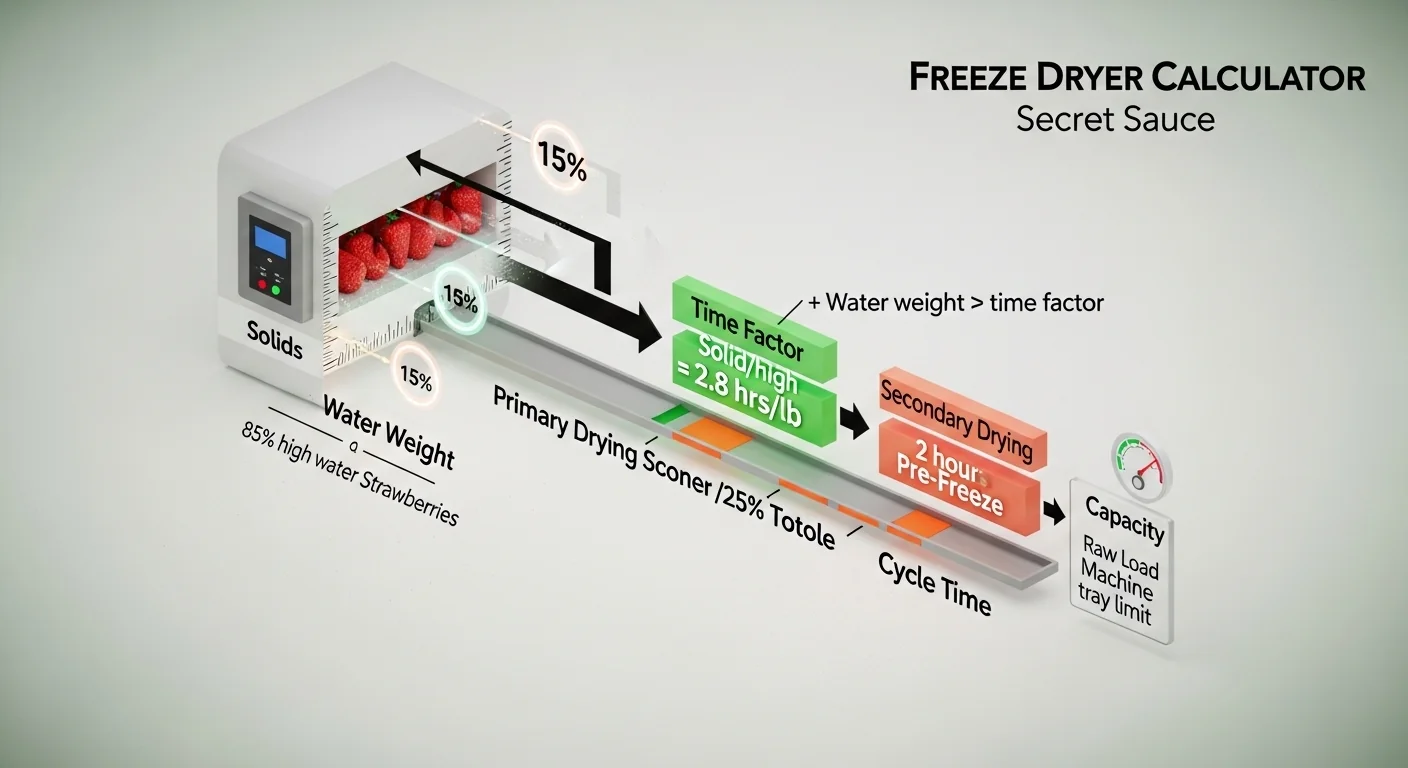
Freeze drying cycle time is not a single number. It depends on the interaction of three variables that most guides treat separately: the volume of water that must be sublimated, the food type (which determines how easily that water releases), and the machine’s tray area, which sets a hard ceiling on how much you can load per run. Getting any one of these wrong produces a cycle estimate that is off by hours, sometimes by an entire day. If you have been comparing freeze drying to dehydrating as an alternative preservation method, the cycle-time difference between the two is significant and depends entirely on these same moisture variables.
This freeze dryer calculator computes three things: the total estimated cycle time (broken into pre-freeze, primary sublimation, and secondary drying phases), your machine’s maximum batch capacity in pounds, and the expected dry yield after all water is removed. It does not account for machine-specific pump performance variations, altitude effects on sublimation pressure, or thermoplate contact inconsistencies. Those variables require physical measurement on your specific unit.
After running your batch inputs through the calculator, you will know whether your planned load fits within your machine’s capacity and approximately when the cycle will finish, so you can schedule harvest, packaging, and storage without guessing.
Use the Tool
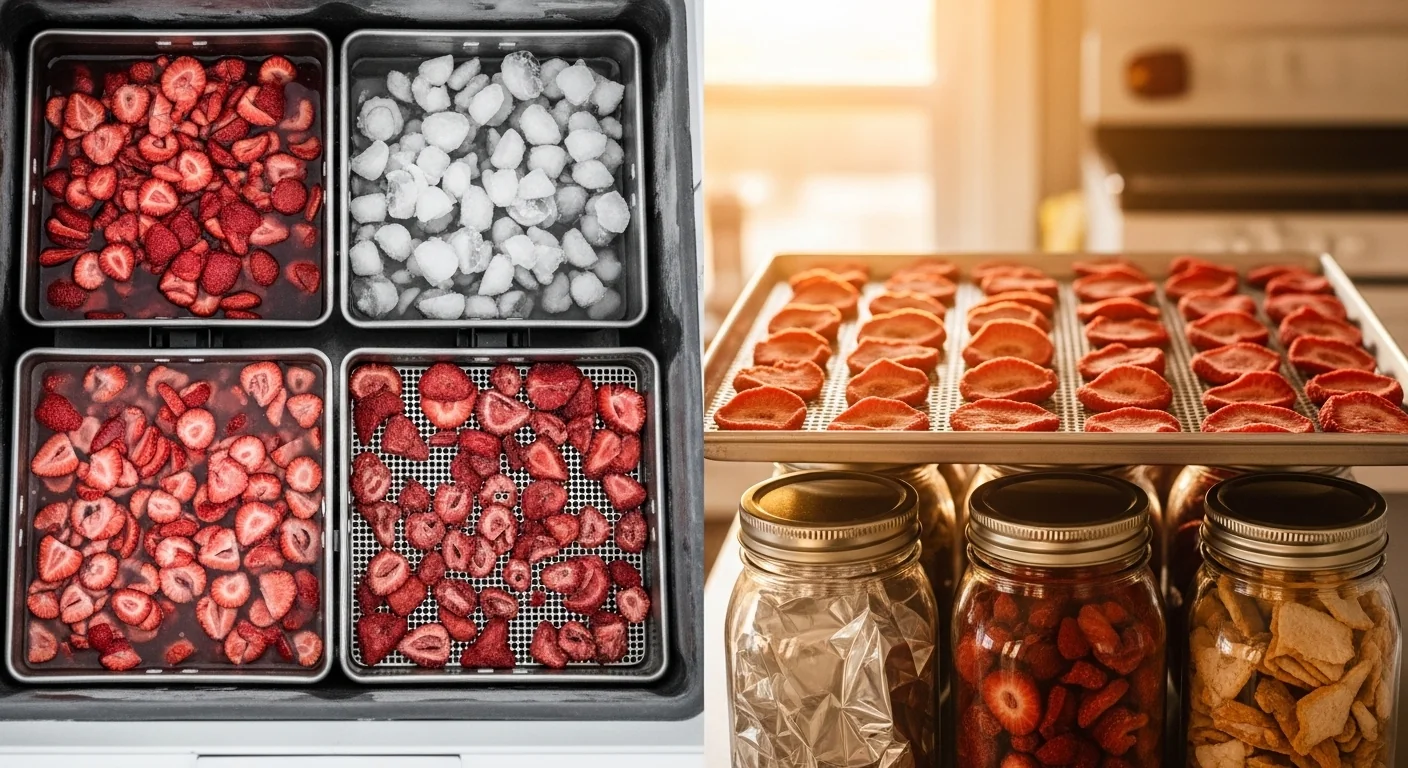
Enter Batch Details
| Machine | Food Type | Water | Raw Wt | Cycle Hrs | Dry Yield |
|---|
How This Calculator Works
- Tray Capacity (lbs) = Tray Area (sq ft) × Max Loading Thickness (0.75 in) × Food Density Factor.
Small = ~7–8 lbs | Medium = ~11–12 lbs | Large = ~18–20 lbs - Water Weight Removed (lbs) = Raw Weight × Water Content % (High 85% / Medium 65% / Low 40%)
- Primary Drying (sublimation) Hours = Water Weight × Time Factor per lb
Solid/High water: 2.8 hrs/lb water | Solid/Medium: 2.5 | Solid/Low: 2.2
Liquid/High: 3.2 hrs/lb | Liquid/Medium: 2.9 | Liquid/Low: 2.5 - Secondary Drying Hours = Primary Drying × 0.25 (removes bound water)
- Pre-freeze Phase = 2 hours (if loading fresh, not pre-frozen)
- Total Cycle Time = Pre-freeze + Primary Drying + Secondary Drying
- Dry Yield (lbs) = Raw Weight × (1 − Water Content %) — typically 10–20% of original weight
Assumptions: Room-temperature starting product loaded fresh. Pre-freezing your food before loading reduces total time by ~6 hours. Results are estimates — actual times vary by batch density, slice thickness, and machine condition. Shelf temperature held at +120°F for primary drying.
Before entering your values, have three things ready: your machine model (so you can confirm its tray count and match it to Small, Medium, or Large in the selector), the raw weight of the food you plan to load in pounds, and a general sense of whether your food is high, medium, or low moisture. Strawberries and soup fall into the high category. Cooked chicken breast and apples land in medium. Bread, cooked rice, and grains are low. Enter raw weight as the total weight of fresh, uncooked or unprocessed food going onto trays, not the weight of an empty tray or packaging.
Quick Start (60 Seconds)
- Machine Size: Select Small (4 trays), Medium (6 trays), or Large (9 trays). If you own a Harvest Right, the small unit has roughly 6 square feet of tray area, medium about 9, and large about 16. Use the size that matches your actual tray count, not the chamber size label.
- Food Type: Choose Liquid for anything pourable at room temperature (soups, broths, milk, yogurt, smoothies). Choose Solid for everything else including fruit, vegetables, cooked meats, eggs, and herbs. Liquids require pre-freezing in molds before trays are loaded.
- Water Content: High means the food is more than 80 water by weight (melons, strawberries, tomatoes, broth). Medium covers 50 to 80 (most cooked meats, apples, cooked vegetables). Low covers under 50 (bread, grains, hard cheese, cooked pasta).
- Raw Weight: Enter the weight of food you are actually putting on the trays, in pounds, before any freeze drying occurs. Do not enter the dry weight target. Accepted range is 0.5 to 200 lbs.
- Common input mistake: Entering the per-tray weight instead of the total batch weight. If you have 6 trays each holding 1.5 lbs, enter 9, not 1.5.
- Unit reminder: The calculator uses pounds throughout. If you weighed your food in grams or kilograms, convert before entering: 1 kg = 2.205 lbs.
- Result reading: The cycle time shown includes the 2-hour pre-freeze phase. If you pre-freeze food overnight before loading, subtract approximately 2 hours from the displayed total.
Inputs and Outputs (What Each Field Means)
| Field | Unit | What It Measures | Common Mistake | Safe Entry Guidance |
|---|---|---|---|---|
| Machine Size | Category (Small / Medium / Large) | Determines tray area and maximum batch load in pounds. Small = ~7.5 lbs max, Medium = ~11.5 lbs, Large = ~19 lbs. | Selecting by chamber physical size rather than tray count. A physically large unit with fewer trays installed has lower capacity. | Match to your actual tray count: 4 trays = Small, 6 = Medium, 9 = Large. |
| Food Type | Category (Liquid / Solid) | Determines the sublimation time factor applied per pound of water weight. Liquids carry a higher factor because structure collapse risk during primary drying requires slower shelf temperature ramp. | Classifying pureed or cooked-down food as solid when it behaves as a liquid at loading temperature. | If the food pours, flows, or holds no shape at room temperature, select Liquid. Frozen-solid yogurt cubes still classify as Liquid in this context. |
| Water Content | Category (High / Medium / Low) | Sets the water weight fraction used to compute how many pounds of water must be sublimated. High = 85%, Medium = 65%, Low = 40%. | Underestimating water content for lightly cooked foods. A bowl of soup classified as medium instead of high will produce a cycle estimate that is hours short. | When in doubt between two categories, select the higher one. Short cycles are worse than long ones because under-dried product fails shelf-stability. |
| Raw Weight | Pounds (lbs) | The total mass of food loaded on trays before any drying occurs. This is used to calculate water weight removed, dry yield, and tray load vs. capacity comparison. | Entering estimated weight from a recipe rather than weighing the actual batch. Recipes rarely match actual prep yield. | Weigh the food after trimming, peeling, and any pre-processing but before loading. Range: 0.5 to 200 lbs. |
| Tray Capacity (output) | Pounds (lbs) | The recommended maximum raw weight for the selected machine size based on tray area and standard loading thickness. | Treating capacity as a soft suggestion. Overloading extends cycle time unpredictably and can leave residual moisture in dense areas of the load. | Keep raw weight at or below this number. If your batch exceeds it, split into two separate cycles. |
| Estimated Dry Yield (output) | Pounds (lbs) | Predicted finished dry weight after sublimation. Calculated as raw weight multiplied by the fraction of non-water solids (1 minus the water content fraction). | Expecting the dry yield to be 50 or more of the raw weight. For high-water foods, the yield is typically under 20 of the raw input. | Use this figure to plan storage container size and mylar bag count before the cycle runs. Similar planning logic applies when calculating output from a canning run, where cooked-down yield also shrinks significantly from raw weight. |
| Water Removed (output) | Pounds (lbs) | Total pounds of water sublimated during the cycle. Useful for understanding pump load and predicting ice buildup on the condenser. | Ignoring this number. Heavy water loads (over 10 lbs) build significant ice mass on the condenser coil and may require a mid-cycle defrost on older units. | If water removed exceeds 12 lbs for your batch, plan for a condenser defrost inspection at cycle end before removing trays. |
| Total Cycle Time (output) | Hours | Sum of pre-freeze phase (2 hrs), primary drying (sublimation), and secondary drying (desorption). This is calendar time from start to cycle complete. | Treating the output as an exact number rather than an estimate. Actual time can vary based on thermoplate contact, food slice thickness, and batch density. | Add a 10 to 15 buffer when scheduling unattended overnight cycles. Do not plan packaging immediately at the estimated end time. |
Worked Examples (Real Numbers)
Example 1: Small Machine, Fresh Strawberries (Solid, High Water)
- Machine Size: Small
- Food Type: Solid
- Water Content: High (85%)
- Raw Weight: 5 lbs
Water weight: 5 x 0.85 = 4.25 lbs
Primary drying: 4.25 x 2.8 hrs/lb = 11.9 hrs
Secondary drying: 11.9 x 0.25 = 3.0 hrs
Pre-freeze: 2.0 hrs
Result: 16.9 hours total cycle time. Dry yield: 0.75 lbs. Water removed: 4.25 lbs.
A 5-pound strawberry batch on a small machine runs close to 17 hours. The resulting dry yield is less than one pound, which illustrates why high-water fruits require multiple batch cycles to build meaningful storage quantities.
Example 2: Medium Machine, Chicken Broth (Liquid, High Water)
- Machine Size: Medium
- Food Type: Liquid
- Water Content: High (85%)
- Raw Weight: 8 lbs
Water weight: 8 x 0.85 = 6.8 lbs
Primary drying: 6.8 x 3.2 hrs/lb = 21.76 hrs
Secondary drying: 21.76 x 0.25 = 5.44 hrs
Pre-freeze: 2.0 hrs
Result: 29.2 hours total cycle time. Dry yield: 1.2 lbs. Water removed: 6.8 lbs.
Liquid broth carries both the highest water fraction and the highest time factor per pound of water. An 8-pound batch approaches a full 30-hour cycle. Freeze the broth in silicone cube molds to roughly 1 inch thick before loading to control shelf-temperature uniformity.
Example 3: Large Machine, Cooked Ground Beef (Solid, Medium Water)
- Machine Size: Large
- Food Type: Solid
- Water Content: Medium (65%)
- Raw Weight: 15 lbs
Water weight: 15 x 0.65 = 9.75 lbs
Primary drying: 9.75 x 2.5 hrs/lb = 24.375 hrs
Secondary drying: 24.375 x 0.25 = 6.1 hrs
Pre-freeze: 2.0 hrs
Result: 32.5 hours total cycle time. Dry yield: 5.25 lbs. Water removed: 9.75 lbs.
Cooked ground beef at medium water content produces a moderately dense cycle on the large machine. At 9.75 lbs of water removed, condenser inspection is advisable at cycle end. The dry yield of 5.25 lbs is approximately 35 of the starting weight, making meat one of the more rewarding foods for yield retention compared to fruit.
Reference Table (Fast Lookup)
| Machine | Food Type | Water Content | Raw Weight (lbs) | Est. Cycle Time (hrs) | Dry Yield (lbs) | Water Removed (lbs) |
|---|---|---|---|---|---|---|
| Small | Solid | High | 5 | 16.9 | 0.75 | 4.25 |
| Small | Solid | Medium | 7 | 16.2 | 2.45 | 4.55 |
| Small | Liquid | High | 5 | 19.0 | 0.75 | 4.25 |
| Medium | Solid | High | 10 | 31.8 | 1.5 | 8.5 |
| Medium | Solid | Medium | 10 | 22.3 | 3.5 | 6.5 |
| Medium | Liquid | High | 8 | 29.2 | 1.2 | 6.8 |
| Large | Solid | High | 15 | 46.6 | 2.25 | 12.75 |
| Large | Solid | Medium | 18 | 38.6 | 6.3 | 11.7 |
| Large | Solid | Low | 18 | 21.8 | 10.8 | 7.2 |
| Large | Liquid | Medium | 14 | 35.0 | 4.9 | 9.1 |
The Dry Yield column is the derived figure most useful for planning. It shows the actual pounds of shelf-stable product you receive from a given raw input. The gap between raw weight and dry yield is widest for high-water foods, which is why high-moisture batches feel less productive per cycle despite long run times.
How the Calculation Works (Formula + Assumptions)
Show the calculation steps
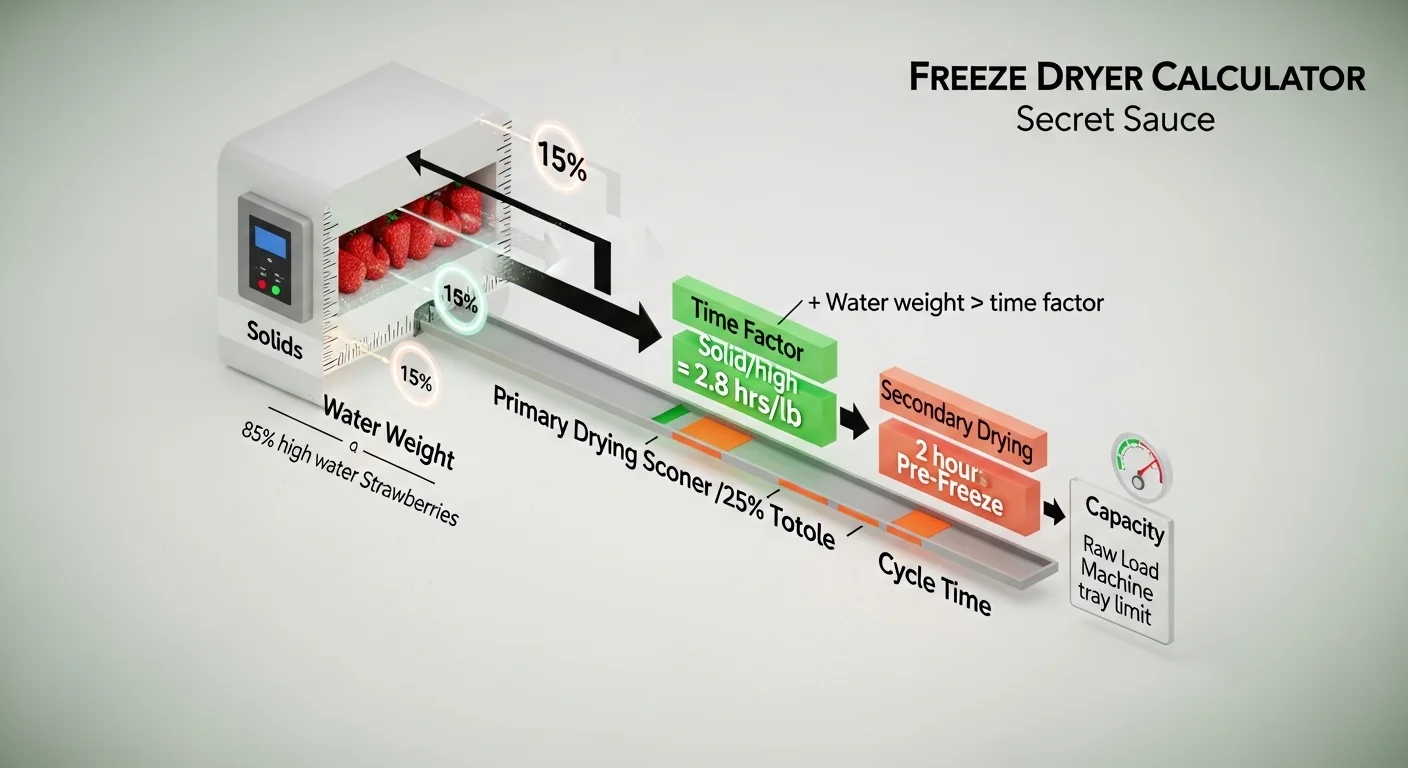
- Water Weight (lbs): Raw Weight x Water Content Fraction. Fractions used: High = 0.85, Medium = 0.65, Low = 0.40. This is the mass of water that must be converted from ice to vapor during sublimation.
- Primary Drying Hours (sublimation phase): Water Weight x Time Factor. Time factors (hrs per lb of water): Solid / High = 2.8, Solid / Medium = 2.5, Solid / Low = 2.2, Liquid / High = 3.2, Liquid / Medium = 2.9, Liquid / Low = 2.5. Liquids carry a higher factor because their structural state requires a slower shelf-temperature ramp to prevent collapse and boiling under vacuum.
- Secondary Drying Hours (desorption phase): Primary Hours x 0.25. Secondary drying removes bound water not released during sublimation. It typically runs at elevated shelf temperature and lower vacuum pressure.
- Pre-Freeze Phase: Fixed at 2.0 hours. This represents the time for the machine’s refrigeration system to freeze fresh-loaded food from room temperature to approximately -10 degrees Fahrenheit. If food is loaded already frozen, this phase can be skipped and approximately 2 hours deducted from the total.
- Total Cycle Time: Pre-Freeze + Primary Drying + Secondary Drying.
- Dry Yield (lbs): Raw Weight x (1 – Water Content Fraction). This is the weight of non-water solids remaining after all drying phases complete.
- Tray Capacity (lbs): A fixed value per machine size derived from tray area and standard 0.75-inch maximum loading thickness: Small ~7.5 lbs, Medium ~11.5 lbs, Large ~19.0 lbs.
Rounding: All intermediate values are carried to full precision. Final cycle time is displayed to one decimal place. Dry yield is displayed to two decimal places.
Unit convention: All weight values are in pounds. No conversion is applied internally. Enter raw weight in pounds.
Assumptions and Limits
- The pre-freeze phase assumes food is loaded at room temperature, approximately 65 to 72 degrees Fahrenheit. Refrigerated food (not fully frozen) will shorten this phase but the reduction is not modeled.
- Water content fractions (85%, 65%, 40%) are representative midpoints for each category. The actual moisture level of a specific food item may differ. A particularly juicy variety of an “average” fruit can behave like a high-water food even when classified as medium.
- Time factors are averages for standard slice or piece thickness of 0.25 to 0.75 inches. Thicker pieces extend primary drying time; thinner pieces shorten it.
- The calculator does not model condenser ice saturation. On batches with more than 10 to 12 lbs of water removed, ice buildup on the condenser may throttle sublimation rate toward the end of the cycle, extending actual run time beyond the estimate.
- Tray capacity values assume a single, even layer of food with no stacking. Stacking or uneven loading reduces effective drying area and may require additional hours beyond the estimate.
- The formula does not account for altitude. At elevations above 5,000 feet, lower ambient pressure affects machine vacuum performance and can alter effective drying rates.
- Machine-to-machine variation in thermoplate contact quality, oil pump efficiency, and refrigeration performance are not modeled. Results should be treated as planning estimates, not engineering specifications.
Standards, Safety Checks, and “Secret Sauce” Warnings
Critical Warnings
- Do not skip the pre-freeze phase for high-moisture liquids. Loading liquid broth or pureed food directly onto trays without freezing first will cause the product to flow and pool in the vacuum chamber during pump-down. The resulting mess damages the unit and voids most manufacturer warranties. Freeze liquid foods completely solid in molds before tray loading.
- Overloading the tray surface is the most common cause of failed shelf-stability. When raw weight exceeds tray capacity, the extra depth of product in contact with adjacent pieces creates insulated zones where sublimation stalls. Moisture can remain trapped in the center of thick stacks even when the outer surface appears fully dried. The only reliable fix is to split the batch.
- A cycle that ends “on time” is not automatically finished. Check final moisture by squeezing a piece from the center of the heaviest tray. It should be completely rigid with zero flexibility. Any give means residual moisture remains and secondary drying must be extended. Packaging prematurely causes rehydration inside sealed bags. Food safety depends on reaching true residual moisture levels below 2.
- Pre-freezing food to -10 degrees Fahrenheit before loading saves approximately 6 hours of total cycle time and significantly reduces oil pump vapor load during the early stages. This is not a minor tip; it is a structural cycle optimization. A dedicated chest freezer used for pre-freezing batches pays for itself in reduced electricity cost and extended pump service intervals over time.
Minimum Standards
- Slice thickness should not exceed 0.75 inches for solid foods. Thicker pieces create thermal gradients that extend primary drying time beyond the estimate and increase the risk of case hardening (dried outer shell trapping moisture inside).
- Dry yield should be stored in heat-sealed mylar bags with oxygen absorbers within 20 to 30 minutes of tray removal. Freeze-dried product begins reabsorbing ambient humidity immediately upon exposure to air. Similar principles apply to other preserved-food outputs, such as when you are calculating yields from a brine solution for fermented vegetable preservation, where environmental exposure time also directly affects the final product.
- For any batch with water removed exceeding 8 lbs, inspect the condenser coil before removing trays. Ice accumulation above this threshold can affect the final desorption phase.
Competitor Trap: Most freeze drying time guides quote a single number, such as “24 to 36 hours for most foods,” without distinguishing between food types, machine sizes, or water content categories. This range conflates a small batch of low-moisture bread with a large batch of high-moisture liquid, which are separated by more than 25 hours of cycle time in practice. Relying on a generic range leads to under-planned cycles, packaging delays, and, most critically, product pulled before it reaches actual shelf stability. The specific combination of food type and water content is what drives the estimate, not a category average.
Common Mistakes and Fixes
Mistake: Classifying Cooked or Pureed Foods as Solid
Cooked vegetable soups, pureed sweet potato, and yogurt are frequently entered as solid foods because the preparer thinks of them as thick or chunky. Once these foods are at loading temperature they behave structurally like liquids under vacuum: they can flow, foam, and collapse. Using the solid classification understates cycle time and misses the pre-freeze handling requirement.
Fix: If the food flows, pours, or holds no independent shape at room temperature, classify it as Liquid and freeze it completely solid in molds before loading.
Mistake: Estimating Raw Weight Instead of Weighing It
A common shortcut is loading trays by visual fill and estimating weight from a recipe or package label. Fresh produce weight varies considerably by variety, ripeness, and trimming. A tray “filled with strawberries” could weigh anywhere from 1.2 to 2.1 lbs depending on berry size and packing density. Estimating introduces cumulative error across multiple trays.
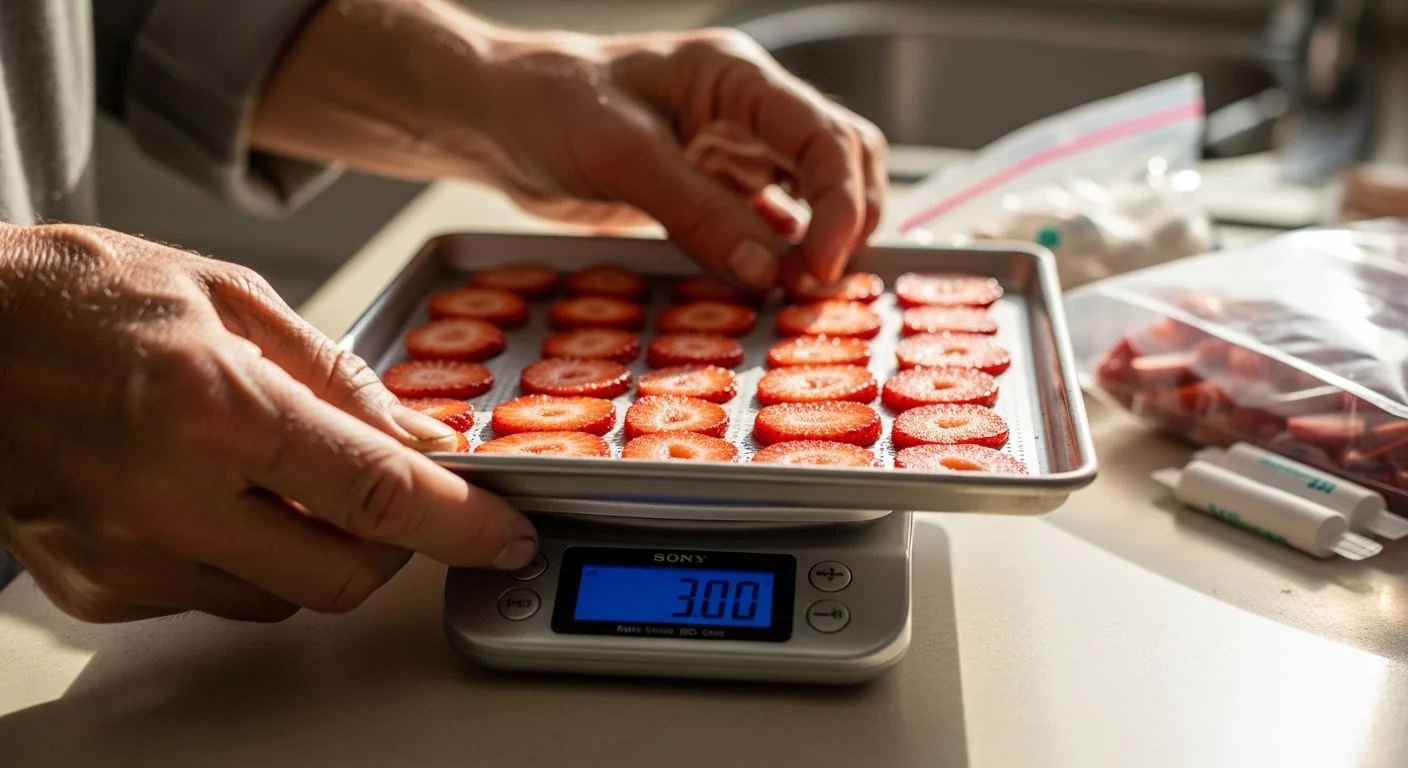
Fix: Place the loaded tray on a kitchen scale before inserting it into the machine. Weigh every tray individually and sum the values for an accurate total raw weight entry.
Mistake: Using the Machine’s Physical Size Instead of Tray Count
Freeze dryer models are sometimes described by chamber dimensions rather than tray count, and manufacturers occasionally update tray configurations between product generations. A physically large chamber installed with fewer than its maximum tray count has significantly lower capacity than the machine size name implies.
Fix: Count the actual trays in your specific unit. Four trays corresponds to Small, six to Medium, and nine to Large in this calculator. If your unit has a non-standard tray count, select the closest category below your actual count rather than above. Tracking per-batch yield data alongside your homestead’s broader harvest accounting, similar to what a honey yield tracker provides for extraction runs, builds a much more reliable picture of per-cycle output over a season.
Mistake: Removing Product Immediately at Cycle End
The calculator’s estimated cycle time is based on formula averages. Real batches vary. Pulling trays the moment the machine signals completion, without a tactile check, is one of the most common causes of improperly dried product. Dense center pieces on a heavy tray may still contain residual bound moisture even when the cycle has technically ended.
Fix: When the machine signals cycle completion, take one piece from the geometric center of the tray with the heaviest load and attempt to bend it. If it bends rather than snapping, extend secondary drying by 1 to 2 hours and recheck.
Mistake: Ignoring the Impact of Pre-Freezing on Pump Life
Loading fresh, room-temperature food forces the vacuum pump to handle the full vapor load from the food’s surface as it freezes inside the chamber during pump-down. This dramatically increases the rate at which pump oil becomes contaminated with water vapor, shortening oil change intervals and, over time, reducing pump efficiency. The cycle time estimate includes a 2-hour pre-freeze phase specifically to model this load.
Fix: Pre-freeze batches to -10 degrees Fahrenheit in a dedicated chest freezer before loading. This removes the pre-freeze phase from the machine’s job, saves roughly 6 hours of run time, and extends pump oil service life between changes.
Next Steps in Your Workflow
Once you have a cycle time estimate and a confirmed dry yield figure, the immediate next action is to assemble your packaging supplies before the cycle ends, not after. For high-water foods like fruit, the dry yield figure from the calculator will often feel surprisingly small. A 10-pound raw batch of strawberries produces approximately 1.5 lbs of finished product. Plan mylar bag count, oxygen absorber units, and label quantities against the dry yield output, not the raw input. If you are running multiple food types in the same batch, the heaviest and most water-dense item sets the minimum cycle time for the entire load. Processing your yield data across multiple batch types, the same way a pectin ratio calculator helps standardize fruit-to-gel conversions across different fruit varieties, builds a production log that makes future batch planning faster and more precise.
After packaging, the broader homestead context matters. Freeze-dried stores are most useful when combined with other preservation outputs: canned goods, frozen stock, fermented products, and dried herbs each fill different shelf-life and use-case roles. The cost side of this equation, specifically whether the energy and time cost of freeze drying makes sense per pound of output relative to your household consumption, connects directly to your broader feed cost planning for livestock and homestead operations. Batch yield and cost per pound are the two numbers that determine whether scaling up to a larger machine is financially justified.
FAQ
How long does freeze drying take for most home batches?
Cycle time ranges from roughly 16 hours for a small batch of low-moisture solids to over 46 hours for a large machine loaded with high-water-content food. The most important variable is not the machine size but the pounds of water that must be sublimated. Food type (liquid vs. solid) sets the time factor applied per pound of water weight. There is no single universal answer that applies across machine sizes and food categories.
What is the difference between primary and secondary drying in freeze drying?
Primary drying, also called sublimation, removes free ice directly from the food by converting it from solid to vapor under vacuum. This phase removes roughly 90 to 95 of total water by mass. Secondary drying, or desorption, removes bound water molecules that remain attached to the food’s molecular structure after sublimation ends. Secondary drying runs at higher shelf temperatures and is typically 20 to 30 of the primary drying duration in time.
How do I calculate freeze-dried food yield from raw weight?
Multiply raw weight by the fraction of non-water solids: 1 minus the water content fraction. For a food with high water content (85% water), the dry yield fraction is 0.15, meaning 1 pound raw produces approximately 0.15 pounds dry. For medium water content (65%), the yield fraction is 0.35. For low water content (40%), the fraction is 0.60. These fractions are applied automatically in the calculator.
Does pre-freezing food actually save significant cycle time?
Pre-freezing food to -10 degrees Fahrenheit before loading eliminates the 2-hour pre-freeze phase from the machine’s cycle and reduces vapor load on the vacuum pump during pump-down. In practice this saves approximately 6 hours of total cycle time by removing the machine’s need to freeze the product from room temperature and by allowing the primary sublimation phase to begin at optimal chamber pressure sooner. The pump oil contamination rate also decreases meaningfully.
Can I freeze dry liquid foods like soup or milk?
Liquids can be freeze dried but must be completely frozen solid before loading onto trays. Pouring liquid directly onto trays and then starting the machine risks product flow inside the chamber during pump-down, which can damage components and create a significant cleanup problem. The standard practice is to freeze liquids in silicone molds or ice cube trays to approximately 0.5 to 1 inch thickness, then transfer the frozen pieces to the freeze dryer trays.
What is the maximum batch size for a home freeze dryer?
Maximum batch capacity depends on machine size. A small 4-tray unit handles approximately 7.5 lbs of raw food. A medium 6-tray unit handles approximately 11.5 lbs. A large 9-tray unit handles approximately 19 lbs. These figures are based on standard tray area and a 0.75-inch maximum food loading thickness in a single, non-stacked layer. Exceeding these limits by stacking food creates drying dead zones and risk of residual moisture in the finished product.
Conclusion
The freeze dryer calculator gives you a specific, formula-derived estimate rather than a generic time range that covers too wide a span to be useful for batch planning. The key insight it encodes is that cycle time is fundamentally a function of water weight, not machine size alone. A small machine with a low-moisture batch can finish faster than a large machine with a high-moisture liquid load. Understanding this relationship before you start a cycle prevents the most costly errors: underestimated run times that force you to extend unplanned, and overloaded trays that produce product that fails the finger-bend moisture check.
The single mistake most worth avoiding is pulling product before confirming physical dryness, regardless of what the machine’s timer says. Cycle time estimates are planning tools, not completion guarantees. Pre-freezing your batches before loading is the one operational habit that consistently shortens run time, extends pump life, and improves batch predictability. For homesteaders tracking food stores across preservation methods, pairing freeze-dried output data with records from your food dehydrator planning gives a complete picture of total preserved yield across your pantry season.