
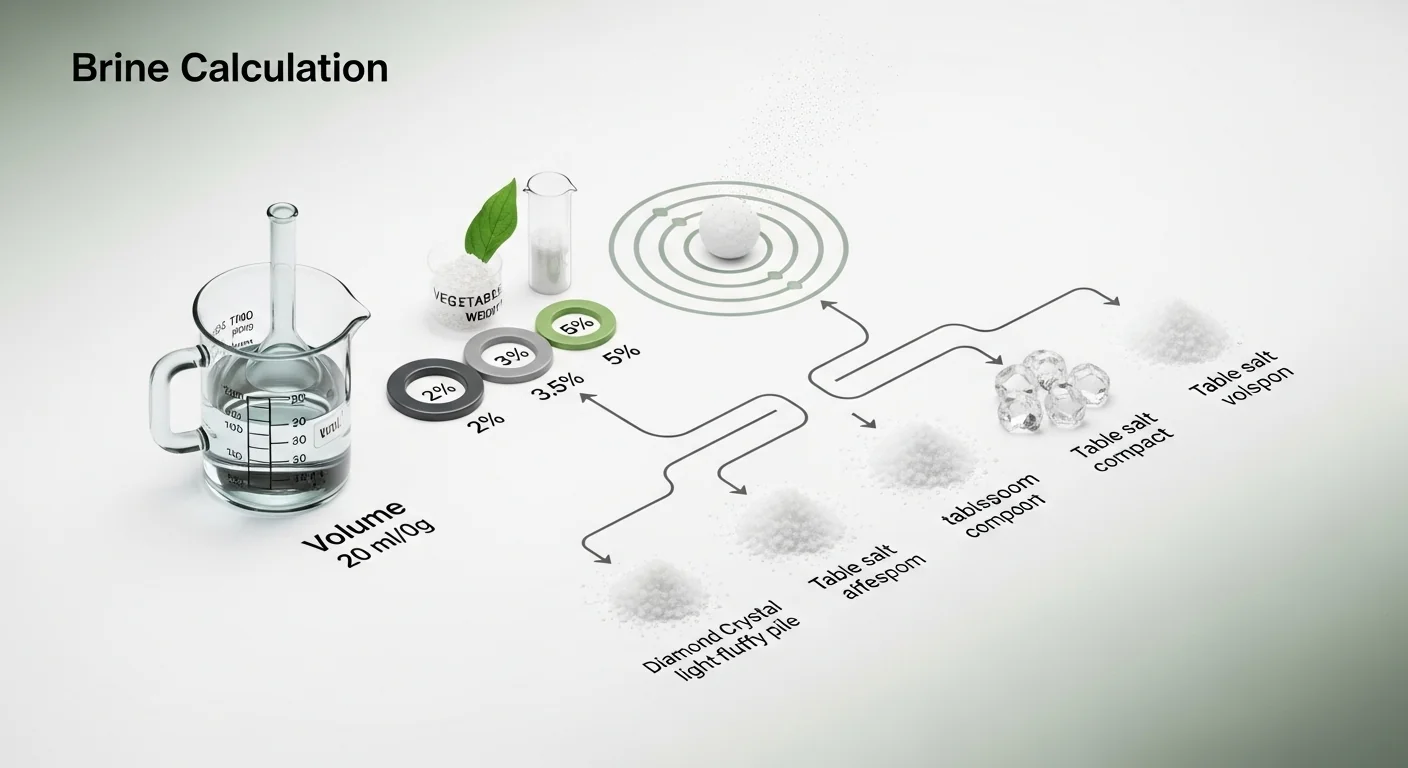
Salt percentage is not a preference. It is the controlling variable that determines whether a fermentation batch is safe to eat, produces the right texture, and stores without spoiling. A brine made by scooping a tablespoon of salt per quart is not a recipe; it is a guess, and the gram weight of that tablespoon changes by as much as 50 percent depending on the salt type sitting in your pantry. Every brine calculation needs three inputs locked in before the salt touches the water: total liquid weight, target concentration, and the specific density of your salt.
This brine calculator computes the exact weight of salt in grams needed for a given volume of water, adjusts the tablespoon conversion based on the grain density of four common salt types, and applies the vegetable weight to total brine weight when that is part of the recipe. It calculates what goes into the jar before fermentation or pickling begins. It does not predict fermentation speed, acidity development, final pH, or shelf life, because those outcomes depend on temperature, vegetable microbiology, and oxygen management that no calculator can model from inputs alone. Pairing this tool with careful canning calculations covers both the fermentation and heat-processing sides of food preservation.
After using this tool, you will know the precise gram weight and tablespoon equivalent of salt to add for a safe, effective brine at your chosen concentration, using the specific salt brand and grain size you have on hand.
Use the Tool
| Target % | Use Case | Salt (g) per 1 qt | Tablespoons |
|---|
How This Calculator Works
Water volume in cups or quarts is converted to milliliters, then to grams (1 mL water = 1 g).
1 cup = 236.6 mL | 1 quart = 946.4 mL
Water Weight (g) = volume × mL-per-unit × 1 g/mL
If vegetable weight is provided, it is added to the water weight. Salt displaces and mixes with the total liquid+food mass.
Total Weight (g) = Water Weight + Vegetable Weight
Brine percentage is the ratio of salt to total weight of water (+ optional vegetables).
Salt Weight (g) = Total Weight × (Target % ÷ 100)
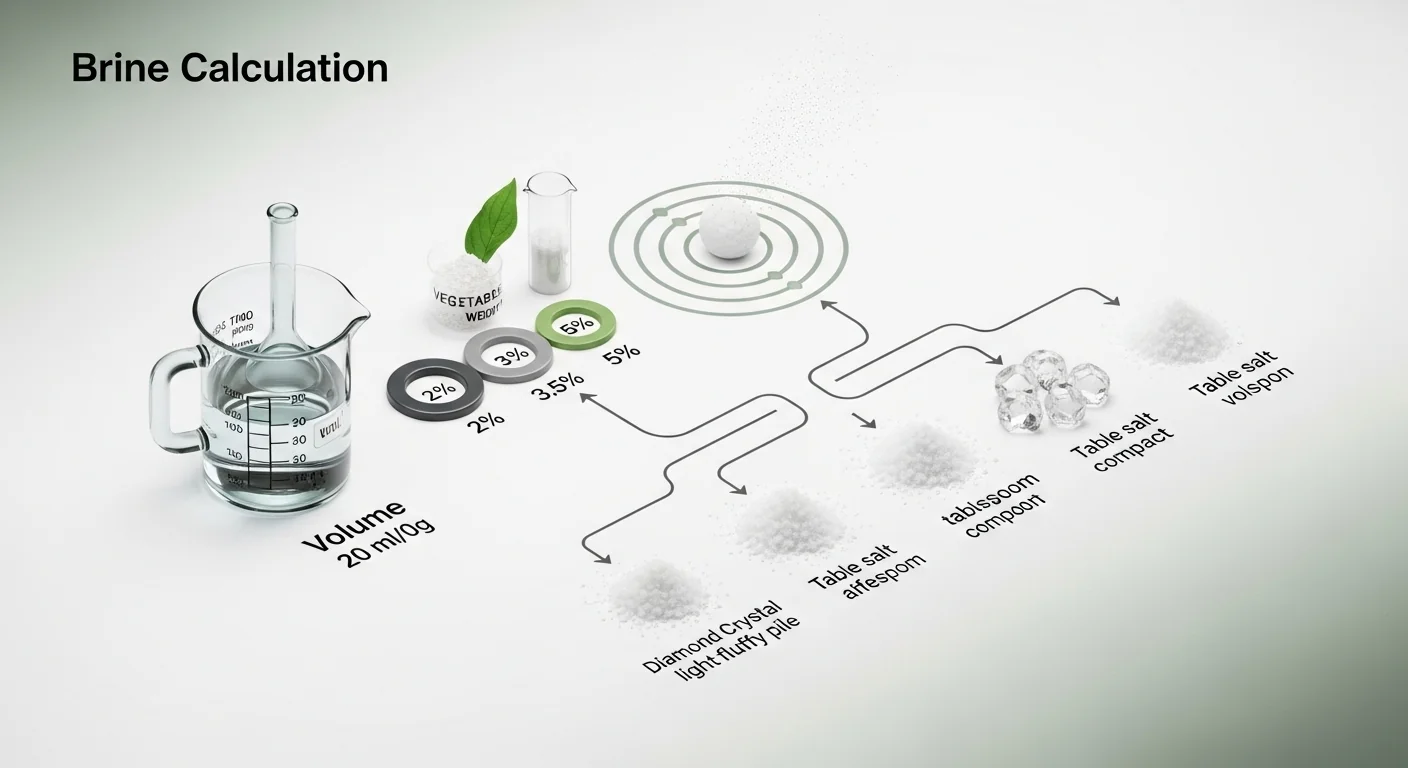
Different salts have different grain densities — the same tablespoon measurement contains very different weights of salt depending on type.
Tablespoons = Salt Weight (g) ÷ g-per-tablespoon (by salt type)
Table Salt: 16.4 g/Tbsp | Morton Kosher: 14.8 g/Tbsp | Diamond Crystal: 8.4 g/Tbsp | Fine Sea Salt: 15.0 g/Tbsp
▼ Assumptions & Limits
- Water density assumed at 1 g/mL (room temperature, no dissolved minerals).
- Vegetable weight is added to total; vegetable water content is not accounted for separately.
- Salt grain density values are averages; actual brands may vary slightly (±5%).
- Iodized table salt may slightly inhibit fermentation — use non-iodized for fermenting.
- Do not use brine below 2% for fermentation — this is the safety floor for inhibiting harmful pathogens.
- Calculator assumes the salt fully dissolves in the water (true for all listed salt types when stirred).
- Maximum recommended brine for most vegetables is 8%; above this, texture degrades significantly.
Before entering values, have your water volume measured in cups or quarts, your vegetable weight in grams if you are including it, and your salt container in hand so you can confirm the exact brand. The salt type selector is not decorative; Diamond Crystal and Morton Kosher weigh nearly twice as differently per tablespoon as their labels suggest, and selecting the wrong option will produce a result that is off by up to 50 percent in volume measurement.
Quick Start (60 Seconds)
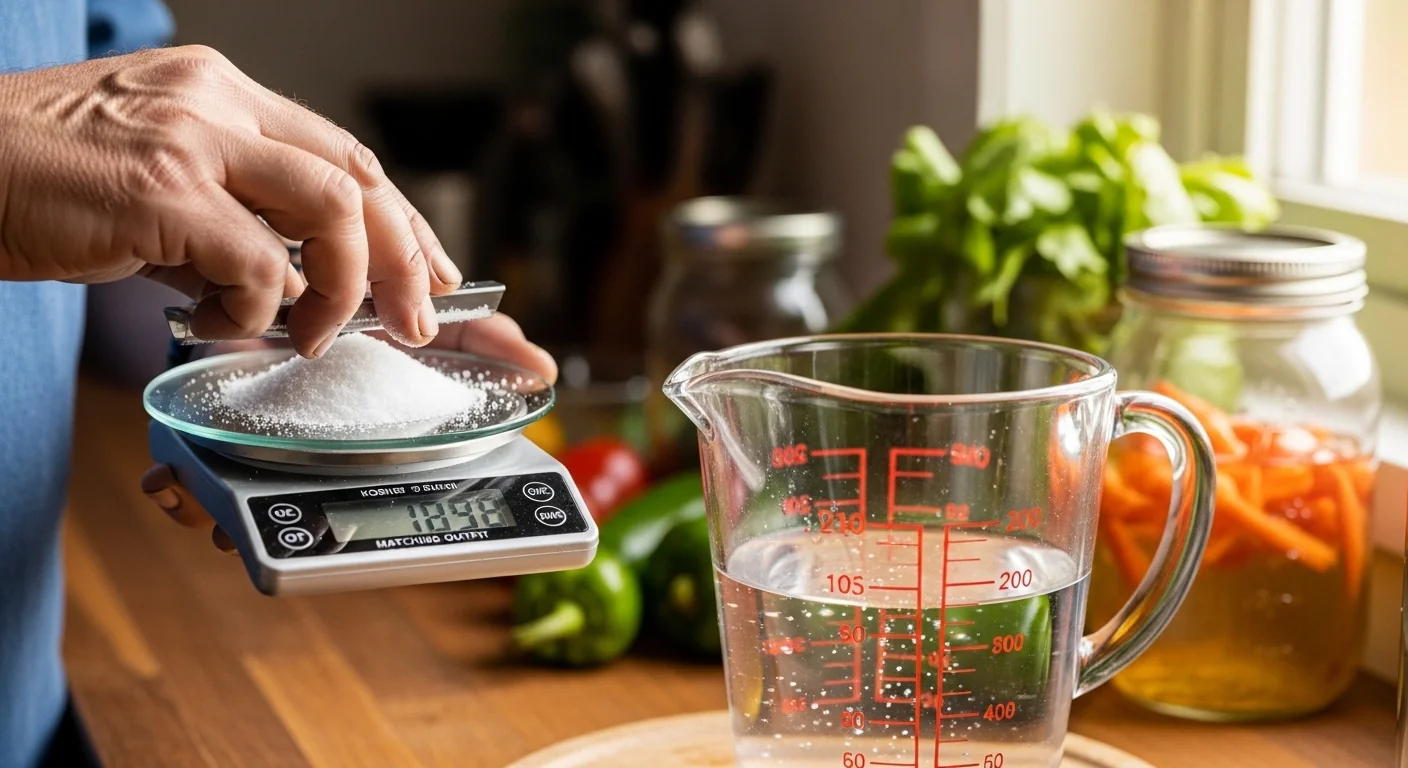
- Water Volume: Enter the amount of water you are brining, not the total jar volume. Use the unit selector to switch between cups and quarts. A standard wide-mouth quart jar holds roughly 3 cups of liquid after the vegetables are packed; measure your actual water, not the jar size.
- Vegetable Weight (optional): Weigh your prepped vegetables in grams on a kitchen scale before packing. Leave this field blank if you are calculating a brine-only solution without accounting for vegetable mass in the total weight.
- Target Brine Percent: Select 2% for lacto-ferments like sauerkraut, kimchi, or fermented pickles. Select 3.5% for refrigerator or short-term pickles. Select 5% for preservation brines intended for pantry storage.
- Salt Type: Check your container label. Morton Kosher and Diamond Crystal Kosher are not interchangeable by volume; Morton is approximately 14.8 grams per tablespoon while Diamond Crystal is approximately 8.4 grams. Using the wrong selection will miscalculate your brine.
- Click "Calculate Brine": Do not click until all required fields are filled. The result will show grams (weigh this), tablespoons, and teaspoons for your selected salt type.
- Use the gram output: Whenever possible, measure salt by weight using a kitchen scale. Tablespoon and teaspoon outputs are conversions provided for convenience; they assume average grain density for that salt type and carry minor rounding variance.
- Weigh, then dissolve: Dissolve the measured salt fully in warm water before adding vegetables. Undissolved salt at the bottom of a jar does not contribute to the active brine concentration.
Inputs and Outputs (What Each Field Means)
| Field | Unit | What It Means | Common Mistake | Safe Entry Guidance |
|---|---|---|---|---|
| Water Volume | Cups or Quarts | The volume of water used to prepare the brine solution | Entering jar volume instead of actual water volume | Measure the water before pouring; must be greater than 0 |
| Water Unit | Cups / Quarts | Unit selector converts to milliliters internally (1 cup = 236.6 mL, 1 quart = 946.4 mL) | Leaving unit on cups when volume is in quarts | Confirm unit matches your measuring vessel before calculating |
| Vegetable Weight | Grams (optional) | Weight of prepared vegetables added to total brine mass for calculating salt percentage | Entering vegetable volume in cups instead of weight in grams | Weigh on a scale; leave blank if not including vegetable mass in calculation |
| Target Brine % | Percent | The concentration of salt relative to total weight of water (plus vegetables if entered) | Selecting 2% for a preservation brine intended for pantry storage | Never go below 2% for fermentation; use 5% for unrefrigerated preservation |
| Salt Type | Selection (g/Tbsp) | Grain density of the specific salt used; determines volume-to-weight conversion | Treating all kosher salts as interchangeable by volume | Confirm brand name on the container; do not guess |
| Salt (grams) output | Grams | The precise mass of salt needed; primary output to use when a scale is available | Ignoring grams output and relying only on tablespoon conversion | Weigh salt on a digital scale for best accuracy |
| Tablespoons output | Tbsp | Volume equivalent of the gram result using the selected salt's grain density | Using tablespoon output with a different salt brand than selected | Only use volume output if your salt brand matches the selector |
| Total Weight output | Grams | Combined weight of water plus vegetable mass used as the base for percent calculation | Expecting this to equal jar capacity; it is brine base weight, not volume | Use for verification only; the salt gram output is the actionable result |
Worked Examples (Real Numbers)
Scenario 1: Small-Batch Lacto-Ferment (Carrots, 1 Quart)
- Water volume: 1 quart (946.4 g)
- Vegetable weight: none entered
- Target brine: 2%
- Salt type: Table salt (16.4 g/Tbsp)
Total weight: 946.4 g. Salt weight: 946.4 x 0.02 = 18.9 g. Tablespoon conversion: 18.9 / 16.4 = 1.15 Tbsp.
Result: 18.9 grams of table salt, approximately 1.15 tablespoons.
This is the minimum safe concentration for lacto-fermentation. The result sits exactly at the 2% safety floor. Any reduction in salt below this level increases the risk of pathogen survival in the jar during the fermentation window.
Scenario 2: Refrigerator Cucumber Pickle (2 Quarts, Including Cucumber Weight)
- Water volume: 2 quarts (1,892.7 g)
- Vegetable weight: 500 g sliced cucumbers
- Target brine: 3.5%
- Salt type: Morton Kosher (14.8 g/Tbsp)
Total weight: 1,892.7 + 500 = 2,392.7 g. Salt weight: 2,392.7 x 0.035 = 83.7 g. Tablespoon conversion: 83.7 / 14.8 = 5.66 Tbsp.
Result: 83.7 grams of Morton Kosher Salt, approximately 5.66 tablespoons.
Including vegetable weight increases total brine mass, which requires more salt to maintain the target concentration. If the 500 g cucumber weight were left out of the calculation, the result would be 66.2 g of salt, a meaningful difference for a 2-quart batch.
Scenario 3: Long-Term Pepper Preservation (4 Cups, Diamond Crystal)
- Water volume: 4 cups (946.4 g)
- Vegetable weight: 200 g sliced peppers
- Target brine: 5%
- Salt type: Diamond Crystal Kosher (8.4 g/Tbsp)
Total weight: 946.4 + 200 = 1,146.4 g. Salt weight: 1,146.4 x 0.05 = 57.3 g. Tablespoon conversion: 57.3 / 8.4 = 6.82 Tbsp.
Result: 57.3 grams of Diamond Crystal Kosher, approximately 6.82 tablespoons.
Note the tablespoon volume here: 6.82 Tbsp of Diamond Crystal delivers the same gram weight as only 3.49 Tbsp of table salt for this batch. This is the most common scaling error in brine recipes written without specifying salt type.
Reference Table (Fast Lookup)
All values below are computed for 1 quart (946.4 g) of water only, with no vegetable weight added. Gram values are the authoritative column; tablespoon columns are derived conversions by salt type.
| Brine % | Use Case | Salt (g) per 1 qt | Table Salt (Tbsp) | Morton Kosher (Tbsp) | Diamond Crystal (Tbsp) |
|---|---|---|---|---|---|
| 1% | Below safe minimum | 9.5 | 0.58 | 0.64 | 1.13 |
| 2% | Light ferment (minimum safe) | 18.9 | 1.15 | 1.28 | 2.25 |
| 2.5% | Mid ferment | 23.7 | 1.44 | 1.60 | 2.82 |
| 3% | Standard ferment | 28.4 | 1.73 | 1.92 | 3.38 |
| 3.5% | Standard pickle | 33.1 | 2.02 | 2.24 | 3.94 |
| 4% | Firm pickle | 37.9 | 2.31 | 2.56 | 4.51 |
| 5% | Preservation brine | 47.3 | 2.88 | 3.20 | 5.63 |
| 6% | Strong preserve | 56.8 | 3.46 | 3.84 | 6.76 |
| 8% | Upper practical limit | 75.7 | 4.62 | 5.11 | 9.01 |
How the Calculation Works (Formula + Assumptions)
Show the calculation steps
Step 1: Convert water volume to grams.
Water is measured by volume (cups or quarts), then converted to milliliters using fixed unit factors: 1 cup = 236.588 mL, 1 quart = 946.353 mL. Because water density at room temperature is approximately 1 g/mL, the milliliter value equals the gram weight directly.
Water Weight (g) = Volume x mL per unit
Step 2: Add optional vegetable weight.
If a vegetable weight is entered in grams, it is added to the water weight to produce total brine base weight. This reflects the practice of calculating brine percentage against the combined weight of liquid and food.
Total Weight (g) = Water Weight + Vegetable Weight
Step 3: Calculate salt weight from percentage.
Brine percentage is a weight-to-weight ratio. The target percentage is applied to the total weight.
Salt Weight (g) = Total Weight x (Target Percent / 100)
Step 4: Convert grams to tablespoons using salt grain density.
Each salt type has a fixed gram-per-tablespoon density: Table salt = 16.4 g/Tbsp, Morton Kosher = 14.8 g/Tbsp, Diamond Crystal Kosher = 8.4 g/Tbsp, Fine Sea Salt = 15.0 g/Tbsp.
Tablespoons = Salt Weight (g) / g per tablespoon (by salt type)
Teaspoons = Tablespoons x 3. Results are rounded to two decimal places for tablespoons and one decimal place for teaspoons.
Assumptions and Limits
- Water density is assumed at 1 g/mL. This is accurate at room temperature (20 degrees Celsius); water density increases slightly at colder temperatures but the difference is negligible for home brine calculations.
- Grain density values (g/Tbsp) are averages based on standard flake and crystal geometry. Actual density can vary within a single bag by plus or minus 5 percent due to settling, humidity, and crystal size variation.
- Vegetable water content is not modeled. Vegetables release moisture during fermentation, which can slightly dilute the brine concentration over time; the calculator uses pre-fermentation input values only.
- The tool assumes all entered salt fully dissolves in the water. Pickling salt, table salt, fine sea salt, and kosher salts all dissolve readily when stirred into room-temperature or warm water. Coarse rock salt may not dissolve completely without heating.
- Iodized table salt is handled mathematically the same as non-iodized; the iodine content is not a weight-significant variable. However, iodine can affect fermentation biology (see Standards section).
- The calculator does not account for vinegar, sugar, or acidulants present in some pickle recipes. Those ingredients affect flavor and preservation but not the salt-to-water brine percentage calculation as defined here.
- Fine Sea Salt density is approximated at 15.0 g/Tbsp. Sea salt grain size varies by brand and origin; verify with a kitchen scale if precision is critical.
Standards, Safety Checks, and "Secret Sauce" Warnings
Critical Warnings
- The 2% floor is not negotiable for fermentation safety. Brines below 2% salt concentration do not reliably inhibit Listeria monocytogenes or other spoilage organisms. Low-salt fermentation attempts that rely on speed or refrigeration as a compensating factor are not equivalent to meeting the minimum safe threshold from the start. This is the single most important number in the calculator.
- Iodized table salt interferes with lacto-fermentation. The iodine added to standard table salt inhibits lactobacillus and other beneficial fermentation bacteria at the colony formation stage. Batches brined with iodized salt may ferment more slowly, produce off-flavors, or fail to acidify properly. Use non-iodized pickling salt, non-iodized table salt, or kosher salt for fermentation applications.
- Volume-based brine recipes are only valid for one specific salt. A recipe that says "1 tablespoon per quart" is only accurate for the exact salt type it was written with. Swapping in Diamond Crystal when Morton Kosher is specified, or vice versa, changes the actual salt concentration by a significant margin. Always verify salt type before using a tablespoon-based recipe, or convert the recipe to grams.
- High-concentration brine above 8% degrades texture before extending safety. Salt actively draws moisture from vegetable cell walls through osmosis. At concentrations above 8%, this process happens faster than fermentation can offset it, producing soft, mushy vegetables without proportional safety benefit over a well-made 5% preservation brine.
Minimum Standards
- Fermentation brines: minimum 2% salt by weight of water plus vegetables.
- Short-term refrigerator pickles: 2% to 4% is the functional range for safe and edible results.
- Pantry preservation brines without heat processing: 5% or higher is required for reliable inhibition of spoilage without refrigeration.
- Heat-processed (canned) pickles in brine: brine percentage interacts with acidification requirements; refer to tested canning recipes using a validated canning calculator rather than adjusting brine in isolation.
Competitor Trap: Most brine ratio guides publish a single tablespoon-per-quart figure without specifying salt type, then note in a footnote that "different salts may vary." That footnote understates a problem that is actually structural. The difference between Diamond Crystal and table salt is not a minor adjustment; it is approximately a 2x factor in volume measurement. A guide that does not address grain density up front and build the conversion into the calculation is giving advice that is unreliable for anyone who does not happen to own the exact salt the author used. Recipes inherited from family or printed in older homesteading books almost universally assumed table salt. Applying those tablespoon figures to modern kosher salt brands is how fermentation batches end up under-salted. The pectin calculator for jam and jelly making faces a similar precision problem with gelling agents measured by volume.
Common Mistakes and Fixes
Mistake: Measuring Salt by Volume Without Identifying the Brand
Reaching for a tablespoon without noting the salt container brand is the origin of the majority of failed or under-salted fermentation batches. A tablespoon of Diamond Crystal weighs 8.4 grams; a tablespoon of table salt weighs 16.4 grams. Both look identical by volume in a measuring spoon. Using the gram output from this calculator and a kitchen scale eliminates this variable entirely.
Fix: Always weigh salt in grams. Use tablespoon measurements only as backup when a scale is unavailable, and only after confirming the exact brand and selecting it in the calculator.
Mistake: Using Jar Capacity Instead of Water Volume
A quart mason jar holds approximately 32 ounces of liquid, but once packed vegetables occupy 30 to 40 percent of that volume, the actual water volume is significantly less. Entering jar volume instead of measured water volume produces a brine that is weaker than calculated. This is particularly common when scaling up from a single-jar recipe to multiple jars.
Fix: Measure the water before adding it to the jar. Note the measured value, enter it in the calculator, then prepare and add vegetables separately.
Mistake: Skipping Vegetable Weight in Total Brine Calculation
When vegetables are submerged in brine, they become part of the total weight base against which the salt concentration is calculated. Omitting the vegetable weight underestimates the denominator, resulting in a brine that is slightly weaker than the target percentage. The effect is more significant with dense root vegetables (beets, carrots, turnips) than with lighter produce like cucumber slices.
Fix: Weigh prepped vegetables on a digital kitchen scale and enter the value in the vegetable weight field. For very light or leafy vegetables where weighing is impractical, the error is minor and can be left blank.
Mistake: Assuming All Ferments Need the Same Brine Percentage
A kimchi-style ferment built around fast lactic acid development performs optimally at 2% to 2.5% brine, while a summer cucumber pickle intended to last three months in the refrigerator benefits from 3.5% to 4%. Applying a single default percentage to all recipes produces inconsistently salted results, and using 2% as a universal percentage for preservation brines intended for pantry storage creates a food safety risk. If you are also working with alternative preservation methods, the freeze dryer calculator is worth bookmarking for comparison.
Fix: Match the brine percentage to the intended use case using the target percentage selector in the calculator. Fermentation, refrigerator pickling, and pantry preservation are distinct applications with distinct salt requirements.
Mistake: Using Iodized Salt for Lacto-Fermentation
Standard iodized table salt is the most commonly available salt in most pantries, and using it for fermentation is a consistent source of problems. Iodine is added to salt as a public health measure, but at fermentation-relevant concentrations it acts as an antimicrobial agent that does not distinguish between pathogens and the beneficial lactobacillus cultures responsible for safe fermentation. Batches brined with iodized salt often show slower acidification, surface discoloration, or off-aromas compared to the same recipe made with non-iodized salt.
Fix: Use non-iodized pickling salt, non-iodized table salt, or any kosher salt (kosher salts are not iodized by standard manufacturing practice) for fermentation and pickling applications.
Next Steps in Your Workflow
Once the salt weight is calculated, the next practical step is dissolving the salt completely before vegetables go in. Stir the measured salt into water at room temperature until no visible crystals remain at the bottom of the vessel. For larger batches or coarser salts, using water that is slightly warm speeds dissolution. Cool the brine to room temperature before submerging vegetables, particularly for fermentation applications where heat can affect the live microbial environment on the vegetable surface. After sealing and allowing the fermentation period to run, the calculation's job is done; temperature, timing, and vessel management take over. For homesteaders working across multiple preservation methods in a season, the dehydrator time estimator is a useful companion for produce that is better dried than fermented.
Scaling a brine recipe is a direct proportion: doubling the water volume doubles the salt output, with no adjustment to the percentage. The same applies to salt type changes. If a tested recipe uses Morton Kosher but only Diamond Crystal is on hand, run both through the calculator at the same percentage and water volume; the gram outputs will match, but the tablespoon outputs will be significantly different. Record the gram figure, not the tablespoon figure, for any recipe you intend to repeat. For homesteaders managing honey harvests alongside fermentation and preservation, the honey yield calculator helps project output quantities from hive data, which is useful for planning batch sizes across a preservation season.
FAQ
What is the minimum safe brine percentage for vegetable fermentation?
The minimum safe concentration for lacto-fermented vegetables is 2% salt by weight of the water plus any vegetables included in the calculation. Below this level, the brine does not reliably inhibit pathogenic organisms during the fermentation window. Some recipes use lower percentages in specific controlled contexts, but 2% is the accepted safety floor for general home fermentation practice.
Why does it matter which kosher salt brand I use?
Morton Kosher Salt and Diamond Crystal Kosher Salt have meaningfully different grain densities: Morton is approximately 14.8 grams per tablespoon while Diamond Crystal is approximately 8.4 grams per tablespoon. Using the same tablespoon measurement with the wrong brand changes the actual brine concentration enough to either under-salt a fermentation batch or over-salt a pickle batch to the point of unpleasant texture.
Should I include vegetable weight in the brine calculation?
Including vegetable weight gives a more precise result, particularly for denser produce like beets, carrots, or whole garlic cloves. For lighter vegetables or small batches, the difference is minor. The calculator handles both approaches: leave the vegetable weight blank for a water-only brine calculation, or enter the gram weight of prepped vegetables to include them in the base weight.
Can I use this calculator for a vinegar-based pickling brine?
This calculator computes salt concentration relative to water weight and is designed for salt-based brines used in fermentation and salt preservation. Vinegar pickling recipes are typically developed around tested acidity ratios (usually a minimum of 5% acetic acid vinegar at specified dilutions) rather than salt percentage. Salt in vinegar pickles functions primarily as a flavor and texture agent, not a preservation mechanism; different calculation logic applies.
What happens if I use iodized salt in a fermentation brine?
Iodine added to standard table salt can inhibit lactobacillus and other beneficial fermentation bacteria, potentially slowing or disrupting the acidification process. Visible signs include slow bubble activity, surface discoloration, or off-aromas. The risk is not that the brine becomes unsafe, but that fermentation does not proceed correctly. Use non-iodized pickling salt, non-iodized table salt, or any standard kosher salt for fermentation applications.
Is measuring brine by weight always more accurate than measuring by volume?
For salt specifically, yes. Weight measurement removes the grain density variable entirely. A gram of Morton Kosher is the same mass as a gram of Diamond Crystal or table salt; what differs is only the volume that gram occupies. Volume measurements with tablespoons or teaspoons carry the density variable with them and are only accurate when the exact salt brand matches what the measurement was calibrated against.
Conclusion
Salt concentration in a brine is a fixed number derived from mass, not a rough approximation derived from a kitchen spoon. The difference between a 2% fermentation brine and a 1% brine that looks identical in the jar is invisible until the batch fails or develops off-aromas. The difference between a Morton Kosher tablespoon and a Diamond Crystal tablespoon is equally invisible and equally consequential. Getting both variables right before the brine is made, not after, is what separates repeatable results from batch-by-batch guesswork.
The most commonly missed failure mode is not the safety threshold itself but the salt type substitution problem: applying a tablespoon figure from a recipe that specified one salt brand while using a different brand with a different grain density. Run any brine recipe through this calculator once with the actual salt on hand, confirm the gram output matches what the recipe intends, and record the gram figure for future batches. For homesteaders working through a full preservation season, the chick brooder temperature calculator is one of the other precision tools in The Yield Grid suite built on the same principle: the correct number before the action, not an approximation adjusted after the fact.