
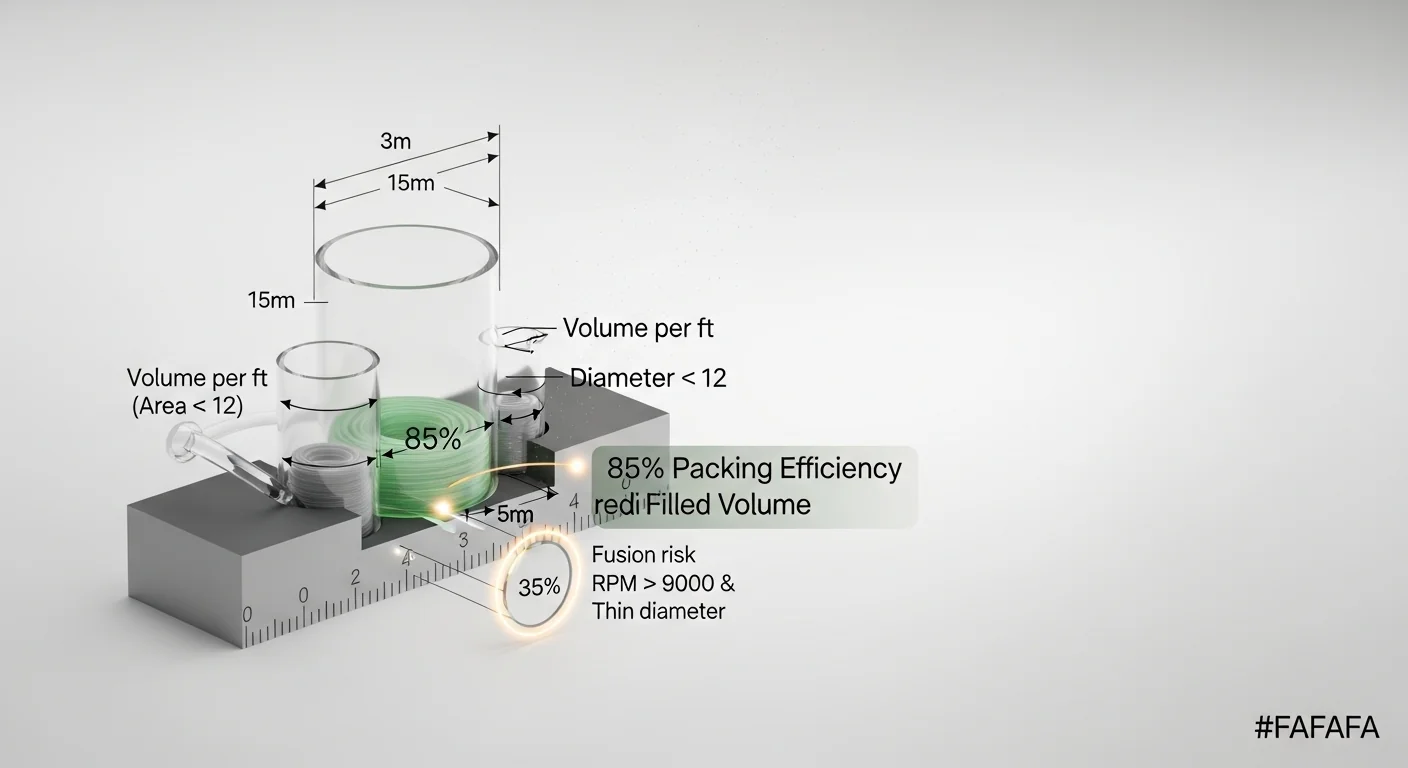
Trimmer line failure isn’t random. The spool runs dry at the worst possible moment, the line snaps every few seconds, or the whole spool fuses solid inside the head because the physics of RPM and diameter were never matched. A weed eater line calculator addresses exactly this: given your spool volume, line diameter, line profile shape, and engine RPM, it produces a concrete footage estimate and flags any configuration that will physically damage your equipment or waste your time in the field. This is mechanical and thermodynamic math, not guesswork. If you plan mowing time for a large property using a mowing time calculator, the same precision logic applies to your trimmer line setup.
This tool calculates two things: the maximum feet of usable trimmer line that will fit in a given spool capacity at a given diameter, and whether your RPM-to-diameter combination will trigger spool welding, rapid fraying, or snap-and-waste behavior. It does not predict cutting time, fuel consumption, or vegetation type performance. It also does not account for line age, UV degradation, or operating temperature beyond the friction-derived fusion threshold baked into its safety checks.
After running your numbers, you will know the exact footage your spool holds and whether your current line choice will survive your trimmer’s RPM, letting you buy the right spool length and diameter before you start loading.
Use the Tool

| Diameter | Shape | Max Feet (your spool) | Risk Level |
|---|
- 0.095″ Twisted Line: Echo Cross-Fire or Husqvarna Titanium Force co-extruded line for durability & reduced welding risk.
- Rapid-Load Head: Speed-Feed 400 bump head for fast, tool-free reloads in the field.
- Safety Gear: Commercial-grade wraparound safety glasses & reinforced shin guards for debris protection.
How This Calculator Works
Step 1: Calculate Cross-Sectional Area of the Line
Using the line diameter, we compute the cross-sectional area:
Line Area = π × (Diameter ÷ 2)²
For example, a 0.095″ line has an area of about 0.00709 sq in.
Step 2: Convert Area to Volume per Foot
Each foot of line occupies:
Volume per foot = Line Area × 12 inches
Step 3: Calculate Maximum Feet of Line
Divide spool capacity by volume per foot, then apply 85% packing efficiency factor:
Max Feet = (Spool Volume ÷ (Line Area × 12)) × 0.85
The 0.85 factor accounts for air gaps and imperfect winding inside the spool.
Step 4: Safety Checks
• Spool Weld / Fusion Check: If RPM exceeds 9,000 and line diameter is 0.065″ or thinner, high friction heat can melt the line into a fused plastic donut inside the head.
• Fraying Check: Square-profile line used against concrete edging will fray rapidly, reducing cutting life.
• Snap Risk: Thin line (0.065″) at very high RPM generates excessive centrifugal force and friction, leading to premature breakage.
Assumptions: Spool is cylindrical; packing efficiency 85%; standard nylon co-polymer line at ambient temperature. Actual results vary with line brand, age, and operating temperature.
Assumptions & Limits
• Spool capacity range: 0.1 – 50 cubic inches. Most residential trimmers hold 1–4 cu in; commercial heads up to 8+ cu in.
• Supported diameters: 0.040″ to 0.200″. Common sizes are 0.065″ (light duty), 0.080″ (medium), 0.095″ (heavy), 0.105″–0.130″ (commercial).
• RPM range: 2,000–15,000. Battery trimmers run 5,000–7,000 RPM; gas models 7,000–10,000+.
• Line material assumed: standard nylon monofilament or co-polymer blend. Specialty materials (titanium-reinforced, carbon fiber) may have different thermal and wear characteristics.
• Packing efficiency of 85% is an industry-standard estimate; actual yield depends on winding technique and spool geometry.
• Fusion/welding temperatures are approximations based on nylon’s glass transition temperature (~160°F sustained friction).
Before calculating, locate two pieces of physical data: your trimmer head’s spool capacity (check the head label, the spool itself, or the manufacturer’s spec sheet, measured in cubic inches) and your trimmer’s operating RPM (found in the owner’s manual or on the engine spec plate). Have your line spool packaging on hand for the diameter and profile shape. All four fields are required before the calculator will run.
Quick Start (60 Seconds)
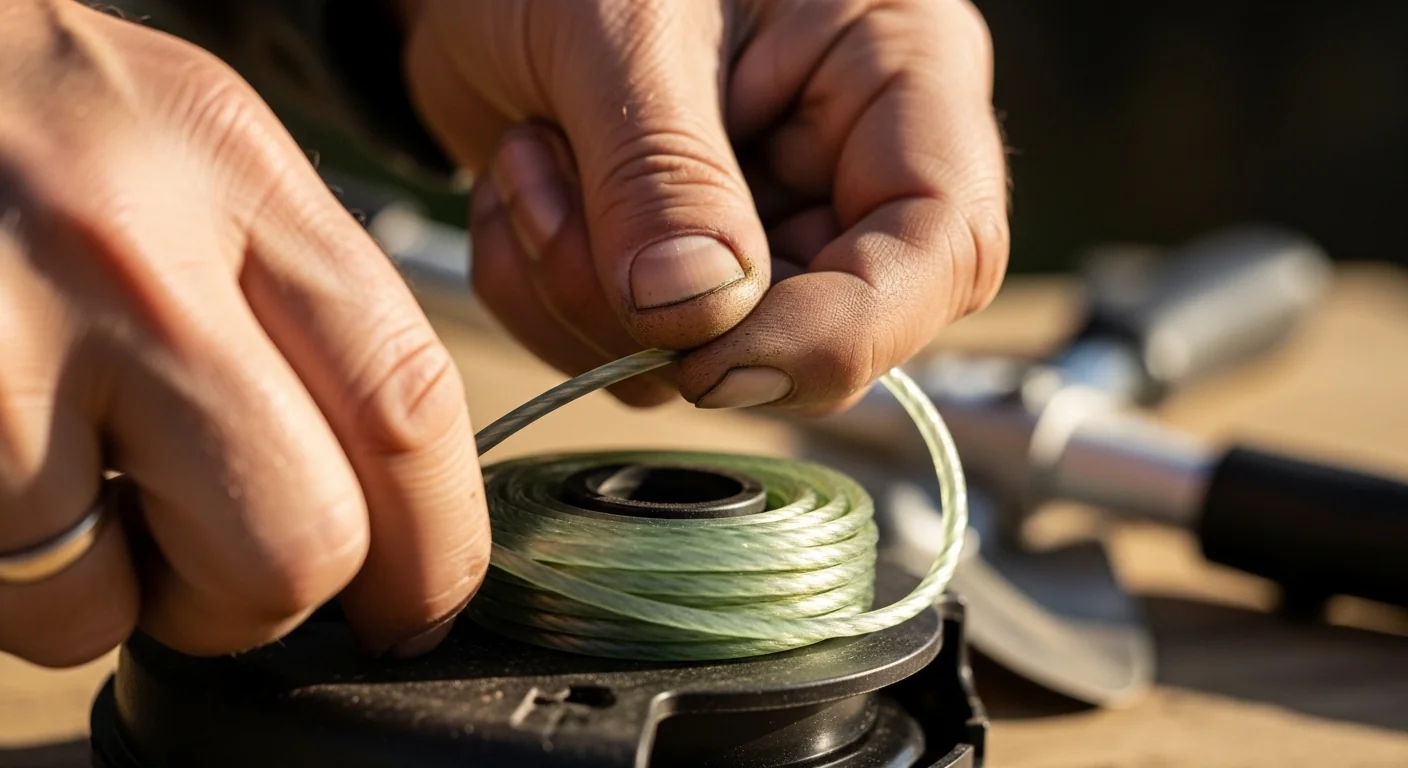
- Spool Capacity (cubic inches): Enter the internal volume of your trimmer head’s spool in cubic inches. Most residential bump heads hold between 1.0 and 2.5 cu in; commercial heads range from 3.0 to 8.0 or more. Do not confuse spool diameter with spool volume.
- Line Shape: Select the cross-sectional profile of your line. Round is the most common. Twisted and star-profile lines have the same cross-sectional area as round at the same diameter, but different cutting behavior. Square-profile line at the same nominal diameter has a slightly larger cross-sectional envelope, and the calculator applies its own fraying flag for square.
- Line Diameter (inches): Enter the gauge exactly as printed on the line packaging. Common values are 0.065, 0.080, 0.095, 0.105, and 0.130. Do not round or convert; the formula uses this number squared, so a small error compounds quickly.
- Trimmer RPM: Enter the no-load or rated operating RPM from your equipment manual. Battery trimmers typically run 5,000 to 7,500 RPM; gas residential models range from 7,000 to 9,000 RPM; commercial gas units can exceed 9,000 RPM. When in doubt, use the higher figure for a conservative safety check.
- Run the calculation: All four fields must be filled before clicking Calculate. Inline error messages appear next to any field that is empty or out of range. The results panel shows maximum footage, a traffic-light safety status, and any triggered warnings.
- Check the warnings box first: The safety check section is the most decision-critical output. A “High Risk” flag means your current configuration will likely damage equipment or waste significant line footage during operation.
- Use the reference table: The on-page mini-table computes results for six common diameters using your spool capacity, so you can see immediately what you gain or lose in footage by changing diameter.
Inputs and Outputs (What Each Field Means)
| Field | Unit | What It Means | Common Mistake | Safe Entry Guidance |
|---|---|---|---|---|
| Spool Capacity | cubic inches | The internal volume of the trimmer head’s line chamber. Determines the absolute upper limit of how much line can fit, before packing losses. | Entering spool outer diameter instead of volume, or using the line length printed on the spool package (which assumes a specific diameter). | Check the stamped spec on the spool housing or look up the head model number. If unavailable, measure the spool’s inner cylinder dimensions and compute volume as pi times radius squared times height. |
| Line Shape | profile type | The cross-sectional geometry of the line. Affects cutting aggressiveness, vibration, noise, and fraying behavior against hard surfaces. | Assuming all shapes at the same diameter pack identically. Square and star profiles carry a slightly higher debris-contact surface area and fray faster on masonry. | Match the shape to your use case before calculating. Square line on open turf is fine; square line dragged across concrete edging degrades rapidly. |
| Line Diameter | inches (decimal) | The gauge of the line, which determines its cross-sectional area and, by extension, how many feet fit in a given spool volume. Larger diameter means fewer feet and greater cutting force per revolution. | Rounding 0.095 to 0.10 or confusing metric millimeter ratings with inch ratings. Some imported line is labeled in mm; 2.4 mm equals approximately 0.094 inches. | Use the exact value printed on the line package. Enter three decimal places (e.g., 0.095, not 0.10). |
| Trimmer RPM | revolutions per minute | The rotational speed of the trimmer head at operating load. Directly determines the kinetic energy delivered per revolution and the friction heat generated inside the head during extended use. | Using the no-load RPM from a tachometer reading instead of the rated operating RPM from the spec sheet. No-load RPM can be 10 to 15 percent higher than loaded RPM. | Use the engine spec sheet value. For commercial gas trimmers, 9,000 to 10,500 RPM is the typical range. If you only have a no-load reading, subtract 500 to 800 RPM for a conservative estimate. |
| Max Feet (output) | feet | The estimated maximum usable trimmer line that fits in your spool at the given diameter, accounting for 85-percent packing efficiency. | Treating this as a precision measurement. It is an estimate. Actual footage may vary plus or minus 10 to 15 percent depending on winding technique and spool geometry. | Use this value to purchase pre-cut lengths or to measure off a bulk spool. Do not load more than the calculated footage; overfilling causes the spool to bind. |
| Safety Status (output) | traffic light | A pass/fail/warning determination based on the RPM-to-diameter checks derived from nylon thermal and mechanical limits. | Ignoring a “Caution” flag and proceeding anyway. A snap-risk or underpowered warning is not cosmetic; it predicts accelerated line consumption and reduced cutting efficiency. | If the status is not “Safe,” address the flagged configuration before loading the spool. Usually a diameter upgrade of one step (e.g., from 0.065 to 0.080) clears the warning. |
Worked Examples (Real Numbers)
Scenario 1: Residential Battery Trimmer, Standard Lawn Maintenance
- Spool Capacity: 1.5 cubic inches
- Line Shape: Round
- Line Diameter: 0.065 inches
- Trimmer RPM: 5,500
Line area = 3.14159 x (0.0325)^2 = 0.003318 sq in. Volume per foot = 0.003318 x 12 = 0.039816 cu in. Max feet = (1.5 / 0.039816) x 0.85 = 32.0 feet.
Result: approximately 32 feet of usable line. Safety status: Safe.
At 5,500 RPM, the thermal load inside the spool head is well below the nylon fusion threshold, and thin 0.065-inch line is appropriate for light residential grass. This is a clean configuration with no triggered warnings.
Scenario 2: Commercial Gas Trimmer with the Wrong Line — Spool Weld Risk
- Spool Capacity: 3.0 cubic inches
- Line Shape: Round
- Line Diameter: 0.065 inches
- Trimmer RPM: 9,500
Line area = 0.003318 sq in. Volume per foot = 0.039816 cu in. Max feet = (3.0 / 0.039816) x 0.85 = 64.0 feet.
Result: approximately 64 feet of usable line. Safety status: HIGH RISK — Spool Weld Alert.
At 9,500 RPM, the centrifugal friction against thick brush generates sustained heat that can exceed the glass transition temperature of standard nylon line. At 0.065 inches, the thin line has very little thermal mass. The nylon inside the spool can melt and fuse into a solid mass, destroying the entire spool load. The calculated footage is meaningless if the line cannot be extracted from the head. Upgrading to 0.095-inch line resolves the fusion risk and is the correct fix, not a different brand of 0.065-inch line.
Scenario 3: Commercial Gas Trimmer, Corrected Configuration
- Spool Capacity: 3.0 cubic inches
- Line Shape: Twisted
- Line Diameter: 0.095 inches
- Trimmer RPM: 9,000
Line area = 3.14159 x (0.0475)^2 = 0.007088 sq in. Volume per foot = 0.007088 x 12 = 0.085056 cu in. Max feet = (3.0 / 0.085056) x 0.85 = 30.0 feet.
Result: approximately 30 feet of usable line. Safety status: Safe.
The trade-off is clear: doubling the line diameter from 0.065 to 0.095 inches roughly halves the footage per spool. But 30 feet of line that runs cleanly at commercial RPM is far more productive than 64 feet that fuses before lunch. Twisted co-extruded line at this diameter also delivers more aggressive cutting force per tip-pass, partially offsetting the reduced footage.
Reference Table (Fast Lookup)
All footage values below are computed using the same formula the calculator uses: (Spool Volume / (pi x (diameter/2)^2 x 12)) x 0.85. Three common spool sizes are shown. The “Max Safe RPM” column reflects the thresholds built into the tool’s safety logic for standard nylon monofilament and co-polymer lines.
| Diameter | Shape | Feet in 1.5 cu in Spool | Feet in 3.0 cu in Spool | Feet in 6.0 cu in Spool | Max Safe RPM (Fusion Limit) | Best Use Case |
|---|---|---|---|---|---|---|
| 0.065″ | Round | 32.0 ft | 64.0 ft | 128.0 ft | 8,000 RPM | Light grass, battery or low-RPM residential |
| 0.080″ | Round | 21.1 ft | 42.2 ft | 84.4 ft | 9,500 RPM | General residential, mixed weeds and grass |
| 0.080″ | Twisted | 21.1 ft | 42.2 ft | 84.4 ft | 9,500 RPM | Residential plus light brush, reduced vibration |
| 0.095″ | Round | 15.0 ft | 29.9 ft | 59.9 ft | 10,000 RPM | Dense weeds, commercial properties |
| 0.095″ | Twisted | 15.0 ft | 29.9 ft | 59.9 ft | 10,000 RPM | Commercial standard, co-extruded preferred |
| 0.105″ | Round | 12.3 ft | 24.5 ft | 49.0 ft | 10,500 RPM | Heavy weeds, light brush clearing |
| 0.130″ | Square | 8.0 ft | 16.0 ft | 32.1 ft | 11,000 RPM | Thick brush, open field only — avoid masonry |
| 0.155″ | Round | 5.6 ft | 11.3 ft | 22.6 ft | 11,500 RPM | Brush clearing, commercial clearing heads only |
How the Calculation Works (Formula + Assumptions)
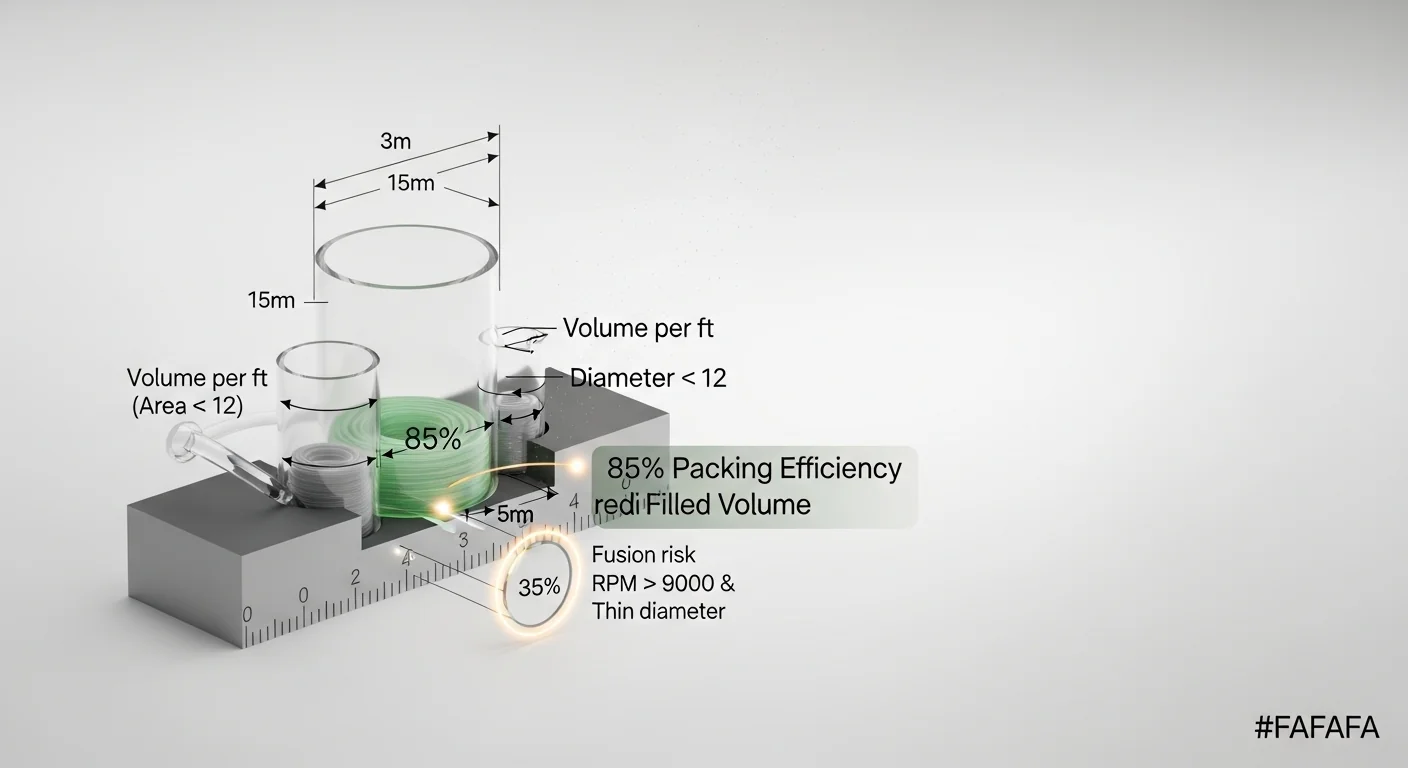
Show the calculation steps
Step 1 — Cross-Sectional Area of the Line
The calculator treats trimmer line as a cylinder. The cross-sectional area is computed using the standard circle area formula:
Line Area (sq in) = pi x (Diameter / 2)^2
For a 0.095-inch line: Area = 3.14159 x (0.0475)^2 = 3.14159 x 0.002256 = 0.007088 sq in. This is the footprint of one cross-slice of the line at any point along its length.
Step 2 — Volume per Foot of Line
One foot of line equals 12 inches of length. The volume it occupies inside the spool is:
Volume per foot (cu in) = Line Area x 12
For 0.095-inch line: 0.007088 x 12 = 0.085056 cu in per foot.
Step 3 — Theoretical Maximum Footage
Divide the spool’s total capacity by the volume each foot of line occupies:
Theoretical Max = Spool Volume / Volume per foot
Step 4 — Apply Packing Efficiency Factor
Line coils in a spool do not pack as efficiently as a theoretical solid cylinder. Air gaps, winding irregularities, and the curved spool geometry mean real-world capacity is approximately 85 percent of the theoretical maximum:
Usable Max Feet = Theoretical Max x 0.85
For a 3.0 cu in spool with 0.095-inch line: (3.0 / 0.085056) x 0.85 = 35.27 x 0.85 = 30.0 feet.
Rounding rule: Results are rounded to one decimal place. Values below 1.0 feet are displayed as 0.9 feet; results are never rounded down to zero.
Unit notes: Spool capacity must be in cubic inches, not liters or fluid ounces. Diameter must be in inches, not millimeters. The formula does not auto-convert units; entering a diameter in millimeters will produce a severely incorrect result.
Assumptions and Limits
- Packing efficiency is fixed at 85 percent. This is a conservative industry-standard estimate. Experienced landscapers winding tight, even coils may achieve closer to 88 to 90 percent; hasty or loose winding may fall below 80 percent.
- Line is assumed to be standard nylon monofilament or co-extruded nylon co-polymer. Specialty materials such as titanium-infused line, carbon-fiber-reinforced line, or polyester-core line have different density, thermal tolerance, and cross-sectional packing characteristics.
- Spool geometry is assumed to be approximately cylindrical. Non-cylindrical spool chambers (tapered or dual-chamber designs) will produce estimates that diverge from actual capacity.
- The fusion threshold (RPM greater than 9,000 combined with 0.065-inch diameter) is based on the thermal behavior of standard nylon at the tip speeds associated with those RPM values for a head with a nominal line reach of 8 to 12 inches. Heads with shorter line reach generate less tip-friction heat at the same RPM.
- RPM input is treated as steady-state operating RPM, not peak or no-load RPM. Entering a no-load tachometer reading may trigger false fusion warnings on equipment that runs cooler under load.
- The calculator does not account for ambient temperature. Operating in very high ambient heat (above 95 F) lowers the effective fusion threshold, making the spool weld scenario more likely at slightly lower RPM values than the 9,000-RPM threshold shown.
- Diameter conversions from metric must be done manually before entry. A line labeled 2.0 mm should be entered as 0.079 inches; 2.4 mm equals 0.094 inches.
Standards, Safety Checks, and Warnings
Critical Warnings
- Spool Weld (Fusion) Alert: When RPM exceeds 9,000 and line diameter is 0.065 inches or thinner, the kinetic friction generated at the trimmer head’s interior can sustain temperatures at or above the glass transition point of standard nylon, approximately 350 F. The line does not melt cleanly; it softens and fuses adjacent coils together, creating a solid plastic mass. The spool cannot be saved. The entire loaded spool must be discarded. The fix is simple: step up to 0.080-inch line minimum for any gas trimmer running above 9,000 RPM, or to 0.095-inch for sustained commercial use. Line tip speed is the analogue concept here — the same physics that makes mower blade tip speed a meaningful safety threshold applies to trimmer line at the head’s outer radius.
- Snap-and-Waste Risk: Thin line (0.065 inches) at RPM values above 8,000 generates centrifugal stress that, on contact with anything denser than light grass, causes the line to snap at the head exit point. Frequent snapping is not a line quality problem; it is a diameter-to-RPM mismatch. The user loses line faster than the vegetation is trimmed, making the spool load ineffective.
- Square Line Fraying on Hard Surfaces: Square-profile line’s corner geometry catches on concrete, asphalt, brick, and stone edging. On open turf it performs well. Against hard surfaces, the corners fracture and curl back rapidly, doubling or tripling effective line consumption. If property edging along curbs, driveways, or walkways is part of the job, round or twisted line is the correct choice. For planning larger edging projects, a landscape edging calculator helps quantify linear footage before buying line.
- Underpowered Setup: Heavy-gauge line (0.105 inches and above) requires sufficient tip speed to cut rather than bend. Below approximately 5,000 RPM, thick line deflects around weeds instead of severing them. The trimmer is doing work without cutting, which strains the motor and delivers poor results. Dropping one or two diameter steps solves this without requiring different equipment.
Minimum Standards
- For any gas trimmer rated above 9,000 RPM: use 0.080-inch line at absolute minimum; 0.095-inch twisted or co-extruded line is the recommended baseline for sustained work sessions.
- For commercial crews doing 6 or more hours of daily trimming: 0.095-inch twisted co-extruded line (such as Echo Cross-Fire or Husqvarna Titanium Force) provides the best durability-to-capacity ratio at commercial RPM ranges.
- For any application involving concrete or masonry contact: avoid square-profile line entirely; use round or twisted profiles only.
- Spool capacity should be matched to job scale. A 1.5-cubic-inch spool holding roughly 15 feet of 0.095-inch line is appropriate for residential maintenance trimming. Commercial crews clearing heavy brush benefit from heads with 3.0 to 6.0 cubic inch capacity to reduce reload frequency — especially relevant if the same crew also handles brush management chemical followup after trimming.
Competitor Trap: Most trimmer line buying guides compare line brands and profiles using marketing language about “cutting power” and “durability” without ever addressing the RPM-to-diameter thermal relationship. A user following that generic advice who runs the cheapest thin line on a high-powered commercial gas trimmer won’t know their line is fusing inside the spool head until the bump head jams and won’t advance on the next strike. By then, the line is already one solid piece. The weld happens invisibly during operation, not as a dramatic failure, which is why so many operators blame the line brand instead of the physics mismatch.
Common Mistakes and Fixes
Mistake: Buying Line Based on Package Footage, Not Spool Capacity
Line packages advertise total footage, which assumes a specific spool diameter and the manufacturer’s standard diameter. A package labeled “50 feet of 0.095-inch line” is sized for an average residential head. If you have a larger commercial head, 50 feet may leave the spool half-empty, reducing cutting sessions between reloads. If you have a smaller head, you will have leftover line that requires separate storage.
Fix: Calculate your spool’s actual capacity first, then buy pre-cut or bulk line to match.
Mistake: Using a High-RPM Gas Trimmer as the Reason to Buy Thinner Line for More Footage
The reasoning sounds logical: thinner line means more feet per spool, which means fewer reloads. The problem is that thinner line at high RPM will either fuse inside the head or snap on first contact with dense weeds, eliminating the footage advantage entirely. The spool weld scenario is the worst outcome: you load 64 feet of 0.065-inch line into a commercial head, run for 20 minutes at 9,500 RPM, and pull out a solid plastic cylinder. Every foot of that line is unusable. The correct trade-off is fewer feet of the right diameter, not more feet of the wrong one.
Fix: Use the calculator’s safety check output to confirm your diameter is appropriate for your RPM before loading the spool.
Mistake: Entering Spool Outer Diameter Instead of Spool Volume
The spool capacity input requires cubic inches of interior volume, not the spool’s outer diameter measurement. Landscapers who measure the outside of the spool housing with a tape and enter that value in inches will see footage estimates that are off by large margins — typically overstated — because the outer diameter of the housing bears no direct relationship to its internal line capacity.
Fix: Find the spool volume in the trimmer head’s product manual or on the spool body’s molded spec text. Alternatively, search the head model number online to retrieve the manufacturer’s listed line capacity.
Mistake: Ignoring the Shape Field When Switching to Square Line for Brush Clearing
Square trimmer line is genuinely better than round for cutting coarse, fibrous vegetation in open areas. But users who switch to square line for a brush-clearing job and then return to edging near concrete without swapping back will fray through a spool in a fraction of the normal time. The corner geometry that makes square line effective on weeds is also what causes catastrophic degradation against masonry. If your property work involves detailed lawn care sequences that include hard-edging, keep two loaded spools available — one round, one square — and swap by task type.
Fix: Select the shape that matches the dominant surface type in each work zone, not the entire job.
Mistake: Converting Millimeter Diameters to Inches Incorrectly
Some imported line brands and older spec sheets list diameter in millimeters. Entering the millimeter value directly into a calculator expecting inches will produce wildly incorrect footage estimates. A 2.4 mm line entered as 0.24 inches is entered at more than double the correct diameter of 0.094 inches, which would produce a footage estimate roughly four times too low because area is proportional to the square of the radius.
Fix: Convert millimeters to inches by dividing by 25.4. Then enter the resulting decimal value. Common conversions: 2.0 mm = 0.079″, 2.4 mm = 0.094″, 3.0 mm = 0.118″, 3.3 mm = 0.130″.
Next Steps in Your Workflow
Once you have your footage calculation and a confirmed safe configuration, the practical next step is sourcing line in the correct quantity. For commercial operations, bulk 1-pound or 5-pound spool rolls are more economical per foot than pre-packaged retail cuts, provided you wind the head yourself. For residential use, pre-cut donut packs in the correct footage simplify loading significantly. A bump-feed head such as the Speed-Feed 400 eliminates tool-free loading entirely and is worth evaluating if reloading time is a recurring friction point in your workflow. Consider how trimmer maintenance fits into your broader property schedule — if you track lawn work systematically, pairing this with a grass seed calculator and mapping your full seasonal sequence means fewer mid-job material shortages across the board.
Beyond the line itself, trimmer work generates debris at velocity. At commercial RPM values, rock fragments and wire fencing debris become genuine projectiles at head level and shin level. Eye protection rated for high-velocity impact and reinforced shin guards are not optional equipment for sustained commercial trimming — they are standard practice. After finishing a major trimming session on a property, the next workflow step might involve edging refinement, turf assessment, or preparing for overseeding. A lawn striping calculator can help plan finishing passes if you’re completing a high-visibility commercial property where visual quality matters after trimming is done.
FAQ
How many feet of trimmer line does a standard residential trimmer hold?
A typical residential bump-head spool with roughly 1.5 cubic inches of capacity holds approximately 32 feet of 0.065-inch line or around 15 feet of 0.095-inch line, after applying the standard 85-percent packing efficiency factor. The exact footage depends on the head’s interior volume and the line diameter you choose. Use the calculator above with your actual spool capacity for a precise estimate.
What causes trimmer line to fuse or weld inside the spool?
Spool welding occurs when friction-generated heat inside the trimmer head exceeds the glass transition temperature of the nylon line, approximately 350 F for standard monofilament. At RPM values above 9,000, combined with thin 0.065-inch line, the thermal load can be sustained long enough to soften adjacent coils, which then bond together as the head cools. The result is a solid plastic mass that cannot be unspooled. The fix is to use a thicker line diameter, which has greater thermal mass and is less prone to softening under friction loads.
Is twisted trimmer line better than round line for the same diameter?
Twisted and round line at the same nominal diameter have the same cross-sectional area, so they fit identically in the spool and produce the same footage estimate. Twisted line generates more cutting aggressiveness at the same tip speed because the helical surface contacts vegetation at multiple angles per revolution. It also tends to run slightly quieter. For the same spool footage, twisted or co-extruded line typically outlasts round line in heavy vegetation by a noticeable margin.
Why does my line snap constantly during trimming?
Frequent snapping is almost always a diameter-to-RPM mismatch, not a line quality defect. Thin line at high RPM reaches its tensile yield point on first impact with dense stems, wire, or stone. The solution is to step up one diameter size, which increases the line’s cross-sectional area and tensile strength. If snap frequency persists after upgrading diameter, check for burrs or sharp edges on the trimmer head exit eyelets, which can weaken line at the exit point during each revolution.
Can I use any line shape in any trimmer head?
Most trimmer heads are designed with round or oval exit eyelets that accommodate round, twisted, or star-profile line without restriction. Square-profile line can sometimes catch on non-square eyelets at higher diameters, creating resistance during feed advancement. Check your head’s manual for compatible profile types. Some fixed-line heads are specifically engineered for square or star line and may not feed round line reliably.
How does RPM affect how much line I use per session?
Higher RPM produces more tip-passes per minute, which accelerates line wear on each vegetation contact. At equal diameter and equal vegetation density, a trimmer running at 9,000 RPM will consume line faster than one running at 6,000 RPM, because each rotation delivers more energy and more contact events. Higher RPM also increases the kinetic impact force on hard surfaces, which is why spool weld and snap risks are indexed to the RPM threshold rather than to trimmer brand or model.
Conclusion
The core differentiator of this calculator is the RPM-to-diameter safety check, which converts the spool welding failure mode from a mystery expense into a predictable, avoidable outcome. Footage math is straightforward geometry; the thermodynamic failure check is what separates a useful weed eater line calculator from a basic unit converter. Before loading a spool on any gas trimmer running above 9,000 RPM, the diameter selection deserves explicit verification, not assumption.
The single most expensive mistake in trimmer line management is running thin, cheap line on a high-powered engine to maximize spool footage. The footage is theoretical; the spool weld is physical. Choosing the correct diameter for your RPM range, then matching line profile to surface type, eliminates the majority of mid-job failures. For anyone managing larger turf areas where equipment efficiency compounds across the full season, pairing trimmer line decisions with a complete property tool set, including a turf watering calculator for irrigation planning, keeps all material estimates grounded in the same data-first approach.