
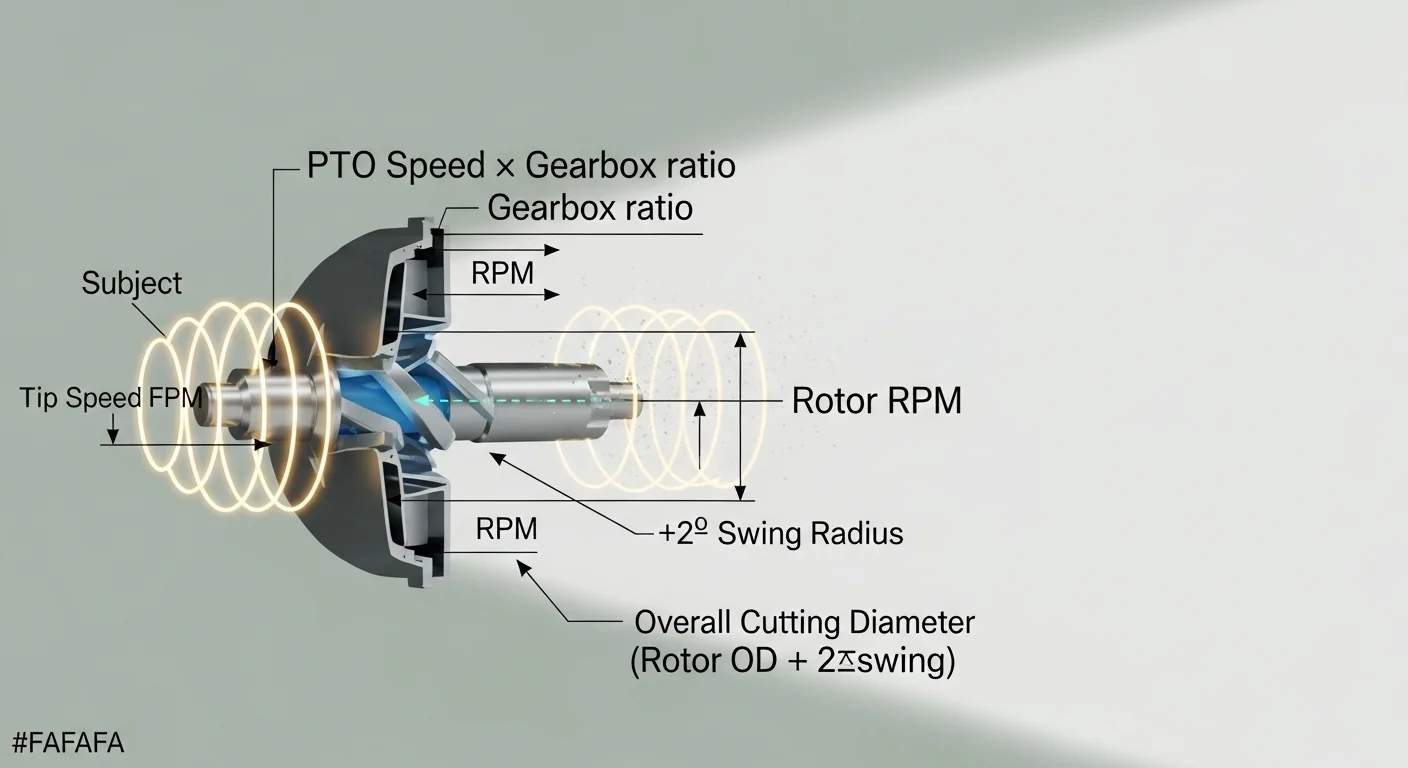
Rotor speed on a flail mower is not a single number to look up in a manual. It is the product of your specific PTO output, the gearbox ratio your machine runs, and the full cutting diameter swept by the blade tips. Miss any one of those variables and you will either undercut vegetation or, more dangerously, push your bearings into a resonance failure mode that shows up weeks later as an expensive shaft seizure rather than an obvious blade strike.
This calculator computes rotor RPM, blade tip speed in feet per minute, and kinetic energy per blade for any combination of PTO speed, gearbox ratio, rotor tube diameter, blade swing radius, blade type, and cutting application. It does not predict wear intervals, estimate fuel consumption, or account for ground speed effects on cut density. Those are separate calculations that depend on forward speed and vegetation density, which this tool cannot measure.
Run this calculator before each application change. If you are switching from brush to grass mowing with the same machine and the same hammers installed, the tool will tell you whether you are heading into the harmonic vibration zone that destroys bearings silently and progressively.
Use the Tool
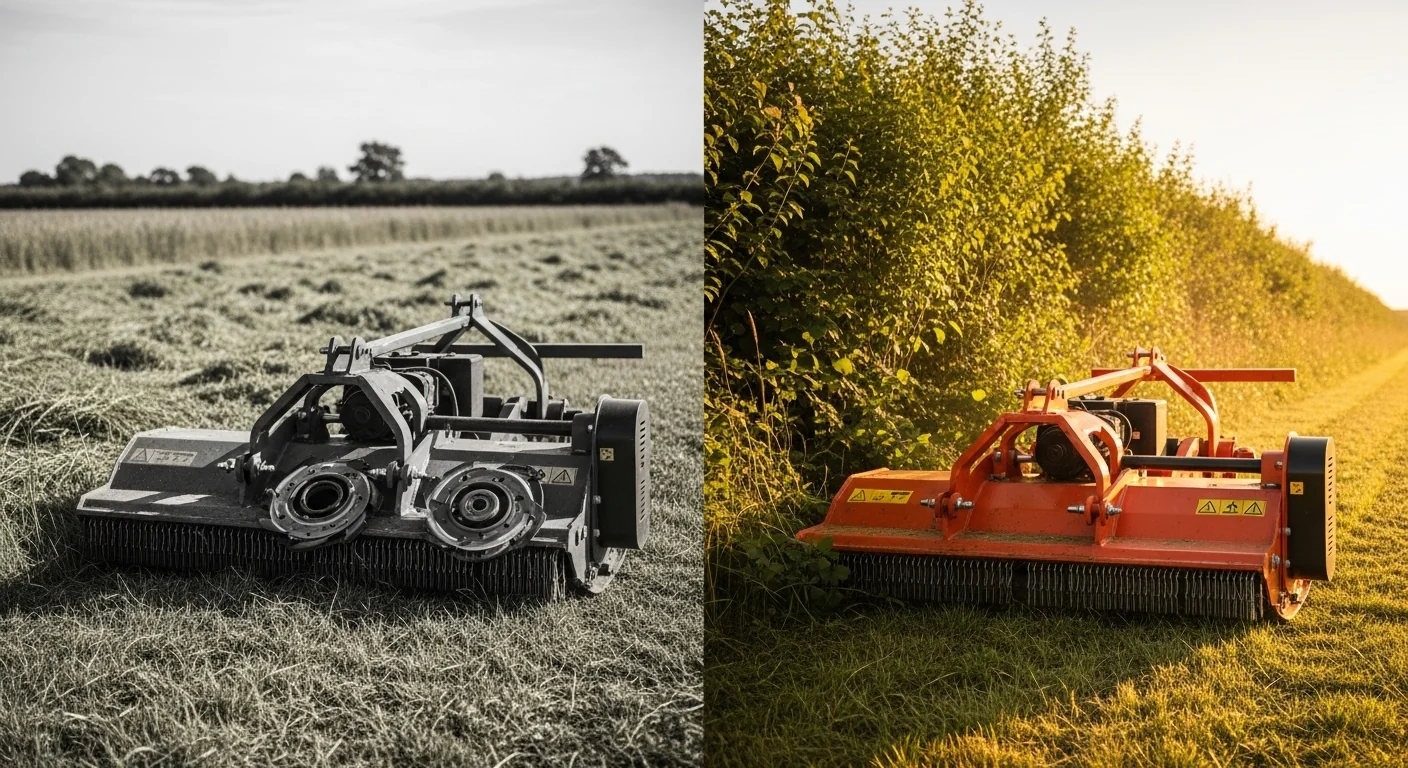
Flail Mower Rotor RPM & Blade Velocity Calculator
Calculate rotor speed, tip velocity, and detect harmonic & shatter risks
8,000 ▼ Brush Min
12,000 Max
20,000 FPM
| PTO (RPM) | Gearbox | Rotor RPM | Tip Speed (FPM)* | Zone |
|---|
How This Calculator Works ►
Assumptions & Limits ►
- PTO speed is assumed constant and steady-state (not accounting for slip under peak load).
- Blade swing radius assumes blades are fully extended by centrifugal force — valid above ~600 Rotor RPM.
- Kinetic energy uses simplified mass estimates: ~2.0 lb for heavy forged hammers, ~0.3 lb for Y-blades. Actual mass varies by manufacturer.
- Overall cutting diameter = Rotor Tube OD + (2 × Swing Radius). This is the blade tip circle, not ground clearance.
- Tip speed is the ideal, frictionless calculation. Real-world tip speed is marginally lower under load.
- Calculator does not account for number of flail stations, blade overlap, or forward ground speed (FPM does not equal acres/hr).
- PTO range: 200–1,100 RPM. Gearbox ratio: 0.5–10. Rotor diameter: 2–24”. Swing radius: 1–18”.
- Safe tip speed range for effective cutting: ~8,000–20,000 FPM. Below 8,000 FPM, cutting efficiency degrades sharply.
Have the following ready before you start: your tractor’s PTO speed setting (typically stamped on the selector lever or listed in the tractor manual as 540 or 1000 RPM, though mid-range settings exist), the gearbox ratio from your flail mower’s specification sheet or input/output shaft speed data, the rotor tube outer diameter in inches, and the swing radius from rotor centerline to the tip of a fully-extended blade. If you are unsure about your shaft configuration and whether it is correctly sized for your mower’s input demand, the PTO shaft sizing calculator covers that step before you even attach the implement.
Quick Start (60 Seconds)
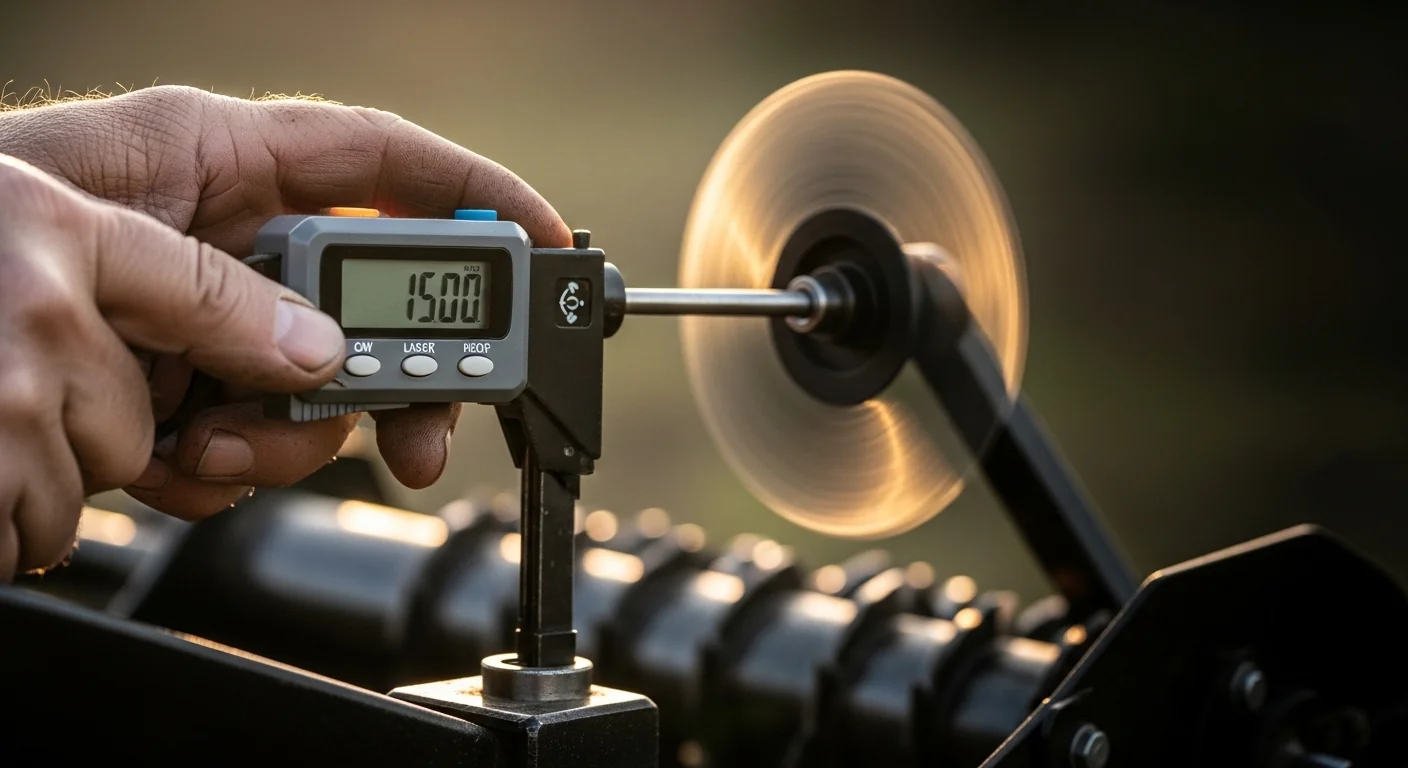
- PTO Speed: Enter the RPM at the tractor’s PTO output shaft, not engine RPM. Standard values are 540 and 1000. If running a mid-speed PTO, confirm the actual output with a tachometer rather than estimating from engine speed.
- Gearbox Ratio: This is the multiplier your flail mower’s gearbox applies to the PTO shaft. A 1:3 ratio means entering 3. Check your mower’s spec sheet; many budget machines omit this label, so measure input versus output RPM directly if needed.
- Rotor Tube Diameter: Measure the outer diameter of the rotor tube itself, not the cutting width. This is typically 4 to 8 inches on compact to mid-duty machines. Do not include blade hardware in this measurement.
- Blade Swing Radius: Measure from the center of the rotor to the cutting tip of a fully-extended blade. This is the dimension that most significantly drives tip speed. A 1-inch error here produces a measurable tip speed error at operating RPM.
- Blade Type: Choose Heavy Forged Hammers or Y-Blades based on what is actually bolted to the rotor today, not what the machine came with originally. Swapped blade types are the most common source of mismatched results.
- Cutting Application: Select the vegetation category you are actually cutting. This is the field that triggers the safety logic. Selecting “Grass” when you are running brush, or vice versa, defeats the purpose of the deterministic checks.
Inputs and Outputs (What Each Field Means)
| Field | Unit | What it represents | Common mistake | Safe entry guidance |
|---|---|---|---|---|
| PTO Speed | RPM | Shaft speed at the tractor’s PTO output stub, the raw input to the mower’s gearbox | Confusing engine RPM with PTO RPM; at 1800 engine RPM a 540-class PTO outputs 540, not 1800 | 200 to 1,100 RPM; confirm with a tachometer if the tractor does not have a PTO RPM display |
| Gearbox Ratio | Multiplier (e.g., 3 = 1:3) | How many times the flail mower gearbox multiplies PTO shaft speed before it reaches the rotor | Entering the ratio as a fraction (0.33) instead of the multiplier (3), which inverts the result | 0.5 to 10; most flail mowers fall between 1.5 and 4; very high ratios above 5 are rare and warrant verification |
| Rotor Tube Diameter | Inches | The outer diameter of the steel tube that forms the rotor body, not the full cutting circle | Measuring the cutting width (the horizontal swath) rather than the rotor tube cross-section | 2 to 24 inches; compact mowers typically run 4 to 6 inches; commercial machines may reach 8 to 10 inches |
| Blade Swing Radius | Inches | Distance from rotor centerline to the cutting tip of a blade hanging fully extended by centrifugal force | Measuring from the outside of the rotor tube instead of from the tube’s centerline | 1 to 18 inches; below 600 rotor RPM blades may not fully extend, making this measurement optimistic |
| Blade Type | Selection | Whether the machine carries heavy forged hammers or thin Y-blades, each with different mass and failure modes | Assuming the factory blade type without physically checking; blades are frequently swapped in the field | Check the installed blade, not the listing for the machine; hammer vs. Y-blade is a binary distinction |
| Cutting Application | Selection | The actual vegetation category being cut, which governs the harmonic and shatter safety checks | Selecting Pasture when mowing a manicured lawn, or selecting Grass when the field contains woody brush | When in doubt, select the heavier category to get the more conservative safety output |
| Rotor RPM (output) | RPM | Calculated shaft speed at the rotor, equal to PTO speed multiplied by the gearbox ratio | Treating this as the cutting RPM at the blade tip; tip speed depends on the full cutting diameter, not just rotor RPM | No entry required; computed automatically |
| Blade Tip Speed (output) | FPM (and m/s) | The linear velocity at the blade tip, which determines cutting effectiveness and safety zone classification | Comparing tip speed between different machines without accounting for diameter differences | Effective range: 8,000 to 20,000 FPM; below 8,000 FPM cutting efficiency falls sharply |
| Kinetic Energy per Blade (output) | ft·lbf | The translational kinetic energy stored in one blade at operating tip speed, using simplified mass estimates | Ignoring this figure when evaluating mismatched blade-application combinations | Higher values indicate more destructive potential on contact; hammer KE in grass is the harmonic trigger |
Worked Examples (Real Numbers)
Example 1: Compact Tractor, Hammers, Heavy Brush Clearing
- PTO Speed: 540 RPM
- Gearbox Ratio: 3.0
- Rotor Tube Diameter: 6 inches
- Blade Swing Radius: 7 inches
- Blade Type: Heavy Forged Hammers
- Application: Heavy Brush / Saplings (>2” diameter)
Result: Rotor RPM = 1,620. Overall cutting diameter = 6 + (2 × 7) = 20 inches. Tip speed = (1,620 × π × 20) ÷ 12 = 8,482 FPM. Kinetic energy per hammer = approximately 621 ft·lbf.
This configuration lands at the low end of the effective brush-clearing range. At 8,482 FPM the machine can handle light brush but may struggle with dense 2-inch-plus stems. Increasing the gearbox ratio to 3.5 (if available) would bring tip speed to roughly 9,896 FPM, meaningfully improving penetration without approaching the over-speed threshold. No harmonic warning fires because the application matches the blade type.
Example 2: 540 PTO, Y-Blades, Lawn Grass Mowing
- PTO Speed: 540 RPM
- Gearbox Ratio: 3.5
- Rotor Tube Diameter: 4 inches
- Blade Swing Radius: 8 inches
- Blade Type: Y-Blades
- Application: Lawn / Grass (under 6” height)
Result: Rotor RPM = 1,890. Overall cutting diameter = 4 + (2 × 8) = 20 inches. Tip speed = (1,890 × π × 20) ÷ 12 = 9,896 FPM. Kinetic energy per Y-blade = approximately 127 ft·lbf.
This is a correctly matched setup. Y-blades at 9,896 FPM deliver clean cuts on lawn-height grass without generating the harmonic trigger. The lower blade mass (approximately 0.3 lb) means the kinetic energy figure is modest compared to hammer configurations, reducing both vibration risk and blade-flutter at lower resistance vegetation densities.
Example 3: 1000 PTO, Hammers, Light Brush
- PTO Speed: 1000 RPM
- Gearbox Ratio: 2.0
- Rotor Tube Diameter: 5 inches
- Blade Swing Radius: 9 inches
- Blade Type: Heavy Forged Hammers
- Application: Light Brush (≤2” diameter stems)
Result: Rotor RPM = 2,000. Overall cutting diameter = 5 + (2 × 9) = 23 inches. Tip speed = (2,000 × π × 23) ÷ 12 = 12,042 FPM. Kinetic energy per hammer = approximately 1,252 ft·lbf.
This setup enters the optimal zone and the application-blade pairing is correct for light brush. The substantially higher kinetic energy (1,252 ft·lbf versus 621 ft·lbf in Example 1) is a product of the higher tip speed and carries real implications for pivot pin and rotor cap hardware inspection intervals.
Reference Table (Fast Lookup)
All rows below assume a 6-inch rotor tube diameter and a 7-inch blade swing radius, producing an overall cutting diameter of 20 inches. Tip speed formula: (Rotor RPM × π × 20) ÷ 12.
| PTO (RPM) | Gearbox Ratio | Rotor RPM | Tip Speed (FPM) | Tip Speed (m/s) | Zone / Suitability |
|---|---|---|---|---|---|
| 540 | 1.8 | 972 | 5,089 | 25.9 | Below effective range — will fold, not cut |
| 540 | 2.5 | 1,350 | 7,069 | 35.9 | Marginal — grass only, poor finish |
| 540 | 3.0 | 1,620 | 8,482 | 43.1 | Grass and light pasture effective |
| 540 | 3.5 | 1,890 | 9,896 | 50.3 | Grass and light brush adequate |
| 540 | 4.0 | 2,160 | 11,310 | 57.5 | Light brush effective; approaching brush threshold |
| 1000 | 1.5 | 1,500 | 7,854 | 39.9 | Marginal — grass only at low efficiency |
| 1000 | 2.0 | 2,000 | 10,472 | 53.2 | Grass and light brush solid |
| 1000 | 2.5 | 2,500 | 13,090 | 66.5 | Optimal for brush clearing |
| 1000 | 3.0 | 3,000 | 15,708 | 79.8 | Optimal; verify hardware torque specs |
| 1000 | 3.5 | 3,500 | 18,326 | 93.1 | High-speed; inspect blade pins before each use |
Note: The tip speed in m/s is calculated as FPM × 0.00508 and is provided for reference against metric-standard specifications from European flail mower manufacturers, who frequently publish tip speed ratings in m/s rather than FPM.
How the Calculation Works (Formula + Assumptions)
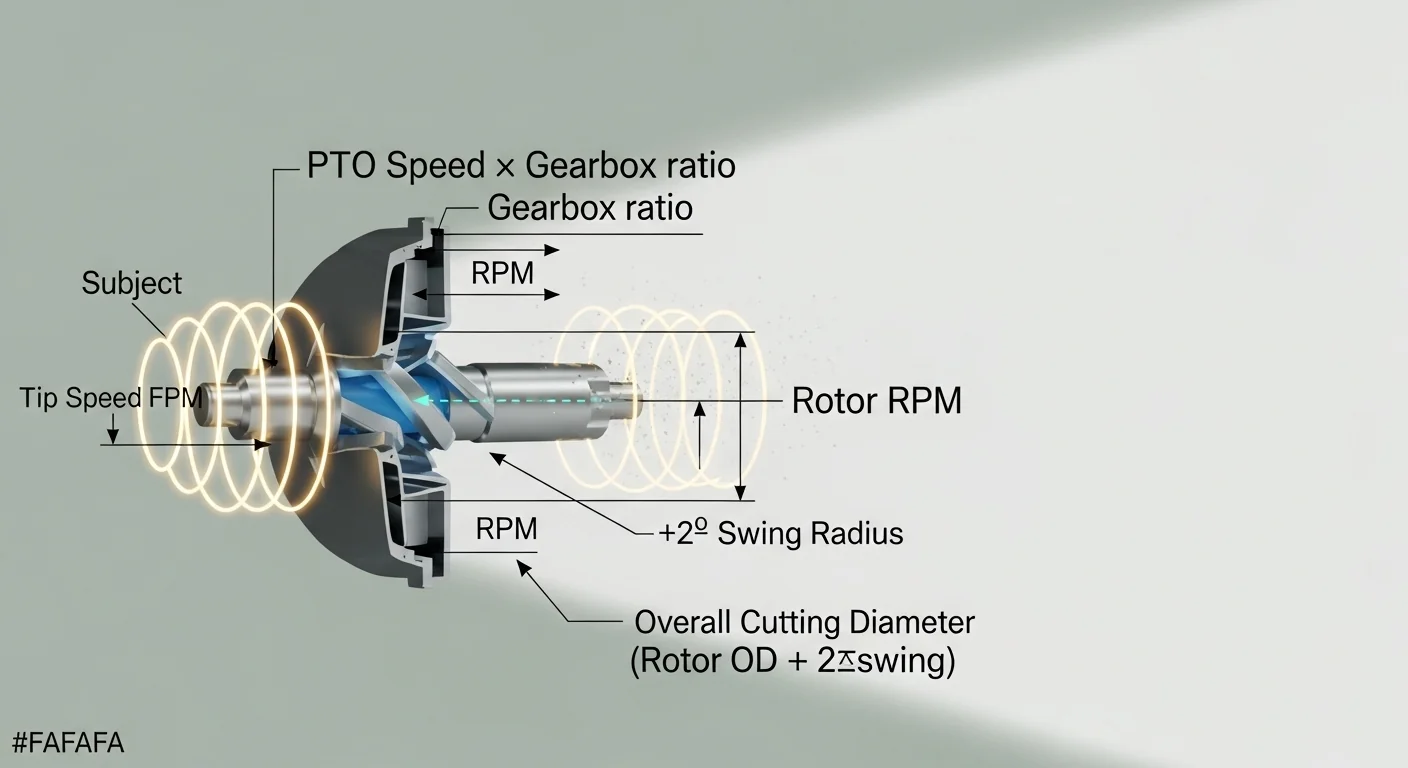
Show the calculation steps
Step 1 — Rotor RPM
Rotor RPM = PTO Speed (RPM) × Gearbox Ratio
The gearbox converts the PTO shaft’s input speed to a higher rotor shaft speed. A 540 RPM PTO running through a 3.0 gearbox outputs exactly 1,620 RPM at the rotor shaft. No intermediate rounding is applied until the final output display, which rounds to the nearest whole RPM.
Step 2 — Overall Cutting Diameter
Overall Diameter (inches) = Rotor Tube Diameter + (2 × Blade Swing Radius)
Both sides of the rotor contribute blade sweep. A 6-inch rotor tube with a 7-inch blade swing radius on each side produces an overall cutting diameter of 20 inches. This is the diameter of the circle traced by the blade tips at full centrifugal extension.
Step 3 — Blade Tip Speed (FPM)
Tip Speed (FPM) = (Rotor RPM × π × Overall Diameter) ÷ 12
The division by 12 converts the circumference from inches to feet. Pi is taken as 3.14159265. The result is rounded to the nearest whole FPM for display. The same figure divided by 196.85 gives meters per second if preferred.
Step 4 — Kinetic Energy per Blade
KE (ft·lbf) = 0.5 × (blade mass in slugs) × (tip speed in ft/s)²
Mass in slugs = mass in pounds ÷ 32.174. Tip speed in ft/s = Tip Speed (FPM) ÷ 60. Heavy forged hammer mass is assumed at 2.0 lb; Y-blade mass is assumed at 0.3 lb. These are simplified estimates and your specific blades may differ. The result rounds to the nearest whole ft·lbf.
Step 5 — Safety Logic Checks
Two deterministic checks run after computation. The Harmonic Bearing Shredder check fires when blade type equals Heavy Forged Hammers AND application is Grass or Pasture. The Blade Shatter check fires when blade type equals Y-Blades AND application is Heavy Brush. Neither check uses a probabilistic estimate; they are binary flags derived from confirmed field failure modes.
Assumptions and Limits
- PTO speed is assumed constant and steady-state. Load-induced PTO slip, which occurs under peak cutting resistance, is not modeled.
- Blade swing radius assumes blades are fully extended by centrifugal force. This assumption is valid above approximately 600 rotor RPM. At lower speeds, blades may hang partially drooped, reducing actual tip speed and cutting diameter.
- Kinetic energy calculations use mass estimates of 2.0 lb for heavy forged hammers and 0.3 lb for Y-blades. Actual blade mass varies by manufacturer and wear state. Blades worn below their minimum thickness profile have less mass, which changes KE figures.
- The calculator does not account for the number of flail stations on the rotor, blade overlap between passes, or forward travel speed. Cutting density per square foot requires a separate area-rate calculation.
- The over-speed warning threshold of 20,000 FPM is a practical field reference, not a regulatory standard. Some OEM specifications set different limits; always defer to the mower manufacturer’s published maximum tip speed.
- Rotor tube diameter and swing radius inputs assume the user measures correctly from the rotor centerline. Measurement from the tube surface rather than the center will cause the overall diameter to be underestimated by the tube radius.
- Gearbox efficiency losses (typically 2 to 5 percent in bevel gearboxes) are not subtracted from the output RPM; this calculator assumes a lossless gearbox for simplicity.
Standards, Safety Checks, and “Secret Sauce” Warnings
Critical Warnings
- Harmonic Bearing Shredder: Running heavy forged hammers through lawn-height grass or thin pasture vegetation is not simply inefficient; it is mechanically destructive. Hammers require meaningful resistance to stay fully extended and absorb torque steadily. In light grass they lose that resistance, flutter at high frequency, and transmit harmonic vibration directly through the rotor shaft into the bearings. Bearing races develop brinelling damage from the repeated micro-impacts. The failure does not announce itself immediately; it accumulates and then manifests as a seized or wobbly rotor shaft weeks after the causal mowing session.
- Blade Shatter on Heavy Brush with Y-Blades: Y-blades are engineered for high-speed contact with low-resistance vegetation. Their thin profile concentrates stress at the pivot point when they strike a stem above roughly 1.5 to 2 inches in diameter. At tip speeds above 8,000 FPM, that contact event is a percussion impact, not a shear cut. The blade can crack or shatter, launching metal fragments outward. Y-blade clearance specifications from most manufacturers explicitly exclude brush and woody material exceeding 1 inch in diameter.
- Over-speed Bracket Fatigue: Tip speeds above 20,000 FPM place centrifugal loads on blade mounting hardware (pins, bolts, and flail brackets) that approach or exceed the design margin for standard flail mounting systems. Inspect and torque all blade fasteners before operating in any configuration that approaches this threshold.
- Under-speed Fold-Not-Cut Mode: Below 8,000 FPM the blade tip lacks the kinetic energy to cleanly sever most vegetation. The mower appears to operate normally but leaves an uneven, ragged cut or simply folds stems down. This condition also accelerates gearbox input torque spikes because the blades engage vegetation without sufficient momentum to carry through the cut cycle.
Minimum Standards
- Minimum effective tip speed for grass and fine vegetation: 8,000 FPM (40.6 m/s).
- Minimum effective tip speed for brush clearing with forged hammers: 12,000 FPM (61.0 m/s).
- Blade pivot pins and rotor caps should be inspected for wear, deformation, and correct torque at every 8 operating hours when running hammers in heavy brush, and at every 20 hours in grass applications with Y-blades.
- Gearbox oil level should be confirmed before each season and changed per manufacturer interval; a gearbox running a 3x ratio multiplier at 1000 PTO generates substantial heat in continuous operation.
Competitor Trap: Many flail mower guides online list a single “recommended RPM” figure without specifying whether they mean PTO RPM or rotor RPM, and without tying it to any blade type or application context. A 540 PTO recommendation means nothing without the gearbox ratio; two machines with identical PTO input but different gearbox ratios will produce rotor speeds that differ by a factor of two or more. Similarly, a tip speed figure without the cutting diameter is incomplete because two machines can share the same rotor RPM but produce wildly different tip speeds based on blade swing radius alone. The flail mower rotor RPM calculator on this page requires all four physical dimensions to produce a meaningful result. Be cautious of any reference that gives a single RPM number and calls it the answer.
Ground speed is the other variable that general guides omit. Fast forward travel at correct tip speed still produces a degraded cut because blade pass frequency per foot of travel drops. For applications where cut quality matters, cross-reference your speed with the tractor ground speed calculator to evaluate the relationship between travel rate and cutting coverage. On the power side, if your tractor struggles to maintain rated PTO speed under load, check available drawbar resources with the drawbar horsepower calculator before assuming the issue is the mower.
Common Mistakes and Fixes
Mistake: Treating Rotor RPM and Blade Tip Speed as Interchangeable
These are two different measurements. Rotor RPM tells you how fast the shaft rotates. Tip speed tells you how fast the blade tip is moving through space, which depends on both RPM and the full cutting diameter. Two machines with identical rotor RPMs but different blade swing radii can have tip speed differences exceeding 3,000 FPM. Tip speed is what determines cutting effectiveness and kinetic energy at contact.
Fix: Always calculate tip speed using the full overall cutting diameter (rotor tube OD + 2 × swing radius), not rotor RPM alone.
Mistake: Entering Gearbox Ratio as a Fraction Instead of a Multiplier
A gearbox labeled 1:3 is a 3x speed multiplier. Entering 0.33 instead of 3 inverts the result, producing a computed rotor RPM lower than PTO input, which is physically impossible for a step-up gearbox. This error is common when operators read the ratio as a division problem rather than a multiplication factor. The calculator accepts ratios from 0.5 to 10; values below 1.0 are valid only for step-down applications, which are uncommon on flail mowers.
Fix: If your spec sheet shows “1:3,” enter 3. If it shows “3:1,” that is a step-down and you would enter 0.33, but verify that this is actually your configuration before accepting the low result.
Mistake: Running Hammers in Grass to “Get More Power”
The intuition that heavier blades cut better in all conditions is incorrect for flail mowers. Hammers need resistance to stay extended and to transfer energy into the cut cycle. In thin grass they flutter, create harmonic vibration, and stress the bearing system rather than the vegetation. The result is increased machine wear with no improvement in cut quality. This is precisely the failure mode that the Harmonic Bearing Shredder warning in the tool flags.
Fix: Use Y-blades for grass and fine vegetation, and reserve hammers for brush, saplings, and material that provides genuine blade resistance. If your machine came with hammers, consider keeping a set of Y-blades for seasonal lawn work.
Mistake: Measuring Swing Radius from the Tube Surface, Not the Centerline
The swing radius is the distance from the center of the rotor to the blade tip. Measuring from the outer surface of the tube introduces an error equal to half the rotor tube diameter. On a 6-inch tube, that means underestimating swing radius by 3 inches, which understates overall cutting diameter by 6 inches and understates tip speed by a proportional amount. On machines where blade tips spin at 9,000 FPM, that measurement error can shift the result by 2,700 FPM or more. For help sizing other rotary implement dimensions, the rotary cutter size calculator addresses comparable geometry for brush hog configurations.
Fix: Add half the rotor tube outer diameter to the measured distance from the tube surface to the blade tip, or measure directly to the center of the tube with a trammel or long rule.
Mistake: Using Y-Blades on Brush Because They Look Like They Survived
Y-blades can sustain brush contact without immediately fracturing, particularly on lighter stems or at lower speeds. This creates a false sense of security. Internal stress cracks can develop in the blade body without any visible sign on the surface. A blade that survived one heavy brush pass may be structurally compromised. The next impact can cause sudden catastrophic failure.
Fix: Treat any Y-blade that has contacted woody material above 1 inch in diameter as suspect. Inspect for cracks, nicks, and bending deformation before the next operating session. Replace without hesitation if in doubt; blade sets are inexpensive compared to rotor repair costs.
Next Steps in Your Workflow
Once you have your rotor RPM and tip speed figures, the immediate decision is whether the result falls in the correct operating zone for the blade type installed. If the tip speed is below 8,000 FPM and you cannot increase PTO speed or swap to a higher gearbox ratio, evaluate whether a longer blade swing radius is compatible with your mower’s design clearances. If the harmonic warning fired, the actionable step is a blade change before the next mowing session, not after. Bearing damage from harmonic vibration is cumulative, and a second mowing session with the wrong blade type in the wrong application extends the damage period.
After confirming the mechanical setup, consider the tractor side of the equation. A mower running correctly at rated tip speed still depends on the tractor maintaining PTO RPM under load. If your tractor cannot sustain rated PTO output in heavy vegetation, the rotor speed drops and so does tip speed, potentially below the effective cutting threshold mid-pass. The 3-point lift capacity calculator is a useful companion check when evaluating whether a particular mower weight and operating load is within your tractor’s rear linkage and stability envelope, especially on slopes. For overall tractor stability on uneven terrain, particularly with a rear-mounted flail mower, also review the tractor tire ballast calculator to confirm front axle loading stays within safe limits at operating weight.
FAQ
What is the ideal rotor RPM for a flail mower?
There is no universal ideal rotor RPM because the meaningful output is blade tip speed, not shaft speed alone. Tip speed depends on rotor RPM and the total cutting diameter. An effective tip speed range for most applications falls between 8,000 and 20,000 FPM. The rotor RPM that produces that tip speed depends entirely on your specific blade swing radius and gearbox configuration.
Can I run a flail mower at 1000 PTO if it is rated for 540?
Running a 540-rated flail mower at 1000 PTO input is a serious risk. The gearbox, rotor shaft, and blade hardware are designed for the torque and speed envelope of the rated PTO speed. A 1000 PTO input on a 540-rated machine can overspeed the gearbox, exceed rotor bearing RPM limits, and create tip speeds far above the blade bracket design threshold. Always operate at or below the rated PTO input speed stated in the mower’s manual.
What is the difference between a flail mower and a brush hog in terms of blade physics?
A brush hog uses one or two large free-swinging blades at relatively low tip speeds; cutting relies on mass and momentum per blade. A flail mower uses many small blades at higher tip speed, relying on kinetic energy per strike across many contact events per second. Flail mowers are more forgiving of debris and can handle varied terrain but require correct blade-to-application matching that a simple rotary cutter does not demand.
Why does blade mass matter if tip speed is the same?
Kinetic energy is proportional to mass. At identical tip speed, a 2-pound hammer carries roughly 6.7 times the kinetic energy of a 0.3-pound Y-blade. That energy difference determines cutting penetration on resistant material and, critically, the harmonic load transferred to the rotor shaft when the blade encounters low-resistance vegetation. Higher blade mass amplifies vibration amplitude when the blade is not receiving proportional resistance from the material being cut.
How do I know if my gearbox ratio is correct?
The most reliable method is direct measurement. Run the PTO at a known speed with the mower disconnected from vegetation, and measure rotor shaft RPM with a contact or laser tachometer. Divide measured rotor RPM by PTO RPM to get the actual ratio. If the spec sheet and measured ratio disagree by more than a few percent, the gearbox may have experienced internal wear or a previous repair using different-ratio internals.
Does forward ground speed affect the flail mower RPM calculation?
Ground speed does not affect rotor RPM or tip speed directly, but it affects the cutting density (blade passes per foot of travel) and the load presented to the blades. Very high ground speed reduces the number of blade contacts per unit area, resulting in an uneven cut even at correct tip speed. Extremely slow ground speed in heavy brush can cause momentary blade loading beyond the steady-state kinetic energy available, resulting in momentary PTO speed drop.
Conclusion
The flail mower RPM calculator produces a result that most operators have never seen before: a computed tip speed tied to their actual machine geometry, paired with a deterministic check for the two most common blade-application mismatches in the field. Neither the Harmonic Bearing Shredder warning nor the Blade Shatter flag is a vague caution. They are binary conditions that, when present, indicate a configuration that will cause measurable mechanical damage or a safety hazard with continued operation.
The single most avoidable mistake across all flail mower configurations is running heavy forged hammers in grass applications. It does not cut better. It does not save time. It damages bearings progressively and silently. Use this calculator before every application change, match the blade type to the material, and confirm that your tip speed falls within the effective range for what is actually growing in the field. For a broader view of how flail mower selection fits within a full farm machinery workflow, the PTO shaft sizing calculator is a logical companion for verifying the drivetrain upstream of the mower itself.