
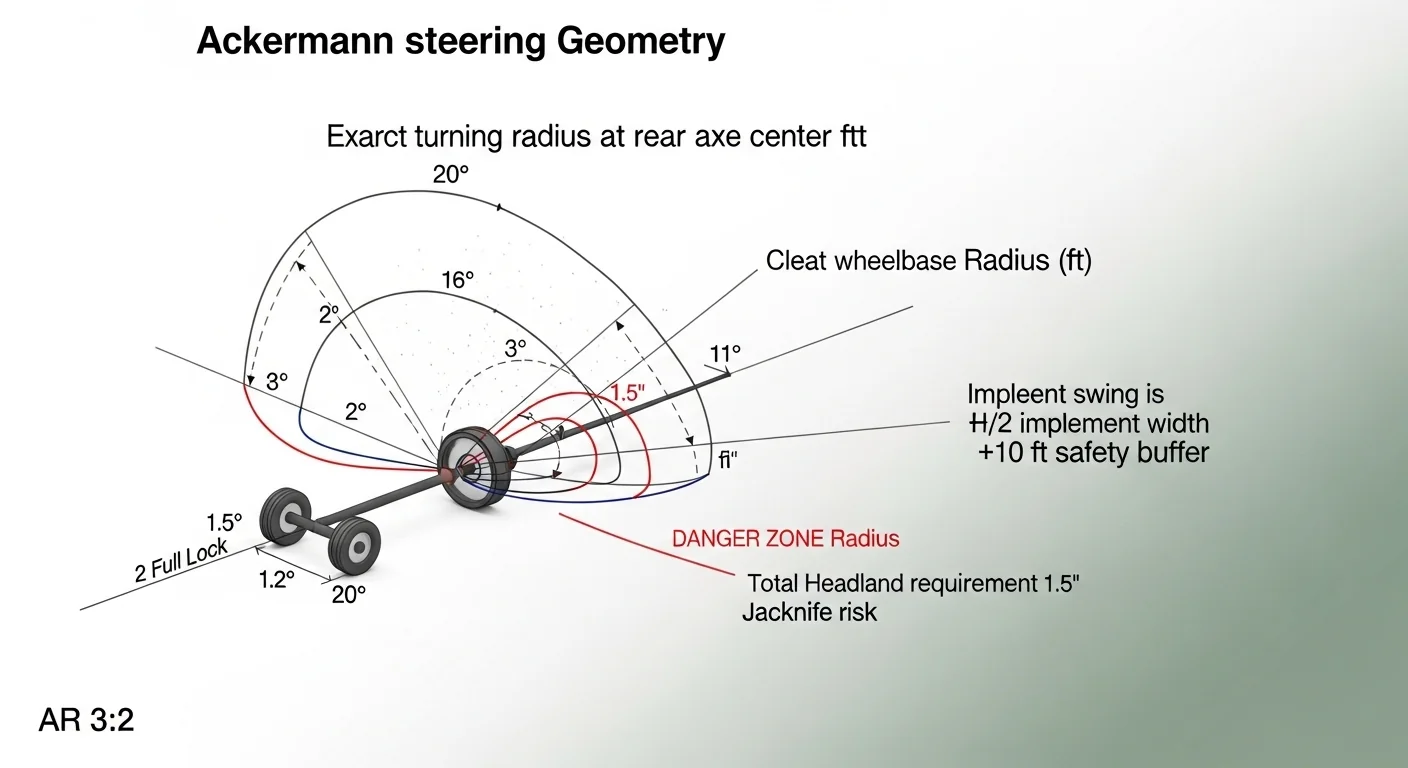
Most end-of-field planning starts with the wrong question. Operators ask “how wide should my headland be?” when the more critical variable is the tractor turning radius itself, which is governed by two mechanical facts that rarely appear in an operator manual: wheelbase and maximum front steering angle. Those two values, run through Ackermann steering geometry, determine a fixed physical constraint that no amount of extra field passes can override. The implement width and row spacing then build on top of that constraint to define the full headland requirement.
This tool calculates minimum turning radius using the Ackermann formula, derives the required headland width from that radius plus implement swing and a fixed safety buffer, and flags jackknife risk when the geometry puts a drawbar-mounted implement’s tongue in contact with the rear tires. It does not account for articulated tractors, four-wheel-drive articulation joints, or GPS-assisted correction during turns. For row-pattern geometry questions on other field implements, the cultivator sweep overlap calculator addresses adjacent spacing decisions in tillage passes.
After entering your tractor’s wheelbase, steering lock angle, implement width, and row spacing, you will know the minimum headland width your field must accommodate and whether your current turning practice creates jackknife conditions that can destroy implement tongues and rear tires.
Use the Tool

Tractor Turning Radius & Headland Spacing Calculator
The Yield Grid — Precision Field Planning Tool
| Wheelbase (in) | Steer Angle | Turn Radius (ft) | Headland Est. (ft) | Assessment |
|---|
How This Calculator Works
Step 1: Minimum Turning Radius
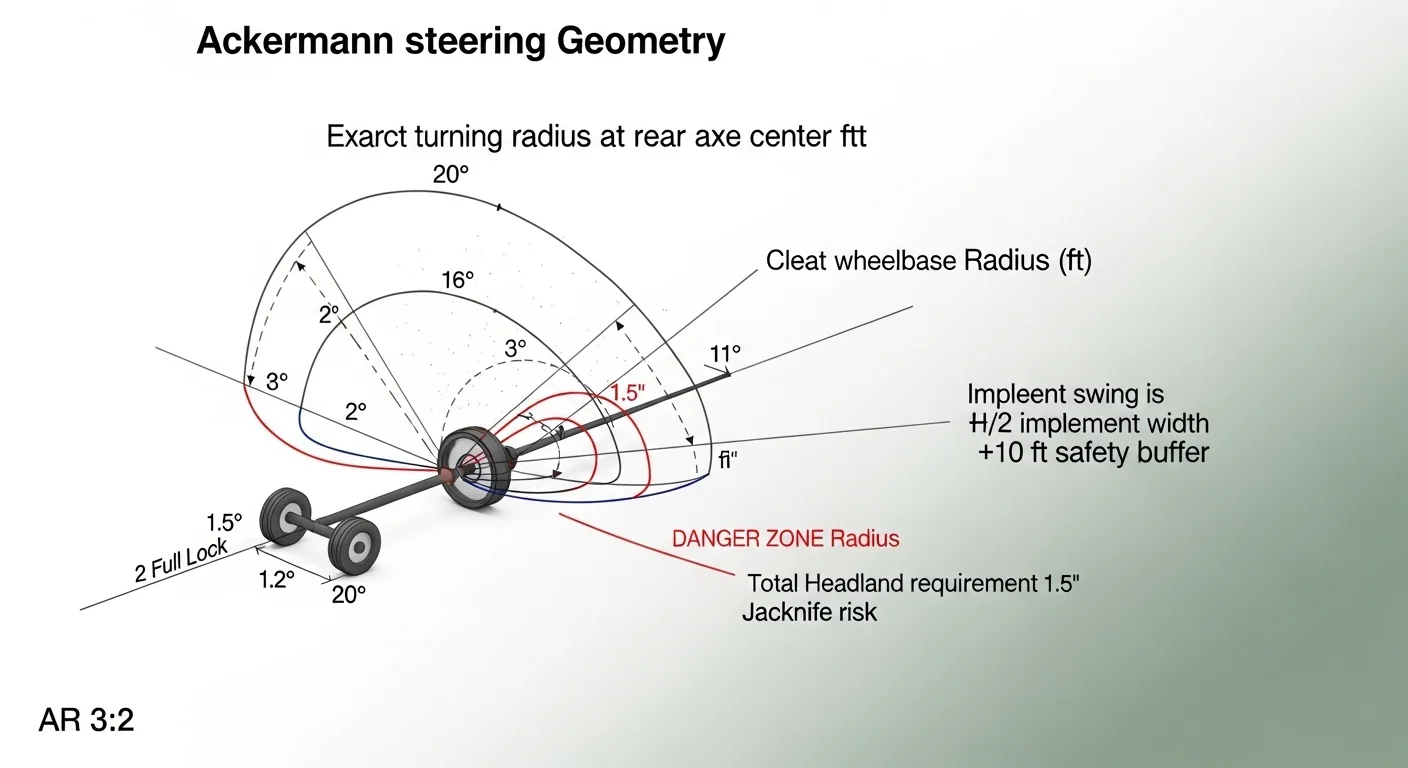
Using the Ackermann steering geometry formula, the minimum turning radius is calculated from your tractor’s wheelbase and front steering angle at full lock:
A larger wheelbase or smaller steering angle increases the turning radius. Most row-crop tractors turn at 45°–55°.
Step 2: Implement Swing Clearance
When the tractor turns, the implement swings outward. The swing distance is estimated from the half-width of the implement, which arcs beyond the tractor’s turn circle:
Step 3: Required Headland Width
The minimum headland (end-of-field turn lane) must accommodate the full turn diameter plus implement swing and a 10-foot safety buffer:
Step 4: Skip-Row Count
The number of rows that must be left unplanted at the headland to allow the tractor to turn without running over crop:
Jackknife Risk Check
If the calculated turning radius is less than 1.5× the wheelbase (converted to feet), the geometry indicates severe jackknife risk — the implement tongue can contact the rear tires.
Assumptions & Limits
- Assumes standard 3-point hitch or drawbar attachment; articulated tractors have different geometry.
- Implement swing uses half-width approximation; actual swing depends on tongue length and hitch offset.
- Buffer of 10 ft added to headland per ASABE S217 safe operating practice.
- Formula is valid for wheelbase 60–220 in, steering angle 20–75°.
- GPS auto-steering systems can reduce required headland by 15–25% in practice.
Before running the calculator, have three numbers ready: your tractor’s wheelbase in inches (front axle center to rear axle center, measured directly or found in the operator manual), the front steering angle at full lock in degrees (typically stamped on the front axle housing or listed in chassis specifications), and your implement’s working width in feet. Row spacing comes from your planter setup card. Enter all four values before clicking Calculate; the tool will not run with any field left empty.
Quick Start (60 Seconds)
- Tractor Wheelbase (inches): Measure front axle center to rear axle center, not overall length. Row-crop tractors typically fall between 90 and 160 inches. Do not use the wheelbase listed for a different configuration (e.g., narrow vs. wide tread).
- Front Steering Angle (degrees): This is the maximum lock angle, not a preferred field angle. Most standard row-crop tractors achieve 45 to 55 degrees. Entering a steering angle the tractor physically cannot reach will produce an optimistic radius that does not exist in the field.
- Implement Width (feet): Use the total working width, tip to tip. A 16-row planter at 30-inch spacing is 40 feet wide. Do not confuse transport width with working width.
- Planter Row Spacing (inches): This is the center-to-center spacing between rows, not the seed spacing along the row. Common values are 30 inches for corn and 36 inches for soybeans.
- Read the jackknife warning first: If the calculator returns a red safety warning, address it before reviewing headland width. A tight radius combined with a long drawbar tongue creates a geometry problem that headland width alone cannot solve.
- Cross-check skip rows against your planter: The skip-row count is the number of rows that must be left as headland passes. Compare it to your planter’s row count to plan pass sequence.
- Verify steering angle before assuming: Operators frequently overestimate lock angle by 5 to 10 degrees. If you are unsure, measure the front tire angle at full lock with a protractor or angle finder.
Inputs and Outputs (What Each Field Means)
| Field | Unit | What It Means | Common Mistake | Safe Entry Guidance |
|---|---|---|---|---|
| Tractor Wheelbase | Inches | Distance from front axle centerline to rear axle centerline; the primary driver of minimum turning radius | Using chassis length or tire-to-tire distance instead of axle centers | 60 to 220 inches; measure directly if unsure |
| Front Steering Angle | Degrees | Maximum achievable front wheel lock angle at full steering travel; a larger angle reduces the turning radius | Entering a theoretical maximum from a brochure rather than the actual mechanical limit of the installed axle | 20 to 75 degrees; 45 to 55 degrees is standard for row-crop tractors |
| Implement Width | Feet | Total working width tip to tip; drives implement swing clearance calculation | Using transport width (folded position) rather than field working width | 4 to 120 feet; enter the deployed working width |
| Planter Row Spacing | Inches | Center-to-center distance between planter rows; used to convert headland width into a skip-row count | Confusing row spacing with seed spacing (in-row distance between seeds) | 10 to 60 inches; 30 inches corn, 36 inches soy are the most common |
| Turning Radius (output) | Feet | Calculated minimum turning radius at the rear axle using Ackermann geometry; sets the lower bound on headland design | Treating this as the outer-tire sweep radius; it is measured at the rear axle, not the outer tire | Values below 15 feet with a drawbar implement should trigger jackknife review |
| Headland Width Required (output) | Feet | Minimum end-of-field lane width combining full turn diameter, half-implement swing, and a 10-foot safety buffer | Planning headland based on turning radius alone without adding swing or buffer | Values above 80 feet indicate significant headland acreage loss; consider GPS turn assistance |
| Implement Swing Clearance (output) | Feet | Estimated arc overhang of the implement during the turn, approximated as half the working width | Ignoring swing entirely when planning headlands on narrow fields | Wide implements (above 40 feet) create swing clearances that dominate the headland calculation |
| Skip Rows (output) | Row count | Number of rows at field ends that must remain unplanted during the main pass to allow turning room; planted separately in headland passes | Skipping too few rows and running over planted crop during turns | Round up; it is better to pre-plant one extra headland row than to destroy emerging crop |
| Headland Area per 1,000 ft (output) | Acres per 1,000 ft field length | Approximate acreage consumed by the headland on both ends of a 1,000-foot field; useful for production planning | Ignoring headland area loss in yield-per-acre calculations for smaller fields | Multiply by 2 for both ends of the field; on short fields this loss can exceed 10 acres per 100 acres |
Worked Examples (Real Numbers)
Example 1: Standard 12-Row Corn Planter, 120-Inch Wheelbase Tractor
- Wheelbase: 120 inches
- Steering angle: 45 degrees at full lock
- Implement width: 30 feet (12 rows at 30-inch spacing)
- Row spacing: 30 inches
Result: Turning radius = 120 / tan(45°) / 12 = 120 / 1.0 / 12 = 10.0 ft. Implement swing = 15 ft. Headland = (10.0 x 2) + 15 + 10 = 45 ft. Skip rows = CEIL(45 / 2.5) = 18 rows.
With a 45-degree lock and a standard drawbar hitch, the jackknife threshold (1.5 x 10.0 ft = 15.0 ft) exceeds the calculated radius of 10.0 ft. Implement tongue contact with rear tires is a real risk at full lock. A wider steering lock or longer tongue reduces this exposure.
Example 2: 24-Row Soybean Planter on a Large Four-Wheel Drive Tractor, 160-Inch Wheelbase
- Wheelbase: 160 inches
- Steering angle: 50 degrees at full lock
- Implement width: 60 feet (24 rows at 30-inch spacing)
- Row spacing: 30 inches
Result: Turning radius = 160 / tan(50°) / 12 = 160 / 1.1918 / 12 = 11.19 ft. Swing = 30 ft. Headland = (11.19 x 2) + 30 + 10 = 62.4 ft. Skip rows = CEIL(62.4 / 2.5) = 25 rows.
A 60-foot implement on a drawbar hitch requires over 62 feet of headland. On a quarter-section field roughly 2,640 feet long, that headland represents meaningful acreage removed from the main plant population. Running a headland pass with the same planter before the main field pass is standard practice at this implement width.
Example 3: Compact Utility Tractor with Narrow Vegetable Planter, 100-Inch Wheelbase
- Wheelbase: 100 inches
- Steering angle: 55 degrees at full lock
- Implement width: 12 feet (4 rows at 36-inch spacing)
- Row spacing: 36 inches
Result: Turning radius = 100 / tan(55°) / 12 = 100 / 1.4281 / 12 = 5.84 ft. Swing = 6 ft. Headland = (5.84 x 2) + 6 + 10 = 27.7 ft. Skip rows = CEIL(27.7 / 3.0) = 10 rows.
The 55-degree lock on a shorter wheelbase gives a very tight geometric radius, but the jackknife limit at 1.5 x 8.33 ft = 12.5 ft still exceeds this radius, flagging risk. A mounted 3-point implement rather than a drawbar planter eliminates the tongue geometry that creates jackknife conditions at these radii.
Reference Table (Fast Lookup)
All rows assume a 30-foot implement width (15 ft swing) and 30-inch row spacing. Headland includes the 10-ft safety buffer. Jackknife threshold is 1.5 x wheelbase (ft).
| Wheelbase (in) | Steer Angle (deg) | Turn Radius (ft) | Jackknife Limit (ft) | Headland Required (ft) | Skip Rows (30″ spacing) | Jackknife Status |
|---|---|---|---|---|---|---|
| 80 | 45 | 5.6 | 10.0 | 36.1 | 15 | DANGER: radius below threshold |
| 100 | 45 | 6.9 | 12.5 | 38.9 | 16 | DANGER: radius below threshold |
| 100 | 55 | 5.8 | 12.5 | 36.7 | 15 | DANGER: radius below threshold |
| 120 | 45 | 10.0 | 15.0 | 45.0 | 18 | DANGER: radius below threshold |
| 120 | 50 | 8.4 | 15.0 | 41.8 | 17 | DANGER: radius below threshold |
| 140 | 45 | 11.7 | 17.5 | 48.3 | 20 | DANGER: radius below threshold |
| 140 | 55 | 8.2 | 17.5 | 41.3 | 17 | DANGER: radius below threshold |
| 160 | 45 | 13.3 | 20.0 | 51.7 | 21 | DANGER: radius below threshold |
| 160 | 50 | 11.2 | 20.0 | 47.4 | 19 | DANGER: radius below threshold |
| 180 | 45 | 15.0 | 22.5 | 55.0 | 22 | DANGER: radius below threshold |
| 180 | 55 | 10.5 | 22.5 | 46.0 | 19 | DANGER: radius below threshold |
| 120 | 45 | 10.0 | 15.0 | 45.0 | 18 | Safe with 3-pt hitch (no tongue geometry) |
Pattern to note: Jackknife risk at full lock is consistent across all standard drawbar configurations in this table because the Ackermann formula produces a tight geometric radius relative to wheelbase length. This is not a calculator error. It is the reason drawbar-mounted heavy planters require deliberate turn management, not snap U-turns. The last row illustrates that a 3-point hitch attachment eliminates tongue geometry risk entirely at the same radius.
How the Calculation Works (Formula + Assumptions)
Show the calculation steps
Step 1: Convert Steering Angle and Calculate Turning Radius
The minimum turning radius is derived from Ackermann steering geometry:
Radius (inches) = Wheelbase (inches) / tan(Steering Angle in radians)
Radius (feet) = Radius (inches) / 12
Steering angle in degrees is converted to radians before computing the tangent. Rounding: keep one decimal place on the foot result.
Step 2: Calculate Implement Swing
Swing (feet) = Implement Width (feet) / 2
This approximates the lateral arc the implement traces during a 180-degree turn. Actual swing depends on hitch offset and tongue length, but half-width is a conservative and widely used field estimate.
Step 3: Calculate Required Headland Width
Headland (feet) = (Radius x 2) + Swing + 10
The 10-foot buffer is added per ASABE S217 safe operating practice. Round the headland to the nearest whole foot for field marking.
Step 4: Calculate Skip Rows
Row Width (feet) = Row Spacing (inches) / 12
Skip Rows = CEILING(Headland (feet) / Row Width (feet))
Always round up. Planting one extra headland row is recoverable; destroying an emerged crop row during a turn is not.
Step 5: Jackknife Risk Check
Jackknife Threshold (feet) = (Wheelbase (inches) / 12) x 1.5
RISK if: Turning Radius (feet) < Jackknife Threshold (feet)
When radius falls below 1.5 times the wheelbase (converted to feet), implement tongue geometry reaches a point where a drawbar-mounted implement’s tongue can contact the rear tires during a sharp turn.
Assumptions and Limits
- The formula applies to standard two-wheel-steer tractors with a single front axle. Articulated four-wheel-drive tractors use a different turning geometry based on the articulation joint, not the front axle angle.
- Implement swing is approximated as half the working width. Actual swing is affected by tongue length, hitch offset, and whether the implement is rigid or folded during turns. Longer tongues increase swing clearance requirements beyond this estimate.
- The 10-foot headland buffer is a fixed conservative value based on ASABE safe operating standards. Actual field conditions (slope, soil type, speed) may require a larger buffer.
- Steering angle is assumed to be at maximum mechanical lock. If the operator typically does not use full lock (common on soft ground or slopes), the actual turning radius will be larger than calculated.
- The jackknife check uses a 1.5x wheelbase threshold. This is a geometry-based approximation; actual tongue-contact risk depends on drawbar height, tongue attachment point, and implement weight distribution.
- GPS auto-steer assisted turns can reduce effective headland requirements by 15 to 25 feet in practice because the system manages approach angle and reduces overshoot. This tool calculates manual-turn geometry only.
- The headland acreage estimate assumes a flat, rectangular field. Irregular field shapes, pivot corners, and terraces alter headland geometry in ways this calculator does not model.
Standards, Safety Checks, and “Secret Sauce” Warnings
Critical Warnings
- The Jackknife Crimp: Any time a large planter on a drawbar hitch is pulled through a tight U-turn, the pivot point sits far behind the rear axle. If the geometric turning radius is smaller than 1.5 times the tractor wheelbase (in feet), the implement tongue swings toward the rear tires. At sharp angles, the steel tongue contacts the tire sidewall, ripping lugs and potentially snapping the tongue. This is not a slow failure. It happens in a single turn. The calculator flags this condition explicitly; do not override the warning without first lengthening the drawbar or switching to a different turn pattern.
- Steering Angle Optimism: Published steering angle specifications sometimes list a theoretical maximum that requires modifications (aftermarket steering stops, axle spacers) not present on a stock tractor. If the calculated turning radius seems tighter than field experience suggests, reduce the steering angle input by 5 degrees and recalculate. The result is a more honest headland requirement. Understanding how drawbar load affects the chassis geometry is covered in the drawbar horsepower calculator, which also documents the relationship between tongue load and steering feel.
- Wide Implement + Tight Lock: A 60-foot implement at 45-degree lock requires over 60 feet of headland before adding the 10-foot buffer. That headland calculation is dominated by swing, not by the tractor’s turning radius. Halving the implement width (splitting into two passes) can reduce headland requirements more than any improvement in tractor steering angle.
- 3-Point vs. Drawbar Geometry: The jackknife warning applies to drawbar-mounted implements only. A 3-point hitch places the pivot point above and ahead of the rear axle, changing the geometry entirely. The same tractor turning radius that creates jackknife risk with a drawbar planter is safe with a 3-point mounted implement. Knowing your hitch type before entering any implement width is critical. The 3-point lift capacity calculator is the starting point for confirming whether a mounted configuration is structurally viable at your implement weight.
Minimum Standards
- Headland width must equal at minimum the full turn diameter (radius x 2) plus implement swing, with no buffer compression. Removing the safety buffer to save headland acreage is a compliance deviation from ASABE S217 safe operating practice.
- Skip-row counts must always round up, not down. A fractional skip-row result of 17.1 means 18 rows must be left, not 17.
- Drawbar-mounted implements should not be turned at angles that produce a radius below the jackknife threshold without the operator first verifying tongue clearance from rear tires by manual inspection at low speed.
Competitor Trap: Most headland spacing guides on farm machinery blogs use a flat “turn radius x 2 + implement width” formula and stop there. They skip implement swing (which requires only half the width, not the full width) and they add no safety buffer. The result is a calculated headland that is consistently 10 to 20 feet narrower than what safe field operation requires. Operators following those guides consistently run out of room, especially on the second pass when approach angles compound. The buffer and swing terms in this calculator are not optional padding. They are the margin between a clean turn and a snapped planter tongue.
Common Mistakes and Fixes
Mistake: Using Overall Tractor Length Instead of Wheelbase
Overall length includes front hood overhang, drawbar extension, and any rear weight bracket. None of those distances affect the Ackermann turning geometry. Only the axle-to-axle wheelbase drives the radius calculation. Entering an overall length of 180 inches instead of a wheelbase of 130 inches produces an erroneously large turning radius that creates false confidence in tight headlands.
Fix: Measure axle center to axle center directly, or locate the wheelbase specification in the chassis section (not the dimensions section) of the operator manual.
Mistake: Treating Turning Radius as the Outer Tire Sweep
The Ackermann formula produces a radius measured at the rear axle centerline. The outer front tire sweeps a significantly larger arc. Marking headland width based on rear axle radius alone leaves no room for the outer tire’s wider path. On soft ground, the outer tire’s track can extend 3 to 5 feet beyond the calculated radius.
Fix: The headland formula already accounts for this by doubling the radius and adding swing and buffer. Do not subtract from the headland result to “save space.”
Mistake: Ignoring Implement Weight Effect on Tire Ballast and Turning
A heavy planter increases rear axle weight, which can change the front axle’s steering feel and limit actual lock angle below the mechanical maximum. Operators who are accustomed to driving unloaded report that full lock with a loaded planter feels and behaves differently, often producing a larger effective radius than the geometry predicts. Correct rear ballasting ensures the front axle retains adequate steering force. The tractor tire ballast calculator helps verify front-to-rear weight distribution before hitching heavy implements.
Fix: Check front axle load percentage with the implement attached. If front axle weight drops below the manufacturer’s minimum (commonly listed as 20 percent of total weight), steering angle and turning precision will be compromised.
Mistake: Applying Row-Crop Tractor Geometry to Rotary Cutter Passes
Operators sometimes use planter headland calculations when planning rotary cutter pass sequences on the same field. Rotary cutters are typically wider relative to their tongue length and have different swing behavior. A headland sized for a 30-foot planter may be inadequate for a similarly wide rotary cutter configuration that places its center of mass differently during the turn arc.
Fix: Run the calculation separately for each implement type. Headland geometry is implement-specific, not tractor-specific.
Mistake: Planning the Same Headland Width for Both Ends of the Field
Fields are rarely the same at both ends. One end may face a road ditch requiring a larger buffer; the other may slope toward a tile inlet. Operators who plan a single uniform headland for both ends sometimes find that the calculated minimum works on one end and creates a safety or drainage problem on the other.
Fix: Calculate once, then add end-specific buffers before marking. The calculator result is the minimum, not the target.
Next Steps in Your Workflow
Once the headland width is confirmed, the immediate practical question is pass sequence. If the skip-row count is fewer than your planter’s row count, you can plant the headland passes first with the same equipment before beginning the main field. If the skip-row count exceeds your planter’s row count, you will need multiple headland passes. Recording the skip-row count and headland width in your field records before planting, alongside ground speed decisions for the main pass, is the most efficient workflow. The tractor ground speed calculator is the logical next calculation after headland geometry is confirmed, because turning approach speed directly affects how much the actual turn radius deviates from the geometric minimum.
For precision seeding operations where headland calibration matters as much as main-field calibration, the headland rows planted at the end of the field are often the rows most affected by speed transitions and row clutch engagement timing. Checking calibration separately for headland passes is standard practice on precision-seeded crops. The seed drill calibration calculator provides a structured approach to confirming seeding rate accuracy across both main and headland passes before the full field is committed.
FAQ
What is a tractor turning radius and how is it calculated?
Tractor turning radius is the minimum radius the rear axle center traces during a full-lock turn. It is calculated using Ackermann steering geometry: wheelbase (in inches) divided by the tangent of the front steering angle (in degrees), then converted to feet. A longer wheelbase or smaller steering angle produces a larger turning radius. This geometric radius is the foundation for all headland spacing calculations.
What is headland spacing and why does it matter?
Headland spacing is the width of unplanted or pre-planted land at field ends that allows the tractor and implement to turn without running over the crop. Insufficient headland leads to crop damage during turns, compaction in the wrong areas, and risk of mechanical damage from jackknifing. Adequate headland spacing is calculated from the turning radius, implement swing clearance, and a fixed safety buffer.
What is the jackknife risk in tractor turning?
Jackknife risk occurs when a drawbar-mounted implement’s tongue is pulled to an angle where it makes contact with the tractor’s rear tires. This happens when the turning radius is smaller than approximately 1.5 times the tractor’s wheelbase. The result can be immediate tire sidewall damage and a snapped implement tongue. It is not a gradual failure and is preventable by planning turns that stay above the jackknife threshold.
How does implement width affect headland requirements?
Implement width determines the swing clearance, which is approximated as half the total working width. For a 60-foot planter, swing clearance adds 30 feet to the headland requirement. On wide implements, swing is the dominant term in the headland formula, exceeding the contribution of the turning radius itself. This is why wide-implement operators often need 60-plus feet of headland even with well-configured tractors.
Does GPS auto-steer change the required headland width?
In practice, GPS auto-steer systems allow operators to manage approach angles more precisely, which can reduce effective headland requirements by 15 to 25 feet compared to manual turns. However, the geometric minimum calculated by this tool remains the physical lower bound. Auto-steer reduces the operator error component of headland planning, not the geometry component. Headlands cannot safely be reduced below the geometric minimum regardless of guidance system precision.
What is a skip-row pattern and when is it used?
A skip-row pattern is a planned sequence where rows at field ends are left unplanted during the main field pass, then planted in a separate headland pass after the main field is complete. The number of rows skipped equals the headland width divided by the row spacing, always rounded up. This approach preserves yield potential in the headland area while ensuring the tractor has room to turn on the main pass without crop damage.
Conclusion
Tractor turning radius is a fixed geometric output of two chassis variables: wheelbase and steering lock angle. No amount of field experience changes the math. What field experience does change is the recognition of when that math is producing a danger condition, specifically when a drawbar-mounted implement’s tongue geometry crosses into jackknife territory. This calculator makes that threshold explicit rather than leaving it to intuition developed from near-misses.
The single most common mistake in headland planning is calculating from turning radius alone and skipping the implement swing and safety buffer. That shortcut consistently produces headlands 15 to 25 feet too narrow for the actual field operation. For operations that also manage boom spraying geometry across the same headlands, the boom sprayer calibration calculator addresses the overlap and coverage decisions that follow after headland dimensions are confirmed. Plan the headland correctly once, and every subsequent pass on that field benefits.