
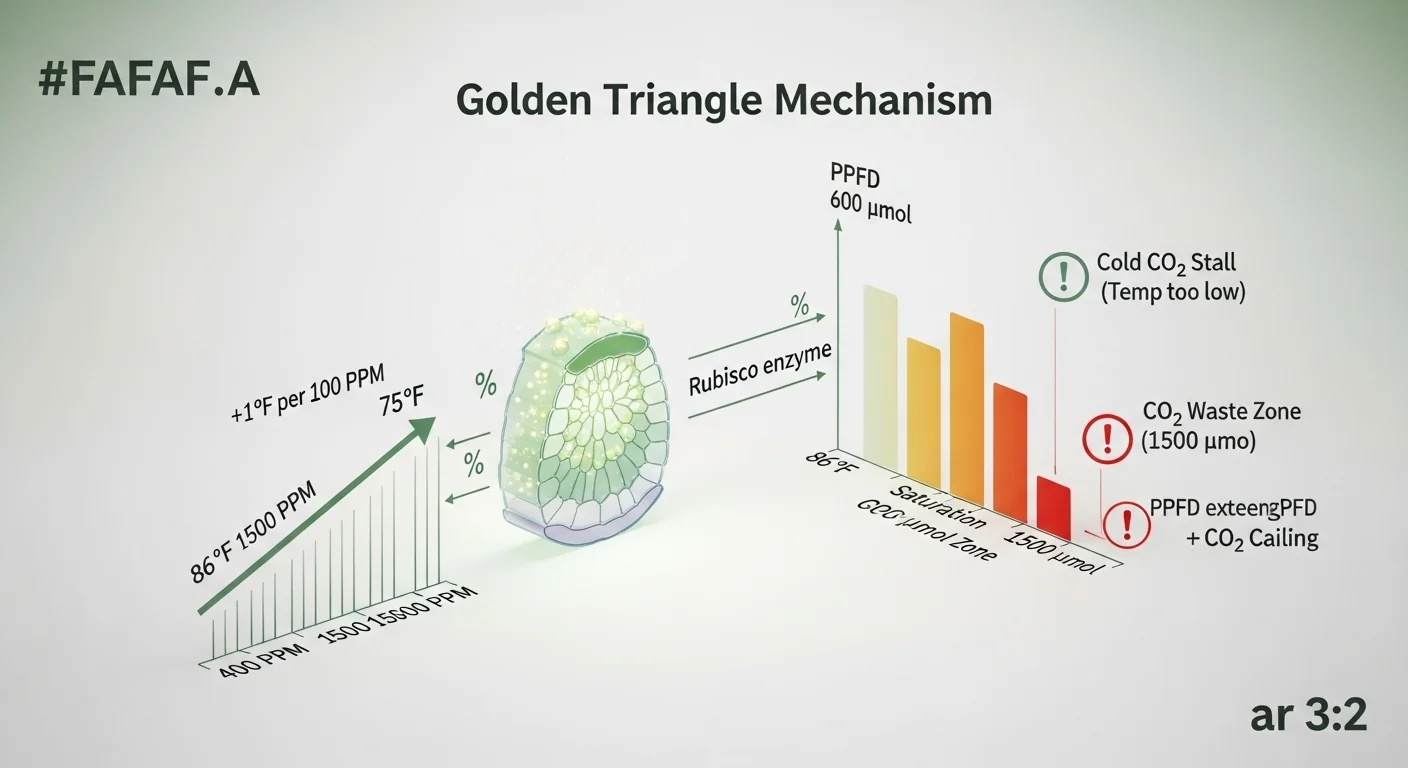
Plant metabolism is not a dial you adjust with one variable. The enzymes that fix carbon during photosynthesis operate on a three-way dependency: CO2 concentration sets the ceiling for photosynthetic throughput, PPFD determines how fast the light reactions push electrons into that cycle, and temperature controls whether the enzymes running the Calvin cycle can keep pace with both. Raise CO2 to 1,500 PPM while locking your canopy temperature at 75 degrees Fahrenheit, and you have spent money pressurizing a room full of gas your plants cannot metabolize. That scenario has a name. This tool was built specifically to detect it.
The temperature CO2 light calculator on this page computes five outputs: your Metabolic Efficiency Score, the Optimal Target Temperature for your current CO2 level, the maximum PPFD your CO2 can actually support, the Temperature Delta between where you are and where you need to be, and your Light Utilization Ratio. What it does not calculate is vapor pressure deficit, nutrient uptake rate, leaf surface temperature, or strain-specific thresholds. Those are separate layers of optimization. The tool models the enzymatic relationship between CO2, canopy air temperature, and photon flux using linear approximations of the underlying biochemistry.
After running this calculator, you will know whether your canopy temperature is properly matched to your CO2 PPM level, and whether your PPFD is within the absorption range your CO2 can support. That single insight determines whether CO2 enrichment is delivering metabolic throughput or just raising your electricity and CO2 bill.
Use the Tool
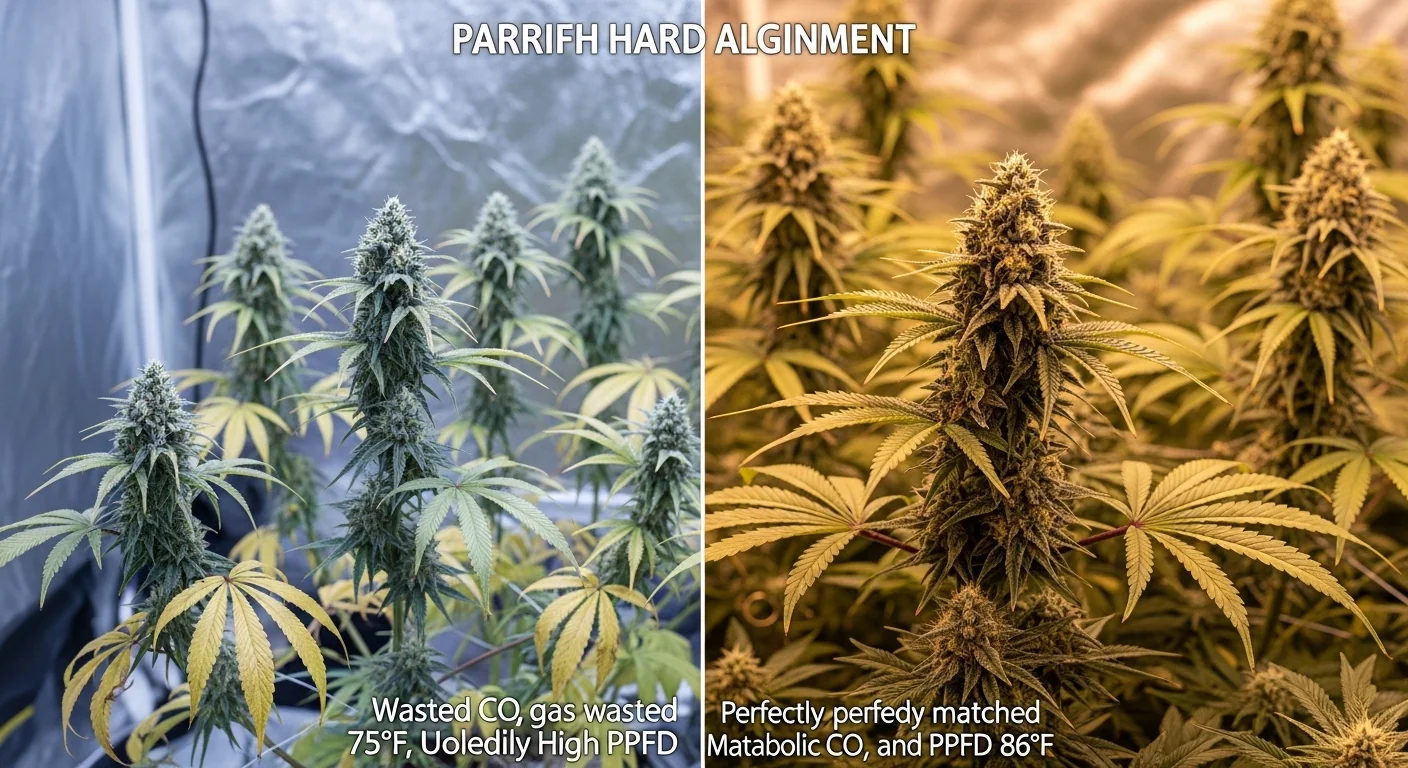
The Golden Triangle: Temp, Light & CO2
Metabolic Curve Calculator — Unlock your grow room’s hidden yield potential by aligning CO2, light, and temperature.
| CO2 (PPM) | Optimal Temp (°F) | Max PPFD (μmol) | Status |
|---|---|---|---|
| 400 | 75.0°F | 600 | Ambient |
| 600 | 77.0°F | 750 | Slight Boost |
| 800 | 79.0°F | 900 | Good |
| 1000 | 81.0°F | 1050 | Optimal |
| 1200 | 83.0°F | 1200 | High |
| 1500 | 86.0°F | 1500 | Max — Needs Heat |
| 2000 | 91.0°F | 2000 | Extreme |
How This Calculator Works
This tool reveals the Golden Triangle of plant metabolism: CO2, Temperature, and Light are enzymatically locked together. Raising one without the others is like pressing the gas with the parking brake on.
Formula Steps:
→ Each 100 PPM above ambient (400) raises the enzymatic ideal by 1°F.
→ At 1500 PPM: 75 + (1100 × 0.01) = 86°F target.
→ Approx. CO2_PPM × 1.0 (μmol/m²/s), capped at 2,000.
→ At 400 PPM: 600 μmol (baseline saturation point).
→ At 1200 PPM: 1,200 μmol max usable PPFD.
→ Negative = too cold (Cold CO2 Stall risk).
→ Positive = too warm (stress threshold risk).
→ >100% = CO2 Waste (light exceeds CO2 capacity).
→ 80–100% = Optimal zone.
→ <80% = CO2 or light underutilized.
→ 100% = Perfect Golden Triangle alignment.
→ Below 70% = significant room for optimization.
Assumptions & Limits
- Based on C3 photosynthesis pathway. C4 crops behave differently.
- Model assumes adequate water, nutrients, and VPD — other limiters can override CO2/temp benefits.
- Optimal temperature formula is linear; real enzymatic curves have diminishing returns above 95°F.
- Max PPFD utilization is a linear approximation. Real saturation curves are sigmoidal.
- CO2 above 2,000 PPM shows diminishing returns and may be harmful; this tool warns but does not model above 2,000 PPM.
- Temperature inputs should reflect true canopy air temperature, not room ambient or leaf surface temp.
Before entering values, collect three measurements taken simultaneously and at the same location. Canopy PPFD should be measured with a quantum PAR meter positioned at the top of the canopy, not ceiling-mounted. CO2 readings should come from an NDIR-type sensor placed at canopy height rather than floor level, since CO2 stratifies in still air. Temperature must be the canopy air temperature, not the thermostat setpoint or the reading from a wall sensor three feet away from the plants. A two-degree discrepancy in any of these inputs produces a meaningfully different recommendation from the tool. Precision agriculture principles apply indoors as much as in the field: if you calibrate your equipment outdoors, the same discipline applies here. Growers who already apply that mindset to tasks like sprayer output calibration often find the measurement discipline translates directly to environmental monitoring.
Quick Start (60 Seconds)
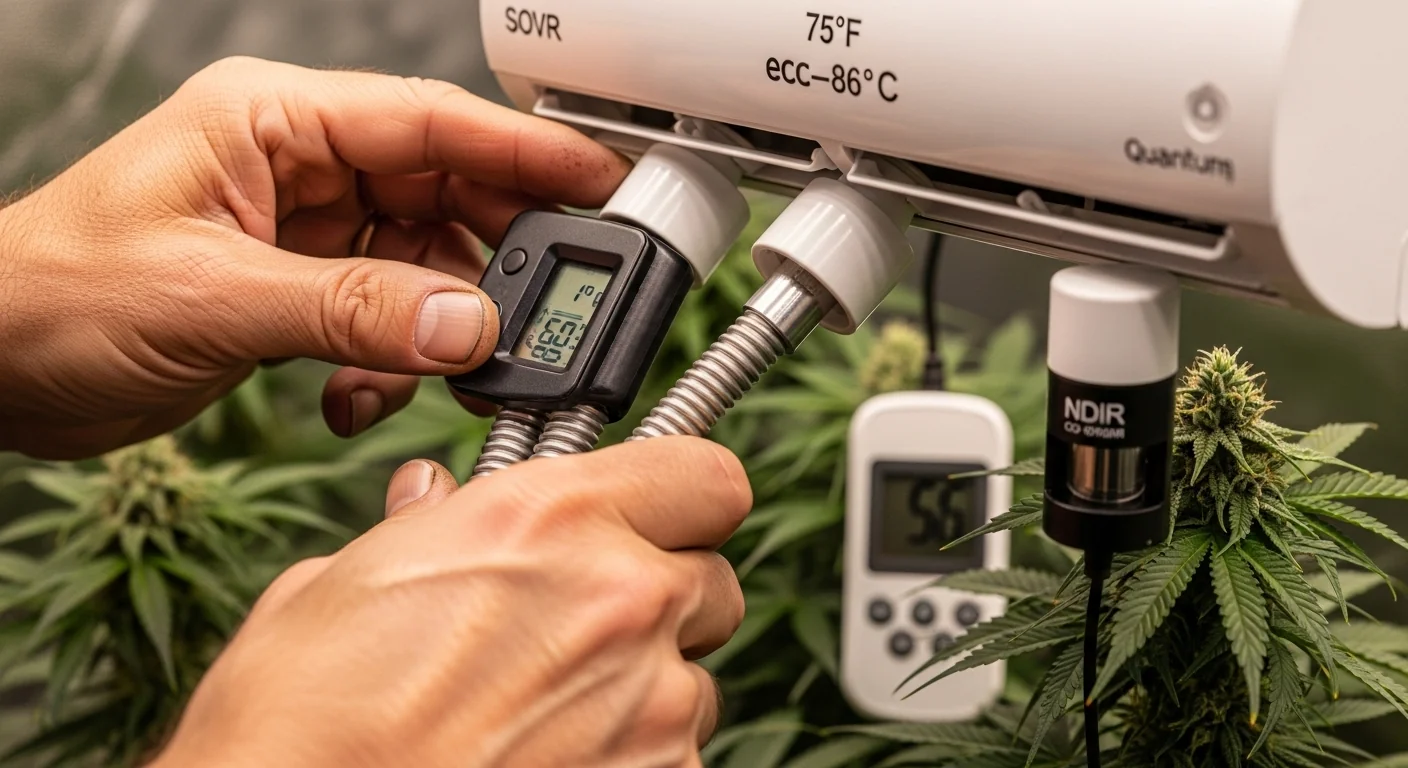
- Canopy PPFD: Enter your quantum PAR meter reading in micromoles per square meter per second (μmol/m²/s). Do not use lux or footcandles; they are not spectrally equivalent. Typical indoor ranges: 200 to 600 for seedlings, 600 to 1,200 for vegetative, 800 to 2,000 for flowering under supplemental CO2.
- Room CO2 Level: Enter the PPM reading from your NDIR sensor. Ambient outdoor air is approximately 400 PPM. If you are not enriching, enter your actual measured value, not 400 as a default. CO2 levels inside a sealed room before lights-on can drift significantly from the assumed baseline.
- Canopy Air Temperature: Enter degrees Fahrenheit measured at canopy height. This is not your room thermostat setting. Place a digital probe thermometer 6 to 12 inches above the canopy surface for an accurate reading.
- Unit check: All three inputs use specific units (μmol/m²/s, PPM, °F). Entering lux instead of PPFD, or Celsius instead of Fahrenheit, will generate a result that looks plausible but is incorrect.
- Simultaneous readings: CO2 PPM, temperature, and PPFD fluctuate constantly. Take all three readings within a two-minute window during the same light period phase for a meaningful result.
- Run both scenarios: If you are evaluating a lighting or CO2 upgrade, run the calculator once with current values and once with your target values to see the projected efficiency delta before purchasing equipment.
Inputs and Outputs (What Each Field Means)
| Field | Unit | What It Represents | Common Entry Mistake | Safe Entry Guidance |
|---|---|---|---|---|
| Canopy PPFD | μmol/m²/s | Photon flux density of photosynthetically active radiation at the canopy surface. Reflects actual light intensity the leaf receives, not fixture wattage or lumens output. | Using manufacturer's peak PPFD rating instead of a measured canopy reading, or averaging a ceiling-mounted sensor that reads 40-60 lower than canopy level. | Measure with a quantum PAR meter at 5 to 10 canopy points and use the average. Valid range: 0 to 3,000 μmol/m²/s. |
| Room CO2 Level | PPM | Volumetric concentration of CO2 in the grow space. Drives the ceiling for photosynthetic throughput and determines the required temperature envelope for enzymatic function. | Using a non-NDIR sensor (electrochemical or MOS types drift significantly), or reading from a sensor placed at floor level where CO2 is lower. | Use a calibrated NDIR sensor at canopy height. Valid range: 0 to 5,000 PPM. Values above 2,000 PPM have diminishing returns and extreme temperature requirements. |
| Canopy Air Temperature | °F | Air temperature measured immediately above the canopy. Governs Rubisco enzyme activity rate. Too cold at high CO2 causes metabolic stall; too hot causes heat denaturation and stomatal closure. | Using the HVAC thermostat setpoint instead of a probe measurement. The canopy microclimate routinely runs 2 to 6 degrees warmer than room ambient due to radiant heat from fixtures. | Use a calibrated digital probe thermometer at canopy height. Valid range for the tool: 32 to 115°F. Typical optimal range for enriched environments: 78 to 90°F depending on CO2 level. |
| Metabolic Efficiency Score | Score (0 to 100) | Composite score reflecting alignment between your CO2 capacity, PPFD supply, and temperature. 100 represents full Golden Triangle alignment. Below 70 signals a meaningful mismatch costing measurable throughput. | Treating a score in the 70s as acceptable when a simple temperature adjustment could move it to 90+. | Use as a decision trigger, not a trophy. Scores below 80 warrant specific action on the identified limiting factor. |
| Optimal Target Temperature | °F | The canopy air temperature at which enzymatic demand matches your CO2 PPM level, computed from the linear formula: 75 + ((CO2 - 400) x 0.01). | Treating this as a ceiling. Optimal temp is the target center, not the maximum safe temperature. | Aim to keep canopy temperature within 2°F of this value during peak CO2 enrichment periods. |
| Max PPFD Utilization | μmol/m²/s | The maximum photon flux your current CO2 level can productively absorb before light becomes excess heat rather than photosynthetic input. CO2 sets the ceiling for light use efficiency. | Assuming higher PPFD is always better. Above this threshold, additional light energy is wasted. | If your input PPFD exceeds this output, consider reducing fixture intensity or increasing CO2 concentration to match light capacity. |
| Temperature Delta | °F (signed) | Difference between your current canopy temperature and the computed optimal. Negative values mean the environment is too cold for the CO2 level present; positive means excess heat. | Ignoring small negative deltas when running high CO2. Even a 4°F cold deficit at 1,200 PPM represents significant enzyme underperformance. | Target a delta within the range of -2 to +3°F. Deltas more negative than -5°F at CO2 levels above 1,000 PPM indicate Cold CO2 Stall conditions. |
| Light Utilization Ratio | Ratio (expressed as proportion) | Your input PPFD divided by the maximum PPFD your CO2 can support, expressed as a proportion. Values above 1.10 indicate the CO2 Waste Zone where excess light cannot be photosynthetically converted. | Using this ratio in isolation without checking the temperature delta. High utilization with a large negative temperature delta still produces poor yield outcomes. | The sweet spot is 0.80 to 1.00. Above 1.10, reduce PPFD or raise CO2. Below 0.60, PPFD is significantly underdriving CO2 capacity. |
Worked Examples (Real Numbers)
Scenario 1: The Cold CO2 Stall (1,500 PPM, 75°F)
- Canopy PPFD: 900 μmol/m²/s
- Room CO2: 1,500 PPM
- Canopy Air Temperature: 75°F
Optimal Temperature: 75 + ((1,500 - 400) x 0.01) = 75 + 11.0 = 86.0°F
Max PPFD Utilization: 1,500 x 1.0 = 1,500 μmol/m²/s
Temperature Delta: 75.0 - 86.0 = -11.0°F
Light Utilization Ratio: 900 / 1,500 x 100 = 60.0
Temperature Penalty: min(11 x 3, 40) = 33 points
Metabolic Efficiency Score: 60 - 33 = 27 out of 100
Result: 27 Metabolic Efficiency Score. Cold CO2 Stall triggered.
This is the most expensive mistake in CO2 enrichment. The grower is spending on 1,500 PPM enrichment while recovering roughly a quarter of the potential metabolic throughput. Raising canopy temperature to 86°F while keeping all other variables constant would move the score to approximately 60, and optimizing PPFD to 1,200 would push it to 90 or above.
Scenario 2: The CO2 Waste Zone (1,200 PPM, Correct Temp, Too Much Light)
- Canopy PPFD: 1,800 μmol/m²/s
- Room CO2: 1,200 PPM
- Canopy Air Temperature: 83°F
Optimal Temperature: 75 + ((1,200 - 400) x 0.01) = 75 + 8.0 = 83.0°F
Max PPFD Utilization: 1,200 x 1.0 = 1,200 μmol/m²/s
Temperature Delta: 83.0 - 83.0 = 0.0°F
Light Utilization Ratio: 1,800 / 1,200 x 100 = 150.0
Temperature Penalty: 0 points
Metabolic Efficiency Score: min(150, 100) - 0 = 100 out of 100 (but CO2 Waste warning active)
Result: CO2 Waste Zone warning triggered. Temperature alignment is perfect, but 600 μmol/m²/s of light is driving heat, not photosynthesis.
The temperature is dialed correctly for the CO2 level, but the light investment is 50% above what the CO2 concentration can process. The fix is either raising CO2 to 1,800 PPM (and raising target temperature to 89°F accordingly) or reducing PPFD to 1,200. Both paths close the efficiency gap.
Scenario 3: Full Golden Triangle Alignment (1,000 PPM, Correct Temp, Matched PPFD)
- Canopy PPFD: 1,000 μmol/m²/s
- Room CO2: 1,000 PPM
- Canopy Air Temperature: 81°F
Optimal Temperature: 75 + ((1,000 - 400) x 0.01) = 75 + 6.0 = 81.0°F
Max PPFD Utilization: 1,000 x 1.0 = 1,000 μmol/m²/s
Temperature Delta: 81.0 - 81.0 = 0.0°F
Light Utilization Ratio: 1,000 / 1,000 x 100 = 100.0
Temperature Penalty: 0 points
Metabolic Efficiency Score: 100 - 0 = 100 out of 100
Result: 100 Metabolic Efficiency Score. Golden Triangle achieved.
All three variables are locked in their optimal relationship. CO2 concentration, enzymatic temperature demand, and photon supply are matched. This is the configuration where additional CO2 investment produces a measurable metabolic return rather than recirculating unused gas.
Reference Table (Fast Lookup)
All values below are derived directly from the tool formulas. The "Cold Stall Risk Temp" column represents the canopy temperature below which enzyme underperformance becomes significant at each CO2 level (defined as Optimal Temp minus 5°F). The "PPFD to CO2 Match" column shows the input PPFD that achieves a 1.00 Light Utilization Ratio at each CO2 level.
| CO2 (PPM) | Optimal Canopy Temp (°F) | Temp Rise from Ambient CO2 (°F) | Max PPFD Utilization (μmol/m²/s) | Cold Stall Risk Below (°F) | PPFD to CO2 Match (μmol/m²/s) |
|---|---|---|---|---|---|
| 400 (ambient) | 75.0 | +0.0 | 600 | 70.0 | 600 |
| 600 | 77.0 | +2.0 | 600 | 72.0 | 600 |
| 700 | 78.0 | +3.0 | 700 | 73.0 | 700 |
| 800 | 79.0 | +4.0 | 800 | 74.0 | 800 |
| 900 | 80.0 | +5.0 | 900 | 75.0 | 900 |
| 1,000 | 81.0 | +6.0 | 1,000 | 76.0 | 1,000 |
| 1,200 | 83.0 | +8.0 | 1,200 | 78.0 | 1,200 |
| 1,500 | 86.0 | +11.0 | 1,500 | 81.0 | 1,500 |
| 1,800 | 89.0 | +14.0 | 1,800 | 84.0 | 1,800 |
| 2,000 | 91.0 | +16.0 | 2,000 | 86.0 | 2,000 |
How the Calculation Works (Formula and Assumptions)
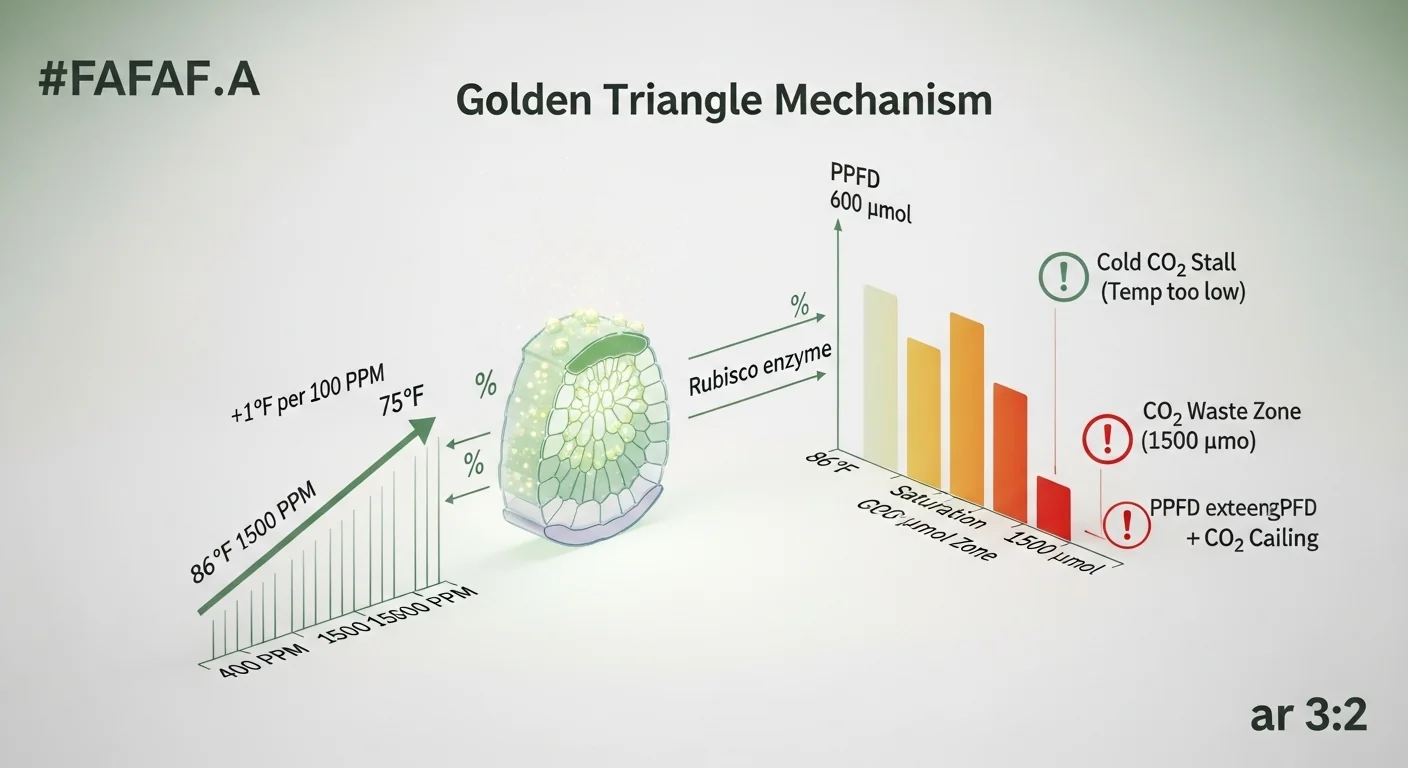
Show the calculation steps
Step 1: Optimal Temperature
The formula treats 400 PPM as the CO2 baseline at which standard enzymatic function applies, with 75°F as the corresponding baseline optimal canopy temperature.
Formula: Optimal Temp (°F) = 75 + ((CO2_PPM - 400) x 0.01)
Each 100 PPM increase above ambient shifts the enzymatic optimum by 1°F. At 1,500 PPM, that is an 11°F shift above baseline. At 2,000 PPM, 16°F. Round all intermediate values to one decimal place.
Step 2: Maximum PPFD Utilization
At or below 400 PPM, the photosynthetic light saturation point for most C3 crops under standard enzymatic conditions is treated as 600 μmol/m²/s. Above 400 PPM, the formula scales linearly: Max PPFD = CO2_PPM x 1.0, capped at 2,000 μmol/m²/s. No unit conversion is required; both inputs are already in compatible units.
Step 3: Temperature Delta
Delta = Current Canopy Temp (°F) - Optimal Temp (°F). Negative values indicate the environment is cooler than enzymatic demand requires. Positive values indicate excess heat. The delta is signed: a delta of -8 is meaningfully different from +8 in terms of which corrective action applies.
Step 4: Light Utilization Ratio
Ratio = (Input PPFD / Max PPFD Utilization) x 100. Values above 110 trigger the CO2 Waste Zone warning. Values between 80 and 100 represent the target utilization band. Ratio is rounded to one decimal place for display.
Step 5: Metabolic Efficiency Score
Light Score = min(Light Utilization Ratio, 100). Temperature Penalty = min(|Temperature Delta| x 3, 40). Final Score = Light Score - Temperature Penalty, floored at 0 and capped at 100. The penalty function is asymmetric: every 1°F of temperature misalignment costs 3 efficiency points, up to a maximum penalty of 40 points. This is a model heuristic, not a biochemical constant.
Assumptions and Limits
- The model assumes C3 photosynthesis. C4 crops (corn, sugarcane, sorghum) have different CO2 affinity and temperature optima; this tool should not be applied to them without adjustment.
- The linear temperature-CO2 relationship (0.01°F per PPM) is a simplification. Real enzymatic response curves are sigmoidal and begin showing diminishing returns above approximately 90°F regardless of CO2 level.
- The max PPFD scaling formula (CO2 x 1.0) is a linear approximation. Actual light saturation curves are sigmoidal and crop-specific. High-light-adapted cultivars may tolerate higher PPFD at a given CO2 level than this model predicts.
- The model does not account for vapor pressure deficit. VPD affects stomatal conductance and CO2 uptake independently of the three variables modeled here. A correct temperature increase that creates an unacceptable VPD will suppress the expected gains.
- CO2 levels above 2,000 PPM show diminishing photosynthetic returns and create significant air quality concerns. The tool generates a warning above 2,000 PPM but does not model the diminishing-returns curve in detail.
- Temperature inputs should reflect true canopy air temperature, not the HVAC setpoint, room ambient average, or leaf surface temperature (which is influenced by transpiration and can be 2 to 4°F cooler than canopy air under high-intensity lighting).
- The 3-point-per-degree temperature penalty in the Metabolic Efficiency Score is a model heuristic calibrated to produce useful decision signals, not a biochemically validated constant. Use the score as a directional indicator, not a quantitative yield predictor.
- Sensor calibration errors in CO2 or temperature instruments directly propagate into all outputs. NDIR sensors require periodic factory calibration; thermocouple probes drift over time. Input accuracy is the primary source of error in real-world use.
Standards, Safety Checks, and "Secret Sauce" Warnings
Critical Warnings
- Cold CO2 Stall (CO2 above 1,200 PPM, canopy temperature below 80°F): The Rubisco enzyme complex that catalyzes CO2 fixation is temperature-sensitive. At 1,500 PPM CO2 and 75°F, the enzyme pool cannot process CO2 at the rate the concentration makes available. The CO2 gas is present; the metabolic pathway to convert it is rate-limited by cold. The tool triggers this warning when CO2 is at or above 1,200 PPM and canopy temperature is at or below 78°F. The fix is thermal management, not additional CO2.
- CO2 Waste Zone (PPFD above 600 μmol/m²/s, CO2 at or above 1,200 PPM, Light Utilization Ratio above 110): Plants absorb light only as fast as CO2 fixation can consume the products of the light reactions. When PPFD exceeds the CO2-determined ceiling, excess photons convert to heat through non-photochemical quenching rather than producing assimilates. The tool detects this as a light-to-CO2 mismatch. Reducing PPFD or raising CO2 closes the gap; doing neither means paying for light infrastructure that delivers heat, not yield.
- High Temperature Stress (canopy temperature above 92°F): Even with CO2 PPM that would theoretically demand temperatures in this range, heat denaturation of photosynthetic proteins and enzyme complexes begins above approximately 92°F for most C3 crops. The tool generates a warning but does not model the denaturation rate. If CO2 enrichment is driving a temperature requirement above 90°F, improving room insulation, CO2 delivery efficiency, and lighting heat management are more productive pathways than simply raising the thermostat.
Minimum Standards
- For any CO2 enrichment above 1,000 PPM to produce a measurable metabolic benefit, canopy air temperature must be brought to within 3°F of the computed Optimal Temperature. Anything outside that window means enrichment cost exceeds metabolic return.
- CO2 sensing must use NDIR technology. Electrochemical and metal-oxide semiconductor CO2 sensors are not accurate enough for high-enrichment environments and produce readings that can be 100 to 300 PPM off, which translates directly to incorrect optimal temperature targets from this tool.
- PPFD should be measured with a spectrally calibrated quantum PAR meter, not estimated from fixture wattage or lumen output. The relationship between wattage and PPFD varies significantly by LED spectrum, fixture design, mounting height, and reflectance. A miscalibrated PPFD input produces a meaningless Light Utilization Ratio. Growers who already apply this discipline to tasks like calibrating rotational equipment for consistent field coverage understand that input precision gates output reliability.
Competitor Trap: Most grow room guides publish a single "optimal temperature for CO2 enrichment" figure, typically in the range of 82 to 86 degrees Fahrenheit, without explaining that this figure only applies to a specific CO2 concentration. A grower running 800 PPM and targeting 86°F is actually running 7 degrees above the enzymatic optimum for that CO2 level, which introduces avoidable heat stress. A grower running 1,500 PPM and targeting 82°F is running 4 degrees below their enzymatic requirement, which produces Cold CO2 Stall. The optimal temperature is not a constant. It is a function of CO2 PPM. Any resource that treats it as a fixed number is missing the core mechanism of the Golden Triangle relationship.
Common Mistakes and Fixes
Mistake: Locking the Thermostat at 75°F While Running High CO2
The 75°F "standard grow temperature" originates from ambient-CO2 growing conditions where enzyme demand does not require supplemental heat. When CO2 enrichment is added above 800 PPM, the enzymatic throughput demand increases and 75°F becomes a metabolic bottleneck rather than an optimum. The canopy enzymes are trying to run a higher-throughput process at a temperature set for a lower gear.
Fix: Recalculate optimal temperature every time CO2 set points change. The formula is straightforward: 75 + ((CO2_PPM - 400) x 0.01). Run this tool anytime you adjust your CO2 regime.
Mistake: Measuring CO2 at Floor Level or from a Wall-Mounted Sensor
CO2 is denser than air at standard conditions and stratifies toward lower elevations in still or low-airflow environments. A sensor mounted at 5 feet when the canopy is at 3 feet can read 50 to 150 PPM lower than the actual canopy concentration, depending on mixing. Entering an underestimated CO2 value into this tool generates a lower-than-actual Optimal Temperature recommendation, and your real canopy environment will be operating at conditions colder than the tool believes necessary.
Precision calibration matters in field applications as well. Growers who apply rigorous measurement discipline to equipment like seed drill calibration recognize that sensor placement errors compound into systematic output errors. Fix: Position your CO2 NDIR sensor at canopy height and ensure adequate horizontal airflow to prevent stratification pockets.
Mistake: Raising PPFD Without Raising CO2 to Match
Upgrading lighting intensity without increasing CO2 enrichment to match the new PPFD ceiling is one of the most common efficiency losses in indoor growing. At 400 PPM ambient CO2, the photosynthetic saturation point for most C3 plants is approximately 600 μmol/m²/s. Running 1,200 μmol/m²/s at ambient CO2 means roughly half the light investment is producing heat rather than photosynthesis.
Fix: Before any PPFD upgrade, calculate the CO2 level and canopy temperature required to utilize the new light intensity. The Max PPFD Utilization output from this tool gives that threshold directly.
Mistake: Treating the Metabolic Efficiency Score as a Yield Predictor
The score is a directional indicator of Golden Triangle alignment. It does not account for VPD, rootzone temperature, nutrient availability, genetics, or disease pressure, all of which independently cap yield potential. A score of 95 in a room with unmanaged VPD or a root disease can still produce a poor outcome. Conversely, a room at 80 efficiency score with excellent husbandry across all other variables can outperform a room at 95 with neglected fundamentals.
Fix: Use the score to identify and correct the biggest efficiency gap (temperature, CO2, or PPFD) first. Then address secondary limiting factors in order of their actual impact on your specific crop.
Mistake: Running Maximum CO2 Enrichment for the Full Light Cycle
CO2 fixation only occurs during the light-dependent reactions of photosynthesis. Maintaining high CO2 enrichment during dark periods wastes CO2 and can suppress natural ethylene signaling in some crops. Additionally, CO2 demand is not uniform across the light period; it peaks mid-session when enzymatic activity is at its highest. Continuous maximum enrichment with no cycling logic means CO2 is present and wasted during suboptimal uptake windows.
Fix: Use an environmental controller that modulates CO2 injection based on time-of-day, measured CO2 depletion rate, and light status. This is the core function of dedicated controllers designed for CO2 regulation in enriched environments.
Next Steps in Your Workflow
Once the tool confirms your Golden Triangle alignment or identifies a specific gap, the next decision is how to close that gap with the least intervention. Temperature adjustments are often the highest-leverage correction because they require no additional CO2 cost: a dual-hose portable AC unit running independently of the room HVAC can raise canopy zone temperature by 4 to 8°F with precise control. If the issue is a CO2-to-PPFD mismatch, the corrective path branches based on which direction you adjust. Raising CO2 to meet PPFD requires sealing the room, upgrading your CO2 distribution manifold, and adding a calibrated NDIR monitor. Lowering PPFD to meet CO2 capacity simply means adjusting fixture dimming or raising mounting height, which costs nothing. Run both scenarios in the tool before committing to equipment purchases. The efficiency delta between the two options will be visible immediately. For growers managing multiple environmental systems across production areas, the same measurement-first discipline applies to mechanical equipment: understanding your actual performance baseline before optimizing is foundational, whether you are calibrating a sprayer or dialing in a CO2 regime. Growers managing tractor-integrated field equipment can apply the same logic using a resource like the drawbar horsepower calculator to verify that power delivery matches implement demand before tuning field run parameters.
After establishing your optimal Golden Triangle conditions, the next layer of optimization is VPD management. Raising canopy temperature to match CO2 demand will typically increase VPD if relative humidity is not adjusted to compensate. Target a VPD range of 1.0 to 1.5 kPa during active vegetative growth and 1.2 to 1.8 kPa during late bloom for most C3 crops. Running this tool alongside a separate VPD calculator gives a complete environmental picture. Growers who apply calibration-first thinking to all operational parameters, including ground-drive field applications with tools like the tractor ground speed calculator, recognize the same principle: each variable interacts with others, and optimizing one in isolation without checking adjacent effects creates new inefficiencies.
FAQ
What is the "Cold CO2 Stall" and how does it affect yield?
The Cold CO2 Stall occurs when CO2 PPM is elevated above 1,000 to 1,200 PPM but canopy temperature remains at or near the ambient-CO2 optimum of 75°F. The Rubisco enzyme complex responsible for carbon fixation operates at a rate proportional to temperature. At high CO2 concentrations, enzymatic demand increases but cold temperatures prevent the reaction from running at speed. CO2 is present but metabolically inaccessible. The practical outcome is spending on CO2 enrichment infrastructure while recovering little to no yield benefit from it.
Why does the optimal temperature increase with CO2 level?
At higher CO2 concentrations, the rate of carbon fixation in the Calvin cycle increases, creating higher demand for enzymatic throughput. Rubisco and the downstream enzymes in the cycle perform more reactions per unit time, which is a temperature-dependent process. Warmer temperatures allow enzyme conformational flexibility and reaction kinetics to keep pace with the increased CO2 substrate availability. The linear approximation used in this tool (0.01°F per PPM above 400) reflects this relationship in a tractable form for practical growing decisions.
Is the Metabolic Efficiency Score a reliable yield predictor?
No. The score quantifies alignment between CO2 concentration, canopy temperature, and PPFD supply. It does not account for VPD, rootzone conditions, genetics, pest pressure, nutrient status, or any other yield-limiting variable. A score of 100 confirms that the Golden Triangle relationship is correctly calibrated; it does not guarantee a specific yield outcome. Use the score as a diagnostic trigger for identifying which of the three primary variables is the largest limiting factor in your current setup.
Can I use this tool for C4 plants like corn or sugarcane?
This tool is calibrated for C3 photosynthesis, which covers most vegetable and specialty crops grown in controlled environments. C4 plants use a different carbon-concentrating mechanism that reduces their sensitivity to atmospheric CO2 and changes their temperature-CO2 relationship significantly. Applying C3-derived formulas to C4 crops will produce incorrect optimal temperature recommendations and should be avoided.
What CO2 sensor type is required for accurate results?
Non-dispersive infrared (NDIR) sensors are the appropriate technology for accurate CO2 measurement in enriched grow environments. Electrochemical sensors and metal-oxide semiconductor (MOS) sensors drift significantly over time, are sensitive to humidity and other gases, and routinely produce readings that are 100 to 300 PPM off in enriched environments. That magnitude of error produces meaningfully incorrect Optimal Temperature outputs from this tool. Calibrate NDIR sensors according to manufacturer schedules, typically every 6 to 12 months.
What happens to plants at CO2 levels above 2,000 PPM?
Above 2,000 PPM, the photosynthetic CO2 response curve for most C3 crops flattens significantly, meaning additional CO2 provides diminishing returns on carbon fixation rate. Additionally, the temperature required to enzymatically process very high CO2 concentrations (above 91°F at 2,000 PPM per this tool's formula) approaches the heat stress threshold for most crops. CO2 above 2,000 PPM in an occupied or poorly sealed space also poses air quality concerns. The tool generates a warning above 2,000 PPM but does not model the diminishing-returns curve in detail.
Conclusion
The temperature CO2 light calculator makes visible a relationship that is easy to spend money on without understanding: CO2 enrichment produces metabolic benefit only when canopy temperature is within the enzymatic operating window for that CO2 concentration. Pump 1,500 PPM into a room at 75°F and the gas circulates unused. The Cold CO2 Stall is the most expensive single mistake in controlled environment agriculture precisely because it costs money on two fronts simultaneously: CO2 infrastructure and the HVAC suppressing the temperature that would unlock it. This tool converts that invisible relationship into a five-output diagnostic in under a minute.
The single most important thing to avoid after using this tool is treating the optimal temperature output as an approximation. It is a calculated target, not a ballpark. A 3°F miss at 1,200 PPM CO2 costs 9 points on the Metabolic Efficiency Score by the tool's own penalty function. Run the calculator before committing to any CO2 enrichment configuration change, and recalculate whenever CO2 set points, fixture intensity, or seasonal temperature conditions shift. For growers calibrating the full production system across multiple equipment types and environments, a disciplined measurement-first approach across all variables, from field implements to indoor climate, is the foundation for predictable outcomes. The cultivator sweep overlap calculator applies the same principle to field bed preparation: get the inputs right, and the output follows.