
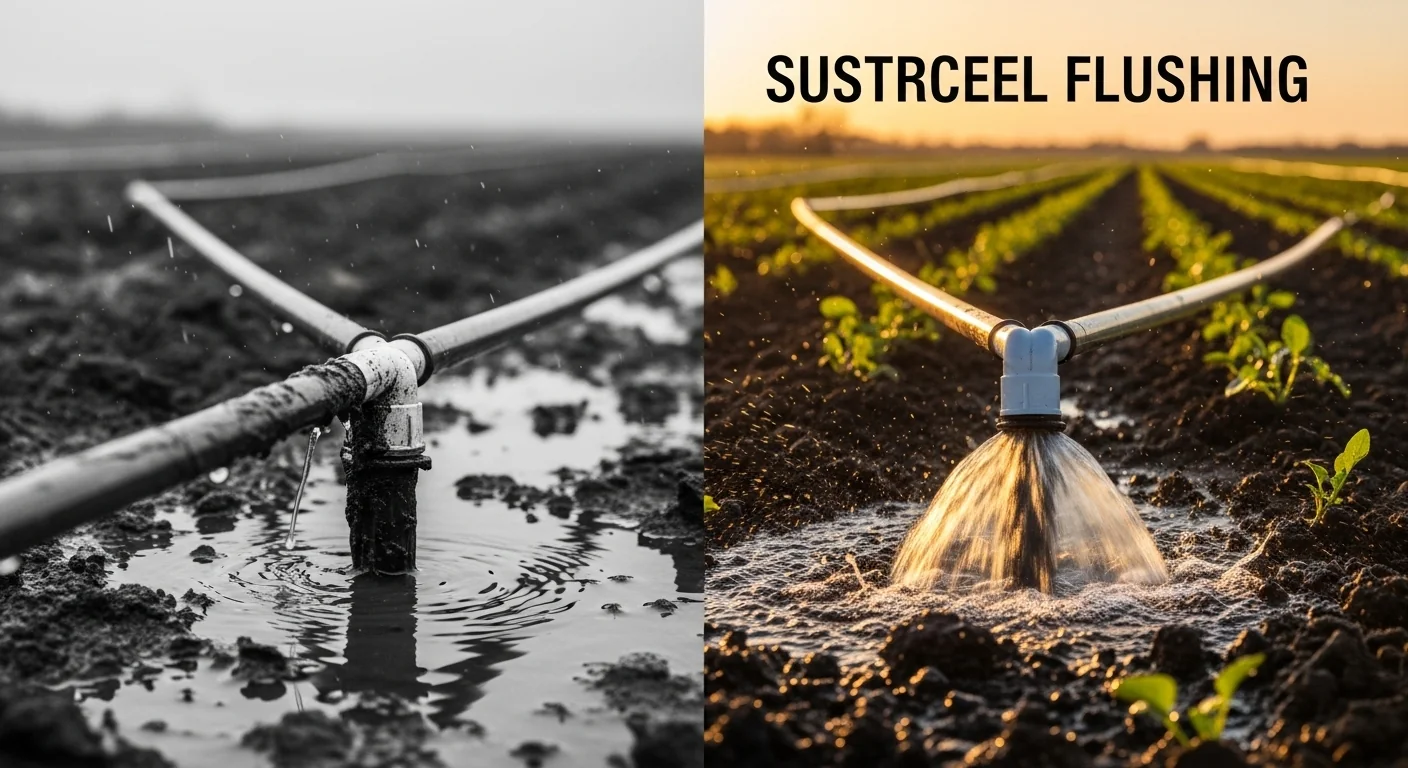
Every drip irrigation system accumulates silt, algae, and biofilm inside the tape over time. The standard fix is to open the end caps and flush the laterals. What most growers do not account for is that flushing requires a fundamentally different flow rate than irrigation does. If your header pipe was sized only to supply watering GPM, opening the end caps causes system pressure to drop sharply, reducing velocity below the threshold needed to carry debris out. The sludge stays in the tape. The clog worsens each season.
This drip tape flush velocity calculator determines how much flow your header manifold must deliver to achieve a 1.5 ft/s velocity inside each lateral during flushing, then compares that figure against your normal watering demand. It outputs the larger of the two values as your required header GPM and recommends a PVC pipe size accordingly. The tool does not account for elevation changes, friction loss through the manifold itself, or pressure at the pump. Those are separate calculations that depend on your site-specific layout. For context on how total drip irrigation run times and system flow interact, that calculator covers the scheduling side of the equation.
After using this tool, you will know whether your existing or planned header pipe can support effective flushing. If flush demand exceeds watering demand, your pipe must be upsized before the first field season or flushing will be cosmetic at best.
Use the Tool
Drip Tape Flush Velocity & Header Sizing Calculator
Prevent end-of-line sludge clogs — size your manifold for both watering AND flush velocity
| Tape ID (in) | 100 ft lateral | 200 ft lateral | 300 ft lateral | Status at 1.5 ft/s |
|---|
How This Calculator Works — Formula & Steps
This tool solves the “End-of-Line Sludge” problem in drip irrigation. Commercial growers often size their header pipe only for watering flow. But when you open the end caps to flush, pressure collapses and sludge stays put. The fix: size the header for the flushing demand, not just watering demand.
Step 1 — Cross-sectional area of one lateral:
→ Converts diameter from inches to feet, then calculates pipe area
Step 2 — Flush GPM required per lateral:
→ 1.5 ft/s is the minimum velocity to carry silt and algae to the end cap
→ 448.8 converts ft³/s to GPM (1 ft³/s = 448.83 GPM)
Step 3 — Total flush demand (all laterals open simultaneously):
Step 4 — Normal watering demand:
→ Converts GPH/100ft to GPM, scaled by actual length and lateral count
Step 5 — Required header capacity:
→ Size your manifold/header pipe for the LARGER of these two demands
→ Typical PVC schedule 40 velocity limits: 4–5 ft/s; size up if needed
Assumes all laterals flush simultaneously (worst case, recommended for safe design). Water temperature assumed 60–70°F. Emitter flow rates from manufacturer specs at rated pressure.
Assumptions & Limits
- Flush velocity target: 1.5 ft/s is the industry minimum to mobilize fine particulates and biofilm in drip tape. Some extension programs recommend up to 2.0 ft/s for heavily silted systems.
- Simultaneous flushing: This calculator assumes all laterals are flushed at once. If you flush in zones, multiply per-zone results instead of the full count.
- Uniform laterals: All laterals are assumed equal in length, diameter, and emitter spacing. For mixed systems, run the calculator per zone.
- Emitter GPH per 100 ft: Use the manufacturer’s specification at your operating pressure. Actual flow varies with pressure — confirm with a bucket test if uncertain.
- Header pipe velocity: After determining header GPM, verify that your chosen pipe size keeps velocity below 5 ft/s (schedule 40 PVC). Use a pipe flow chart or your irrigation supplier’s sizing table.
- Elevation and friction: This calculator does not account for elevation changes or friction losses in the header. For systems over 500 ft or with significant elevation change, consult a certified irrigation designer.
- Units: All inputs in US customary units (inches, feet, GPH/GPM). For metric systems, convert inputs before entering.
Recommended Products for Proper Flushing
Before entering values, have your drip tape specification sheet available. You will need the tape’s inside diameter (not outside diameter), the emitter flow rate in gallons per hour per 100 feet of tape, and the measured or planned length of your laterals from header connection to end cap. Lateral count should reflect how many lines connect to a single header zone that will flush simultaneously.
Quick Start (60 Seconds)
- Number of drip tape laterals: Count only the lines in one flushing zone. If your field has 120 rows but you flush 40 at a time, enter 40, not 120.
- Inside diameter of tape: Use the tape’s ID, not the nominal size stamped on the label. A tape labeled “5/8 inch” typically has an ID of 0.520 inches. Pull the spec sheet or measure with calipers.
- Custom diameter field: If your tape is not in the dropdown, select “Custom” and enter the ID in decimal inches (for example, 0.580). Do not convert to millimeters; the calculator uses inches.
- Emitter flow rate (GPH per 100 ft): This is a per-100-foot rate from the manufacturer, not a per-emitter rate. Confirm the figure matches your operating pressure.
- Length of laterals (ft): Measure from the header punch to the physical end cap. Do not estimate. An error of 50 feet on a 200-foot run changes watering GPM by 25%.
- Units throughout: All inputs are US customary. Inches for diameter, feet for length, GPH for emitter rate. There is no metric conversion built in.
- Run the calculation before assuming your current pipe is fine: Systems with high lateral counts and narrow tape often require more flow for flushing than for irrigation, which surprises most growers on first use.
Inputs and Outputs (What Each Field Means)
| Field | Unit | What it Measures | Common Mistake | Safe Entry Guidance |
|---|---|---|---|---|
| Number of Drip Tape Laterals | Count (integer) | How many lateral lines will flush simultaneously from one header zone | Entering total field rows instead of rows per flush zone | Enter 1 to 5000; whole numbers only |
| Inside Diameter of Tape | Inches (decimal) | The internal bore of the drip tape, which determines cross-sectional area and required flush flow | Using nominal size (7/8″) instead of actual measured ID (0.710″) | Use manufacturer spec sheet; select “Custom” if not listed |
| Emitter Flow Rate | GPH per 100 ft | Total emitter output per 100 feet of tape at rated operating pressure | Entering per-emitter GPH instead of per-100-ft aggregate flow | Verify against spec sheet; confirm operating pressure matches rated pressure |
| Length of Laterals | Feet | Physical run length of one lateral from header punch to end cap | Measuring bed length rather than actual tape run; forgetting header offset | Measure tape length, not bed centerline; enter 1 to 10,000 ft |
| Flush GPM per Lateral (output) | GPM | Flow required through one lateral to achieve 1.5 ft/s velocity based on inside diameter | Assuming this value is negligible for small-diameter tape | Read-only result; determined by tape ID and the 1.5 ft/s standard |
| Total Flush GPM (output) | GPM | Combined flush demand across all laterals in the zone, all flushing simultaneously | Assuming partial flushing is sufficient for sludge removal | Read-only; scales linearly with lateral count |
| Watering GPM (output) | GPM | Total flow required to irrigate all laterals at normal emitter output | Treating this as the only value the header needs to handle | Read-only; the calculator compares this against flush demand automatically |
| Required Header GPM (output) | GPM | The larger of total flush GPM and total watering GPM; this is what your manifold pipe must carry | Sizing the manifold only to watering GPM and ignoring this output | Read-only; use this value to select manifold pipe diameter |
Worked Examples (Real Numbers)
Example 1: Small Market Garden with 5/8″ Tape
- Number of laterals: 20
- Tape inside diameter: 0.520 inches (5/8″ standard)
- Emitter flow rate: 34 GPH per 100 ft
- Lateral length: 200 ft
Cross-sectional area = 3.1416 x (0.520 / 2 / 12)² = 0.001474 ft²
Flush GPM per lateral = 1.5 x 0.001474 x 448.83 = 0.99 GPM/line
Total flush demand = 0.99 x 20 = 19.8 GPM
Watering GPM per lateral = (34 / 60) x (200 / 100) = 1.133 GPM/line
Total watering = 1.133 x 20 = 22.7 GPM
Result: Header GPM = 22.7 GPM (watering demand drives sizing). Recommended pipe: 1-1/4″ Schedule 40 PVC.
In this small system, normal irrigation flow exceeds flush demand. The header pipe selected for watering will incidentally satisfy flush velocity requirements. This is the best-case scenario but cannot be assumed without running the numbers.
Example 2: Commercial Row Crop Operation with 7/8″ Tape and High Lateral Count
- Number of laterals: 100
- Tape inside diameter: 0.710 inches (7/8″ standard)
- Emitter flow rate: 12 GPH per 100 ft
- Lateral length: 100 ft
Cross-sectional area = 3.1416 x (0.710 / 2 / 12)² = 0.002749 ft²
Flush GPM per lateral = 1.5 x 0.002749 x 448.83 = 1.85 GPM/line
Total flush demand = 1.85 x 100 = 185.0 GPM
Watering GPM per lateral = (12 / 60) x (100 / 100) = 0.200 GPM/line
Total watering = 0.200 x 100 = 20.0 GPM
Result: Header GPM = 185.0 GPM (flush demand drives sizing at 9.25x watering demand). Recommended pipe: 3″ Schedule 40 PVC.
This scenario illustrates the critical failure mode. A grower who sized the header for watering only would install a pipe capable of 20 GPM. When end caps are opened for flushing, that pipe cannot supply 185 GPM, pressure drops to near zero, and sludge accumulation continues unchecked.
Example 3: T-Tape 515 Strawberry Operation, Medium Zone
- Number of laterals: 50
- Tape inside diameter: 0.595 inches (T-Tape 515)
- Emitter flow rate: 45 GPH per 100 ft
- Lateral length: 300 ft
Cross-sectional area = 3.1416 x (0.595 / 2 / 12)² = 0.001931 ft²
Flush GPM per lateral = 1.5 x 0.001931 x 448.83 = 1.30 GPM/line
Total flush demand = 1.30 x 50 = 65.0 GPM
Watering GPM per lateral = (45 / 60) x (300 / 100) = 2.25 GPM/line
Total watering = 2.25 x 50 = 112.5 GPM
Result: Header GPM = 112.5 GPM (watering demand drives sizing). Recommended pipe: 2″ Schedule 40 PVC.
High-flow emitters at long lateral lengths produce significant watering demand that overshadows flush requirements. The 2″ pipe sized for irrigation will comfortably deliver adequate flush velocity when end caps are opened.
Reference Table (Fast Lookup)
All flush GPM values are computed from the 1.5 ft/s standard and the tape’s inside diameter. Pipe recommendations are based on Schedule 40 PVC carrying the stated flow at velocities below 5 ft/s.
| Tape Type | ID (inches) | Flush GPM per Lateral | 10 Laterals (Total Flush) | 25 Laterals (Total Flush) | 50 Laterals (Total Flush) | 100 Laterals (Total Flush) | Rec. Pipe (100 Laterals) |
|---|---|---|---|---|---|---|---|
| 5/8″ Standard | 0.520 | 0.99 GPM | 9.9 GPM | 24.8 GPM | 49.6 GPM | 99.2 GPM | 2″ SCH40 PVC |
| T-Tape 515 | 0.595 | 1.30 GPM | 13.0 GPM | 32.5 GPM | 65.0 GPM | 130.1 GPM | 2.5″ SCH40 PVC |
| T-Tape 508 | 0.625 | 1.43 GPM | 14.3 GPM | 35.8 GPM | 71.7 GPM | 143.4 GPM | 3″ SCH40 PVC |
| 7/8″ Standard | 0.710 | 1.85 GPM | 18.5 GPM | 46.3 GPM | 92.5 GPM | 185.0 GPM | 3″ SCH40 PVC |
| 5/8″ Standard | 0.520 | 0.99 GPM | 9.9 GPM | 24.8 GPM | 49.6 GPM | 99.2 GPM | 2″ SCH40 PVC |
| 7/8″ Standard | 0.710 | 1.85 GPM | 18.5 GPM | 46.3 GPM | 92.5 GPM | 185.0 GPM | 3″ SCH40 PVC |
| T-Tape 515 (zone flush) | 0.595 | 1.30 GPM | 13.0 GPM | 32.5 GPM | 65.0 GPM | 130.1 GPM | 2.5″ SCH40 PVC |
| T-Tape 508 (zone flush) | 0.625 | 1.43 GPM | 14.3 GPM | 35.8 GPM | 71.7 GPM | 143.4 GPM | 3″ SCH40 PVC |
| 5/8″ (large zone) | 0.520 | 0.99 GPM | 9.9 GPM | 24.8 GPM | 49.6 GPM | 99.2 GPM | 2″ SCH40 PVC |
| 7/8″ (large zone) | 0.710 | 1.85 GPM | 18.5 GPM | 46.3 GPM | 92.5 GPM | 185.0 GPM | 3″ SCH40 PVC |
Note: Flush GPM per lateral is independent of lateral length. Length affects watering demand only. A longer lateral does not require more flush flow to achieve 1.5 ft/s; it simply requires that velocity for longer before the tape is fully purged.
How the Calculation Works (Formula and Assumptions)
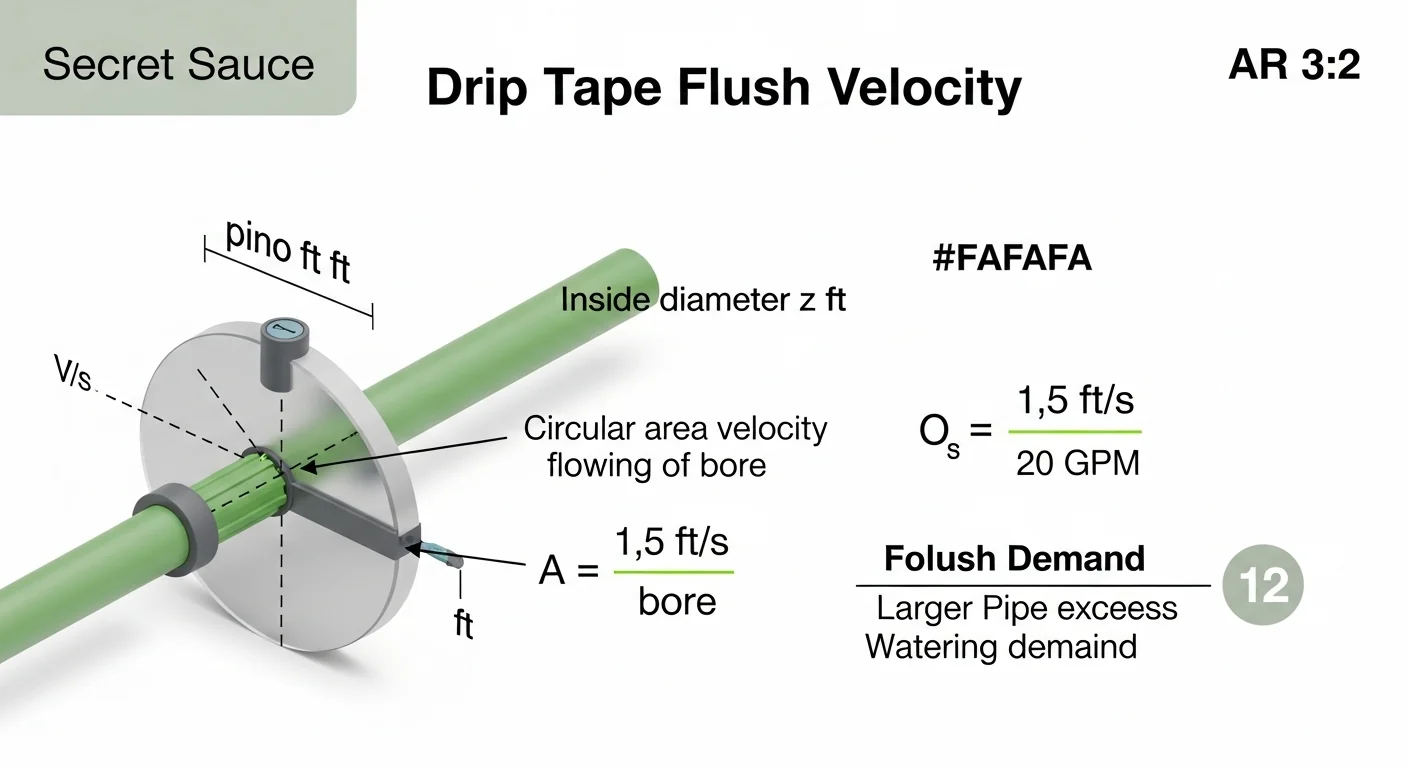
Show the calculation steps
Step 1: Cross-sectional area of the tape bore
The inside diameter is converted from inches to feet by dividing by 12. The radius is half the diameter. Area is calculated using the circle area formula:
Area (ft²) = pi x (ID_inches / 2 / 12)²
Example with 0.520″ ID: Area = 3.14159 x (0.02167)² = 0.001474 ft²
Step 2: Required flush flow per lateral
The velocity equation rearranges to flow rate. At 1.5 ft/s, the volumetric flow in ft³/s is 1.5 x Area. The conversion factor 448.83 converts ft³/s to US gallons per minute:
Flush_GPM_per_line = 1.5 x Area (ft²) x 448.83
Step 3: Total flush demand
Multiplies per-lateral flush flow by the number of laterals flushing simultaneously:
Total_Flush_GPM = Flush_GPM_per_line x Number_of_Laterals
Step 4: Watering demand
The emitter rate in GPH per 100 ft is divided by 60 to convert to GPM per 100 ft, then scaled by actual length:
Watering_GPM_per_line = (Emitter_GPH_per_100ft / 60) x (Lateral_Length / 100)
Total_Watering_GPM = Watering_GPM_per_line x Number_of_Laterals
Step 5: Header sizing
Header_GPM = max(Total_Flush_GPM, Total_Watering_GPM)
The manifold pipe must carry whichever value is larger. Pipe size recommendations are based on Schedule 40 PVC velocity limits (4 to 5 ft/s maximum).
Rounding rule: Flush GPM per lateral is rounded to two decimal places for display. Total values under 10 GPM are shown to two decimal places; values of 10 or above are shown to one decimal place.
Assumptions and Limits
- The 1.5 ft/s velocity target is the widely cited minimum for mobilizing silt and biofilm in drip tape. Some cooperative extension guidelines cite 2.0 ft/s for heavily silted systems or recycled water sources. This calculator uses the more conservative 1.5 ft/s. If your water source has high suspended solids, consider applying a manual safety factor.
- All laterals are assumed identical in length, inside diameter, and emitter spacing. Mixed-diameter or mixed-length systems require separate calculations per zone.
- All laterals in the entered count are assumed to flush simultaneously. Zone-flushing scenarios (flushing a subset at a time) should use the actual count per simultaneous flush event.
- Emitter flow rate is taken as a constant from the manufacturer’s spec at rated pressure. Actual output varies with operating pressure, temperature, emitter age, and partial clogging. A bucket test or catch-can verification is more accurate than relying solely on the spec sheet value. The irrigation catch-can test calculator can help quantify actual distribution uniformity in the field.
- This calculator does not account for friction loss through the header itself, elevation change, or pump curve constraints. After determining required header GPM, a separate friction loss analysis is needed to confirm adequate pressure at the farthest lateral during flushing.
- The conversion factor 448.83 is exact for US gallons (1 ft³/s = 448.83 US GPM). Do not substitute Imperial gallons or liters per minute without converting inputs first.
- Pipe size recommendations are conservative estimates based on typical Schedule 40 PVC velocity limits. Always verify with a friction loss table for your specific pipe material and layout geometry.
Standards, Safety Checks, and “Secret Sauce” Warnings
Critical Warnings
- Pressure collapse at flush: When end caps are opened on a header sized only for watering GPM, the sudden drop in system resistance causes pressure to fall sharply. Flow velocity inside the tape drops well below 1.5 ft/s. The sludge does not move. Opening the end caps without adequate header flow accomplishes nothing except wasting water and creating a false sense of maintenance completion.
- Compounding clog cycles: Biofilm and fine sediment do not flush out in particle-by-particle increments. Velocity must exceed the mobilization threshold across the entire lateral simultaneously. Repeated inadequate flushing allows layers to consolidate. After two or three seasons of ineffective flushing, emitter orifices can become permanently restricted and the tape requires replacement.
- Filter sizing must precede header sizing: A 120-mesh disc filter upstream of the header reduces particulate load in the tape. But if the filter is undersized for flush GPM, it will restrict flow during the flush event and prevent velocity from reaching 1.5 ft/s even if the header pipe is correctly sized. Verify filter capacity against the required Header GPM from this calculator.
- Surge pressure at flush initiation: Rapidly opening multiple end caps simultaneously on a pressurized system can create a hydraulic surge. For systems with long headers or high static pressure, staged opening of end caps is advisable. The water hammer calculator can quantify surge risk before field flushing procedures are finalized.
Minimum Standards
- Minimum flush velocity: 1.5 ft/s inside the drip tape lateral (measured or calculated at the tape bore, not the header).
- Recommended filter mesh for drip tape systems: 120 mesh (125 micron) minimum. Coarser filters allow particles large enough to bridge emitter orifices to pass through.
- Header pipe velocity should not exceed 5 ft/s during any operating mode (watering or flushing) to avoid unacceptable friction loss and noise in Schedule 40 PVC systems.
- Flush events should be conducted at the start of the irrigation season, at the end, and after any known water quality event (turbidity spike, algae bloom, pump failure). Annual flushing is insufficient for high-solid-load water sources.
Competitor Trap: Most drip irrigation sizing guides and online tools stop at calculating watering GPM and pipe size for delivery. They treat flushing as an afterthought and do not model the velocity physics inside the tape bore. The result is that a grower can correctly design an entire system for uniform water distribution and still end up with a header pipe that is incapable of flushing. This calculator solves the problem that competing resources do not frame correctly: flush demand and watering demand are independent requirements that must both be satisfied by the same pipe. Confirm your header pipe can handle the flushing demand identified here before finalizing any manifold design. Then use the PVC friction loss calculator to verify pressure at the end of your header remains adequate when carrying that peak flush flow.
Common Mistakes and Fixes
Mistake: Sizing the Header Manifold for Watering GPM Only
This is the most common and costly error in drip system design. Watering demand is calculated from emitter output, which is often far lower than flush demand for systems with many laterals and narrow tape. A 2″ pipe that delivers watering GPM perfectly may carry only a fraction of the flow needed to achieve 1.5 ft/s during flushing.
Fix: Run this calculator before finalizing any manifold pipe purchase. Use the Required Header GPM output as your pipe sizing input, not the watering demand figure alone.
Mistake: Using Nominal Tape Size Instead of Measured Inside Diameter
Drip tape is sold by nominal size (5/8″, 7/8″), but the actual inside diameter varies by manufacturer and product line. Two tapes labeled 5/8″ from different suppliers may have inside diameters that differ by 0.050 inches or more. Because cross-sectional area scales with the square of the radius, a small ID error creates a meaningful error in calculated flush GPM per lateral.
Fix: Obtain the actual inside diameter from the manufacturer’s product spec sheet. If unavailable, use calipers on a tape sample. Enter the measured value using the custom diameter option in the calculator.
Mistake: Entering Total Field Rows Instead of Rows per Flush Zone
A field with 200 lateral rows rarely flushes all 200 simultaneously. Flush zones are typically subdivided to stay within pump capacity. Entering the full field count produces a header GPM figure that may be unrealistically high for the actual flush event and lead to oversizing.
Fix: Determine how many laterals flush simultaneously in a single zone. Enter that zone count. For gravity-fed systems with variable head pressure, the gravity-fed drip irrigation calculator can help identify flow limits before zone counts are finalized.
Mistake: Treating Emitter GPH per 100 ft as a per-Emitter Rate
Manufacturers typically publish emitter flow rates as an aggregate per 100 feet of tape, which already accounts for emitter spacing. If a user confuses this with a per-emitter rate and multiplies by emitter count, the watering GPM figure will be dramatically overstated, which can cause the calculator to falsely show that flush demand is not the limiting factor.
Fix: Confirm that the emitter flow rate entered represents total output per 100 feet of tape, not output from a single emitter. The spec sheet will typically state “GPH per 100 ft” or “L/h per 100 m.” If only a per-emitter rate is available, multiply by emitters per 100 ft to derive the aggregate figure.
Mistake: Skipping Friction Loss Verification After Getting Header GPM
This calculator outputs the flow rate the header must carry. It does not determine whether the pipe can maintain adequate pressure over its length at that flow rate. A 3″ pipe at 180 GPM over 500 feet of run will experience significant friction loss, potentially dropping pressure below what the laterals require for proper flushing velocity at the far end.
Fix: After determining Required Header GPM from this tool, use a friction loss calculator to verify pressure adequacy at the hydraulically most remote lateral. The pipe volume calculator can also help estimate priming time and total system water volume for larger header pipe selections.
Next Steps in Your Workflow
Once you have the Required Header GPM figure, the immediate next step is pipe selection. Cross-reference the recommended pipe size with your local supplier’s Schedule 40 PVC flow tables to confirm velocity stays below 5 ft/s. If the required GPM exceeds what your current pump can supply at adequate pressure, the system may need a pump upgrade or the flush zone may need to be subdivided. The irrigation pump sizing calculator is the logical follow-on tool for confirming pump output against total flush demand.
Beyond pipe and pump sizing, the flushing schedule itself matters. Even a correctly sized header will lose effectiveness if flushing is infrequent or poorly timed. Establish end-of-season and start-of-season flush events at minimum, plus any time water quality incidents occur. For systems operating with gravity-fed supply or variable inlet pressure, verify that inlet flow rate during the flush event can match the Required Header GPM your system demands. The hose flow rate calculator provides a quick field check for supply-side capacity when a dedicated flowmeter is not available.
FAQ
What is the minimum flush velocity for drip tape?
The widely cited minimum is 1.5 feet per second inside the lateral. This threshold is sufficient to mobilize fine silt and algae biofilm under typical agricultural water quality conditions. Systems irrigating with recycled water, pond water, or sources with elevated suspended solids may require higher velocities, with some extension guidelines citing 2.0 ft/s as a practical target for those applications.
Does lateral length affect how much flow I need to flush the tape?
No. The flush GPM per lateral is determined entirely by the tape’s inside diameter and the 1.5 ft/s velocity target. Length does not affect the flow rate required to achieve that velocity. Longer laterals do require that the velocity be sustained for a longer duration before the tape is fully purged, but the instantaneous flow requirement at the header is the same regardless of lateral length.
Can I flush drip tape in zones to reduce header GPM demand?
Yes. If the required header GPM for your full lateral count exceeds what your system can supply, dividing the field into flush zones is a practical solution. Enter the lateral count per zone into this calculator rather than the total field count. Each zone is then flushed sequentially, and the header only needs to carry the per-zone demand at any given time.
Why does the calculator compare flush GPM to watering GPM?
Because the header pipe must handle both operating modes. During irrigation, it carries watering demand. During flushing, it carries flush demand. The pipe, and the pump behind it, must handle whichever value is larger. Many systems have watering demands that exceed flush demands, in which case no upsizing is needed. Others, particularly those with low-flow emitters or very narrow tape, have flush demands that far exceed watering demands and require a larger pipe than a watering-only analysis would suggest.
What pipe material should I use for the header manifold?
Schedule 40 PVC is standard for agricultural drip system manifolds due to its pressure rating, UV resistance (with burial or shading), chemical compatibility with fertilizer injection, and availability in the sizes this calculator may recommend. For portable or temporary systems, HDPE layflat hose is commonly used for its flexibility and ease of deployment. Galvanized steel and copper are generally avoided due to corrosion concerns with drip system chemicals.
Is one flush event per season enough?
For most systems using clean groundwater or municipal supply, two events (beginning and end of season) are a reasonable baseline. Systems using surface water, recycled water, or water with measurable turbidity typically need more frequent flushing. Any event that causes visible water quality change (algae blooms, pump draw-down, supply line disturbance) should trigger an unscheduled flush. Annual flushing with inadequate velocity is far less effective than two or three properly sized flush events per season.
Conclusion
The drip tape flush velocity calculation exists to solve a specific, underappreciated failure mode: the header pipe sized for watering that collapses under flush demand. The physics are simple and deterministic, which is why the tool can give you a concrete answer rather than a general recommendation. If your Required Header GPM is flush-driven, no amount of opening end caps slowly or flushing more frequently will compensate for inadequate flow. The fix is a larger pipe or a smaller flush zone.
The single most important mistake to avoid is treating watering GPM as the only design constraint for your header manifold. Run the numbers both ways before committing to a pipe size. If you are designing a new system, the cost difference between a correctly sized and an undersized manifold is minimal at installation and significant over the life of the system in replacement tape and clogged emitters. For a full view of how your manifold interacts with the rest of your distribution network, the Manning’s equation calculator can provide additional context on flow dynamics in open-channel conveyance leading to your irrigation inlet.