
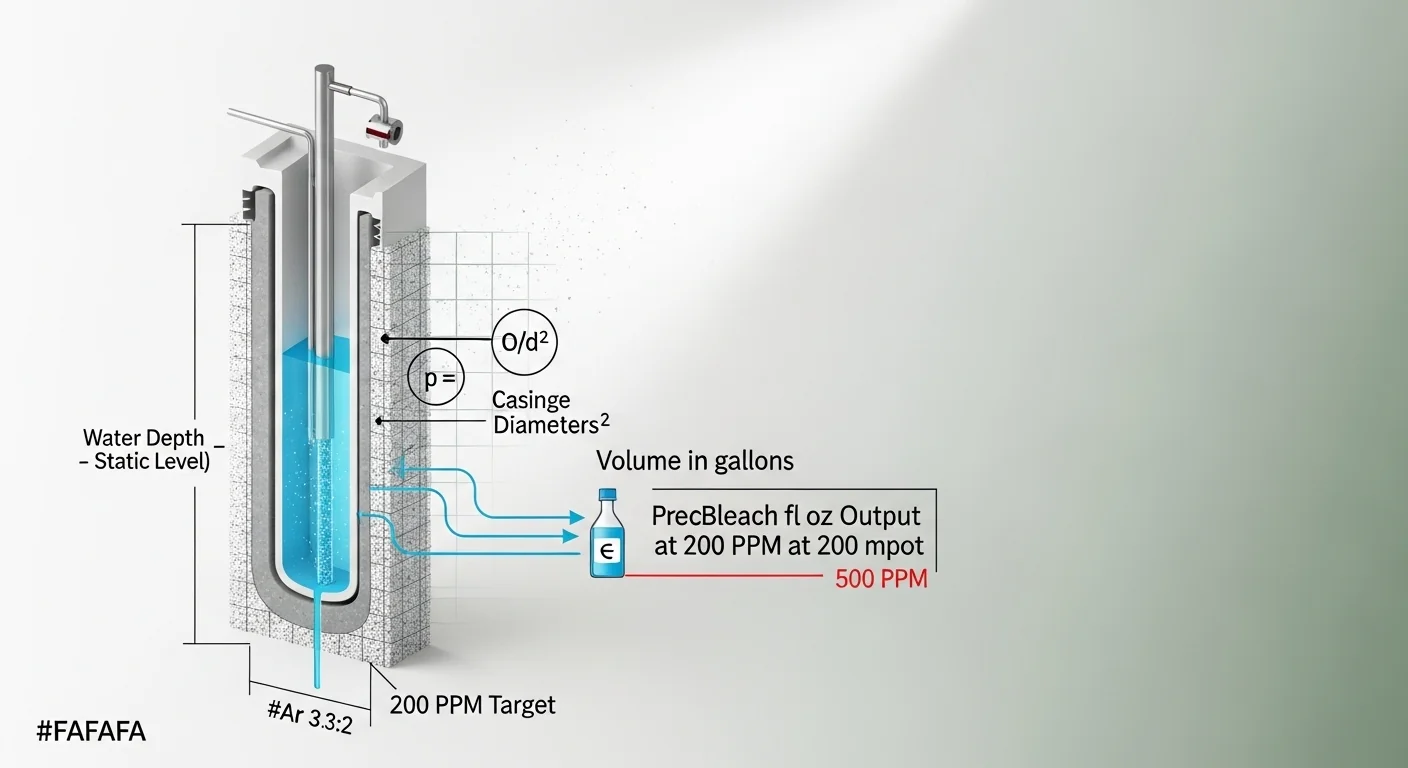
Dumping an arbitrary amount of bleach into a private well is the single most common disinfection error homeowners make, and it produces two equally damaging outcomes: too little chlorine leaves iron bacteria biofilm intact, and too much corrodes the submersible pump, rubber check valves, and pressure system components. The difference between these failure modes is a matter of fluid ounces, and those fluid ounces are determined entirely by the actual volume of water sitting in the well casing, not by well depth alone.
<100 PPM Safe Zone
100–300 PPM Caution
300–500 PPM Pump Risk
>500 PPM
| Casing Dia. | Water Depth | Volume (gal) | Bleach Needed (fl oz) |
|---|
How This Calculator Works
This well shock chlorination calculator uses the exact volume of water in your well casing to compute the minimum effective bleach dose that achieves 200 PPM free chlorine — the standard disinfection target proven to penetrate iron bacteria biofilm without corroding submersible pump components.
Water Depth (ft) = Total Well Depth − Static Water Level
Example: 150 ft − 50 ft = 100 ft of standing water
Volume (gal) = Water Depth × (Diameter ÷ 24)² × π × 7.48
Example: 100 × (6÷24)² × 3.1416 × 7.48 ≈ 146.9 gallons
Bleach (fl oz) = Volume (gal) × 200 PPM ÷ (Concentration% × 75)
Example: 73.2 × 200 ÷ (8.25 × 75) ≈ 23.6 fl oz
The factor 75 converts percent-concentration to PPM-equivalent per fluid ounce per gallon. The factor 7.48 converts cubic feet to gallons. The ÷24 converts diameter inches to a radius in feet (halved), squared for area.
Assumptions: Uniform casing diameter, no gravel pack volume adjustment, static water level is measured from surface to water surface. If your well has a sand/gravel development zone, increase dose by 10–15% to account for void space not captured by the casing volume alone.
Assumptions & Limits
- Targets exactly 200 PPM free chlorine — the accepted range for residential well shock (100–300 PPM). This dose penetrates biofilm and kills iron bacteria without immediately degrading pump materials.
- Do not exceed 500 PPM. Above this threshold, sodium hypochlorite rapidly corrodes stainless steel pump housings, rubber impellers, and check valve seats. A $1,500+ submersible pump can be permanently damaged within hours.
- Underdosing (<100 PPM) fails to penetrate iron bacteria biofilm. The protective slime shields bacteria from chlorine contact — rotten-egg odor and coliform contamination may persist.
- Use unscented sodium hypochlorite only. Regular household bleach with surfactants, thickeners, or fragrances can foul the well. NSF-certified 8.25% well-safe bleach is strongly recommended.
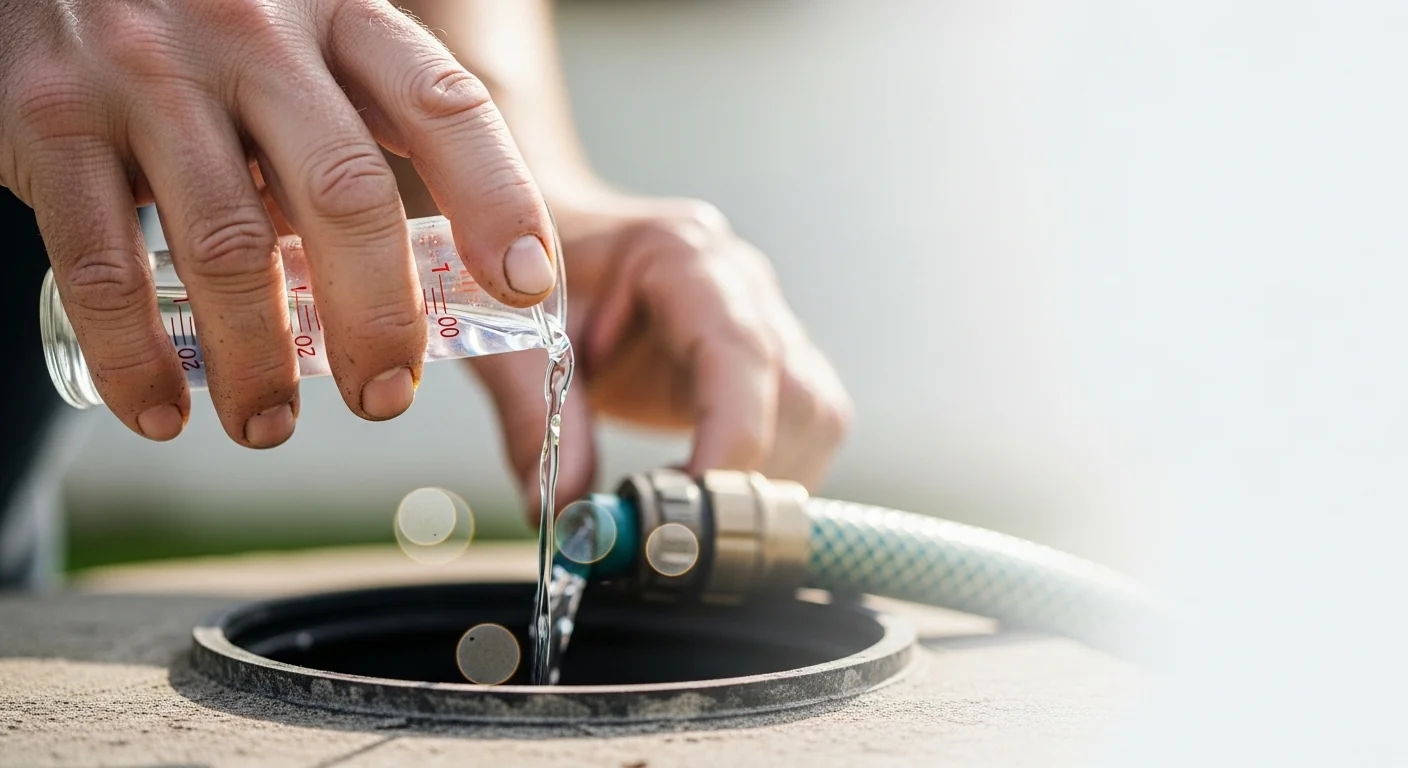
- After adding bleach, recirculate for 30–60 minutes using a garden hose from a yard spigot back down the wellhead to mix throughout the column.
- Let stand 12–24 hours. Flush all household fixtures until chlorine smell disappears. Test with 0–500 PPM strips before drinking.
- Replace all sediment and carbon filters after shocking — chlorine degrades filter media and activated carbon must be renewed.
- Calculator assumes uniform casing diameter. Large-diameter bored wells or wells with gravel packs may hold significantly more water than casing volume alone.
- Well depth range: 10–2,000 ft. Casing diameter range: 2–24 inches.
This calculator computes the exact sodium hypochlorite dose needed to reach 200 PPM free chlorine inside your well casing, using your measured total depth, static water level, casing inner diameter, and the bleach concentration printed on the label. It does not account for gravel pack void space beyond the casing, surface piping volume, or pressure tank hold volume, so treat the output as the minimum casing dose. After you treat the casing, recirculate and flush according to your state health department protocol before re-testing the water.
Once you have the fluid-ounce figure from this tool, you can make a firm decision on whether your current bleach concentration is appropriate or whether switching to a higher-concentration NSF-certified product reduces handling risk. If you rely on a reverse osmosis system for drinking water, also review your reverse osmosis waste water calculator to understand how post-treatment flushing affects membrane efficiency before returning the system to service.
Use the Tool
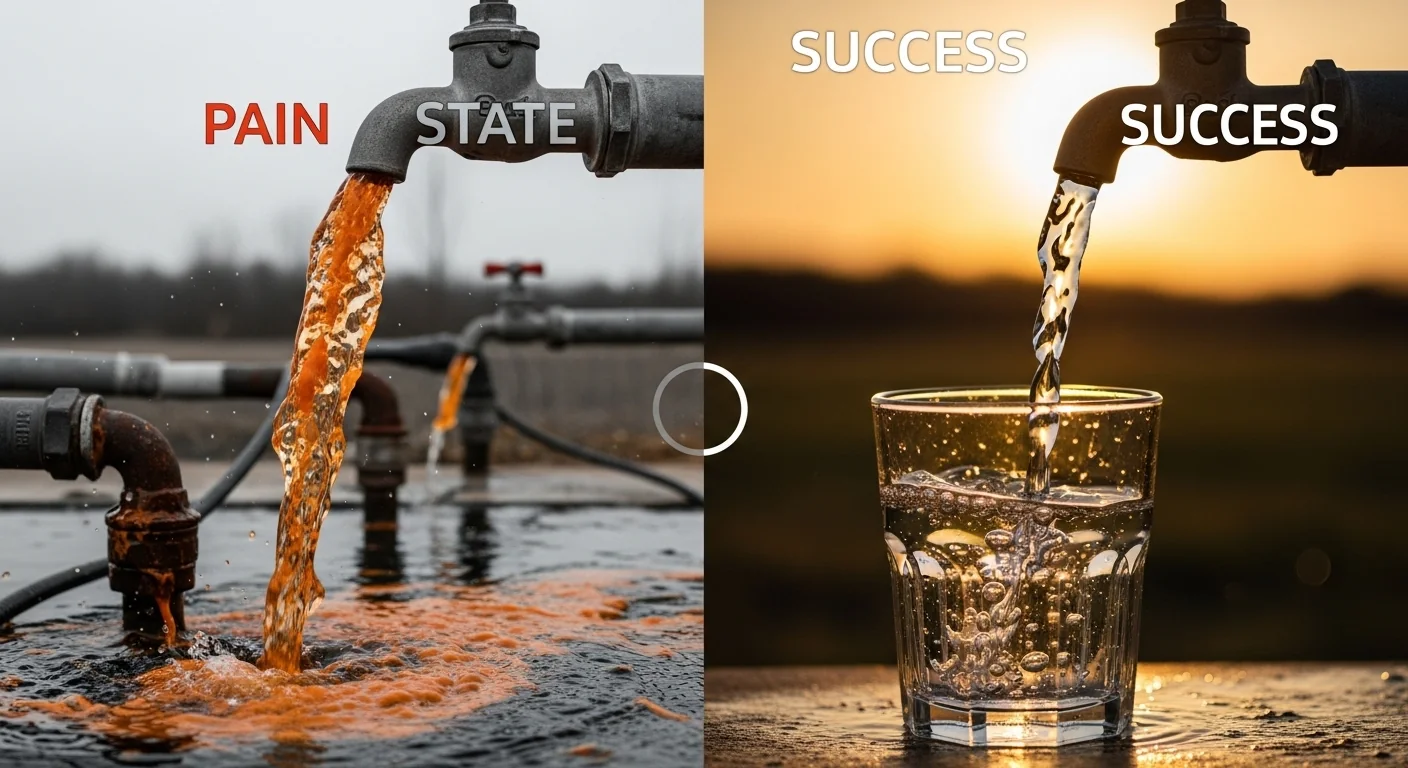
Before you start, have three measurements ready: the total drilled depth of the well in feet (from the well completion report or a measuring tape), the static water level in feet from surface (often found on the original well log or measured with a sounder), and the casing inner diameter in inches from the well driller’s documentation. Your bleach label will show the sodium hypochlorite concentration. If you have a well pressure tank you will need to assess separately, the well pressure tank calculator covers drawdown volume and bladder sizing for that component.
Quick Start (60 Seconds)
- Well Total Depth (ft): Enter the drilled depth from ground surface to the bottom of the well. This is not the pump setting depth. Acceptable range is 10 to 2,000 ft. Source this from your well completion report or a plumb-line measurement.
- Static Water Level (ft): Enter the depth from ground surface down to the top of the standing water column when the pump is off and the water has equilibrated. This must be less than total depth. If unknown, a licensed well driller can measure it with a water-level sounder.
- Casing Inner Diameter (inches): Enter the inside diameter of the well casing, not the nominal outer dimension. Most residential drilled wells use 4-inch or 6-inch steel or PVC casing. Bored wells may be 12 to 24 inches. Do not guess; the casing diameter drives volume nonlinearly because it appears squared in the formula.
- Bleach Concentration: Select the sodium hypochlorite percentage printed on the product label. Regular household bleach is typically 5.25% or 6%. NSF-certified well-safe bleach is commonly 8.25%. Pool and commercial grades run 10% to 12.5%. Do not use bleach that contains thickeners, fragrances, or surfactants.
- Click Calculate: Results appear below. The traffic-light gauge shows where your calculated PPM falls relative to the 100-300 PPM safe zone. If the needle is in the red zone, the result will explain whether you are underdosing or exceeding the pump-safe threshold.
Inputs and Outputs (What Each Field Means)
| Field | Unit | What It Represents | Common Entry Mistake | Safe Entry Guidance |
|---|---|---|---|---|
| Well Total Depth | feet (ft) | Distance from ground surface to the bottom of the drilled borehole | Confusing pump setting depth or screen depth with total drilled depth | Use the well completion report. If unavailable, measure with a weighted plumb line to the bottom. |
| Static Water Level | feet (ft) | Depth from surface to the water surface when the pump has been off for at least 4 hours | Measuring immediately after pumping, which gives a drawdown depth rather than true static level | Let the well rest a minimum of 4 hours after last pump cycle before measuring. Must be less than total depth. |
| Casing Inner Diameter | inches (in) | Inside diameter of the well casing tube through which the water column rises | Using nominal pipe size (outer diameter) instead of inner diameter, or guessing 6 inches for a 4-inch casing | Check the well driller’s spec sheet. Common residential values: 4 in and 6 in. Every inch of error is squared in the volume formula. |
| Bleach Concentration | percent sodium hypochlorite (%) | Active chlorine strength of the sodium hypochlorite product | Using an old or sun-exposed jug; bleach loses roughly 20% of its labeled potency per year of storage | Use a fresh jug purchased within the last 6 months. Select the concentration printed on the current label. |
| Bleach Dose (output) | fluid ounces (fl oz) | Volume of bleach needed to reach 200 PPM free chlorine in the calculated water column | Applying this dose to household fixtures and surface piping without accounting for their separate volume | This dose covers the casing water column only. Recirculate through yard spigots to distribute chlorine into the pressure system. |
| Water Column Volume (output) | gallons (gal) | Computed volume of standing water in the casing between the static level and the well bottom | Assuming a shallow casing equals a small volume; a large-diameter bored well can hold 500+ gallons even at 50 ft of water depth | Review this number before purchasing bleach. Very large volumes may require commercial-grade product to minimize handling volume. |
Worked Examples (Real Numbers)
Example 1: Shallow Residential Well, 4-Inch Steel Casing
- Well Total Depth: 80 ft
- Static Water Level: 30 ft from surface
- Water Column Depth: 50 ft
- Casing Inner Diameter: 4 inches
- Bleach Concentration: 8.25%
Volume = 50 ft x (4 / 24)² x 3.1416 x 7.48 = 50 x 0.02778 x 23.499 = 32.6 gallons
Result: 32.6 x 200 / (8.25 x 75) = 6,520 / 618.75 = 10.5 fl oz of 8.25% bleach.
A shallow, narrow well requires less than a standard measuring cup of NSF-certified bleach. This is a common scenario where homeowners drastically overdose by pouring in a full gallon, driving PPM well above the pump-safe threshold for no disinfection benefit.
Example 2: Standard Depth Residential Well, 6-Inch Casing
- Well Total Depth: 150 ft
- Static Water Level: 50 ft from surface
- Water Column Depth: 100 ft
- Casing Inner Diameter: 6 inches
- Bleach Concentration: 8.25%
Volume = 100 ft x (6 / 24)² x 3.1416 x 7.48 = 100 x 0.0625 x 23.499 = 146.9 gallons
Result: 146.9 x 200 / (8.25 x 75) = 29,380 / 618.75 = 47.5 fl oz (approximately 5.9 cups) of 8.25% bleach.
This is the most common residential configuration. At 100 ft of water column in a 6-inch casing, the volume is close to 150 gallons, requiring nearly 6 cups of NSF-certified bleach to reach the 200 PPM target cleanly.
Example 3: Deep Well with Standard Household Bleach (5.25%)
- Well Total Depth: 200 ft
- Static Water Level: 80 ft from surface
- Water Column Depth: 120 ft
- Casing Inner Diameter: 6 inches
- Bleach Concentration: 5.25%
Volume = 120 ft x (6 / 24)² x 3.1416 x 7.48 = 120 x 0.0625 x 23.499 = 176.2 gallons
Result: 176.2 x 200 / (5.25 x 75) = 35,240 / 393.75 = 89.5 fl oz (approximately 11.2 cups) of 5.25% bleach.
Using lower-concentration household bleach more than doubles the physical handling volume compared to 8.25% product. At this well depth and diameter, switching to NSF-certified 8.25% bleach would cut the volume to approximately 59 fl oz, reducing spill risk and measurement difficulty during treatment.
Reference Table (Fast Lookup)
All values assume a target dose of 200 PPM free chlorine. Volume is computed from the casing volume formula. Bleach volumes are rounded to one decimal place.
| Casing Dia. (in) | Water Column (ft) | Water Volume (gal) | Bleach @ 5.25% (fl oz) | Bleach @ 8.25% (fl oz) | Bleach @ 12.5% (fl oz) |
|---|---|---|---|---|---|
| 4 | 25 | 16.3 | 8.3 | 5.3 | 3.5 |
| 4 | 50 | 32.6 | 16.6 | 10.5 | 7.0 |
| 4 | 100 | 65.2 | 33.1 | 21.1 | 13.9 |
| 6 | 50 | 73.4 | 37.3 | 23.7 | 15.7 |
| 6 | 100 | 146.9 | 74.6 | 47.5 | 31.3 |
| 6 | 150 | 220.3 | 111.9 | 71.2 | 47.0 |
| 6 | 200 | 293.7 | 149.2 | 94.9 | 62.7 |
| 8 | 75 | 196.0 | 99.5 | 63.4 | 41.8 |
| 8 | 100 | 261.3 | 132.7 | 84.5 | 55.7 |
| 8 | 200 | 522.6 | 265.4 | 169.0 | 111.5 |
Notice that moving from a 4-inch to a 6-inch casing at the same water column depth increases volume by a factor of 2.25, because diameter is squared in the volume calculation. This nonlinear relationship is why guessing the casing size rather than measuring it produces large dosing errors.
How the Calculation Works (Formula + Assumptions)
Show the calculation steps
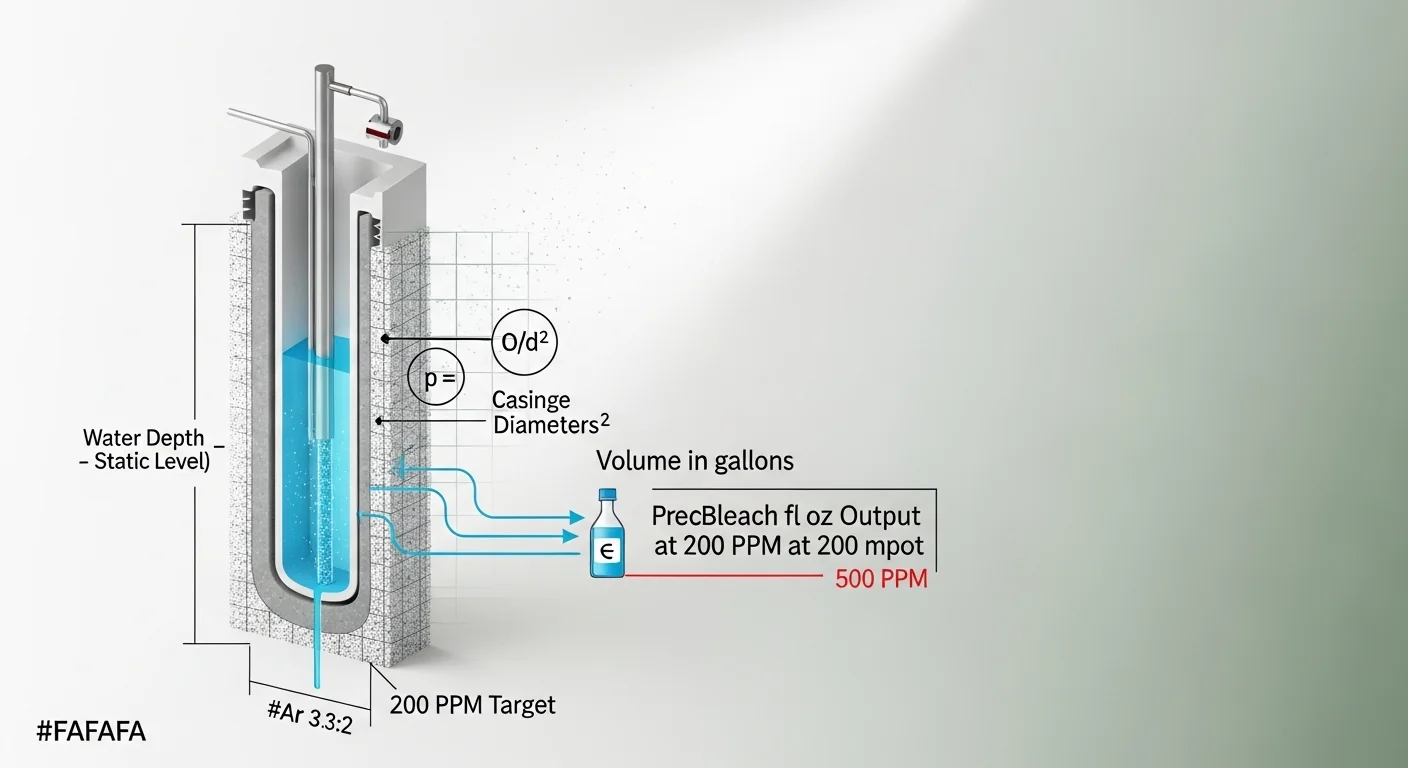
Step 1: Compute the water column depth.
Water Depth (ft) = Total Well Depth (ft) – Static Water Level (ft)
This isolates only the vertical height of standing water in the casing. The static level is subtracted because the portion of casing above the waterline contains only air and holds no water to chlorinate.
Step 2: Compute the casing water volume in gallons.
Volume (gal) = Water Depth (ft) x (Casing Diameter (in) / 24)² x 3.14159 x 7.48
Breaking this down: dividing the diameter by 24 converts inches to a radius expressed in feet (diameter / 2 / 12). Squaring that and multiplying by pi gives the casing cross-sectional area in square feet. Multiplying by water depth gives cubic feet of water. Multiplying by 7.48 converts cubic feet to US gallons.
Step 3: Compute the bleach dose in fluid ounces.
Bleach (fl oz) = Volume (gal) x Target PPM / (Bleach Concentration (%) x 75)
The target PPM is fixed at 200. The factor 75 is a unit-conversion constant derived from the relationship between fluid ounces of sodium hypochlorite per gallon and parts per million of free chlorine, accounting for the active chlorine content at a given label concentration. This formula is the standard used in well-water disinfection guides published by state extension services.
Rounding: Volume is shown to one decimal place. Bleach dose is shown to one decimal place. When measuring, round up to the nearest practical graduation on your measuring cup; a slight positive rounding error is safe within the 100-300 PPM target window.
For comparison with the broader concept of fluid volume in cylindrical pipes, the same diameter-squared relationship appears in our pipe volume calculator, which covers a range of pipe sizes and materials.
Assumptions and Limits
- The formula assumes a uniform casing inner diameter from the static water level to the bottom of the well. Wells with multiple casing diameters (e.g., an upper 6-inch steel casing transitioning to a 4-inch liner at depth) require a segmented calculation for each diameter zone.
- Gravel pack, sand development zones, or open-hole sections below the casing are not included. Actual water volume in those formations can substantially exceed the casing-only figure, meaning the calculated dose could underperform if chlorinated water must also penetrate those zones.
- The formula uses a fixed target of 200 PPM. Some state health departments specify a different target (commonly 50 PPM for routine maintenance or up to 500 PPM for severe iron bacteria remediation). Confirm your jurisdiction’s recommended concentration before treating.
- Bleach concentration degrades with time and heat exposure. A jug labeled 8.25% that has been stored in a hot utility room for 18 months may deliver meaningfully less active chlorine per fluid ounce than the label states. Use product purchased within the past 6 months.
- The model does not include the volume of the drop pipe, pressure line, or any surface plumbing. Recirculating water from a yard spigot back down the wellhead is the standard method for distributing chlorine through those components after the casing dose is applied.
- Inputs are valid for total depth between 10 and 2,000 ft and casing diameters between 2 and 24 inches. Very large-diameter bored wells (24 inches or greater) may require institutional-grade sodium hypochlorite delivery to avoid excessive handling of large volumes of concentrate.
- This tool calculates a chemical dose, not a disinfection guarantee. Post-treatment bacteriological testing by a certified lab is the only method to confirm potable water status.
Standards, Safety Checks, and “Secret Sauce” Warnings
Critical Warnings
- Overdose above 500 PPM corrodes submersible pump components. Sodium hypochlorite at concentrations above 500 PPM attacks stainless steel pump housings, degrades rubber impeller seals, and can dissolve the elastomers in check valves. A submersible pump rated at 10 or more years of service life can be structurally compromised within hours of high-PPM exposure. The cost of a replacement pump installation routinely exceeds $1,500 in parts and labor, making a $6 chlorine test strip the most cost-effective tool in your kit.
- Underdose below 100 PPM fails to penetrate iron bacteria biofilm. Iron bacteria (Gallionella, Leptothrix, and related species) produce a dense extracellular matrix that physically shields the bacteria from contact with dilute chlorine. A well with rotten-egg odor, orange slime at fixtures, or persistent coliform detects after a previous treatment was almost certainly undertreated. Biofilm acts as a physical barrier; the chlorine must be concentrated enough to oxidize through it, not just contact the outer surface.
- Additive-containing bleach can foul the well. Bleach products formulated with thickeners, surfactants, or fragrances introduce compounds into the aquifer that are not removed by flushing. Use only unscented sodium hypochlorite with no additives, and verify NSF certification for potable water use where available.
Minimum Standards
- Target free chlorine concentration: 100 to 300 PPM in the well casing, with 200 PPM as the design point.
- Contact time: minimum 12 hours in the casing before flushing, with 24 hours preferred for iron bacteria remediation.
- Post-flush verification: test using chlorine test strips calibrated to the 0-500 PPM range before returning to drinking water use. Confirm residual chlorine is below 4 PPM at the tap before consuming.
- Filter replacement: replace all sediment and carbon block filters after each shock treatment. Activated carbon adsorbs chlorine and will release degraded byproducts if not replaced post-treatment.
Competitor Trap: A large portion of well disinfection guides published online recommend adding “one gallon of bleach per 100 feet of well depth” as a universal rule. This formula ignores casing diameter entirely and can produce doses ranging from a 30 PPM near-miss on a large-diameter bored well to a 900 PPM pump-killing overdose on a narrow 4-inch casing. It was written as a rough field heuristic for well drillers who could inspect the well physically before dosing, not as a homeowner calculation method. The depth-only rule is not endorsed by the EPA’s well disinfection guidance (EPA 816-F-09-010) or by major state extension programs, which uniformly require casing volume as the basis for dosing.
If your well system includes a submersible pump drawing from significant depth, also review the NPSH calculator to verify that post-treatment pressure conditions remain within the pump’s operating curve before restarting it after the shock treatment soak period. Pressure anomalies during restart can indicate check valve damage worth investigating before assuming the disinfection resolved all issues.
Common Mistakes and Fixes
Mistake: Using Total Depth as the Water Column Depth
Some calculators and advice sources tell users to enter the full drilled depth of the well, not the actual depth of standing water. A well drilled to 200 ft with a static water level at 130 ft contains only 70 ft of water column, not 200 ft. Using the full drilled depth inflates the calculated volume by a factor of nearly three in that example, producing an overdose that exceeds the pump-safe threshold.
Fix: Always subtract the static water level from total depth before calculating volume, or use this calculator’s two-field input structure which performs that subtraction automatically.
Mistake: Entering Nominal Pipe Size Instead of Inner Diameter
A “6-inch” PVC well casing has a nominal outer diameter of 6 inches but an inner diameter of approximately 5.95 to 6.28 inches depending on wall thickness and schedule. Steel well casings often have similar discrepancies. Because the diameter term is squared in the volume formula, even a half-inch error compounds into a meaningful volume difference on deeper wells.
Fix: Locate the original well driller’s completion report for the actual casing specification, or measure the inner diameter directly with a tape measure at the wellhead opening.
Mistake: Skipping Recirculation After Adding Bleach
Pouring bleach directly down the well casing without recirculating treats only the static water column. The drop pipe, check valve, pressure tank bladder, and all surface plumbing from the wellhead to the house receive no contact with chlorinated water in a static treatment. Coliform bacteria in the pressure system biofilm can re-contaminate the water within days of treatment.
Fix: After adding the calculated bleach dose, connect a garden hose to a yard spigot and route it back down the wellhead. Run the pump intermittently for 30 to 60 minutes to circulate chlorinated water through the pressure system. A hose with the right flow characteristics for your pump and casing setup is worth checking against a hose flow rate calculator to confirm adequate recirculation velocity.
Mistake: Treating With Degraded Bleach
Sodium hypochlorite is unstable. Heat and UV exposure accelerate decomposition, and a product left in a warm storage area for more than a year may deliver only a fraction of the labeled active chlorine. Treating a well with degraded bleach produces a result that appears correct on paper but chronically underdoses the casing, allowing biofilm to persist despite apparent compliance with the dosing formula.
Fix: Purchase a fresh jug immediately before treatment. Do not use product from a previous season or one that has been stored near heat sources. NSF-certified 8.25% well-safe bleach stored properly in a cool, dark location retains acceptable potency for approximately 6 months from the manufacture date.
Mistake: Not Testing After Flushing
Flushing chlorine from the system is a required step, but stopping at “the water smells clear” is not a standard. Chlorine residual can dissipate from the tap faster than it dissipates from the pressure tank bladder or from dead-end supply lines in the house. A person who stops flushing when the kitchen tap smells clean may still have residual above the 4 PPM secondary standard in a basement utility sink or irrigation zone.
Fix: Use chlorine test strips rated for the 0-500 PPM range during treatment to verify you hit the target dose, and a standard pool test strip (0-10 PPM) at every fixture and hose bib after flushing to confirm safe residual levels throughout the system before returning to drinking water use.
Next Steps in Your Workflow
Once you have the calculated bleach volume in hand, the next practical step is sourcing NSF-certified sodium hypochlorite, a measuring container accurate to fluid ounces, and a garden hose long enough to reach from a yard spigot back down the wellhead opening. Plan the treatment for a period when you can isolate the well from household use for a minimum of 12 hours, and shut off any water softeners or iron filters upstream of the pressure tank to prevent chlorine from fouling the media. After flushing, if you notice elevated outlet pressure fluctuations or unusual cycling behavior, that may indicate a waterlogged pressure tank rather than a residual disinfection issue, and the well pressure tank calculator can help you assess whether the bladder pre-charge is within spec.
For wells in agricultural or mixed-use settings where pumping systems are more complex, verify that your post-treatment startup pressure does not create transient pressure spikes in the distribution line. Fast valve closures after a pump restart following a long soak period can generate water hammer, and reviewing your system against the water hammer calculator is a worthwhile check before restoring full irrigation service. Bacteriological retesting through a certified lab at 3 days and again at 14 days post-treatment is the only reliable method to confirm that shock chlorination succeeded.
FAQ
How much bleach do I need to shock a well with a 6-inch casing and 100
feet of water?
At 100 feet of water column in a 6-inch casing, the water volume is approximately 146.9 gallons. Using 8.25% NSF-certified bleach, you need approximately 47.5 fluid ounces (just under 6 cups) to reach 200 PPM. With standard 5.25% household bleach, that increases to approximately 74.6 fluid ounces. Enter your exact measurements in the calculator above for a precise result.
What PPM should I target for well shock chlorination?
Most state extension programs and EPA guidance documents use 200 PPM free chlorine as the design concentration for residential well disinfection. The acceptable working range is approximately 100 to 300 PPM. Below 100 PPM, the dose may not penetrate iron bacteria biofilm. Above 500 PPM, the concentration becomes corrosive to standard submersible pump components, rubber seals, and check valves.
Can I use regular laundry bleach to shock a well?
Only if it contains no additives. Standard unscented sodium hypochlorite at 5.25% or 6% is technically usable, but requires a larger physical volume per treatment than higher-concentration alternatives, increasing spill and measurement error risk. Products containing fragrances, thickeners, or surfactants must not be used in potable water wells. NSF-certified sodium hypochlorite at 8.25% is the preferred choice because it is formulated specifically for water treatment with no additives.
How do I find my static water level if it is not on the well report?
A water level sounder (also called an electric depth gauge or e-tape) is the accurate tool. It is a weighted sensor on a calibrated tape that signals with a light or buzzer when the probe contacts water. Professional well drillers carry this instrument. As an approximation, your local cooperative extension office or state geological survey may have average static levels for your aquifer zone, but a direct measurement is strongly preferred for dosing calculations.
How long should I wait before using the water after shock chlorination?
Allow a minimum of 12 hours of contact time in the casing and pressure system before flushing. After flushing, do not use the water for drinking or cooking until chlorine test strips confirm residual free chlorine is below 4 PPM at the kitchen tap. Bacteriological testing at 3 days and 14 days post-treatment through a certified water testing lab provides the definitive confirmation that disinfection was effective.
Does shock chlorination kill iron bacteria permanently?
A single treatment reduces iron bacteria populations significantly but rarely eliminates them from the well screen, gravel pack, and aquifer formation adjacent to the well. Recurrence is common, particularly in wells with high dissolved iron. Annual or biennial shock chlorination is the standard maintenance approach for affected wells. Persistent cases may warrant physical well cleaning or in-well UV treatment in combination with chemical disinfection.
Conclusion
The single biggest mistake to avoid is the depth-only heuristic that circulates widely online. Volume is a three-dimensional calculation, and casing diameter contributes to it nonlinearly. If you maintain a pressure tank or other well system components, the sump pump calculator addresses related pump sizing decisions for drainage systems in the same property context. For well disinfection specifically, measure accurately, dose precisely, recirculate thoroughly, and test before drinking.