
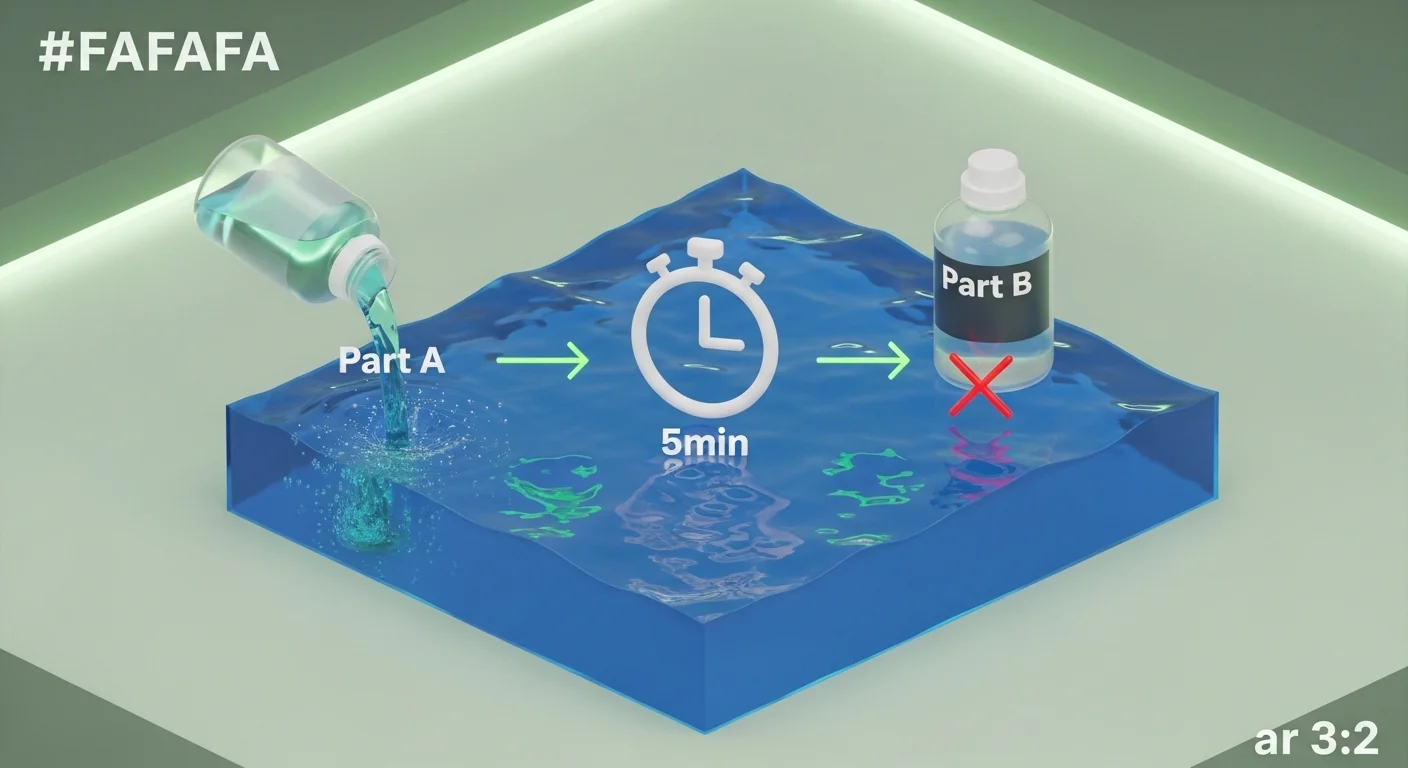

The math behind raising reservoir EC is straightforward multiplication. The part that trips up experienced growers and automated systems alike is the order and physical separation of Part A and Part B additions. Calcium Nitrate and Magnesium Sulfate cannot contact each other in concentrated form without reacting to form Calcium Sulfate, an insoluble precipitate that locks nutrients out of solution before plants ever see them. This page treats that chemistry as an engineering constraint, not a footnote.
This calculator takes four inputs, current EC, target EC, reservoir volume in gallons, and your nutrient brand’s concentration factor in mL per gallon per 1.0 mS/cm, and returns the exact mL dose for Part A and Part B individually, along with a real-time precipitation risk flag. It does not account for pH shifts caused by dosing, water source mineral contribution to EC, or temperature-dependent conductivity drift. Those are separate calculations that require different inputs.
After running this tool, you will know exactly how many milliliters of each nutrient part to add, in which order to add them, and whether your dose volume puts you at risk of gypsum precipitation before the nutrients reach your plants.
Use the Tool
Hydroponic A/B Nutrient Dosing & Precipitation Sizer
Calculate precise Part A & B doses, EC delta, and get instant gypsum-lockout safety warnings.
| Target EC (mS/cm) | ΔEC (from current) | Dose Per Part (mL) | Total Dose (mL) | Status |
|---|
How This Calculator Works — Formula & Assumptions
This hydroponic nutrient dosing calculator uses a linear EC-response model to compute the exact volume of concentrated Part A and Part B solution needed to raise your reservoir’s EC to your target value.
- Step 1 — EC Deficit:
ΔEC = Target EC − Current EC
This is the EC gap your nutrients must close. - Step 2 — Total Dose:
Dose (mL) = ΔEC × Reservoir Volume (Gal) × Concentration Factor (mL/Gal per 1.0 EC)
The Concentration Factor comes from your nutrient brand’s label — it is the mL per gallon required to raise EC by exactly 1.0 mS/cm. - Step 3 — Split into A and B:
Part A Dose = Dose / 2 | Part B Dose = Dose / 2
A/B nutrients are always applied in equal parts (1:1 ratio). - Step 4 — Precipitation Check:
If Part A + Part B added simultaneously to an undiluted/undispersed spot → TRIGGER PRECIPITATE WARNING
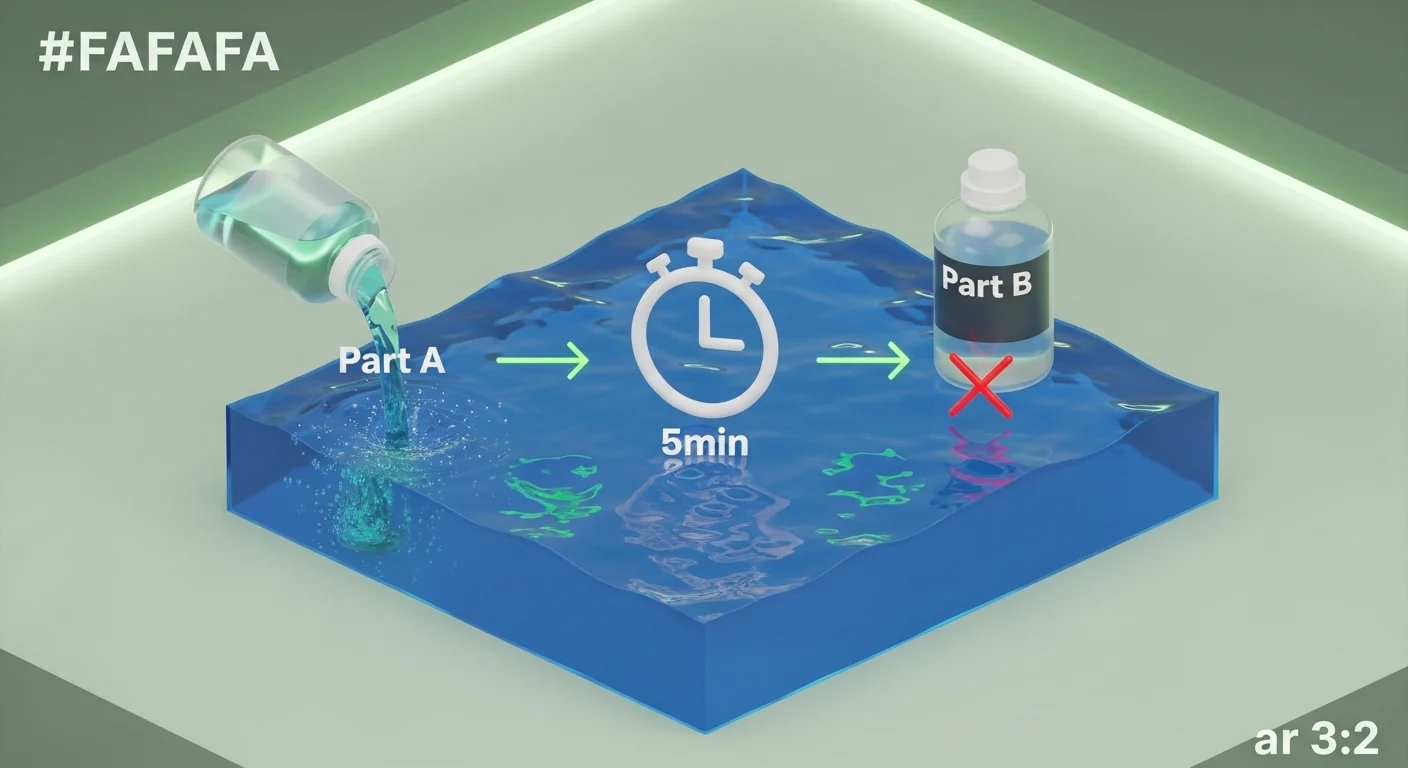
Always add Part A first, allow 5 minutes of circulation, then add Part B.
Assumptions & Limits: EC response is linear and assumes your nutrient is pre-dissolved in a stock solution, not dry powder. Results are for A/B 2-part nutrients only — single-part nutrients use the full dose figure without splitting. Water EC must be < target EC for dosing to be meaningful. The 1:1 A:B ratio applies to standard balanced A/B systems; specialty formulas may vary. Accuracy depends on your EC meter being calibrated — check calibration monthly. Maximum dose shown is capped at practical grower range (EC 0.1 – 5.0 mS/cm). Results are estimates — always verify with your EC meter after mixing.
The Gypsum Concrete Problem — Why A and B Must Never Mix Directly
The “Gypsum Concrete” Lockout is the most common and costly mistake in A/B nutrient systems. Here’s the brutal chemistry:
Part A contains Calcium Nitrate (Ca(NO₃)₂). Part B contains Magnesium Sulfate (MgSO₄, aka Epsom Salt). When concentrated solutions of both are combined in the same spot before dilution, the calcium ions (Ca²⁺) and sulfate ions (SO₄²⁻) react instantly:
- The reaction: Ca²⁺ + SO₄²⁻ → CaSO₄ (Calcium Sulfate / Gypsum)
- The result: A white chalky precipitate forms immediately and sinks to the reservoir floor as an inert rock — drywall gypsum. Your plants cannot access calcium or sulfur locked in this form.
- The symptom: White powder or crust on reservoir walls and floor, persistent calcium and magnesium deficiency despite “correct” EC readings. EC can read correct while nutrients are biologically unavailable.
- The fix: Always add Part A first, run your circulation pump for a minimum of 5 minutes to fully dilute, then add Part B.
The same principle applies to automated dosing pumps: do not inject Part A and Part B through tubes that are close together in the reservoir. Space the injection points 12+ inches apart with a circulation pump running at all times.
Recommended Equipment for Precision Dosing
Precision dosing requires the right tools. These are the professional-grade pieces that serious growers use:
Before entering your numbers, have your calibrated EC meter reading ready from the reservoir (not the stock tank), your reservoir volume in US gallons, and your nutrient manufacturer’s concentration factor, which appears on most labels as “mL per gallon to reach 1.0 EC” or similar. If your brand expresses this differently, run a small test dilution to calibrate your own factor before entering it here. Growers switching between nutrient brands should recalibrate this factor every time, since identical EC readings can reflect very different ionic balances depending on the formula. For a cross-reference between EC and parts-per-million readings, the PPM to EC converter on this site handles that unit translation directly.
Quick Start (60 Seconds)

- Target Reservoir EC: Enter your desired end-state EC in mS/cm. For most leafy crops, 1.2 to 2.0 is appropriate. Fruiting crops typically run 2.0 to 3.5. Do not enter your stock solution EC here; this is the final diluted reservoir target.
- Current Reservoir EC: Take a live reading from your reservoir with a calibrated meter, not a recent memory. EC drifts throughout the day as water evaporates and plants uptake nutrients. A reading more than 30 minutes old may produce an incorrect dose.
- Reservoir Volume: Enter the actual water volume in US gallons, not the tank capacity. A 100-gallon reservoir that is 80 gallons full should be entered as 80. Overdosing from an overestimated volume is one of the fastest routes to nutrient burn.
- Concentration Factor: This is the mL of your specific nutrient per gallon of water that raises EC by exactly 1.0 mS/cm. Check your nutrient brand’s feeding chart or label. A common range for 2-part concentrates is 4 to 6 mL/gal, but this varies substantially by brand and formula strength.
- Click Calculate: The result will not appear until all four fields are filled and valid. If you see an inline error, address it before the result panel becomes active.
- Read the precipitation warning first: Before measuring out your dose, check the warning banner. If it is visible, follow the 5-minute delay protocol between Part A and Part B additions.
- Verify with your meter: After dosing and 10 minutes of full circulation, take a new EC reading. The calculator assumes a linear response, but actual results vary with water temperature and ionic balance.
Inputs and Outputs (What Each Field Means)
| Field | Unit | What It Represents | Common Mistake | Safe Entry Guidance |
|---|---|---|---|---|
| Target Reservoir EC | mS/cm | The electrical conductivity you want the reservoir to reach after dosing. Represents total dissolved ion concentration of nutrients in solution. | Entering the stock tank EC or a target from a seedling stage chart while the plants are in flower. | Use your crop’s current growth stage EC range. Seedling: 0.5-1.2. Veg: 1.2-2.0. Fruiting: 2.0-3.5. |
| Current Reservoir EC | mS/cm | A live measurement of your reservoir’s existing conductivity before any nutrients are added during this session. | Using yesterday’s reading. EC rises as water evaporates and drops as plants uptake ions, so only a live reading is accurate. | Measure at reservoir depth, not at the surface. Rinse probe in distilled water before reading. |
| Reservoir Volume | US Gallons | The actual volume of water currently in the reservoir, not the tank’s rated maximum capacity. | Using the tank’s labeled capacity. A half-full 200-gallon tank is 100 gallons, and the dose calculation will double if entered incorrectly. | Measure actual fill level using a sight gauge, dipstick, or fill volume tracking log. |
| Concentration Factor | mL/Gal per 1.0 EC | How many mL of your specific nutrient concentrate, per gallon of reservoir water, raises EC by exactly 1.0 mS/cm. This is brand and formula specific. | Assuming all 2-part nutrients share the same factor. A 5 mL/gal factor for one brand may be 3.5 or 7 for another, even at the same nominal strength. | Test: add 5 mL to 1 gallon of plain water, measure EC delta. Divide 1.0 by that delta to find your actual factor. |
| Total Dose (Output) | mL | Combined Part A and Part B volume required to close the EC gap across your full reservoir volume. | Treating this as the amount to add of a single product. It must be split into two equal halves (A and B), added separately. | Add Part A first. Wait 5 minutes minimum with circulation running. Then add Part B. |
| EC Deficit (Output) | mS/cm | The gap between current and target EC (ΔEC). This drives the entire dose calculation. | Ignoring a large ΔEC. A delta above 1.5 mS/cm should typically be dosed in two separate sessions to avoid osmotic shock. | If ΔEC exceeds 1.5, plan to dose to an intermediate EC first, then dose again after 24 hours. |
| Part A Dose (Output) | mL | Volume of Calcium Nitrate concentrate to add first. Equal to half the total dose. | Adding Part B simultaneously or to the same injection point before Part A has fully dispersed. | Add to the reservoir intake or nearest the circulation pump return for fastest dispersal. |
| Part B Dose (Output) | mL | Volume of Magnesium Sulfate concentrate to add after Part A has circulated. Equal to half the total dose. | Adding Part B to the same location in the reservoir where Part A was just poured, before dilution is complete. | Add Part B at a different physical location in the reservoir, or wait the full 5-minute circulation window. |
Worked Examples (Real Numbers)
Scenario 1: Small Home DWC System, Leafy Greens
- Target EC: 1.8 mS/cm
- Current EC: 0.5 mS/cm
- Reservoir Volume: 20 gallons
- Concentration Factor: 5.0 mL/gal per 1.0 EC
Result: ΔEC = 1.3 mS/cm. Total dose = 1.3 x 20 x 5.0 = 130 mL. Part A = 65 mL. Part B = 65 mL.
A 20-gallon system is small enough that 65 mL additions carry meaningful precipitation risk if both are poured near the same spot. Add Part A near the air stone or pump return, wait 5 minutes, then add Part B at the opposite end of the reservoir.
Scenario 2: Commercial NFT Channel System, Fruiting Tomatoes
- Target EC: 2.8 mS/cm
- Current EC: 1.2 mS/cm
- Reservoir Volume: 150 gallons
- Concentration Factor: 4.5 mL/gal per 1.0 EC
Result: ΔEC = 1.6 mS/cm. Total dose = 1.6 x 150 x 4.5 = 1,080 mL. Part A = 540 mL. Part B = 540 mL.
The ΔEC of 1.6 mS/cm crosses the large-jump threshold. For mature fruiting plants this can be tolerated in one session, but running the system for an additional 15 minutes of circulation before recirculating to plant channels is advisable. The 540 mL per part is a high-volume addition that demands physically separated injection points.
Scenario 3: Greenhouse Reservoir Refill After Dilution Event, Mixed Crops
- Target EC: 2.5 mS/cm
- Current EC: 0.6 mS/cm (heavy fresh-water top-off overnight)
- Reservoir Volume: 300 gallons
- Concentration Factor: 5.0 mL/gal per 1.0 EC
Result: ΔEC = 1.9 mS/cm. Total dose = 1.9 x 300 x 5.0 = 2,850 mL. Part A = 1,425 mL. Part B = 1,425 mL.
A 1.9 mS/cm jump over 300 gallons represents a substantial total salt load. This scenario warrants splitting into two dosing sessions: dose to an intermediate EC of 1.5 first, let the system stabilize for several hours, then dose the remainder to 2.5. This protects root zones from a rapid osmotic shift after a dilution event.
Reference Table (Fast Lookup)
The table below is computed from the formula using a Concentration Factor of 5.0 mL/gal per 1.0 mS/cm (a common mid-range value for standard 2-part concentrates). Doses scale linearly: for a Factor of 4.0 mL/gal, multiply total mL by 0.8; for Factor 6.0, multiply by 1.2.
| Target EC (mS/cm) | Starting EC (mS/cm) | EC Delta (mS/cm) | Dose per 50 Gal (mL total) | Dose per 100 Gal (mL total) | Dose per 200 Gal (mL total) | Risk Level |
|---|---|---|---|---|---|---|
| 1.0 | 0.3 | 0.7 | 175 | 350 | 700 | Low |
| 1.5 | 0.3 | 1.2 | 300 | 600 | 1,200 | Low |
| 1.8 | 0.5 | 1.3 | 325 | 650 | 1,300 | Low |
| 2.0 | 0.5 | 1.5 | 375 | 750 | 1,500 | Moderate |
| 2.0 | 0.3 | 1.7 | 425 | 850 | 1,700 | Moderate – split recommended |
| 2.5 | 1.0 | 1.5 | 375 | 750 | 1,500 | Moderate |
| 3.0 | 1.0 | 2.0 | 500 | 1,000 | 2,000 | High – split into 2 sessions |
| 3.5 | 1.0 | 2.5 | 625 | 1,250 | 2,500 | High – verify crop tolerance |
| 3.5 | 0.5 | 3.0 | 750 | 1,500 | 3,000 | Critical – mandatory staged dosing |
| 4.0 | 1.0 | 3.0 | 750 | 1,500 | 3,000 | Critical – verify crop/application |
How the Calculation Works (Formula + Assumptions)
Show the calculation steps
Step 1: Compute EC deficit (ΔEC)
Subtract current reservoir EC from target EC.
ΔEC = Target EC (mS/cm) – Current EC (mS/cm)
If the result is zero or negative, no nutrients are needed. The tool returns a zero dose.
Step 2: Compute total nutrient dose
Multiply ΔEC by reservoir volume in gallons and by the concentration factor.
Total Dose (mL) = ΔEC x Volume (gal) x Factor (mL/gal per 1.0 EC)
This gives the combined volume of both nutrient parts required.
Step 3: Split into Part A and Part B
Standard 2-part A/B systems are dosed at a 1:1 ratio.
Part A Dose (mL) = Total Dose / 2
Part B Dose (mL) = Total Dose / 2
Rounding is applied to one decimal place on the final result only, not to intermediate values.
Step 4: Precipitation risk assessment
If Part A dose per application is 1.0 mL or greater, the calculator flags a precipitation risk and displays the 5-minute addition protocol. At 50 mL or greater per part, the high-risk variant of the warning is shown, which includes specific guidance on injection point separation for automated dosers.
Assumptions and Limits
- The EC response to nutrient addition is assumed to be linear. In practice, very high-EC solutions may exhibit slightly non-linear conductivity curves, particularly above 3.5 mS/cm.
- Water source EC is assumed to be reflected in the “Current Reservoir EC” input. If your source water contributes significant EC from calcium carbonate or other minerals, those ions occupy EC bandwidth without contributing the same nutrients as A/B formula ions.
- The concentration factor is assumed to be stable. Nutrient concentrate density can shift at extreme temperatures (below 10°C or above 35°C). Store stock solutions at room temperature before measuring.
- Part A and Part B are assumed to be added to a fully circulating reservoir. If circulation is off or flow is restricted, actual EC distribution will be uneven and your spot readings will be unreliable.
- The 1:1 Part A to Part B ratio applies to balanced 2-part systems. Some specialty formulas (bloom boosters, calcium-forward base nutrients) use non-equal ratios. Check your nutrient line’s protocol before applying split calculations from this tool.
- This tool does not model pH change from nutrient addition. Concentrated Calcium Nitrate additions can shift pH upward; Magnesium Sulfate additions are typically neutral to slightly acidic. Always check and adjust pH after dosing, after EC has stabilized.
- The calculator does not account for nutrient uptake between the time you take your current EC reading and the time you add nutrients. In high-transpiration conditions, EC can drop measurably within an hour.
Standards, Safety Checks, and “Secret Sauce” Warnings
The chemistry driving these warnings is not a preference or a manufacturer guideline. It is solubility physics.
Critical Warnings
- Simultaneous injection creates Gypsum: When concentrated Calcium Nitrate (Part A) and Magnesium Sulfate (Part B) contact each other before dispersing, the reaction Ca2+ + SO42- produces Calcium Sulfate (CaSO4). This compound is sparingly soluble and precipitates immediately as a white powder. It settles to the reservoir floor and is biologically unavailable to plants. No amount of subsequent mixing recovers it. Your EC meter will read the correct target value while actual bioavailable calcium and sulfur are partially locked out in solid form.
- Automated dosers are the highest-risk setup: Peristaltic pump systems that inject Part A and Part B through tubes positioned close together in the reservoir are a common source of chronic, hard-to-diagnose calcium deficiency in otherwise well-managed systems. The precipitation happens at the injection zone before bulk water dilution occurs. Injection points should be separated by at least 12 inches, with the circulation pump positioned to rapidly sweep both injection zones. For automated systems, a minimum 5-minute timer delay between Part A and Part B dosing cycles is a baseline safety standard.
- Large EC jumps stress root zones: A single-session ΔEC above 1.5 mS/cm produces a rapid increase in osmotic potential in the root zone. For plants already under heat or transpiration stress, this can trigger wilting that resembles underwatering, even though the reservoir is full. Stage large doses across multiple sessions separated by at least several hours, with EC verification between each.
- EC-correct does not mean nutrient-complete: After a precipitation event, EC can read exactly at target because the remaining dissolved ions maintain conductivity, but the ionic ratios are shifted. Calcium and sulfur are under-represented. Deficiency symptoms (blossom end rot, tip burn in leafy crops) can emerge weeks after a single significant precipitation event.
Minimum Operating Standards
- Always run your circulation pump before, during, and for at least 10 minutes after any nutrient addition. Circulation is not optional; it is what determines whether concentrated nutrients precipitate or disperse safely.
- Verify EC with a calibrated meter after every dosing session, taken 10 minutes after the final addition with full circulation running. Calibrate your EC meter against reference solution at least monthly.
- Never add nutrients to a stagnant reservoir. If your pump is off for any reason, restore circulation first and verify it is running before dosing. A properly sized air pump running continuously in deep water culture systems provides the baseline agitation that prevents localized concentration spikes at injection points.
Competitor Trap: Most nutrient dosing guides online focus entirely on the dose volume calculation and treat A/B addition order as a casual tip in a sidebar. This framing is misleading because the precipitation risk is not merely a best-practice suggestion; it is a chemical constraint that operates independent of grower intent. A system where Part A and Part B are added without spatial separation or timing delays will produce gypsum precipitation on every dosing cycle. The deficiency symptoms that result, commonly misread as pH imbalance or magnesium shortage, lead growers to add more nutrients or adjust pH repeatedly without fixing the actual cause. The 5-minute delay and separated injection points are the only reliable mechanical controls against this failure mode.
Managing nutrient solution chemistry involves more than EC alone. If you are running an NFT or recirculating system where channel flow rates influence nutrient delivery, cross-reference your system design with the NFT hydroponics calculator to confirm your flow rate supports the nutrient concentrations you are targeting.
Common Mistakes and Fixes
Mistake: Using Tank Capacity Instead of Actual Water Volume
A grower with a 100-gallon reservoir that is currently holding 65 gallons enters 100 into the volume field. The resulting dose is 54% larger than required, pushing the reservoir well above target EC. The error compounds if the system is partially drained and refilled; every top-off without recalculation drifts the actual volume further from the assumed value. The fix is to track actual fill volume using a measurement reference mark on the tank, or calculate volume from the water level and tank geometry each time you dose.
Mistake: Applying a Generic Concentration Factor Across Brands
The concentration factor is not standardized across nutrient manufacturers. A value of 5 mL/gal per 1.0 EC is common for some 2-part concentrates, but other formulas require 3.5 or 8 mL/gal to produce the same EC shift. Using a factor from a different brand’s feeding chart will produce systematically under- or over-concentrated results. The fix is to measure your own factor: add a known mL of concentrate to a known volume of plain water and measure the EC change directly with your meter.
Mistake: Skipping the 5-Minute Delay With Small Doses
Growers sometimes apply the Part A/B protocol strictly for large doses but skip the delay for top-off additions of 20 to 50 mL, reasoning that the small volume makes precipitation negligible. Calcium Sulfate precipitation is concentration-dependent at the contact point, not at the reservoir scale. A 20 mL addition of concentrated Part A poured directly next to a simultaneous 20 mL of Part B still creates a localized Ca2+ and SO42- concentration that exceeds the solubility threshold. The fix is to treat every dosing session, regardless of volume, as requiring the separation and delay protocol.
Mistake: Not Accounting for Source Water EC
Municipal tap water and well water commonly measure between 0.1 and 0.6 mS/cm from dissolved minerals (primarily calcium carbonate and chlorides). If a grower starts with fresh tap water showing 0.4 mS/cm and enters 0.0 as their current EC, the dose calculation overshoots the target by the equivalent of 0.4 mS/cm across the entire reservoir. For growers using CalMag supplements or water with significant hardness, checking the CalMag dosage calculator can help quantify what the source water is already contributing. The fix is always to use a live EC reading from the actual reservoir water, including any baseline mineral contribution.
Mistake: Treating a Post-Dose EC Reading as Final Before Full Circulation
Taking an EC reading immediately after adding nutrients, before the reservoir has fully homogenized, produces an inaccurate result. The reading near the injection point will be higher than the bulk reservoir, while a reading at the far end will be lower. Growers who check too quickly often add a second correction dose that overshoots target EC. The fix is to wait a minimum of 10 minutes with full circulation running before taking a post-dose verification reading, and always sample from the same location each time for consistency.
Next Steps in Your Workflow
EC is one variable in a two-variable solution chemistry system. After confirming your target EC is reached, pH adjustment is the immediate next step. Nutrients added to the reservoir shift pH in both directions depending on the formula, and root zones operate within a tight optimal pH band (typically 5.5 to 6.5 for most hydroponic crops). If your pH has drifted following dosing, the hydroponic pH down calculator on this site handles the acid dilution math for bringing pH back into range without overshooting.
Longer-term, EC management is most effective when paired with environmental monitoring. Vapor pressure deficit directly controls how aggressively plants transpire, which drives both water and nutrient uptake rates. A reservoir that looks well-managed at 7:00 AM can show a significant EC swing by mid-afternoon on a hot, low-humidity day. Running the VPD calculator alongside your regular EC checks helps you anticipate periods of high transpiration where the reservoir will need more frequent adjustment.
FAQ
Can I use this calculator for 3-part nutrients or single-part solutions?
This calculator is designed specifically for 2-part A/B systems where Parts A and B are dosed in a 1:1 ratio. For 3-part systems (Grow, Micro, Bloom), you would need to know the EC contribution of each part individually and calculate them separately. Single-part systems use the total dose figure without splitting, so the formula still applies but the precipitation warning and timing protocol do not.
What is a realistic concentration factor range for most 2-part concentrates?
Most standard 2-part hydroponic concentrates fall between 3.5 and 7.0 mL per gallon per 1.0 mS/cm of EC change. Premium concentrates designed for recirculating systems often run on the lower end (less product per gallon), while budget or general-purpose nutrients may require more. Always verify against your specific brand and lot, since formulation changes between product runs can shift the factor slightly.
My EC reading dropped overnight even though I did not add water. What happened?
EC drops without water addition indicate that plants are taking up nutrients faster than water, or that significant nutrient precipitation has occurred. In the first case, nutrient ions are leaving solution through root uptake faster than water is being transpired (common in late flowering or under high light intensity). In the second case, a precipitation event has removed dissolved ions from solution as an insoluble solid. Checking the reservoir floor for white powder or crust helps distinguish between the two causes.
How often should I use this calculator during a grow cycle?
In actively growing reservoirs with recirculation, checking EC daily and dosing whenever EC drops more than 0.2 to 0.3 mS/cm below target is a reasonable baseline. Automated EC controllers handle this continuously, but the underlying math is the same. Manual systems with larger reservoirs relative to plant load may only require dosing every 2 to 3 days. The key is not a fixed schedule but a response to measured EC drift.
Does water temperature affect EC readings?
Yes. Conductivity increases with temperature, typically by roughly 2% per degree Celsius in nutrient solutions. Most modern EC meters include automatic temperature compensation (ATC), which normalizes readings to a reference temperature (usually 25°C). If your meter lacks ATC, readings taken at different water temperatures in the same reservoir will differ even if the actual ion concentration has not changed. Always note whether your meter is ATC-enabled when comparing readings across sessions.
What do I do if the calculator shows a negative EC delta?
A negative EC delta means your current reservoir EC already meets or exceeds your target. No nutrient addition is needed. If EC is moderately above target (0.2 to 0.5 mS/cm), you can allow normal plant uptake and evaporation to bring it down naturally while topping off with plain water. If EC is significantly above target, diluting with reverse-osmosis or distilled water reduces EC; add water, mix fully, and re-measure before adding nutrients.
Conclusion
The dose math in this hydroponic nutrient dosing calculator is straightforward; the chemistry constraint that most guides omit is not. Calcium Sulfate precipitation is the silent failure mode in A/B nutrient systems, and it operates at every dose volume, not just large ones. The 5-minute delay between Part A and Part B additions, combined with physically separated injection points, is the mechanical solution to an inescapable chemistry problem. Getting the mL dose right without getting the addition sequence right produces a reservoir that reads correctly on your meter while delivering a degraded ionic profile to your plants.
Run this calculator at every dosing session. Verify with your meter after full circulation. And if you are dialing in a new grow cycle from scratch, the crop steering calculator provides a framework for adjusting EC and irrigation strategy together across growth phases, rather than treating EC as an isolated variable.