
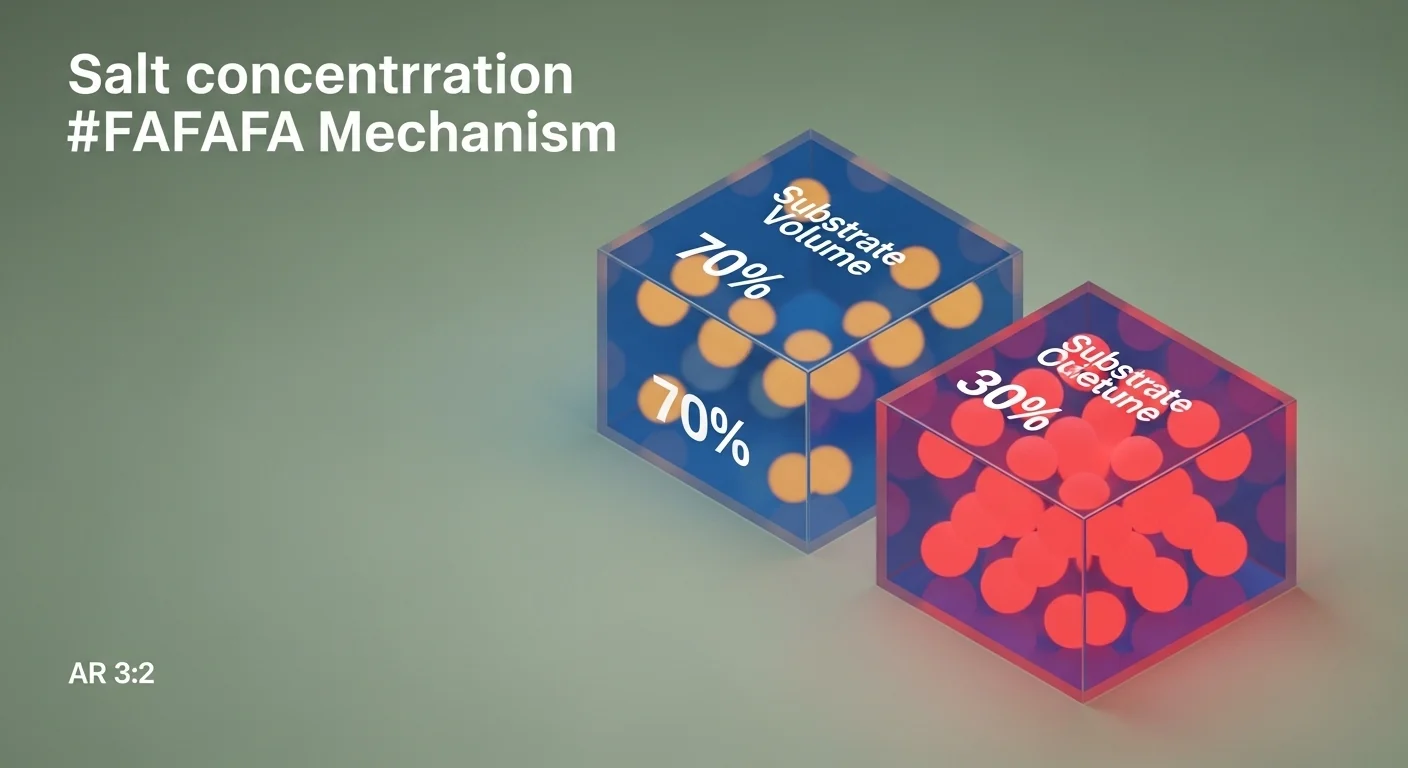
Every grower running Rockwool or coco coir knows the phrase “let it dry back.” What most dryback guides omit is the physics running underneath that decision: as substrate water evaporates, the salt mass does not leave with it. Dissolved nutrients stay locked in whatever water volume remains. That concentration effect is not linear and it is not gentle. At aggressive overnight dryback levels, a perfectly reasonable starting EC can double or triple inside the slab before the lights turn on.
This crop steering calculator quantifies two things simultaneously: how much water your substrate holds at full field capacity, and what your feed EC will physically concentrate to at your chosen dryback target. It does not predict plant uptake rates, root mass behavior, or cultivar-specific stress responses. It models the salt concentration physics only, based on the volumetric water content math that substrate sensors like the TEROS 12 measure in real time. Understanding how your nutrient dosing interacts with substrate volume is just as important as the dryback percentage itself.
after running this tool, you will know your exact EC spike ceiling at any dryback target and whether your current starting EC is safe to push that far without triggering root-zone salt toxicity.
Use the Tool
Crop Steering: Rockwool Dryback & Field Capacity
Calculate VWC targets, EC salt spikes, and dryback safety thresholds for precision crop steering.
| Dryback % | Target VWC % | Water Remaining | EC Spike | Risk |
|---|
How This Calculator Works — Formula & Assumptions
This crop steering calculator uses the physical relationship between water volume, VWC, and salt concentration to predict EC behavior during dryback.
Water_FC = SubstrateVol × (VWC% ÷ 100)How many liters/gallons of water are in the block when fully saturated.
TargetVWC% = VWC_FC% − Dryback%The VWC the block will reach before the next irrigation cycle begins.
EC_Spike ≈ InitialEC × (VWC_FC% ÷ TargetVWC%)As water evaporates, salt mass stays constant but volume shrinks — so EC concentration rises proportionally.
If Dryback > 40% → TRIGGER SALT TOXICITY LOCKOUTAt this level, EC typically exceeds safe root-zone limits and root burn risk becomes severe.
Assumptions & Limits:
- Model assumes uniform water distribution across the substrate block at all times.
- Salt mass is treated as conserved — irrigation salts do not evaporate with water.
- VWC at field capacity is measured immediately after full saturation (post-drain plateau).
- EC spike formula is a linear concentration model; actual plant uptake may slow EC rise slightly in late dryback.
- Calculator does not account for root uptake differential (roots absorb water faster than salts, so actual in-slab EC may spike faster than predicted).
- Values above 50% dryback are extrapolations beyond typical growing practice and should not be targeted.
- Temperature is not modeled; high temps increase evapotranspiration and accelerate dryback.
Before entering values, have your substrate slab specs on hand: physical dimensions or manufacturer-listed volume, a recent VWC reading at full saturation (taken immediately after your last irrigation drain plateau), your current target dryback as a percentage, and the EC reading from your substrate sensor or most recent drain runoff. If you are switching between Liters and Gallons, use the unit toggle above the inputs before calculating. For growers tracking irrigation EC rather than substrate EC, note that substrate EC typically reads higher than feed EC due to concentration in the slab.
Quick Start (60 Seconds)
- Substrate Volume: Enter the total physical volume of the slab or block, not the pot volume. A standard Grodan Hugo slab is 7.5 liters. Switch the unit toggle to Gallons if your scale is imperial before typing the number.
- VWC at Field Capacity: This is the VWC reading immediately after full saturation, once free drainage has stopped. For Rockwool it typically falls between 55 and 75. Do not use a mid-cycle reading, only the saturated peak value.
- Target Dryback: Enter the percentage you want the substrate to lose from field capacity before the next irrigation shot fires. Vegetative phases typically run 10 to 15. Flower phases commonly target 20 to 30. Do not enter a value above 40 expecting a safe result.
- Current Substrate EC: Use the EC value your in-slab sensor reports, or the most recent drain runoff EC if you do not have real-time sensors. Do not substitute your reservoir or feed EC here; they are not the same value.
- Click Calculate Dryback only after all four fields are filled. The button intentionally does nothing on empty or out-of-range inputs.
- Review the Steering Mode badge and the Dryback Stress Level gauge before acting on the EC spike result. A green gauge does not mean the EC spike is harmless if your starting EC is already elevated.
- Use the EC Physics Reference Table in the results to scan adjacent dryback levels and decide where your actual safe ceiling sits given your specific inputs.
Inputs and Outputs (What Each Field Means)
| Field | Unit | What it means | Common mistake | Safe entry guidance |
|---|---|---|---|---|
| Substrate Volume | Liters or Gallons | Total physical volume of the grow medium block or slab at full capacity | Confusing pot volume with slab volume, or measuring the outer slab dimensions instead of listed product specs | Use manufacturer spec sheets; Grodan Hugo slabs are 7.5 L, smaller cubes range from 0.5 to 2 L |
| VWC at Field Capacity | % | Volumetric water content of the substrate at full saturation after drainage stops | Using a daytime mid-cycle VWC reading instead of the post-irrigation peak value | Read immediately after the first morning irrigation once drain flow stops; sensor placement matters significantly |
| Target Dryback | % | The percentage of water loss from field capacity before re-irrigation triggers | Targeting the same dryback in veg and flower without adjusting EC accordingly | Stay below 40% under all circumstances; above this threshold the EC spike model enters lockout territory |
| Current Substrate EC | mS/cm | Electrical conductivity of the root-zone solution as measured in the slab | Using reservoir feed EC instead of substrate EC; substrate EC is usually higher due to salt accumulation | Use an EC reference tool if converting between measurement scales; substrate EC above 4.0 mS/cm warrants careful dryback planning |
| Water at Field Capacity (output) | Liters | Total water volume held in the substrate when fully saturated | Treating this as a watering volume target rather than a total capacity reference | This is the denominator for all EC concentration calculations; smaller blocks hold less buffer against EC spikes |
| Target VWC After Dryback (output) | % | The VWC level the substrate should reach before irrigation fires | Confusing this with a moisture deficit; the target VWC is the trigger floor, not the irrigation volume | Values below 25% indicate very high stress conditions regardless of substrate type |
| EC Spike at Target Dryback (output) | mS/cm | The predicted root-zone EC concentration at the target dryback level | Assuming EC remains constant through dryback when it physically cannot | Values above 5.0 mS/cm indicate root burn risk; values above 7.0 mS/cm indicate near-certain damage on contact |
| Steering Mode (output) | Classification | Categorizes the dryback target as Vegetative, Generative, High Stress, or Danger Zone based on the entered dryback percentage | Using the mode label as a growth guarantee rather than a stress direction indicator | Steering mode reflects dryback intensity only; EC spike and VWC floor should be evaluated independently |
Worked Examples (Real Numbers)
Example 1: Vegetative Block, Conservative Dryback
- Substrate: Grodan Hugo slab, 7.5 liters
- VWC at Field Capacity: 65%
- Target Dryback: 12%
- Current Substrate EC: 2.5 mS/cm
Water at field capacity: 7.5 x (65/100) = 4.875 L
Target VWC: 65 – 12 = 53%
EC spike: 2.5 x (65/53) = 3.07 mS/cm
Result: 4.88 L water at saturation, target VWC of 53%, EC concentrates to 3.07 mS/cm at the dryback floor.
This is a textbook vegetative steering window. The EC spike stays well below the 5.0 mS/cm risk threshold, and the target VWC remains high enough for strong root-zone buffering. No lockout risk present at this configuration.
Example 2: Aggressive Flower Dryback, EC Risk Threshold Crossed
- Substrate: 10-liter coco coir block
- VWC at Field Capacity: 60%
- Target Dryback: 25%
- Current Substrate EC: 3.0 mS/cm
Water at field capacity: 10 x (60/100) = 6.0 L
Target VWC: 60 – 25 = 35%
EC spike: 3.0 x (60/35) = 5.14 mS/cm
Result: 6.0 L at saturation, 35% target VWC, EC spikes to 5.14 mS/cm at the dryback floor.
The EC spike clears the 5.0 mS/cm burn threshold. A plant absorbing water at the dryback floor is drawing from solution at 5.14 mS/cm, not 3.0 mS/cm. To push a 25% flower dryback safely, the starting EC would need to be reduced below 2.9 mS/cm to keep the spike under the threshold.
Example 3: Overnight Lockout Event
- Substrate: 7.5-liter Rockwool slab
- VWC at Field Capacity: 68%
- Target Dryback: 42%
- Current Substrate EC: 3.0 mS/cm
Water at field capacity: 7.5 x (68/100) = 5.1 L
Target VWC: 68 – 42 = 26%
EC spike: 3.0 x (68/26) = 7.85 mS/cm
Result: 5.1 L at saturation, 26% target VWC, EC spikes to 7.85 mS/cm. Salt toxicity lockout threshold exceeded.
This is the overnight burn scenario. With 42% dryback, the slab reaches 26% VWC by morning. At lights-on the plant initiates transpiration, drawing 7.85 mS/cm solution through roots that expect 3.0 mS/cm. Root cell damage is immediate. The dryback percentage looked aggressive but manageable; the EC physics made it lethal.
Reference Table (Fast Lookup)
Baseline assumptions: 7.5 L Rockwool slab, VWC at field capacity 65%, starting substrate EC 3.0 mS/cm.
| Dryback % | Target VWC % | Water Remaining (L) | EC Spike (mS/cm) | EC Change from Start | Risk Level |
|---|---|---|---|---|---|
| 5% | 60% | 4.50 | 3.25 | +0.25 | Safe (Vegetative) |
| 10% | 55% | 4.13 | 3.55 | +0.55 | Safe (Vegetative) |
| 15% | 50% | 3.75 | 3.90 | +0.90 | Vegetative Ceiling |
| 20% | 45% | 3.38 | 4.33 | +1.33 | Generative |
| 25% | 40% | 3.00 | 4.88 | +1.88 | Generative (near limit) |
| 30% | 35% | 2.63 | 5.57 | +2.57 | High Risk |
| 35% | 30% | 2.25 | 6.50 | +3.50 | High Risk |
| 40% | 25% | 1.88 | 7.80 | +4.80 | LOCKOUT THRESHOLD |
| 45% | 20% | 1.50 | 9.75 | +6.75 | CRITICAL LOCKOUT |
The “EC Change from Start” column is the derived value competitors rarely show: this is the absolute increase in mS/cm your root zone absorbs relative to your starting measurement. At 30% dryback, you are not feeding at 3.0 mS/cm; you are feeding at 5.57 mS/cm. That gap is where damage originates.
How the Calculation Works (Formula + Assumptions)
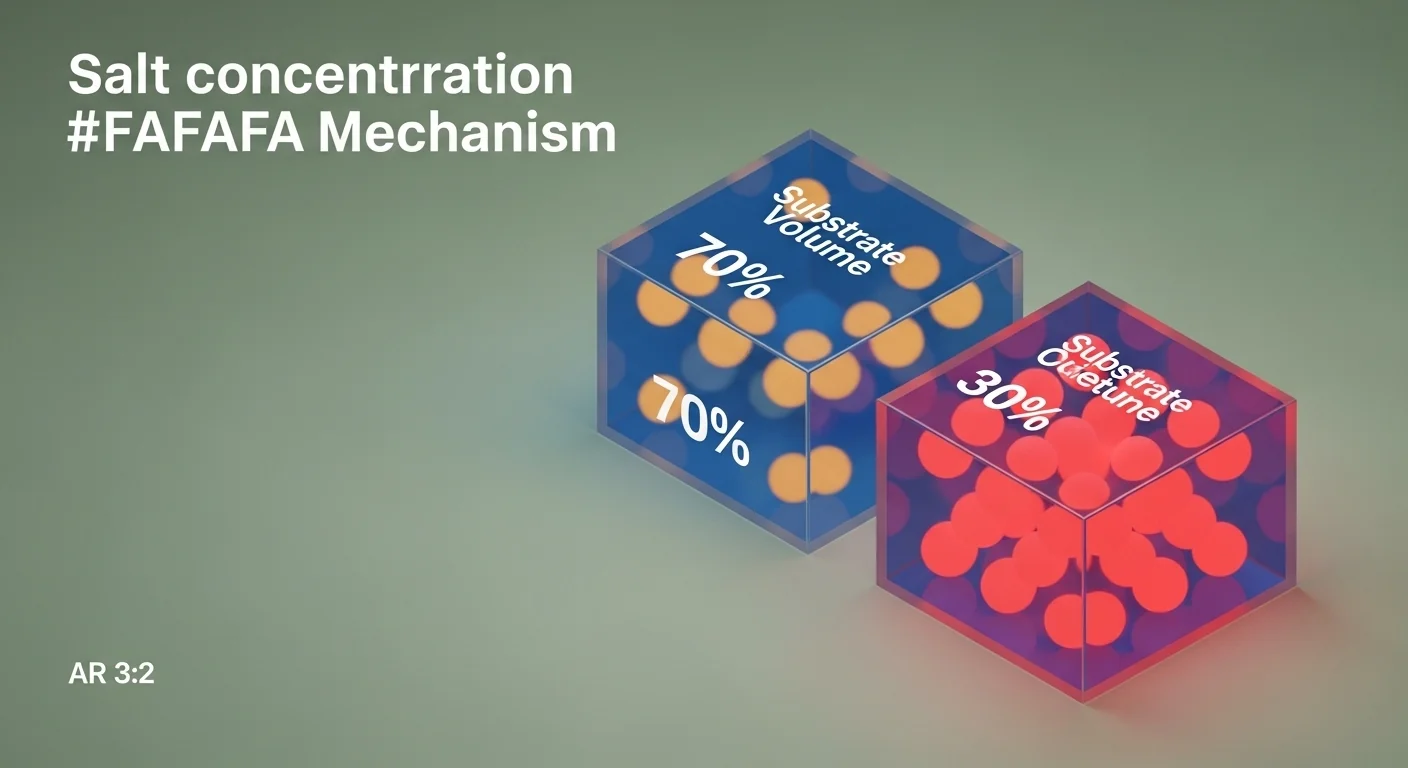
Show the calculation steps
Step 1: Water at Field Capacity
Water_FC = SubstrateVol x (VWC_FC / 100)
Multiply the substrate volume in liters by the field capacity VWC expressed as a decimal. A 7.5 L slab at 65% VWC holds 4.875 L of water. Round to two decimal places for reporting.
Step 2: Target VWC After Dryback
TargetVWC = VWC_FC – Dryback
Subtract the dryback percentage from field capacity VWC directly. Both values are in the same units (percentage points of volumetric water content). No conversion needed. Round to one decimal place.
Step 3: EC Spike at Target Dryback
EC_Spike = InitialEC x (VWC_FC / TargetVWC)
The ratio of field capacity VWC to target VWC is the concentration multiplier. Salt mass is conserved as water volume shrinks. Multiply initial EC by this ratio to get the predicted root-zone EC at the dryback floor. Round to two decimal places.
Step 4: Safety Gate
If Dryback exceeds 40%, the salt toxicity lockout threshold is triggered regardless of calculated EC. This is a hard boundary, not a guideline. Substrates below 25% VWC lose hydraulic connectivity in Rockwool and many coco products.
Unit Conversion: If volume is entered in Gallons, the calculator converts to Liters using the factor 1 Gallon = 3.78541 Liters before applying the formulas above. All outputs are reported in Liters.
Assumptions and Limits
- Salt mass is treated as fully conserved. The model assumes no salt precipitation, no root salt exclusion, and no significant foliar uptake altering substrate EC directly.
- Water distribution is assumed uniform across the substrate block at all measurement points. In practice, Rockwool has hydraulic gradients; top-of-slab and bottom-of-slab readings can differ by several percentage points.
- VWC at field capacity must be measured at the post-saturation drain plateau, not mid-irrigation. An inflated field capacity input produces an underestimated EC spike result.
- The concentration model is linear. In late-stage dryback, root uptake of water faster than salt uptake can cause actual in-slab EC to spike faster than the formula predicts, making this model slightly conservative at extreme dryback values.
- Temperature and transpiration rate are not modeled. High vapor pressure deficit conditions accelerate evapotranspiration and compress the time to dryback, increasing the overnight lockout risk even at nominally safe percentages. A slab that takes 6 hours to reach 20% dryback under mild conditions may reach the same point in 3 hours under high heat and low humidity.
- Values above 50% dryback are mathematical extrapolations. No grower should target this range; results are displayed only to illustrate the physics.
- Coco coir and Rockwool have different hydraulic characteristics. Field capacity and VWC sensor readings are not directly interchangeable between substrates without recalibration. For coco-specific preparation considerations, the coco buffering math reference provides supplementary context.
Standards, Safety Checks, and “Secret Sauce” Warnings
Critical Warnings

- The Overnight EC Spike: The most common undetected grow room failure is not a nutrient deficiency or pest. It is a plant consuming 5+ mS/cm solution at lights-on after an aggressive overnight dryback. The starting EC was 3.0 mS/cm. The substrate EC at 40% dryback is 7.8 mS/cm. The plant has no way to detect the difference until root damage is already occurring. This calculator makes that spike visible before it happens.
- The 40% Hard Ceiling: Dryback beyond 40% of field capacity is a salt toxicity trigger, not an aggressive generative technique. The formula output above that threshold is not theoretical; it reflects the physical concentration ratio of the remaining solution. Root burn from overnight lockout is not recoverable within the same crop cycle.
- EC Is Not Static: Growers who set a nutrient feed at 3.0 mS/cm and target 30% flower dryback are not feeding at 3.0 mS/cm. They are feeding at the spike value the formula produces, which in a 65% field capacity Rockwool slab exceeds 5.5 mS/cm. Every percentage of dryback applied is a multiplier on EC concentration.
- Small Blocks Spike Faster: A 1-liter propagation cube and a 10-liter Rockwool slab at the same dryback percentage do not behave identically. Smaller substrate volumes have less hydraulic buffering, so EC concentration at any given dryback is more localized and more damaging. This tool accepts volume as a primary input for this reason.
Minimum Standards
- Target VWC after dryback should remain at or above 25% for Rockwool to maintain hydraulic continuity to root hairs.
- EC spike at the dryback floor should remain below 5.0 mS/cm as a working safety margin for most cultivars under standard temperature and humidity conditions.
- Any substrate EC reading above 4.0 mS/cm before irrigation should trigger a review of dryback targets before the next overnight period.
Competitor Trap: Most crop steering guides online present dryback as a percentage with a simple “veg: 15%, flower: 30%” framework, with no mention of what happens to EC during that water loss. That approach is incomplete and potentially damaging. It treats EC as a static property of the nutrient solution when it is a dynamic property of whatever water remains in the substrate. Any grower following a dryback protocol without accounting for starting EC and block volume is operating without the key variable the outcome actually depends on. Growers monitoring VPD, DLI, and irrigation timing but skipping the DLI-linked irrigation modeling and EC concentration math are making decisions with half the picture.
Common Mistakes and Fixes
Mistake: Using Reservoir EC as the Substrate EC Input
Reservoir or feed solution EC is always lower than what accumulates in the substrate between irrigations. Salts concentrate in the slab as water is absorbed by roots and evaporates; the feed EC entering the system is not what the roots are bathing in during dryback. Entering a feed EC value of 2.0 mS/cm when the actual substrate EC is 3.5 mS/cm produces a calculated spike that is severely underestimated.
Fix: Use a substrate sensor reading or recent drain runoff EC for this field. If only feed EC is available, add at minimum 0.5 to 1.0 mS/cm as a conservative substrate correction before entering the value.
Mistake: Measuring VWC at Field Capacity Mid-Cycle

Field capacity is a specific physical state: the maximum water retention of the substrate after free drainage has fully stopped. Taking a VWC reading during active irrigation, shortly after a shot, or at any point before drainage flow has ceased will produce an inflated field capacity value. A falsely high field capacity input causes the model to underestimate the EC spike at any given dryback level.
Fix: Record VWC field capacity only at the stable plateau reading after the first heavy irrigation of the day, once runoff has slowed to a stop. Mark this reading in your grow logs and update it only when substrate conditions change.
Mistake: Applying the Same Dryback Target Regardless of Starting EC
A 25% dryback at 2.0 mS/cm starting EC produces a spike to roughly 3.25 mS/cm in a typical Rockwool slab. The same 25% dryback at 4.0 mS/cm starting EC produces a spike above 6.5 mS/cm. Growers who dial in their dryback percentages in early flower without adjusting for increasing substrate EC over the crop cycle create compounding risk as the run progresses. Converting between EC and PPM scales while troubleshooting can introduce additional confusion; use a PPM to EC conversion reference to avoid misreading sensor outputs.
Fix: Recalculate the EC spike projection every time substrate EC rises by more than 0.5 mS/cm from your original input value. Do not assume the same dryback target is safe across the full crop cycle.
Mistake: Targeting Maximum Dryback in Both Veg and Flower Phases
Generative steering using aggressive dryback is a flower-phase technique. Applying 25 to 30% dryback during vegetative growth applies osmotic stress that competes with the expansive cell growth veg steering is intended to produce. Vegetative stages benefit from high moisture availability and lower EC concentration, not the stress-concentration dynamic that drives flower site development.
Fix: Run 8 to 15% dryback during vegetative phases with high irrigation frequency. Reserve dryback targets above 20% for confirmed flower phase once root architecture and transpiration demand support the stress load. Cal-Mag demand also shifts significantly between phases, and calcium and magnesium dosing should be adjusted alongside phase transitions to maintain cation balance in the solution.
Mistake: Not Accounting for Block Size When Comparing Dryback Protocols
Grower forums frequently share dryback targets without listing substrate volume. A 30% overnight dryback on a 10-liter slab versus a 2-liter block produces completely different EC spike exposures and VWC floors, even if every other variable matches. Smaller blocks reach dangerous VWC floors faster and have less total buffer against salt concentration spikes.
Fix: Always note substrate volume alongside any shared dryback percentage. When adapting a protocol from a source using different block sizes, run both sets of inputs through this calculator separately before applying any dryback targets to your own system.
Next Steps in Your Workflow
Once you have your EC spike and target VWC values from this calculator, the next decision point is whether your current irrigation automation can actually trigger at the precise substrate VWC floor you just calculated. Data loggers like Aroya and Solus can fire irrigation shots based on sensor-triggered VWC thresholds, which makes this math actionable in real time. If your system uses time-based irrigation without VWC feedback, the dryback percentage you target is a rough estimate at best because substrate drydown rates shift with canopy size, light intensity, and vapor pressure deficit. Pairing this tool with a VPD-based transpiration reference helps you anticipate how fast a given dryback percentage will occur under different climate conditions.
The EC spike result also directly informs how you should adjust your starting feed EC heading into heavy flower. If the calculator shows your planned dryback pushes the spike above 5.0 mS/cm, you have two levers: reduce the starting EC of your feed, or reduce the dryback target. Both are valid. Many cultivars tolerate higher EC during mid-flower than early veg, but the ceiling is still a ceiling. Cross-reference your adjusted feed program against your full nutrient schedule to verify that lowering EC does not simultaneously create a macronutrient deficit in high-demand flower stages.
FAQ
What is field capacity in Rockwool?
Field capacity is the maximum volumetric water content a substrate holds after free drainage stops. In Rockwool, this typically falls between 55 and 75% VWC depending on slab density and fiber orientation. It is measured as a stable plateau reading on a substrate sensor immediately after a full saturation event, once drainage from the slab has slowed to a stop.
What is a safe dryback percentage for flower steering?
The dryback percentage alone is not sufficient to determine safety. A 25% dryback at a starting substrate EC of 2.0 mS/cm is materially different from the same dryback at 4.0 mS/cm. The EC spike at the dryback floor is the critical variable. As a working standard, keep the calculated EC spike below 5.0 mS/cm and ensure target VWC remains at or above 25%.
Why does EC spike during dryback?
Dissolved salts in the substrate solution do not evaporate with the water. As evapotranspiration removes water from the slab, the total salt mass stays in whatever water volume remains. A smaller water volume containing the same salt mass produces a proportionally higher concentration, which is what EC measures. This is a basic physical concentration effect, not a nutrient chemistry phenomenon.
How is this calculator different from reading a VWC sensor alone?
A VWC sensor tells you current water content. This calculator tells you what EC concentration the root zone will reach if water content drops to your target dryback level. The two data points are complementary. VWC sensors report what is happening; this tool predicts what will happen to nutrient concentration if the dryback proceeds to the intended target.
Can I use this calculator for coco coir substrates?
Yes. The underlying formula applies to any substrate where field capacity and EC can be measured. Coco coir typically has different hydraulic characteristics from Rockwool, including a lower native field capacity and higher cation exchange capacity, which affects base EC readings. Enter the actual measured field capacity VWC for your specific coco product rather than assuming a Rockwool-typical value.
What should I do if my EC spike result is above 5.0 mS/cm?
You have two primary adjustments available: reduce the target dryback percentage until the calculated spike drops below the threshold, or reduce your starting substrate EC before the overnight period. Flushing the substrate with a low-EC feed to bring the measured EC down before a heavy dryback period is a common corrective technique when substrate salt accumulation has drifted upward over a crop cycle.
Conclusion
The crop steering calculator resolves a specific and underappreciated problem: dryback percentages are commonly shared and discussed without the EC concentration physics that determine whether a given target is safe or damaging. Water volume changes during dryback, but salt mass does not. Every point of VWC the substrate loses is a multiplication event on root-zone EC. The value this tool produces, the EC spike at your target dryback floor, is the number that determines whether an aggressive overnight dryback program produces bigger flowers or burned roots.
The single most preventable mistake in substrate-based crop steering is entering a heavy flower dryback target without checking the resulting EC spike against the starting substrate EC. Growers who avoid this step are not running crop steering; they are running irrigation reduction with unknown chemical consequences. For growers extending this workflow into full environmental dialing, the grow room dehumidifier sizing calculator helps ensure that the increased transpiration pressure from generative dryback steering does not create humidity and disease conditions that cancel out the flower quality gains.