
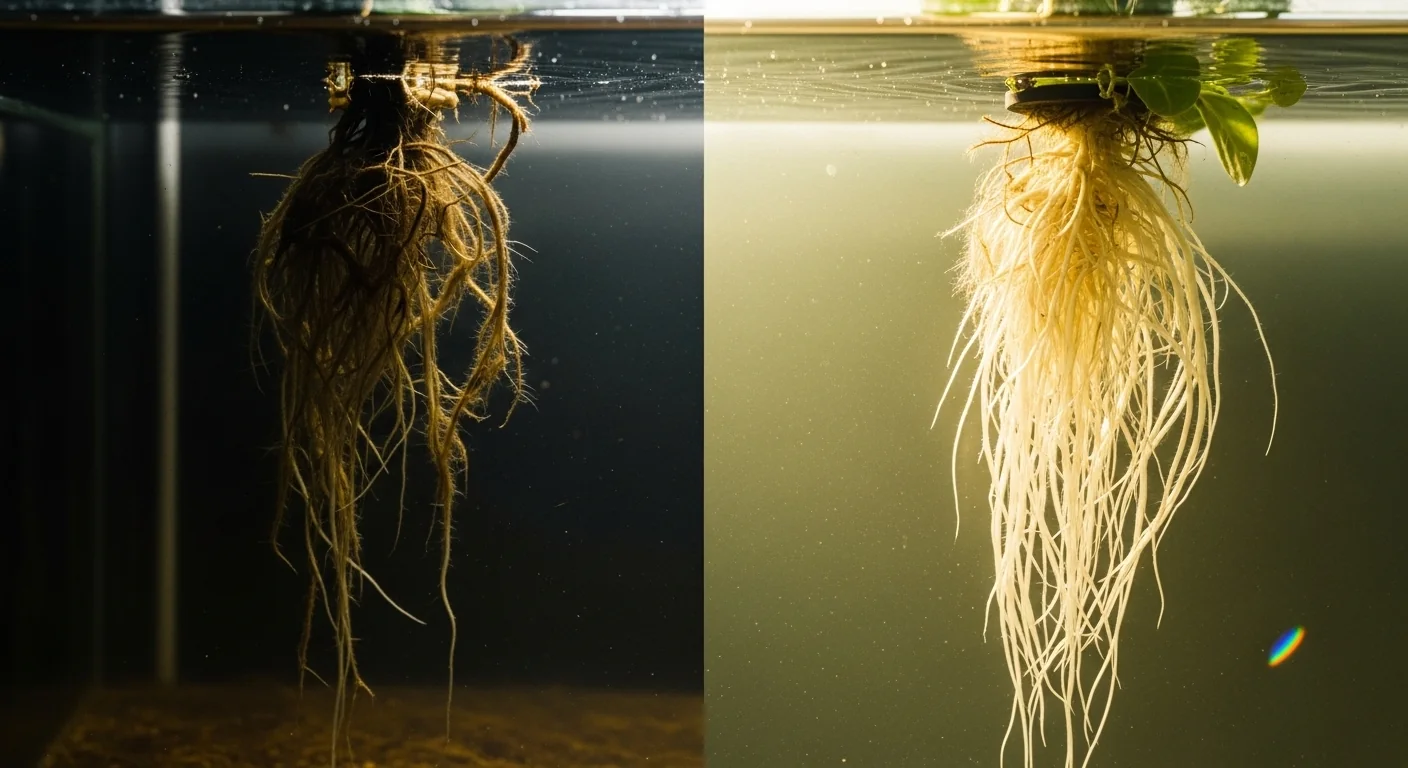
Reservoir temperature is not a secondary consideration in hydroponic management. It is a hard physical constraint. At 80°F and above, dissolved oxygen (DO) solubility drops sharply, and the pathogen Pythium becomes difficult to prevent regardless of sanitation protocols. At the other end, temperatures below 60°F throttle enzyme activity in root tissue, slowing nutrient transport even when the nutrient solution is perfectly balanced. The problem most growers face is not knowing how much water or ice to add to actually hit the target, rather than just guessing and rechecking.
This water temperature calculator solves two distinct problems in one interface. In Mix Water Mode, it applies Richmann’s Mixing Rule to calculate the exact volume of tap water needed to shift your reservoir from its current temperature to a specified target. In Ice Cube Mode, it switches to a latent heat of fusion calculation when your tap water is too warm to provide any cooling effect at all. What this tool does not do: it does not model heat gain from pumps, lights, or ambient air over time, and it does not replace a dedicated chiller in systems that require sustained temperature control across a full grow cycle.
After using this calculator, you will know the precise volume of water or weight of ice to add right now to reach your target reservoir temperature, along with whether that target falls inside or outside the biologically safe range for hydroponic root zones.
Use the Tool
| Parameter | Value | Unit |
|---|
| Temp Range (°F) | Zone | Effect on Plants & Nutrients |
|---|---|---|
| < 60°F | Too Cold | Slowed nutrient uptake, root damage risk |
| 60–64°F | Cool | Acceptable short-term; slower growth |
| 65–68°F | Ideal | Peak root oxygenation & nutrient absorption |
| 68–72°F | Ideal | Optimal grow range — most hydro systems |
| 72–75°F | Caution | DO levels drop; algae risk increases |
| 75–80°F | Warm | Root disease (Pythium) risk rises sharply |
| > 80°F | Danger | Pythium likely; DO critically low; plant stress |
How This Calculator Works
Mix Water Mode — Richmann’s Mixing Rule
When your tap water is cooler than the reservoir and you need to bring the temperature down (or up), we use Richmann’s Rule of Mixtures. This assumes water has a uniform specific heat capacity and mixing is homogeneous.
- V_res = current reservoir volume (gal)
- T_cur = current reservoir temperature (°F)
- T_target = desired target temperature (°F)
- T_tap = tap water temperature (°F)
- V_add = volume of tap water to add (gal)
The resulting final volume is V_res + V_add. The resulting temperature is verified using the same mixing formula.
Ice Cube Mode — Latent Heat of Fusion
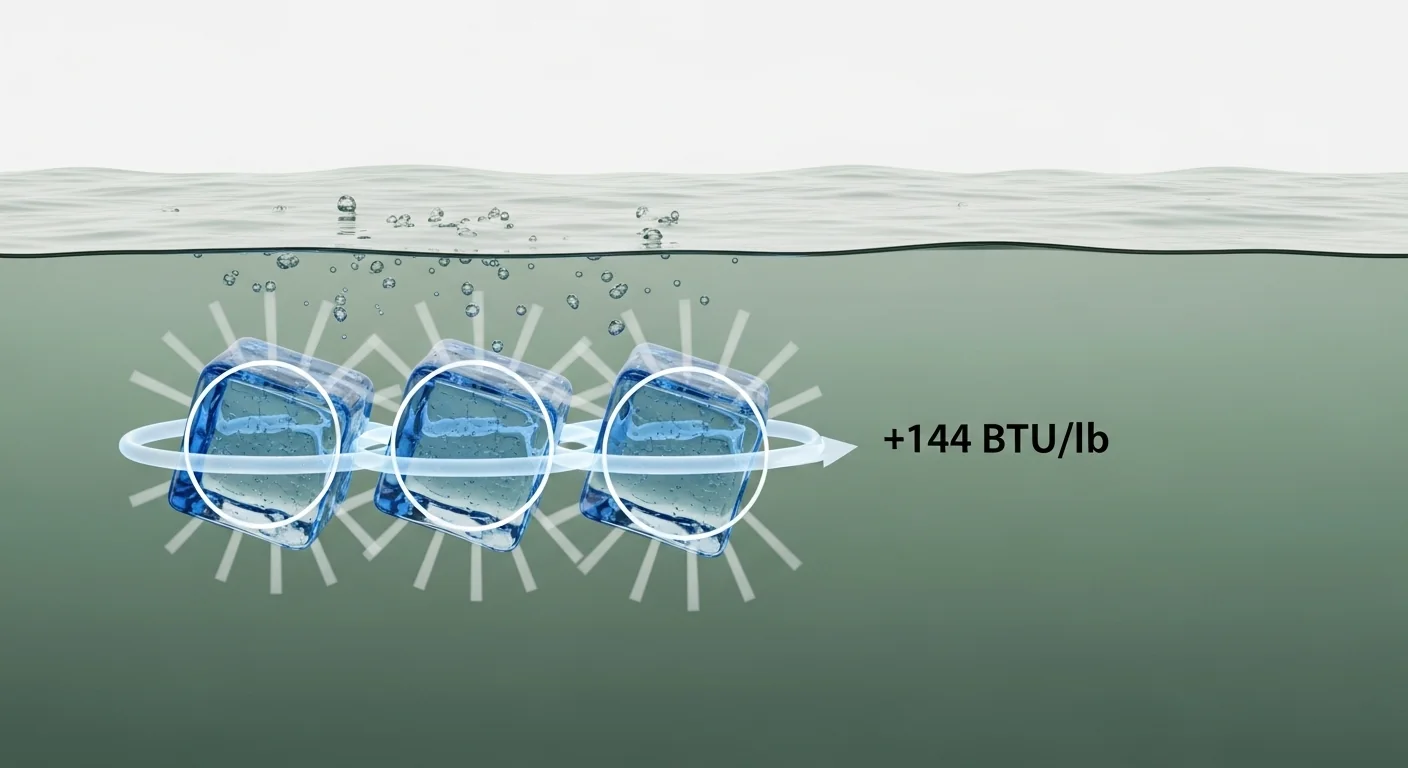
When tap water is too warm to cool your reservoir, ice is the answer. Ice absorbs energy in two phases: (1) melting (latent heat at 32°F / 0°C) and (2) the resulting meltwater warming to equilibrium.
- m_water = mass of reservoir water (lbs; 1 gal = 8.34 lb)
- Cp = specific heat of water = 1 BTU/lb·°F
- Lf = latent heat of fusion of ice = 144 BTU/lb
- ΔT = T_current − T_target
- m_ice = pounds of ice needed
Assumptions & Limits
- Water density assumed at 8.34 lb/gal (standard room temperature)
- Ice enters at exactly 32°F (0°C) — commercial or freezer ice
- No heat gain from environment during the mixing process
- Nutrient solution modeled as pure water (minor variation in practice)
- Dissolved oxygen (DO) changes are not calculated — monitor separately
- Results are estimates; actual reservoir conditions may vary slightly
- For large systems (>500 gal), a dedicated water chiller is recommended
- Valid input ranges: Temperatures 32°F–212°F; Volumes 0.1–10,000 gal
Before calculating, have your current reservoir volume in US gallons, a thermometer reading of your reservoir water, your target temperature, and either your tap water temperature (for Mix Water Mode) or confirmation that tap water is too warm to cool (for Ice Cube Mode). A digital probe thermometer is strongly recommended over strip thermometers for accuracy. Temperature management is inseparable from other climate variables; if you also manage canopy vapor pressure, the VPD calculator pairs well with reservoir work since root zone and aerial microclimate interact.
Quick Start (60 Seconds)
- Choose your mode first. If your tap water temperature is at or above your target reservoir temperature, skip Mix Water Mode entirely and go directly to Ice Cube Mode. Adding warm tap water to a warm reservoir cannot produce cooling.
- Current Reservoir Volume (gal): Measure actual water volume, not tank capacity. A 50-gallon reservoir running at 40 gallons changes the math significantly.
- Current Reservoir Temp (°F): Measure near the center of the reservoir, away from heater or chiller outlets and away from the surface. Surface readings are not representative.
- Target Temp (°F): Enter your intended final temperature. The ideal range for most hydroponic crops is 65 to 72°F. Do not enter a target equal to your current temperature.
- Tap Water Temp (°F) (Mix Water Mode only): Test your tap water as it runs, not from a stored container. Municipal tap temperature can vary by several degrees seasonally.
- Ice Cube Mode inputs: You only need reservoir volume, current temperature, and target temperature. The calculator derives the ice mass needed from those three values alone.
- Read the zone indicator in the results panel. The color-coded gauge shows whether your target temperature falls in the safe, caution, or danger zone before you act.
Inputs and Outputs (What Each Field Means)
| Field Name | Unit | What It Means | Common Mistake | Safe Entry Guidance |
|---|---|---|---|---|
| Current Reservoir Volume | US gal | The actual volume of water currently in the reservoir, not the tank’s rated capacity | Entering rated tank size instead of current fill level | 0.1 to 10,000 gal; measure by fill level if tank is partially empty |
| Current Reservoir Temp | °F | The bulk temperature of the existing reservoir water | Reading surface temperature, which is typically warmer than bulk | 32 to 212°F; measure mid-depth, away from inlets and outlets |
| Target Temperature | °F | The temperature you want the reservoir to reach after mixing | Setting target equal to current temperature (no change needed) | 32 to 212°F; must differ from current temp; 65-72°F is the standard hydroponic range |
| Tap Water Temperature | °F | The temperature of the water being added from the tap (Mix Water Mode only) | Assuming tap water is always cool; it can exceed 75°F in summer months | 32 to 212°F; if tap temp is at or above target temp, switch to Ice Cube Mode |
| Water to Add (output) | gal | Volume of tap water to add to reach the target temperature via Richmann’s Rule | Adding water without accounting for reservoir overflow | Ensure your reservoir has capacity for the added volume before mixing |
| Ice Needed (output) | lbs | Mass of ice at 32°F required to cool the reservoir to target temperature (Ice Cube Mode) | Weighing ice after partial melting; use fresh ice at freezer temperature | Commercial or household freezer ice; assumes ice enters at exactly 32°F |
| Final Volume (output) | gal | Total reservoir volume after water or ice meltwater is added | Ignoring volume increase, which dilutes nutrient concentration | Recheck EC and pH after any volume addition; recalibrate nutrients accordingly |
| Achieved Temp (output) | °F | Verified final temperature calculated from the mixing formula | Assuming this equals the target exactly under all conditions | Real-world result may vary slightly due to heat exchange with environment during mixing |
| Temp Drop (output) | °F | The absolute difference between current and final temperature | Not comparing this to actual post-mix thermometer readings to verify | Always verify with a thermometer after mixing; large drops may require multiple additions |
Worked Examples (Real Numbers)
Scenario 1: Cooling a Summer DWC Reservoir with Cool Tap Water
- Current reservoir volume: 50 gal
- Current reservoir temperature: 78°F
- Target temperature: 68°F
- Tap water temperature: 58°F
Result: Using Richmann’s Mixing Rule, V_add = 50 x (78 – 68) / (68 – 58) = 50 x 10 / 10 = 50.00 gallons of tap water. Final volume: 100 gal. Achieved temperature: (50 x 78 + 50 x 58) / 100 = 7800 / 100 + 2900 / 100 = 68.0°F.
This scenario produces a 1:1 ratio because the temperature gap between reservoir and target matches the gap between target and tap exactly. Doubling reservoir volume is significant; nutrients will be diluted and EC must be rechecked after mixing.
Scenario 2: Warming a Cold Winter Reservoir with Warm Tap Water
- Current reservoir volume: 30 gal
- Current reservoir temperature: 58°F
- Target temperature: 66°F
- Tap water temperature: 80°F
Result: V_add = 30 x (58 – 66) / (66 – 80) = 30 x (-8) / (-14) = 240 / 14 = 17.14 gallons of warm tap water. Final volume: 47.14 gal. Achieved temperature: (30 x 58 + 17.14 x 80) / 47.14 = (1740 + 1371.2) / 47.14 = 66.0°F.
Warming via tap water requires the tap temperature to exceed the target, which is common in warmer months but may not apply in winter. If tap water in your facility runs below 66°F in cold seasons, a reservoir heater or an inline water heater may be the only viable solution. The greenhouse heater sizing tool covers ambient heating requirements if the facility itself contributes to reservoir heat loss.
Scenario 3: Ice Cube Mode for a Dangerously Warm Reservoir
- Reservoir volume: 40 gal
- Current reservoir temperature: 82°F
- Target temperature: 68°F
- Tap water temperature: 75°F (too warm to use in Mix Water Mode)
Result: Water mass = 40 x 8.34 = 333.6 lbs. Temperature drop = 82 – 68 = 14°F. Ice needed = (333.6 x 1.0 x 14) / (144 + 1.0 x (68 – 32)) = 4670.4 / (144 + 36) = 4670.4 / 180 = 25.95 lbs of ice. Ice meltwater adds approximately 3.11 gallons, bringing final volume to about 43.11 gal.
At 82°F, Pythium and DO depletion are active threats. Twenty-six pounds of ice is a substantial quantity to have on hand, highlighting why this scenario calls for a long-term chiller solution rather than repeated ice additions as a primary strategy.
Reference Table (Fast Lookup)
| Reservoir Vol (gal) | Current Temp (°F) | Target Temp (°F) | Tap / Mode | Water or Ice to Add | Final Volume (gal) |
|---|---|---|---|---|---|
| 20 | 78 | 68 | 58°F tap (Mix) | 20.00 gal | 40.00 |
| 50 | 78 | 68 | 58°F tap (Mix) | 50.00 gal | 100.00 |
| 100 | 78 | 68 | 58°F tap (Mix) | 100.00 gal | 200.00 |
| 50 | 80 | 68 | 60°F tap (Mix) | 75.00 gal | 125.00 |
| 50 | 75 | 68 | 55°F tap (Mix) | 26.92 gal | 76.92 |
| 30 | 78 | 65 | 55°F tap (Mix) | 39.00 gal | 69.00 |
| 40 | 82 | 68 | Ice Cube Mode | 25.95 lbs ice | 43.11 |
| 50 | 82 | 68 | Ice Cube Mode | 32.43 lbs ice | 53.89 |
| 100 | 82 | 68 | Ice Cube Mode | 64.87 lbs ice | 107.78 |
| 50 | 85 | 68 | Ice Cube Mode | 39.42 lbs ice | 54.73 |
Note: Ice meltwater volumes are computed at 8.34 lb/gal. Rows using Mix Water Mode show exact Richmann results. Larger volumes require proportionally more water or ice; the ratio of water-to-add vs. current volume is constant for a given temperature combination.
How the Calculation Works (Formula + Assumptions)
Show the calculation steps
Mix Water Mode: Richmann’s Mixing Rule
Richmann’s Mixing Rule states that when two bodies of water at different temperatures are combined, the resulting temperature is the mass-weighted average of the two temperatures. For water at standard conditions, mass is proportional to volume (density is treated as uniform), so the formula simplifies to a volume-weighted average:
V_add = V_reservoir x (T_current – T_target) / (T_target – T_tap)
Where all volumes are in gallons and all temperatures in degrees Fahrenheit. The sign of the numerator and denominator must both be negative (cooling scenario) or the formula will produce a negative volume, signaling an invalid input combination. Final temperature is verified by:
T_final = (V_reservoir x T_current + V_add x T_tap) / (V_reservoir + V_add)
Rounding: Results are displayed to two decimal places for volumes and one decimal place for temperatures.
Ice Cube Mode: Latent Heat of Fusion
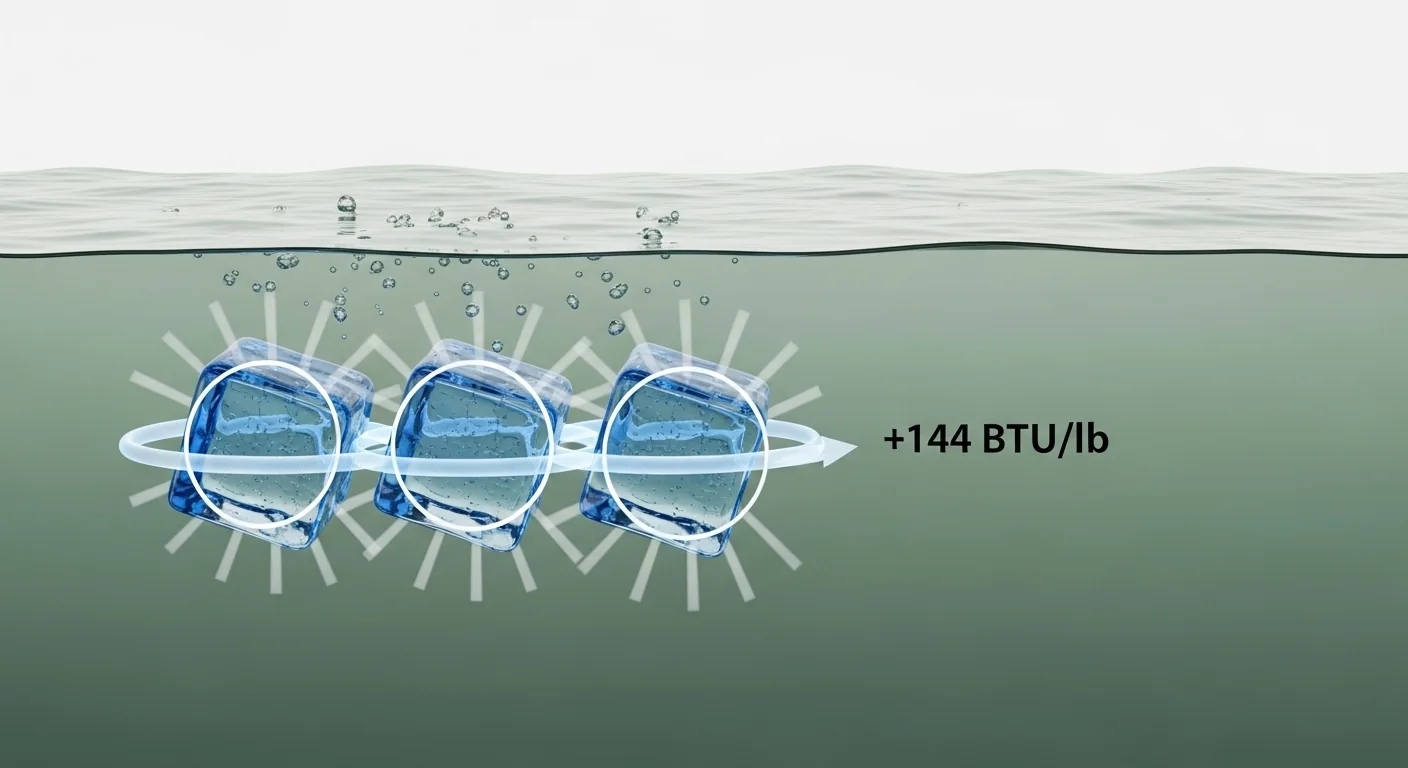
When tap water cannot provide cooling because it is at or above the target temperature, ice removes heat in two phases. First, ice absorbs its latent heat of fusion (144 BTU/lb) as it melts at 32°F without changing temperature. Second, the resulting meltwater warms from 32°F to the final equilibrium temperature, absorbing additional sensible heat.
The heat the reservoir must lose:
Q_reservoir = m_water x Cp x (T_current – T_target)
The heat each pound of ice absorbs:
Q_ice_per_lb = Lf + Cp x (T_target – 32)
Solving for ice mass:
m_ice = (m_water x Cp x delta_T) / (Lf + Cp x (T_target – 32))
Constants used: Cp = 1.0 BTU/lb/°F, Lf = 144 BTU/lb, water density = 8.34 lb/gal.
Rounding: Ice mass displayed to two decimal places in pounds. Meltwater volume shown to two decimal places in gallons.
Assumptions and Limits
- Water density is assumed to be 8.34 lb/gal (approximately 62°F). At 80°F it is closer to 8.31 lb/gal; this introduces a minor error of less than 0.5% in ice calculations.
- Ice is assumed to enter the reservoir at exactly 32°F. Warmer ice (partially melted) delivers less cooling capacity per pound.
- No heat exchange with the environment is modeled during mixing. In practice, the reservoir will gain or lose some heat from ambient air during and after mixing, particularly in uninsulated reservoirs.
- The nutrient solution is modeled as pure water. Dissolved salts alter specific heat slightly; at typical hydroponic EC levels (1.5 to 3.5 mS/cm) the effect is negligible.
- Dissolved oxygen (DO) dynamics are not calculated. The tool shows a zone warning but does not quantify how much DO changes with temperature.
- Volume additions from ice meltwater are included in the final volume calculation but are not reflected in a nutrient dilution warning. Recheck EC after any large ice addition.
- The tool is not suitable as the sole control mechanism for systems requiring sustained temperature regulation. It is a point-in-time calculation.
- Valid ranges: temperatures 32 to 212°F, volumes 0.1 to 10,000 gallons.
Standards, Safety Checks, and “Secret Sauce” Warnings
Critical Warnings
- Tap water at or above your target temperature cannot cool your reservoir. This is a physical impossibility, not an edge case. If your tap reads 72°F and your target is 68°F, Mix Water Mode will block the calculation and redirect you to Ice Cube Mode. Do not attempt to estimate a partial cooling effect by eye.
- Above 72°F, dissolved oxygen levels decline with every degree. At 80°F, DO in water drops to approximately the level where Pythium (root rot) proliferates rapidly in most recirculating hydroponic systems. The zone indicator in this tool flags the danger boundary at 75°F as a caution and 80°F as a critical alert, consistent with published hydroponic crop management standards.
- Large water additions dilute nutrient concentration. Adding 50 gallons to a 50-gallon reservoir halves your EC. Failure to recheck and correct nutrient levels after temperature correction is one of the most common causes of secondary deficiency symptoms in DWC and recirculating NFT systems.
- Ice additions are a short-term intervention, not a long-term strategy. If your reservoir consistently reaches temperatures requiring Ice Cube Mode, a dedicated chiller is the engineering solution. The hydroponic water chiller calculator can help size a unit for your system volume and heat load.
Minimum Standards
- Target reservoir temperature for most hydroponic crops: 65 to 72°F. High-value crops such as lettuce and leafy greens perform best toward the lower end of this range (65 to 68°F) where DO solubility is highest.
- Below 60°F: treat as a cold-stress event. Root enzyme activity slows and nutrient uptake rates decline even in a properly balanced solution. If the reservoir drops below this threshold repeatedly, review your ambient temperature management alongside the reservoir system.
- Aeration rate affects effective DO regardless of temperature. If your reservoir temperature is in range but plants show symptoms of oxygen deprivation, review pump sizing before blaming temperature alone. The DWC air pump calculator can assess whether your current aeration is adequate for your system volume.
Competitor Trap: Many water mixing guides online present only the simplified temperature-averaging formula without addressing the physical constraint that tap water must be cooler than the target in order to cool the reservoir at all. If a grower follows those guides during a summer heat event when tap water is 73°F and the target is 68°F, every gallon they add raises the reservoir temperature, making the problem worse. This calculator blocks that failure mode explicitly.
Common Mistakes and Fixes
Mistake: Measuring Reservoir Temperature at the Surface
Surface temperature is almost always higher than bulk temperature due to heat absorption from ambient air and light sources. A grower measuring 74°F at the surface may have 71°F in the bulk, which changes both the urgency and the volume of water needed. Inserting a probe thermometer to mid-depth and away from inlets gives a representative reading.
Fix: Always measure bulk temperature at mid-depth before entering any value into this calculator.
Mistake: Entering Tank Rated Capacity Instead of Actual Fill Volume
A 100-gallon reservoir running at 60 gallons produces a very different water-addition target than a full tank. The formula uses actual water mass; an overstated volume causes the calculator to prescribe more water than is actually needed, and the resulting temperature overshoot moves the reservoir past the target in the wrong direction.
Fix: Use a sight gauge, a float measurement, or fill-to-mark volume tracking to determine actual current volume before calculating.
Mistake: Ignoring EC Dilution After Temperature Correction
Temperature correction often requires adding substantial volumes of water. A 50-gallon reservoir receiving 50 gallons of cool tap water doubles in volume and halves its nutrient concentration. Growers who correct temperature but not EC afterward may diagnose the resulting deficiency symptoms as a pH or lockout problem and waste time troubleshooting the wrong variable. Checking EC right after mixing is a non-optional step.
Fix: After completing the temperature correction, measure EC immediately and re-dose nutrients to the appropriate target range for your crop stage. See the hydroponic EC calculator for nutrient concentration guidance.
Mistake: Using Partially Melted Ice in Ice Cube Mode
Ice that has been sitting at room temperature for even a short time has already absorbed some of its latent heat of fusion. When partially melted ice is added, it delivers less cooling effect per pound than the 144 BTU/lb constant used in the formula. The result is a reservoir that ends up warmer than the target despite having added the calculated ice mass.
Fix: Use ice directly from a freezer at or near 32°F. If ice has been sitting at room temperature, add a modest buffer of 10 to 15% more ice by weight than calculated.
Mistake: Treating Ice Mode as a Substitute for a Chiller
Reservoirs that consistently require Ice Cube Mode calculations are systems that have a structural thermal problem: insufficient insulation, excessive pump heat, proximity to heat-generating equipment, or inadequate facility cooling. Ice is a rapid-response tool for acute heat events, not a system design solution. Repeated ice additions also increase water handling workload and introduce contamination risk if bulk ice storage conditions are poor.
Fix: Use Ice Cube Mode results to quantify the cooling demand, then use that BTU figure as the basis for sizing a dedicated chiller unit.
Next Steps in Your Workflow
Once you have added the calculated volume of water or the calculated mass of ice, wait 10 to 15 minutes with your circulation pump running before taking a follow-up temperature reading. Temperature stratification in reservoirs can persist briefly after mixing if the pump flow rate is low. The post-mix reading is your confirmation that the single-point calculation tracked reality; if the result is off by more than 1 to 2 degrees, remeasure your inputs and recalculate rather than adding more water or ice by feel.
After confirming temperature, your next measurement is EC. Large water additions change nutrient concentration, and large ice additions also dilute the solution as meltwater accumulates. For growers managing precise nutrient ratios, a quick check with the PPM to EC converter against your target solution strength will confirm whether a top-up is needed before returning plants to normal operation.
FAQ
What is the ideal water temperature for hydroponics?
The most widely cited range for recirculating hydroponic systems is 65 to 72°F. Within this band, dissolved oxygen solubility is high enough to support healthy root respiration, and beneficial microbial activity is within normal bounds. Some high-oxygen crops such as lettuce perform best toward the lower end, while warmth-tolerant crops may tolerate up to 74°F short-term without measurable harm.
Why can’t I just add cold tap water if my tap is 70°F and my target is
68°F?
Because Richmann’s Mixing Rule requires the additive to be cooler than the target. At 70°F tap water added to a 78°F reservoir, the mixture will settle somewhere between 70 and 78°F, never reaching 68°F regardless of how much tap water you add. The calculator detects this condition automatically and redirects to Ice Cube Mode.
How much does dissolved oxygen actually change with temperature?
DO saturation in water decreases as temperature rises. At 65°F, freshwater saturation is approximately 9.4 mg/L. At 75°F it drops to around 8.1 mg/L. At 85°F it falls below 7.2 mg/L, a level where root zone oxygen stress becomes likely in high-demand crops. The calculator does not compute exact DO values but the zone thresholds reflect these biological breakpoints.
What if my reservoir is outdoors and gains heat quickly after I cool it?
This calculator is a point-in-time tool. It tells you how to reach the target temperature at the moment of mixing but does not model ongoing heat gain from sunlight, ambient air, or pump heat. Outdoor or high-heat-load systems require a chiller capable of matching the continuous heat input rate. Use the ice calculation result to estimate BTU demand per hour and size accordingly.
Does adding ice harm my nutrient solution?
Pure ice does not introduce contaminants directly, but commercial ice can vary in water quality. Any ice addition dilutes the existing nutrient solution because the meltwater adds volume without adding nutrients. After any ice addition large enough to change the reservoir volume by more than a few gallons, measure EC and pH and adjust both back to target values before resuming normal operation.
Is the formula accurate for saltwater or nutrient-dense solutions?
The calculation uses pure water constants (density 8.34 lb/gal, Cp 1.0 BTU/lb/°F). Dissolved salts reduce specific heat slightly and increase density. At typical hydroponic nutrient concentrations (EC below 5 mS/cm), the deviation is small enough to be within the margin of real-world mixing variability. At unusually high nutrient concentrations, expect a small systematic underestimate of cooling effect.
Conclusion
The one mistake worth repeating from this page: adding tap water to cool a reservoir when tap water is at or above the target temperature makes the problem worse, not better. Every gallon added in that scenario raises the final equilibrium temperature. If your climate or facility creates this condition repeatedly, the correct long-term tool is a water chiller, and understanding the dew point and ambient humidity conditions in your grow space can also reveal whether condensation, evaporation, or radiant gain is the dominant heat source. The dew point calculator is a useful companion if ambient conditions are part of the thermal management challenge.