
CO2 Tank Duration Calculator
Estimate how long your CO2 tank will last in your grow room or greenhouse
Greenhouse & Hydroponics
Running out of CO2 mid-cycle is not a minor inconvenience -- it is a measurable setback for any crop that depends on enriched atmospheres to hit yield targets. The variable that most growers underestimate is not tank size or flow rate in isolation; it is the interaction between flow rate and duty cycle. A regulator set to 1 SCFH running 30 minutes per hour consumes exactly half as much gas as the same regulator running continuously -- yet the overwhelming majority of online duration estimates treat CO2 as if it flows 24/7.
This CO2 calculator accepts four real inputs: tank weight in pounds, flow rate in standard cubic feet per hour (SCFH), burn time (the fraction of each hour the regulator is actually open), and your daily operating hours. It outputs total active hours of CO2 supply and a refill timeline based on your schedule. It does not model room volume, actual PPM concentration, or plant uptake rates -- those variables require atmospheric modeling well beyond what a single-input duration tool can support.
After running your numbers, you will know whether your current tank size and regulator setting can sustain your grow cycle without a mid-run refill -- and exactly how many days you have before the tank runs dry.
Use the Tool
Before entering values, have your regulator's SCFH dial setting ready along with your timer configuration (how many minutes per hour the solenoid is open). Tank weight should reflect the current fill level, not the labeled capacity -- a partially used tank produces proportionally shorter run times. If you are running a carbon scrubber in a sealed room, note that scrubbers do not consume CO2 directly, but proper carbon filter sizing affects how well your room stays sealed, which directly impacts CO2 retention efficiency.
Quick Start (60 Seconds)
- Tank Size: Select the preset (5, 10, 20, or 50 lb) or choose "Custom" and enter the actual weight. Use the weight of CO2 remaining, not the tare weight of the cylinder itself.
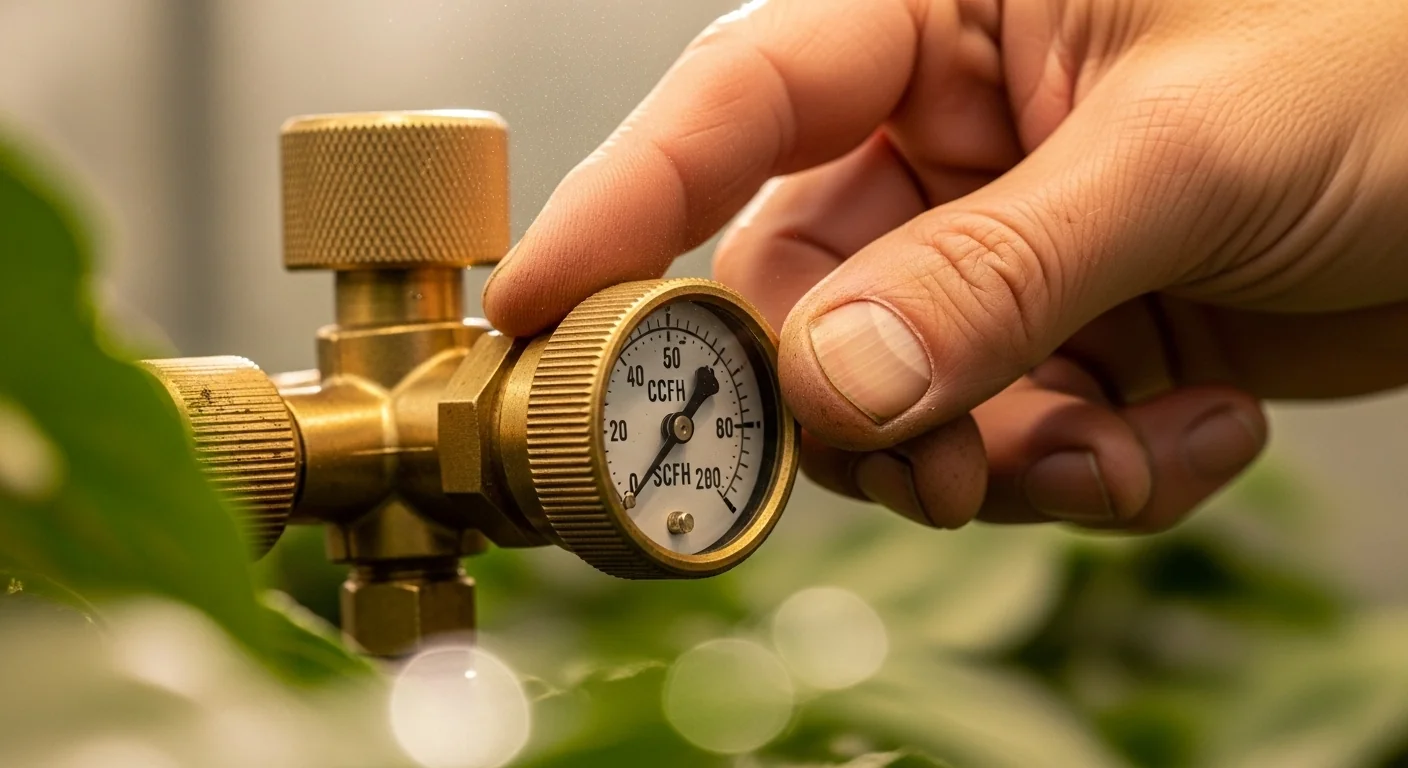
- Flow Rate (SCFH): Read this directly from your CO2 regulator's flow gauge. Typical indoor grow settings range from 0.3 to 2 SCFH. Do not guess -- small errors here compound over hours.
- Burn Time (mins/hr): Enter how many minutes per hour your solenoid or timer keeps the regulator open. If you run CO2 continuously, enter 60. If you use a 15-minute-on, 45-minute-off cycle, enter 15.
- Daily Use Hours: Enter the number of hours per day your CO2 system is active. This is used exclusively to calculate the refill timeline in calendar days.
- All four fields are required before the calculator will run. Leaving any field blank blocks the calculation and shows an inline error message.
- Unit reminder: Flow rate must be in SCFH (standard cubic feet per hour), not CFM (cubic feet per minute) or liters per minute. Entering CFM instead of SCFH produces a result roughly 60 times shorter than actual.
- Custom tank tip: If you have an unusual cylinder (35 lb, 75 lb, etc.), select "Custom weight" and enter the exact value. Supported range is 1 to 300 lbs.
Inputs and Outputs (What Each Field Means)
| Field | Unit | What it means | Common mistake | Safe entry guidance |
|---|---|---|---|---|
| Tank Size | lbs | Weight of CO2 gas inside the cylinder at fill capacity | Using labeled capacity instead of actual remaining fill | Weigh the cylinder on a scale and subtract tare weight if partially used |
| Custom Tank Weight | lbs | Exact CO2 weight for non-standard cylinders | Entering total cylinder weight including steel | Tare weight is stamped on the collar of most cylinders; subtract it from gross weight |
| Flow Rate | SCFH | Volume of CO2 gas delivered per hour when the regulator is open | Reading CFM or LPM from the gauge and entering that value directly | 1 CFM = 60 SCFH; 1 LPM = 0.0353 SCFH -- convert before entering |
| Burn Time | mins per hour | How many minutes per hour the regulator is actively delivering CO2 | Entering 60 for systems on a timer, when the solenoid is only open 10-20 minutes per hour | Check your timer settings directly; do not estimate |
| Daily Use Hours | hrs per day | Total hours per day CO2 is scheduled to run (used only for refill day calculation) | Entering 24 for a light-cycle-only CO2 schedule that actually runs 12-16 hours | CO2 enrichment is typically active only during the photoperiod; match your light schedule |
| Tank Duration (output) | hours | Total active hours of CO2 supply based on inputs | Confusing "active hours" with calendar hours -- the tank does not run continuously | Divide by your daily use hours to get calendar days |
| Refill Alert (output) | days | Calendar days until refill at your specified daily schedule | Ignoring this value and running to empty rather than scheduling a refill proactively | Order or schedule a refill when you hit roughly 25 days remaining on a 50 lb tank |
Worked Examples (Real Numbers)
Example 1: Small Grow Tent with a 20 lb Tank
- Tank size: 20 lb
- Flow rate: 0.5 SCFH
- Burn time: 15 minutes per hour
- Daily use: 12 hours
Gas volume: 20 x 8.74 = 174.8 cu ft. Usage per active hour: 0.5 x (15 / 60) = 0.125 cu ft. Duration: 174.8 / 0.125 = 1,398 hours.
Result: At 12 hours per day, this tank lasts approximately 116 days -- nearly four months without a refill. This scenario reflects a conservative timer setting that preserves gas effectively for a single-tent operation.
Example 2: Mid-Scale Greenhouse, 50 lb Tank
- Tank size: 50 lb
- Flow rate: 1.5 SCFH
- Burn time: 20 minutes per hour
- Daily use: 16 hours
Gas volume: 50 x 8.74 = 437.0 cu ft. Usage per active hour: 1.5 x (20 / 60) = 0.5 cu ft. Duration: 437.0 / 0.5 = 874 hours.
Result: At 16 hours per day, this configuration yields approximately 54.6 days. A 50 lb tank is a workable solution for this setup, though a bimonthly exchange schedule should be planned in advance.
Example 3: Aggressive Enrichment, 20 lb Tank
- Tank size: 20 lb
- Flow rate: 2.0 SCFH
- Burn time: 30 minutes per hour
- Daily use: 18 hours
Gas volume: 20 x 8.74 = 174.8 cu ft. Usage per active hour: 2.0 x (30 / 60) = 1.0 cu ft. Duration: 174.8 / 1.0 = 174.8 hours.
Result: At 18 hours per day, this tank empties in approximately 9.7 days. High flow rates with long duty cycles consume a 20 lb tank faster than most growers expect. Stepping up to a 50 lb cylinder, or reducing the duty cycle, would extend intervals significantly.
Reference Table (Fast Lookup)
| Tank (lbs) | Flow Rate (SCFH) | Burn Time (min/hr) | Gas Volume (cu ft) | Usage/Active Hr (cu ft) | Duration (hrs) | At 12 hrs/day (days) | At 16 hrs/day (days) |
|---|---|---|---|---|---|---|---|
| 5 | 0.5 | 15 | 43.7 | 0.125 | 349.6 | 29.1 | 21.9 |
| 10 | 0.5 | 15 | 87.4 | 0.125 | 699.2 | 58.3 | 43.7 |
| 20 | 0.5 | 15 | 174.8 | 0.125 | 1,398.4 | 116.5 | 87.4 |
| 20 | 1.0 | 20 | 174.8 | 0.333 | 524.6 | 43.7 | 32.8 |
| 20 | 2.0 | 30 | 174.8 | 1.000 | 174.8 | 14.6 | 10.9 |
| 50 | 0.5 | 15 | 437.0 | 0.125 | 3,496.0 | 291.3 | 218.5 |
| 50 | 1.5 | 20 | 437.0 | 0.500 | 874.0 | 72.8 | 54.6 |
| 50 | 3.0 | 30 | 437.0 | 1.500 | 291.3 | 24.3 | 18.2 |
| 100 | 1.5 | 20 | 874.0 | 0.500 | 1,748.0 | 145.7 | 109.3 |
The "Usage/Active Hr" column is the derived figure -- calculated as Flow Rate x (Burn Time / 60) -- and is the variable most commonly omitted from manual estimates. Comparing rows within the same tank size shows how dramatically duty cycle shifts the outcome without changing tank size at all.
How the Calculation Works (Formula + Assumptions)
Show the calculation steps
Step 1 -- Convert tank weight to gas volume:
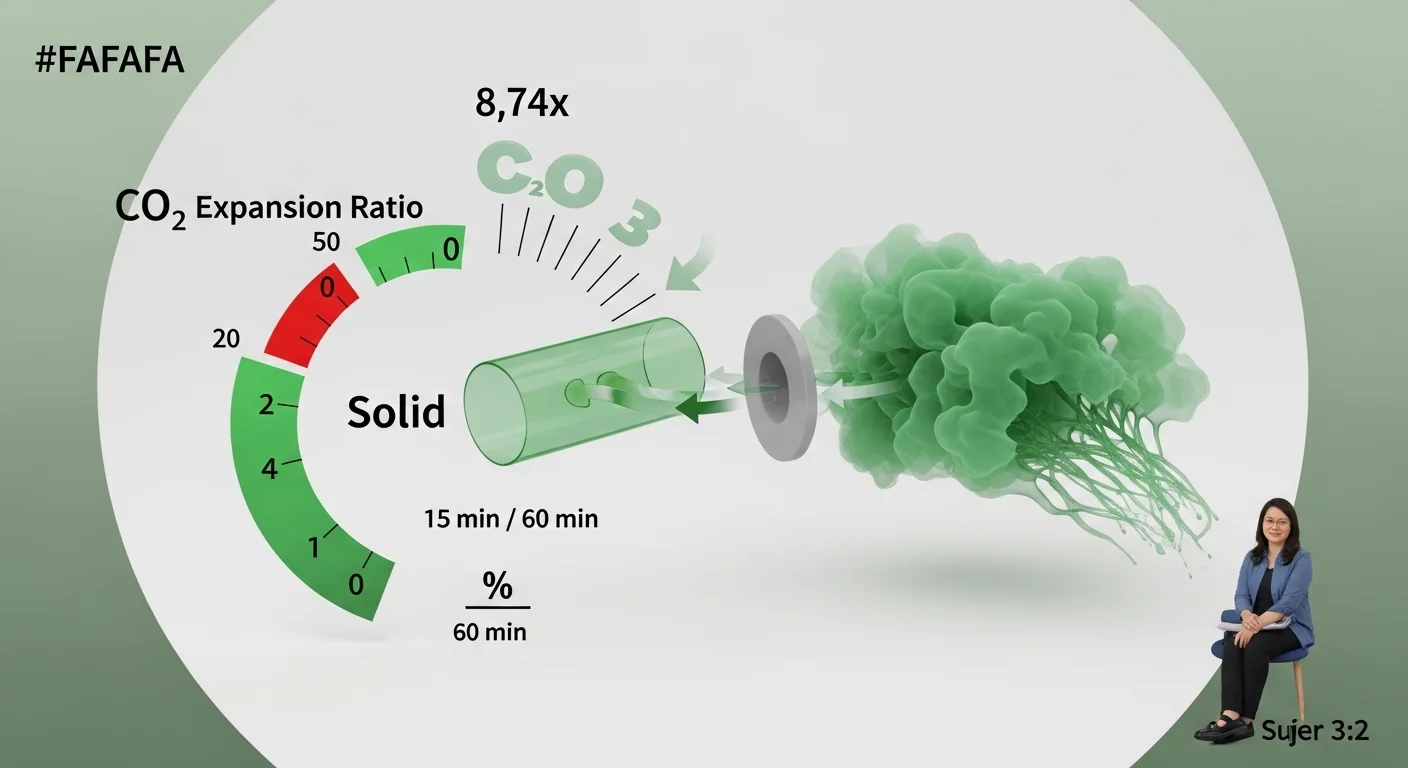
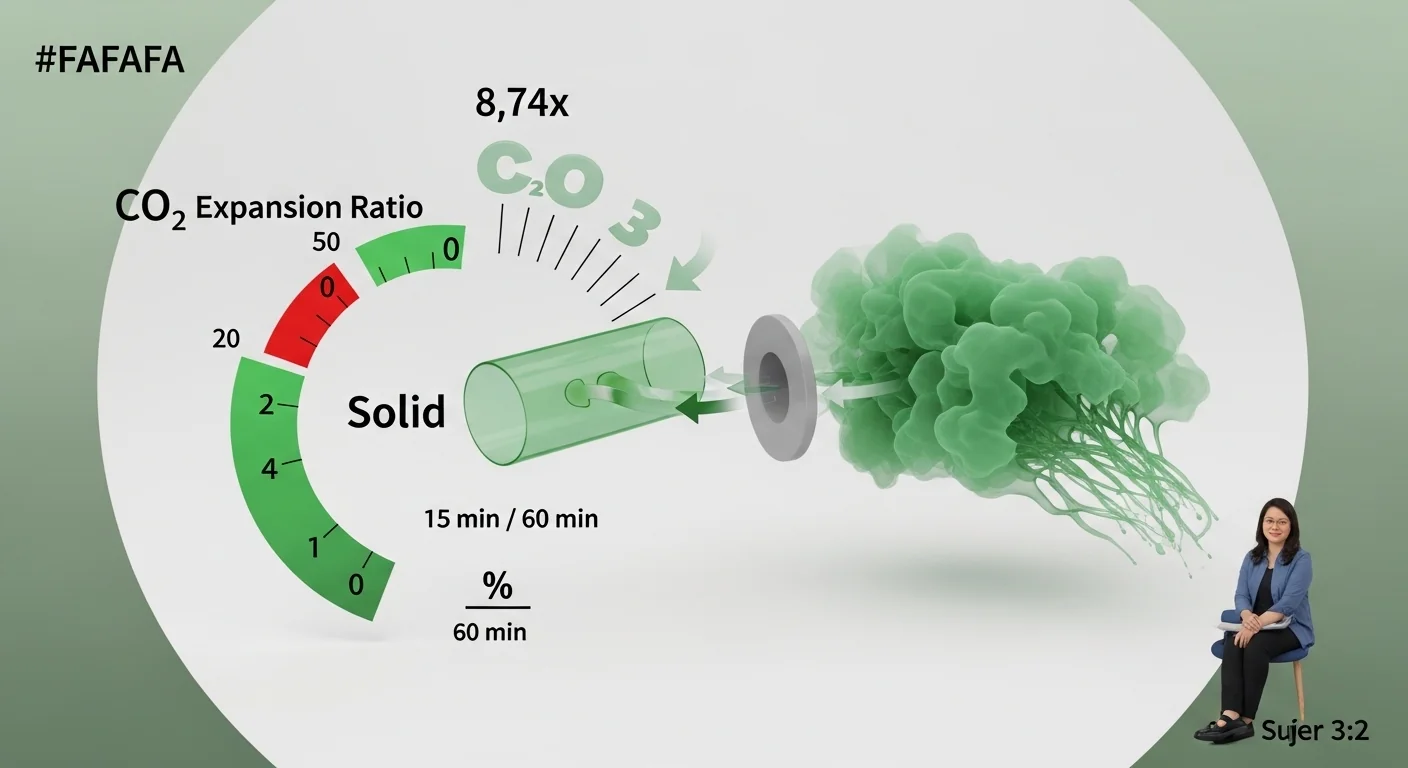
CO2 expands at a ratio of approximately 8.74 cubic feet per pound at standard temperature and pressure (70 degrees F / 21 degrees C, 1 atmosphere). Multiply tank weight in pounds by 8.74 to get total available gas in cubic feet.
Gas Volume (cu ft) = Tank Weight (lbs) x 8.74
Step 2 -- Calculate actual usage per active hour:
The burn time input converts a timer's duty cycle into a fractional hour. Dividing burn minutes by 60 gives the fraction of each hour the regulator is open. Multiply that fraction by the flow rate to get real consumption per active hour.
Usage per Hour (cu ft) = Flow Rate (SCFH) x (Burn Minutes / 60)
Step 3 -- Calculate tank duration in active hours:
Divide total gas volume by usage per active hour to get the number of hours the tank will supply CO2 while the system is running.
Duration (hrs) = Gas Volume (cu ft) / Usage per Hour (cu ft)
Step 4 -- Convert to calendar days:
Divide total active hours by daily use hours to translate the duration into a refill schedule expressed in days.
Days = Duration (hrs) / Daily Use Hours (hrs/day)
Rounding: All intermediate values are computed in full precision. The primary output is rounded to one decimal place. Reference table values are rounded to one decimal place for readability.
Assumptions and Limits
- The 8.74 cu ft/lb expansion factor applies at 70 degrees F and 1 atmosphere. Cold storage environments (below 50 degrees F) reduce actual expansion, meaning the tank may deliver slightly less gas than calculated.
- Flow rate is assumed to be constant and stable at the regulator's set value throughout the tank's life. In practice, flow rate can drop slightly as tank pressure decreases below approximately 500 PSI.
- Tank fill is assumed to be 100% at the weight entered. If entering a partially used tank, weigh the cylinder and subtract the tare weight stamped on the collar before entering the value.
- No leaks, line losses, or pressure drops are modeled. A faulty check valve or loose fitting can drain a tank significantly faster than calculated.
- The calculator does not model room volume, air exchange rate, or CO2 concentration (PPM). It computes gas supply duration only, not whether that gas is sufficient to reach a target concentration.
- Maximum supported inputs: 300 lbs tank weight, 50 SCFH flow rate, 60 minutes burn time. Values outside these ranges are blocked by inline validation.
- Results are estimates. Real-world duration typically varies plus or minus 10 to 15 percent depending on tank age, ambient temperature, and regulator calibration drift.
Standards, Safety Checks, and "Secret Sauce" Warnings
Critical Warnings
- The duty cycle is the hidden variable. Entering your flow rate without accounting for burn time produces an estimate that is often 3 to 4 times longer than reality. A regulator set to 1 SCFH running 15 minutes per hour consumes exactly 0.25 cu ft per active hour -- not 1. Every duration estimate that ignores this will be off by the same factor.
- Flow rate units must match. Regulator gauges in North America are commonly labeled in SCFH, but some imported units display LPM (liters per minute) or CFM (cubic feet per minute). Entering a CFM value as SCFH produces a result 60 times larger than actual. Verify your gauge's unit label before entering any number.
- Partial tanks produce pro-rated results. A 20 lb cylinder that is only half full contains the equivalent of a 10 lb fill. Always weigh the cylinder and subtract tare weight for mid-cycle calculations.
- CO2 enrichment without adequate light produces minimal crop benefit. Elevated CO2 increases photosynthesis rates only when light levels are also elevated. Using this DLI calculator alongside CO2 duration planning helps ensure your light and gas schedules are aligned for actual plant response.
Minimum Standards
- For most indoor cannabis and vegetable crops, a target of 1,000 to 1,500 ppm CO2 is standard. A practical midpoint of 1,200 ppm is widely referenced across controlled environment agriculture guidelines.
- CO2 enrichment is only productive during the photoperiod. Running CO2 during dark hours in a sealed room produces no photosynthetic benefit and wastes supply. Set your daily use hours to match your light-on period.
- For greenhouse applications where natural CO2 exchange occurs through vents, enrichment is most effective when ventilation is minimized. The greenhouse CO2 calculator accounts for room volume and exchange rate to help size supplementation correctly for non-sealed environments.
Competitor Trap: Most CO2 duration calculators on the web use a simplified formula: Gas Volume / Flow Rate. That approach assumes the regulator runs continuously at full flow, 24 hours a day, which is almost never how grow room CO2 systems operate. The result is a duration estimate that overstates actual tank life by a factor proportional to your duty cycle. A timer set to 15 minutes on, 45 minutes off means the true consumption rate is one quarter of the regulator's stated flow. Calculators that omit burn time and daily hours are not calculating your situation -- they are calculating a theoretical maximum that no real installation matches. Tools that also ignore the CO2 burner heat load produced by propane or natural gas CO2 generators miss an additional variable; those systems interact with the CO2 burner heat load in ways that require separate AC or ventilation sizing.
Common Mistakes and Fixes
Mistake: Using Flow Rate as the Only Variable
Entering only tank size and flow rate while ignoring burn time treats the regulator as if it runs 60 minutes per hour. In most timer-controlled grow rooms, the solenoid is open for 10 to 20 minutes per hour, making actual consumption a fraction of the stated SCFH. This mistake consistently produces estimates that are 3 to 6 times longer than actual tank life.
Fix: Check your timer controller's on/off settings and enter the actual open minutes per hour in the Burn Time field.
Mistake: Treating Daily Hours as 24
The refill timeline calculation depends on how many hours per day the CO2 system is scheduled to run. Entering 24 when your system only operates during a 12-hour photoperiod produces a refill date that is twice as far away as reality. The system will run out of CO2 before the calculated date.
Fix: Enter your actual photoperiod or CO2 schedule duration -- the number of hours per day the timer allows the system to operate, not the number of hours in a day.
Mistake: Ignoring Ventilation Rate in Non-Sealed Rooms
This calculator estimates supply duration, not atmospheric concentration. In rooms with active exhaust fans or frequent air exchanges, CO2 leaks out faster than in sealed environments. A grow room with high air exchange rates may never reach target PPM even with a correctly sized tank. Many growers attribute this to an undersized tank when the real issue is ventilation design. A properly sized exhaust system, modeled with a grow tent fan size calculator, interacts directly with CO2 retention.
Fix: Seal the room as thoroughly as possible during CO2 injection periods or use supplemental CO2 designed for non-sealed, high-exchange environments.
Mistake: Entering Cylinder Tare Weight Instead of CO2 Weight
An empty 20 lb CO2 cylinder typically weighs 7 to 9 lbs on its own. If a grower weighs a cylinder and enters the gross weight (cylinder plus gas), the resulting gas volume calculation overstates available CO2. If they enter only the tare weight without gas, the estimate is essentially zero.
Fix: The tare weight is stamped on the cylinder collar as "TW" followed by a number in pounds. Subtract this from the scale reading to get the actual CO2 weight remaining.
Mistake: Assuming CO2 Enrichment Works at Low Light Levels
Elevated CO2 increases the rate of photosynthesis only when light intensity is sufficient to drive that reaction. At low daily light integral (DLI) levels, plants are already light-limited and cannot use additional CO2. Running CO2 enrichment under low-light conditions wastes gas without producing measurable growth response. This is a frequently overlooked interaction, especially during propagation or early seedling stages. Proper humidity management through a grow room dehumidifier calculator and light planning should accompany any CO2 regime.
Fix: Confirm your canopy-level PPFD and daily light integral support elevated CO2 utilization before enriching. Most published guidelines recommend a minimum of 600 to 800 PPFD for CO2 enrichment to produce a meaningful response.
Next Steps in Your Workflow
Once you have your tank duration and refill date, the next question is whether your flow rate and room configuration will actually achieve target CO2 concentration. Duration tells you how long the gas supply lasts; it does not confirm that your room will reach 1,200 ppm or maintain it through a full photoperiod. For sealed grow spaces, the calculation is straightforward: volume times target concentration divided by CO2 density at STP gives you a delivery target in cubic feet. For greenhouses with passive or active ventilation, that calculation becomes more complex. Vapor pressure deficit management, tracked with the VPD calculator, also interacts with CO2 enrichment -- stomatal conductance determines how effectively plants use the CO2 you are supplying, and VPD drives stomatal behavior.
For growers running CO2 alongside a sealed, climate-controlled environment, the next practical step is confirming that your HVAC and dehumidification capacity can handle the thermal and humidity load of a fully sealed space. Sealing a room tightly enough to retain CO2 also traps heat and transpired moisture. Planning your greenhouse fan and airflow configuration to handle internal circulation without venting CO2 outside is the practical engineering step that follows any CO2 sizing calculation.
FAQ
How long does a 20 lb CO2 tank last in a grow room?
It depends on flow rate and duty cycle. At 0.5 SCFH with a 15-minute-per-hour burn time (0.125 cu ft per active hour), a 20 lb tank provides approximately 1,398 active hours. At 12 hours per day, that is roughly 116 days. At 2 SCFH with 30-minute burn time (1 cu ft per active hour), the same tank lasts only 175 hours, or about 10 days at 18 hours per day.
What is SCFH and how do I find it on my CO2 regulator?
SCFH stands for Standard Cubic Feet per Hour -- the volume of CO2 gas delivered at standard temperature and pressure conditions. Most CO2 regulators for grow room use have a flow gauge on the secondary (outlet) side. Look for the needle dial and its corresponding unit label; common markings are SCFH, CFH, or occasionally LPM. If your gauge reads LPM, multiply by 0.0353 to convert to SCFH before entering the value.
Does temperature affect how long my CO2 tank lasts?
Indirectly, yes. The 8.74 cu ft per pound expansion constant used in this calculator applies at approximately 70 degrees F. Cold environments compress CO2 back toward liquid phase more readily, potentially reducing deliverable gas volume slightly. More practically, very cold storage conditions can cause regulator freeze-up and inconsistent flow delivery, which affects real-world duration independent of the calculation.
Should I run CO2 during lights-off periods?
For most crops, no. Photosynthesis requires both light and CO2. During dark periods, plants respire rather than photosynthesize and cannot use supplemental CO2 productively. Running CO2 during lights-off wastes tank supply without producing growth benefit. Setting your daily use hours equal to your photoperiod is the standard approach for light-cycle-based CO2 management.
What is the difference between a CO2 tank calculator and a CO2 ppm
calculator?
A CO2 tank duration calculator (this tool) tells you how long your gas supply will last based on tank weight, flow rate, and duty cycle. A CO2 ppm calculator estimates what atmospheric concentration you can achieve in a given room volume at a given delivery rate. They answer different questions and require different inputs. This tool does not model room volume or target concentration -- it calculates supply duration only.
Is a 50 lb CO2 tank worth it compared to a 20 lb tank?
For most grow rooms running CO2 year-round, a 50 lb cylinder offers a meaningful reduction in refill frequency at a cost-per-pound advantage common with larger fills. The total gas volume is 2.5 times greater (437 cu ft vs 174.8 cu ft), so at identical flow settings, it lasts 2.5 times longer. The tradeoff is cylinder weight and handling, which can be a practical constraint in small spaces or when personal lifting capacity is limited.
Conclusion
The #1 mistake to avoid is using duration estimates that ignore your timer's duty cycle. Enter your actual burn time setting, not 60 minutes, unless your system truly runs continuously. Once you have an accurate duration, pair it with a scheduled refill date, a sealed-room plan, and a lighting strategy that supports CO2 utilization. For growers moving from CO2 tanks to propane or natural gas CO2 generators, the sizing logic changes substantially -- reviewing the greenhouse heater and heat load tools is a reasonable starting point for understanding the thermal interaction those systems introduce.