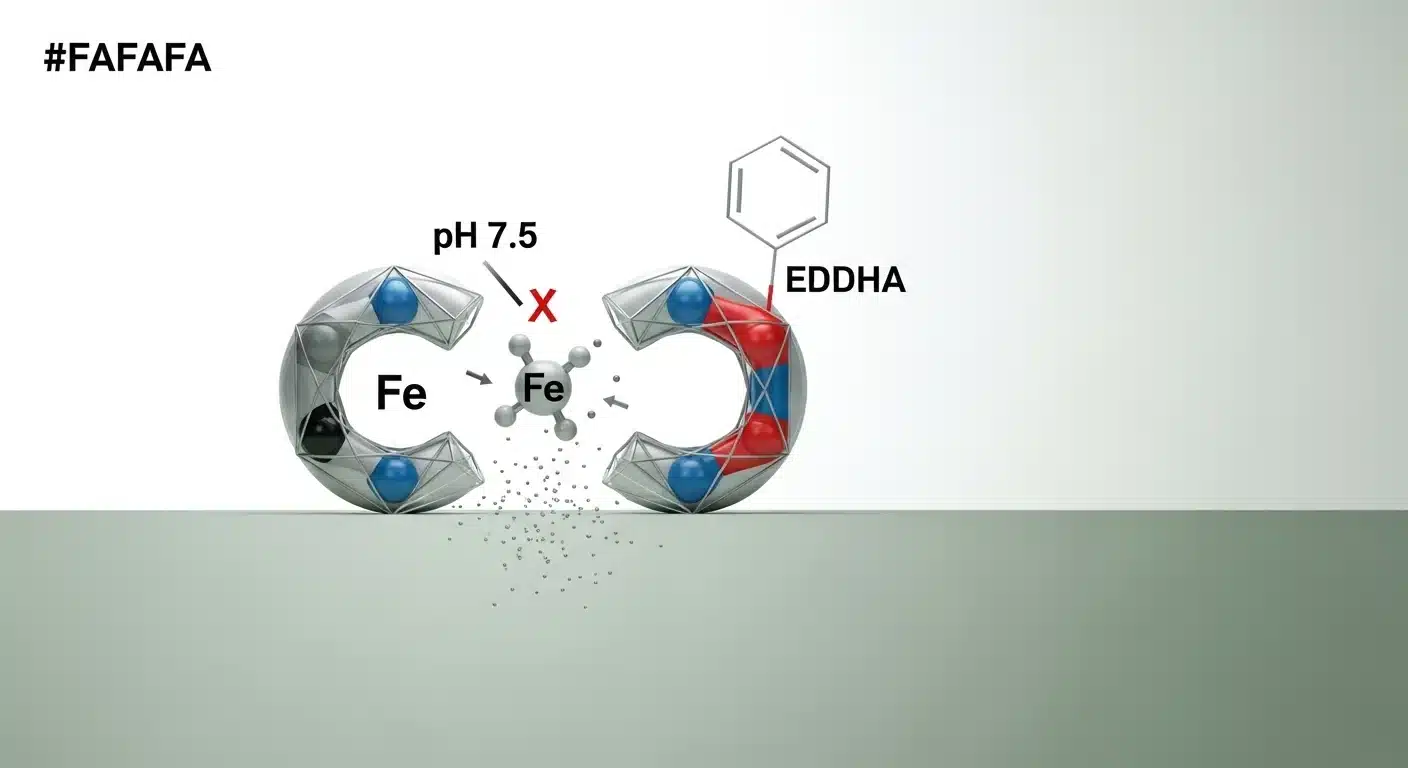
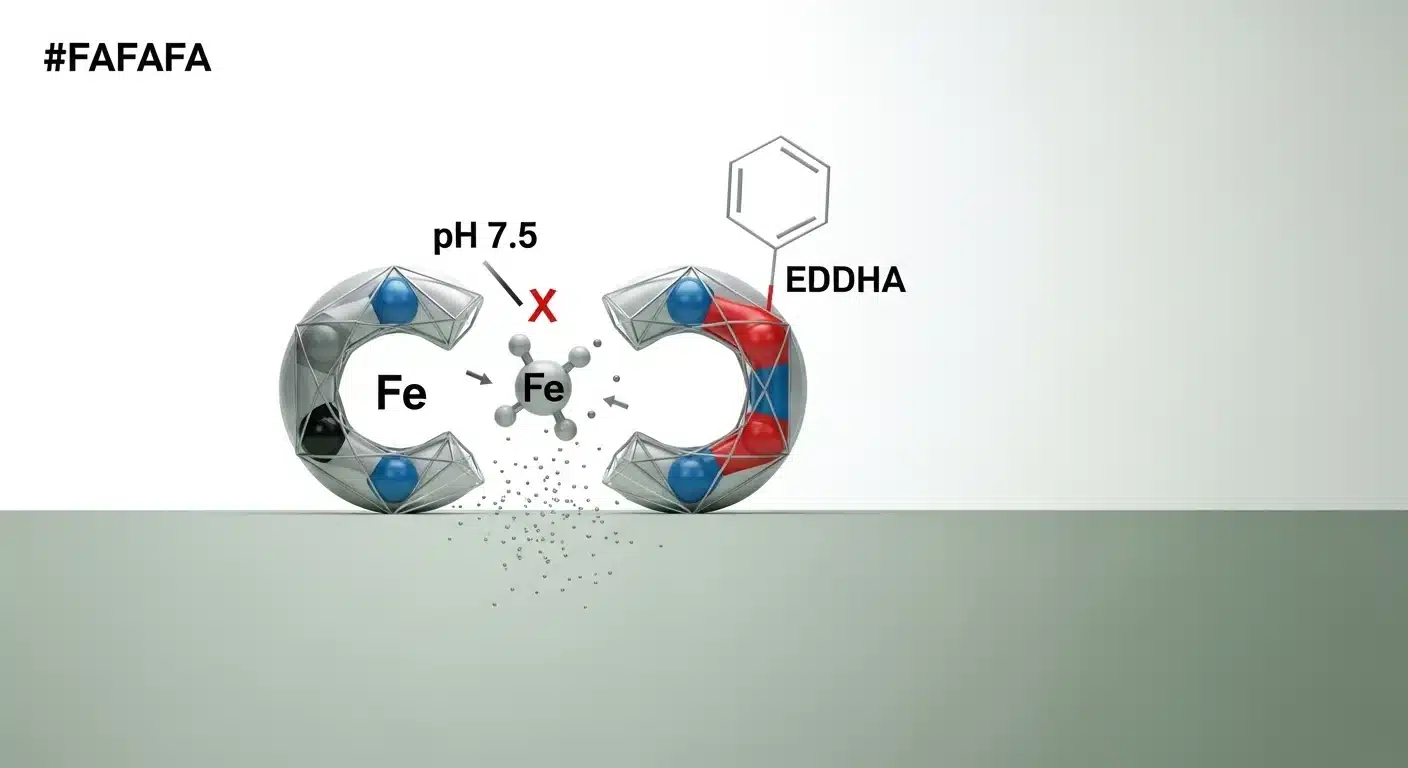
Iron chlorosis in turf almost never comes down to a shortage of iron in the soil. Alkaline soil contains iron in abundance. The failure happens at the chemistry level: the chelating molecule that holds iron in plant-available form releases its grip when soil pH climbs past the product’s stability ceiling, and the freed Fe³ ion precipitates instantly into iron oxide. The grass starves while sitting on top of what looks like an ample supply. Diagnosing the lockout requires knowing the exact pH ceiling for each iron source, not just spraying more product and hoping.
This calculator evaluates four critical inputs, soil pH, soil temperature, iron source type, and target response window, and returns a deterministic soil availability result based on published chelate stability chemistry. It does not predict blade color recovery speed, account for competing cation displacement, or replace a laboratory soil analysis. What it does is tell you, with specificity, whether the product in your hand will release iron to roots at your measured soil pH before you buy or apply it.
If your soil pH is above 6.5 and you are using EDTA chelated iron, the calculator will show 0% availability. That single data point is the decision: switch sources before spending money on application.
Use the Tool
Iron (Fe) Chelation Temp & pH Availability
Instantly diagnose iron lockout and find the right chelated iron source for your soil conditions.
Enter your soil conditions above and click Calculate Iron Availability to diagnose iron lockout and get product recommendations.
| Iron Source | pH Stability Ceiling | Soil Availability | Best Use Case |
|---|---|---|---|
| Iron Sulfate | ≤ 6.9 | Acid Soils Only | pH 5.5–6.9, budget option |
| EDTA Chelated | ≤ 6.5 | Low–Neutral Soil | pH 5.0–6.5, greenhouse / high-acid |
| DTPA Chelated | ≤ 7.5 | Near-Neutral Soil | pH 5.0–7.5, broadest budget chelate |
| EDDHA Chelated | pH 4 – 11 | All pH Ranges | Alkaline turf, worst-case chlorosis |
| Foliar Iron | N/A (bypasses soil) | Direct Uptake | Cold soils (<55°F), fast greening |
| pH 7.8 + EDTA | Exceeded ❌ | 0% — Iron Oxide | Classic “Rusty Dirt” trap |
| pH 8.2 + EDDHA | Within range ✓ | 100% Available | Worst-case alkaline turf fix |
EDDHA Iron Powder
Liquid Foliar Iron
Colorant / Pigment
Soil Meter
How This Calculator Works
Step 1 — Iron Source + pH Availability
When pH exceeds the chelate’s stability ceiling, the chelating agent releases the iron molecule. The free Fe³⁺ instantly reacts with OH⁻ ions in alkaline soil to form iron oxide (rust, Fe₂O₃) — an insoluble compound plant roots cannot absorb.
Step 2 — Temperature Override
Below 55°F, microbial activity and root metabolic processes slow dramatically. Even fully available chelated iron in the soil solution cannot be absorbed at rate sufficient to correct chlorosis. Foliar iron bypasses the root uptake pathway entirely.
Step 3 — Response Time Alignment
Assumptions & Limits
- This tool evaluates soil availability only. Foliar iron bypasses soil chemistry entirely and is unaffected by pH rules.
- DTPA stability ceiling is pH 7.5 (industry standard, USDA source). Above this, DTPA is partially degraded, not fully locked out — use EDDHA for safety above 7.5.
- Results assume ambient humidity and normal CEC (cation exchange capacity). High clay or organic-matter soils may buffer pH differently.
- No account is made for competing ions (Ca²⁺, Mn²⁺, Cu²⁺) which can displace iron from chelate rings at high concentrations.
- Temperature range accepted: 20°F – 120°F. Values outside this range are invalid inputs.
- pH range accepted: 3.5 – 10.0. Values outside this range are invalid inputs.
- This tool is for turf and landscape use. Hydroponic or soilless media follow different availability curves.
- Always confirm soil pH with a calibrated meter (±0.1 accuracy) before product selection.
Before running the calculator, have two measurements ready: a confirmed soil pH reading taken with a calibrated meter (not a color strip test, which lacks the resolution needed for chelate selection) and a soil temperature reading at a 2-to-3-inch depth taken in the morning. If you are unsure how soil pH affects other nutrient availability curves in parallel with iron, the soil phosphorus availability tool covers a nutrient that directly competes with iron in high-pH conditions and provides useful context for diagnosing multi-nutrient lockout.
Quick Start (60 Seconds)
- Soil pH: Enter your reading to one decimal place (example: 7.2, not just "7"). The valid entry range is 3.5 to 10.0. A whole-number estimate is the single most common input error on this field and it can shift the lockout verdict.
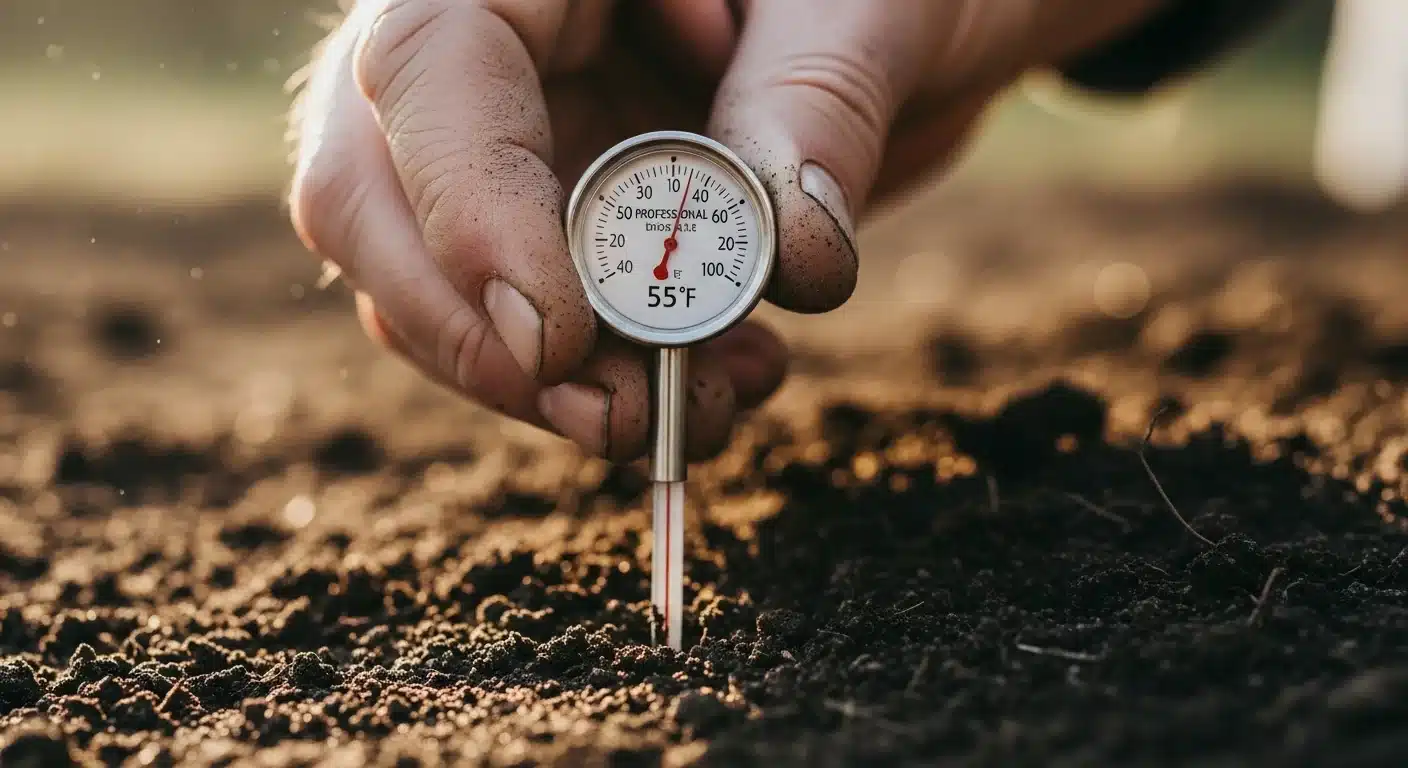
- Soil Temperature (°F): This is ground temperature, not air temperature. A soil thermometer pushed 2 to 3 inches below the surface gives the correct value. The 55°F threshold in the calculator is the root metabolic cutoff for iron uptake, not an ambient air guideline.
- Iron Source: Match the exact chelate type printed on the product label, not the trade name. "EDTA chelated iron" and "EDDHA chelated iron" are chemically opposite in alkaline soil performance. Many budget lawn products use EDTA without foregrounding it on the front panel.
- Target Response Time: Select "Fast" only if you need visible greening within 24 to 48 hours. Fast response requires foliar application regardless of soil pH. Selecting "Medium" or "Slow" routes through soil application, which requires a pH-stable chelate choice.
- All four fields are required. The calculator does not run a partial calculation. Missing any field blocks the result to prevent an incomplete verdict from informing a product decision.
Inputs and Outputs (What Each Field Means)
| Field | Unit | What It Measures | Common Mistake | Safe Entry Guidance |
|---|---|---|---|---|
| Soil pH | pH units (dimensionless) | Hydrogen ion concentration in soil solution; governs chelate stability ceiling for each iron source | Using strip test kits that round to whole numbers, or entering air pH from a water report | Enter to one decimal place; calibrate meter before reading; test multiple spots and average |
| Soil Temperature | Degrees Fahrenheit | Root-zone temperature at 2-3 inch depth; below 55°F suppresses root iron uptake regardless of soil availability | Using ambient air temperature, which can be 15-25°F warmer than soil on a sunny day | Measure at dawn for lowest-bias reading; use a probe thermometer, not a surface reading |
| Iron Source | Categorical (product type) | The chelating agent class determines the pH stability ceiling at which iron is released from the molecule | Selecting EDTA for alkaline turf because it is labeled "chelated iron" without checking the pH range | Read the guaranteed analysis panel, not just the front label; look for the chelate abbreviation |
| Target Response Time | Categorical (window) | Desired speed to visible color improvement; dictates application method (foliar vs. soil) | Selecting "Medium" or "Slow" and then applying foliar, expecting instant results | Match the window to your situation; "Fast" triggers a foliar mandate in results |
| Fe Soil Availability (output) | Percent (0 or 100) | Whether the selected iron source is chemically stable at the entered pH and can be absorbed by roots | Interpreting a 100% result as a guarantee of uptake when soil temp is also below 55°F | Read both the primary result and the warning panel; availability and uptake are two different conditions |
Worked Examples (Real Numbers)
Scenario 1: The Alkaline Lawn, Wrong Product
- Soil pH: 7.8
- Soil Temperature: 68°F
- Iron Source: EDTA Chelated Iron
- Target Response Time: Medium (3-7 days)
Result: 0% soil availability. Iron lockout confirmed.
At pH 7.8, EDTA has already exceeded its stability ceiling of 6.5. The moment EDTA iron contacts this soil, the chelating molecule drops the iron ion. Fe³ combines with hydroxide ions to form iron oxide (Fe₂O₃), which grass roots cannot absorb. A soil application of any volume will produce no greening. EDDHA is the correct replacement for soil pH above 7.0.
Scenario 2: Healthy Match, Moderate pH
- Soil pH: 6.2
- Soil Temperature: 72°F
- Iron Source: DTPA Chelated Iron
- Target Response Time: Medium (3-7 days)
Result: 100% soil availability. Source is correctly matched.
DTPA holds iron stable through pH 7.5. At pH 6.2, the chelate molecule maintains its bond and iron is released gradually into the soil solution as roots take it up. At 72°F, root metabolic activity is well above the 55°F suppression threshold. A standard soil drench or granular application is appropriate for the medium response window.
Scenario 3: Correct Chelate, Cold Soil Override
- Soil pH: 8.2
- Soil Temperature: 48°F
- Iron Source: EDDHA Chelated Iron
- Target Response Time: Fast (24-48 hours)
Result: 100% soil availability, but foliar application is mandatory on two grounds: soil temperature is below 55°F and a fast response window was selected.
EDDHA is correctly specified for pH 8.2 and would work as a soil application once temperatures recover above 55°F. For immediate greening in cold conditions, a liquid foliar iron spray bypasses the cold-suppressed root system entirely and delivers iron directly to leaf tissue. The EDDHA soil application can be planned for a warm-up period to build soil iron reserves concurrently.
Reference Table (Fast Lookup)
| Iron Source | pH Stability Ceiling | Available at pH 6.0 | Available at pH 6.5 | Available at pH 7.0 | Available at pH 7.5 | Available at pH 8.0 | Foliar Bypass at Any pH |
|---|---|---|---|---|---|---|---|
| Iron Sulfate (FeSO₄) | 7.0 | Yes | Yes | No (lockout) | No (lockout) | No (lockout) | Yes |
| EDTA Chelated Iron | 6.5 | Yes | No (lockout) | No (lockout) | No (lockout) | No (lockout) | Yes |
| DTPA Chelated Iron | 7.5 | Yes | Yes | Yes | No (lockout) | No (lockout) | Yes |
| EDDHA Chelated Iron | 11.0 (effectively all soils) | Yes | Yes | Yes | Yes | Yes | Yes |
| Liquid Foliar Iron | N/A (bypasses soil) | Yes | Yes | Yes | Yes | Yes | Always foliar |
| Iron Sulfate at pH 7.1 | Ceiling exceeded by 0.1 | - | - | No | - | - | Yes |
| EDTA at pH 6.6 | Ceiling exceeded by 0.1 | - | - | No | - | - | Yes |
| DTPA at pH 7.6 | Ceiling exceeded by 0.1 | - | - | - | No | - | Yes |
| Any source, soil temp <55°F | pH irrelevant for uptake | Locked (root suppression) | Locked | Locked | Locked | Locked | Yes (foliar mandatory) |
How the Calculation Works (Formula + Assumptions)
Show the calculation steps
Step 1: Source-to-pH lockout check
Each iron source has a published pH stability ceiling, the point at which the chelating ring can no longer hold the iron ion against the buffering capacity of an alkaline soil solution. The logic is binary: if soil pH exceeds the ceiling, availability is 0. If pH is at or below the ceiling, availability is 100 (before temperature correction).
- Iron Sulfate: ceiling = 7.0. If pH is greater than 7.0, result is locked out.
- EDTA: ceiling = 6.5. If pH is greater than 6.5, result is locked out.
- DTPA: ceiling = 7.5. If pH is greater than 7.5, result is locked out.
- EDDHA: ceiling = 11.0. Result is never locked out in agricultural soil pH ranges.
Step 2: Temperature override check
If soil temperature is below 55°F, the calculator triggers a foliar application mandate. This does not change the availability percentage (the iron is still chemically available in the soil), but it flags that root metabolic suppression will prevent meaningful uptake. Availability in soil and uptake by roots are separate conditions.
Step 3: Response time alignment
Selecting a fast response window (24 to 48 hours) triggers the foliar mandate regardless of temperature because soil-to-root-to-blade translocation cannot occur within that window even under ideal conditions. Medium and slow windows rely on soil application with a pH-stable source.
Rounding and precision: pH entries are accepted to one decimal place. The stability ceiling comparisons are strict (greater than, not greater than or equal to), meaning a pH exactly equal to the ceiling is treated as within range.
Assumptions and Limits
- The calculator assumes a standard mineral soil profile. Organic-matter-dominant soils (high peat, compost-heavy mixes) can buffer pH differently and may allow slightly better iron retention than a mineral soil at the same measured pH.
- Cation exchange capacity is not factored in. High-CEC soils with elevated calcium or magnesium can displace iron from chelate molecules even within the normal pH range. If you suspect CEC is a factor, the CEC soil calculator provides a framework for evaluating this dimension separately.
- The DTPA ceiling of 7.5 reflects industry-consensus agronomic guidelines. Some published studies note partial degradation beginning above pH 7.0 in high-carbonate soils, meaning DTPA performance in the 7.0-to-7.5 range may be reduced but not zero on all soil types.
- Competing ions (Cu²⁺, Mn²⁺, Zn²⁺) are not modeled. At elevated concentrations these can compete for chelate binding sites and reduce effective iron delivery below what the pH alone would predict.
- Foliar iron absorption rate varies with leaf surface wax, stomatal aperture, humidity, and adjuvant use. The calculator flags foliar as the recommended route but does not predict absorption efficiency.
- The tool does not account for antagonistic interactions between phosphorus and iron. High soil-available phosphorus can precipitate iron in the rhizosphere even when the chelate is technically stable. For phosphorus-heavy applications, reviewing iron and phosphorus together is advisable.
- pH readings from digital meters require calibration before use. A meter that reads 0.3 units high could incorrectly classify a pH 6.8 soil as pH 7.1, triggering a lockout verdict for DTPA that would not apply to the actual soil.
- This tool applies to soil and turf contexts. Hydroponic systems, soilless media, and nutrient film technique setups operate under fundamentally different availability curves and are outside the scope of this calculator.
Standards, Safety Checks, and "Secret Sauce" Warnings
Critical Warnings
- The EDTA oxidation trap: At soil pH above 6.5, EDTA releases its iron immediately upon contact with alkaline soil. The freed Fe³ reacts with OH¯ ions to form ferric hydroxide and eventually iron oxide. There is no delayed release, no partial availability, no recovery from this reaction. Every gram of EDTA product applied above its ceiling pH is converted to an insoluble compound that the grass cannot access. This is not a nuance issue; it is a complete failure mode.
- The cold-soil uptake gap: A 100% availability result from the calculator does not mean greening will occur on schedule if soil temperature is below 55°F. Root cells require enzymatic activity to transport chelated iron across the cell membrane. Below the 55°F threshold, that process operates too slowly to correct visible chlorosis at normal application rates. Availability in soil solution and uptake into the plant are two separate gates.
- The pH drift risk on repeat applications: Repeated iron sulfate applications acidify soil slightly over multiple seasons. This can work in your favor by lowering pH below the 7.0 ceiling, but it can also overshoot in acid-sensitive areas and drive pH below 6.0, where manganese toxicity becomes a risk. Monitoring pH after multiple iron sulfate applications is not optional maintenance.
- Product label ambiguity: The label term "chelated iron" does not specify the chelating agent. EDTA, DTPA, EDDHA, and lignosulfonate are all technically chelates. Lignosulfonate-chelated iron (sometimes labeled just "iron chelate") has a stability ceiling closer to pH 6.5 to 7.0, similar to EDTA. If the label does not name the specific chelate, contact the manufacturer before applying to alkaline soil.
Minimum Standards
- For any soil application targeting lawns at pH 7.0 or above, the minimum specification is DTPA chelated iron. EDTA and iron sulfate are categorically disqualified above that threshold.
- For soils above pH 7.5, EDDHA is the only soil-applied chelated iron for lawns that meets an agronomically defensible standard for iron availability.
- Soil temperature must exceed 55°F for a soil application to reliably deliver iron to actively growing turf. Below this threshold, foliar application is not a preference but a functional requirement. The base saturation calculator can help evaluate whether competing cations at high pH are compounding the iron challenge beyond what chelate selection alone can resolve.
Competitor Trap: The Big-Box "Chelated Iron" Problem
A large share of retail chelated iron products marketed for lawns use EDTA as the chelating agent. This is disclosed in the guaranteed analysis section, but not on the front panel. Turf managers and homeowners with soil pH readings of 7.2, 7.5, or 7.8 routinely purchase these products, apply at labeled rates, and observe no response. The common diagnosis is "product failure" or "iron-deficient soil." The actual diagnosis is a chelate-pH mismatch that was predictable before purchase. The product performed exactly as its chemistry dictated. EDTA chelated iron sold for lawn use without a pH ceiling warning on the front label is a structural information gap that costs applicators real money and delays proper turf recovery by weeks or seasons.
Common Mistakes and Fixes
Mistake: Choosing a Chelate Based on Price, Not Soil pH
EDTA chelated iron is the least expensive chelate form and is widely available. At soil pH 6.3 or below, it works well. Above 6.5, every dollar spent on EDTA applied to soil is functionally wasted because the chemistry does not allow iron delivery. The lower unit cost becomes irrelevant against a zero-availability outcome. EDDHA costs significantly more per unit but is the only economically rational choice above pH 7.0 for soil application.
Fix: Test soil pH first, select the minimum chelate grade that clears the pH ceiling, and calculate cost per unit of effective iron delivered, not cost per pound of product.
Mistake: Applying Soil Iron in Early Spring Without Checking Temperature
Early spring iron applications are common because chlorosis is visually prominent when turf breaks dormancy. Soil temperatures in early spring, particularly in USDA zones 5 through 7, frequently remain below 55°F through April. A soil-applied EDDHA product at pH 7.5 and soil temperature 44°F is chemically available but biologically inaccessible. Applicators see no response and question the product or the pH test rather than the temperature.
Fix: Monitor soil temperature before scheduling soil iron applications. If temperature is below 55°F, substitute or supplement with a foliar iron spray, which bypasses root uptake and enters through leaf stomata regardless of soil temperature.
Mistake: Treating Yellow Grass as a Nitrogen Deficiency
Iron chlorosis and nitrogen deficiency both produce a yellowing pattern in turf, but they differ in distribution. Nitrogen deficiency typically yellows uniformly across the entire turf stand, while iron chlorosis often appears in high-pH zones, along concrete edges (where lime leaches from concrete raises local pH), or in consistently wet areas where iron oxidizes. Applying nitrogen to chlorotic turf that actually needs chelated iron for lawns delays the correct treatment and can worsen visual symptoms by pushing growth without the iron needed for chlorophyll synthesis. If you are planning a broader fertility review, the lawn fertilizer calculator can help separate nitrogen rate decisions from micronutrient timing.
Fix: Test both soil pH and a visual chlorosis pattern map before attributing yellowing to nitrogen. Interveinal chlorosis on young leaves is strongly indicative of iron, not nitrogen.
Mistake: Expecting Soil pH to Lower Itself After Iron Sulfate Application
Iron sulfate does have a mild acidifying effect through sulfur oxidation. However, this process takes weeks to months in active soil biology and is too slow to rescue an iron application that is already locked out. Applicators sometimes reason that applying iron sulfate will both lower pH and supply iron simultaneously. In alkaline soil, the iron precipitates before any pH shift occurs. The acidification happens independently and much later than the iron lockout.
Fix: Treat pH management and iron supply as separate problems on separate timelines. For faster pH reduction, a sulfur-based amendment calculated through the soil pH lowering calculator is the more direct intervention. Apply the correct chelate immediately for iron; address pH reduction as a medium-term soil improvement project.
Mistake: Foliar Iron as a Permanent Solution for Soil pH Problems
Foliar iron sprays work quickly and bypass soil pH entirely. This makes them excellent for fast greening, cold-soil situations, and emergency chlorosis correction. They are not a long-term iron management strategy. Leaf-absorbed iron is not mobile within the plant to newly developing tissue at the same rate as root-absorbed iron. Repeat foliar applications add up in cost, and the underlying soil chemistry problem remains unaddressed.
Fix: Use foliar iron for immediate visual correction, then address the root cause: either lower soil pH to a range where a less expensive chelate works, or transition to a soil-applied EDDHA program once temperatures support root uptake. Reviewing the lime calculator in reverse, or the sulfur-based tools, can quantify what amendment volume is needed to shift pH to a stable range.
Next Steps in Your Workflow
After running the calculator, the most actionable next step depends on which result you received. A 0% availability result with a pH-stable source like EDDHA does not exist; EDDHA returns 100% at all agricultural pH ranges. A 0% result means you have Iron Sulfate or an EDTA or DTPA product in conditions that exceed its ceiling. The immediate next step is source substitution, not a rate increase. Increasing application rate of a locked-out product adds no available iron; it just increases cost and, in the case of iron sulfate, adds sulfate to the soil with no iron benefit.
A 100% availability result paired with a temperature warning means you have the right product but wrong timing for soil application. If your lawn fertility program is due for a broader assessment alongside the iron decision, the NPK calculator can help you build a complete nutrient plan that integrates iron timing with macronutrient applications. For growers managing soil health at a system level, understanding how cation balance affects iron competition through the fertilizer salt index calculator is a useful parallel step, particularly when high-rate soluble fertilizers are part of the same program.
FAQ
What is the difference between EDTA and EDDHA chelated iron?
EDTA (ethylenediaminetetraacetic acid) is a synthetic chelating agent that holds iron stable only through soil pH 6.5. EDDHA (ethylenediamine-N,N'-bis(2-hydroxyphenylacetic acid)) is a more complex molecule that maintains its iron bond across pH 4 to 11. In practical turf terms, EDDHA is the only soil-applied chelated iron option for lawns with pH readings above 7.0. The chemistry difference translates directly into application outcome.
Why does yellow grass appear even after applying chelated iron?
Three conditions prevent greening after application: the chelate type is not pH-stable at your soil pH and the iron locked out before uptake; soil temperature is below 55°F and root metabolic activity is too slow for absorption; or the yellowing is from nitrogen deficiency rather than iron chlorosis. Each cause has a different fix. The calculator addresses the first two specifically.
Can I mix EDTA chelated iron with water to create a foliar spray?
Foliar iron applications bypass soil pH entirely, so EDTA dissolved in water and sprayed on leaf tissue is not affected by the soil pH lockout rules. Iron is absorbed through stomata and leaf cuticle. However, purpose-formulated foliar iron products like ferrous sulfate heptahydrate or DTPA-based liquids are typically more effective for foliar use due to adjuvant formulation and particle size, not because EDTA itself fails on leaves.
How often should chelated iron be applied to lawns?
Application frequency depends on the underlying cause. If the cause is a structural pH mismatch, repeated applications of the correct chelate are a maintenance strategy, not a fix. Correcting soil pH toward the 6.0 to 6.5 range makes iron naturally more available and reduces dependence on premium chelates. For soils that cannot be acidified (near concrete, high-lime subsoils), an EDDHA program at two to four applications per growing season is a typical maintenance cadence.
Is iron sulfate the same as chelated iron?
No. Iron sulfate (FeSO₄) is an inorganic iron salt, not a chelated compound. It has no chelating ring to protect the iron ion from soil chemistry. In acid soils below pH 7.0, iron sulfate dissolves and releases iron into the soil solution where roots can access it. Above pH 7.0, the iron precipitates as iron hydroxide or oxide within minutes of soil contact. Chelated iron, by contrast, keeps iron ion bound within an organic molecule that resists precipitation up to its specific ceiling pH.
What does soil temperature have to do with iron absorption?
Root cells absorb chelated iron through an active transport process that requires enzymatic energy. Below 55°F, membrane enzyme activity in grass roots slows substantially, reducing the rate at which iron can cross from the soil solution into root tissue. The iron may be chemically available in the soil but is not being collected fast enough to correct chlorosis at visible rates. Foliar application bypasses this barrier by delivering iron directly to photosynthetically active leaf cells.
Conclusion
Selecting chelated iron for lawns without knowing your soil pH and the stability ceiling of your chosen product is statistically likely to produce a failed application on any turf in the alkaline pH range, which covers a substantial portion of established lawns in arid and semi-arid regions, areas with limestone subsoils, and any turf adjacent to concrete or masonry structures. The calculator makes this a deterministic decision rather than a guessing exercise: enter your measured conditions, get a binary verdict, and spend on the product that actually delivers iron to roots at your pH.
The single most avoidable mistake is applying EDTA chelated iron to soil above pH 6.5 and attributing the resulting non-response to something other than chelate chemistry. That product will not work there regardless of rate, timing, or adjuvant. If your analysis reveals a persistent structural pH problem driving chronic iron chlorosis, pairing this calculator with the soil pH sulfur calculator to plan a long-term acidification program is the more complete path to iron availability without permanent dependence on premium chelate products.