
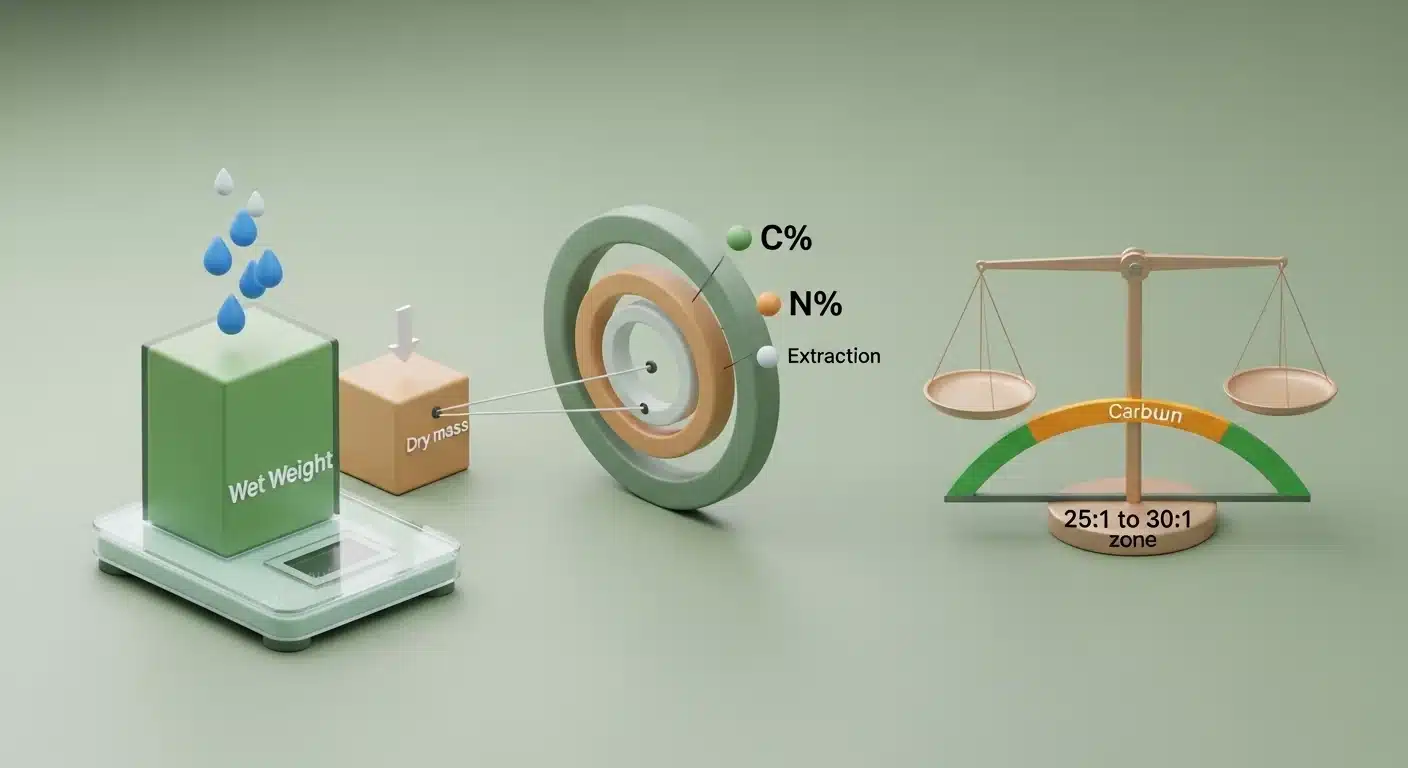
The core problem with most composting advice is that it conflates volume with chemistry. Telling a gardener to mix “three parts browns to one part greens by volume” produces wildly inconsistent results because different materials have radically different densities, moisture levels, and elemental composition. A kilogram of wet grass clippings and a kilogram of dry cardboard share nothing in common except weight. The carbon-to-nitrogen ratio, always computed on a dry-weight basis, is the only metric that actually predicts whether aerobic bacteria will generate sustained heat or whether the pile will collapse into an anaerobic slime.
This calculator takes wet weight, moisture content, carbon percentage, and nitrogen percentage for up to four materials and returns the blended C:N ratio along with individual material breakdowns. It does not predict exact composting timelines, account for pile geometry and aeration frequency, or model the temperature curve inside a windrow. Those variables matter, but none of them are useful if the underlying C:N ratio is wrong from the start. If you are working with manure as a nitrogen source, the manure nitrogen availability calculator provides complementary data on the actual available nitrogen fraction before you enter values here.
After running this calculator, you will know whether your pile is at risk of going anaerobic (below 20:1), locked in the thermophilic sweet spot (25:1 to 30:1), or destined to stall from nitrogen starvation (above 40:1), and you will have the specific material adjustments needed to fix whichever problem applies.
Use the Tool
Compost C:N Ratio Calculator
The Yield Grid — Soil, Fertilizer & Amendments Math
How This Calculator Works
Dry Weight (kg) = Wet Weight × (1 − Moisture% ÷ 100)
Total C (kg) = Σ (Dry Weight × C% ÷ 100)
Total N (kg) = Σ (Dry Weight × N% ÷ 100)
C:N Ratio = Total C ÷ Total N
| Material | Type | Wet Wt (kg) | Dry Wt (kg) | C (kg) | N (kg) | C:N |
|---|
| Material | Moisture % | C % | N % | C:N (dry) | Type | Status |
|---|---|---|---|---|---|---|
| Grass Clippings | 78 | 40 | 3.5 | 11.4 | Green | Too Low — Mix |
| Food Scraps | 68 | 40 | 3.8 | 10.5 | Green | Too Low — Mix |
| Coffee Grounds | 60 | 45 | 2.1 | 21.4 | Green | Borderline |
| Dry Leaves | 12 | 46 | 0.7 | 65.7 | Brown | Too High — Mix |
| Cardboard | 10 | 49 | 0.25 | 196 | Brown | Too High — Mix |
| Straw | 12 | 47 | 0.6 | 78.3 | Brown | Too High — Mix |
| Grass + Leaves Mix (50/50) | — | 43 | 2.1 | ~27 | Blend | ✓ Optimal |
Recommended Tools for Hot Composting
Assumptions & Limits
- This calculator uses dry-weight basis — all C% and N% values must be expressed as a percentage of the dry material mass.
- Moisture percentage (0–99%) is applied first to convert wet weight to dry weight before computing C and N contribution.
- C and N percentage inputs should reflect the material as analyzed (not as purchased or as-fed).
- The thermophilic target range (25:1 – 30:1) applies to active hot composting. Vermicomposting and cold composting may tolerate a wider range.
- Anaerobic threshold: ratios below 20:1 risk oxygen depletion, putrid odors, and ammonia volatilization.
- Stall threshold: ratios above 40:1 indicate carbon excess — decomposition may take years without nitrogen amendment.
- The nitrogen drawdown effect from fresh wood chips (C:N > 400:1) is not modeled separately; enter actual lab values for accuracy.
- This tool assumes uniform mixing of all materials. In practice, pile layering affects local decomposition rates.
- Up to 4 materials supported. For larger blends, aggregate similar materials before entry.

Before entering values, have the following ready: the as-weighed (wet) mass of each material in kilograms, the moisture percentage of each component (measured or referenced from published tables), and the carbon and nitrogen percentages of each material on a dry-weight basis. Lab analysis gives the most accurate C and N values; published averages from extension service tables are acceptable for planning but introduce some margin of error. If you are working with a blend of more than four materials, aggregate the two most similar ones into a single entry first. For help planning how much finished compost you will need, the compost calculator is a natural companion tool before you start building your pile.
Quick Start (60 Seconds)
- Wet Weight (kg): Weigh each material separately on a scale before mixing. Do not estimate by the bucket or wheelbarrow load; density differences between straw and food scraps make volume guesses unreliable.
- Moisture % : Enter as a number between 0 and 99. Fresh grass clippings typically run 75 to 80%; dry autumn leaves run 10 to 15%; kitchen vegetable scraps run 60 to 75%. Do not enter 100 (pure water) or negative values.
- Carbon % : Enter the carbon fraction of the dry material, not the whole wet weight. Most plant materials fall between 40% and 50% C on a dry basis. Wood chips and cardboard are at the high end; fresh manure is lower.
- Nitrogen % : Enter as a percentage of dry weight. Values typically range from 0.1% for straw to 5% for rich food scraps. Coffee grounds run approximately 2.1%; grass clippings approximately 3.5%.
- Optional materials: Materials B and D can be left entirely blank if you are only working with two components. Leave all four fields for that material empty, not just some of them.
- Units are fixed in kilograms: If you are working in pounds, multiply by 0.4536 before entering. Because C:N is a ratio, the unit conversion cancels out internally, but all four fields for a single material must use the same system.
- Click Calculate only after all active rows are complete. Partially filled rows trigger a validation error that blocks the result.
Inputs and Outputs (What Each Field Means)
| Field | Unit | What It Measures | Common Mistake | Safe Entry Guidance |
|---|---|---|---|---|
| Wet Weight (each material) | kg | Total as-received mass including water content | Estimating by bucket volume instead of weighing | Use a kitchen or postal scale; even a bathroom scale works for large batches |
| Moisture % | % of wet weight | Water fraction that is subtracted to calculate dry mass | Entering a dry-weight moisture figure (lab reports often differ) | Use published extension values for common materials or a probe meter for accuracy |
| Carbon % | % of dry weight | Elemental carbon content available to microbial metabolism | Using total organic carbon (TOC) from a water test rather than a solids analysis | Range 30 to 55% for most plant materials; confirm values are on a dry-weight basis |
| Nitrogen % | % of dry weight | Total nitrogen available for microbial protein synthesis | Entering available nitrogen (from a fertilizer label) instead of total nitrogen | Range 0.1% (straw) to 5% (rich food scraps); values above 6% are rare in plant materials |
| C:N Ratio (output) | unitless ratio | Mass of carbon relative to mass of nitrogen across all inputs combined | Treating the output as a per-material figure rather than a blended average | Target 25:1 to 30:1 for thermophilic composting; read interpretation text for corrective steps |
| Total C (output) | kg | Sum of (dry weight x C%) across all active materials | Treating this as volume of carbon-rich material rather than elemental mass | Reference only; the ratio is the actionable output |
| Total N (output) | kg | Sum of (dry weight x N%) across all active materials | Confusing this with fertilizer nitrogen or plant-available nitrogen | If Total N approaches zero, re-check N% entries; a pile needs at least trace nitrogen to decompose |
| Per-Material C:N (breakdown table) | unitless ratio | C:N of each ingredient in isolation, computed on a dry basis | Assuming a material with a good standalone C:N will fix an imbalanced blend | Use to identify which specific material is driving the imbalance |
Worked Examples (Real Numbers)
Scenario 1: Classic Grass-and-Leaves Autumn Pile (C:N Too High)
- Material A (Grass clippings): 10 kg wet, 78% moisture, 40% C, 3.5% N
- Material C (Dry autumn leaves): 20 kg wet, 12% moisture, 46% C, 0.7% N
Result: C:N = 44.8:1
Dry weight of grass: 10 x (1 – 0.78) = 2.2 kg. Dry weight of leaves: 20 x (1 – 0.12) = 17.6 kg. Total C: (2.2 x 0.40) + (17.6 x 0.46) = 0.88 + 8.10 = 8.98 kg. Total N: (2.2 x 0.035) + (17.6 x 0.007) = 0.077 + 0.123 = 0.200 kg. Ratio: 8.98 / 0.200 = 44.9:1. Despite using the most common “greens plus browns” pairing, the heavy leaf load pushes the ratio well above the 40:1 stall threshold. Cutting the leaf mass to 8 kg and keeping the grass at 10 kg shifts the ratio to approximately 28:1.
Scenario 2: Food Scraps and Shredded Cardboard (Optimal Result)
- Material A (Kitchen vegetable scraps): 8 kg wet, 68% moisture, 40% C, 3.8% N
- Material C (Shredded corrugated cardboard): 5 kg wet, 10% moisture, 49% C, 0.25% N
Result: C:N = 29.8:1
Dry scraps: 8 x 0.32 = 2.56 kg. Dry cardboard: 5 x 0.90 = 4.50 kg. Total C: (2.56 x 0.40) + (4.50 x 0.49) = 1.024 + 2.205 = 3.229 kg. Total N: (2.56 x 0.038) + (4.50 x 0.0025) = 0.097 + 0.011 = 0.108 kg. Ratio: 3.229 / 0.108 = 29.9:1. This lands squarely in the thermophilic zone. The pile should reach 55 to 65 degrees Celsius within 48 hours if moisture is maintained at 50 to 60% and the pile has adequate volume.
Scenario 3: Coffee Grounds and Straw (Extreme Imbalance)
- Material A (Spent coffee grounds): 3 kg wet, 60% moisture, 45% C, 2.1% N
- Material C (Wheat straw): 15 kg wet, 12% moisture, 47% C, 0.6% N
Result: C:N = 64.6:1
Dry grounds: 3 x 0.40 = 1.20 kg. Dry straw: 15 x 0.88 = 13.20 kg. Total C: (1.20 x 0.45) + (13.20 x 0.47) = 0.540 + 6.204 = 6.744 kg. Total N: (1.20 x 0.021) + (13.20 x 0.006) = 0.025 + 0.079 = 0.104 kg. Ratio: 6.744 / 0.104 = 64.8:1. Even though coffee grounds are widely called a “nitrogen source,” three kilograms of them cannot balance fifteen kilograms of high-carbon straw. To reach 28:1, approximately 9 kg of fresh grass clippings would need to replace some of the straw, or the straw load would need to drop to around 4 kg.
Reference Table (Fast Lookup)
| Material | Typical Moisture % | C % (dry basis) | N % (dry basis) | Dry C:N Ratio | Type | Thermophilic Status |
|---|---|---|---|---|---|---|
| Fresh grass clippings | 75 to 80 | 40 | 3.5 | 11.4:1 | Green | Too low alone; blend with high-C browns |
| Kitchen vegetable scraps | 65 to 75 | 40 | 3.8 | 10.5:1 | Green | Too low alone; ideal nitrogen source when blended |
| Spent coffee grounds | 55 to 65 | 45 | 2.1 | 21.4:1 | Green | Borderline; marginally below the 25:1 threshold |
| Fresh cattle manure | 80 to 85 | 38 | 2.5 | 15.2:1 | Green | Too low; strong nitrogen source, add browns liberally |
| Dry autumn leaves | 10 to 15 | 46 | 0.7 | 65.7:1 | Brown | Too high alone; must be blended with greens |
| Corrugated cardboard (shredded) | 8 to 12 | 49 | 0.25 | 196:1 | Brown | Extreme carbon excess; use sparingly as a structural layer |
| Wheat straw | 10 to 14 | 47 | 0.6 | 78.3:1 | Brown | Too high; nitrogen drawdown risk without significant greens |
| Fresh wood chips (softwood) | 40 to 55 | 50 | 0.1 | 500:1 | Brown | Not suitable for hot composting without massive nitrogen amendment |
| Newspaper (shredded) | 5 to 8 | 49 | 0.06 | 817:1 | Brown | Carbon-only filler; negligible nitrogen contribution |
| Grass clippings + leaves (50/50 by dry weight) | Blended | 43 | 2.1 | ~27:1 | Blend | Optimal thermophilic range (25 to 30:1) |
How the Calculation Works (Formula and Assumptions)
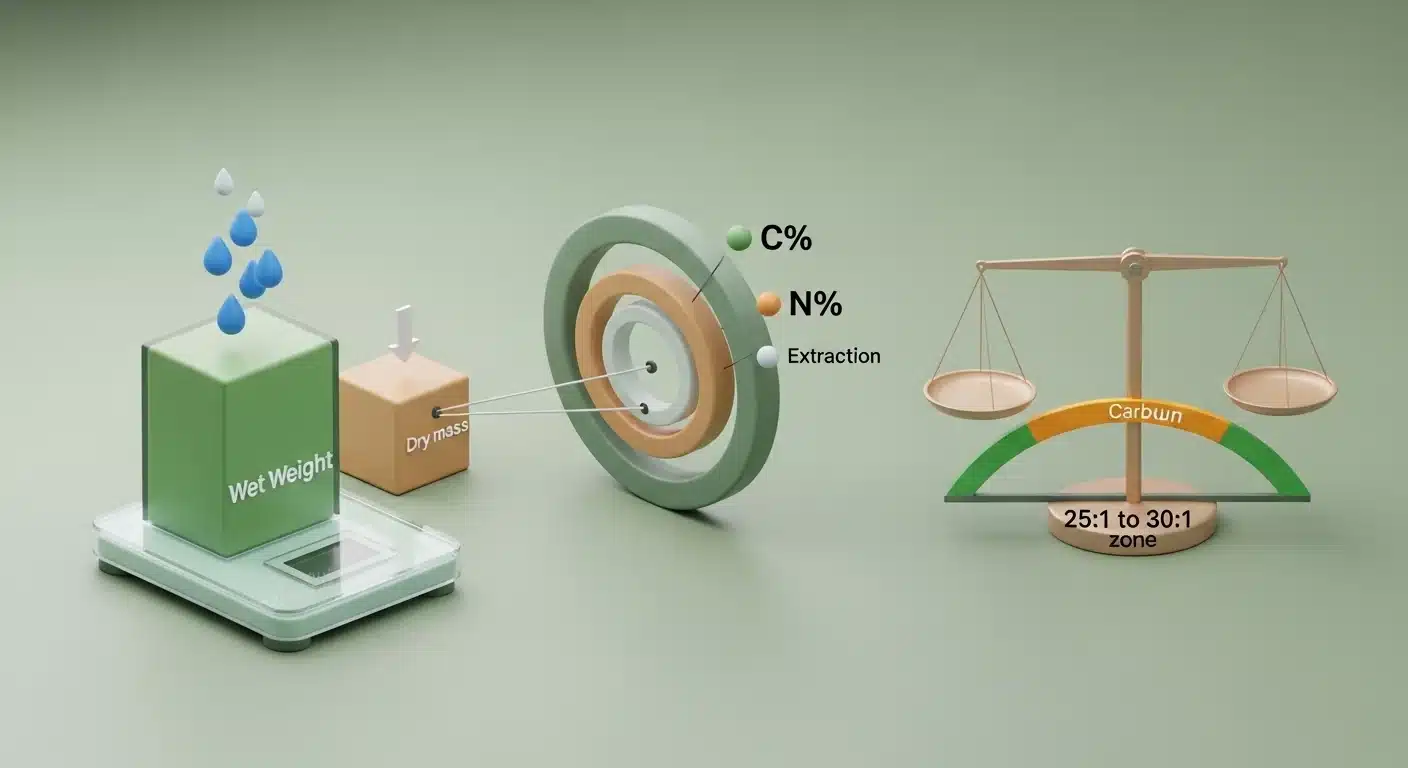
Show the calculation steps
- Step 1: Compute dry weight for each material.
Dry Weight (kg) = Wet Weight (kg) x (1 – Moisture% / 100)
Example: 10 kg of grass at 78% moisture = 10 x (1 – 0.78) = 2.2 kg dry weight. - Step 2: Compute carbon contribution for each material.
Carbon (kg) = Dry Weight (kg) x (C% / 100)
Example: 2.2 kg dry grass at 40% C = 2.2 x 0.40 = 0.88 kg carbon. - Step 3: Compute nitrogen contribution for each material.
Nitrogen (kg) = Dry Weight (kg) x (N% / 100)
Example: 2.2 kg dry grass at 3.5% N = 2.2 x 0.035 = 0.077 kg nitrogen. - Step 4: Sum carbon and nitrogen across all materials.
Total C = sum of all individual carbon contributions.
Total N = sum of all individual nitrogen contributions. - Step 5: Divide to get the ratio.
C:N Ratio = Total C / Total N
Rounding: displayed to one decimal place in the output. - Unit note: The formula requires all materials to use consistent weight units. Because the ratio is dimensionless, converting all values from pounds to kilograms before entry yields the identical result.
Assumptions and Limits
- All C% and N% inputs must be expressed on a dry-weight basis. Wet-basis analytical values (common in feed lab reports) will produce an understated ratio.
- Moisture percentage is used only to convert wet weight to dry weight. It does not model pile-wide moisture balance after mixing.
- The tool assumes uniform mixing of all materials. Stratified layering in practice means local zones within the pile may have very different effective C:N values.
- Nitrogen values represent total nitrogen, not plant-available or mineralizable nitrogen. The fraction of nitrogen accessible to microbes depends on the form (protein-bound vs. mineral) and is not modeled here.
- Wood chip nitrogen drawdown effects are not modeled separately. Enter actual laboratory C:N values for wood chips; do not use generic “brown material” defaults.
- The thermophilic target (25:1 to 30:1) applies to aerobic hot composting. Vermicomposting, cold composting, and bokashi fermentation tolerate different ranges.
- The tool supports up to four materials. For larger blends, aggregate two materials with similar C:N profiles before entry.
- Published moisture and C:N averages from extension tables vary by source. Lab analysis is the most reliable input for high-precision applications.
Standards, Safety Checks, and Secret Sauce Warnings
Critical Warnings
- Below 20:1: Anaerobic slime threshold. When the C:N ratio drops this low, aerobic bacteria consume oxygen faster than it can be replenished. The pile goes anaerobic, producing hydrogen sulfide, methane, and ammonia gas. The resulting slimy, malodorous mass attracts rodents and flies and can persist for months. This is the single most common failure mode in grass-heavy backyard composting. Adding water to such a pile accelerates the problem. The fix is always more carbon: dry leaves, shredded cardboard, or straw, added and turned through the pile immediately.
- Above 40:1: Nitrogen drawdown stall. At ratios above 40:1, the microbial population is nitrogen-limited. Bacteria strip whatever trace nitrogen exists, then go dormant. The pile may sit for two years with no detectable heat, no volume reduction, and no pathogen kill. Fresh wood chips with C:N values above 400:1 are the most common culprit; a single large batch mixed into an otherwise balanced pile can shift the blended ratio into stall territory. Use the nitrogen calculator to determine how much nitrogen amendment is needed to correct a stalled pile.
- 20:1 to 25:1: Marginal zone. The pile will decompose and may heat, but the oxygen demand remains high. Monitor temperature daily with a probe thermometer and turn the pile every 2 to 3 days to prevent localized anaerobic pockets from forming.
- 30:1 to 40:1: Slow but functional. Decomposition proceeds but at below-optimal speed. Pathogen and weed seed kill is less reliable because the pile temperature may not sustain 55 degrees Celsius for the required 3 consecutive days.
Minimum Standards
- Thermophilic target range: 25:1 to 30:1 by dry weight.
- Minimum ratio to avoid anaerobic conditions under normal management: 20:1.
- Maximum ratio for reliable hot composting within a 90-day window: 40:1.
- Pile temperature indicator of correct C:N: 55 to 65 degrees Celsius within 48 hours of building, sustained for at least 3 days to kill common pathogens.
Competitor Trap: Nearly every popular composting guide recommends “3 parts brown to 1 part green by volume” as a universal rule. That ratio is based on the rough average C:N of generic leaf mold and generic grass clippings with no correction for moisture content, material density, or actual elemental composition. A pile built with dense wet straw and light dry compost might obey the 3:1 volume rule and still land at 80:1 on a dry-weight basis. Conversely, a pile that looks carbon-heavy by eye might actually be nitrogen-rich once the high moisture content of the “browns” is accounted for. The only way to know is to compute the actual dry-weight C:N ratio, which is exactly what this calculator does. For a broader view of how soil organic matter contributes nitrogen over time after composting is applied, the soil organic matter nitrogen release calculator is a useful follow-on tool.
Common Mistakes and Fixes
Mistake: Using Volume Ratios Instead of Dry-Weight Calculations
A wheelbarrow of dry leaves occupies far more volume than a wheelbarrow of grass clippings, but the dry masses may be similar because leaves are far less dense. The volume-based “3 parts brown” heuristic can produce ratios ranging from 15:1 to over 100:1 depending on the specific materials and how tightly they are packed. The fix is straightforward: weigh each material separately on a scale before mixing and use those weights as inputs.
Fix: Weigh, do not estimate. A 10-dollar postal scale is sufficient for most home composting batches.
Mistake: Entering Wet-Basis C and N Values
Some laboratory reports, particularly those formatted for liquid manure or slurry analysis, express carbon and nitrogen as a percentage of the wet (as-received) sample rather than the dry sample. Entering a wet-basis nitrogen value of 1.2% instead of the dry-basis equivalent of 6% will inflate the calculated C:N ratio by roughly fivefold, producing a false stall-zone diagnosis when the pile is actually well-balanced. Always confirm the analytical basis before entering values.
Fix: Look for “dry weight basis” or “DW” notation on the lab report. If the report only provides wet-basis values, divide by (1 – moisture fraction) to convert.
Mistake: Treating Coffee Grounds as a Major Nitrogen Source
Coffee grounds have a C:N ratio of approximately 20:1 to 24:1, which is below the thermophilic threshold on their own but only marginally so. The mistake arises when composters assume that because grounds are dark, moist, and grouped with “greens,” they carry roughly the same nitrogen density as fresh grass clippings. Three kilograms of grounds add only about 25 grams of nitrogen; at the same weight, fresh grass clippings would contribute nearly 77 grams. Grounds are useful but should be treated as a moderate supplement, not a primary nitrogen driver.
Fix: Enter coffee grounds as a separate material and observe their individual contribution in the breakdown table. Supplement with higher-N greens if the blended ratio is still above 30:1.
Mistake: Ignoring Moisture Percentage When Estimating Dry Weight
Fresh grass clippings are approximately 78% water by weight. A 10-kilogram batch contains only 2.2 kg of actual dry matter. Composters who estimate their “grass input” without accounting for this step will dramatically overestimate both the carbon and nitrogen contribution of their greens. The calculator enforces this correction automatically, but only if the moisture percentage field is filled in accurately. Leaving moisture at zero, or entering a guess of 50% when the actual value is 78%, shifts the calculated ratio by a factor of more than two in some scenarios. The compost ratio calculator can cross-check your proportional estimates if you are working without a scale.
Fix: Use a published extension table or a handheld moisture meter to determine the moisture content of each material before entering it.
Mistake: Including Wood Chips Without Adjusting for Extreme C:N
Fresh softwood chips carry a C:N ratio of 400:1 or higher. Adding even a moderate volume of wood chips to an otherwise balanced pile can push the blended ratio above 80:1 without a visible sign of imbalance in the pile’s appearance or texture. The nitrogen drawdown effect then unfolds over weeks, during which available nitrogen is locked up by microbial biomass rather than released to the surrounding soil. The pile will eventually decompose, but slowly and without generating useful heat.
Fix: Pre-compost or age wood chips separately for 6 to 12 months before incorporating them into a hot pile, or add them only in thin layers with a proportional weight of high-nitrogen greens calculated using this tool.
Next Steps in Your Workflow
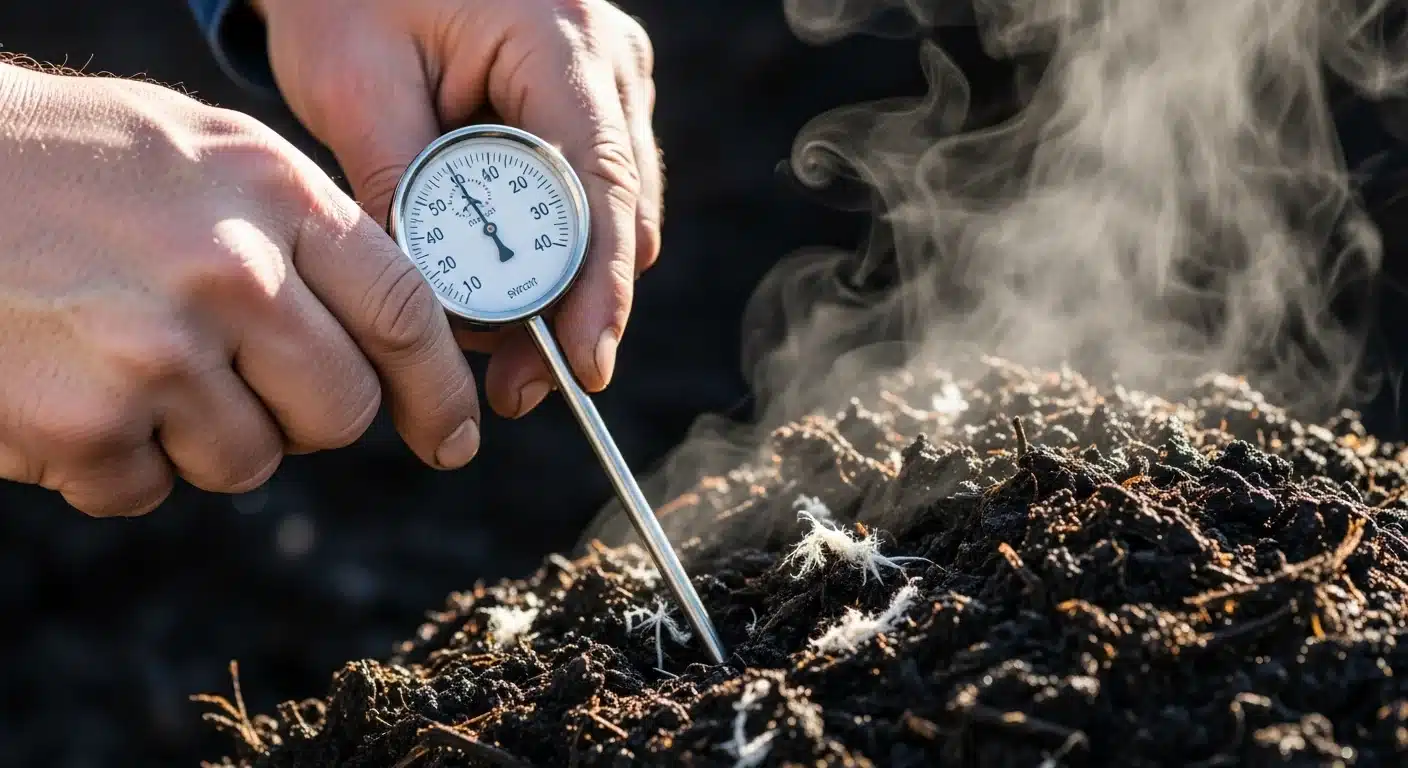
Once the calculator confirms a ratio in the 25:1 to 30:1 range, the next step is building or activating the pile and measuring internal temperature at 24 and 48 hours using a probe thermometer positioned at the center mass. A correctly balanced pile in the right ambient conditions should reach 55 degrees Celsius within two days. If it does not, the most likely causes are insufficient pile volume (below approximately 1 cubic meter), excess moisture suppressing oxygen flow, or C:N inputs that used estimated rather than measured values. Adjust accordingly before concluding the ratio is wrong. After the first turn at peak temperature, use the NPK calculator to estimate the approximate nutrient profile of the finished compost before you apply it to beds.
If your end goal includes brewing a liquid amendment from the finished material, the compost tea recipe tool provides proportions and aeration timing for aerobic extraction once your compost has fully cured. Finished compost should register a C:N of approximately 10:1 to 12:1, which you can verify by running a small sample back through this calculator using the fully cured material’s lab-measured values.
FAQ
What is the ideal C:N ratio for composting?
For thermophilic (hot) composting, the target is 25:1 to 30:1 on a dry-weight basis. This range gives aerobic bacteria enough carbon for energy and enough nitrogen for protein synthesis to generate sustained heat above 55 degrees Celsius. Ratios outside this band still decompose but more slowly and with greater risk of odor or stall.
Why does the calculator use dry weight instead of wet weight?
Carbon and nitrogen exist only in the solid fraction of a material, not in its water content. Using wet weight without correcting for moisture dilutes the apparent carbon and nitrogen concentrations, producing a ratio that reflects water quantity rather than elemental chemistry. All published C:N ratio standards, including the 25:1 to 30:1 thermophilic target, are expressed on a dry-weight basis.
Can I use this calculator for vermicomposting?
The formula applies universally, but the target range is different. Worms tolerate a C:N range of roughly 20:1 to 40:1 and are more sensitive to ammonia toxicity from very low ratios than to the inefficiency of high ratios. Avoid inputs below 15:1 in a worm bin, and do not use this tool’s thermophilic thresholds as your pass/fail criteria for vermicomposting.
How do I find the C and N percentages for a material I do not recognize?
University extension services and USDA compost research publications maintain tabulated C:N values for hundreds of organic materials. Cooperative Extension offices in the United States, and similar bodies in other countries, publish free downloadable tables. For unusual industrial byproducts (brewery waste, food processing residuals), request a lab analysis from a certified agricultural testing laboratory. Do not use pet food nutritional labels or consumer product ingredient lists as source data.
Why is my pile not heating even though the calculator shows 27:1?
A correct C:N ratio is necessary but not sufficient for thermophilic composting. The pile also requires adequate moisture (50 to 60% by weight), sufficient mass (at least 1 cubic meter), oxygen from turning or forced aeration, and ambient temperatures above 10 degrees Celsius. If all inputs were estimated rather than measured, revisit the moisture percentage values first, as this is the most commonly misestimated parameter.
What happens if I enter the same material twice in two rows?
The calculator treats each row as an independent material and sums their contributions. If you accidentally split one material across two rows, the result will still be mathematically correct as long as the weights and percentages are accurate and consistent. There is no penalty for splitting a single material into two entries, though combining them into one row reduces the chance of data entry error.
Conclusion
The carbon-to-nitrogen ratio calculator eliminates the guesswork that makes volume-based composting advice unreliable. By working from weighed inputs, actual moisture content, and published or lab-measured elemental percentages, it produces a single ratio that directly predicts whether aerobic bacteria have what they need to generate sustained thermophilic heat. The 25:1 to 30:1 target is not a rough guideline; it reflects the documented stoichiometry of microbial metabolism in aerobic composting systems. Outside that range, the consequences are predictable and specific: anaerobic collapse below 20:1, sluggish decomposition above 40:1.
The single most important mistake to avoid is relying on volume-based mixing rules without verifying the actual dry-weight ratio. A pile can look balanced, smell neutral in its first week, and still fail to heat because the elemental composition of its materials does not support thermophilic microbiology. Use this tool before you build the pile, not after it stalls. If you are planning how much finished compost to produce for a specific application, the raised bed soil calculator can help you back-calculate the volume of finished compost needed from your garden dimensions.