
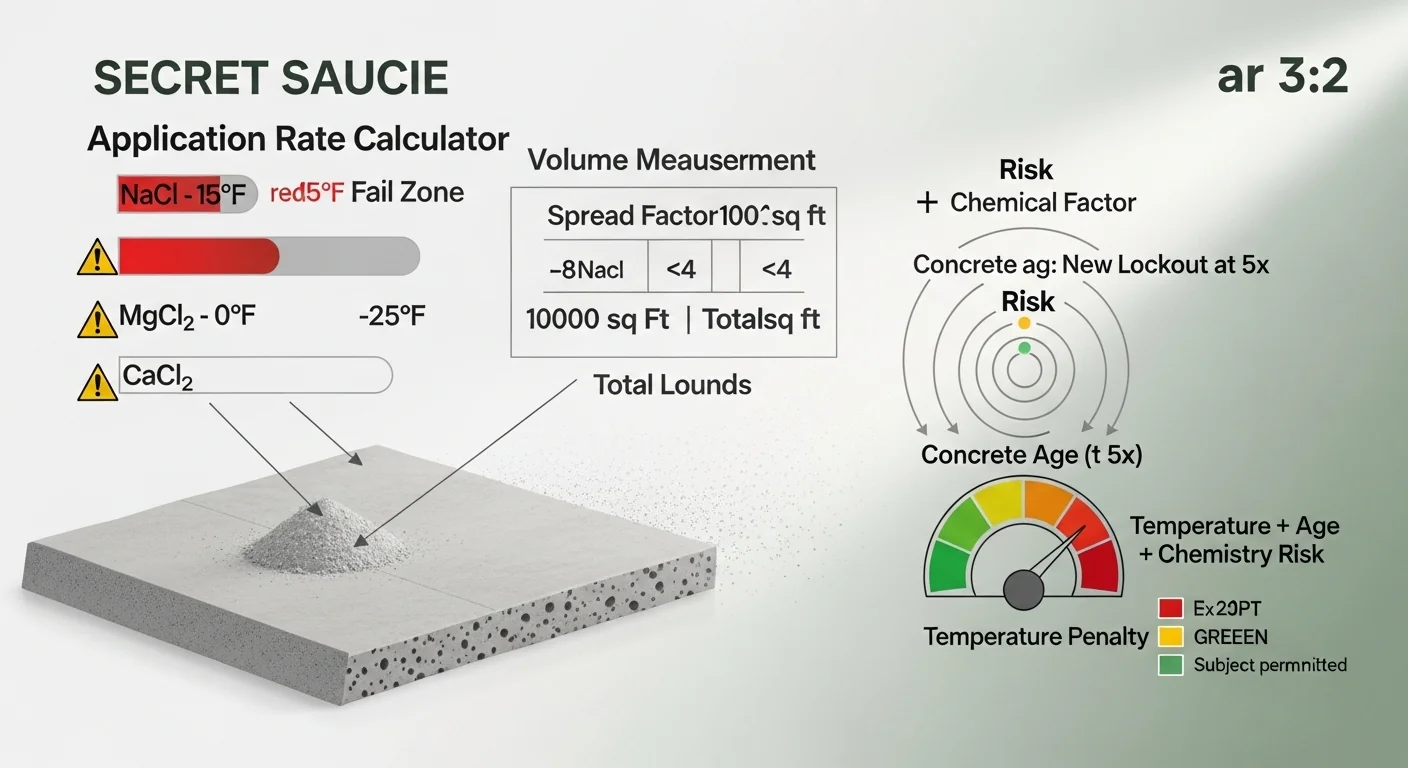
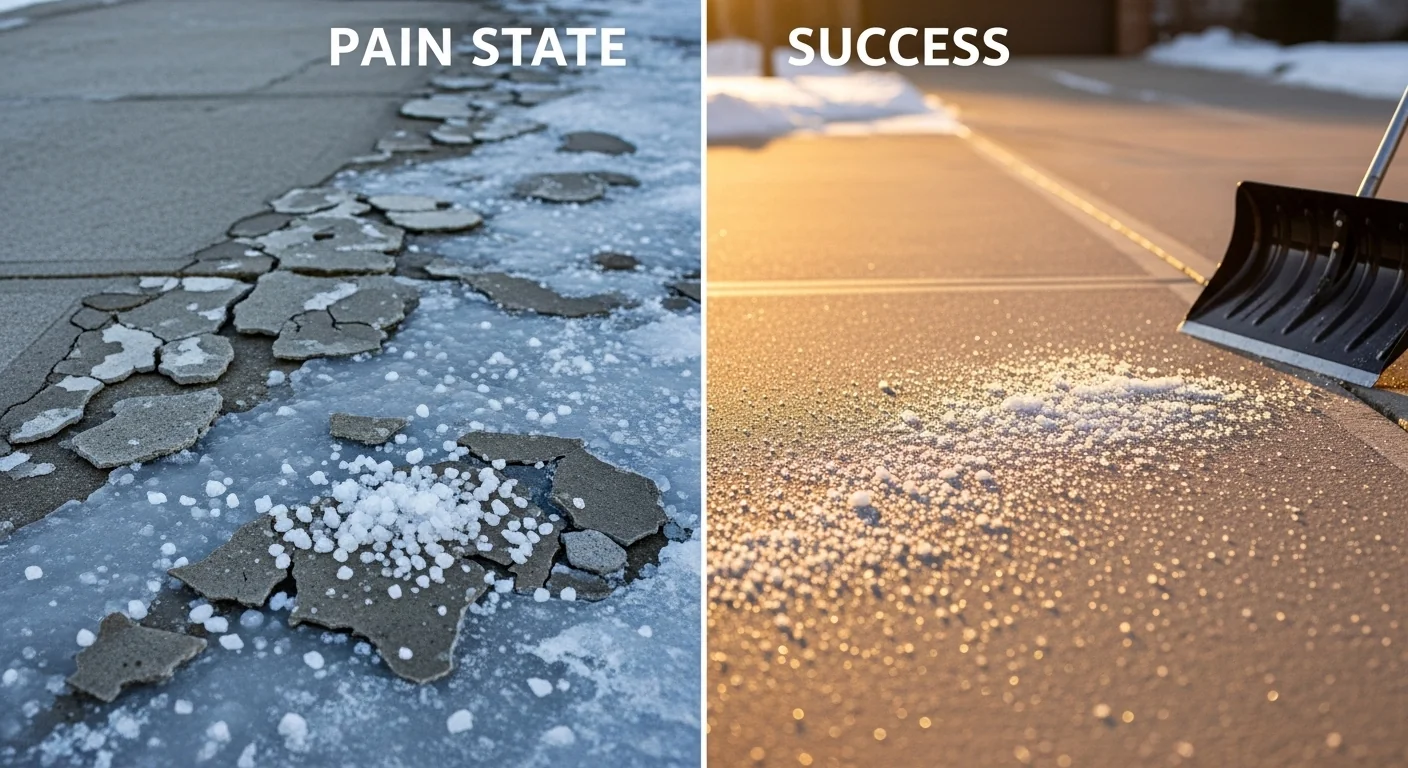
Choosing the wrong deicer at the wrong temperature does not just waste product. It can trigger a specific chain of thermodynamic events that physically destroy concrete surfaces from the inside out. The problem is not simply “salt damages concrete over time.” It is that certain chemical-temperature combinations create a partial-melt-then-refreeze cycle that is more mechanically destructive than the original ice ever was. Understanding that distinction changes every purchasing and application decision you will make this winter.
This calculator determines the correct spread rate in pounds for your specific driveway or sidewalk area, flags chemical-temperature mismatches before you apply anything, and issues a concrete-age lockout when your surface is too young to safely receive any chemical deicer. It does not predict long-term surface wear or account for variables like concrete mix design, existing sealer condition, or sub-base drainage. Those factors remain in your hands as the property manager.
After running this calculator, you will know exactly how many pounds of your chosen deicer to apply, whether that product can physically work at the current temperature, and whether your concrete is at elevated risk of freeze-thaw spalling before you buy or pour a single ounce.
Use the Tool
Ice Melt Application Rate Calculator
Snow Melt (NaCl vs CaCl₂) Spread Rate & Concrete Spalling Risk
Warnings & Standards
| Chemical | Min Effective Temp | Rate (lbs/1,000 ft²) | Concrete Risk |
|---|
How This Calculator Works
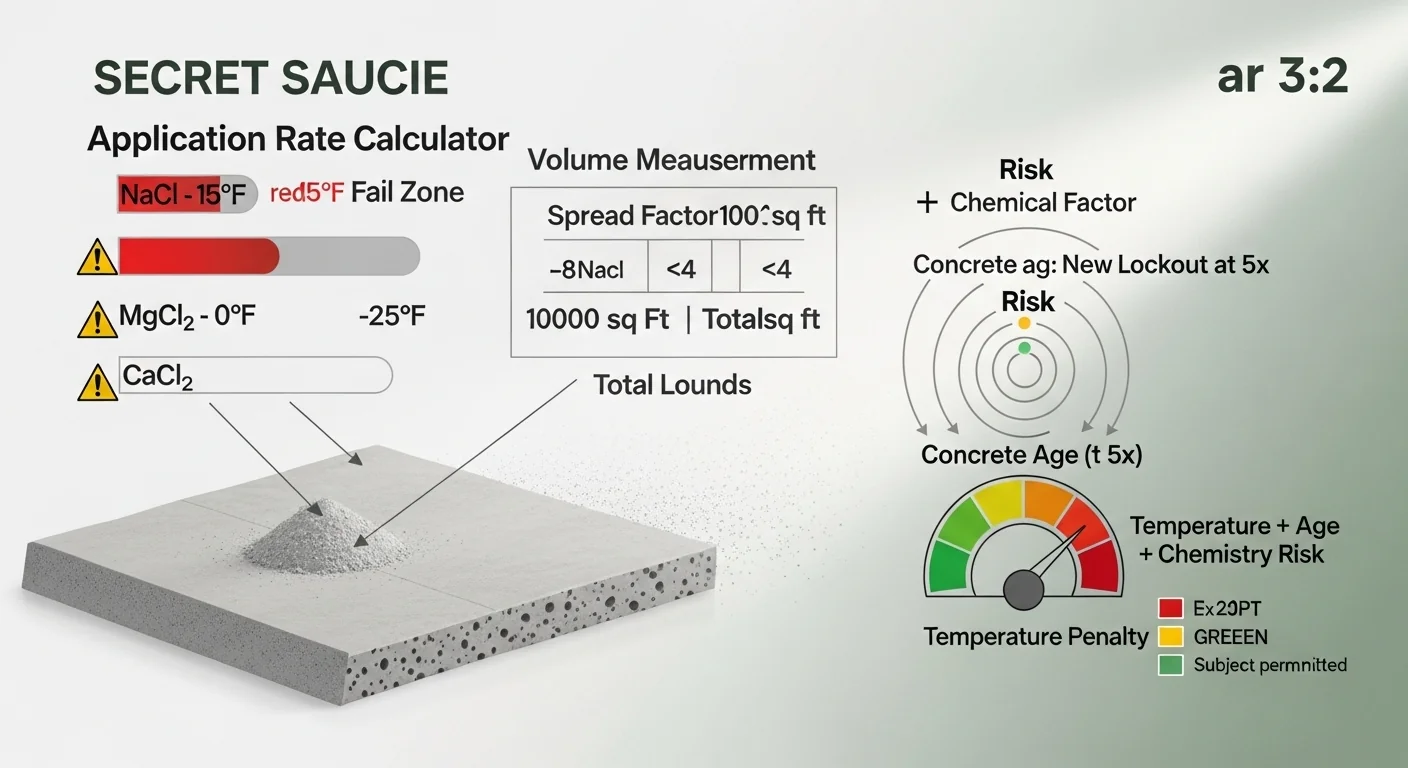
Step 1: Temperature Check — The calculator first checks if your selected deicer can actually work at the current temperature. Rock Salt (NaCl) is chemically ineffective below 15°F. Magnesium Chloride (MgCl₂) stops melting below 0°F. Calcium Chloride (CaCl₂) works down to -25°F.
Step 2: Concrete Age Assessment — Newly poured concrete (less than 1 year old) has not fully cured. Applying any chemical deicer on young concrete dramatically increases freeze-thaw spalling risk. The calculator issues a lockout warning for new concrete.
Step 3: Spread Rate Calculation — Application Rate = (Area ÷ 1,000) × Chemical Spread Factor. Spread factors: NaCl = 8 lbs/1,000 ft², MgCl₂ = 4 lbs/1,000 ft², CaCl₂ = 4 lbs/1,000 ft². These are standard manufacturer rates for moderate ice cover.
Step 4: Spalling Risk Score — Combines concrete age, chemical type, and temperature into a risk assessment. NaCl on mid-age concrete in cold temps creates the most dangerous freeze-thaw cycle. The thermodynamic failure: salt water seeps into concrete pores, then violently refreezes overnight, blowing off the surface layer.
Assumptions: Rates assume moderate ice thickness (¼” glaze). Heavy snowpack requires mechanical removal first. Rates are per single application. Pre-treat application rates are typically 50% of listed values. Always follow manufacturer guidelines for your specific product.
Assumptions & Limits
This calculator assumes a single application on moderate ice cover (approximately ¼-inch glaze). For heavy ice or packed snow, mechanical removal (shoveling or plowing) should be performed first.
Spread rates are based on widely published manufacturer guidelines and may vary by product concentration and pellet size. Liquid deicers are not covered by this tool.
Concrete spalling risk is a general assessment. Actual risk depends on concrete mix design, air entrainment, sealer condition, drainage, and local freeze-thaw cycle frequency.
Temperature readings should be taken at ground level when possible, as pavement temperature can differ from ambient air temperature by 5–10°F.
Always consult product labels and local environmental regulations before applying chemical deicers near vegetation, water features, or stormwater drains.
Before starting, measure your surface area in square feet (length times width for rectangular areas; break irregular shapes into rectangles and add the totals). Have a reliable outdoor thermometer reading ready, taken at ground level if possible, since pavement temperature can run 5 to 10 degrees colder than ambient air on clear nights. Know your concrete's approximate age before selecting the surface age option, as this single field controls the spalling lockout logic.
Quick Start (60 Seconds)
- Area (sq ft): Multiply length by width for your driveway or walkway. Enter the total in square feet, not square yards. A standard two-car driveway runs 400 to 800 sq ft; a standard front walk is 80 to 200 sq ft.
- Temperature (°F): Use current ambient outdoor temperature, not the forecast high. If it is 6 AM and 12°F, enter 12, not the afternoon high of 28°F. The melt-fail check fires on the temperature at time of application.
- Chemical type: Select the product you are actually holding, not the one you prefer. If you have rock salt in the garage but the temperature is 10°F, the calculator will flag the melt failure so you do not waste it.
- Concrete age: "Newly poured" means any surface that has been in place less than one full calendar year. When uncertain, select the younger category. The lockout is a conservative protection, not a penalty.
- Read the traffic light first: Before noting the pound quantity, check the status indicator. A red light means the calculation result should not be acted on regardless of the number shown.
- Avoid over-application: The output is a recommended spread rate for moderate ice glaze. Applying double the amount does not double the effectiveness and significantly increases concrete pore penetration.
- Pre-treatment cut: If applying before a storm, use approximately half the calculated spread rate. The reference table below includes pre-treat rates for all three chemical types.
Inputs and Outputs (What Each Field Means)
| Field Name | Unit | What It Means | Common Mistake | Safe Entry Guidance |
|---|---|---|---|---|
| Driveway / Sidewalk Area | sq ft | Total surface area receiving deicer application | Entering square yards instead of square feet (multiplies error by 9) | Measure length x width in feet; add multiple zones together |
| Ambient Temperature | °F | Outdoor air temperature at time of application | Using forecast high instead of current reading; pavement is colder than air on clear nights | Read thermometer at the time you plan to apply; use ground-level reading when possible |
| Chemical Type | Select | Active deicer compound; controls spread rate and minimum effective temperature | Assuming all "ice melt" bags are the same product; label-reading required | Match the selection to the actual ingredient listed on your product label |
| Concrete Age | Select | Approximate curing maturity of the surface | Assuming a surface poured last fall is "old enough" to accept deicers safely | If the surface was poured within the last 12 months, select "Newly Poured" regardless of appearance |
| Total Pounds (output) | lbs | Calculated deicer quantity for one standard application on your area | Treating the output as a minimum rather than a target; over-application is the leading cause of accelerated surface damage | Apply the stated amount uniformly; do not re-apply until the first application has had time to work (typically 15 to 30 minutes) |
| Risk Score / Traffic Light (output) | 0-100 scale | Composite spalling risk based on chemical type, surface age, and temperature | Ignoring the red or yellow indicator and proceeding with application anyway | A red indicator means stop and reconsider the chemical choice or surface condition before applying |
For projects involving paved walking surfaces like stepping stone paths, area calculations follow the same square-footage method used here.
Worked Examples (Real Numbers)
Scenario 1: Small Front Walkway, Rock Salt, Mild Cold
- Area: 180 sq ft
- Temperature: 22°F
- Chemical: Rock Salt (NaCl)
- Concrete Age: 5+ Years Old
Result: 1.44 lbs of NaCl (180 ÷ 1,000 × 8 = 1.44 lbs). Status: CAUTION.
At 22°F, NaCl is operating in its marginal zone (15 to 25°F). The caution flag fires because partial melting followed by overnight refreezing is most likely in exactly this temperature range. The quantity is correct for the area, but the risk profile is elevated. Calcium chloride would be a safer substitute on older pavement at this temperature.
Scenario 2: Large Driveway, Calcium Chloride, Extreme Cold
- Area: 1,200 sq ft
- Temperature: -8°F
- Chemical: Calcium Chloride (CaCl2)
- Concrete Age: 5+ Years Old
Result: 4.8 lbs of CaCl2 (1,200 ÷ 1,000 × 4 = 4.8 lbs). Status: Low Risk.
CaCl2 remains effective to -25°F and generates exothermic heat as it dissolves, actively working against refreeze. This is the appropriate chemical selection for extreme cold. Five pounds is a practical purchasing increment and covers the surface with a small safety margin.
Scenario 3: New Concrete Driveway, Any Deicer, Moderate Cold
- Area: 500 sq ft
- Temperature: 20°F
- Chemical: Rock Salt (NaCl)
- Concrete Age: Newly Poured (less than 1 year)
Result: SPALLING LOCKOUT. Application quantity is suppressed.
Newly poured concrete has not completed its pore-densification process. Even the lower-risk calcium chloride should be avoided during the first winter season. Sand or fine grit provides traction without chemical pore intrusion.
Reference Table (Fast Lookup)
| Chemical | Min Effective Temp (°F) | Standard Rate (lbs / 1,000 ft²) | Pre-Treat Rate (lbs / 1,000 ft²) | Lbs for 500 ft² (standard) | Lbs for 1,000 ft² (standard) | Lbs for 2,000 ft² (standard) | Mature Concrete Risk | New Concrete (<1 yr) Status |
|---|---|---|---|---|---|---|---|---|
| NaCl (Rock Salt) | 15 | 8 | 4 | 4.0 | 8.0 | 16.0 | High | LOCKOUT |
| NaCl at 15-25°F (marginal zone) | 15 | 8 | 4 | 4.0 | 8.0 | 16.0 | Very High (freeze-thaw bomb zone) | LOCKOUT |
| NaCl below 15°F | FAILS | N/A | N/A | N/A | N/A | N/A | MELT FAIL | LOCKOUT |
| MgCl2 (Magnesium Chloride) | 0 | 4 | 2 | 2.0 | 4.0 | 8.0 | Moderate | LOCKOUT |
| MgCl2 below 0°F | FAILS | N/A | N/A | N/A | N/A | N/A | MELT FAIL | LOCKOUT |
| CaCl2 (Calcium Chloride) | -25 | 4 | 2 | 2.0 | 4.0 | 8.0 | Low | LOCKOUT |
| CaCl2 at -25°F (effective floor) | -25 | 4 | 2 | 2.0 | 4.0 | 8.0 | Low | LOCKOUT |
| Any chemical, new concrete (<1 yr) | Any | N/A | N/A | LOCKOUT | LOCKOUT | LOCKOUT | SPALLING LOCKOUT | LOCKOUT |
Pre-treat rates assume application before precipitation begins. Standard rates assume application to active moderate ice glaze (approximately 1/4 inch). Heavy ice or compacted snow requires mechanical removal before any deicer application.
How the Calculation Works (Formula + Assumptions)
Show the calculation steps
Step 1: Temperature Validity Check
Before computing any quantity, the tool checks whether the selected chemical can actually work at the entered temperature:
- NaCl (Rock Salt): effective floor is 15°F. Below this threshold, the tool returns MELT FAIL.
- MgCl2 (Magnesium Chloride): effective floor is 0°F. Below this, MELT FAIL.
- CaCl2 (Calcium Chloride): effective floor is -25°F. Below this, MELT FAIL.
If NaCl is entered with a temperature between 15°F and 25°F, the tool passes the melt check but raises a CAUTION flag because this range represents the highest freeze-thaw cycle risk.
Step 2: Concrete Age Lockout
If Concrete Age is set to "Newly Poured (less than 1 year)," the tool issues a SPALLING LOCKOUT regardless of chemical type or temperature. No application quantity is returned. This lockout applies to all three chemicals because even lower-risk formulations penetrate uncured pore structures.
Step 3: Spread Rate Calculation
The application quantity formula is:
Total Application (lbs) = (Area ÷ 1,000) × Chemical Spread Factor
- NaCl Spread Factor: 8 lbs per 1,000 sq ft
- MgCl2 Spread Factor: 4 lbs per 1,000 sq ft
- CaCl2 Spread Factor: 4 lbs per 1,000 sq ft
The result is rounded to two decimal places. Units are total pounds for the entered area.
Step 4: Composite Risk Score
A risk score (0 to 100) combines chemical type, concrete age, and temperature to drive the gauge bar and traffic-light indicator:
- NaCl contributes a base risk factor of 3 (scaled by 15 = 45 points).
- MgCl2 contributes a base risk factor of 1.5 (scaled by 15 = 22.5 points).
- CaCl2 contributes a base risk factor of 1 (scaled by 15 = 15 points).
- Concrete age multiplies risk: new concrete adds 50 points; 1-5 year concrete adds 25 points; mature (5+ year) adds 10 points.
- Temperature below 10°F adds 25 points; 10 to 20°F adds 15 points; 20 to 32°F adds 5 points.
- A MELT FAIL condition adds 20 points. The score is capped at 100.
Scores above 60 render red, 35 to 60 render yellow, and below 35 render green.
Assumptions and Limits
- Spread rates assume moderate ice cover of approximately 1/4 inch glaze. Thicker or layered ice requires mechanical removal first.
- Rates reflect single-application totals. Multiple applications in one event compound concrete pore exposure.
- Pre-treatment rates are not automatically calculated; users should apply approximately 50% of the output quantity when treating proactively before a storm.
- The effective temperature floors are based on widely published manufacturer guidance. Specific product concentrations, pellet sizes, and carrier agents vary by brand and may shift actual performance by a few degrees.
- Spalling risk score is a general assessment tool, not a structural engineering evaluation. Actual risk depends on concrete mix design, air entrainment, existing sealer condition, and local freeze-thaw cycle frequency over the surface's lifetime.
- Liquid deicer formulations are not included. Liquid application rates differ from granular/pellet rates and require separate calculation.
- Pavement temperature can diverge from ambient air temperature by 5 to 15°F on radiative cooling nights. A thermometer on the surface itself provides a more accurate application decision than ambient air readings alone.
- Environmental regulations regarding deicer runoff near stormwater drains, wetlands, and vegetation zones vary by municipality and are not addressed by this tool.
Standards, Safety Checks, and "Secret Sauce" Warnings
Critical Warnings
- The Freeze-Thaw Bomb at Marginal Temperatures: When NaCl is applied at temperatures between 15°F and 25°F, the salt partially dissolves the ice surface. The resulting brine seeps into the microscopic pore structure of the concrete. If overnight temperatures then drop below 15°F, that trapped water refreezes and expands by roughly 9% in volume, a mechanical force that exceeds the tensile strength of most residential concrete mixes. The surface layer delaminates and spalls. This is not slow chemical degradation; it is a single-event structural failure. The tool flags this entire temperature band as a caution zone precisely because the product technically "works" while simultaneously setting the conditions for surface destruction.
- Concrete Under One Year Old: Freshly placed concrete continues strengthening and densifying its pore network for the first 12 months. During this period, chemical deicers of any type, including calcium chloride, should not be applied. The open pore structure of young concrete absorbs brine more deeply and with less resistance than mature concrete, and the resulting freeze-thaw damage can occur after just one or two events. Sand or non-chemical traction agents are the only safe option for first-winter concrete.
- Melt Failure Disguised as Partial Success: At temperatures below a chemical's effective floor, the deicer sits on the surface without dissolving meaningful ice. However, if daytime solar gain briefly warms the surface, a small amount of product may dissolve, creating localized brine that refreezes once the sun moves. This is more damaging than not applying anything, because it creates uneven brine pockets rather than a dry surface.
- Over-Application Compounds Damage: Applying twice the recommended rate does not halve the time to melt or double effectiveness. It increases brine concentration and surface saturation, accelerating pore penetration and, when runoff travels to lawn edges, causes turf and ornamental plant chloride toxicity.
Minimum Standards
- Apply chemical deicers only after mechanical removal of bulk snow. Deicers work on ice and thin residual layers, not on several inches of packed snow.
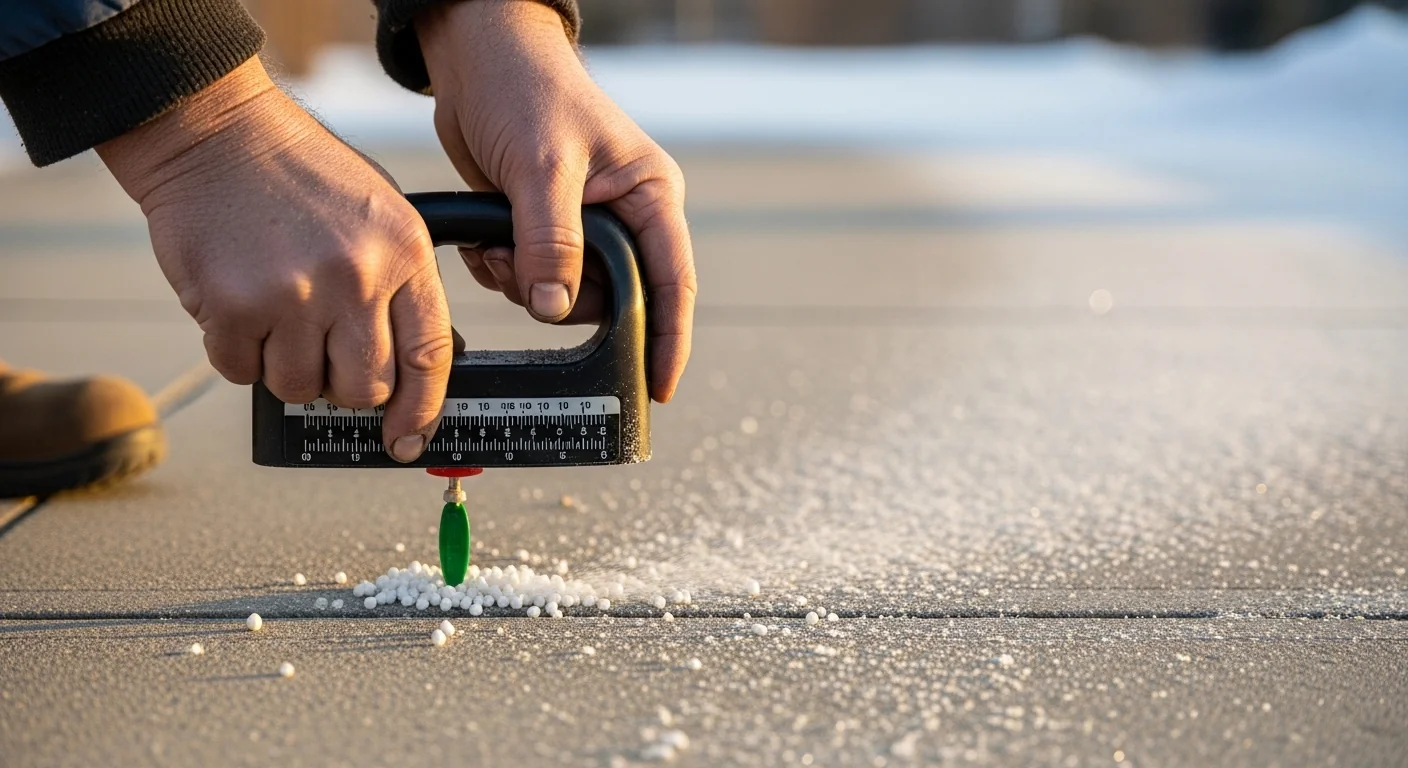
- Use a walk-behind drop spreader with a winter deflector shield for any area over 400 sq ft. Hand spreading is inaccurate and almost always results in over-application in some zones and under-application in others.
- Apply a penetrating concrete sealer (Silane/Siloxane formulation) to any concrete surface before the first winter season. This treatment reduces brine penetration depth significantly and is the most effective single protective measure available outside of switching to a less aggressive chemical.
- Store rock salt in a sealed, dry container. Exposure to humidity causes clumping and uneven distribution, making accurate spread rates nearly impossible to achieve even with a calibrated spreader.
Competitor Trap: Most ice melt content presents a simple table of "chemicals and temperatures" without explaining what happens in the zone just above the minimum effective temperature. Rock salt at 16°F is technically "within spec," which is why most guides say it should work. What those guides skip is the mechanism: product that barely dissolves at its effective floor creates the highest-risk brine concentration of any application scenario, because the water-to-salt ratio is at its most aggressive pore-penetrating point. Knowing the effective floor temperature is necessary but insufficient. The marginal zone behavior is the information that actually determines whether your driveway survives the winter.
For hardscape surfaces where slope affects drainage and therefore ice accumulation patterns, the patio slope calculator can help you assess whether standing water and ice pooling is a drainage problem rather than a deicer selection problem. Similarly, properties with steep driveway approaches may find the gravel driveway slope calculator useful for understanding where runoff from deicer application will travel.
Common Mistakes and Fixes
Mistake: Using Rock Salt Below Its Effective Temperature Floor
At temperatures below 15°F, NaCl does not generate enough exothermic reaction to initiate meaningful melting. Users who apply rock salt at 8°F and then wonder why the driveway is still icy six hours later are experiencing a chemistry failure, not a quantity problem. Adding more product will not help. The fix is to switch to calcium chloride, which works to -25°F, or to use traction agents like sand until temperatures rise above the NaCl threshold.
Mistake: Treating Concrete Age as Unimportant
A driveway poured in September is still in its first winter by February. It looks solid, cured, and strong. Internally, its pore network is still open and absorbing moisture readily, which makes it uniquely vulnerable to brine intrusion. Many homeowners skip the age question because they assume cured appearance equals structural readiness. The fix is to use sand-only traction for any surface under 12 months old and apply a Silane/Siloxane sealer before the following winter.
Mistake: Eyeballing Spread Rate Without Measuring Area
Spreading "a few handfuls" on an unmeasured surface results in wildly inconsistent application. A 1,200 sq ft two-car driveway requires 9.6 lbs of calcium chloride at standard rates; what feels like "a few handfuls" might be 2 lbs or 20 lbs. Both extremes cause problems. Under-application leaves active ice; over-application saturates concrete pores and damages nearby lawn edges. If you are planning a paved installation and need to think about base material volumes before you even get to deicer selection, the paver base calculator is a useful early-stage reference.
Mistake: Applying Deicer Before Clearing Bulk Snow
Deicers work by lowering the freeze point of water at the ice-concrete interface, then breaking the ice-surface bond so it can be removed mechanically. They are not designed to dissolve several inches of packed snow from the top down; that process is slow, wasteful, and burns through product at a rate that far exceeds any calculated spread rate. The fix is to shovel or plow to the pavement first, then apply deicer to the residual ice layer, then clear the resulting slush.
Mistake: Ignoring Runoff Zones When Calculating Application Area
Deicer applied to a sloped driveway does not stay where it lands. Meltwater carrying dissolved chlorides runs to lawn edges, garden beds, storm drains, and in some regions, protected waterways. Calculating only the surface area without accounting for where the meltwater travels leads to chronic turf damage and ornamental plant toxicity over repeated seasons. The fix is to flag runoff paths before the first application and consider using lower-rate MgCl2 or CaCl2 in zones adjacent to landscaping, since those products are less aggressive to plant tissue than NaCl brine at equivalent dilution rates.
Next Steps in Your Workflow
Once you have your calculated application quantity, the immediate next step is equipment calibration. A standard rotary broadcast spreader needs to be set to a rate appropriate for the particle size of your specific deicer product, which varies between pellets, granules, and flakes. If you plan to protect your concrete long-term rather than just managing this season's ice, scheduling a Silane/Siloxane sealer application before next fall is the most cost-effective structural protection available. For properties where the ice problem is partly a drainage design issue, resolving standing water accumulation points will reduce the ice load your deicers need to handle each event.
For full property winterization, your deicer calculation is one component of a broader site workflow. Hardscape projects that feed into your winter management plan, including retaining wall construction or stair design, both involve concrete surfaces that will eventually require the same deicer selection decisions covered here. Planning chemical compatibility at the design stage, rather than after the pour, gives you the ability to spec air-entrained concrete mixes and apply a protective sealer during construction rather than as a reactive fix.
FAQ
What is the standard ice melt application rate in pounds per 1,000 square feet?
Rock salt (NaCl) has a standard application rate of 8 lbs per 1,000 sq ft for moderate ice conditions. Calcium chloride (CaCl2) and magnesium chloride (MgCl2) both apply at 4 lbs per 1,000 sq ft for the same ice coverage. Pre-treatment rates are approximately half the standard rates for all three products. These figures come from widely published manufacturer guidance for granular and pellet deicer formulations.
At what temperature does rock salt stop working?
Rock salt (NaCl) reaches its effective lower limit at 15°F. Below this temperature, the endothermic dissolution process becomes too slow to generate meaningful melting. In the marginal range between 15°F and 25°F, NaCl technically functions but at reduced speed and with elevated risk of creating brine that will refreeze overnight, which is the primary mechanism driving concrete surface spalling from deicer use.
Is calcium chloride safe to use on concrete driveways?
Calcium chloride (CaCl2) carries the lowest concrete spalling risk of the three common granular deicers. Its exothermic dissolution generates heat that works against refreeze, and it is effective to -25°F without triggering the marginal-zone freeze-thaw cycle that NaCl does. However, no chemical deicer should be applied to concrete less than one year old, and all deicers will cause damage over many seasons on unsealed concrete surfaces.
Why does concrete spall after using ice melt?
Concrete spalling from deicer use is a freeze-thaw cycle problem, not a simple chemical corrosion problem. When brine (dissolved deicer in water) seeps into concrete pores and then refreezes, the volumetric expansion of ice within a confined pore space exerts pressure that exceeds the concrete's tensile strength. The surface layer delaminates. This is most severe when NaCl creates brine near its effective floor temperature, because that brine remains liquid at a temperature range where overnight refreeze is almost certain.
Can I use ice melt on new concrete?
No. Concrete less than one year old should not receive any chemical deicer application. During the first year, the concrete's pore network is still densifying through continued cement hydration. Open pores absorb brine more readily and to greater depth than mature concrete, and the resulting freeze-thaw damage can occur from a single event. Use sand or non-chemical traction grit through the first full winter season, then apply a Silane/Siloxane penetrating sealer before year two begins.
What is the difference between calcium chloride and magnesium chloride for driveways?
Both products apply at 4 lbs per 1,000 sq ft and are less damaging to concrete than NaCl. Calcium chloride works to -25°F and is exothermic, making it the better choice for extreme cold. Magnesium chloride is effective to 0°F and is generally considered gentler on vegetation and pet paws at typical application rates, making it a useful compromise in climates where temperatures rarely fall below 0°F and the driveway borders planted areas.
Conclusion
The decision about which deicer to apply and at what rate is more consequential than it appears on a January morning. The temperature floor failures and the concrete-age lockout built into this calculator represent the two scenarios where the most confident application decisions produce the worst outcomes: a homeowner spreading rock salt at 10°F accomplishes nothing except setting up a brine-refreeze cycle, and a homeowner treating a September pour with any chemical deicer the following January accelerates surface damage that will show up by spring. Both failures are entirely preventable with the right pre-application check.
Use the calculated pound quantity as your target, not your minimum. Calibrate your spreader to hit it accurately across the full surface. If your concrete is unsealed, schedule a Silane/Siloxane application for the fall before the next deicer season. And if the temperature is below your chemical's effective floor when the ice event hits, put the bag away and reach for sand instead. The product you save today will work correctly next week when the temperature recovers.