
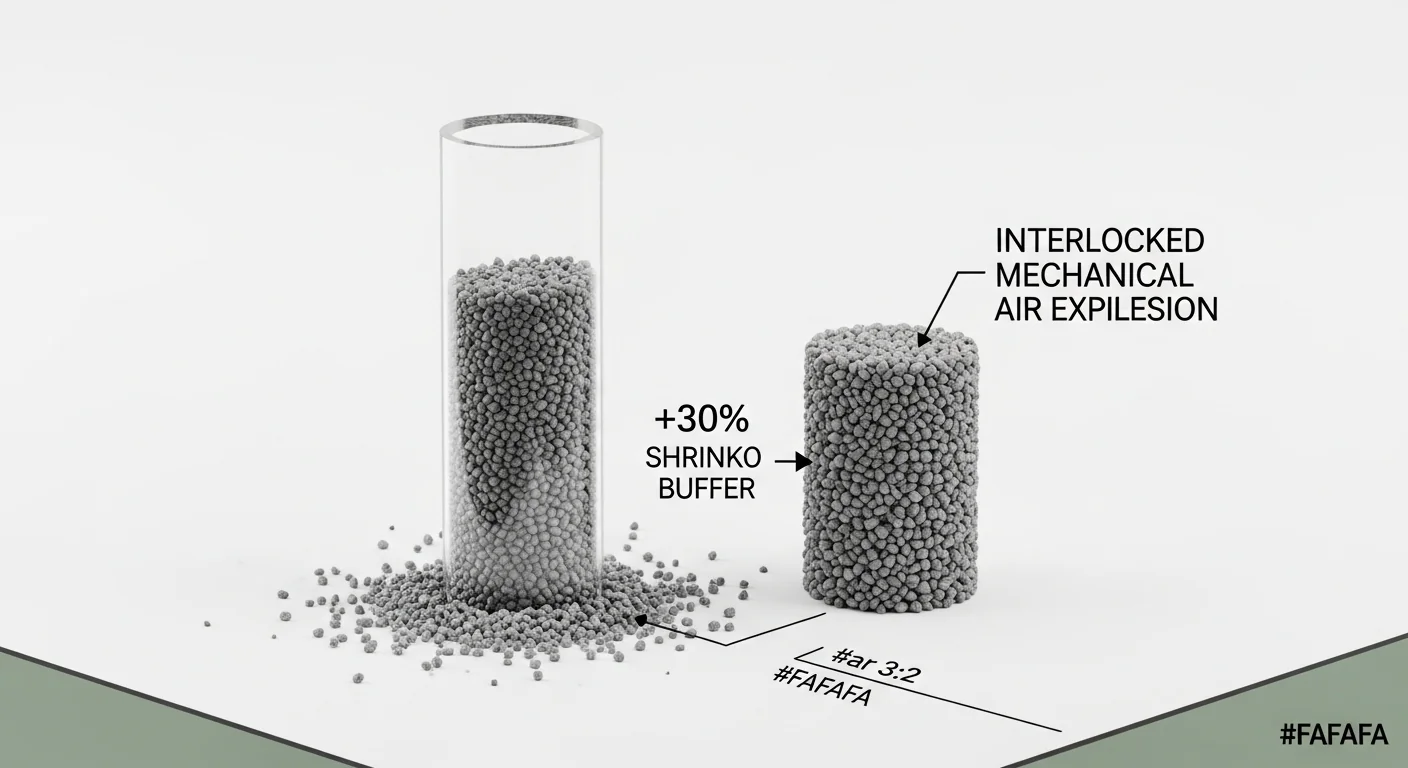
Most material calculators treat a cubic foot of loose gravel and a cubic foot of properly compacted base as the same thing. They are not. A vibratory plate compactor drives out air and forces particles to interlock, shrinking the volume by a significant margin. Order only the theoretical “geometric” yardage and you will be staring at a half-empty project with a compactor idling and a crew waiting. This paver base calculator bakes in the material-specific compaction buffer so the number you take to the supplier already covers the post-compaction reality.
Enter your patio, walkway, or driveway dimensions, choose your base aggregate, and this tool gives you the cubic yards to order — not the naive volume. It also separates the computed base-only yardage from the shrinkage buffer, shows where your material goes in a stacked bar, and checks whether your planned depth meets industry minimums for pedestrian or vehicular loads. The tool does not design your cross-section, does not account for subgrade preparation or geotextile, and does not replace a geotechnical engineer for load-critical jobs.
Use the order figure as your purchase quantity, add a 5–10% overage for the inevitable uneven spread, and you will not stop work because a truck came up short.
Use the Tool
Paver Base Compaction & Yield Calculator
Accounts for aggregate shrinkage so you order exactly what you need — no project-halting shortfalls.
| Area (sq ft) | Depth | Base Yards | Order (w/ 30% buffer) | Use Case |
|---|
How This Calculator Works
This calculator uses the standard aggregate compaction formula used by professional landscape contractors. It accounts for the physical compression of granular base material when mechanically compacted.
Compaction factor varies by material: Class 5 Gravel ≈ 25–30% shrinkage; Crushed Concrete ≈ 20–25% shrinkage; Sand ≈ 15–20% shrinkage. This tool applies a conservative 30% buffer for Class 5 and Crushed Concrete, and 25% for Sand to ensure you never run short.
Assumptions & Limits
- Compaction shrinkage of 25–30% assumes use of a vibratory plate compactor (not hand tamping). Hand tamping achieves significantly less compaction and will require an even larger buffer.
- Base depth is the target compacted depth. You must install more loose material to achieve the final compacted depth.
- This calculator does not account for sub-base excavation depth, existing soil conditions, or geotextile fabric thickness.
- Class 5 Gravel and Crushed Concrete are well-graded aggregates well-suited for load-bearing paver bases. Sand alone is not recommended for driveways or vehicle-rated patios.
- Driveway applications under vehicular traffic require a minimum of 8 inches of compacted base to prevent rutting. This is a code and engineering standard — not a guideline.
- Yield calculations assume standard bulk density. Delivery moisture content may vary actual yield by ±5%.
- Always add 5–10% overage when ordering from a supplier to account for uneven distribution and material left in the truck.
Before you reach for the calculator, have your overall length and width in feet ready. Know the target compacted base depth — measured after the plate compactor has done its job — and decide whether you are using Class 5 gravel, crushed concrete, or sand. For driveways, the tool will explicitly flag depths below 8 inches. Once you hit “Calculate”, the results section appears and the page scrolls you straight to the only number that matters for ordering: cubic yards to order.
If you are also working with jointing material after the pavers go down, our polymeric sand calculator picks up right where this one leaves off.
Quick Start (60 Seconds)
- Measure the total length of the paver area in feet; include any soldier course or border.
- Measure the total width the same way — do not subtract for obstructions until you are certain they sit below the base.
- Pick your compacted depth in inches. Pedestrian patios typically need 4 inches; a driveway under vehicle traffic requires at least 8 inches.
- Choose your base material. Class 5 gravel and crushed concrete give the best load-bearing performance; sand alone is not rated for driveway use.
- Press “Calculate Paver Base” or hit Enter in any number field.
- Look at the large “Cubic Yards to Order” number — that is your procurement target.
- Use the “Reset” button to clear everything and try a different scenario without refreshing the page.
Inputs and Outputs (What Each Field Means)
Every field maps directly to a physical measurement or material selection. The table below explains what the calculator expects and what it delivers, including the most frequent input mistakes contractors and DIY users make.
| Input / Output | Unit | What it means | Common mistake | Safe entry guidance |
|---|---|---|---|---|
| Patio / Walkway Length | feet (ft) | Total linear length of the area to be paved, measured along the primary axis | Entering inches instead of feet; using “step-off” estimations that miss curved edges | Round up to the nearest half-foot; measure with a tape, not a stride |
| Patio / Walkway Width | feet (ft) | Total perpendicular width of the paved surface | Forgetting to include the width of edging restraints; measuring only the field area | Include the full excavated width, not just the visible paver field |
| Target Compacted Base Depth | inches (in) | The final thickness of the aggregate layer after mechanical compaction | Inputting the loose-screeded depth, which is always thicker than the compacted depth | Verify against a grade stake after a test compaction pass; never assume the screed height equals the compacted height |
| Base Material Type | — | Aggregate classification affecting compaction factor, drainage, and load-bearing capacity | Choosing sand for a driveway or heavy-traffic area; thinking “gravel is gravel” regardless of gradation | Select Class 5 or crushed concrete for any vehicular surface; reserve sand for pedestrian-only applications on stable subgrade |
| Cubic Yards to Order (output) | cubic yards | Total loose cubic yards to purchase, including the compaction buffer | Ignoring the buffer and only ordering the raw base yardage | Provide this exact number to your supplier, then add a separate 5–10% overage |
| Base Yards (No Compaction) | cubic yards | Geometric volume of the compacted prism if compaction caused zero shrinkage | Using this as the order quantity — that mistake alone leaves projects 20–30% short | Treat this as a reference number; never place a purchase order with it |
| Compaction Shrinkage | cubic yards | Additional yardage required to offset the volume reduction during compaction | Believing the supplier’s “compacted-in-place” claim applies without a plate compactor | Use as a sanity check that the buffer is realistic for the chosen material |
| Surface Area | square feet (sq ft) | Plan-view area used for all volume calculations | None — this is a straightforward product of length and width | Compare to your own sketch to confirm no digit transposition |
Worked Examples (Real Numbers)
Small Garden Walkway — Class 5 Gravel
- Length: 20 ft
- Width: 3 ft
- Compacted depth: 4 in
- Material: Class 5 Gravel
Result: Surface area = 60 sq ft. Base yards (no compaction) = 0.74 yd³. Compaction buffer (30%) adds 0.22 yd³. Cubic yards to order = 1.0 yd³ (rounded from 0.96).
A short, narrow path like this might seem trivial, but ordering 0.74 yards without the buffer would leave the final compacted layer thin and uneven. One cubic yard, combined with a small overage, keeps the job running.
Backyard Patio — Crushed Concrete
- Length: 12 ft
- Width: 10 ft
- Compacted depth: 4 in
- Material: Crushed Concrete
Result: Surface area = 120 sq ft. Base yards = 1.48 yd³. Crushed concrete compaction buffer (25%) adds 0.37 yd³. Order quantity = 1.9 yd³.
Crushed concrete compacts slightly less than Class 5, but the principle is identical. The tool automatically applies the correct factor — you do not need to guess.
Single-Car Driveway — Class 5 Gravel (8-inch Depth)
- Length: 20 ft
- Width: 12 ft
- Compacted depth: 8 in
- Material: Class 5 Gravel
Result: Surface area = 240 sq ft. Base yards = 5.93 yd³. Order quantity with 30% buffer = 7.7 yd³. The tool also passes the 8-inch minimum driveway depth check — no critical warning appears. If you had entered 6 inches for the same driveway, the tool would flag a rutting risk in red.
This example shows why the depth threshold matters: a 240 sq ft driveway at 6 inches would order about 5.8 yd³, but that thinner base leads to expensive failures long before the pavers show wear.
Reference Table (Fast Lookup)
All values below assume Class 5 gravel with a 30% compaction buffer. Use the table to estimate material needs before you measure precisely, or to double-check the calculator output.
| Area (sq ft) | Compacted Depth (in) | Base Yards (no comp.) | Yards to Order | Typical Use |
|---|---|---|---|---|
| 50 | 4 | 0.62 | 0.8 | Landing pad or small porch step |
| 100 | 4 | 1.23 | 1.6 | Narrow walkway or utility path |
| 200 | 4 | 2.47 | 3.2 | Garden path or pool surround |
| 400 | 4 | 4.94 | 6.4 | Average pedestrian patio |
| 400 | 8 | 9.88 | 12.9 | Driveway apron (8-inch standard) |
| 600 | 4 | 7.41 | 9.6 | Large backyard patio |
| 800 | 6 | 14.81 | 19.3 | Single-car paver driveway (minimum 8-inch recommended) |
| 1200 | 8 | 29.63 | 38.5 | Double-car driveway |
The highlighted rows show that doubling the depth nearly doubles the required cubic yardage, even for the same footprint. Because the compaction buffer is multiplicative, the difference between ordering with and without the buffer grows significantly on larger jobs.
How the Calculation Works (Formula + Assumptions)
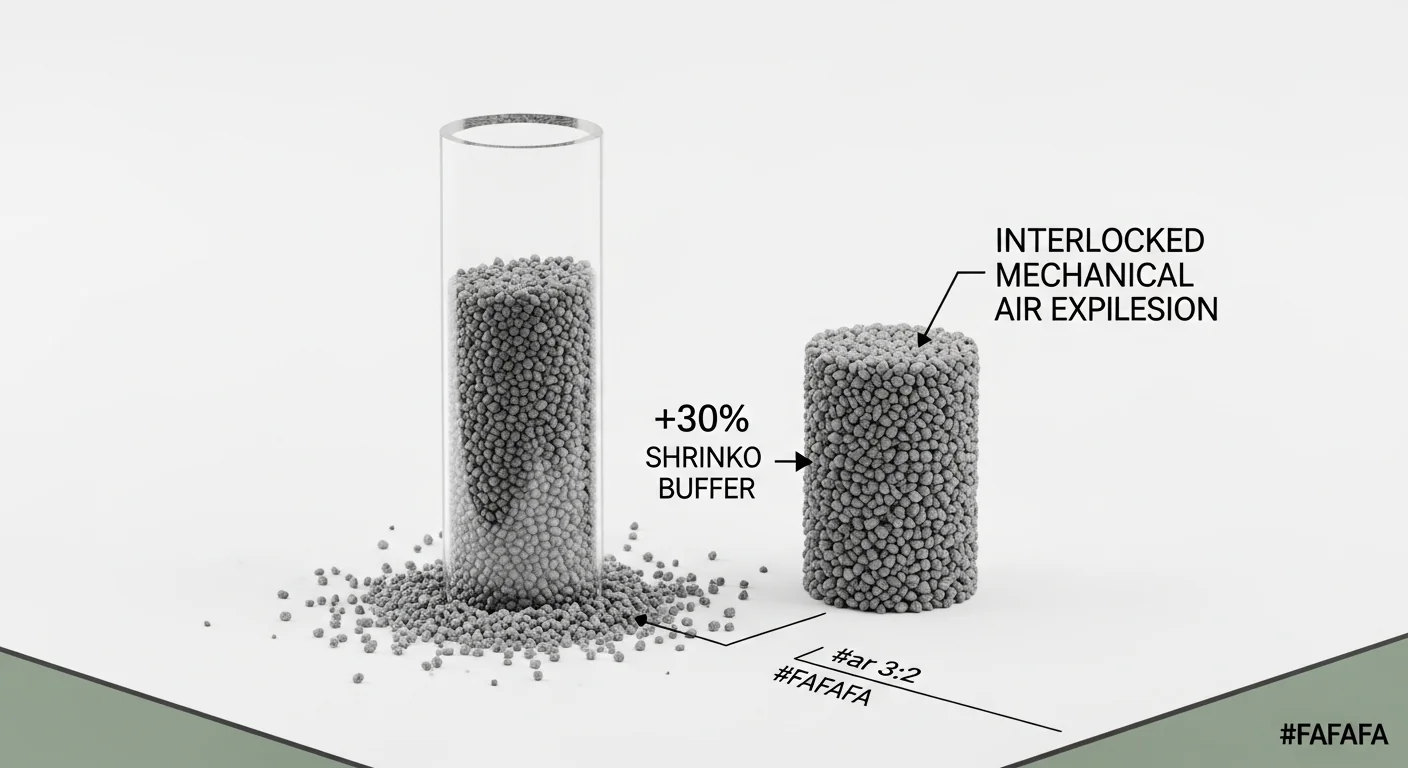
The math is straightforward, but the single step most calculators skip is the material-dependent compaction factor. Here is exactly what happens when you press “Calculate”.
Show the calculation steps
Step 1 — Compute the surface area
Surface Area (sq ft) = Length (ft) × Width (ft)
This step uses the full projected area; the calculator rounds to one decimal place for display but keeps full precision internally.
Step 2 — Convert depth to feet and get cubic feet
Cubic Feet = Surface Area × (Depth in inches ÷ 12)
Depth stays in its entered inches, so 4 inches becomes 0.333… feet. The result is the theoretical compacted volume in cubic feet.
Step 3 — Convert to cubic yards (base requirement)
Base Yards = Cubic Feet ÷ 27
This is the geometric volume you would need if compaction caused no shrinkage. For display, it rounds to two decimal places.
Step 4 — Apply the compaction buffer
Yards to Order = Base Yards × Compaction Factor
The factor differs by material: Class 5 gravel = 1.30, Crushed concrete = 1.25, Sand = 1.20. The buffer accounts for aggregate particle rearrangement and expulsion of air voids under mechanical compaction.
Step 5 — Derive shrinkage contribution
Compaction Shrinkage = Yards to Order − Base Yards
This number is shown in the secondary stat card so you can see exactly how much extra you are adding to avoid a shortfall.
Rounding rule: The final ordered yards display rounds to one decimal place because aggregate suppliers typically sell by the quarter-yard or half-yard, and that precision matches practical ordering. All intermediate values retain full float accuracy to avoid cascading rounding errors.
Assumptions & Limits
- Compaction factors assume mechanical compaction with a vibratory plate compactor of sufficient weight. Hand tamping yields less compaction and would require an even larger buffer, not accounted for here.
- Base depth is the target compacted depth. You must screed loose material thicker than this, but the calculator does not tell you the loose thickness — it only computes the volume of compacted material and the adjusted order quantity.
- The tool does not include sub-base excavation volume, existing soil bearing capacity, or the thickness of geotextile or bedding sand layers. For a full cross-section design, consult a civil engineer or pair this with our gravel calculator for multi-layer projects.
- Yield calculations use standard bulk density assumptions. Actual delivered weight and volume can vary by ±5% depending on moisture content and aggregate source, which is why the supplier overage note is essential.
- Material factors are fixed at 1.30, 1.25, and 1.20 for Class 5, crushed concrete, and sand respectively. While real-world compaction can range slightly, these values represent conservative, widely accepted defaults in landscape construction.
- The rutting warning trigger (depth < 8 inches when depth ≥ 6) acts as a heuristic for potential vehicular use. It does not replace a structural evaluation, but it flags conditions where paver base failure is common.
- Results assume a uniform, level subgrade. Sloping sites may require additional material to maintain minimum base thickness across the pad — see our patio slope calculator for grading considerations.
Standards, Safety Checks, and “Secret Sauce” Warnings
Every calculation includes live, deterministic checks that turn hidden failure modes into plain-language alerts. These are not generic tips; they are hard-coded into the engine based on published industry guidelines and field observations.
Critical Warnings (When the Tool Flags a Problem)
- Rutting risk — shallow base for vehicular use: If your depth falls between 6 and 8 inches, the calculator assumes potential driveway or parking application and displays a red danger-level warning. A compacted base below 8 inches under repeated vehicle loads is the single most common cause of paver rutting and base degradation.
- Sand-only base insufficient for heavy loads: Selecting sand as the base material when depth is under 6 inches triggers a warning. Sand lacks the angular interlock of crushed aggregates and is not recommended by ICPI for vehicular surfaces or high-traffic pedestrian areas.
Minimum Standards (What Professional Installers Already Know)
- Pedestrian minimum: The Interlocking Concrete Pavement Institute (ICPI) recommends at least 4 inches of compacted aggregate base for light foot traffic. The tool notes when depth is at or below 3 inches.
- Lift compaction for deep sections: When the target compacted depth reaches 8 inches or more, the tool advises compacting in 4-inch lifts. Single-pass compaction of deep layers produces uneven density and leaves the lower portion under-compacted, compromising long-term performance.
- Compaction deficit awareness: Regardless of material, the results explicitly state the yardage shortfall you would experience without the buffer, preventing the most common ordering mistake.
Competitor Trap: Many online calculators only multiply length × width × depth ÷ 27 and call it done. They ignore compaction entirely, or they leave the user to guess a “fluff factor.” That approach produces an order quantity that fails the moment a plate compactor hits the stone. This tool bakes the buffer into the primary output and makes the shrinkage visible, so you are never left holding a number that looks correct on paper but collapses in the field.
If your project includes geogrid reinforcement, the base thickness and compaction interaction change. Our geogrid retaining wall calculator covers those specs.
Common Mistakes and Fixes
Mistake: Ordering the “base yards” number without the compaction buffer
The calculator clearly separates base yards and yards to order for a reason. Once the compactor runs, the actual compacted volume is smaller than the delivered loose volume. Ordering only the geometric yardage guarantees a shortfall, stops work, and forces a second delivery fee. Fix: always use the “Cubic Yards to Order” output as your baseline and then add the separate 5–10% overage.
Mistake: Assuming any gravel behaves the same as Class 5
River rock, pea gravel, and ungraded fill do not compact like a well-graded aggregate with fines. The tool’s factors are calibrated for the three materials in the dropdown. Substituting an unspecified “road base” without knowing its gradation can lead to either under-compaction or an excessive buffer. Fix: confirm with your supplier that the material matches Class 5 or crushed concrete specifications before relying on the factor.
Mistake: Measuring after the fact instead of before
Holding the calculator until the excavation is done often means accepting whatever footprint the machine left. Uneven edges and over-digging inflate area and waste material. Fix: stake out the final paver perimeter, measure from stake to stake, and input those dimensions before any soil is removed.
Mistake: Confusing compacted depth with loose-screeded depth
A screed set to 5 inches will compact down to roughly 3.5–4 inches with Class 5 gravel. If you input 5 inches thinking that is your final compacted depth, you will under-order. Fix: decide on the required compacted thickness, enter that, and let the buffer account for the extra loose volume. The tool already assumes you are inputting the finished compacted dimension.
Mistake: Skipping the overage entirely on large jobs
Even a perfect calculation cannot account for material left in the delivery truck, wind-blown fines, or irregularities in subgrade. On a 30-yard order, a 5% variance is 1.5 yards — enough to stop paving. Fix: add a 5–10% overage to the displayed order quantity and round up to the nearest half-yard when phoning the supplier.
Next Steps in Your Workflow
Your paver base yardage is now locked in, but that number only solves the aggregate portion of the project. The next critical layer is the bedding course — typically 1 inch of concrete sand or stone screenings that creates a smooth setting bed for the pavers. Once the base is compacted and grade-checked, order that sand separately, because trying to use base aggregate for bedding will make final leveling difficult.
Before you call the supply yard, also work out your edge restraint and jointing material. The perimeter restraint holds the entire assembly together, and polymeric sand locks individual units. Jumping straight from base calculation to paver installation without those two items leads to lateral spreading and weed intrusion. Our paver sealer calculator can help you plan the protective finish once everything is in place, but the immediate priority is getting the base built right.
FAQ
Does this calculator work for permeable paver bases?
It computes aggregate volume, but permeable systems often use open-graded stone with less fines, which compacts differently. The standard compaction factors here are for dense-graded base materials. For no-fines permeable bases, confirm the supplier’s compaction recommendation and consider adding an extra 5% to the buffer manually.
Why does the tool show a red warning even though I entered 6 inches for a walkway?
The warning triggers when depth is 6 inches or more but still below 8, because the calculator cannot distinguish whether the surface is a walkway or a driveway apron. At 6 inches with Class 5 or crushed concrete, you get a caution about potential under-design for vehicle loads. If the area is truly pedestrian-only, you can safely ignore the alert, but if a car might ever drive on it, upgrading to 8 inches is prudent.
Should I use Class 5 gravel or crushed concrete for my project?
Both are well-graded, angular aggregates suited for paver bases. Class 5 is a regional specification with specific gradation bands; crushed concrete is recycled and often slightly more angular, which can interlock well. The calculator applies a 30% buffer for Class 5 and 25% for crushed concrete. Availability and price typically drive the choice more than performance differences at pedestrian depths.
Can I use this calculator for a poured concrete slab base?
No. This tool is designed for flexible paver base systems that require granular aggregate. Poured concrete volume calculations do not involve a compaction buffer and are measured by cubic yards of fresh mix, not loose stone. The geometry formula may look similar, but the material behavior is entirely different.
What if my project has multiple depth zones — a walkway at 4 inches and a driveway at 8 inches?
Run the calculator twice: once for each distinct area and depth combination. Add the “Cubic Yards to Order” numbers together. Because the compaction buffer is proportional, you can safely sum them. Just make sure you accurately measure the separate footprints to avoid double-counting transition zones.
Is the 5–10% overage really necessary if the tool already adds a buffer?
Yes. The buffer accounts for volume lost during compaction, not for spillage, uneven spreading, or the inevitable heel of material left in the delivery truck. The 5–10% extra is a logistics margin that prevents a second trip charge. On small jobs under 2 yards, rounding up to the next half-yard often covers it.
Conclusion
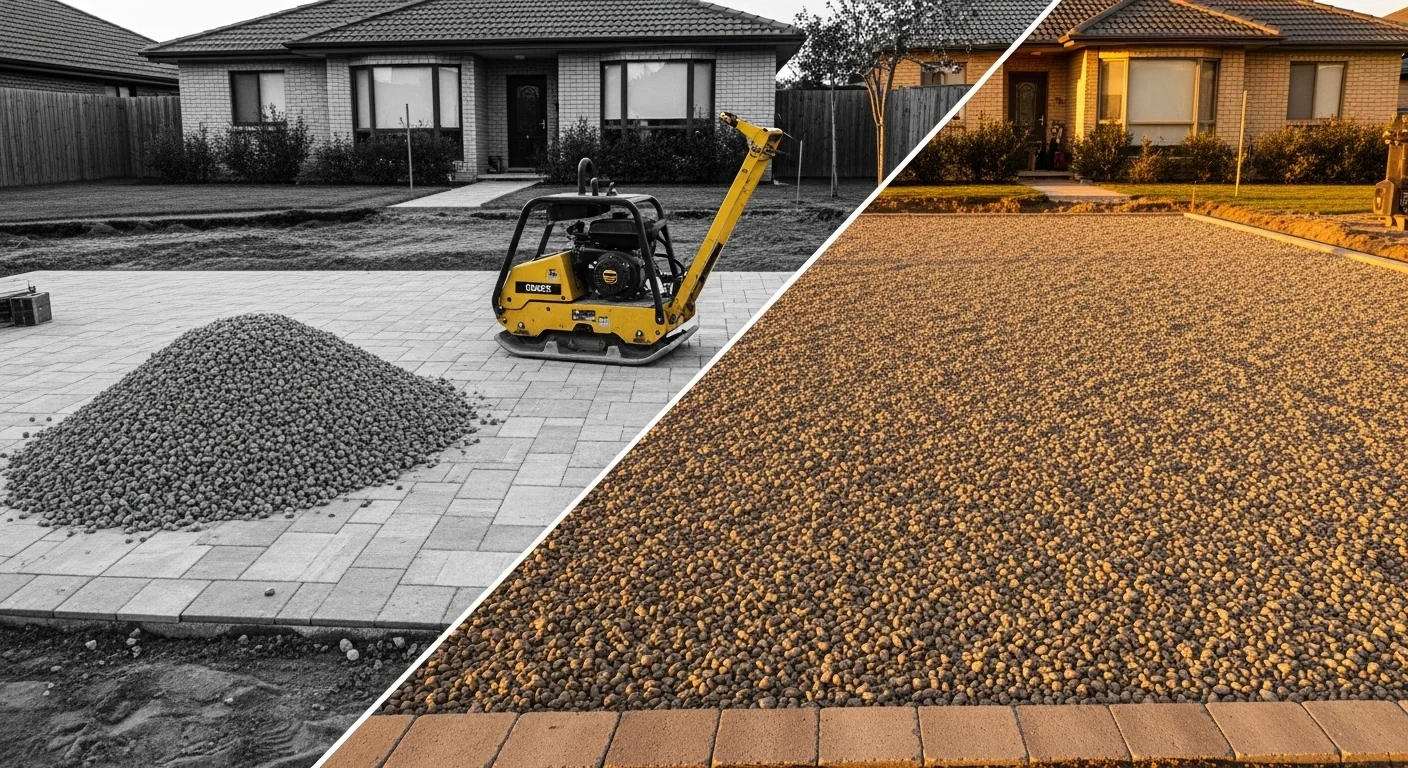
This tool exists because the gap between a geometric cubic-yard figure and what actually fills a paver base after compaction is large enough to derail an entire workday. By materializing that gap as a visible buffer and matching it to the aggregate type you are using, the calculator turns a hidden planning flaw into a hard number you can hand to the dispatcher. The single biggest mistake you can avoid is treating the raw base yardage as your order quantity — once you bypass that trap, the rest is logistics.
Pair this resource with good site prep and the right equipment, and the base layer becomes the least stressful part of the build. For the concrete edging and structural calculations that often accompany patio and walkway projects, our retaining wall calculator handles another piece of the hardscape equation with the same attention to real-world conditions.