
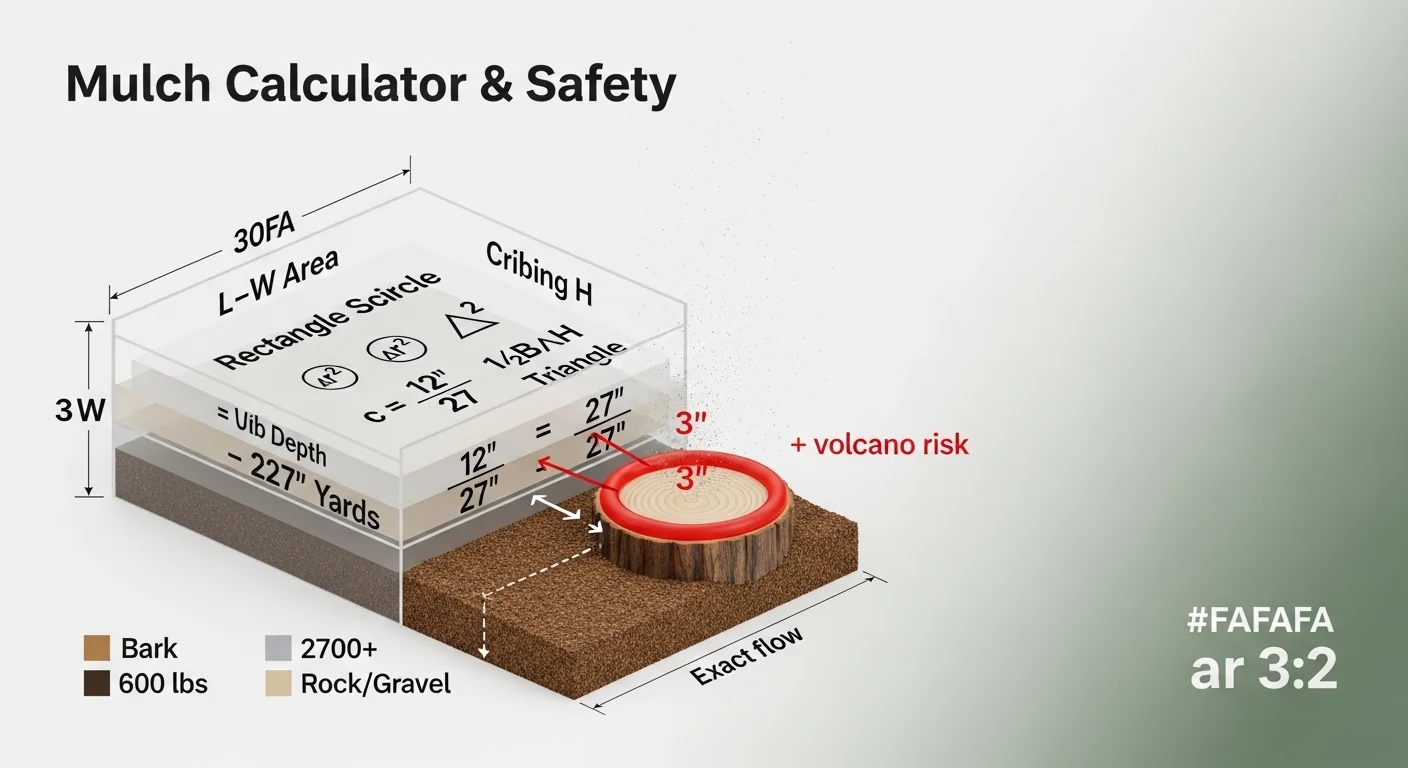
Calculating mulch volume is straightforward arithmetic. What most guides skip is the biological and structural context that determines whether your calculation is actually safe to act on. The difference between 2 inches of bark mulch and 4 inches is not just twice as much material -- at 4 inches against a tree trunk, you have created the conditions for bark rot, phloem suffocation, and eventually girdling roots that can kill a mature tree over several seasons. Volume math does not flag that. A properly built calculator should.
This tool calculates cubic yardage for rectangular, circular, and triangular garden beds, estimates material weight by type (bark mulch, river rock, or gravel), and computes weed barrier fabric rolls and staple counts when requested. It also runs a set of deterministic safety checks derived from established horticultural standards -- not generic tips. If you are planning a broader ground preparation project that includes amending or replacing native soil, the topsoil calculator handles volume estimates for fill material in the same unit system.
After running your numbers, you will know how many cubic yards to order, the delivery weight to verify against your vehicle's payload rating, how many weed barrier rolls to purchase, and whether your planned depth triggers any safety flags before a single bag is opened.
Use the Tool
Before entering values, measure your bed dimensions in feet and decide on your target depth in inches. Have the shape type determined first -- circular beds require only a radius, triangular beds require base and height (not the hypotenuse), and rectangular beds require both length and width. Material type changes the weight estimate significantly: bark mulch runs roughly 600 lbs per cubic yard while river rock runs closer to 2,700 lbs per cubic yard, which matters if you are estimating delivery vehicle capacity or planning how many wheelbarrow trips the job requires. If your project mixes both organic mulch and crushed stone sections, the gravel calculator handles decomposed granite and crushed stone separately with ton-based output.
Quick Start (60 Seconds)
- Bed Shape: Select rectangle, circle, or triangle. The dimension fields change based on your selection. A common mistake is entering the full diameter instead of the radius for circular beds -- the tool expects radius only.
- Dimensions: Enter all values in feet, not inches or yards. A 10-foot by 6-foot bed is entered as 10 and 6, not 120 and 72.
- Target Depth: Enter in inches. The tool accepts values from 0.5 to 12 inches. For bark mulch around trees, 2 to 3 inches is the safe ceiling -- entering 4 or more triggers a critical warning about mulch volcano formation.
- Material Type: Choose bark mulch, river rock, or gravel. This does not change the cubic yardage result, but it changes the weight output substantially. Order materials by volume (cubic yards), verify delivery by weight.
- Weed Barrier: Set to Yes if you want the tool to calculate how many 4 ft x 50 ft rolls of landscape fabric you need along with a staple count estimate.
- Calculate: All required fields must be filled before the results panel appears. The tool validates each field and shows inline error messages -- it will not calculate on incomplete inputs.
- Reset: Use the Reset button to clear all fields and results before starting a new bed calculation.
Inputs and Outputs (What Each Field Means)
| Field | Unit | What It Means | Common Mistake | Safe Entry Guidance |
|---|---|---|---|---|
| Bed Shape | n/a | Geometry used to calculate area (rectangle, circle, triangle) | Choosing rectangle for an irregular bed instead of breaking it into zones | Break irregular beds into sub-shapes and add the cubic yard results |
| Length | feet | Longest dimension of a rectangular bed | Entering inches instead of feet (e.g., entering 120 for a 10-foot bed) | Always measure in feet; convert before entering |
| Width | feet | Shorter dimension of a rectangular bed | Measuring to the edge of the mulch zone, not the planting zone | Measure the exact area to be covered, excluding any hard borders or edging |
| Radius | feet | Distance from center to edge of a circular bed or tree ring | Entering diameter (the full width) instead of half-width | Measure from the center stake to the outer edge; divide the full width by 2 if unsure |
| Base | feet | The base of a triangular bed | Entering the slope length (hypotenuse) instead of the horizontal base | Use the flat ground measurement along the base, not the angled side |
| Height | feet | The perpendicular height of a triangular bed (not the slant) | Measuring the slant side rather than the vertical drop | Perpendicular distance from base to the opposite vertex, measured at 90 degrees to the base |
| Target Depth | inches | How deep the material will be spread after settling | Not accounting for settling -- fresh mulch compresses 10-20% within weeks | For bark mulch, target 2-3 inches. Add 10% to account for settling if desired |
| Material Type | n/a | The material being applied, which determines estimated weight per cubic yard | Treating all mulches as the same weight when planning delivery logistics | River rock and gravel weigh 4x to 5x more per cubic yard than bark mulch -- verify vehicle payload capacity |
| Include Weed Barrier | n/a | Toggles weed fabric roll and staple calculations based on total bed area | Forgetting to account for seam overlap, which adds 10-15% to fabric needed | The tool calculates exact rolls; add one extra roll per project for seam overlap and waste |
| Cubic Yards (output) | yd³ | Total volume of material required to fill the bed at the specified depth | Confusing cubic yards with square yards when placing orders | Always confirm with your supplier that orders are placed in cubic yards, not cubic feet |
| Estimated Weight (output) | lbs / tons | Approximate delivery or haul weight based on material density averages | Ignoring weight and overloading a standard pickup truck (rated 1,500-2,000 lbs) | Check your vehicle's payload spec before hauling. Rock and gravel frequently require multiple trips or a dedicated delivery |
| Bags Needed (output) | bags | Number of standard 2-cubic-foot retail bags equivalent to your calculated volume | Using the bag count to order bulk delivery (bulk is sold by the yard, not the bag) | Use the bag count only when buying bagged product at a garden center -- bulk delivery pricing uses cubic yards |
For river rock specifically, the weight differential versus bark mulch is significant enough to affect paving and base preparation. If your design includes a rock section adjacent to a paved area or retaining structure, review the estimated tonnage with the river rock calculator, which breaks tonnage output into crushed and natural round variants with different density defaults.
Worked Examples (Real Numbers)
Example 1: Standard Rectangular Front Bed with Bark Mulch
- Shape: Rectangle
- Length: 20 ft, Width: 8 ft
- Area: 160 sq ft
- Depth: 3 inches
- Material: Bark Mulch
Result: Volume = 160 x (3 / 12) / 27 = 1.48 cubic yards. Estimated weight: 888 lbs. Bags equivalent: 20 bags (2 cu ft each).
At 3 inches, this is within the recommended safe range for bark mulch. A standard half-ton pickup can carry this in a single load, but check your truck's specific payload rating before hauling -- wet mulch weighs considerably more than dry.
Example 2: Circular Tree Ring at Excessive Depth (Volcano Warning
Scenario)
- Shape: Circle
- Radius: 3 ft
- Area: 28.27 sq ft
- Depth: 4 inches
- Material: Bark Mulch
Result: Volume = 28.27 x (4 / 12) / 27 = 0.35 cubic yards. Estimated weight: 210 lbs.
The calculator flags this scenario with a danger warning. At 4 inches of depth against a tree trunk, the constant moisture from decomposing bark mulch rots the cambium layer, suffocates the phloem, and promotes anaerobic soil conditions directly at the root collar. Reducing depth to 3 inches and maintaining a 3-to-6-inch mulch-free zone at the trunk eliminates this risk entirely.
Example 3: Narrow Gravel Path with River Rock
- Shape: Rectangle
- Length: 24 ft, Width: 3 ft
- Area: 72 sq ft
- Depth: 3 inches
- Material: River Rock
Result: Volume = 72 x (3 / 12) / 27 = 0.67 cubic yards. Estimated weight: 1,809 lbs (0.90 tons).
Less than one cubic yard, but nearly a full ton. This is the key insight for river rock projects: the volume is modest, but the weight frequently exceeds what a standard half-ton pickup can carry in a single trip. Plan for a delivery drop or split the haul across two loads with confirmation of your vehicle's rated payload.
Reference Table (Fast Lookup)
All values below use exact formula outputs rounded to two decimal places. Bag count assumes standard 2-cubic-foot retail bags.
| Area (sq ft) | Depth (in) | Volume (cu ft) | Cubic Yards | Bark Mulch Weight (lbs) | River Rock Weight (lbs) | Bags (2 cu ft) |
|---|---|---|---|---|---|---|
| 50 | 2 | 8.33 | 0.31 | 186 | 837 | 5 |
| 50 | 3 | 12.50 | 0.46 | 276 | 1,242 | 7 |
| 100 | 2 | 16.67 | 0.62 | 372 | 1,674 | 9 |
| 100 | 3 | 25.00 | 0.93 | 558 | 2,511 | 13 |
| 200 | 2 | 33.33 | 1.23 | 738 | 3,348 | 17 |
| 200 | 3 | 50.00 | 1.85 | 1,110 | 4,995 | 25 |
| 500 | 2 | 83.33 | 3.09 | 1,854 | 8,343 | 42 |
| 500 | 3 | 125.00 | 4.63 | 2,778 | 12,501 | 63 |
| 1,000 | 3 | 250.00 | 9.26 | 5,556 | 25,002 | 125 |
How the Calculation Works (Formula + Assumptions)
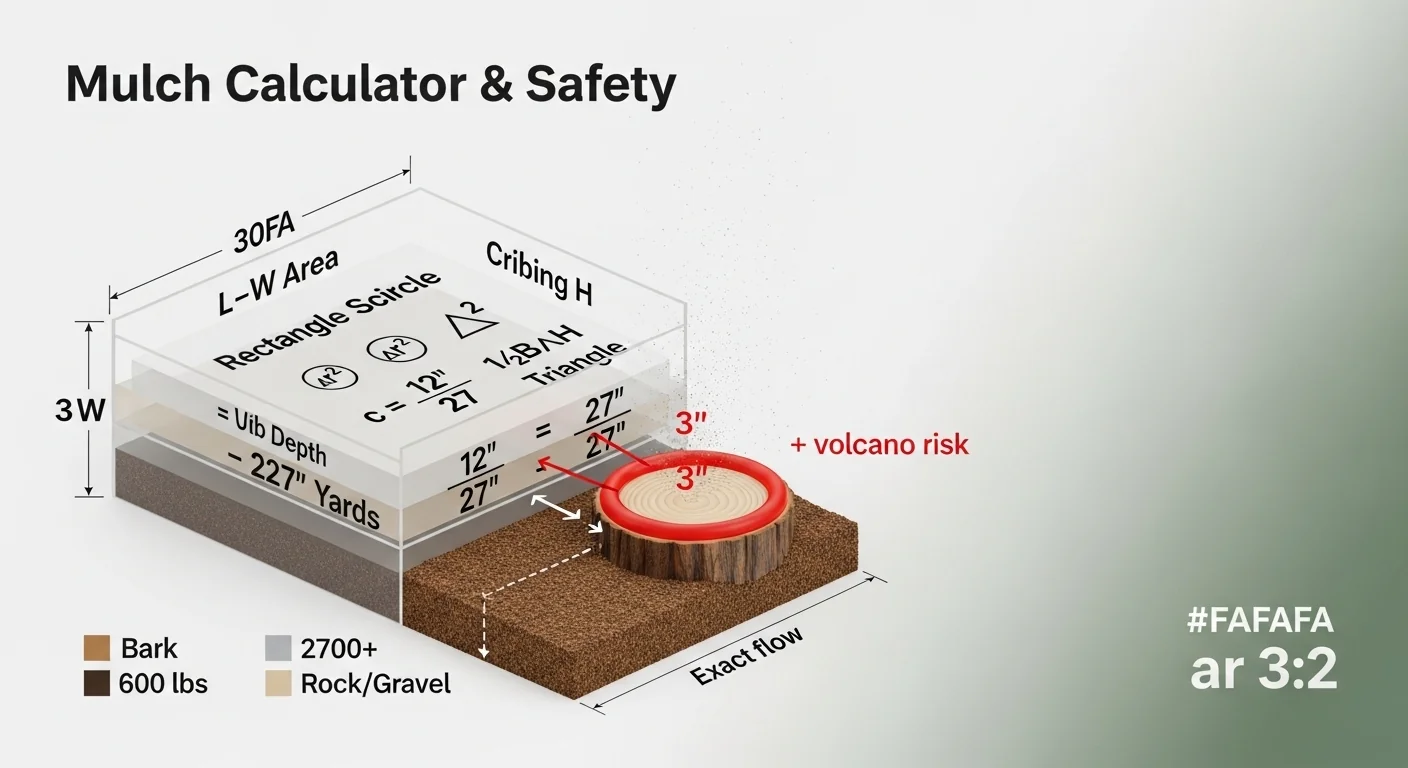
Show the calculation steps
Step 1: Calculate bed area
Rectangle: Area = Length (ft) x Width (ft)
Circle: Area = 3.14159 x Radius (ft)²
Triangle: Area = 0.5 x Base (ft) x Height (ft)
Step 2: Convert depth to feet
Depth (ft) = Depth (in) / 12
Example: 3 inches / 12 = 0.25 ft
Step 3: Calculate volume in cubic feet
Volume (cu ft) = Area (sq ft) x Depth (ft)
Step 4: Convert to cubic yards
Volume (cu yd) = Volume (cu ft) / 27
There are 27 cubic feet in one cubic yard.
Step 5: Estimate weight
Bark Mulch: Weight (lbs) = Volume (cu yd) x 600
River Rock: Weight (lbs) = Volume (cu yd) x 2,700
Gravel: Weight (lbs) = Volume (cu yd) x 2,800
Tons = Lbs / 2,000
Step 6: Bags equivalent
Bags = ceiling(Volume (cu ft) / 2)
This rounds up to ensure full coverage. Bags are assumed to be 2 cubic feet each (standard retail size).
Step 7: Weed barrier rolls
Roll Area = 200 sq ft (standard 4 ft x 50 ft roll)
Rolls = ceiling(Bed Area / 200)
Staples = ceiling(Bed Area / 4) -- one staple per 4 sq ft of fabric
Rounding rule: All intermediate calculations are carried at full floating-point precision. Final cubic yard output is rounded to two decimal places. Weight is rounded to the nearest whole pound. Bag and roll counts are always rounded up (ceiling function) to ensure no shortfall.
Assumptions and Limits
- Bark mulch density is assumed at 600 lbs per cubic yard. Freshly chipped green material, wet product, or dense hardwood mulch may run 800 to 1,000 lbs per cubic yard -- use the weight output as a minimum estimate, not a precise figure.
- River rock density is assumed at 2,700 lbs per cubic yard. Smooth river rock and angular crushed limestone have different actual densities. If your supplier provides a specific density, recalculate: (Volume in cu yd) x (supplier lbs/yd) for accuracy.
- Gravel density is assumed at 2,800 lbs per cubic yard. Pea gravel runs lighter; compacted road base runs heavier.
- Bag size is assumed at 2 cubic feet. Some premium bagged mulches are sold in 1.5 cu ft bags. Confirm bag size before using the bag count to place a purchase.
- Weed barrier rolls are assumed to be 4 ft x 50 ft (200 sq ft). Commercial-grade rolls can run 3 ft x 100 ft or 6 ft x 100 ft -- adjust roll count manually if using a different roll size.
- The tool assumes a uniform depth across the entire bed. Sloped beds, beds with root mounds, or beds with embedded boulders will have variable actual depth -- calculate zones separately for more accuracy.
- Settling is not factored into the output. Bark mulch typically compresses 10 to 20% within 30 to 60 days. For areas where maintained depth matters, order slightly more or add 10% to your depth input before calculating.
- Maximum supported area is 100,000 sq ft and maximum depth is 12 inches. Inputs outside these ranges will trigger validation errors.
Standards, Safety Checks, and "Secret Sauce" Warnings
Critical Warnings
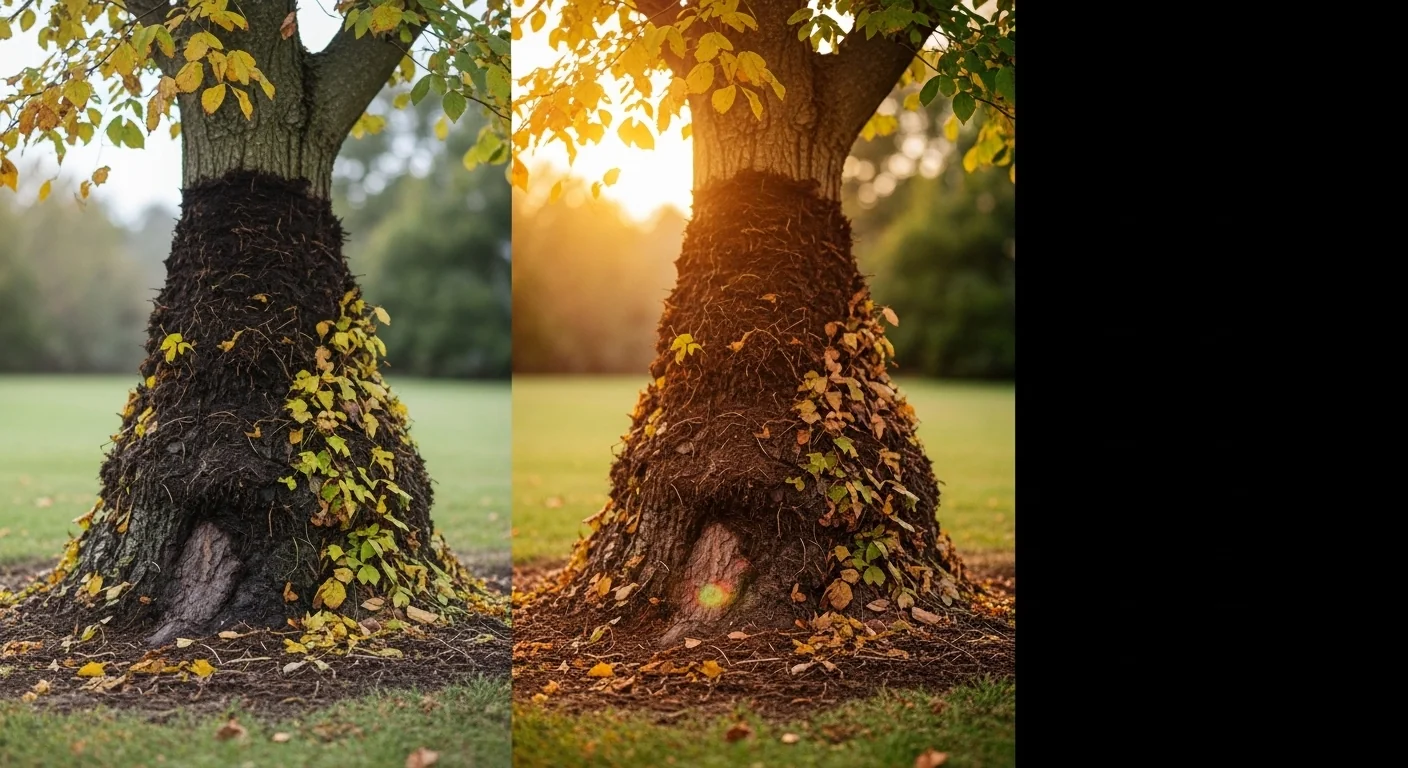
- Mulch Volcano / Tree Collar Rot: Applying bark mulch at depths greater than 3 inches against a tree trunk creates a sustained wet environment at the bark surface. This damages the cambium and phloem -- the layers responsible for moving nutrients from leaves to roots. As the bark rots, the tree loses its ability to transport carbohydrates downward, eventually starving and killing the root system from the trunk out. The condition is irreversible once rot reaches the cambium at the root flare. The safe standard is 2 to 3 inches of depth maximum, with a 3-to-6-inch trunk exclusion zone maintained at all times. Use the critical root zone calculator to understand how far the protective zone extends for trees of different trunk diameters.
- Sour Mulch Toxicity: Bulk mulch stored in large, unturned piles can undergo anaerobic decomposition, producing acetic acid, methanol, and hydrogen sulfide gas. The resulting "sour mulch" has a vinegar, ammonia, or sulfur smell. Applied directly to plant beds, it can cause rapid wilting and death of annuals and perennials within 24 to 48 hours. Always check your bulk delivery for an off smell before spreading. If present, spread the mulch thinly in an open area and allow 24 to 72 hours for off-gassing before applying near plant material.
Minimum Standards
- Bark mulch applied at less than 1.5 inches provides negligible weed suppression and dries out rapidly in full sun. The practical minimum for weed control and moisture retention is 2 inches.
- For commercial-grade weed suppression under river rock or gravel, use a minimum 3-oz-per-sq-yd woven polypropylene landscape fabric (such as DeWitt Pro-5). Lightweight non-woven fabrics break down under aggregate weight and UV exposure within 2 to 3 seasons. Proper overlap at seams is at least 6 inches. The landscape fabric overlap calculator computes the exact seam allowance and total fabric required when beds are wider than a single roll.
- When edging is not installed, allow for 10 to 15% additional volume to account for mulch migration and settling beyond the bed perimeter.
Competitor Trap: Most online mulch calculators output a cubic yard number and nothing else. They do not distinguish between a 3-inch application on an open perennial bed and a 4-inch application on a tree ring. Both return the same volume math, but only one of them is actively damaging your landscape. A calculation without a depth safety check is an incomplete tool -- and the gap between "how much" and "is this safe" is where most mulch-related tree damage originates. Depth is not a preference; it is a biological threshold.
Common Mistakes and Fixes
Mistake: Ordering by Volume Without Checking Weight
A landscaper calculates 2 cubic yards of river rock, loads it into a standard pickup, and overloads the truck's rear suspension or exceeds its payload rating -- often by a factor of two or more. Two cubic yards of river rock weighs approximately 5,400 lbs. Most half-ton pickups are rated for 1,500 to 2,000 lbs of payload. The math does not work in a single trip.
Fix: Always check the weight output before planning transport. For anything over 1,500 lbs, price a delivery drop against the cost and time of multiple haul trips.
Mistake: Measuring the Wrong Dimension for Circular Beds
A common error is entering the full diameter of a circular tree ring or round bed as the radius. A 10-foot diameter bed entered as "radius 10" returns an area of 314 sq ft when the actual area is 78.5 sq ft -- a fourfold overestimate that results in a significantly oversized order.
Fix: The radius is exactly half the diameter. Measure across the full bed, divide by two, then enter that number. The tool's hint text calls this out, but it remains the most common dimensional error on circular inputs.
Mistake: Applying Mulch Directly Over Perennial Crowns
Burying the crown (the point where stem meets root) of perennials like hostas, daylilies, and ornamental grasses under mulch promotes crown rot and fungal infection. This is distinct from the mulch volcano problem (which affects woody plants) but shares the same root cause -- sustained moisture against a plant's most vulnerable tissue.
Fix: Pull mulch back 2 to 4 inches from the base of perennial clumps. For organic mulches that are already applied too deep near crowns, use a hand cultivator to pull material away rather than layering new product.
Mistake: Ignoring Settling in High-Traffic or Windy Locations
A 3-inch application in an exposed bed or a path that sees foot traffic can compact or blow down to 1.5 to 2 inches within a single season. The following spring, the bed appears to need a full refresh when it actually needs only a half-inch top-dressing. Ordering a full refresh volume annually adds unnecessary cost.
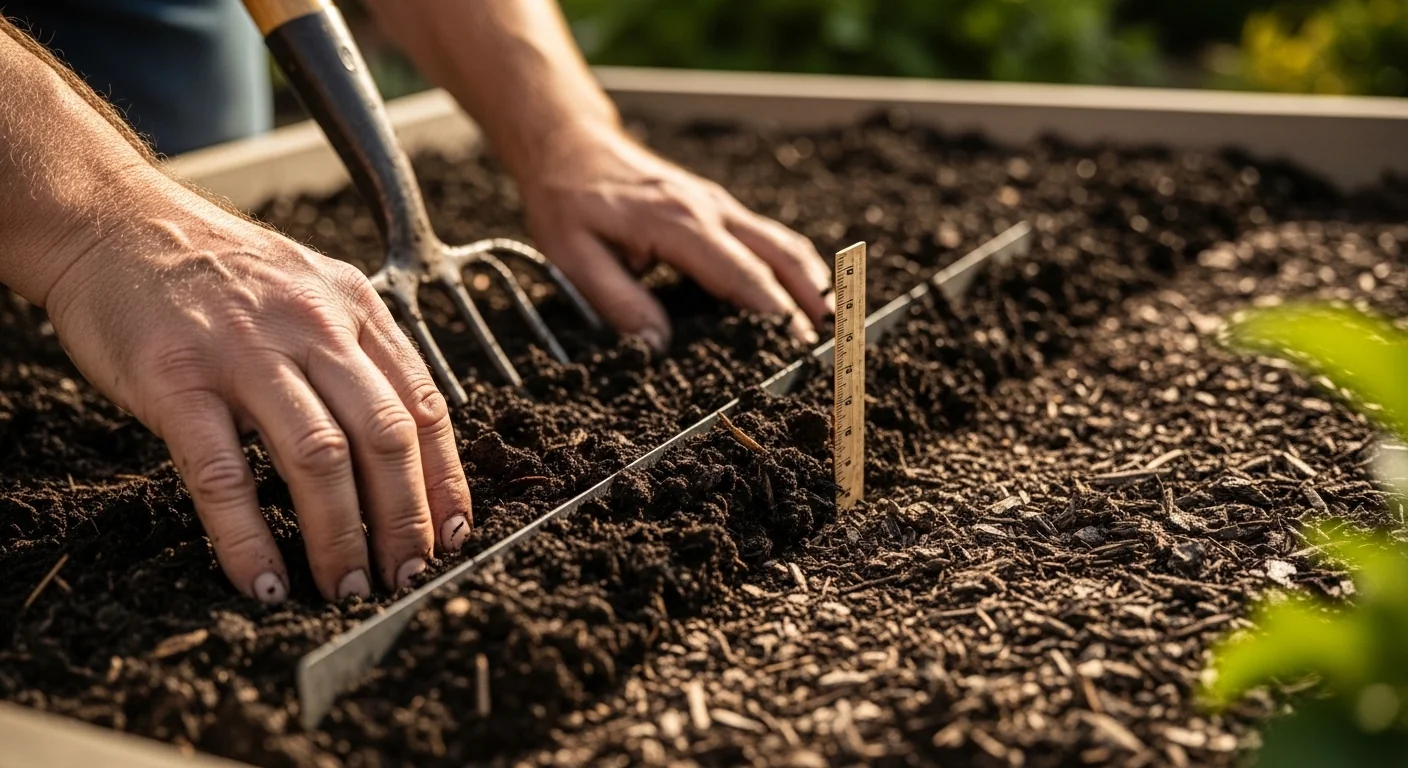
Fix: Before ordering an annual refresh, probe the existing mulch depth with a screwdriver or ruler at several points in the bed. Top-dress only to bring the depth back to 2 to 3 inches, not to a full re-application. This approach also avoids inadvertently building up depth beyond the safe threshold near woody stems.
Mistake: Using Non-Woven Fabric Under Rock or Gravel
Non-woven spunbond fabric, sold in lightweight rolls at most garden centers, degrades rapidly under heavy aggregate. The weight and abrasion of river rock or gravel breaks down the non-woven fiber matrix within two to three seasons, allowing weed breakthrough just as the fabric becomes impossible to remove without disturbing the rock layer above it. For erosion-prone or water-managed planting areas, the failure of the fabric layer can compound into a soil displacement problem, which is discussed in the context of ground-cover management on the compost blanket erosion calculator.
Fix: Specify woven polypropylene landscape fabric rated at a minimum of 3 oz per square yard for any application that will be covered with rock, gravel, or aggregate. The higher cost at purchase is substantially less than the labor cost of removing degraded fabric from beneath an established stone surface.
Next Steps in Your Workflow
Once you have your cubic yardage and weight figures, the immediate next step is confirming your delivery or haul logistics before contacting a supplier. Bulk landscaping materials are priced by the cubic yard, but delivery minimums vary by supplier -- many require a minimum of 1 cubic yard for a bulk order. If your calculation returns less than 1 yard, bagged product from a garden center is typically more economical than a bulk delivery. For jobs above 3 to 5 cubic yards, scheduled delivery is almost always the right choice: it eliminates vehicle overloading risk, reduces the number of physical handling steps, and the per-yard cost is usually lower than retail bags at that volume. If your larger project also involves area lawn preparation or bare-soil seeding adjacent to the mulched beds, the sod calculator handles coverage estimates for rolled sod in the same square footage framework you have already measured.
For projects that include hardscape elements alongside the mulched planting areas -- retaining walls, raised bed borders, or stone edging -- measure and calculate those volumes separately before placing any material order. Combining a mulch order with a stone delivery from the same supplier often reduces per-unit cost and consolidates delivery scheduling. The retaining wall calculator outputs block count and backfill volume for common wall configurations, which can be coordinated alongside your mulch delivery if you are placing a combined order with a landscaping materials supplier.
FAQ
How many cubic yards of mulch do I need for a 10 x 10 area at 3 inches
deep?
Area is 100 sq ft. Volume = 100 x (3/12) = 25 cubic feet. Divide by 27 = 0.93 cubic yards. In practical terms, this is just under 1 cubic yard, so if ordering in bulk you would round up to 1 yard. The bagged equivalent is approximately 13 standard 2-cubic-foot bags.
What is the difference between 2-inch and 3-inch mulch depth in terms
of volume?
For any given area, the difference is exactly 50%. A 1,000-square-foot bed at 2 inches requires 6.17 cubic yards. The same bed at 3 inches requires 9.26 cubic yards. The additional depth costs 50% more material while providing marginally better moisture retention -- but increases the risk of crown and trunk problems near woody plants.
How much does a cubic yard of bark mulch weigh?
Dry bark mulch averages approximately 600 lbs per cubic yard. Freshly chipped or wet material can range from 800 to 1,000 lbs per cubic yard. Suppliers typically work with dry weight averages, but if your mulch was stored outdoors in rain, actual delivery weight will be higher. Always verify your vehicle's payload rating before hauling bulk mulch.
Is river rock or bark mulch better for weed suppression?
Neither is inherently better; their effectiveness depends on what is installed beneath them. River rock is permanent, does not decompose, and retains heat. Bark mulch decomposes over 1 to 3 seasons, adding organic matter to soil, but requires annual top-dressing. Both materials require an appropriate weed barrier underneath to achieve lasting suppression -- the barrier does the weed work, not the material itself.
How many bags of mulch equal a cubic yard?
A cubic yard contains 27 cubic feet. Standard retail bags contain 2 cubic feet each. Therefore, 1 cubic yard equals 13.5 bags, which means 14 bags are required to fill exactly 1 cubic yard without shortfall. Bags are cheaper per cubic foot at small volumes; bulk delivery becomes more cost-effective around 2 to 3 cubic yards depending on local supplier pricing.
What is mulch volcano damage and how do I identify it?
Mulch volcano damage occurs when bark mulch is piled deep against a tree trunk, typically in a cone or mound shape. Visible signs include bark discoloration or peeling at the base, soft or spongy trunk tissue at the root flare, and in advanced cases, sprouts (epicormic growth) emerging from the trunk as the tree attempts to compensate for phloem damage. Girdling roots are a secondary consequence that may not become visible for 5 to 10 years.
Conclusion
The single most consequential mistake to avoid is treating depth as a continuous preference rather than a bounded standard. More mulch is not better mulch. At 2 to 3 inches, bark mulch moderates soil temperature, retains moisture, and suppresses weeds. At 4 to 6 inches against a tree trunk, it is a slow biological injury. Run your numbers, check the safety output, and plan your project from there. If your beds include mature trees, reviewing their root protection requirements alongside your mulch plan is worth doing -- the tree root protection calculator defines the critical zone boundaries where compaction, grade change, and material piling interact with root health.