
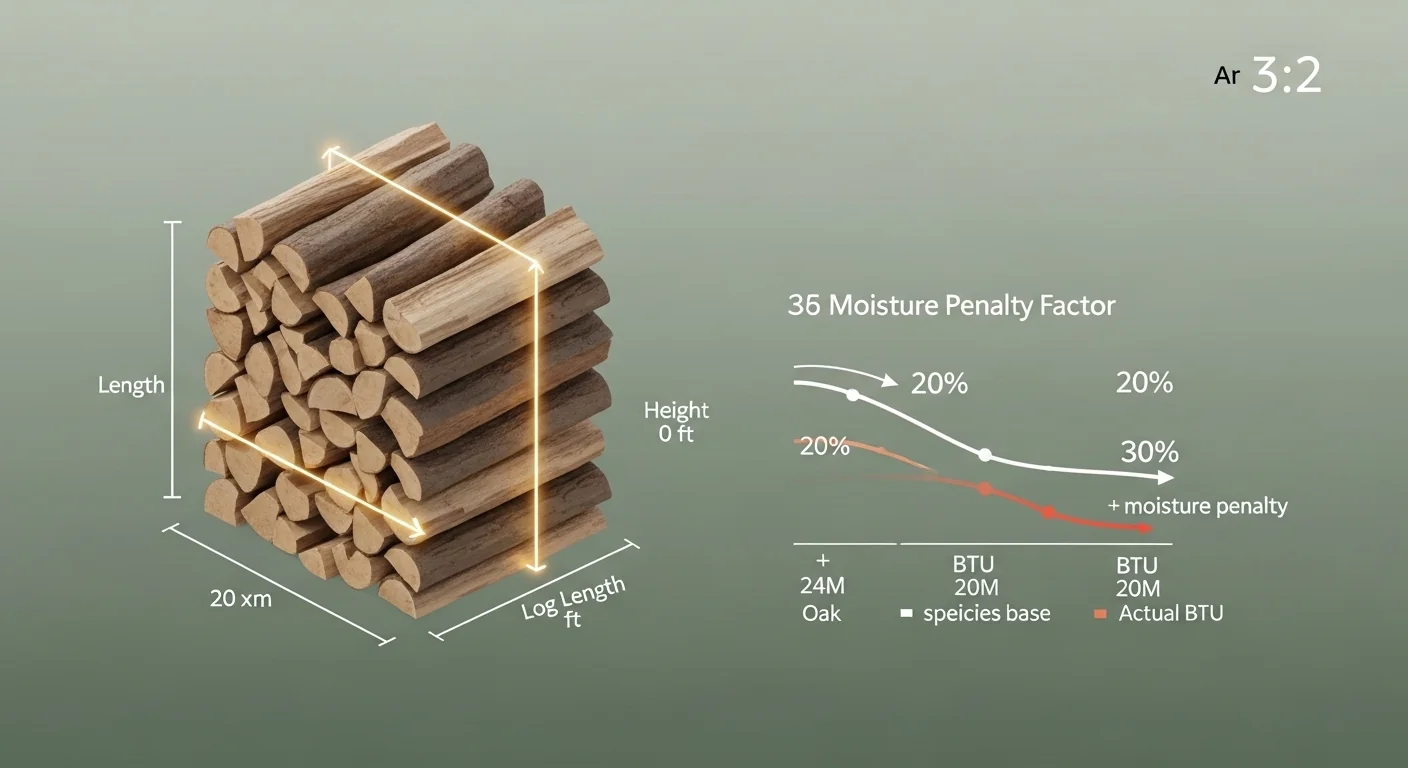
Buying or cutting firewood by the “cord” sounds straightforward until the stack arrives and no one agrees on what a cord is. A full cord is a defined unit of 128 cubic feet, but what gets sold, stacked, and burned is almost never a full cord. Log length, stacking height, and whether the seller means a full cord or a face cord all change the math before a single log hits the firebox. Add moisture content to that equation and the BTU deficit between what wood could deliver and what it actually delivers in your stove can be staggering.
This tool calculates stack volume in cubic feet, converts that to full cords and face cords, selects species-specific base BTU values, and then applies a moisture content penalty factor to show your actual heat output. It does not account for stove combustion efficiency, chimney draft, altitude, or splitting quality. Those variables exist, but the single largest controllable factor in real-world BTU delivery is moisture content, and that is precisely what this calculator makes visible. If you also need to estimate how much your cut logs weigh before stacking, the log weight calculator handles that step separately.
After running your numbers, you will know whether your wood is ready to burn, how many BTUs you are leaving on the table by burning wet wood, and whether your stack represents enough fuel for your heating season.
Use the Tool
(stack volume)
(16-inch logs)
(actual output)
| Species | Dry BTU/cord | At 15% MC | At 25% MC | At 35% MC | Rating |
|---|
How This Calculator Works — Formula & Method
This calculator uses three core steps to determine your firewood’s real heat output:
Step 1: Stack Volume (cubic feet)
Converts log length from inches to feet, then multiplies all three dimensions.
Step 2: Full Cords & Face Cords
A full cord = 4 ft × 4 ft × 8 ft = 128 cubic feet. A face cord uses 16″ standard logs (one-third of a full cord depth).
Step 3: Actual BTU Output (moisture-adjusted)
Moisture steals BTUs in two ways: (1) energy is wasted boiling water out of the wood before combustion, and (2) the resulting low-temperature flue gases condense as creosote rather than exhausting cleanly.
BTU Efficiency % shown in the gauge:
Assumptions & Limits
- BTU/cord figures are industry averages for air-dry wood (≈15–20% MC); actual values vary by log density, splitting quality, and drying conditions.
- Stack volume assumes tightly stacked, straight logs. Irregular stacking (crossed, gapped, or rounded pile) reduces real wood content by 15–25%.
- Moisture content entered must be measured with a pin-type moisture meter inserted into a freshly split face — surface readings are unreliable.
- The BTU moisture penalty is a thermodynamic approximation. Real-world losses also depend on stove efficiency, draw, altitude, and combustion air.
- Face cord calculation assumes 16-inch standard logs as the denominator; your face cord count changes if your actual log length differs.
- Creosote risk is flagged at >25% moisture content, consistent with NFPA 211 and EPA wood-burning guidance.
- Species BTU values: Red Oak 24M, White Ash 20M, Pine 14.3M BTU per full cord (USDA Forest Products Laboratory ranges, midpoint used).
- Input ranges enforced: Length 0.1–500 ft, Height 0.1–20 ft, Log Length 6–48 in, Moisture 5–80%.
Before you start, have three measurements ready: the length and height of your stacked pile in feet, and the length of an individual log in inches. A standard stovewood log runs 16 inches; if you cut to a different length, measure one. Enter your current moisture content reading from a pin-type meter inserted into a freshly split face, not the surface of a seasoned-looking log. Select the species that matches what you have. Then click Calculate.
If you are working from an existing firewood inventory and need to cross-reference heat output against a second calculation method, the firewood calculator covers heat content from a different input approach and can be used as a check.
Quick Start (60 Seconds)
- Stack Length (feet): Measure the horizontal run of the pile end-to-end. If the stack bends or branches, break it into segments and add them. Enter a decimal if needed (e.g., 8.5 ft). Valid range is 0.1 to 500 ft.
- Stack Height (feet): Measure the tallest consistent height, not peaks. A full cord standard is 4 feet high; most stacks are between 3 and 6 feet. Valid range is 0.1 to 20 ft.
- Log Length (inches): Measure one log, not estimate. Standard stovewood is 16 inches. Splits for a large fireplace may run 20 to 24 inches. Valid range is 6 to 48 inches.
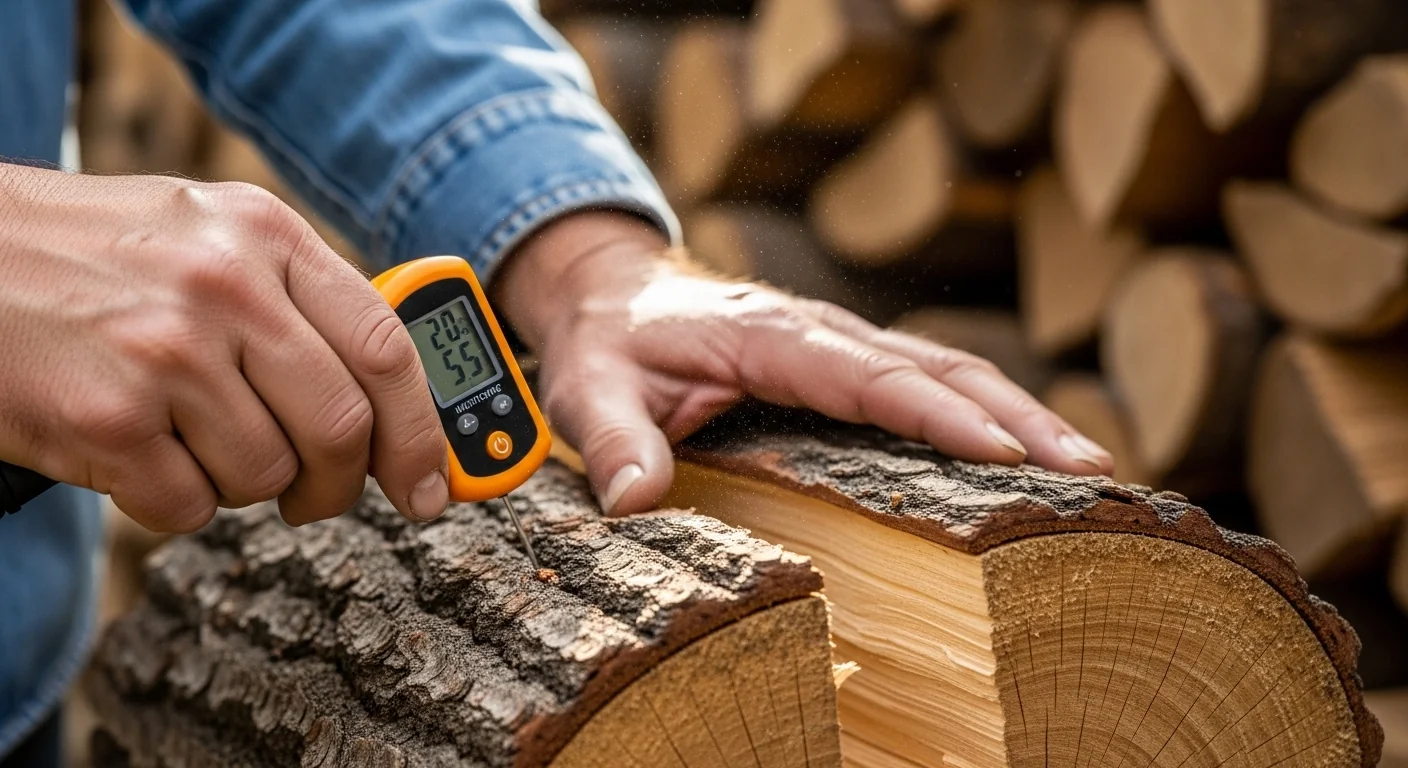
- Moisture Content (%): Use a pin-type digital moisture meter, pressed into a freshly split face, center of the log. Surface readings on seasoned wood underestimate interior moisture by 5 to 15 points. Valid range is 5 to 80.
- Wood Species: Select the dominant species in the stack. If you have a mixed load, use the lower-BTU species as the conservative estimate. A mixed oak-and-pine stack will not perform like pure oak.
- Common input mistake: Entering log length in feet instead of inches. A 16-inch log entered as 16 feet produces a wildly inflated volume number. The field expects inches.
- Run the calculation before buying: If a seller quotes a “face cord” price, enter the seller’s stated dimensions and your log length to see the full-cord equivalent. The difference is often one-third of the advertised amount.
Inputs and Outputs (What Each Field Means)
| Field | Unit | What It Measures | Common Mistake | Safe Entry Guidance |
|---|---|---|---|---|
| Stack Length | Feet | Horizontal dimension of the stacked pile from end to end | Measuring the ground footprint of a rounded pile instead of the actual stack face | Run a tape along the base of the stacked logs; 8 ft is the standard full-cord length |
| Stack Height | Feet | Vertical height of the stacked pile from ground to top | Measuring the peak of an uneven pile rather than a representative height | Measure 3 points and average; 4 ft is the standard full-cord height |
| Log Length | Inches | Length of individual cut logs (the depth of the stack) | Entering feet instead of inches, or estimating rather than measuring | Measure one actual log; standard stovewood is 16 in, fireplace wood often 18-24 in |
| Moisture Content | Percent | Water weight as a proportion of total wood weight; directly determines BTU output | Taking surface meter readings on weathered logs, which read 5-15 points lower than interior | Split a log and take the reading within 30 seconds from the freshly exposed center |
| Wood Species | Selection | Determines the base BTU-per-cord figure used in the calculation | Selecting oak when the stack contains a significant proportion of softwood or mixed species | When in doubt, select the lower-BTU species for a conservative estimate |
| Stack Volume | Cubic feet (output) | Raw three-dimensional volume of the stack before cord conversion | Confusing cubic feet with cords; 128 cubic feet equals one full cord | Use this number to compare against seller quotes that use cubic feet |
| Full Cords | Cords (output) | Stack volume divided by 128; the legally defined unit in most U.S. states | Assuming a face cord is a full cord; a face cord is typically one-third of a full cord | A winter heating supply for a primary heat source is typically 3-5 full cords in cold climates |
| Face Cords | Face cords (output) | Number of 16-inch face-cord equivalents in the stack | Using face cord pricing to compare against full cord pricing without conversion | One face cord with 16-inch logs equals one-third of a full cord (128 / 3 = 42.67 cubic feet) |
| Actual BTU Output | Million BTU (output) | Heat your stack will actually deliver after the moisture penalty is applied | Assuming the species BTU rating is what you get regardless of moisture | Compare this to your heating season demand to know if your supply is adequate |
Worked Examples (Real Numbers)
Scenario 1: Standard 8×4 Stack of Seasoned Red Oak, 16-Inch Logs
- Stack Length: 8 ft
- Stack Height: 4 ft
- Log Length: 16 in
- Moisture Content: 15%
- Species: Red Oak (24.0 M BTU per full cord dry)
Volume = 8 x 4 x (16/12) = 42.67 cubic feet. Full Cords = 42.67 / 128 = 0.33 cords. Moisture factor at 15% = 1.0 – (15 – 15) x 0.004 = 1.0. Actual BTU = 0.33 x 24.0 x 1.0 = 7.93 million BTU.
Result: 0.33 full cords delivering 7.93 million BTU at 100% moisture efficiency. This is a textbook face cord of seasoned oak at peak performance. At this moisture level, essentially no BTUs are lost to water evaporation before combustion.
Scenario 2: Large 16×4 Stack of Green Red Oak, 16-Inch Logs
- Stack Length: 16 ft
- Stack Height: 4 ft
- Log Length: 16 in
- Moisture Content: 30%
- Species: Red Oak (24.0 M BTU per full cord dry)
Volume = 16 x 4 x (16/12) = 85.33 cubic feet. Full Cords = 85.33 / 128 = 0.667 cords. Moisture factor at 30% = 0.85 – (30 – 20) x 0.025 = 0.85 – 0.25 = 0.60. Actual BTU = 0.667 x 24.0 x 0.60 = 9.6 million BTU.
Result: 0.67 full cords delivering only 9.6 million BTU — 40% of maximum potential output lost to moisture. This same stack, if properly seasoned to 15% MC, would yield approximately 16.0 million BTU. The difference represents enough heat to matter significantly in a cold winter month, and the lost energy exits the flue as steam and precursor compounds that deposit as creosote.
Scenario 3: 8×4 Stack of Dry Pine, 24-Inch Logs
- Stack Length: 8 ft
- Stack Height: 4 ft
- Log Length: 24 in
- Moisture Content: 18%
- Species: Pine (14.3 M BTU per full cord dry)
Volume = 8 x 4 x (24/12) = 64.0 cubic feet. Full Cords = 64.0 / 128 = 0.50 cords. Face Cords (16-in equivalent) = 0.50 x (48/24) = 1.0 face cord. Moisture factor at 18% = 1.0 – (18 – 15) x 0.004 = 1.0 – 0.012 = 0.988. Actual BTU = 0.50 x 14.3 x 0.988 = 7.07 million BTU.
Result: 0.50 full cords of dry pine delivering 7.07 million BTU. At 18% MC, pine performs close to its rated output. The species limitation is the base BTU figure, not moisture in this case. Dry pine burns fast and hot — useful for quick heat or kindling — but its lower density means you burn through volume faster than hardwood at the same BTU demand.
Reference Table (Fast Lookup)
The table below shows actual BTU output per full cord at different moisture content levels for each of the three species, along with the calculated efficiency loss and a creosote risk rating. All BTU figures are derived from the formula: Base BTU x Moisture Factor.
| Species | Moisture Content | Moisture Factor | BTU Output per Full Cord (M BTU) | BTU Lost vs. 15% MC (M BTU) | Creosote Risk Rating |
|---|---|---|---|---|---|
| Red Oak | 15% | 1.00 | 24.00 | 0.00 | Minimal |
| Red Oak | 20% | 0.98 | 23.52 | 0.48 | Low |
| Red Oak | 25% | 0.725 | 17.40 | 6.60 | Moderate — caution zone |
| Red Oak | 30% | 0.60 | 14.40 | 9.60 | High — flue inspection advised |
| White Ash | 15% | 1.00 | 20.00 | 0.00 | Minimal |
| White Ash | 20% | 0.98 | 19.60 | 0.40 | Low |
| White Ash | 25% | 0.725 | 14.50 | 5.50 | Moderate — caution zone |
| Pine | 15% | 1.00 | 14.30 | 0.00 | Minimal (resin watch) |
| Pine | 20% | 0.98 | 14.01 | 0.29 | Low-Moderate |
| Pine | 25% | 0.725 | 10.37 | 3.93 | High — pine resin amplifies creosote |
| Pine | 30% | 0.60 | 8.58 | 5.72 | Severe |
How the Calculation Works (Formula + Assumptions)
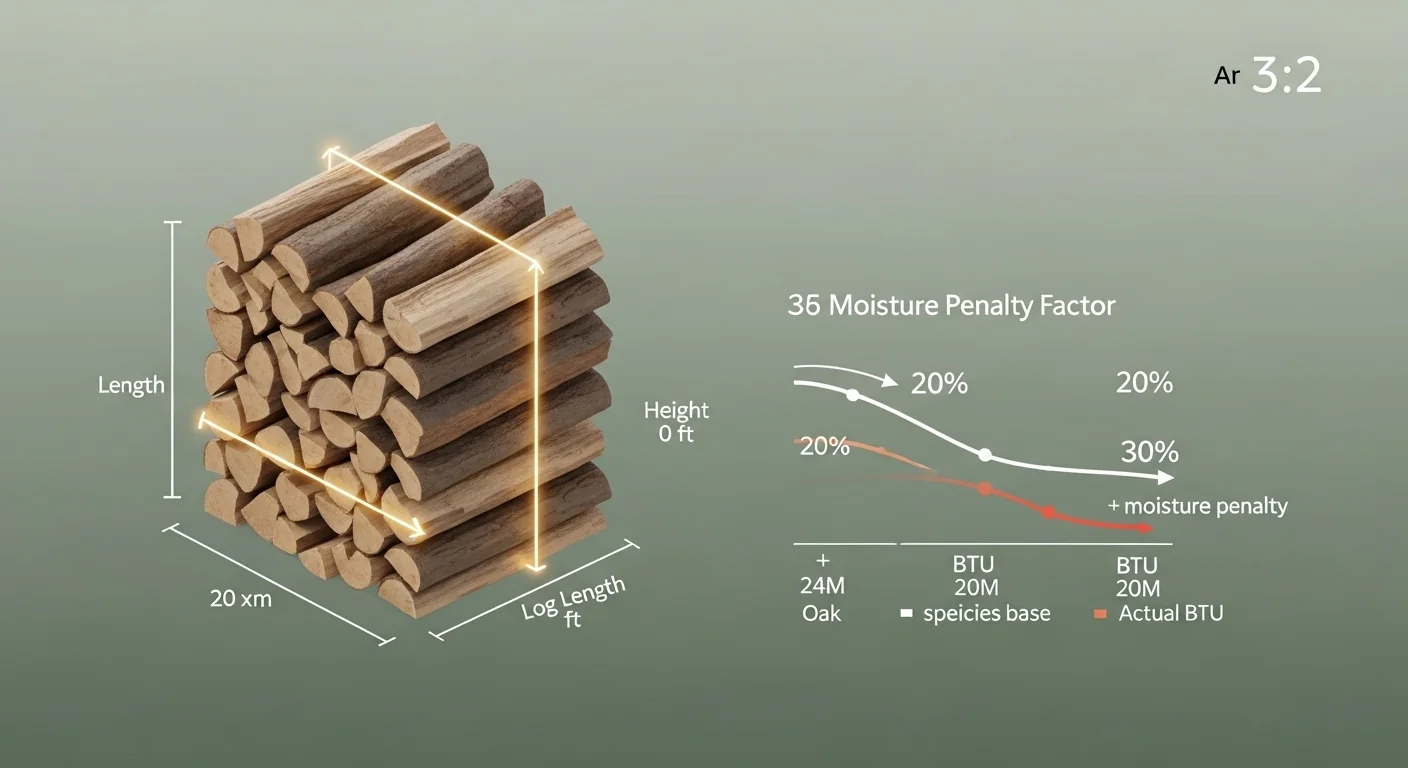
Show the calculation steps
Step 1: Stack Volume in Cubic Feet
Volume (ft³) = Stack Length (ft) x Stack Height (ft) x (Log Length (in) / 12)
The log length is converted from inches to feet by dividing by 12. This gives the depth dimension of the stack in feet. Multiplying all three dimensions produces total stack volume in cubic feet.
Step 2: Full Cords and Face Cords
Full Cords = Volume (ft³) / 128
A full cord equals 4 ft x 4 ft x 8 ft = 128 cubic feet by legal definition in most U.S. states. Face Cords are calculated as: Full Cords x (48 / Log Length in inches). This expresses how many face-cord-equivalents exist using 16-inch standard logs as the reference depth. If your logs are 16 inches, one face cord = one-third of a full cord.
Step 3: Moisture Factor
The moisture factor adjusts the base BTU rating downward as moisture content rises. The formula uses three bands:
- If MC is 15% or below: factor = 1.0 – (MC – 15) x 0.004 (minor reduction, approaching 1.0 at 15%)
- If MC is between 15% and 20%: same formula, smooth linear slope
- If MC is above 20% and up to 30%: factor = 0.85 – (MC – 20) x 0.025 (steeper slope, significant BTU loss)
- If MC exceeds 30%: factor = 0.60 – (MC – 30) x 0.012 (severe loss, floor of 0.20)
The factor floor of 0.20 prevents the output from reaching zero, acknowledging that even very wet wood produces some heat. Rounding: all output values are rounded to two decimal places. Volume uses one decimal place.
Step 4: Actual BTU
Actual BTU (M BTU) = Full Cords x Species Base BTU x Moisture Factor
Species base BTU values used: Red Oak = 24.0 M BTU/cord, White Ash = 20.0 M BTU/cord, Pine = 14.3 M BTU/cord. These are midpoint figures from USDA Forest Products Laboratory published ranges for air-dry wood at approximately 15% moisture content.
BTU Efficiency Gauge
Efficiency = (Actual BTU / (Full Cords x Species BTU x Moisture Factor at 15%)) x 100
This compares your moisture-adjusted output to what the same stack would produce at ideal 15% MC, expressed as a percentage.
Assumptions and Limits
- BTU-per-cord figures are midpoint averages from published USDA Forest Products Laboratory data for air-dry wood. Actual values vary by tree age, soil conditions, heartwood-to-sapwood ratio, and splitting quality.
- Stack volume assumes tight, straight stacking. Irregular, crossed, or gapped stacking can reduce actual wood content by 15 to 25%, meaning the calculator overestimates volume for loosely stacked piles.
- The moisture factor is a thermodynamic approximation. Real-world BTU loss also depends on stove combustion efficiency (modern EPA-certified stoves recover more), flue draw, and air supply settings.
- Moisture content entered must come from a pin-type meter reading on a freshly split log face. Surface readings, especially on split wood that has air-dried on the outside, will read lower than the interior and lead the calculator to overestimate BTU output.
- Face cord output is calculated using 16-inch logs as the reference denominator for “standard” face cord depth. If you use a different log length, the face cord count reflects your actual log depth, not the traditional 16-inch convention.
- Creosote risk ratings in the widget are derived from the NFPA 211 standard and EPA wood-burning guidance, which cite 25% MC as the threshold above which low flue temperatures and condensation risk increase significantly.
- The calculator does not account for bark-on versus bark-off logs. Bark adds volume without adding proportional BTU content; bark-heavy stacks will produce slightly less heat than the species rating suggests.
- Altitude affects combustion completeness. At elevations above 5,000 feet, wood stoves may need draft adjustments; the BTU output figures assume sea-level combustion conditions.
Standards, Safety Checks, and “Secret Sauce” Warnings
Critical Warnings
- The Creosote Threshold: Wood above 25% moisture content burns at temperatures too low to exhaust flue gases cleanly. The resulting steam, laced with volatile compounds, condenses on chimney walls as creosote. At 30% MC or higher, this process is rapid. Stage 3 glazed creosote, the type produced by sustained wet-wood burning, is highly flammable and extremely difficult to remove. NFPA 211 is explicit: if you are burning unseasoned wood regularly, your flue must be inspected and swept before each heating season.
- The Face Cord Trap: Most residential firewood is sold as a “face cord” or “rick,” not a full cord. A face cord stacked with 16-inch logs holds one-third the wood of a full cord by volume. A face cord with 24-inch logs holds half a full cord. Sellers who price by the face cord without specifying log length are selling an ambiguous product. Run your numbers before purchasing — a face cord at full-cord pricing is not a deal; it is a unit mismatch.
- BTU Claims Without Moisture Context are Meaningless: A cord of Red Oak rated at 24 million BTU assumes dry wood at approximately 15% MC. That same cord at 30% MC delivers closer to 14.4 million BTU. Firewood sellers who cite species BTU ratings without discussing moisture are quoting theoretical maximums, not what you will get from the stack.
- Surface Meter Readings Lie: A pin-type moisture meter pressed against the outer face of a split log that has been air-drying for two weeks will read lower than the interior. Always split a fresh log and measure immediately from the newly exposed center. This is the reading the calculator needs to produce an accurate BTU estimate.
Minimum Standards
- Moisture content at or below 20% before burning in a wood stove or fireplace insert, consistent with EPA and most state air quality guidelines for residential wood burning.
- Annual chimney inspection and sweeping before each heating season, per NFPA 211, especially if any green or unseasoned wood was burned in the prior season.
- A full cord is legally defined as 128 cubic feet in stacked, 4-foot logs. Any unit smaller than this sold as a “cord” may violate consumer protection weights-and-measures laws in your state. When in doubt, request dimensions in writing.
- Firewood should be stored off the ground on a rack, covered on top but open on the sides, for a minimum of 6 months for softwoods and 12 months for dense hardwoods like oak, to reach acceptable moisture levels without a kiln.
Competitor Trap: Most firewood BTU comparison articles rank species by million BTU per cord and stop there. They do not calculate what those numbers mean at the moisture levels typical of wood sold commercially in the fall, when a large percentage of firewood on the market has been cut within the same growing season. An article that tells you Red Oak delivers 24 million BTU per cord without explaining that green oak at 35% MC delivers closer to 11 million BTU per cord is giving you half the information needed to make a real decision. For anyone heating a barn or outbuilding, where combustion appliances are often running harder and chimneys are less frequently swept, the moisture penalty is not a footnote — it is the central variable. The barn ventilation calculator is a useful companion for homesteaders sizing heating systems for enclosed animal spaces, where flue gas management and combustion air interact with ventilation requirements.
Homesteaders planning their total winter fuel budget alongside hay and feed costs will find the winter cattle feed calculator a useful companion for projecting all cold-weather operational expenses together rather than treating firewood and livestock feed as separate line items.
Common Mistakes and Fixes
Mistake: Trusting a Face Cord Quote as a Full Cord
A face cord is typically one-third to one-half of a full cord depending on log length. Buyers who compare face cord pricing to full cord pricing — or assume a face cord will heat a home for a season as a full cord would — consistently come up short on fuel. The gap is not trivial: a face cord with 16-inch logs contains only 42.67 cubic feet of stacked wood, compared to 128 cubic feet in a full cord.
Fix: Always ask for the dimensions of the stacked pile (length, height, log length) and run them through the calculator to determine full cord equivalents before agreeing to a price.
Mistake: Measuring Moisture on the Log Surface
The outer face of a split log dries faster than the interior. A log with 28% interior moisture can read 16% on its outer surface after several weeks of air exposure. Using the surface reading in the BTU calculation causes a significant overestimate of heat output and masks creosote risk.
Fix: Split a log from the pile and take the meter reading within 30 seconds from the freshly exposed center. This is the accurate interior reading the calculator is designed to use.
Mistake: Selecting Species Based on What the Seller Claims
Mixed firewood loads are common. A pile sold as “oak” may contain significant portions of ash, maple, or other species, and loads sold in rural areas often include whatever was available at the time of cutting. Overestimating species quality in the calculator will inflate the BTU output prediction.
Fix: Visually identify the dominant species in the pile before selecting. When in doubt, select a lower-BTU species or average the BTU values of the species you can identify. A conservative estimate serves your planning better than an optimistic one. If you need to estimate the weight of the load before purchase, the log weight calculator can help verify the volume claim by cross-checking density and weight.
Mistake: Buying All Your Firewood in the Fall
Wood cut and delivered in October is almost certainly green, regardless of what the seller says. Oak cut in the spring requires at least 12 months of covered, off-ground storage to reach 20% MC or below in most climates. Softwoods can season faster, but “six months” is the minimum under ideal conditions. Fall buyers who burn the load immediately are burning at 30 to 45% MC, paying hardwood prices for softwood BTU output.
Fix: Buy firewood in the spring for the following winter heating season. Split and stack it immediately with airflow on the sides and a weather cover on top. Measure moisture content in September before the heating season begins.
Mistake: Assuming a Bigger Pile Means More Cords
Log length is the most frequently overlooked variable in cord estimation. A 4x4x8 stack of 16-inch logs is a full cord. The same stack dimensions with 24-inch logs contains 1.5 full cords. Conversely, a stack with 12-inch logs holds only 0.75 of a full cord. Volume changes linearly with log length, but most buyers eyeball a pile and assume it looks about right.
Fix: Measure an actual log before entering the value. Do not estimate based on what the wood “looks like.” The log length field is the depth of the stack, and it has a proportional effect on every output number in the calculation.
Next Steps in Your Workflow
Once you know your full cord equivalent and BTU output, the practical next question is whether that amount of wood covers your heating season. A well-insulated 1,500 square foot home in a cold climate can require 3 to 5 full cords of hardwood per season when wood heat is the primary source. Run the calculator multiple times using the dimensions of each separate stack if you have more than one pile, then add the full cord totals. Knowing the aggregate BTU available — and the moisture-adjusted reality of that number — gives you a defensible fuel inventory figure rather than an estimate.
For homesteaders managing a full winter operation, firewood is one line in a larger fuel and feed budget. After confirming your wood supply is adequate, the hay cost calculator and the feed cost calculator can help round out the full picture of cold-weather operating costs for livestock alongside your heating fuel. Planning these together reduces the chance of discovering a shortfall in February when prices for both commodities are at their seasonal peak.
FAQ
What is the difference between a full cord and a face cord?
A full cord is a legally defined unit equal to 128 cubic feet of stacked wood, typically 4 feet high by 4 feet deep by 8 feet long. A face cord uses the same 4 x 8-foot face but is only as deep as the log length, commonly 16 inches. With 16-inch logs, one face cord is one-third of a full cord. Log length determines the ratio, which is why sellers must disclose it.
How do I know if my firewood is seasoned enough to burn?
The only reliable method is measuring with a pin-type moisture meter inserted into a freshly split log face. Visual cues — checking ends for cracks, tapping logs together for a hollow ring — are rough indicators only. The accepted threshold for clean combustion and low creosote risk is 20% moisture content or below. Readings above 25% indicate wood that should continue seasoning before use.
Why does moisture content affect BTU output so dramatically?
Every BTU spent evaporating water in the wood before combustion is a BTU not delivered as heat. Water in wood must reach 212 degrees Fahrenheit and convert to steam before the cellulose beneath it can ignite. At 30% moisture content, a significant portion of combustion energy is consumed by this phase-change process, reducing flame temperature, flue gas temperature, and ultimately heat delivery to the living space.
Does the type of wood really matter that much compared to moisture content?
Species choice matters, but moisture content matters more at extreme levels. A cord of dry pine at 15% MC outperforms a cord of green oak at 35% MC in actual BTU delivered. The reference table on this page makes this comparison explicit. For sustained, overnight heat, a dense hardwood like oak is superior species-to-species when both are dry. But burning wet hardwood is worse than burning dry softwood.
What is creosote and why does wet wood cause it?
Creosote is a byproduct of incomplete combustion deposited on chimney flue walls when flue gas temperatures are too low to carry volatile compounds out of the chimney. Wet wood burns at lower temperatures, which means the flue stays cooler and compounds condense into tar-like or glazed deposits. Stage 3 creosote is thick, glazed, and highly flammable. It is the primary cause of chimney fires in residential wood-burning systems.
Can I use this calculator for wood pellets or compressed logs?
No. This calculator is designed for natural-cut cordwood measured by stack volume. Pellets and compressed logs are sold by weight and have different moisture content profiles, BTU-per-unit values, and combustion characteristics than natural firewood. The formula, the species BTU figures, and the moisture penalty function are all specific to natural cordwood and would produce incorrect results if applied to manufactured fuel products.
Conclusion
The BTU output of a firewood stack is not fixed at the species rating on a comparison chart. It is variable, and moisture content is the variable that dominates every other factor in the calculation. A cord of oak that looks and smells like firewood but reads 32% on a moisture meter is delivering less than 60% of its rated heat output. Every additional cord burned at that moisture level costs real money in fuel volume consumed, real risk in creosote accumulation, and real inefficiency in heating performance. The firewood cord calculator makes that loss explicit rather than invisible.
The most common and expensive mistake in residential firewood management is treating a face cord as equivalent to a full cord, either through seller misrepresentation or buyer assumption. Know your dimensions, measure your log length, read your moisture from a split face — and run the calculation before you commit to a purchase or enter a heating season assuming your supply is adequate. The tool is only useful if the inputs are accurate, and accurate inputs require a tape measure and a moisture meter, not estimates.