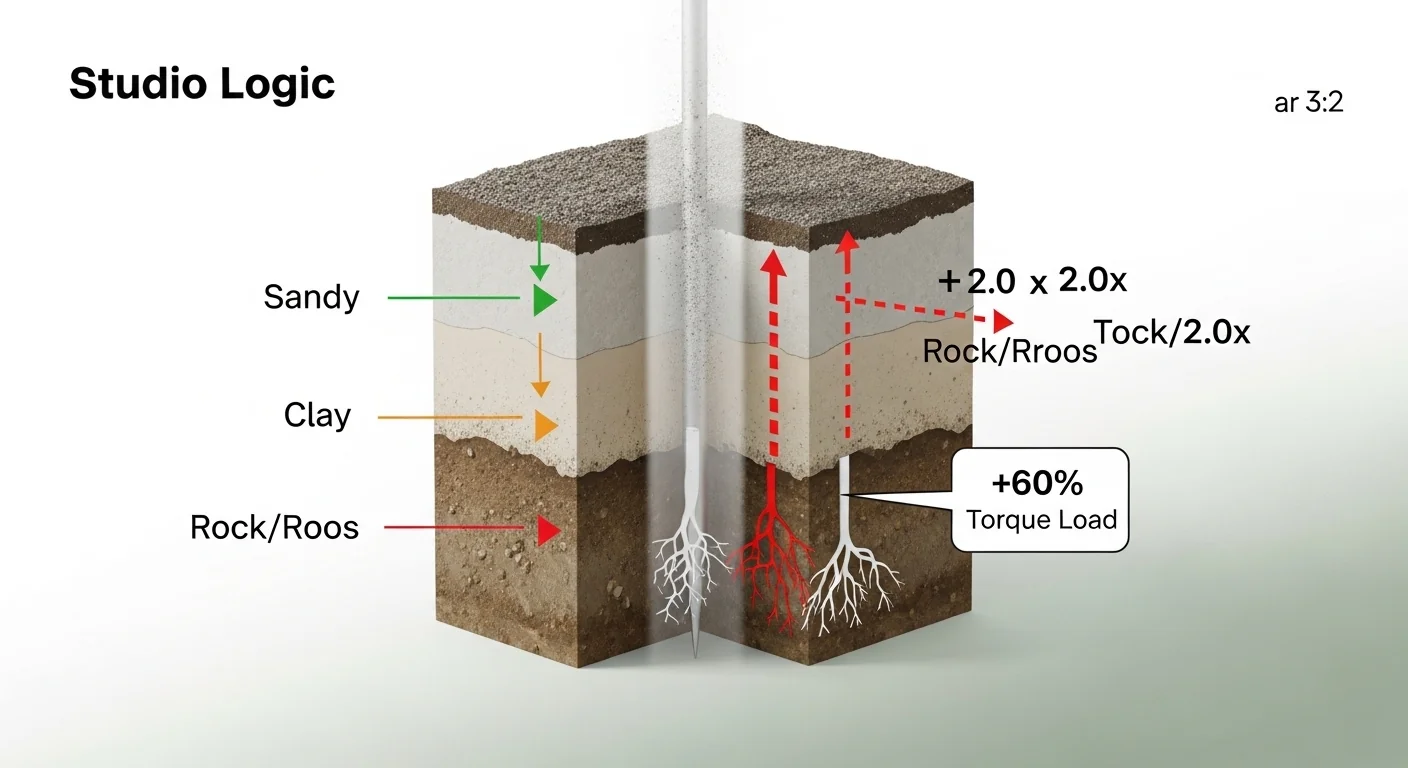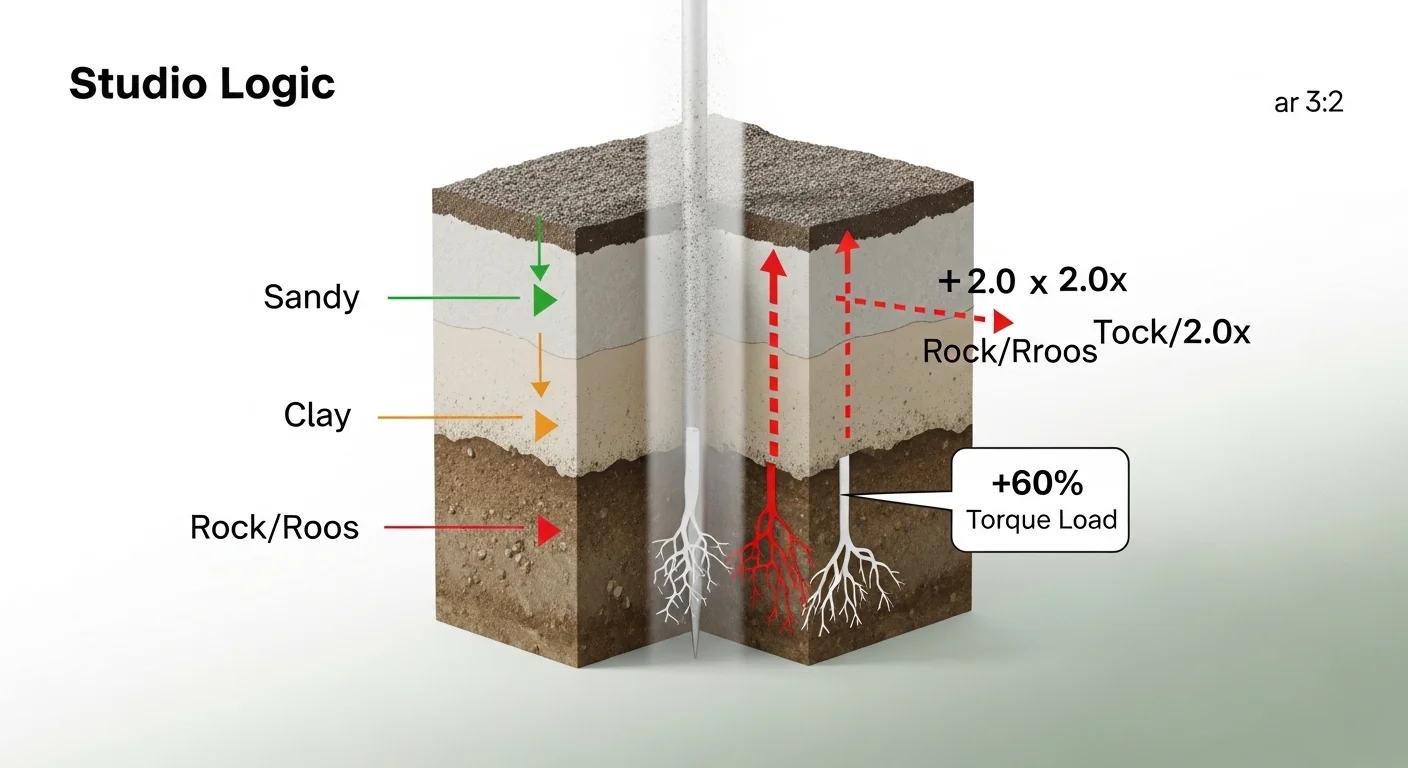
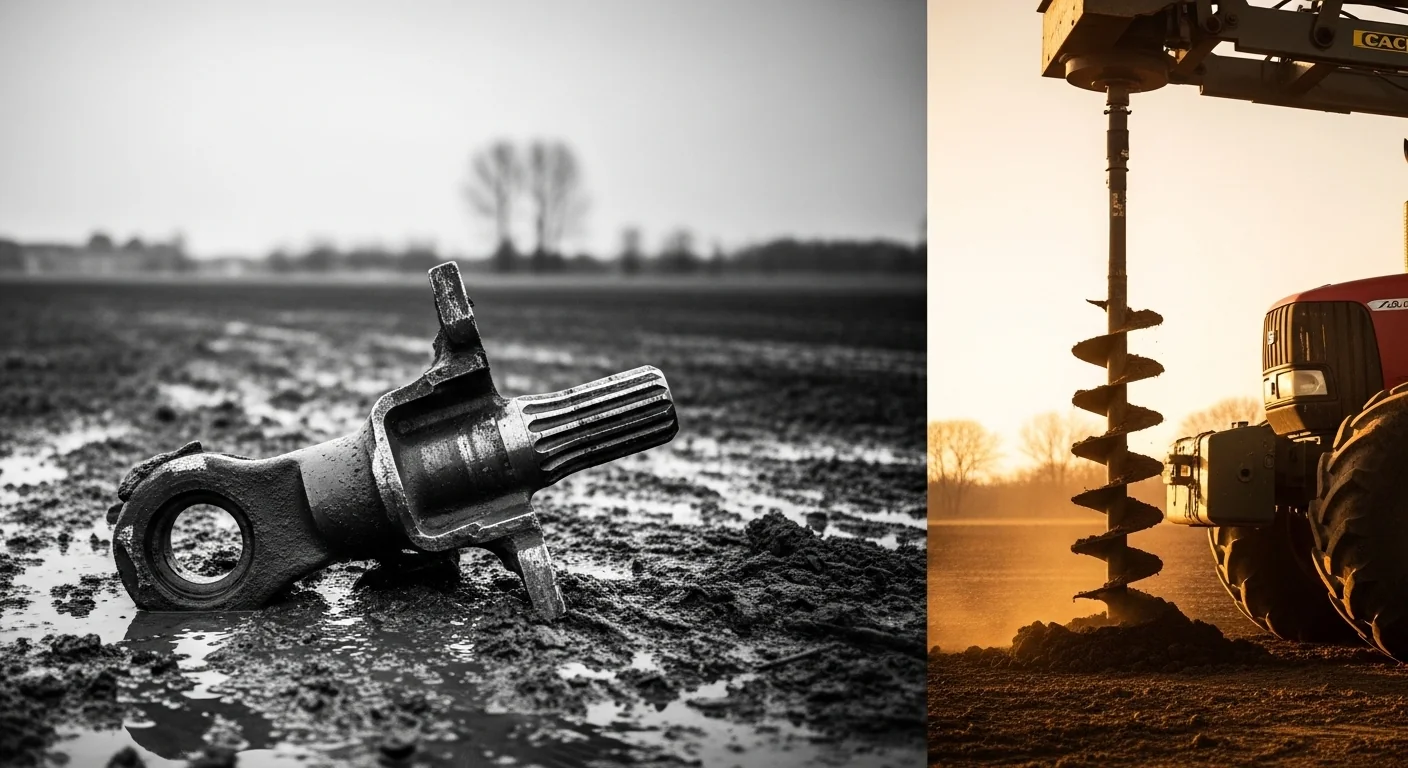
When an auger tip catches a buried root or stone, the 540 RPM PTO shaft does not simply stall. The torsional energy stored in a spinning driveline transfers backward through the gearbox in a fraction of a second. At 40 HP, that event delivers over 1,167 foot-pounds of twisting force to components that may be rated for far less. That sequence, not slow wear, is how gearboxes fail, PTO stubs shear, and tractors are thrown into uncontrolled lateral motion. Understanding the torque math before drilling is the only way to match clutch rating, shear bolt grade, and soil conditions to the actual forces involved.
This calculator takes your tractor’s rated PTO horsepower, your auger gearbox ratio, the bit diameter you are running, and the soil type on your job. It returns the calculated torque at the auger output shaft, the severity rating relative to standard gearbox limits, and a deterministic slip clutch warning if your setup lacks overspeed protection. What it does not do: it does not account for driveline angle losses (typically 3 to 8 percent at severe joint angles), and it does not replace the torque rating printed on your specific gearbox housing.
After running this calculator, you will know whether your planned combination of horsepower, gearbox ratio, and soil type falls inside or outside the safe torque range for a standard Category 1 or Category 2 auger gearbox, and you will know what slip clutch torque rating to specify before operating.
Use the Tool
| Tractor PTO HP | PTO Shaft Torque | Auger Torque (3:1) | Risk Level |
|---|
| Auger Diameter | Recommended Bolt Grade | Approx. Shear Torque | Notes |
|---|---|---|---|
| 6–9 inch | Grade 5 (7/16″) | ~350 lb-ft | Replace after each binding event |
| 12 inch | Grade 5 (1/2″) | ~500 lb-ft | Most common size; keep 4 spares |
| 18 inch | Grade 8 (1/2″) | ~700 lb-ft | Do NOT use Grade 8 as slip protection |
| 24 inch | Slip clutch only | N/A | Shear bolts inadequate at this diameter |
How This Calculator Works
Assumptions & Limits
- Assumes standard 540 RPM PTO speed. 1000 RPM PTO tractors produce ~46% less torque at same HP.
- Gearbox efficiency assumed at 100% (real-world losses ~3–8%); actual auger torque may be slightly lower.
- Soil resistance factors are engineering estimates based on typical binding scenarios, not laboratory values.
- This calculator does not replace manufacturer torque specifications for your specific auger and tractor combination.
- Always consult your tractor and auger operator’s manual before operation.
- Maximum safe operating torque varies by gearbox brand and model — check your gearbox rating plate.
How This Calculator Works
Assumptions & Limits
- Standard 540 RPM PTO speed assumed.
- Gearbox efficiency losses (~3–8%) not included.
- Soil factors are engineering estimates, not lab values.
- Always check your specific auger/tractor manual.
Before entering values, have your tractor operator's manual open to the PTO specification page so you can confirm whether your machine outputs at 540 RPM or 1000 RPM (this calculator uses 540 RPM, the standard for post hole auger drives). Locate your auger gearbox nameplate for the reduction ratio, which is almost always 3:1 on standard units but varies on heavy-duty models. If you are unsure of your effective PTO output, the drawbar horsepower calculator can help you cross-reference power at the shaft against field load conditions before you size any driven implement.
Quick Start (60 Seconds)
- Tractor PTO Horsepower: Use the PTO HP figure from your operator's manual, not the engine HP. PTO HP is typically 15 to 20 percent lower than engine HP on utility tractors. Entering engine HP overstates torque output.
- Auger Gearbox Ratio: The ratio is usually stamped on the gearbox cover or listed in the auger attachment manual. Enter "3" for a standard 3:1 unit. Entering 1:1 (no reduction) will return a torque value far below actual and produce a false "safe" reading.
- Auger Bit Diameter: Select the actual bit you are mounting, not the largest bit the auger can accept. Bit diameter affects soil resistance interpretation and the affiliate equipment recommendations, not the base torque math, but choosing the wrong size skews the safety context.
- Soil Condition: Select the most resistant soil type present in the area being drilled, not the average. A single buried root in sandy loam still triggers a root-class binding event.
- Slip Clutch: Select "No" if you are running a solid driveline shaft with no overrunning or friction slip mechanism. Shear bolts are NOT a slip clutch and should be selected as "No" for the purpose of this warning system.
- Units: All torque outputs are in foot-pounds (lb-ft). To convert to Newton-meters, multiply by 1.356.
- Gearbox rating: After calculating, compare your auger torque result against the maximum continuous torque rating on your gearbox nameplate before proceeding.
Inputs and Outputs (What Each Field Means)
| Field | Unit | What It Means | Common Mistake | Safe Entry Guidance |
|---|---|---|---|---|
| Tractor PTO Horsepower | HP | The rated power output at the tractor's PTO shaft at 540 RPM | Using engine HP instead of PTO HP inflates the torque result | 10 to 600 HP; verify on the PTO spec page of your manual |
| Auger Gearbox Ratio | Ratio (e.g., 3) | The speed reduction between the PTO input shaft and the auger output shaft | Entering 1:1 (i.e., "1") when a reduction gearbox is fitted returns falsely low torque | 1 to 10; most post hole augers use 3:1 |
| Auger Bit Diameter | Inches | The cutting diameter of the auger bit being run | Selecting a smaller diameter than actually mounted understates soil resistance context | Choose the actual mounted bit, not the maximum the unit accepts |
| Soil Condition | Category | The most resistant soil type present in the drilling area; drives the soil resistance factor | Averaging soil type across the field instead of selecting the worst-case present | Select the hardest material you expect the bit to contact |
| Slip Clutch Installed | Yes / No | Whether a friction or overrunning slip mechanism is present in the driveline | Treating shear bolts as equivalent to a slip clutch; they are not | Select "No" if running shear bolts only or a solid non-breakaway shaft |
| Auger Output Torque (output) | lb-ft | Calculated torque at the auger output shaft after gearbox multiplication | Comparing this to the PTO shaft torque rating instead of the gearbox output rating | Must be below your gearbox's continuous torque rating |
| PTO Shaft Torque (output) | lb-ft | Torque at the tractor's PTO stub shaft before the gearbox | Using this figure to size the slip clutch (the clutch must handle post-gearbox torque demand) | Reference only; the auger output torque governs component sizing |
| Soil Resistance Factor (output) | Multiplier (x) | An engineering multiplier applied to the calculated torque to reflect binding-event severity in the selected soil type | Ignoring the effective torque (torque x soil factor) when sizing protective devices | Use the effective torque (not base auger torque) to size your slip clutch |
Worked Examples (Real Numbers)
Scenario 1: 25 HP Compact Tractor, 9-Inch Bit, Sandy Loam
- PTO Horsepower: 25 HP
- Gearbox Ratio: 3:1
- Auger Bit: 9 inch
- Soil: Sandy Loam (factor: 1.0)
- Slip Clutch: Installed
Result: PTO shaft torque = (25 x 5,252) / 540 = 243 lb-ft. Auger output torque = 243 x 3 = 729 lb-ft (Caution zone). Effective torque with soil factor = 729 lb-ft.
This combination sits in the caution range for standard 3-point auger gearboxes, most of which carry a continuous rating near 700 to 900 lb-ft. Confirm your specific gearbox rating before sustained operation. The installed slip clutch should be set to slip at approximately 800 to 850 lb-ft.
Scenario 2: 40 HP Utility Tractor, 12-Inch Bit, Dense Clay, No Slip Clutch
- PTO Horsepower: 40 HP
- Gearbox Ratio: 3:1
- Auger Bit: 12 inch
- Soil: Dense Clay (factor: 1.3)
- Slip Clutch: None (solid driveline)
Result: PTO shaft torque = (40 x 5,252) / 540 = 389 lb-ft. Auger output torque = 389 x 3 = 1,167 lb-ft (High Risk). Effective torque with clay soil factor = 1,517 lb-ft.
This is the classic configuration described in the Corkscrew Root Snap failure scenario. The 1,167 lb-ft base torque already exceeds most standard gearbox ratings. Without a slip clutch, a single binding event in clay can instantaneously transfer the full 1,517 lb-ft effective load backward through the driveline. The PTO snap warning is active for this combination and should be treated as a hard stop before operation.
Scenario 3: 65 HP Tractor, 18-Inch Bit, Roots and Hardpan, Slip Clutch
Installed
- PTO Horsepower: 65 HP
- Gearbox Ratio: 3:1
- Auger Bit: 18 inch
- Soil: Roots / Hardpan (factor: 1.6)
- Slip Clutch: Installed
Result: PTO shaft torque = (65 x 5,252) / 540 = 632 lb-ft. Auger output torque = 632 x 3 = 1,896 lb-ft (Extreme range). Effective torque with root soil factor = 3,034 lb-ft.
An 18-inch bit at 65 HP generates torque that is appropriate for a heavy-duty commercial gearbox, not a standard Category 1 unit. The slip clutch for this setup must be rated well above 1,900 lb-ft continuous, and the driveline shaft cross-sections, yoke grades, and connection hardware all require verification against this load. This combination also falls under OSHA 1910.265 rollover hazard considerations if the auger binds completely.
Reference Table (Fast Lookup)
All values assume standard 540 RPM PTO and a 3:1 auger gearbox ratio. The minimum slip clutch rating column uses a 10 percent overhead above calculated auger torque as the minimum setting threshold.
| Tractor PTO HP | PTO Shaft Torque (lb-ft) | Auger Torque at 3:1 (lb-ft) | Risk Zone | Min Slip Clutch Rating (lb-ft) | Typical Tractor Class |
|---|---|---|---|---|---|
| 20 HP | 195 | 584 | Safe | 643 | Sub-compact |
| 25 HP | 243 | 729 | Caution | 802 | Compact |
| 30 HP | 292 | 875 | Caution | 963 | Compact / Utility |
| 35 HP | 340 | 1,021 | High Risk | 1,123 | Utility |
| 40 HP | 389 | 1,167 | High Risk | 1,284 | Utility |
| 50 HP | 486 | 1,459 | High Risk | 1,605 | Utility / Row Crop |
| 65 HP | 632 | 1,896 | Extreme | 2,086 | Row Crop |
| 80 HP | 777 | 2,332 | Extreme | 2,565 | Row Crop |
| 100 HP | 972 | 2,917 | Extreme | 3,209 | Row Crop / High HP |
Tractors above 35 HP paired with a standard 3:1 gearbox will produce auger torque above 1,000 lb-ft. Most entry-level and mid-range 3-point auger gearboxes sold for residential use carry ratings between 500 and 900 lb-ft continuous. Verify your specific gearbox rating before assuming the calculations above are within your equipment's operating limits.
How the Calculation Works (Formula and Assumptions)
Show the calculation steps
Step 1: PTO Shaft Torque
The standard torque formula for rotating machinery converts horsepower and RPM into torque in foot-pounds. At 540 RPM (the universal standard for Category 1 and Category 2 PTO-driven implements):
Torque_PTO (lb-ft) = (PTO_HP x 5,252) / 540
The constant 5,252 is derived from the unit conversion between horsepower, RPM, and torque: 1 HP = 33,000 ft-lb/min, divided by 2 x pi to convert to radians, which resolves to 5,252 when expressed as a direct divisor at the 1 RPM baseline. The result is rounded to the nearest whole number for display.
Step 2: Auger Output Torque After Gearbox
The gearbox reduces rotational speed and multiplies torque by the stated ratio. For a 3:1 gearbox:
Torque_Auger (lb-ft) = Torque_PTO x Gearbox_Ratio
No efficiency factor is applied in this calculator; real-world gearbox losses of 3 to 8 percent mean actual auger torque is marginally lower than calculated. This makes the calculator slightly conservative, which is intentional for safety applications.
Step 3: Soil Resistance Factor (Effective Torque)
The soil factor is applied to represent the additional torque demand created by soil binding against the auger flighting. These multipliers are engineering estimates based on the relative binding resistance of each soil category:
Sandy Loam: 1.0x | Dense Clay: 1.3x | Roots/Hardpan: 1.6x | Rock: 2.0x
The effective torque (auger torque x soil factor) is used to determine risk zone and to trigger safety warnings. It is not an independently measured value for your specific site; it is a worst-case binding estimate for the selected soil category.
Step 4: Risk Zone Classification
Risk zones are based on the calculated auger output torque (before soil factor), benchmarked against typical continuous torque ratings published for standard agricultural auger gearboxes:
Safe: below 600 lb-ft | Caution: 600 to 999 lb-ft | High Risk: 1,000 lb-ft and above
Assumptions and Limits
- The calculator assumes a 540 RPM PTO output speed. Tractors with 1,000 RPM PTO produce approximately 46 percent less torque at the same rated HP. Running this calculator for a 1,000 RPM PTO application will overstate torque.
- Gearbox efficiency is assumed at 100 percent (no friction loss). Real gearboxes lose 3 to 8 percent. This makes the tool conservative, not permissive.
- Soil resistance factors are engineering estimates for typical binding conditions, not values measured at any specific site. Actual peak binding torque during a root or rock contact event will vary significantly from these figures.
- The tool does not model driveline angle losses. Severe angles at the PTO shaft U-joints (above 15 degrees) reduce effective torque transmission and increase vibration, neither of which is captured here.
- This calculator does not account for auger bit condition. A worn or damaged cutting tooth increases soil resistance without changing the HP or ratio inputs, so actual drilling loads may exceed calculated values on worn equipment.
- Slip clutch setting guidance (10 to 20 percent above calculated auger torque) is a general industry practice, not a standard prescribed by ASABE or OSHA for this application specifically. Always refer to your slip clutch manufacturer's adjustment procedure.
- The shear bolt sizing table in the widget provides common field references only. Bolt shear torque values depend on manufacturing grade consistency, corrosion state, and hole tolerances; a corroded Grade 5 bolt may shear below its rated torque.
Standards, Safety Checks, and Secret Sauce Warnings
Critical Warnings
- The Corkscrew Root Snap: When an auger tip anchors into a buried root or rock and the PTO shaft continues rotating, the driveline does not slip or break gradually. The stored rotational energy transmits as a single high-amplitude torque spike backward through the gearbox to the PTO stub shaft. At 40 HP with a 3:1 gearbox and no slip clutch, that spike exceeds 1,167 lb-ft instantaneously. The PTO stub shaft, the driveline cross-yokes, and the gearbox input bearing are all potential failure points. The tractor itself can be thrown laterally if the auger binding force is high enough relative to tire-to-ground traction.
- Grade 8 Shear Bolts Are Not a Safety Device: Grade 8 hardware is often used by operators who believe a stronger bolt provides better protection. The opposite is true in this application. A shear bolt must fail predictably at a torque below the gearbox's maximum rating. Grade 8 bolts typically require two to three times the shear force of Grade 5, meaning the gearbox or PTO shaft fails before the bolt does. Always use the exact grade and diameter specified in your auger attachment manual.
- Binding in Rock Without Slip Protection Is a Rollover Risk: In rock or ledge soil conditions, the torque multiplier applied by this calculator (2.0x) reflects the sudden complete seizure of the auger bit. On a tractor with low rear ballast or on a slope, the reactive torque from a seized 18-inch or larger auger can exceed the tractor's lateral stability margin. This is the scenario addressed by OSHA 1910.265(c)(28) rollover protection requirements for mechanically driven earth boring equipment used near structures.
- Entry-Level Gearboxes at High HP: Many 3-point auger kits sold at farm supply retail stores carry gearboxes rated for 500 to 700 lb-ft. These units are designed for tractors in the 20 to 30 HP range. Attaching them to 40 HP or larger tractors places continuous operating torque above the gearbox rating on every hole. Failure is not a question of whether; it is a question of how many hours.
Minimum Standards
- A slip clutch should be rated at a minimum of 10 percent above the calculated auger output torque at your operating HP. For a 40 HP tractor at 3:1, the minimum clutch setting is approximately 1,284 lb-ft.
- After any binding event where the auger seized and the slip clutch activated, inspect the clutch friction plates and reset to the specified torque before resuming. Clutches that slip repeatedly can glaze their friction surfaces and require a higher force to activate.
- Shear bolts must be replaced with identical grade and diameter hardware after each activation. Using any available bolt from a toolbox is one of the most common causes of secondary driveline failure on the next binding event.
Competitor Trap: Most online guides on tractor auger shear bolt sizing focus on the PTO shaft torque figure, then recommend a bolt grade based on that number. The problem is that PTO shaft torque is the pre-multiplication value. The auger output shaft (after the gearbox) carries three times that load in a standard 3:1 unit. A bolt sized to protect against 389 lb-ft (the PTO shaft torque on a 40 HP tractor) provides no meaningful protection when the binding event generates 1,167 lb-ft at the auger itself. Always size protective hardware against the post-gearbox torque figure, not the PTO input torque.
For operators running auger attachments alongside other demanding 3-point implements, the 3-point lift capacity calculator can confirm whether your hitch category is appropriately matched to the combined weight and torque loads of the mounting frame and gearbox assembly.
Understanding how PTO-driven attachments draw power is also relevant when planning field sequences with multiple implements. The PTO shaft sizing calculator covers the mechanical shaft dimension requirements that govern whether a given driveline cross-section can handle the torque loads derived here.
Common Mistakes and Fixes
Mistake: Using Engine HP Instead of PTO HP
Engine HP and PTO HP are not the same number. On most utility tractors, PTO HP runs 15 to 20 HP below engine HP due to parasitic losses in the transmission, hydraulic pump, and accessories. Entering engine HP into the torque calculation overstates the actual torque available at the auger shaft and can make an undersized gearbox appear adequately rated when it is not.
Fix: Open the tractor operator's manual to the PTO specification table. Use the PTO HP figure, not the gross or flywheel HP on the engine sticker.
Mistake: Treating Shear Bolts as Equivalent to a Slip Clutch
Shear bolts provide one-time, single-event protection. They activate after the binding event has already occurred, meaning full torque has already been transmitted to the driveline for the duration of the thread engagement before shear. A slip clutch limits torque continuously throughout the binding event from the first moment of overload. Operators who run shear bolts alone and classify their setup as "protected" are underestimating the impulse load that travels through the driveline before the bolt shears.
Fix: Select "No" in the slip clutch field for any setup running shear bolts without a dedicated friction or overrunning clutch mechanism. The calculator's warning system is calibrated for this distinction. For demanding soil conditions, consider how other high-torque PTO implements like a rotary cutter are protected with slip clutches as standard equipment on commercial-grade models.
Mistake: Ignoring Soil Condition When Selecting Clutch Settings
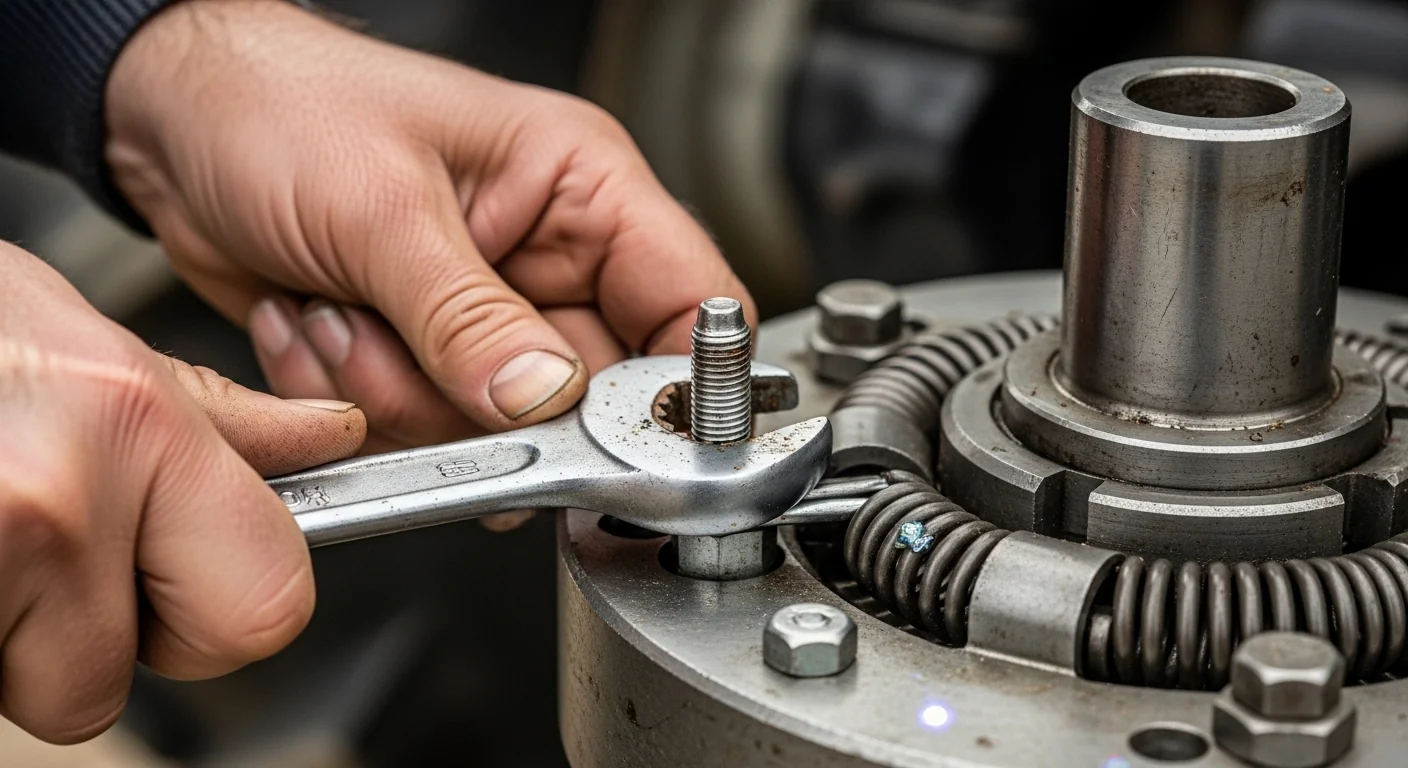
Slip clutches are often set once at the shop and never adjusted for field conditions. A clutch set to activate at 850 lb-ft may be correct for sandy loam drilling but provides inadequate protection in clay or root-heavy ground where binding events generate effective loads of 1.3 to 1.6 times the calculated base torque.
Fix: Use the effective torque figure (auger torque multiplied by the soil resistance factor) as the reference value for clutch inspection before drilling in different soil types. If your clutch setting is below the effective torque for your conditions, lower the activation threshold or switch to a higher-rated unit.
Mistake: Running an 18-Inch or Larger Bit on an Undersized Gearbox
Auger bit diameter does not directly enter the torque formula, but larger bits dramatically increase soil contact area and binding frequency. An 18-inch bit in clay or root conditions creates binding events that occur more frequently and at higher peak torque than a 9-inch bit in the same soil. The gearbox sees more stress cycles per hour, not just higher peak loads. Operators who size their gearbox for the calculated HP but ignore bit diameter in hard soil settings find gearbox failures occurring well below the calculated torque rating because of fatigue rather than single-event overload. For reference on how tractor power translates to heavy implement loads, the subsoiler HP requirements guide covers similar torque-to-soil interaction principles for deep tillage tools.
Fix: Cross-reference the auger manufacturer's bit diameter recommendations for your gearbox model. Most manufacturers publish a maximum bit diameter per HP range, not just a maximum HP.
Mistake: Not Checking Gearbox Nameplate Before Each Season
Gearbox torque ratings are printed on a nameplate that is often obscured by paint, dirt, or rust after a few seasons of use. Operators frequently assume their equipment is matched to their tractor because it has always worked before, not because they have confirmed the rating against current horsepower. If the tractor is upgraded or a second tractor with higher HP is paired with an existing auger, the gearbox that was adequate before may now be chronically overloaded.
Fix: Before each drilling season, clean and read the gearbox nameplate. Compare the continuous torque rating against the calculated auger torque for your current tractor. If the nameplate is missing or unreadable, contact the manufacturer with the model number before operating.
Next Steps in Your Workflow
Once you have the auger output torque figure and confirmed the risk zone for your combination, the immediate next step is matching that number to your slip clutch rating. If you do not have the clutch's rated activation torque written down, locate it in the attachment documentation or contact the manufacturer before the next field session. A clutch set too high provides no protection; one set too low will slip during normal drilling and waste time. The reference table above includes the minimum recommended clutch setting for each common HP level as a starting baseline.
Post-hole work often sequences with other 3-point category operations on the same day, which means PTO shaft loads and ground speed decisions compound. After confirming your auger torque figures, the tractor ground speed calculator can help you plan travel between hole locations to match hydraulic and PTO recovery intervals. For operations involving logging or winch work in the same area where post holes are being drilled, the tractor logging winch capacity tool covers the separate cable-tension and driveline considerations for that implement class.
FAQ
What is a good rule of thumb for auger gearbox torque ratings?
Entry-level residential auger gearboxes are typically rated for 500 to 700 lb-ft continuous torque, suitable for tractors up to approximately 25 HP at a 3:1 ratio. Mid-range agricultural units handle 800 to 1,200 lb-ft. Heavy-duty commercial gearboxes reach 1,500 lb-ft and above. Verify the specific rating on your unit's nameplate rather than relying on price point or brand tier as a proxy.
Does auger bit diameter affect the torque calculation?
Bit diameter does not change the mathematical torque output at the auger shaft. That value is governed solely by horsepower, PTO RPM, and gearbox ratio. However, larger diameter bits create more soil contact, more frequent binding events, and higher fatigue loading on the gearbox per hour of operation. Bit diameter matters for operational safety context, not for the base torque formula.
What is the difference between a slip clutch and a shear bolt?
A slip clutch is a continuous-action torque limiter that allows the driveline to slip whenever torque exceeds its set threshold, protecting components throughout the binding event from first contact. A shear bolt is a single-use mechanical fuse that breaks after the torque spike has already been transmitted. Both provide some protection, but a slip clutch provides significantly better protection against the initial impulse load of a sudden binding event.
Why does this calculator use 5,252 as the constant in the torque
formula?
The constant 5,252 comes from the definition of horsepower (33,000 ft-lb per minute) divided by 2 times pi, which converts from linear work per minute to torque in a rotational system. At exactly 1 RPM, 1 HP equals 5,252 lb-ft of torque. Dividing by actual RPM (540 in this case) scales that to the operating speed.
Can this calculator be used for 1,000 RPM PTO applications?
Not directly. The formula uses 540 RPM as the divisor. A 1,000 RPM PTO at the same horsepower produces substantially less torque at the shaft (roughly 46 percent less), which then gets multiplied by the gearbox ratio. Running a 1,000 RPM PTO application through this calculator will significantly overstate torque and produce an artificially high risk-zone reading. Check your tractor's PTO specification before using the results here.
How often should a slip clutch be inspected?
Inspect the slip clutch at the start of each operating season and after any binding event that caused the clutch to activate. Repeated activation can glaze the friction plates, causing the clutch to require more force to slip than its rated setting. Friction plate wear also reduces the contact area available for heat dissipation during activation, which accelerates further degradation in high-cycle applications.
Conclusion
The single most important mistake to avoid is running a solid driveline without slip clutch protection in any soil condition that contains roots, hardpan, or rock. That combination is not a question of risk tolerance; it is a predictable mechanical failure waiting for the right binding event. Use the auger output torque figure from this tool to specify the correct slip clutch rating before your next drilling session, and verify your gearbox nameplate against that number before attaching to any tractor above 25 HP. For operators working through a broader equipment checklist before field season, the flail mower RPM calculator covers the PTO-speed-to-blade-tip-speed relationship that governs a separate but equally torque-sensitive category of rotary PTO implements.