
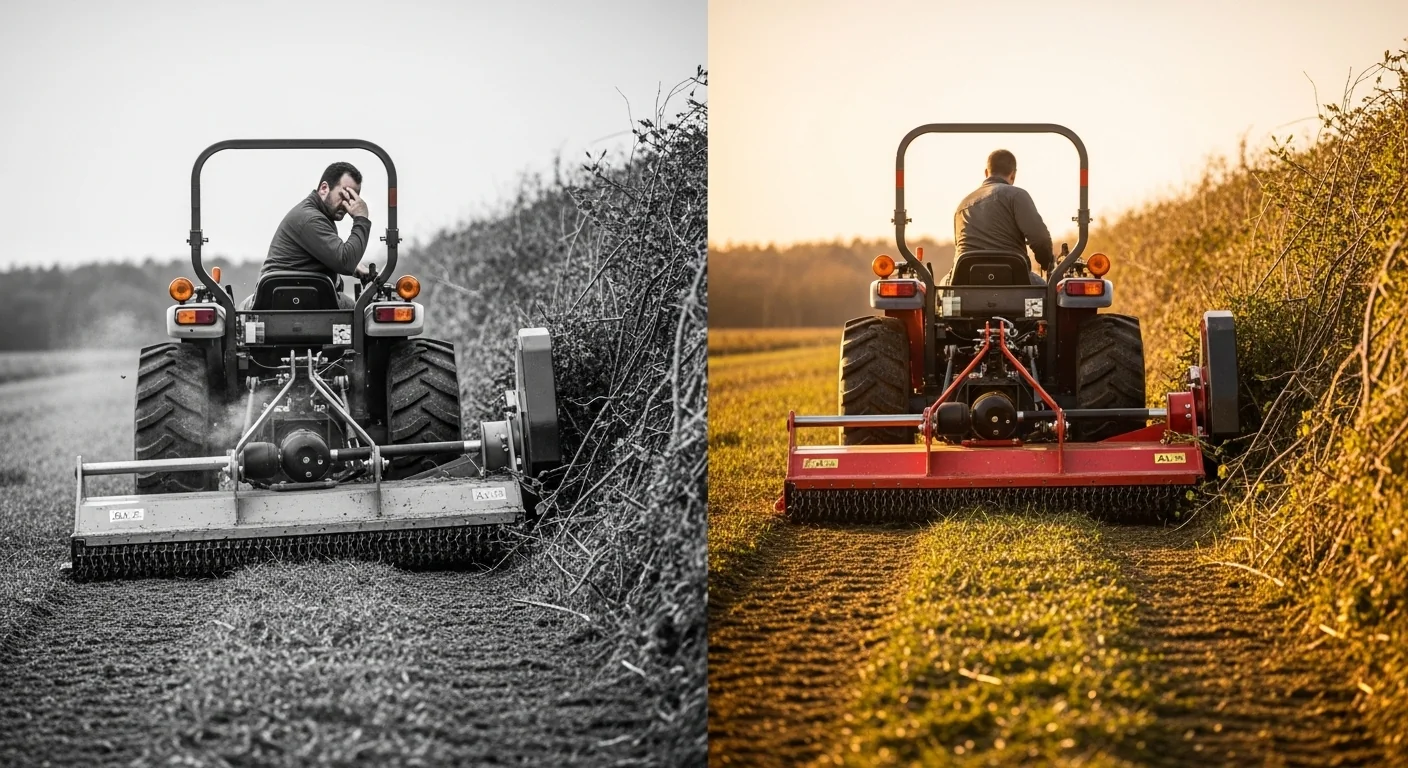
The problem with oversized rotary cutters is not that they fail immediately. They work fine in open pasture, which is exactly why the mistake goes undetected until the cutter hits a dense stand of brush or a mat of standing weeds, and then everything stops. Blade momentum collapses, the slip clutch heats up in seconds, and the tractor transmission absorbs torque loads it was never rated to handle. The failure is not mechanical bad luck; it is a sizing mismatch that a single calculation could have prevented.
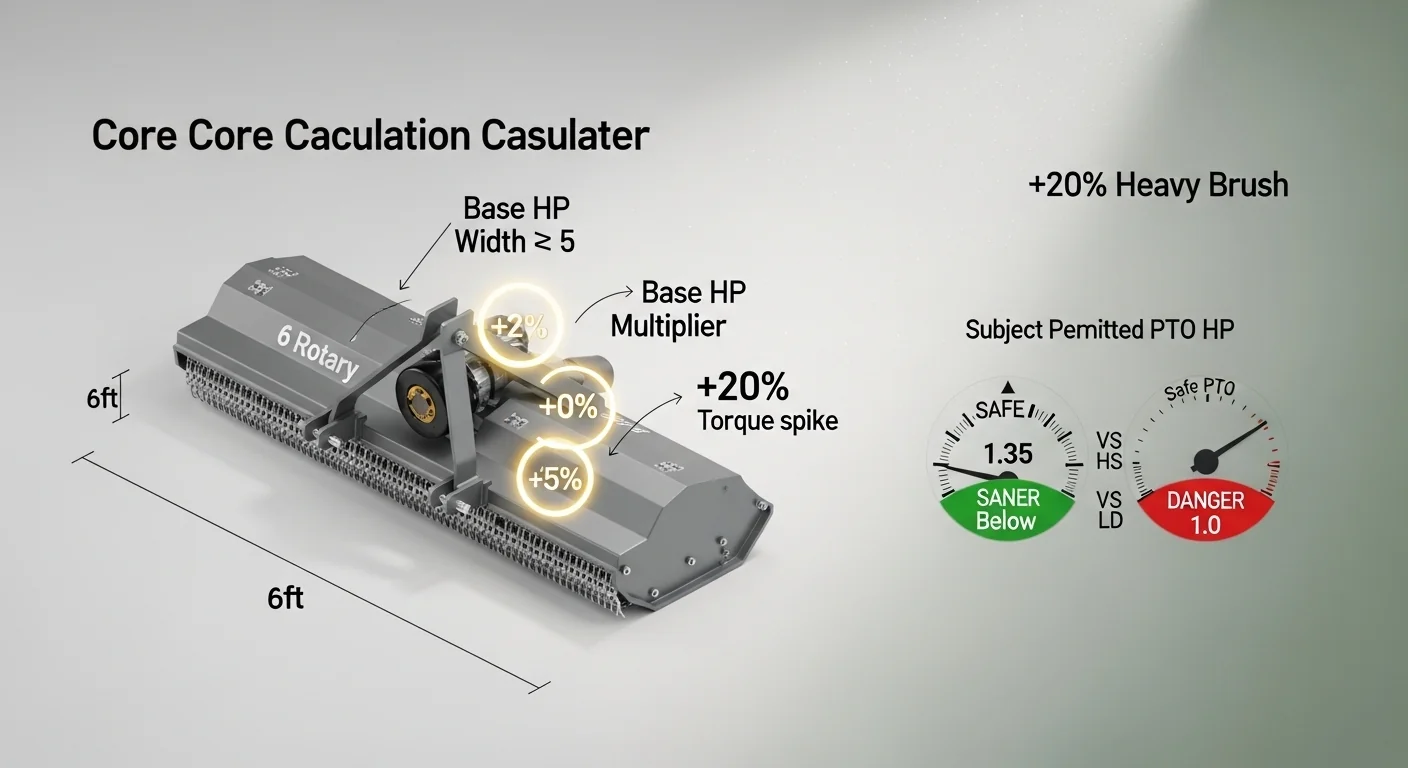
This rotary cutter size calculator for tractor applications uses the standard industry rule of 5 PTO HP per foot of cutting width for rotary cutters and brush hogs, and 3.5 PTO HP per foot for finish mowers, with a 20% upward adjustment for heavy vegetation. It identifies whether your available PTO horsepower covers the implement you are planning to run, and it flags the specific failure modes when the numbers do not add up. It does not account for ground slope, soil moisture effects on standing vegetation, or tractor ballast, all of which can shift real-world load beyond what any formula can predict. Before you commit to a cutter size, also verify that your hitch can lift the implement’s weight; the 3-point lift capacity calculator covers that check separately.
After running your numbers, you will know whether your PTO HP is adequate, marginal, or insufficient for the width and vegetation type you selected, and you can make a cutter size decision before purchasing or attaching an implement that will damage your equipment.
Use the Tool
Rotary Cutter Size Calculator
Match your tractor’s PTO horsepower to the right cutter size & detect stall risk
| Width (ft) | Rotary / Brush Hog | Finish Mower | Heavy Brush (+20%) | Your Match |
|---|
How This Calculator Works
This rotary cutter size calculator for tractor uses industry-standard PTO horsepower rules to match your tractor’s PTO HP to the correct implement size and warn you of stall and clutch-burn risk.
- Base HP requirement — Rotary Cutter / Brush Hog:
HPreq = Width (ft) × 5 HP/ft - Base HP requirement — Finish Mower:
HPreq = Width (ft) × 3.5 HP/ft - Heavy Brush / Sapling density adjustment:
HPreq × 1.20 (adds 20%) - Medium density adjustment:
HPreq × 1.10 (adds 10%) - Stall/clutch-burn trigger:
If your PTO HP < HPreq, blades stall in thick patches, risking slip-clutch burn and shear-bolt failure.
Assumptions & Limits:
- PTO HP is typically 80–85% of engine HP. Always use PTO HP (stamped on spec sheet), not gross engine HP.
- Formula applies to standard 540 RPM and 1000 RPM PTO implements.
- Ratings assume implements in serviceable condition with sharp blades.
- Terrain slope, rocks, and stumps add unpredictable load — add a safety margin of 10–15%.
- Always use Grade 2 shear bolts as a sacrificial fuse — never Grade 8 which can damage the gearbox.
- A properly rated slip clutch is the last line of defense before mechanical failure.
The “Transmission Stall” Trap Explained
A common and costly mistake: a homeowner buys a 35 HP compact tractor and hooks up a 7-foot heavy-duty rotary cutter “because it fits on the 3-point hitch.” The problem:
- Engine HP ≠ PTO HP. A 35 engine-HP tractor delivers only ~28–30 PTO HP at the shaft.
- A 7-foot rotary cutter in thick brush needs 35–42 PTO HP to maintain blade momentum.
- When the cutter hits a dense patch, blades stall, the slip clutch overheats and burns out, or the shear bolt snaps.
- Repeated stalling can bend the PTO driveline and damage the gearbox — a $500–$2,000 repair.
- A 5-foot cutter on the same tractor operates safely and efficiently in the same conditions.
Rule of thumb: Always match implement size to PTO HP first, then to hitch capacity.
Before you start, have your tractor’s spec sheet open. You need the rated PTO horsepower, not the engine horsepower listed on the hood decal. These numbers differ by 15 to 20 HP on most compact and utility tractors, and using the wrong figure is the single most common input error. Also confirm the cutting width in feet of the implement you are evaluating and a realistic description of the vegetation you typically mow.
Quick Start (60 Seconds)
- Tractor PTO Horsepower: Enter the PTO HP from your operator’s manual or spec sheet. Acceptable range is 10 to 300. If you only have engine HP, multiply by 0.82 as a conservative estimate. Do not enter gross engine HP directly.
- Implement Type: Select “Rotary Cutter / Brush Hog” for any heavy-duty flail or rotary blade implement. Select “Finish Mower” for light-duty finish-cut decks. The HP-per-foot coefficient changes between these two types, so a wrong selection produces a misleading result.
- Target Cutter Width (feet): Enter the cutting width of the specific implement, not the overall machine width. Common values are 4, 5, 6, 7, 8, and 10 feet. Fractional widths like 5.5 are accepted.
- Vegetation Density: “Light Grass” covers maintained pasture and roadsides. “Medium” covers mixed grass and first-year brush. “Heavy” applies to 2-inch-diameter saplings, thick woody brush, or any material that requires sustained blade force to cut through. When in doubt, select the heavier category.
- Check the gauge bar: The HP utilization bar shows your available PTO HP as a percentage of the requirement. Green means adequate reserve; orange means marginal; red means stall risk is present.
- Read the warnings panel: Even if the primary verdict is green, the warnings panel flags shear bolt grade, slip clutch sizing, and PTO shaft shield status. These are not optional reminders.
- Use the reference table: The quick-lookup table shows HP requirements for common widths side by side. If your current PTO HP puts you in the yellow or red column, the table shows immediately which width would bring you into the safe zone.
Inputs and Outputs (What Each Field Means)
| Field | Unit | What It Means | Common Mistake | Safe Entry Guidance |
|---|---|---|---|---|
| Tractor PTO HP | HP | Shaft power delivered to the implement at the PTO stub | Entering rated engine HP instead of PTO HP | Find “PTO HP” in the tractor spec sheet; acceptable range 10-300 |
| Implement Type | Selection | Determines HP-per-foot coefficient: 5 for rotary/brush hog, 3.5 for finish mower | Selecting “Finish Mower” for a heavy-duty brush hog underestimates HP by 30% | If the implement cuts saplings or woody brush, always select Rotary Cutter |
| Cutter Width | Feet | The actual cutting swath of the implement, not transport width | Using nominal frame size rather than rated cutting width | Check the implement data plate or spec sheet for cutting width; enter 2-20 ft |
| Vegetation Density | Selection | Load multiplier: Light = 1.0x, Medium = 1.10x, Heavy = 1.20x | Selecting “Light” for fields that have periodic brush regrowth | If you have ever stalled on this ground before, select at least Medium |
| HP Required (output) | PTO HP | Minimum PTO HP needed to sustain blade speed in the selected conditions | Treating this as a target rather than a minimum | Add 10-15% above the result as a practical safety margin for slopes and debris |
| HP Utilization (output) | Ratio | Your PTO HP divided by required HP; below 1.0 means stall risk | Assuming 1.0 (exact match) is safe; marginal starts at 1.15 | A ratio of 1.2 or higher is the recommended working threshold |
| Verdict (output) | Status | Safe / Marginal / Stall Risk based on the ratio threshold | Treating “Marginal” as equivalent to “Safe” in dense brush | In heavy vegetation, only “Safe” verdict (ratio 1.2+) should be accepted |
Worked Examples (Real Numbers)
Scenario 1: 35 PTO HP Compact Tractor, 5-Foot Brush Hog, Light Pasture
- PTO HP: 35
- Implement: Rotary Cutter / Brush Hog
- Cutting Width: 5 ft
- Vegetation Density: Light Grass
Result: HP Required = 5 ft x 5 HP/ft = 25 PTO HP. HP Utilization = 35 / 25 = 1.40. Verdict: Safe.
This is the textbook match. The tractor carries a 40% power reserve above the calculated floor, leaving room for uneven ground and the occasional heavier patch without blade slowdown.
Scenario 2: 28 PTO HP Compact Tractor, 7-Foot Brush Hog, Heavy Brush
- PTO HP: 28
- Implement: Rotary Cutter / Brush Hog
- Cutting Width: 7 ft
- Vegetation Density: Heavy (2-inch saplings)
Result: HP Required = 7 ft x 5 HP/ft = 35 base HP, then x 1.20 (heavy density) = 42 PTO HP. HP Utilization = 28 / 42 = 0.67. Verdict: Stall Risk.
This is the exact failure scenario the tool is designed to catch. The tractor is running at 67% of what the implement requires. Every pass through thick brush will stall the blades, and the slip clutch will cycle through heat-cool cycles that progressively degrade its friction plates.
Scenario 3: 45 PTO HP Utility Tractor, 6-Foot Finish Mower, Medium
Brush
- PTO HP: 45
- Implement: Finish Mower
- Cutting Width: 6 ft
- Vegetation Density: Medium (mixed grass and brush)
Result: HP Required = 6 ft x 3.5 HP/ft = 21 base HP, then x 1.10 (medium density) = 23.1 PTO HP. HP Utilization = 45 / 23.1 = 1.95. Verdict: Safe.
The finish mower’s lower HP-per-foot coefficient means this 45 HP tractor is substantially overpowered for the task, which is not a problem. The concern would be if the same tractor were asked to run a 10-foot rotary cutter in similar conditions, which would require 57.75 PTO HP and produce a marginal-to-danger verdict.
Reference Table (Fast Lookup)
All HP values are minimum PTO HP requirements. The “20% Buffer Target” column represents the tractor PTO HP needed to maintain a 1.20 safety ratio (the recommended working threshold) in the given configuration.
| Width (ft) | Rotary/Brush Hog (Light) | Rotary/Brush Hog (Heavy +20%) | Finish Mower (Light) | Finish Mower (Heavy +20%) | 20% Buffer Target (Rotary, Light) |
|---|---|---|---|---|---|
| 4 ft | 20 PTO HP | 24 PTO HP | 14 PTO HP | 16.8 PTO HP | 24 PTO HP |
| 5 ft | 25 PTO HP | 30 PTO HP | 17.5 PTO HP | 21 PTO HP | 30 PTO HP |
| 6 ft | 30 PTO HP | 36 PTO HP | 21 PTO HP | 25.2 PTO HP | 36 PTO HP |
| 7 ft | 35 PTO HP | 42 PTO HP | 24.5 PTO HP | 29.4 PTO HP | 42 PTO HP |
| 8 ft | 40 PTO HP | 48 PTO HP | 28 PTO HP | 33.6 PTO HP | 48 PTO HP |
| 9 ft | 45 PTO HP | 54 PTO HP | 31.5 PTO HP | 37.8 PTO HP | 54 PTO HP |
| 10 ft | 50 PTO HP | 60 PTO HP | 35 PTO HP | 42 PTO HP | 60 PTO HP |
| 12 ft | 60 PTO HP | 72 PTO HP | 42 PTO HP | 50.4 PTO HP | 72 PTO HP |
How the Calculation Works (Formula + Assumptions)
Show the calculation steps
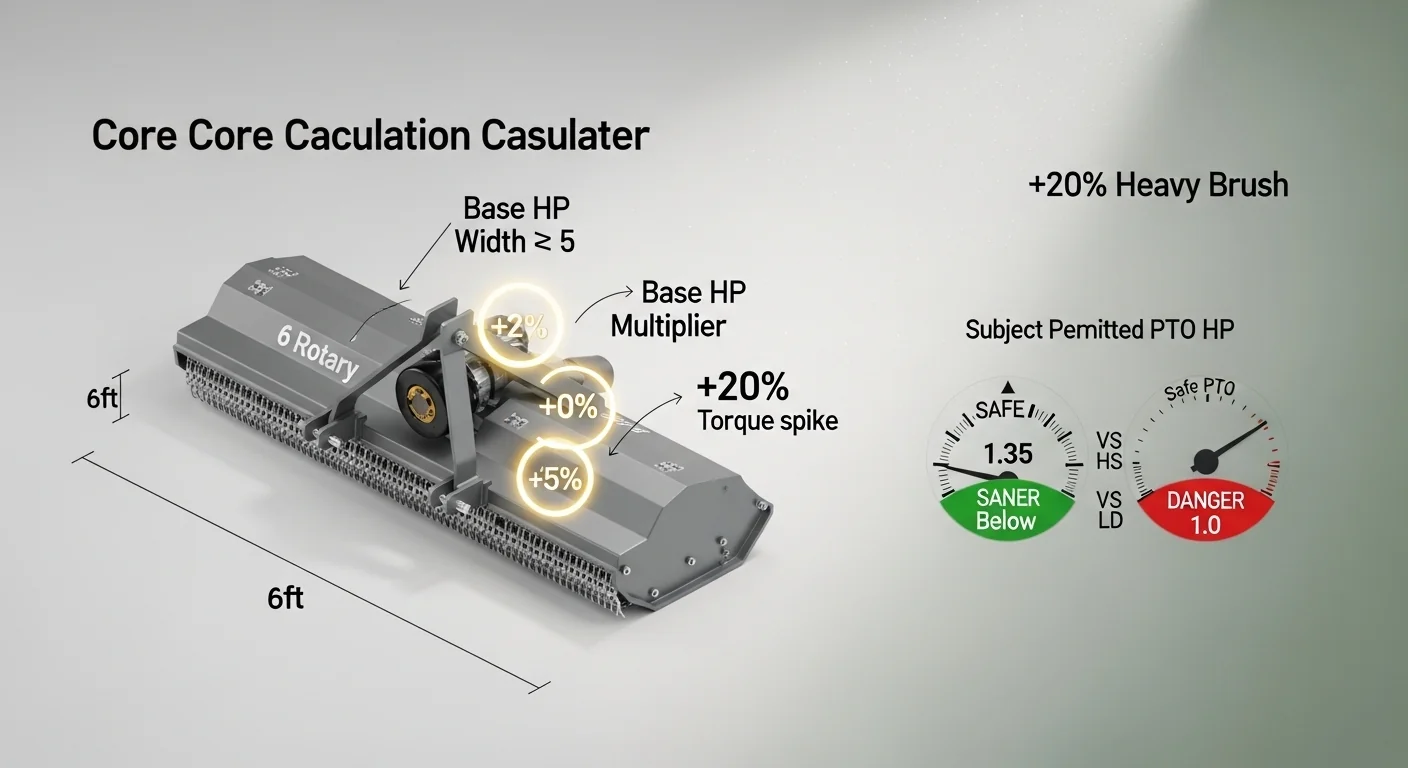
Step 1: Determine the base HP coefficient.
The implement type sets the coefficient used in all subsequent calculations. Rotary cutters and brush hogs use 5 HP per foot of cutting width. Finish mowers use 3.5 HP per foot. This difference reflects the mechanical work required to maintain blade momentum against heavy, fibrous, or woody plant material versus clipping maintained turf.
Step 2: Calculate base HP requirement.
HP_base = Cutting Width (ft) x Coefficient (HP/ft)
Example: 6-foot rotary cutter = 6 x 5 = 30 PTO HP base requirement.
Step 3: Apply the vegetation density multiplier.
Light grass: HP_req = HP_base x 1.00 (no adjustment)
Medium brush: HP_req = HP_base x 1.10
Heavy brush / saplings: HP_req = HP_base x 1.20
Step 4: Calculate the HP utilization ratio.
Ratio = Your PTO HP / HP_req
Ratio below 1.0: Stall risk. Ratio 1.0 to 1.19: Marginal. Ratio 1.20 and above: Safe.
Rounding rule: HP_req values are displayed to one decimal place. The ratio comparison uses unrounded values internally to avoid false safe verdicts at borderline inputs.
Assumptions and Limits
- The HP-per-foot coefficients are based on standard industry rules of thumb for 540 RPM PTO implements at rated operating speed. Implements running at 1000 RPM PTO should be verified against manufacturer specifications separately.
- The formula assumes the implement is in serviceable condition with blades at or near factory sharpness. Dull or worn blades can increase effective HP demand beyond what any coefficient-based formula can predict.
- Terrain slope is not included. A 15-degree slope on wet ground can significantly increase traction load, which competes with available PTO power. The formula result should be treated as a flat-ground minimum.
- The density multiplier (1.20 for heavy brush) is a single-point adjustment. Mixed fields with pockets of very dense brush surrounded by light grass will see variable loading that may briefly exceed the formula’s predicted ceiling even when the average density appears moderate.
- PTO HP values entered by the user are assumed to be the manufacturer’s rated PTO output at governor-controlled engine speed. High-hour tractors with worn injectors or fuel system degradation may deliver less than rated PTO HP.
- The tool does not account for the implement’s moment of inertia or flywheel effect. Heavier cutters with more blade mass resist stalling better at equivalent HP loads; lighter cutters are more susceptible to sudden load spikes. This factor is not captured in width-based formulas.
- Results should not be used as the sole basis for determining compliance with OSHA, ASABE, or any regional safety standard. Consult the implement manufacturer’s rated HP range before finalizing selection.
Standards, Safety Checks, and “Secret Sauce” Warnings
Critical Warnings
- The “fits on the hitch” trap. A 3-point hitch’s category rating governs lifting capacity, not PTO power compatibility. An implement can physically attach to a hitch that is connected to a tractor with less than half the required PTO HP. The connection point is not a compatibility indicator. Hitch attachment is a mechanical fit check; PTO HP adequacy is an entirely separate calculation that has to be run independently before the implement is operated.
- Slip clutch failure is silent and cumulative. A slip clutch that cycles repeatedly through stall events does not produce obvious failure symptoms immediately. The friction plates wear incrementally, reducing the clutch’s slip threshold progressively until it either locks up permanently (transmitting full stall torque to the gearbox) or slips so freely it cannot deliver rated power. By the time the problem is obvious, internal gearbox damage has often already occurred.
- Rotary cutter loads differ from other PTO implements. A PTO-driven post hole digger operates at very different torque profiles than a rotary cutter. The torque math for diggers is covered in the PTO post hole digger torque calculator, but the key point here is that HP-per-foot rules are implement-specific and cannot be transferred between categories.
- Vegetation density is the variable most operators get wrong. A field that looks like “medium brush” from the cab can contain 2-inch-base saplings hidden in grass that will spike instantaneous blade load far above the formula’s heavy-brush ceiling. When in doubt, add a manual 10% buffer on top of the heavy-brush result.
Minimum Standards
- Use only Grade 2 shear bolts as specified by the implement manufacturer. Grade 5 and Grade 8 fasteners do not shear at the calibrated torque level and will transfer full stall loads to the gearbox and PTO driveline. This is not a cost-saving decision; Grade 8 bolts in a shear-bolt position are a functional hazard.
- The PTO slip clutch must be rated at or above the tractor’s maximum torque output at the PTO stub, not just its HP rating. Undersized clutches are the most common source of gearbox failures on properly sized tractor-implement pairings.
- Inspect the PTO shaft safety shield before every attachment. A cracked or missing shield is an entanglement hazard. The shield does not affect performance ratings, so operators commonly overlook it during pre-operation checks.
- Verify PTO shaft length and telescoping range match the implement’s input shaft at full 3-point lift height. An incorrect shaft length that bottoms out or pulls apart under load causes immediate mechanical failure. The PTO shaft sizing calculator handles that specific check.
Competitor Trap: Most implement sizing guides stop at “match HP to cutter width” and call it done. That single-line check misses the entire engine HP vs. PTO HP distinction that causes a large proportion of actual stall failures. A tractor marketed as a “35 HP compact” almost universally delivers 28 to 30 PTO HP at the shaft. Using the engine figure without adjustment builds a sizing error directly into the calculation from the start, and the implement will underperform or stall in any demanding condition even though the numbers appeared to match. This tool forces the distinction at the input level. If you only have engine HP available, the tool’s hint text explains how to derive a conservative PTO HP estimate before running the calculation.
Common Mistakes and Fixes
Mistake: Entering Engine Horsepower Instead of PTO Horsepower
Engine HP is the gross output of the motor measured at the crankshaft under controlled test conditions. PTO HP is the power remaining after drivetrain losses, measured at the external PTO stub under operating conditions. On compact tractors, the difference is typically 15 to 20 HP. Operators who enter engine HP will calculate a lower HP requirement ratio than actually exists, producing a false-safe verdict. Understanding how drawbar HP differs from PTO HP and engine HP is a separate but related concept covered in the drawbar horsepower calculator.
Fix: Locate the “PTO HP” row in the tractor’s specification sheet. If the document only lists engine HP, multiply by 0.82 as a conservative starting estimate.
Mistake: Selecting “Light” Vegetation for Fields with Occasional Heavy
Patches
A 40-acre field that is predominantly maintained grass but has a 2-acre corner with annual sapling regrowth is not a “light” field when the tractor operates in that corner. The formula’s density multiplier applies to the conditions at the point of highest load, not the average field condition. Operators who select light density based on overall field appearance will run inadequate HP through the high-load zones every pass.
Fix: Select density based on the densest vegetation the implement will encounter during the run, not the majority condition of the field.
Mistake: Treating a “Marginal” Verdict as Acceptable for Regular Use
The marginal zone (HP utilization ratio 1.0 to 1.19) means the tractor has less than a 20% power reserve above the calculated floor. Under flat-ground, ideal conditions this may function without stalling. Add a slight slope, a hidden wet patch, or a section of regrowth that is denser than estimated, and the marginal tractor will stall. Repeated marginal operation accelerates slip clutch wear faster than any other single factor.
Fix: Treat marginal verdicts as a recommendation to reduce cutter width by one size or select an implement with lower HP-per-foot requirements for the given application.
Mistake: Using Grade 8 Hardware as Shear Bolt Replacements
Grade 8 bolts are stronger than Grade 2 bolts by design. In a shear bolt position, that strength is a defect, not an advantage. When the implement hits an immovable object (buried rock, stump root, concrete debris), the shear bolt is the deliberate weak point meant to fail first, protecting the gearbox and PTO driveline. A Grade 8 bolt will not shear at the calibrated load. The force transfers entirely to the gearbox housing and internal gears.
Fix: Keep a supply of manufacturer-specified Grade 2 shear bolts in the tractor toolbox. Never substitute. Replace after each shearing event with the correct grade.
Mistake: Ignoring PTO Shaft Length After Changing Implement Width
Stepping up from a 5-foot to a 7-foot rotary cutter on the same tractor often involves a different implement with a different 3-point hitch mounting geometry and input shaft position. A PTO shaft calibrated for the smaller implement may bottom out or overextend at full lift height on the larger one. Neither failure is immediately obvious during ground-level hookup.
Fix: After changing implement size, verify PTO shaft telescoping range at both ground-working depth and full raise height before operating. If the shaft is marginal, source a replacement with the correct collapsed and extended length range. The flail mower RPM calculator covers blade-speed considerations for alternative mowing configurations if you are evaluating flail options for the same PTO setup.
Next Steps in Your Workflow
Once the calculator confirms your PTO HP is adequate for the cutter size and vegetation you are targeting, the next check is whether your tractor’s overall powertrain, including tire grip and ballast, can translate that PTO HP into consistent forward motion through dense material. A tractor with adequate PTO output but insufficient rear ballast will lose traction before the cutter stalls, which shows up as tire spinning rather than blade slowdown. Ballast requirements for stable PTO implement operation are covered in detail through the tractor tire ballast calculator. Separately, if your application involves ground-engaging work after mowing, such as subsoiling to break up root mats, the HP demands shift significantly; the subsoiler HP requirements calculator covers that transition.
On the maintenance side, the single most valuable action after any mowing session involving heavy vegetation is a slip clutch inspection. Remove the clutch cover, check the friction plate surface for glazing or heat discoloration, and verify the spring-loaded slip torque has not drifted from the manufacturer’s specification. A clutch that slipped more than twice in a session should be inspected before the next use. Blade condition follows immediately after: a rotary cutter blade that has hit rocks or stumps loses cutting edge geometry quickly, increasing the torque required to sever plant material and pushing effective HP demand upward even when the formula says the tractor is adequately powered.
FAQ
What is the difference between engine HP and PTO HP on a tractor?
Engine HP is the gross power output measured at the crankshaft under test conditions. PTO HP is what remains after accounting for drivetrain friction losses, accessory loads, and the mechanical efficiency of the power transfer from engine to the external PTO stub shaft. On compact and utility tractors, PTO HP is typically 80 to 85 percent of rated engine HP. For sizing implements, always use PTO HP.
Why does a rotary cutter need more HP per foot than a finish mower?
Rotary cutters and brush hogs are designed to sever woody, fibrous, or thick plant material with a free-swinging or fixed blade at high rotational momentum. Maintaining blade speed through dense material requires substantially more sustained power than clipping maintained grass. The HP-per-foot coefficient reflects the sustained torque demand at the blade tip, not just the force to initiate cutting.
What happens mechanically when a rotary cutter stalls on a tractor?
When blade momentum collapses, the PTO driveline instantaneously transmits a high-torque spike back through the shaft. The slip clutch is designed to absorb this spike by slipping. If the clutch is undersized, misadjusted, or worn, it cannot fully isolate the shock, and the gearbox receives impact loads that can crack housing webs, shear internal gear teeth, or damage bearings. Repeated stall events compound the damage even when each individual event appears minor.
Is a 20% HP buffer always necessary, or is it just conservative?
For flat-ground, light vegetation mowing with a well-maintained implement, operators regularly work at ratios closer to 1.05 to 1.10 without immediate problems. The 1.20 threshold becomes necessary when any of these conditions change: uneven terrain, dense or variable vegetation, a high-hour tractor delivering below-spec PTO HP, or an implement with worn blades demanding more torque to achieve the same cut. For new pairings, the 1.20 buffer is the appropriate starting point.
Can I run a 540 RPM implement on a 1000 RPM PTO tractor?
Yes, with the correct adapter or a dual-speed PTO if the tractor is equipped. The HP-per-foot sizing formula remains the same regardless of PTO speed. However, blade tip speed and cutting behavior differ between 540 and 1000 RPM configurations, and the implement must be rated for the selected PTO speed. Running a 540 RPM implement at 1000 RPM will damage or destroy it immediately.
Does cutting direction or pattern affect HP requirements?
Cutting against the direction of blade rotation (back-cutting) typically reduces the effective load on the blade because plant material is deflected rather than captured and forced through the cut zone. However, back-cutting also reduces cut quality and can increase material roping around the spindle. For HP sizing purposes, the formula values assume standard forward cutting through standing material. Back-cutting may allow a slightly smaller HP margin to function, but it should not be relied upon to rescue an undersized pairing.
Conclusion
The rotary cutter size calculator for tractor applications converts a straightforward arithmetic check into a decision tool that surfaces the specific failure modes most operators only discover after the damage has already occurred. The core formula is not complicated: width times a coefficient, adjusted for vegetation density. What the formula does is force the use of PTO HP as the input variable rather than the engine HP figure that is far more visible on the machine and in marketing materials. That single distinction is responsible for a large share of implement stalling problems on compact and utility tractors, and catching it before hookup costs nothing.
The number one mistake to avoid is also the simplest to check: find the PTO HP line in your tractor’s spec sheet before you enter any number. Do not estimate from the engine HP badge or the dealer’s verbal description. If you use the same tractor for heavy ground-engaging work between mowing seasons, the box blade draft force calculator gives you the same kind of traction-versus-implement sizing check for grading and leveling tasks. Size for the worst condition you will realistically encounter, not the average, and build in the recommended 20% reserve. The implement that runs quieter and performs more consistently than a competing tractor’s larger cutter is almost always the one that is properly matched to the machine pulling it.