
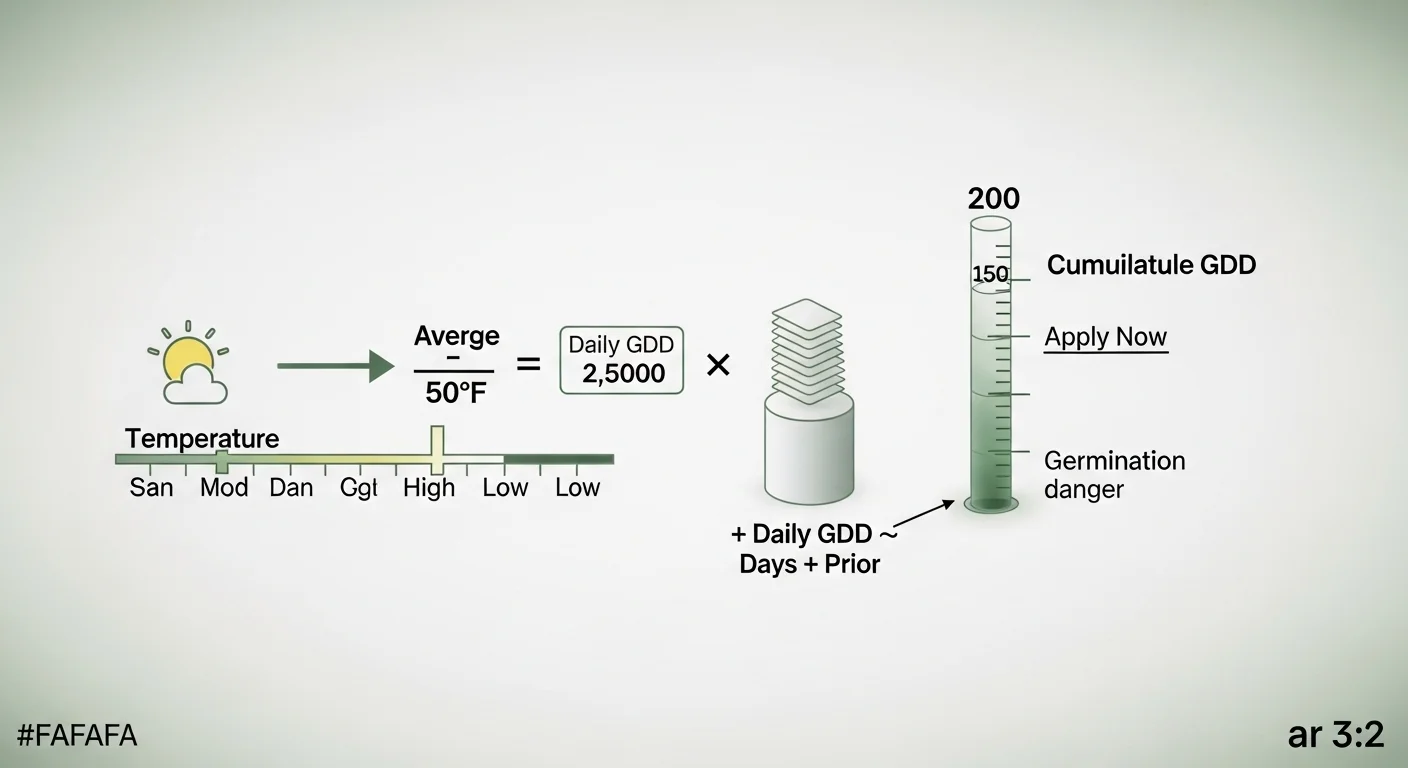
Crabgrass seeds do not germinate because a date on the calendar says April. They germinate because enough thermal energy has accumulated in the soil to trigger biological activity. That threshold is expressed in Growing Degree Days (GDD), a unit that measures cumulative heat above a species-specific base temperature. When that number is reached, the seed coat breaks and germination begins, regardless of what month it is. If your pre-emergent herbicide is not already active in the soil before that threshold, you have spent money on a product that will do nothing.
This tool calculates Daily GDD from your entered high and low temperatures, then multiplies by your tracking window and adds any prior accumulated GDD to produce a running Cumulative GDD total. It also compares that total to published application and germination thresholds for common turfgrass weeds. What it does not do: it does not pull live weather data, predict future temperatures, or account for soil moisture, mulch cover, or shading, all of which influence how quickly soil warms relative to air temperature.
After running your numbers, you will know whether you are still in the safe accumulation window, inside the Golden Window where pre-emergent application is urgent, or past the germination threshold where pre-emergent products are unlikely to be effective.
Use the Tool

GDD Weed Emergence Tracker
Calculate Growing Degree Days to time your pre-emergent application — stop calendar guessing and start hitting the exact window.
How This Calculator Works
What are Growing Degree Days (GDD)?
GDD measure how much heat has accumulated over time. Biological organisms — weeds, insects, plants — don’t respond to calendar dates; they respond to accumulated thermal energy. When enough heat accumulates above the base temperature, biological events (like germination) are triggered.
Step 1 — Daily GDD
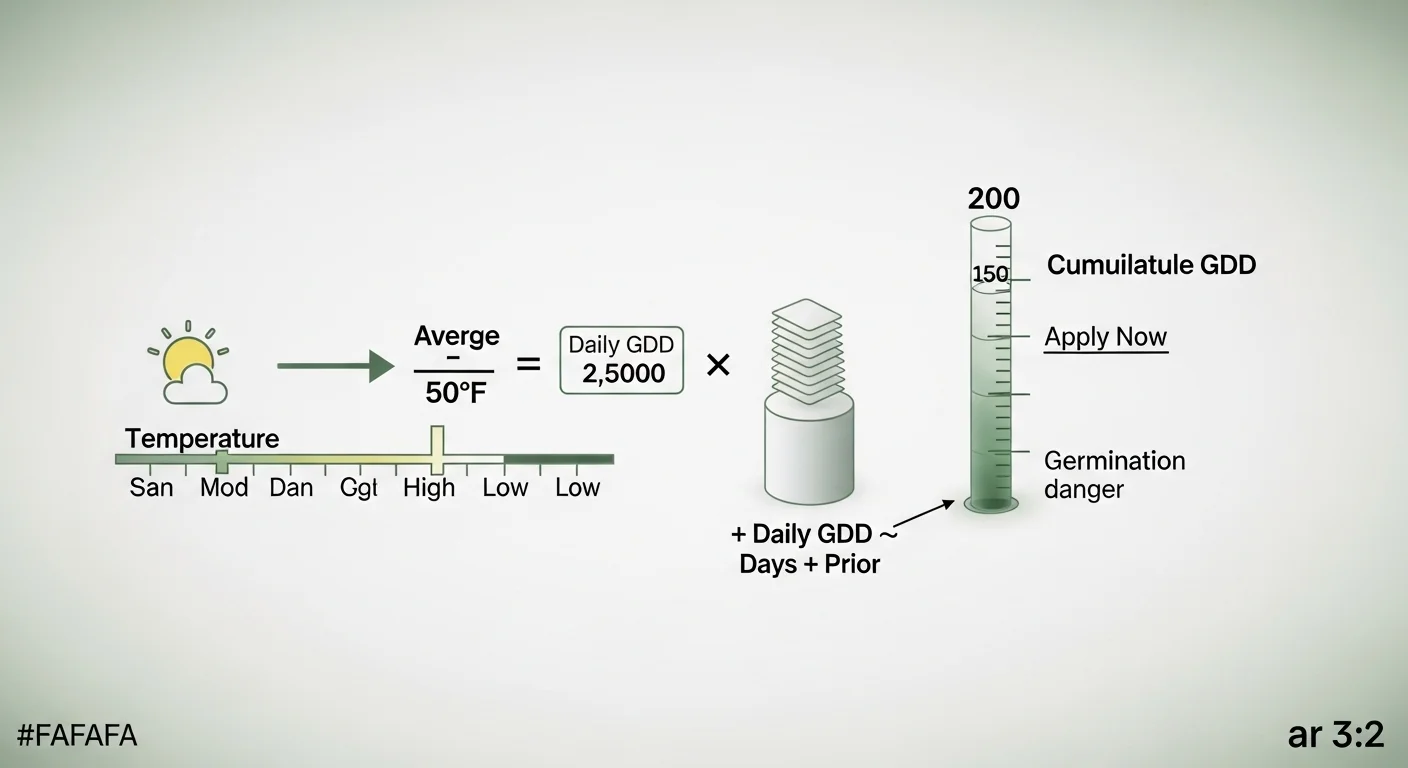
Daily GDD = ((T_max + T_min) / 2) − T_baseAverage today’s high and low, then subtract the base temperature. If the result is negative (cold day), it counts as 0 GDD — cold days don’t subtract from accumulated heat.
Step 2 — Cumulative GDD
Cumulative GDD = Prior GDD + (Daily GDD × Days)GDD accumulates day-over-day from the start of your tracking period. This calculator assumes consistent daily temps for the entered number of days.
Step 3 — Thresholds
Crabgrass germination: ≈200 GDD
Pre-emergent mandate: Apply Prodiamine/Dimension at 150 GDD — that’s your Golden Window.
Danger zone: Above 200 GDD, seeds may already be germinating.
Assumptions
This model uses the simple average method — the most widely used approach in turfgrass and agronomy. It assumes uniform daily temps across your tracking window. For higher accuracy, enter daily readings one at a time and accumulate manually.
Assumptions & Limits
- This tool uses the Simple Average method: (T_max + T_min) / 2. Some agronomists use the Baskerville-Emin sine-wave method for greater precision near the base temperature.
- Negative daily GDD values are truncated to 0 — cold days do not “un-accumulate” heat.
- Crabgrass emergence threshold of 200 GDD (base 50°F) is widely cited in turfgrass literature; local soil type, compaction, and cultivar variation can shift this ±30 GDD.
- This tool does not account for soil temperature directly — air temperature is used as a proxy. Bare soil warms faster than heavily shaded or mulched areas.
- Pre-emergent residual effectiveness is assumed to be 8–12 weeks under average conditions. Heavy rain or high temperatures may reduce residual.
- GDD thresholds for non-crabgrass weeds (Goosegrass, Foxtail, etc.) are approximate. Consult your local university extension for location-specific values.
- This calculator is for educational and planning purposes. Always verify with a soil thermometer and consult your local Cooperative Extension Service.
Before you calculate, have three pieces of information ready: your local daily high and low air temperatures for the period you want to track (from a weather station, app, or on-site sensor), your chosen base temperature (50°F is the published standard for crabgrass and most cool-season turfgrass pests), and an estimate of how many days you have been in the current temperature window. If you have been logging temperatures since January 1 or since last frost, enter that accumulated GDD total in the Prior GDD field. If this is your first calculation of the season, leave Prior GDD at zero. For tracking conditions like sun exposure that affect soil warming rates, the sun path calculator can help you understand how much direct radiation your lawn area is actually receiving.
Quick Start (60 Seconds)
- Target Weed / Pest: Choose from the dropdown. Crabgrass is the default and the most commonly tracked species. Goosegrass and Foxtail have higher thresholds; Emerald Ash Borer triggers much earlier in the season around 50 GDD.
- Base Biological Temp (Tbase): Enter in degrees Fahrenheit. Do not change this from 50°F unless you have a species-specific reference. Dropping the base artificially inflates your GDD total and produces a false sense of urgency.
- Daily High Temp (Tmax): Enter today’s or your period’s average high in °F. Do not use overnight readings here. This field requires the highest temperature of the day.
- Daily Low Temp (Tmin): Enter the lowest temperature of the day in °F. Tmin must be less than or equal to Tmax; the calculator will flag this error if reversed.
- Days of Accumulation: The number of days your temperature pattern has been consistent. If temperatures vary widely day to day, this tool is best used with a single representative day, then re-run as conditions change.
- Prior Accumulated GDD: Leave at zero if starting fresh. If you have been tracking since January 1, enter the GDD total from that log here. This is the field that makes cumulative season tracking possible.
- Hit Calculate GDD. Do not interpret results until all six fields are confirmed correct.
Inputs and Outputs (What Each Field Means)
| Field | Unit | What It Means | Common Mistake | Safe Entry Guidance |
|---|---|---|---|---|
| Target Weed / Pest | Select | Sets the germination and pre-emergent thresholds for the selected species | Using Crabgrass thresholds for Goosegrass, which germinates later | Identify the dominant weed pressure in your lawn before selecting |
| Tbase (°F) | °F | Temperature below which biological activity stops; sets the zero-point for GDD accumulation | Using 32°F (freezing) instead of the biological base, which massively overstates GDD | Use 50°F for crabgrass, foxtail, and most warm-season weeds; verify for other species |
| Tmax (°F) | °F | The single daily maximum air temperature for the tracking period | Using afternoon readings instead of the true daily maximum | Range: -20 to 130°F; values above 86°F may require a capped-high correction in more advanced models |
| Tmin (°F) | °F | The single daily minimum air temperature for the tracking period | Entering Tmin higher than Tmax, which the calculator flags as an error | Use the overnight low from a calibrated weather station, not a handheld reading taken at dawn |
| Days of Accumulation | Days | How many consecutive days the entered temperatures represent | Entering 30 days with one week’s representative temperatures, creating false accumulation | Range: 1 to 365 days; re-run the calculator weekly for more accurate season tracking |
| Prior Accumulated GDD | GDD | GDD already logged before this calculation period; enables running seasonal totals | Leaving at zero when significant accumulation has already occurred earlier in the season | Range: 0 to 2000 GDD; retrieve from prior calculations or a county extension GDD log |
| Cumulative GDD (output) | GDD | Total heat units accumulated; compared against species thresholds to determine application urgency | Treating this as a definitive soil temperature measurement rather than an air-temperature proxy | Cross-reference with a soil thermometer reading at 2-inch depth for highest confidence |
| Application Status (output) | Safe / Warn / Danger | Traffic-light indicator: Safe = still building, Warn = Golden Window open, Danger = germination likely underway | Waiting for a “Danger” status before acting; pre-emergent window has already closed at that point | Act when status first shifts to Warn, not when it hits Danger |
Worked Examples (Real Numbers)
Scenario 1: Mild Early Spring, First Calculation of the Season
- Target Weed: Crabgrass
- Tmax: 62°F
- Tmin: 41°F
- Tbase: 50°F
- Days: 12
- Prior GDD: 0
Calculation: ((62 + 41) / 2) – 50 = 51.5 – 50 = 1.5 GDD per day. 1.5 x 12 = 18 GDD cumulative.
Result: 18 GDD. Status: Safe.
At this rate, it would take roughly 88 more days at the same temperature pattern to reach the 150 GDD application threshold. Monitor weekly and log temperatures daily. The season is early, but tracking should start now, not later.
Scenario 2: Warm Stretch in Late March, Carrying Forward Prior Accumulation
- Target Weed: Crabgrass
- Tmax: 71°F
- Tmin: 54°F
- Tbase: 50°F
- Days: 10
- Prior GDD: 85
Calculation: ((71 + 54) / 2) – 50 = 62.5 – 50 = 12.5 GDD per day. 12.5 x 10 = 125 GDD new accumulation. 125 + 85 = 210 GDD cumulative.
Result: 210 GDD. Status: Danger.
A warm 10-day stretch pushed cumulative GDD from 85 to 210, clearing both the 150 GDD pre-emergent threshold and the 200 GDD germination threshold in the same window. A homeowner who planned to apply on April 1 would have missed the window entirely. Pre-emergent applied now is unlikely to provide full-season control for crabgrass.
Scenario 3: Standard Spring Week, Golden Window Identified
- Target Weed: Crabgrass
- Tmax: 67°F
- Tmin: 51°F
- Tbase: 50°F
- Days: 7
- Prior GDD: 110
Calculation: ((67 + 51) / 2) – 50 = 59 – 50 = 9 GDD per day. 9 x 7 = 63 GDD new. 110 + 63 = 173 GDD cumulative.
Result: 173 GDD. Status: Golden Window (Warn).
Cumulative GDD has cleared 150 and germination is 27 GDD away. At 9 GDD per day in current conditions, that is roughly 3 more days. Prodiamine or Dimension granular should be applied and watered in immediately. Delaying by even one more warm weekend may move the status to Danger.
Reference Table (Fast Lookup)
All rows calculated using Tbase = 50°F, simple average method. Germination threshold for Crabgrass = 200 GDD. Pre-emergent threshold = 150 GDD.
| Tmax / Tmin (°F) | Daily GDD | Days to 150 GDD | Days to 200 GDD | 10-Day Cumulative | Status at 10 Days |
|---|---|---|---|---|---|
| 55 / 38 | -3.5 (= 0) | N/A | N/A | 0 GDD | Safe |
| 58 / 42 | 0.0 | N/A | N/A | 0 GDD | Safe |
| 62 / 44 | 3.0 | 50 days | 67 days | 30 GDD | Safe |
| 66 / 50 | 8.0 | 19 days | 25 days | 80 GDD | Safe |
| 70 / 52 | 11.0 | 14 days | 18 days | 110 GDD | Safe |
| 73 / 55 | 14.0 | 11 days | 14 days | 140 GDD | Safe |
| 75 / 58 | 16.5 | 9 days | 12 days | 165 GDD | Apply Now |
| 78 / 60 | 19.0 | 8 days | 11 days | 190 GDD | Apply Now |
| 80 / 62 | 21.0 | 7 days | 10 days | 210 GDD | Germinating |
| 84 / 65 | 24.5 | 6 days | 8 days | 245 GDD | Germinating |
How the Calculation Works (Formula + Assumptions)
Show the calculation steps
Step 1: Calculate the Daily Average Temperature
Add the daily maximum and minimum air temperatures, then divide by two:
Tavg = (Tmax + Tmin) / 2
Example: (72 + 54) / 2 = 63.0°F
Step 2: Subtract the Base Temperature
Subtract the biological base temperature (Tbase) from Tavg:
Daily GDD = Tavg - Tbase
Example: 63.0 – 50 = 13.0 GDD
If the result is negative (cold day), it is set to 0. Cold does not subtract previously accumulated GDD.
Step 3: Multiply by Days and Add Prior GDD
Cumulative GDD = Prior GDD + (Daily GDD x Days)
Example: 80 + (13.0 x 10) = 210 GDD
Rounding Rules
Daily GDD is carried to two decimal places internally. Cumulative GDD is displayed to one decimal place in results. Reference tables round to whole numbers for readability.
Unit Notes
All temperature inputs are in degrees Fahrenheit (°F). GDD values produced by this tool are in Fahrenheit-based GDD units (GDDF). If you use Celsius-based GDD data from a university extension, convert using: GDDF = GDDC x 1.8. The thresholds in this calculator (150, 200 GDD) are in Fahrenheit units.
Assumptions and Limits
- This tool uses the Simple Average method: (Tmax + Tmin) / 2. University extensions and pest management programs often publish GDD data using this same method, making comparisons straightforward. However, the Baskerville-Emin (sine curve) method produces more precise results when daily temperatures swing widely or frequently dip near the base temperature.
- Negative daily GDD values are truncated to zero. Biological activity does not run backward on cold days; heat accumulated in prior days is not lost.
- The 200 GDD germination threshold for crabgrass is a widely cited turfgrass literature value using Tbase = 50°F. Local soil type, compaction level, irrigation history, and cultivar variation can shift the actual germination point by plus or minus 30 GDD.
- This calculator uses air temperature as a proxy for soil temperature. Bare, south-facing slopes and compacted driveways warm faster than shaded, mulched beds. Soil at 2-inch depth may be 5 to 15°F warmer than air-based GDD estimates on sunny days in early spring.
- The Days field assumes the entered Tmax and Tmin values are representative of the entire period. Significant temperature variability within the tracking window will reduce accuracy. For best results, run the calculator once per week with that week’s actual average values.
- Pre-emergent herbicide residual activity (Prodiamine, Dimension) is assumed at 8 to 12 weeks under standard conditions. Heavy rainfall, high soil temperatures, or disturbed soil can shorten effective residual. Reapplication timing should be calculated separately.
- Goosegrass, Foxtail, and Spurge thresholds are approximate. Consult your local Cooperative Extension Service for region-specific germination data before making final product application decisions.
- Chill-hours accumulated over winter can affect spring germination dynamics. For tools that track cold exposure, see the chill hours calculator which uses a complementary approach to seasonal heat-unit modeling.
Standards, Safety Checks, and “Secret Sauce” Warnings
Critical Warnings
- The calendar date is not a valid trigger. Applying pre-emergent herbicide on a fixed date (April 1, Tax Day, forsythia bloom) can miss the actual thermal window by 2 to 6 weeks depending on the year’s temperature pattern. In a warm spring, crabgrass can accumulate 200 GDD by mid-March. In a cold spring, the window may not open until May. Only cumulative GDD tracking is accurate.
- Waiting for soil to “feel warm” is not calibrated. Human tactile estimates of soil warmth are not reproducible. Two people standing in the same yard will give different estimates. GDD provides a numeric, repeatable measurement that does not change based on who is measuring.
- Applying after 200 GDD for crabgrass is functionally wasted product. Most pre-emergent herbicides work by forming a chemical barrier that prevents root penetration during germination. Once germination has begun, the seedling root has already breached that layer. Post-emergent options for crabgrass exist but require accurate species identification and appropriate timing.
- Low base temperature assumptions inflate GDD counts artificially. If your Tbase is set lower than the species threshold, every warm day contributes more GDD than is biologically meaningful. Always match Tbase to the published species-specific value. For resistance and fungicide rotation planning, the fungicide FRAC code calculator follows the same principle of matching biological specificity to product selection.
Minimum Standards
- Apply Prodiamine or Dimension at or before 150 cumulative GDD (Tbase = 50°F) for crabgrass prevention. Do not wait for 200 GDD.
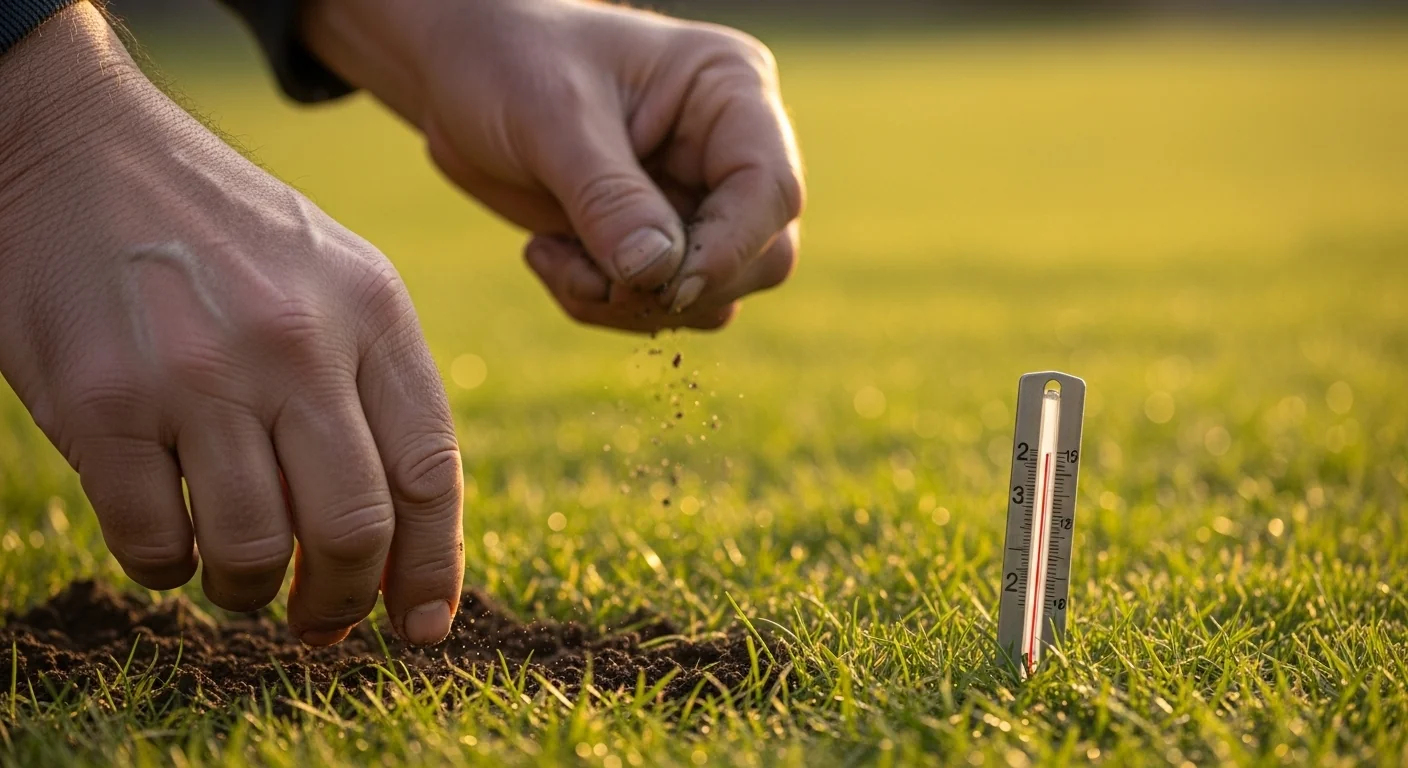
- Verify application with a soil thermometer at 2-inch depth. The GDD model from air temperatures is an estimate; a reading at or above 55°F at 2 inches is a physical confirmation that soil conditions are reaching germination range.
- Re-run this calculator after any 5-consecutive-day warm stretch, especially in early spring. A single warm week can push GDD faster than weekly monitoring intervals capture.
Competitor Trap: The majority of lawn care guides still publish pre-emergent timing as a calendar range: “apply between March 15 and April 15.” That advice reflects an average, not a decision rule. An average date is correct for an average year. In an above-average warm year, that window closes weeks before March 15 in southern states, and days before it in the mid-Atlantic and Midwest. In a cold year, applying on March 15 means your pre-emergent product sits in cold soil degrading for 4 to 6 additional weeks before it is needed, reducing residual life precisely when it matters. Calendar-based guidance is not wrong on average; it is wrong on the years when getting it right costs the most.
For broader integrated pest management context, the neem oil mixing ratio tool covers organic pre-emergent and contact treatment options when post-emergent intervention is needed after a missed window.
Common Mistakes and Fixes
Mistake: Treating GDD as Equivalent to Soil Temperature
Cumulative GDD is derived from air temperature, not a direct soil reading. Soil temperature at germination depth (1 to 2 inches) can differ significantly from what GDD models predict, particularly on sunny bare soil or under heavy mulch. GDD provides an index, not a measurement. A digital probe thermometer inserted at 2-inch depth is the physical verification step.
Fix: Use GDD to determine urgency, then confirm with a 2-inch soil probe before purchasing and applying product.
Mistake: Using a Single Day’s Temperatures for Multi-Week Calculations
Entering one warm afternoon’s Tmax and overnight Tmin and then multiplying by 21 days produces a highly inaccurate cumulative figure if that day was not representative of the three-week period. Spring temperatures are volatile, and a single outlier reading can overstate or understate GDD by a large margin.
Fix: Enter a true weekly average, or re-run the calculator each week with that specific week’s actual temperatures and use the Prior GDD field to carry forward the running total. For planning sequential actions tied to heat accumulation, the approach mirrors succession planting logic, where timing is recalculated at each interval rather than set once at the start of the season.
Mistake: Selecting the Wrong Weed Species
Goosegrass (Eleusine indica) germinates at approximately 260 GDD, roughly 60 GDD later than crabgrass. Using the crabgrass threshold (200 GDD) for goosegrass will cause the calculator to show a Danger status before goosegrass is actually at risk. This can lead to a second application at the wrong time and unnecessary product use.
Fix: Identify the dominant weed species in your lawn before calculating. If you have both, run the calculator twice with each species selected and plan your application to address the earlier-germinating species first.
Mistake: Ignoring Prior Season Accumulation
Starting the Prior GDD field at zero in April, when temperatures have been above the base since February, produces a dangerously understated cumulative total. This is the most common reason homeowners believe they still have several weeks when the germination window is already open.
Fix: Retrieve GDD accumulation data from your state’s Cooperative Extension GDD tracking system, or use a weather station app that logs cumulative degree days since January 1. Enter that number as your Prior GDD value.
Mistake: Applying After Seeing Green Shoots and Assuming Pre-Emergent Still Works
If crabgrass seedlings are already visible, germination has occurred. Pre-emergent herbicides operate on germinating seeds as they crack open, not on seedlings that have already emerged above the soil surface. Applying Prodiamine to a lawn with visible crabgrass shoots will not remove existing seedlings and may lead to the false belief that “the product didn’t work.”
Fix: If seedlings are visible, the window for pre-emergent has closed for this germination cohort. Switch to post-emergent options such as Quinclorac or fenoxaprop, applied to actively growing seedlings with no more than two to three true leaves.
Next Steps in Your Workflow
Once you have your Cumulative GDD total and an application status, the immediate decision is straightforward: if the result is Safe, log your inputs, set a reminder to recalculate in 5 to 7 days, and check your local forecast for any upcoming warm stretches that could accelerate accumulation. If the result is in the Golden Window, purchase and apply your pre-emergent product within the next 48 hours, then water it in according to label requirements. If the status is Danger, call your local county extension office to discuss post-emergent options and document the timing failure for next season’s planning. Timing tools like the harvest date calculator use the same principle of anchoring decisions to biological events rather than calendar assumptions, and running both in parallel through the growing season creates a more complete picture of what is happening in your soil.
After managing the pre-emergent window, the next layer of turfgrass management involves understanding nutrient and spacing needs as the season progresses. The plant spacing calculator is useful when overseeding thin areas after pre-emergent residual has expired, typically 8 to 12 weeks post-application, ensuring new seed is distributed at the correct density for the cultivar and application method.
FAQ
What is the difference between Growing Degree Days and soil temperature?
Growing Degree Days is an index calculated from air temperature. Soil temperature is a direct physical measurement at a specific depth. GDD predicts biological timing based on accumulated atmospheric heat; soil temperature measures the actual thermal condition where germination occurs. The two are correlated but not identical, particularly on sunny days, under mulch, or in compacted soils where radiation or insulation create large air-to-soil temperature differences.
Why is 50°F used as the base temperature for crabgrass?
50°F (10°C) is the temperature below which crabgrass cellular metabolism is effectively suspended. Below this threshold, the plant cannot accumulate meaningful thermal energy toward germination. This value is derived from laboratory germination studies and is the most widely published base temperature in North American turfgrass literature. Changing it without a species-specific reference will produce unreliable results.
Can I use this calculator for Celsius temperatures?
This calculator is built for Fahrenheit inputs and Fahrenheit-based GDD thresholds. To use Celsius data, convert each temperature to Fahrenheit before entry: F = (C x 1.8) + 32. The output GDD values will then be in Fahrenheit GDD units. Do not compare Fahrenheit GDD outputs to Celsius GDD thresholds published by European extension services without converting the thresholds as well.
Does heavy rain affect GDD accumulation?
Rain itself does not directly affect GDD accumulation in this model, which is based purely on temperature. However, heavy rain can cool soil through evaporation and lower the next day’s minimum temperature, which affects the following day’s GDD input. Additionally, saturated soil warms more slowly than dry soil, meaning real germination may lag behind what GDD alone predicts during wet periods.
How accurate is the Simple Average method compared to more complex GDD models?
The simple average method is reliable when daily temperatures stay well above or well below the base temperature. It can overestimate GDD when minimum temperatures frequently drop below Tbase during the same day that maximums are well above it, because the sine-wave distribution of actual temperatures differs from the straight average. For most spring pre-emergent timing decisions, the simple average method is accurate enough for practical field use.
What happens if I miss the Golden Window entirely?
Missing the pre-emergent window does not mean you have no options, but those options change substantially. Post-emergent herbicides for crabgrass (Quinclorac, fenoxaprop, mesotrione) can be effective on young seedlings, typically up to the two-to-three leaf stage. Older plants are harder to kill and may require repeat applications. Document the missed window, note your local GDD accumulation date for next year, and start tracking earlier in the following season.
Conclusion
The central argument of this tool is not that the calendar is useless, but that it is only correct on average. GDD tracking gives you a mechanism to know whether this specific spring is running ahead of, behind, or on pace with historical norms, and to act on that information rather than on a date that was accurate last year. The tool provides a Cumulative GDD total, a status indicator, and a milestone timeline so that the decision to apply pre-emergent is grounded in measured thermal accumulation, not in a schedule written months ago.
The single most costly mistake in pre-emergent timing is waiting until the product feels urgent to apply it, because by that point the biological window is often already closing. The Golden Window status in this calculator is designed to catch that urgency 20 to 50 GDD before the germination threshold, giving enough time to purchase product and apply before the first cohort of seeds cracks open. Run the calculator at the start of every warm stretch in late winter and early spring, log your results, and treat the output as a decision input, not a guarantee. For additional seasonal planning that accounts for both heat accumulation and plant development timing, the seed packet calculator provides a useful companion reference for scheduling the rest of your growing season around the same temperature-driven framework.