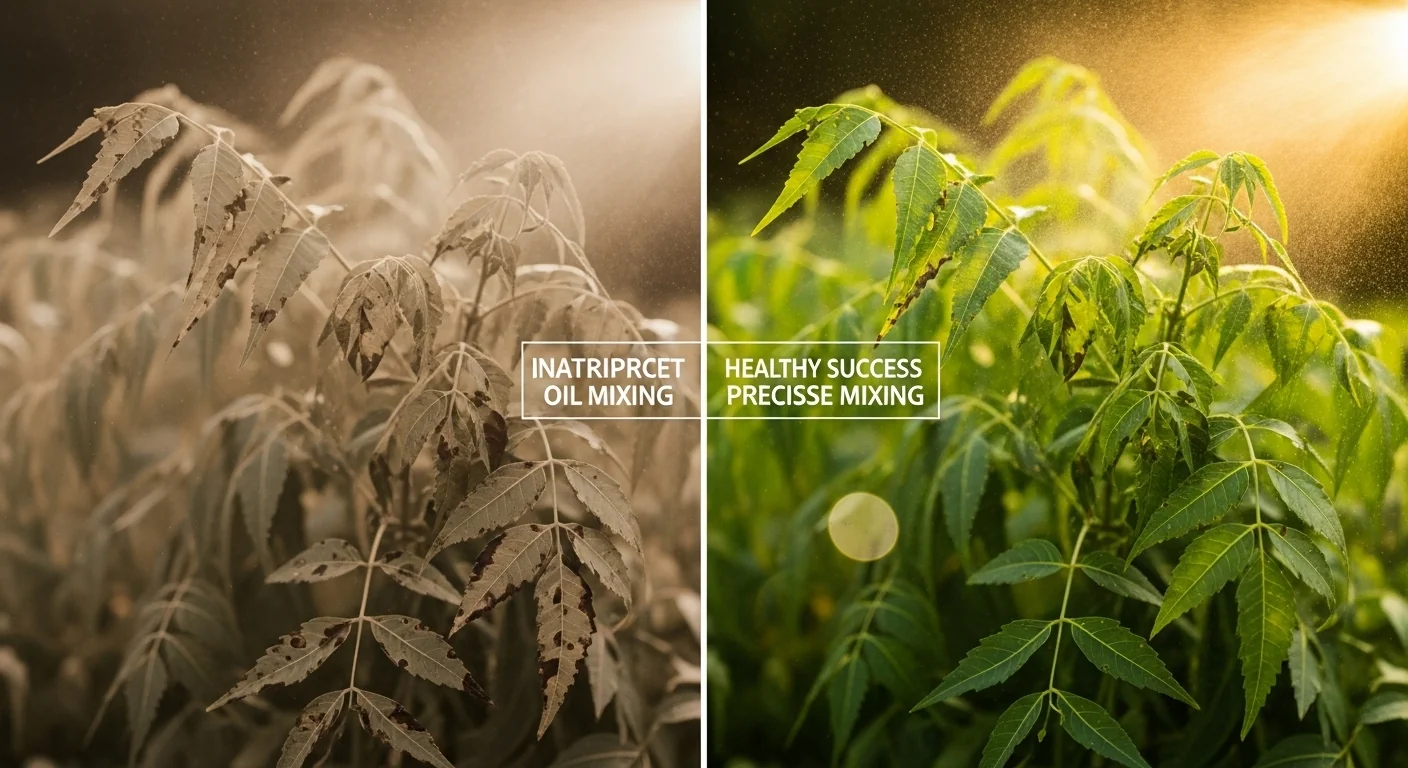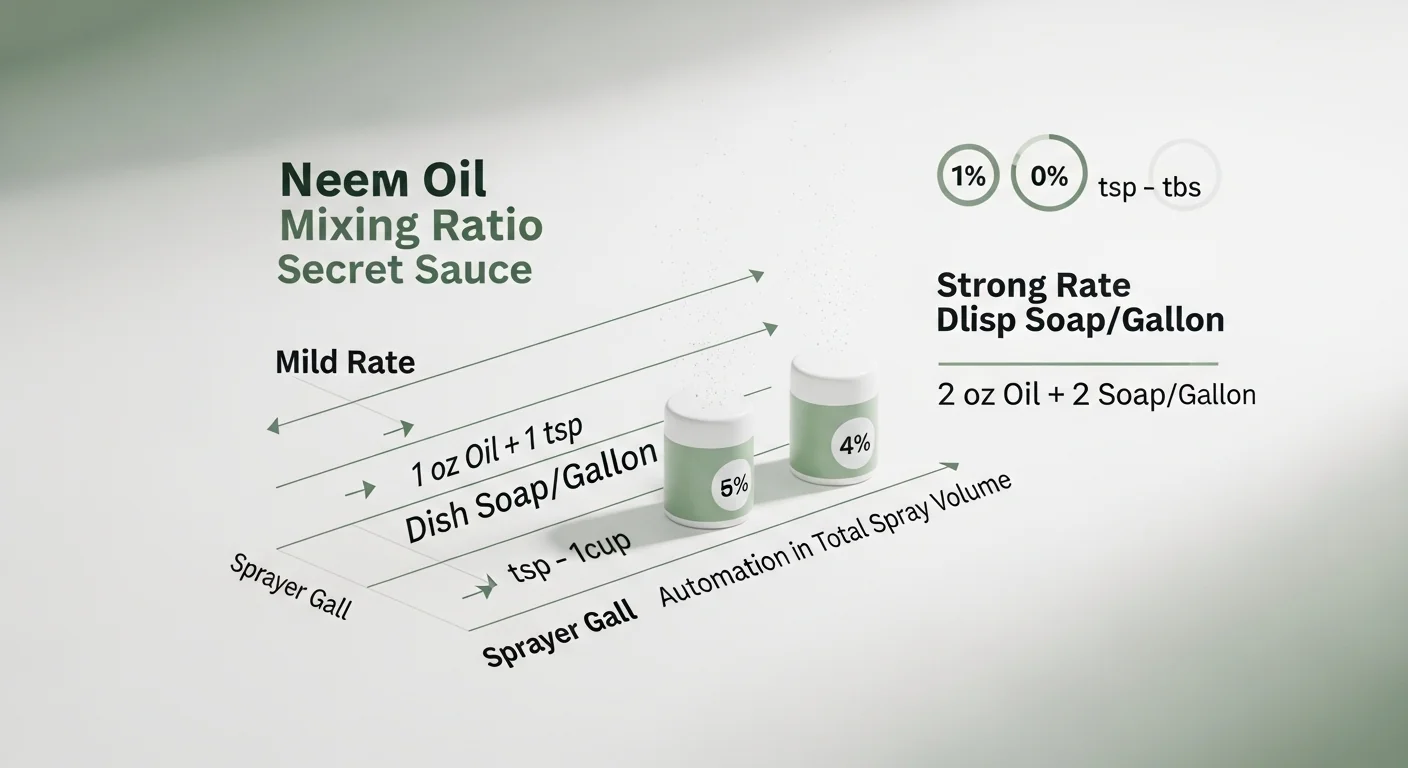
Neem Oil Mixing Tool
Calculate your neem oil spray ratio for any sprayer size
Getting the neem oil mixing ratio wrong rarely shows up as an immediate pest problem. It shows up weeks later as burned foliage, ineffective spray coverage, or a white residue that signals the emulsification failed. The failure point is almost always the same: gardeners either measure by feel instead of by volume, or they scale up for a larger tank without recalculating the soap proportion alongside the oil. Both produce a spray that either damages plants or does nothing useful.
This tool calculates two outputs from one formula: how much cold-pressed neem oil and how much liquid dish soap (the emulsifier) to add per total sprayer volume, in either a standard mild rate or a stronger rate for active pest pressure. It does not predict pest mortality, factor in azadirachtin degradation over time, or account for water hardness and pH. Those variables matter for long-term programs, but they do not change the fundamental mixing ratio this tool is designed to produce. If you are also tracking spray timing alongside a broader disease management plan, the fungicide resistance code tool pairs well for rotation planning.
After using this calculator, you will know the exact volume of oil and soap for your specific tank size, in units that match standard measuring spoons and fluid ounce measurements, so you can mix your spray without guessing.
Use the Tool
Before opening the calculator, have your sprayer's rated gallon capacity ready. This is not the amount of water you are putting in; it is the total tank volume printed on the sprayer label or handle. Enter that number in the sprayer size field, then select your intended strength. Mild is suitable for preventative spraying and routine applications. Strong is designed for active infestations and should not be the default starting point. The calculator will output neem oil in fluid ounces (or cups for large tanks) and soap in teaspoons or tablespoons depending on volume, giving you measurements you can take directly to your kitchen scale or measuring set.
Quick Start (60 Seconds)
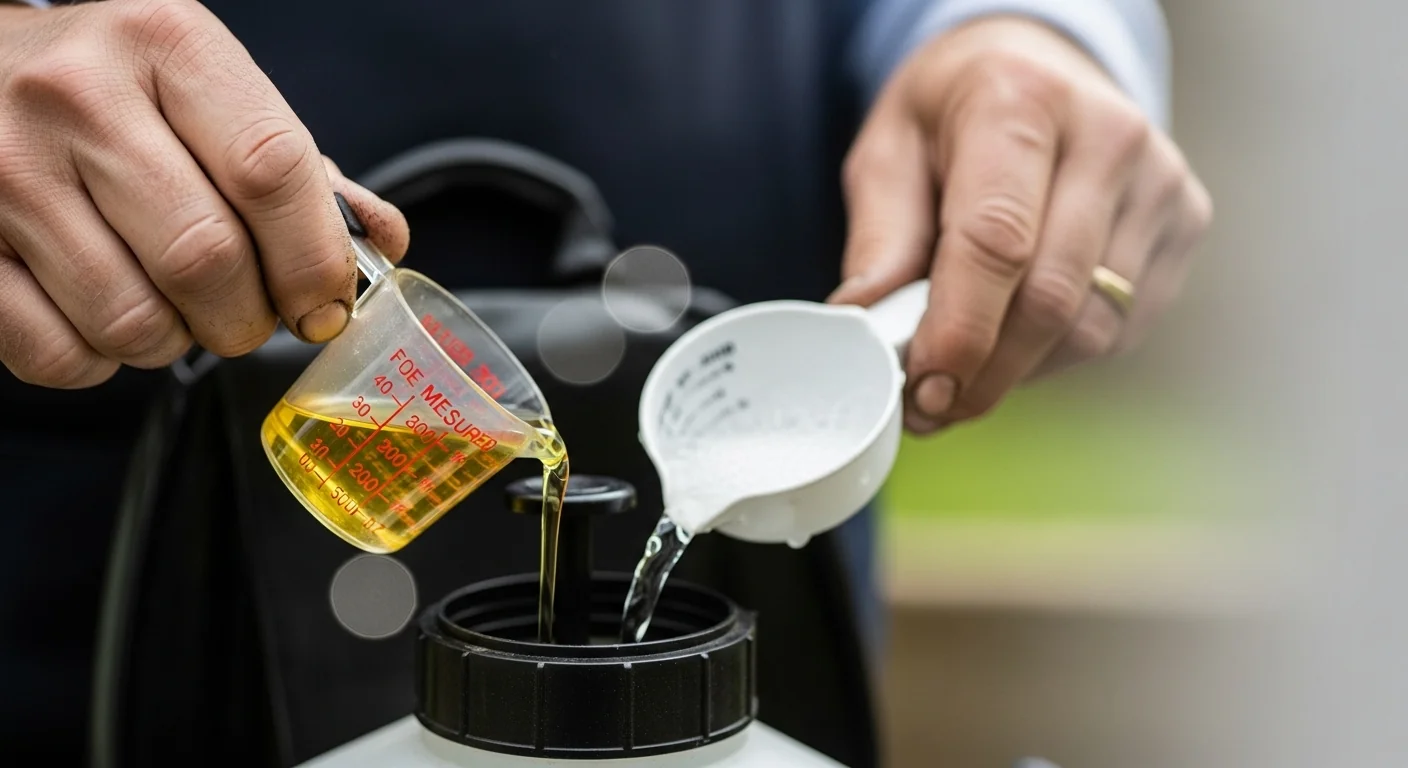
- Sprayer Size field: Enter the sprayer's rated total capacity in US gallons, not the amount of water you plan to fill. A 2-gallon backpack sprayer gets "2," not "1.8." Accepted range is 0.1 to 100 gallons.
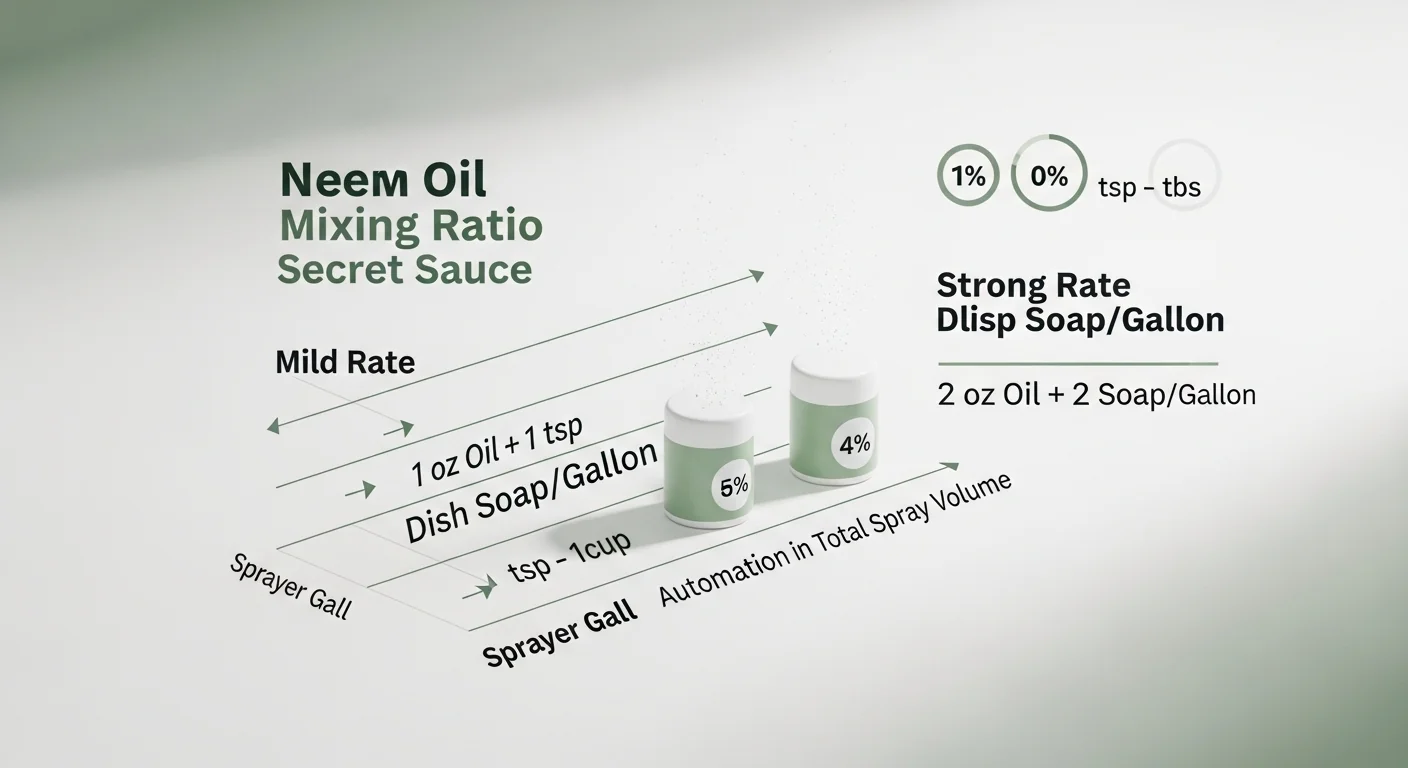
- Strength selector: Choose Mild (1 fl oz neem oil + 1 tsp soap per gallon) for preventative or routine use. Choose Strong (2 fl oz neem oil + 2 tsp soap per gallon) only under confirmed pest pressure.
- Oil unit output: For sprayers under 8 gallons, the result appears in fluid ounces. At 8 gallons and above, it converts to cups to match larger measuring vessels.
- Soap unit output: Under 3 gallons, you will see teaspoons. At 3 gallons and above, the result converts to tablespoons. Very large mixes display in cups.
- Water field: The water volume shown is your fill target, meaning fill the tank to the labeled capacity after adding oil and soap. Do not add water separately and then add oil and soap on top of a full tank.
- Reset button: Clears all fields and collapses the results panel. Use this when switching between different tank sizes in a single session.
- Enter key shortcut: Pressing Enter inside the sprayer size field triggers the calculation without clicking the button.
Inputs and Outputs (What Each Field Means)
| Field Name | Unit | What It Means | Common Mistake | Safe Entry Guidance |
|---|---|---|---|---|
| Sprayer Size | US gallons | The total rated capacity of the tank, not the current water volume | Entering the amount of water added rather than the tank's full rated size | Check the sprayer label or handle for the printed gallon rating; use decimals for sizes like 1.5 gal |
| Strength | Mild / Strong toggle | Determines the rate applied per gallon: 1 oz/gal (mild) or 2 oz/gal (strong) | Defaulting to Strong on every spray, including on seedlings and drought-stressed plants | Start with Mild for first applications; escalate to Strong only after confirming pest pressure |
| Neem Oil (output) | fl oz or cups | Volume of cold-pressed 100% neem oil to add to the tank before filling with water | Measuring by tablespoon instead of fluid ounce; 1 fl oz and 2 tablespoons are the same volume but easy to misread on different tools | Use a dedicated fluid ounce measuring cup; do not estimate with cooking spoons |
| Dish Soap (output) | tsp or tbsp | Volume of pure liquid dish soap required to emulsify the oil so it stays suspended in water | Using antibacterial soap or concentrated castile soap at the same teaspoon rate as standard dish soap | Use standard unscented dish soap or pure castile soap at half the stated dose if using concentrate |
| Water (output) | gallons | Target fill volume; equals the sprayer's rated capacity. Fill after adding oil and soap. | Adding oil and soap to a full tank, which prevents proper mixing and leaves clumps of oil at the surface | Add soap to a partially filled tank first, then add neem oil, then fill to capacity while agitating |
For timing spray applications around your crop's growth stage, cross-referencing with a succession planting schedule helps identify which crops are coming into harvest windows where spray residue timing matters most.
Worked Examples (Real Numbers)
1-Gallon Handheld Sprayer, Preventative Spray (Mild Rate)
- Sprayer size: 1 gallon
- Strength: Mild (1 fl oz neem oil per gallon, 1 tsp soap per gallon)
Result: 1 fl oz neem oil, 1 tsp dish soap, fill to 1 gallon.
This is the baseline recipe that most product labels reference as a standard preventative rate. It is the right starting point for new applications, soft-bodied pest prevention (aphids, spider mites), and routine foliar spray routines. Mix immediately before spraying and use the entire batch within 8 hours.
2-Gallon Backpack Sprayer, Active Aphid Infestation (Strong Rate)
- Sprayer size: 2 gallons
- Strength: Strong (2 fl oz neem oil per gallon, 2 tsp soap per gallon)
Result: 4 fl oz neem oil, 4 tsp dish soap (approximately 1 tbsp + 1 tsp), fill to 2 gallons.
The strong rate doubles both the oil and the emulsifier proportionally. At 4 fl oz total oil, this falls within the accepted upper limit for most ornamental and vegetable applications. Apply only in the early morning or evening to avoid phytotoxicity, and do not repeat at this rate more than once every 7 days without observing plant response.
5-Gallon Pump Sprayer, Mild Rate for Orchard Row Application
- Sprayer size: 5 gallons
- Strength: Mild (1 fl oz neem oil per gallon, 1 tsp soap per gallon)
Result: 5 fl oz neem oil, 5 tsp dish soap (1 tbsp + 2 tsp), fill to 5 gallons.
Scaling to a 5-gallon tank is where many applicators introduce error because they calculate the oil correctly but forget to scale the soap at the same ratio. This example confirms that the emulsifier must always track the oil proportionally. A 5-gallon mild mix uses 5 tsp soap, not the 1 tsp they remember from the 1-gallon recipe.
Reference Table (Fast Lookup)
| Sprayer (gal) | Rate | Neem Oil | Dish Soap | Soap (converted) | Oil per Tank (%vol approx.) |
|---|---|---|---|---|---|
| 0.5 gal | Mild | 0.5 fl oz | 0.5 tsp | 1/2 tsp | 0.78 fl oz per 64 fl oz total |
| 0.5 gal | Strong | 1 fl oz | 1 tsp | 1 tsp | 1.56 fl oz per 64 fl oz total |
| 1 gal | Mild | 1 fl oz | 1 tsp | 1 tsp | 0.78 fl oz per 128 fl oz total |
| 1 gal | Strong | 2 fl oz | 2 tsp | 2 tsp | 1.56 fl oz per 128 fl oz total |
| 2 gal | Mild | 2 fl oz | 2 tsp | 2 tsp | 2 fl oz per 256 fl oz total |
| 3 gal | Mild | 3 fl oz | 3 tsp | 1 tbsp | 3 fl oz per 384 fl oz total |
| 5 gal | Mild | 5 fl oz | 5 tsp | 1 tbsp + 2 tsp | 5 fl oz per 640 fl oz total |
| 5 gal | Strong | 10 fl oz | 10 tsp | 3 tbsp + 1 tsp | 10 fl oz per 640 fl oz total |
| 10 gal | Mild | 10 fl oz | 10 tsp | 3 tbsp + 1 tsp | 10 fl oz per 1280 fl oz total |
The final column (oil volume per total tank fluid ounces) is a derived check value, not an input. It exists so you can verify the concentration is consistent regardless of tank size.
How the Calculation Works (Formula + Assumptions)
Show the calculation steps
Step 1: Identify your sprayer capacity in US gallons.
This is the rated volume of the tank, not the water fill amount.
Step 2: Select your rate per gallon based on strength.
Mild rate = 1 fl oz neem oil and 1 tsp dish soap per gallon.
Strong rate = 2 fl oz neem oil and 2 tsp dish soap per gallon.
Step 3: Multiply both components by the total gallon count.
Neem Oil (fl oz)  = Sprayer Size (gal) x Rate (fl oz / gal)
Dish Soap (tsp)   = Sprayer Size (gal) x Rate (tsp / gal)
Water             = Fill tank to rated capacity (gal)
Step 4: Convert units for usability.
Oil output converts to cups when the raw fl oz result reaches or exceeds 8 fl oz (i.e., 8 gallons or more at mild rate).
Soap output converts to tablespoons when the raw tsp result reaches 3 tsp (3 tsp = 1 tbsp).
Rounding is applied to one decimal place for oil and one decimal place for soap in standard units.
Assumptions and Limits
- All calculations assume 100% cold-pressed neem oil. Clarified hydrophobic extract of neem oil (HPNE/neem extract) is a different product with a different concentration profile and should not be used at the same rate.
- Soap rates assume standard liquid dish soap, not concentrate. If using castile soap concentrate (such as Dr. Bronner's pure castile), halve the soap quantity to avoid excess surfactant buildup on leaf surfaces.
- The tool does not account for water hardness. Hard water (above 200 ppm calcium carbonate) can reduce emulsification quality; using filtered or rainwater improves mixing in those cases.
- Strong rate is not appropriate for seedlings (under 4 weeks from germination), plants showing drought stress, or fruiting trees within 1 week of harvest.
- Neem oil degrades rapidly after mixing. The calculated batch should be used within 8 hours of preparation. No storage math is included in this tool.
- The tool does not factor in application method (foliar spray vs. soil drench). Soil drench applications for fungus gnats typically use a different dilution strategy entirely and this calculator is not designed for that use case.
- Spray coverage and reapplication intervals are not modeled. The calculator outputs a single-batch composition only.
Standards, Safety Checks, and "Secret Sauce" Warnings
Critical Warnings
- Do not spray neem oil in direct sunlight. Applying any neem oil mix to foliage while the sun is at full intensity causes the oil to heat rapidly on leaf surfaces, producing phytotoxicity symptoms that appear as scorched, bleached, or papery patches within 12 to 24 hours. Apply exclusively in the early morning (before 9 a.m.) or in the evening after direct sun exposure has ended for the day.
- Strong rate can damage sensitive tissue. At 2 fl oz per gallon, the oil concentration is high enough to cause contact damage on soft new growth, flowers in bloom, and any plant already under water or heat stress. Reserve the strong rate for confirmed, visually verified infestations on established, well-watered plants only.
- Oil and water separate continuously. Even a properly emulsified neem oil spray begins separating within minutes of mixing. Agitate the sprayer tank constantly during application. A spray applied from a settled, un-agitated tank delivers inconsistent concentration across the same plant.
- Use within 8 hours of mixing. Azadirachtin, the active component in cold-pressed neem oil, degrades quickly after it is diluted into water. Preparing batches in advance and storing them for later use is not effective.
Minimum Standards
- The universally accepted baseline is 1 fl oz neem oil + 1 tsp dish soap per 1 gallon of water. This is the reference point used on most product labels and represents the lowest effective preventative rate.
- Soap is not optional. Neem oil is hydrophobic and will not suspend in water without a surfactant. A "soap-free" neem oil spray produces floating oil droplets that coat the nozzle, clog the filter, and deliver inconsistent coverage.
- Reapplication intervals should be 7 days at minimum under active pest conditions, extending to 14 days for purely preventative programs. More frequent applications at the strong rate can accumulate excess oil on leaf surfaces and create cosmetic or physiological damage.
Competitor Trap: Most online neem oil mixing guides give you the 1 oz per gallon rule and stop there. They do not distinguish between the mild and strong rate, they do not flag that the soap must scale proportionally with oil when you change tank size, and almost none include the direct-sun phytotoxicity warning that turns a protective spray into a plant-damaging event. The result is that gardeners who follow a basic recipe article and apply at midday in summer end up with burned leaves and conclude that neem oil does not work on their plants. The spray did not fail; the application timing did.
If your spray schedule overlaps with critical growth windows, the harvest date calculator helps you track how many days remain to harvest so you can decide whether a spray application is appropriate for residue management. For growers managing recurring fungal and pest pressure across a season, pairing neem oil rotations with a FRAC code rotation plan reduces the risk of developing resistance to any single active ingredient.
Common Mistakes and Fixes
Mistake: Scaling Oil Without Scaling Soap
The single most common error in multi-gallon mixing is correctly multiplying the neem oil volume but keeping the soap at the 1-teaspoon amount remembered from a 1-gallon recipe. When soap is underdosed relative to oil volume, emulsification is incomplete. The oil forms larger droplets that separate from the water solution within the first few minutes, leaving most of the surface area of each gallon under-dosed and the nozzle filter coated in raw oil.
Fix: Always calculate soap and oil simultaneously using the same multiplier. If you are mixing 4 gallons at the mild rate, the result is 4 fl oz oil and 4 tsp soap, not 4 fl oz oil and 1 tsp soap.
Mistake: Using Concentrated Castile Soap at the Standard Rate
Castile soap concentrates are significantly more concentrated than standard dish soap by volume. Using 1 teaspoon of concentrated castile soap per gallon when the recipe calls for standard dish soap delivers two to three times the actual surfactant load. At high surfactant concentrations, the soap itself becomes a mild phytotoxic agent, stripping the waxy cuticle from leaves and increasing moisture loss.
Fix: If using castile soap concentrate, reduce the soap quantity to roughly half the calculated dose. Standard diluted dish soap (the kind sold in squeeze bottles for handwashing) can be used at the full calculated rate.
Mistake: Applying to Plants Already Under Stress
Drought-stressed, heat-stressed, or recently transplanted plants have reduced cuticle integrity. Neem oil spray on stressed foliage creates faster oil uptake and reduced ability to metabolize the contact load, increasing the likelihood of tip burn, spot necrosis, or general wilting within 24 hours of application. This gets attributed to the neem oil product when the contributing factor is the plant's condition at time of application. If you are planning your garden's spacing and plant health to reduce stress-related vulnerability, a plant spacing calculator can help ensure adequate airflow and root room before pest pressure becomes an issue.
Fix: Water plants thoroughly 12 to 24 hours before any neem oil application. Do not spray plants that were transplanted within the last 7 days.
Mistake: Measuring Oil by Tablespoon When Fluid Ounce Is Required
Both tablespoons and fluid ounces are volume measurements, but the labeling on different measuring tools makes this a frequent source of confusion. Two tablespoons equal one fluid ounce. A gardener who measures "1 tablespoon" thinking they are measuring "1 fluid ounce" delivers half the required oil volume per gallon, effectively cutting the mix down to half-strength without knowing it. The spray still looks milky white and applies normally, masking the dosing error. Tracking your actual vegetable yields through the growing season helps reveal whether spray programs are having the expected effect on crop output; the vegetable yield calculator can provide a useful season-over-season baseline for that comparison.
Fix: Use a fluid ounce measuring cup with clear fl oz markings, not tablespoon spoons, for measuring neem oil. The calculator outputs in fl oz precisely to align with this format.
Mistake: Preparing Large Batches in Advance
Azadirachtin, the primary pest-active compound in cold-pressed neem oil, begins breaking down once it is diluted into water. A batch prepared the evening before and applied the following afternoon has degraded significantly in its azadirachtin content. It may still function as a contact irritant due to the oil itself, but the systemic and growth-regulating activity diminishes quickly after dilution. Many gardeners who report that "neem oil stopped working" have shifted to advance preparation without realizing it changed the product's efficacy profile.
Fix: Mix only the quantity you will use within the current session. Prepare batches immediately before application, not hours in advance.
Next Steps in Your Workflow
After calculating your neem oil mixing ratio and preparing the spray, the application itself is only one part of a repeating cycle. Most effective neem oil programs involve a first application to suppress existing pest populations, a follow-up application 7 days later to address eggs that hatched after the initial spray, and then a 14-day preventative interval going forward. Keeping a spray log with dates, tank sizes, and strength settings helps you avoid accidentally reapplying at the strong rate when a mild maintenance dose would have been sufficient. If you are managing container plantings specifically, the pot size calculator helps ensure your containers have the root volume to support plants through recurring spray cycles without added stress from root crowding.
For gardeners managing neem oil programs across multiple crop types or succession plantings, timing the spray schedule around planting rotations matters more than most guides acknowledge. Spraying a bed 3 days before a new transplant goes in leaves residue on the soil surface and nearby plants that can affect the transplant's establishment. The square foot garden planner is a useful reference for mapping which beds are receiving spray programs at any given time versus which are in a fresh-planting phase.
FAQ
What is the standard neem oil mixing ratio for garden use?
The accepted standard for most home garden applications is 1 fluid ounce of cold-pressed neem oil combined with 1 teaspoon of liquid dish soap per 1 gallon of water. This is referred to as the mild rate. The strong rate doubles both components to 2 fl oz oil and 2 tsp soap per gallon, reserved for confirmed and active pest infestations on established plants.
Can I mix neem oil without soap?
Neem oil will not mix into water without a surfactant. Without soap, the oil separates immediately, coating the nozzle and delivering raw oil droplets rather than a suspended spray. The soap acts as an emulsifier, breaking the oil into small particles that stay distributed throughout the water. Skipping the soap produces an inconsistent, potentially damaging mix that wastes the oil and delivers poor coverage.
How long does a mixed neem oil spray stay effective?
Once diluted into water, azadirachtin in neem oil begins degrading. Mixed spray should be used within 8 hours of preparation for full efficacy. After that window, the spray still contains oil and soap and may provide some contact irritant effect, but the systemic pest-growth-disrupting properties associated with azadirachtin are significantly reduced. Prepare only what you will apply in a single session.
Why does neem oil cause leaf burn on some plants?
Leaf burn from neem oil is almost always caused by application in direct sunlight or application to plants that were already drought or heat stressed at the time of spraying. The oil absorbs heat on the leaf surface and, in combination with reduced cuticle integrity on stressed plants, causes localized cell damage. Applying in the early morning or evening, and ensuring plants are well-watered before spraying, prevents most phytotoxicity incidents.
How often should I apply neem oil spray?
Under active pest pressure, apply every 7 days for 2 to 3 cycles, then reassess. For preventative programs with no visible infestation, a 14-day interval is generally sufficient. Applying more frequently than every 7 days at the strong rate risks soap and oil accumulation on leaf surfaces. Always observe the plant for 24 hours after the first application before committing to a full treatment program.
Does the type of dish soap matter for neem oil mixing?
Yes. Standard liquid dish soap designed for handwashing works well as an emulsifier. Antibacterial soaps contain additional active compounds that can interfere with plant surface biology. Concentrated castile soaps (liquid) work but should be used at roughly half the calculated teaspoon dose because of their higher surfactant concentration per volume. Avoid soaps with added degreasers or heavy fragrance oils, which can contribute to phytotoxic reactions at higher dilution rates.
Conclusion
If there is one mistake to avoid after leaving this page, it is applying a correctly calculated spray in full midday sun and then concluding that neem oil is ineffective on your pests. The spray composition was right; the timing window was wrong. For growers looking to extend an integrated pest management system beyond individual sprays into a planned cultivation layout, the aquaponics biofilter calculator is a related resource if you are managing closed-loop growing systems where chemical spray options are limited and biological control becomes the primary management strategy.