
Pump sizing mistakes rarely show up at the hardware store. They show up on the electric bill six months later, or in a failed mechanical seal you can’t explain. The core problem is that brake horsepower (BHP) and the motor’s rated nameplate horsepower are not the same number, and most irrigators size their pump using the wrong one. Water horsepower is the theoretical minimum energy to move a given volume of water against a given head. BHP is the real shaft power demand after accounting for the pump’s hydraulic losses. Electrical draw is higher still, after the motor’s own inefficiency is factored in. Each conversion step compounds the error if the wrong input is used.
This irrigation pump sizing calculator computes Water Horsepower (WHP), Brake Horsepower (BHP), Electrical HP, kilowatt draw, annual energy consumption, and annual operating cost from four measured inputs: system flow rate, Total Dynamic Head, pump efficiency from a manufacturer curve, and motor electrical efficiency. It also applies the Pump Affinity Laws to estimate VFD savings and checks your operating point against established efficiency benchmarks. What it does not do: it does not replace a certified pump curve, does not account for variable-speed system curves, and does not calculate Net Positive Suction Head (NPSH) margins.
After running the calculator, you will know whether your pump is appropriately sized, whether a Variable Frequency Drive retrofit pencils out financially, and what motor horsepower class your system actually requires.
Use the Tool

Irrigation Pump Sizing Calculator The Yield Grid
Calculate Brake Horsepower (BHP), Water HP, Electrical Draw & Real Operating Costs
Warnings & Standards Check
| Pump Eff. (%) | WHP | BHP | Elec. kW | Annual Cost |
|---|
Recommended Equipment for Irrigation Pump Optimization
Drive (VFD)
Starter
Multimeter
Pump
How This Calculator Works
Irrigation Pump Sizing Calculator uses industry-standard hydraulic engineering formulas to determine the actual mechanical and electrical power required to move water through your irrigation system.
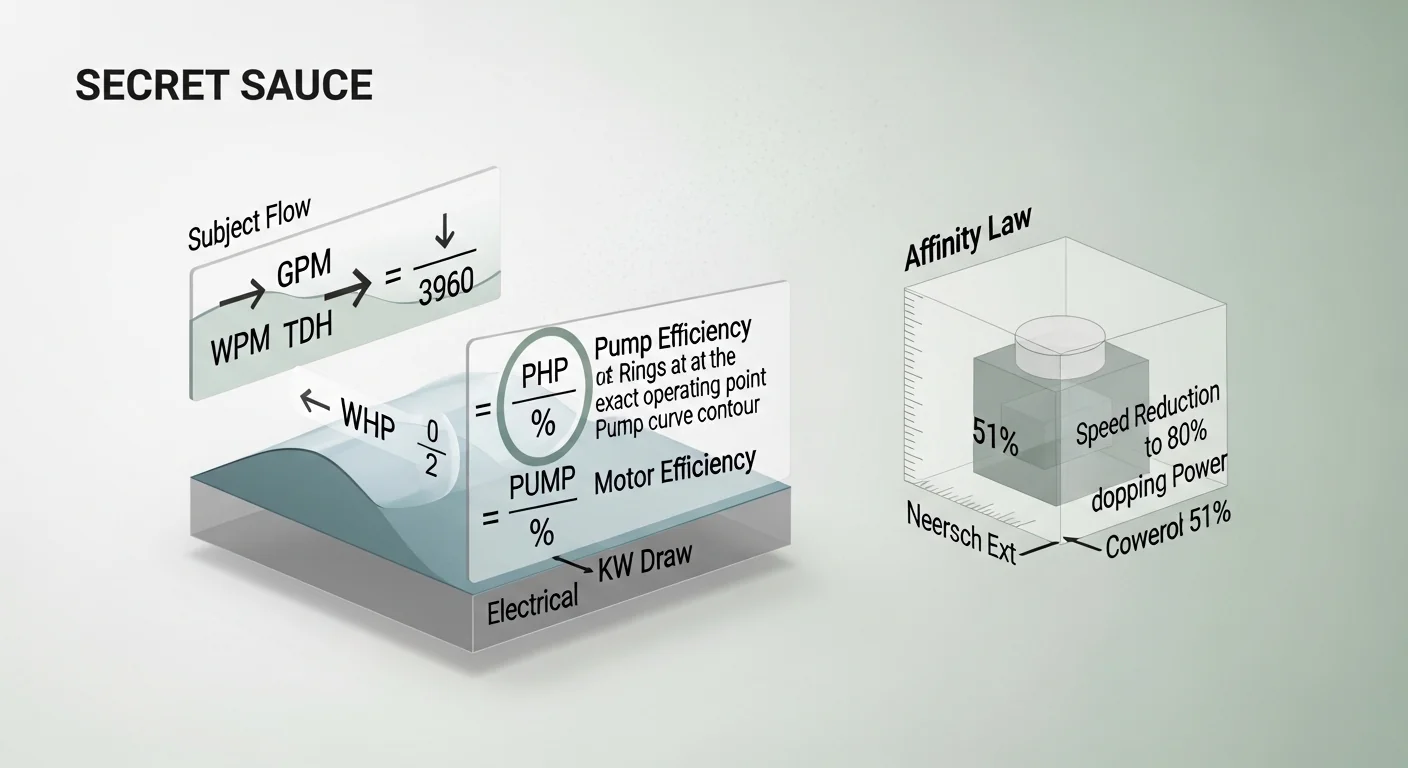
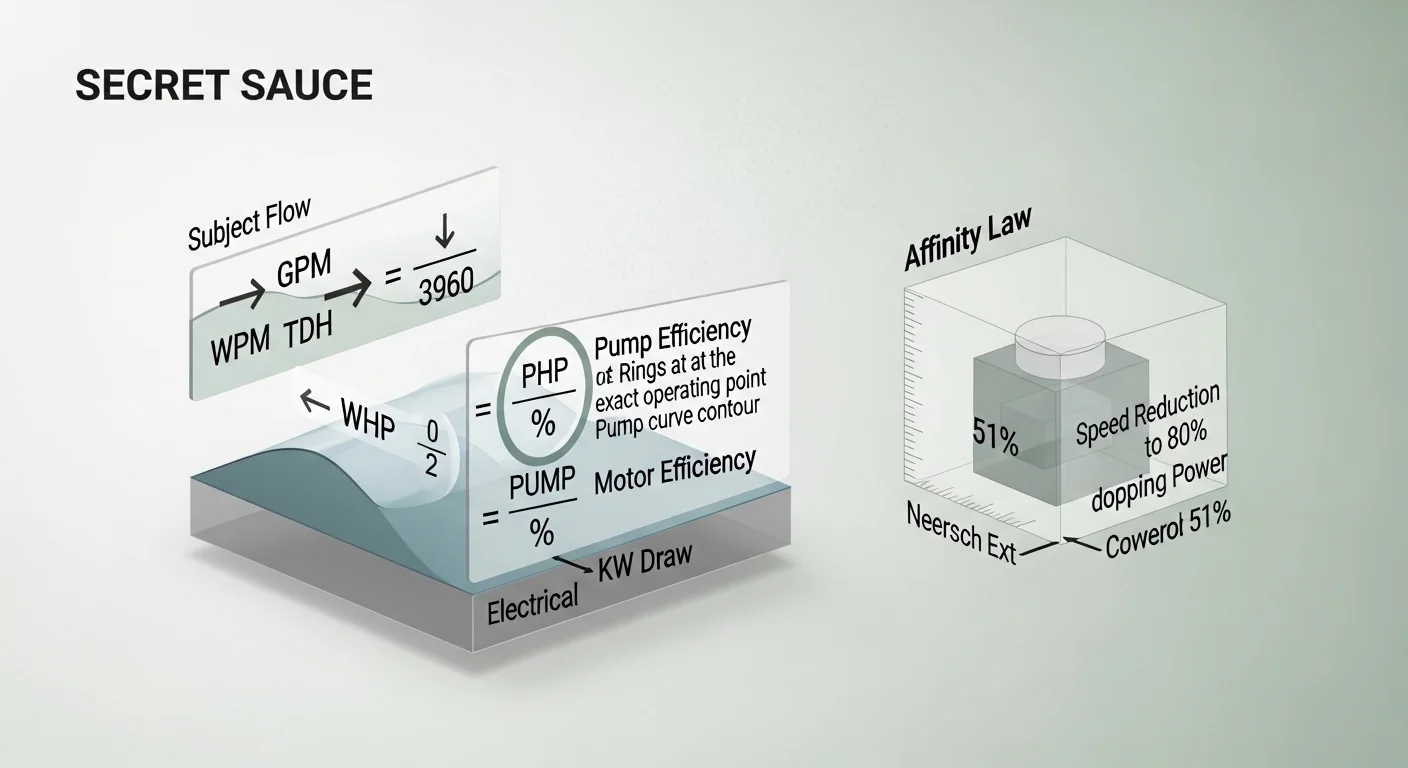
Step 1 — Water Horsepower (WHP): The theoretical power needed to move water at a given flow rate and pressure, with no losses.
Where 3960 is the constant derived from water density (8.33 lb/gal) × 33,000 ft·lb/min per HP. TDH is in feet.
Step 2 — Brake Horsepower (BHP): The actual shaft power needed from the motor, accounting for pump mechanical and hydraulic losses.
Step 3 — Electrical HP: The electrical power the motor must draw from the grid, accounting for motor winding and iron losses.
Step 4 — Kilowatts & Cost:
Wire-to-Water Efficiency = WHP ÷ Electrical HP × 100. This is the true system efficiency combining pump and motor losses. Values above 50% are good for agricultural irrigation.
VFD Affinity Law: Reducing pump speed to 80% of full speed reduces flow to 80% but reduces power consumption to only 51% (speed ratio cubed). A VFD on an oversized pump can reduce energy costs by 30–50%.
Assumptions & Limits: Assumes clear, cold water at standard conditions (60°F, SG=1.0). Does not account for altitude derating, slurry/viscous fluids, variable TDH with flow, or motor power factor. Pump efficiency must come from the manufacturer’s certified pump curve at the actual operating point (GPM, TDH). Motor efficiency should be nameplate or NEMA Premium table data. Results are for sizing and budgeting; always have a licensed irrigation engineer verify final designs for systems above 50 HP.
Before entering values, have your pump manufacturer’s performance curve in hand, open to the page showing efficiency contours. Locate your operating point at the intersection of your design GPM and TDH, then read the pump efficiency from the nearest efficiency island. Motor efficiency should come from the motor nameplate or from a NEMA Premium motor efficiency table for your motor’s horsepower class and speed. If you are unsure how to calculate TDH for your system, the PVC friction loss calculator can help you quantify the friction component before you add static lift and discharge pressure.
Quick Start (60 Seconds)
- System Flow Rate (GPM): Enter your design flow, not the pump’s maximum rated flow. If your system has multiple zones running simultaneously, add those zone flows together. Measurement tools like a hose flow rate calculator can help confirm field-measured delivery before using a design figure.
- Total Dynamic Head (TDH, feet): Sum of static head (vertical lift), friction losses through all pipe and fittings, and any required discharge pressure. Do not confuse static head with TDH; friction losses can easily add 20 to 40 feet on a long mainline run.
- Pump Efficiency (%): Must come from the pump curve at your specific GPM and TDH operating point. Do not use the pump’s peak efficiency rating; it applies only at the Best Efficiency Point (BEP) flow, not your actual flow.
- Motor Electrical Efficiency (%): For older standard-efficiency motors, use 85 to 88 as a conservative default. NEMA Premium motors rated at 30 HP typically run 92 to 93. Verify against the motor nameplate or NEMA MG-1 tables.
- Annual Operating Hours: Estimate honestly. An irrigation well that runs 12 hours per day for 100 days equals 1,200 hours. Overestimating inflates cost projections; underestimating understates payback periods.
- Electricity Rate ($/kWh): Use your agricultural tariff rate, not the residential rate. Many utilities offer off-peak agricultural rates that are 15 to 30 percent lower than standard residential pricing.
Inputs and Outputs (What Each Field Means)
| Field | Unit | What It Represents | Common Mistake | Safe Entry Guidance |
|---|---|---|---|---|
| System Flow Rate | GPM | Volume of water the system must deliver per minute at the pump discharge | Using pump catalog max flow instead of actual system design flow | Use demand-side design flow; measure or calculate from zone emitter requirements |
| Total Dynamic Head | feet | Total resistance the pump must overcome: static lift + friction + required pressure | Omitting friction losses, especially in long mainlines or undersized pipe | Calculate friction losses at design flow using pipe sizing software or a friction loss table before entering |
| Pump Efficiency | % | Ratio of hydraulic output power to shaft input power at the operating point | Using the peak BEP efficiency from a catalog instead of the efficiency at the actual GPM/TDH operating point | Read from the pump curve efficiency contour at your specific GPM and TDH intersection |
| Motor Electrical Efficiency | % | Ratio of shaft output power to electrical input power, accounting for winding and iron losses | Assuming 100% or leaving at default when motor data is available on the nameplate | Use nameplate data; for unknown motors, 88% is a reasonable conservative standard-efficiency assumption |
| Annual Operating Hours | hours/yr | Total runtime used to compute annual energy consumption and cost | Using calendar days without accounting for off-season shutdown or zone rotation timing | Multiply daily runtime by the number of operating days in your irrigation season |
| Electricity Rate | $/kWh | Blended or time-of-use electricity cost used to convert energy consumption to dollars | Using the residential rate instead of the agricultural rate, which overstates cost | Use the line item rate from your utility bill under the agricultural tariff schedule |
| Water Horsepower (WHP) | HP | Theoretical minimum power to move water at the given GPM and TDH, with no losses | Treating WHP as the motor size needed; WHP is always less than BHP | Output only; use as a benchmark to compare against BHP and assess efficiency loss |
| Brake Horsepower (BHP) | HP | Actual shaft power required from the motor after accounting for pump efficiency losses | Selecting a motor at exactly BHP with no service factor allowance | Select a motor at the next standard HP above BHP multiplied by the motor’s service factor (typically 1.15) |
| Electrical HP | HP | Electrical power the motor draws from the grid, accounting for motor efficiency losses | None (output only); note that kW is the more useful grid-side unit | Output only; kW = Electrical HP x 0.746 |
| Power Draw | kW | Continuous electrical demand at the meter when the pump is running at the entered conditions | Confusing kW (demand) with kWh (consumption over time) | Output only; multiply by hours to get energy consumption |
| Wire-to-Water Efficiency | % | Combined system efficiency: ratio of WHP to Electrical HP, measuring total conversion from grid power to hydraulic work | Ignoring this metric; it exposes combined losses that BHP alone hides | Output only; below 45% signals a poorly matched pump-motor combination worth investigating |
Pump cavitation risk is not calculated here, but if your system has a long suction lift or operates near the vapor pressure of water, cross-reference your suction conditions with the NPSH calculator before finalizing pump selection.
Worked Examples (Real Numbers)
Scenario 1: Small Residential Irrigation Well
- System Flow Rate: 150 GPM
- Total Dynamic Head: 80 ft
- Pump Efficiency: 72%
- Motor Efficiency: 90%
- Annual Operating Hours: 800
- Electricity Rate: $0.12/kWh
WHP = (150 x 80) / 3960 = 3.03 HP. BHP = 3.03 / 0.72 = 4.21 HP. Electrical HP = 4.21 / 0.90 = 4.68 HP. kW = 4.68 x 0.746 = 3.49 kW. Annual kWh = 3.49 x 800 = 2,792. Annual Cost = 2,792 x $0.12 = $335.
Result: 4.21 BHP, $335 annual operating cost, wire-to-water efficiency 64.7%.
A 5 HP motor (next standard frame above 4.21 BHP with 1.15 service factor clearance) is appropriate. The pump is operating within the 70% efficiency zone; a modest improvement in pump selection could reduce costs without major equipment changes.
Scenario 2: Mid-Size Agricultural Center Pivot System
- System Flow Rate: 600 GPM
- Total Dynamic Head: 150 ft
- Pump Efficiency: 76%
- Motor Efficiency: 93%
- Annual Operating Hours: 1,500
- Electricity Rate: $0.095/kWh
WHP = (600 x 150) / 3960 = 22.73 HP. BHP = 22.73 / 0.76 = 29.91 HP. Electrical HP = 29.91 / 0.93 = 32.16 HP. kW = 32.16 x 0.746 = 23.99 kW. Annual kWh = 23.99 x 1,500 = 35,985. Annual Cost = 35,985 x $0.095 = $3,419.
Result: 29.91 BHP, $3,419 annual operating cost, wire-to-water efficiency 70.7%.
A 30 HP NEMA Premium motor matches well with a 1.15 service factor. The wire-to-water efficiency of 70.7% is solid for agricultural service, and the motor efficiency of 93% is consistent with NEMA Premium standards at this horsepower class.
Scenario 3: Large Farm Pump Running Off Best Efficiency Point
- System Flow Rate: 1,000 GPM
- Total Dynamic Head: 120 ft
- Pump Efficiency: 58% (off-curve, oversized pump)
- Motor Efficiency: 89%
- Annual Operating Hours: 2,000
- Electricity Rate: $0.11/kWh
WHP = (1,000 x 120) / 3960 = 30.30 HP. BHP = 30.30 / 0.58 = 52.24 HP. Electrical HP = 52.24 / 0.89 = 58.70 HP. kW = 58.70 x 0.746 = 43.79 kW. Annual kWh = 43.79 x 2,000 = 87,576. Annual Cost = 87,576 x $0.11 = $9,633.
Result: 52.24 BHP, $9,633 annual operating cost, wire-to-water efficiency 51.6%.
The same system with a correctly sized pump operating at 76% efficiency would require 39.87 BHP, draw 33.41 kW, and cost $7,351 annually, saving $2,282 per year. At that savings rate, impeller trimming or pump replacement pays back within two to three seasons in most agricultural markets.
Reference Table (Fast Lookup)
The table below shows WHP, BHP at three efficiency levels, kilowatt draw at 75% pump and 92% motor efficiency, and estimated annual cost at 1,200 operating hours and $0.11/kWh. Use it to quickly bracket your system before entering specific numbers in the calculator above.
| Flow (GPM) | TDH (ft) | WHP | BHP at 65% Eff. | BHP at 75% Eff. | BHP at 85% Eff. | kW (75% pump / 92% motor) | Est. Annual Cost |
|---|---|---|---|---|---|---|---|
| 100 | 80 | 2.02 | 3.11 | 2.69 | 2.38 | 2.18 | $287 |
| 200 | 80 | 4.04 | 6.22 | 5.39 | 4.75 | 4.37 | $578 |
| 300 | 100 | 7.58 | 11.66 | 10.10 | 8.92 | 8.19 | $1,081 |
| 500 | 120 | 15.15 | 23.31 | 20.20 | 17.82 | 16.38 | $2,162 |
| 700 | 140 | 24.75 | 38.07 | 33.00 | 29.12 | 26.76 | $3,531 |
| 1,000 | 150 | 37.88 | 58.27 | 50.50 | 44.56 | 40.95 | $5,405 |
| 1,500 | 160 | 60.61 | 93.24 | 80.81 | 71.31 | 65.52 | $8,648 |
| 2,000 | 180 | 90.91 | 139.86 | 121.21 | 107.00 | 98.28 | $12,972 |
How the Calculation Works (Formula + Assumptions)
Show the calculation steps
Step 1: Water Horsepower (WHP)
WHP = (GPM x TDH) / 3960
The constant 3960 comes from the weight of water (8.33 pounds per gallon) multiplied by the mechanical equivalent of one horsepower (33,000 foot-pounds per minute), then simplified. TDH must be in feet. GPM must be US gallons per minute. WHP represents the theoretical minimum energy with zero losses in the pump or motor.
Step 2: Brake Horsepower (BHP)
BHP = WHP / (Pump Efficiency / 100)
Pump efficiency is entered as a percentage (e.g., 72), divided by 100 to convert to decimal before use. BHP is always larger than WHP unless pump efficiency equals 100%, which is physically impossible in a real centrifugal pump.
Step 3: Electrical Horsepower
Electrical HP = BHP / (Motor Efficiency / 100)
Motor efficiency is similarly entered as a percentage. Electrical HP accounts for resistive heat losses in motor windings and core iron losses. A 92% efficient motor returns 92 HP of shaft power for every 100 HP of electrical input.
Step 4: Kilowatts and Annual Cost
kW = Electrical HP x 0.746
0.746 is the exact conversion factor from horsepower to kilowatts (1 HP = 745.7 W, rounded to 0.746). Annual kWh = kW x Annual Hours. Annual Cost = Annual kWh x $/kWh.
Step 5: Wire-to-Water Efficiency
Wire-to-Water Efficiency = (WHP / Electrical HP) x 100
This metric combines pump and motor losses into one number and is the most useful metric for benchmarking a pumping system against alternatives.
Rounding: WHP, BHP, and Electrical HP are rounded to two decimal places. kW is rounded to two decimal places. Annual kWh is rounded to the nearest whole number. Annual cost is rounded to the nearest dollar.
Assumptions and Limits
- The formula assumes clear, cold water at standard conditions (60 degrees F, specific gravity = 1.0). Pumping warmer water, or water with dissolved solids or suspended sediment, requires density corrections not included here.
- Pump efficiency is assumed to be constant at the entered value. Real pump curves show efficiency varying with flow, so if your operating point shifts seasonally, recalculate at each operating condition.
- Motor efficiency is assumed to be the full-load nameplate value. Motors running at partial load (below 50% of rated HP) often operate at lower efficiency; this tool does not apply part-load derating.
- TDH is assumed to be a single static value. Variable systems with pressure-regulating valves, zone changes, or seasonal drawdown will have different TDH at different times of day or season.
- The VFD Affinity Law savings estimate assumes ideal speed-to-power cubing behavior. Real VFD systems have drive losses (typically 2 to 5%) and the system curve may not follow the ideal affinity parabola if static head dominates TDH.
- The calculator is appropriate for preliminary sizing and budgeting on systems up to approximately 200 HP. Systems larger than 50 BHP should have designs signed off by a licensed engineer in most jurisdictions.
- Power factor is not calculated. Three-phase motor installations may face demand charges based on apparent power (kVA), which is higher than real power (kW) if power factor is low.
Standards, Safety Checks, and “Secret Sauce” Warnings
Critical Warnings
- Off-curve operation causes mechanical failure, not just wasted energy. When a centrifugal pump operates far below its BEP flow (a common result of buying a used oversized pump), radial thrust loads on the impeller shaft increase sharply. The result is accelerated bearing wear, mechanical seal leakage, and shaft fatigue, often within one to two irrigation seasons. The electrical cost overrun is visible on the bill; the mechanical damage is silent until it fails mid-season.
- Wire-to-water efficiency below 45% is a system failure condition. At that level, more than half of every electricity dollar is being converted to heat and vibration rather than hydraulic work. This is not a “run it until it breaks” situation for any system that operates more than 500 hours per year; the financial bleed is substantial.
- Selecting the motor at exactly BHP with no service factor leaves no headroom. NEMA service factor ratings (commonly 1.15) exist specifically for transient demand spikes during startup, priming cycles, and pump runout conditions. A motor operated above its service factor rating trips thermal protection and, over time, degrades winding insulation.
- System pressure surges after pump shutdown can exceed static TDH by a large margin. This is not captured in BHP calculations, but it is a real sizing concern for long mainlines. The water hammer calculator should be used to check transient pressure in systems with fast-closing valves or high-velocity mainlines.
Minimum Standards
- Pump efficiency at the design operating point should be 70% or above for agricultural centrifugal pumps. The Best Efficiency Point (BEP) for well-selected agricultural pumps typically falls between 70% and 85%.
- Motor electrical efficiency should meet NEMA Premium standards for the motor’s horsepower and speed class. For motors in the 15 to 200 HP range at 1,800 RPM, NEMA Premium efficiency ranges from 91% to 95.4%.
- For center pivot and large drip systems, the center pivot irrigation calculator can help verify that your pump’s design flow matches actual field application demand before committing to final pump selection.
Competitor Trap: Most irrigation pump sizing guides stop at BHP and recommend a motor. The number they give is technically correct but financially incomplete. Without wire-to-water efficiency and the Affinity Law VFD analysis, the user has no basis to evaluate whether impeller trimming, a VFD retrofit, or a pump replacement is the better capital decision. The BHP calculation tells you what motor you need today. The wire-to-water number tells you whether the system you have is worth keeping.
Common Mistakes and Fixes
Mistake: Using the Catalog Peak Efficiency Instead of the Curve Efficiency at Your Operating Point
Pump catalogs advertise the peak efficiency at BEP, which is the best-case number and only applies at one specific GPM and TDH combination. If your system operates at a flow 20% above or below BEP, the actual efficiency can be 8 to 15 percentage points lower, substantially understating your true BHP and cost. Fix: always locate your specific GPM and TDH on the manufacturer’s published pump curve and read the efficiency island that contains your operating point.
Mistake: Forgetting to Include Friction Loss in TDH
Static head (vertical lift from water surface to discharge) is the most obvious TDH component, but friction losses through pipe, fittings, valves, and filters often add 20 to 60 feet or more in large agricultural systems. Undershooting TDH means undershooting BHP, which means the motor you select will run at or above its service factor rating under real conditions. Fix: calculate friction losses at your design flow rate for every segment of mainline and lateral before summing TDH; for systems with significant pipe runs, the PVC friction loss calculator linked above is a useful starting point.
Mistake: Selecting a Motor at Exactly BHP Without Service Factor Margin
A pump requiring 14.3 BHP selected with a 15 HP motor sounds correct, but if the motor’s service factor is 1.0 (common in inverter-duty designs), any demand spike will trigger thermal protection. Fix: multiply BHP by the motor’s service factor before selecting the motor frame, and verify the service factor on the motor nameplate, not the catalog description.
Mistake: Assuming a Pressure Tank Adds Significant Head Capacity
For well systems with a pressure tank, there is a tendency to credit the tank pressure as available head and understate TDH. The pressure tank maintains pressure between pump cycles; it does not reduce the pump’s TDH requirement while running. Systems with a well pressure tank must still size the pump for the full TDH including the tank’s working pressure range as a discharge pressure component.
Mistake: Ignoring Power Factor When Sizing Electrical Infrastructure
The kW output from this calculator is real power. Three-phase induction motors draw apparent power (kVA) that is higher by a factor equal to 1 divided by the power factor (typically 0.80 to 0.90 for agricultural motors at full load). Electrical panels, breakers, wire, and utility demand charges are often sized to apparent power. Undersizing the service entrance based on kW alone can cause nuisance tripping or excess demand charges. Fix: after confirming kW draw from this tool, verify that the electrical supply infrastructure is sized for apparent power at the expected power factor.
Next Steps in Your Workflow
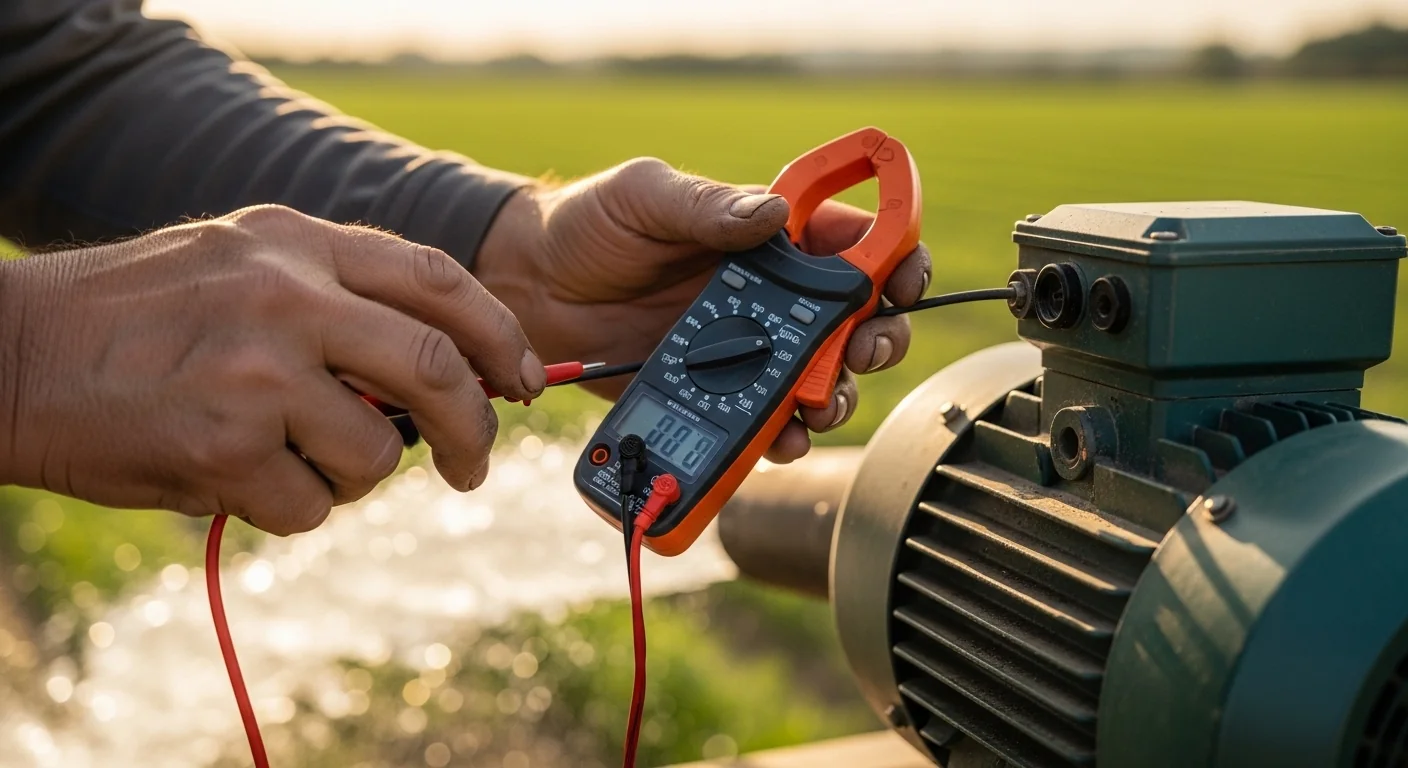
Once you have BHP confirmed, the next design decision is whether your electrical service can support the load. A 50 HP pump drawing 43 kW at 480V three-phase requires a properly sized feeder, disconnect, and motor starter or soft-start. The irrigation wire size calculator can help confirm that your feeder conductor is adequate for the full-load amperage and that voltage drop over a long run does not degrade motor performance. Undersized wire on a large irrigation pump is a fire risk and a frequent cause of unexplained motor failures.
On the field application side, the BHP calculation tells you what the pump delivers at the meter, but it does not tell you whether that water is being applied efficiently at the field. If your system includes sprinklers or drip emitters, running the sprinkler run time calculator with the same design GPM ensures that pump capacity is matched to the agronomic demand of your crops, not just to the mechanical capability of the hardware. A pump that is correctly sized hydraulically but mismatched to field demand will run more hours than necessary, pushing operating costs back up even if BHP efficiency is good.
FAQ
What is the difference between Water Horsepower and Brake Horsepower?
Water Horsepower (WHP) is the theoretical power required to move water at a given flow rate and pressure, assuming a perfect pump with no losses. Brake Horsepower (BHP) is the actual shaft power the motor must deliver to the pump, accounting for the pump’s real hydraulic and mechanical efficiency. BHP is always higher than WHP. The difference represents the heat and friction losses inside the pump itself.
What is a good pump efficiency for an agricultural irrigation system?
For centrifugal pumps used in agricultural irrigation, the Best Efficiency Point (BEP) typically falls between 70% and 85% depending on pump design and size. Operation at 70% or above at the actual system GPM and TDH is considered acceptable. Below 65%, energy waste is significant enough to warrant pump evaluation. Below 55%, the pump is operating far enough off its curve that mechanical damage is also likely.
How do I find my pump’s efficiency if I don’t have the curve?
Contact the pump manufacturer with the pump model number and impeller size. Most manufacturers provide performance curves as downloadable PDFs on their websites or through a technical support request. If the pump is old or unbranded, a pump testing service can measure actual efficiency on-site using a flow meter, pressure gauges, and a power meter. Do not use estimated efficiency values from generic tables when sizing motors for systems above 10 HP.
When does a Variable Frequency Drive (VFD) make financial sense for an irrigation pump?
A VFD makes the strongest financial case when the pump is oversized for the system’s actual demand, when flow requirements vary seasonally or by zone, or when the current pump efficiency is significantly below BEP. The Affinity Laws predict that reducing speed to 80% of full speed reduces power consumption to approximately 51% of full-speed draw. The calculator’s VFD analysis section shows the annual savings and estimated payback period based on your specific inputs.
Does this calculator work for submersible well pumps?
Yes, with one important adjustment: for a submersible well pump, Total Dynamic Head must include the full vertical lift from the pumping water level to the discharge point, plus friction in the drop pipe and surface piping, plus any required discharge pressure. The pumping water level is the depth to the water surface while the pump is running, not the static water level, and it must account for drawdown at your design flow rate. Motor efficiency for submersible motors is typically 85% to 92% depending on horsepower and age.
What does wire-to-water efficiency mean and why does it matter?
Wire-to-water efficiency measures how much of the electrical energy drawn from the grid is converted into useful hydraulic work delivered to the water. It combines pump efficiency and motor efficiency into one number. A system with 75% pump efficiency and 92% motor efficiency has a wire-to-water efficiency of approximately 69%. Systems below 50% are wasting more energy in losses than they are delivering as useful output, and corrective action typically has a short payback period at agricultural operating hours.
Conclusion
The irrigation pump sizing calculator gives you the numbers that matter for both equipment selection and operating cost decisions: BHP for motor sizing, wire-to-water efficiency for system performance benchmarking, and VFD payback for capital planning. The calculation itself is straightforward; the harder discipline is sourcing accurate inputs, particularly pump curve efficiency at the actual operating point rather than the catalog peak value. That single input, more than any other, determines whether the result is useful or misleading.
The most consequential mistake in pump sizing is not undersizing or oversizing the motor by one frame. It is selecting a pump based on availability or price without checking whether it can operate near BEP at your system’s specific flow and head. A pump running at 55% efficiency instead of 75% costs the same at the hardware store but burns thousands of dollars more per season, accelerates mechanical wear, and sets up a failure that appears unrelated to the original sizing decision. Run the numbers before the purchase, not after the first electric bill. If your system includes multiple pump stations or a well serving a pressure tank, the sump pump calculator can help cross-check sizing for secondary lift stations that are often sized by rule of thumb rather than by the hydraulic formula.