
Solar heat gain is not a summer inconvenience inside a greenhouse. It is a thermodynamic event. On a clear June afternoon, an unshaded 240 sq ft polycarbonate greenhouse can receive more than 70,000 BTU per hour of solar radiation through its glazing. Without effective shading, interior air temperature climbs well above ambient, accelerating respiration, suppressing fruit set, wilting transplants, and in the worst cases, killing crops within hours. The math is not complicated, but the variables interact in ways most growers never account for.
This shade cloth percentage calculator computes gross solar heat gain based on your greenhouse footprint and peak summer irradiance, then shows exactly how much of that load a given shade cloth density and placement will block. It does not model convective losses, nighttime radiation, or humidity, and it makes no claims about final interior air temperature. What it does do is expose the critical placement and material variables that determine whether your shade cloth actually cools the space or silently makes it worse. Ventilation is equally important once you have sized your shade correctly; the greenhouse fan calculator covers that side of the thermal equation.
After running this tool, you will know whether your current or planned shade cloth density and placement will meaningfully reduce solar load, and you will receive a clear warning if your setup has the potential to function as a heat trap rather than a heat shield.
Use the Tool
Greenhouse Shade Cloth Cooling & Solar Gain Calculator
Optimize your shade cloth percentage — stop heat buildup before it damages your plants.
| Shade % | Solar Blocked (BTU/hr) | Remaining Load (BTU/hr) | Best For | Rating |
|---|
Aluminet 50–70% Reflective Shade Panels
Solar-Powered Exhaust Fans
Wax Cylinder Auto Vent Openers
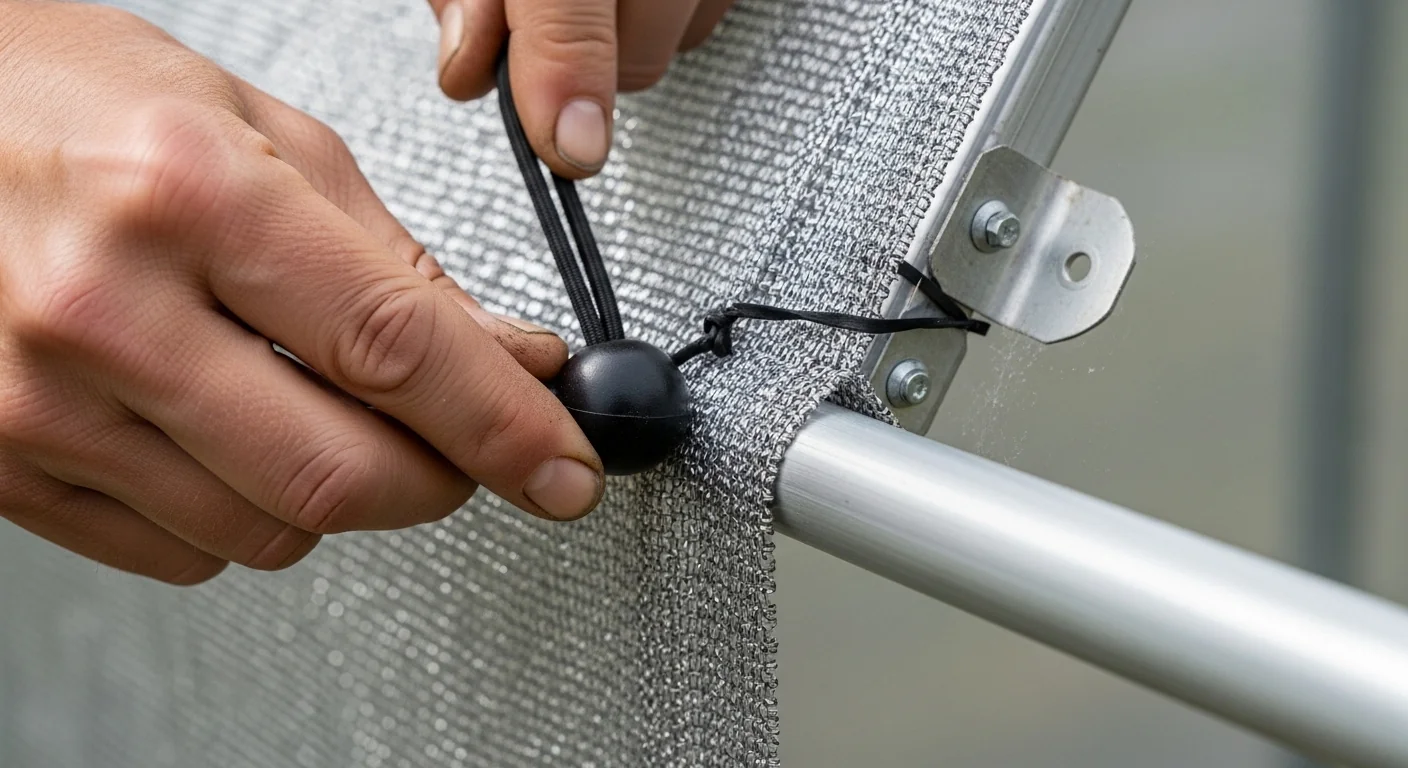
Heavy-Duty Shade Cloth Bungee Balls
How This Calculator Works
The footprint of your greenhouse determines how much solar radiation reaches the interior.
This is the peak heat load entering an unshaded greenhouse at the specified irradiance level (default 300 BTU/hr/sq ft for typical US summer noon sun).
The shade cloth blocks a fraction of incoming radiation. A 50% cloth blocks exactly half the solar load.
This is the primary result: the BTU/hr prevented from entering your greenhouse.
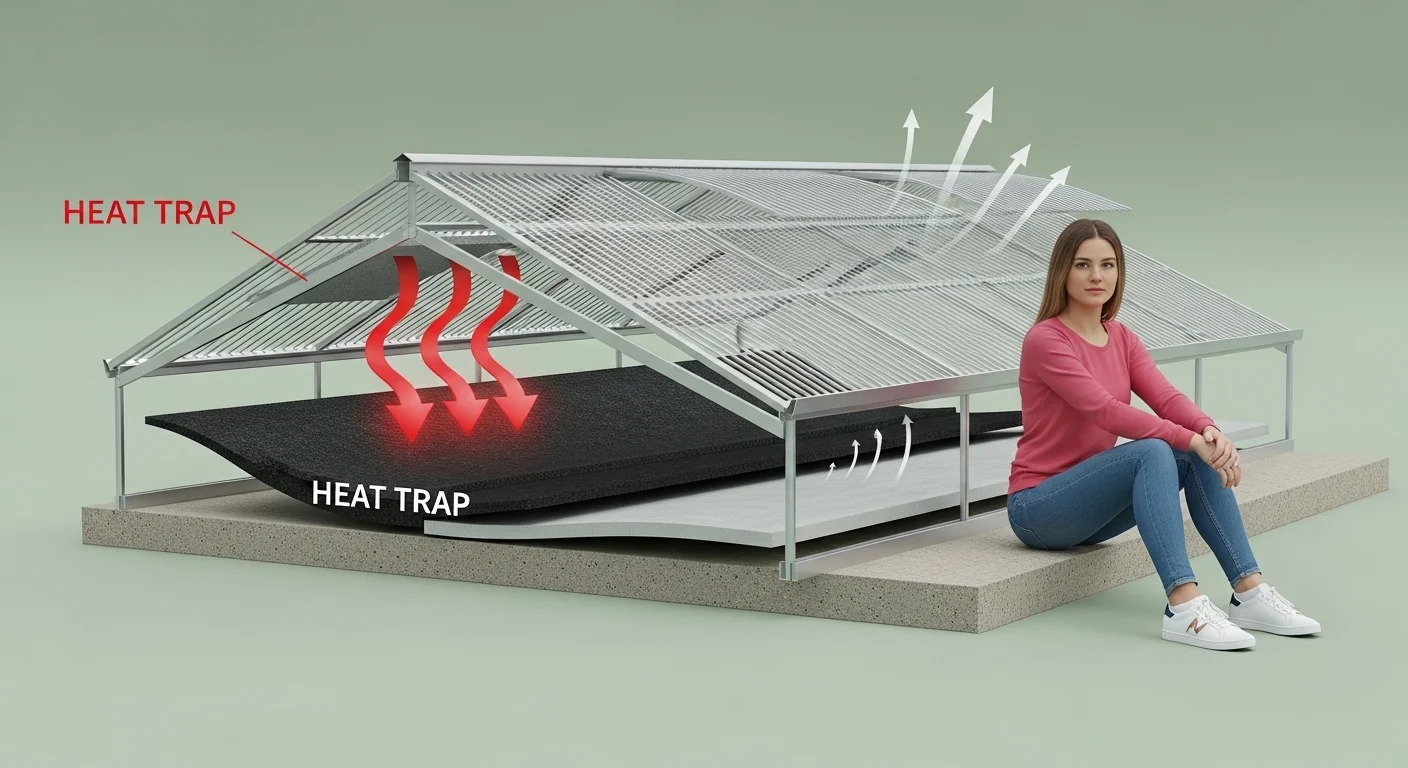
Black cloth absorbs solar radiation rather than reflecting it. Hung inside your greenhouse, it converts light to radiant heat and releases that heat directly into trapped interior air — turning your greenhouse into a thermal oven, often reaching 120°F+. The cloth must be placed outside or overhead to allow convective and radiative heat dissipation away from the interior.
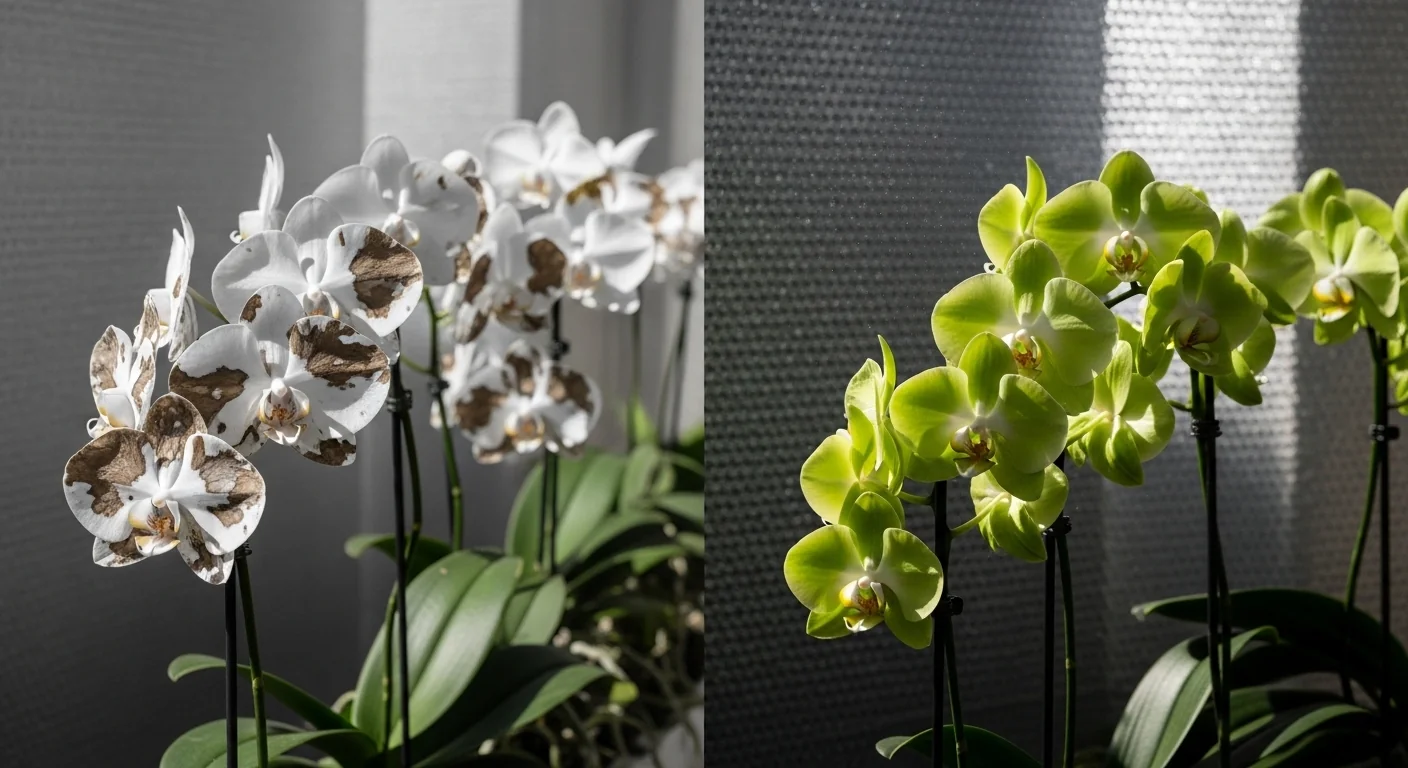
Orchids are highly sensitive to direct solar radiation. Less than 70% shading risks leaf scorch, bleached foliage, and growth stall.
- Solar irradiance default (300 BTU/hr/sq ft) represents peak summer noon irradiance at mid-latitudes (US Zones 5–9). Coastal or high-latitude climates may be lower; desert Southwest may be higher.
- The formula models horizontal roof-plane solar gain only. Sidewall solar gain (glazed walls) is not included — actual loads may be 10–30% higher in fully glazed structures.
- Shade cloth ratings are nominal density figures provided by manufacturers. Actual blocking varies ±5% by weave tightness and UV degradation over time.
- Aluminet reflective cloth is modeled with full nominal density credit because it reflects rather than absorbs. Black poly inside placement triggers the oven effect correction.
- This calculator models solar radiant gain only. Convective losses, ventilation rates, thermal mass, humidity, and nighttime radiation are outside its scope.
- Orchid mandate applies to most tropical orchid genera (Phalaenopsis, Oncidium, Dendrobium). Some high-light species (Cattleya, Vanda) may tolerate 30–50%.
- Max valid irradiance range: 50–600 BTU/hr/sq ft. Min valid shade density: 10%. Max valid shade density: 95%.
Have your greenhouse interior dimensions measured in feet before starting. You will need length, width, your shade cloth density rating (printed on the label or packaging), and the cloth type. If you are unsure of your local peak irradiance, the default value of 300 BTU/hr/sq ft is a reasonable baseline for most continental US summer conditions at solar noon. Select your primary crop type accurately because the tool enforces mandatory thresholds for certain plant categories. For context on how shade reduction affects photosynthetically active light reaching your canopy, the DLI calculator handles the light-budget side of the same decision.
Quick Start (60 Seconds)
- Greenhouse Length (ft): Measure the interior floor dimension, not the exterior frame. Valid range is 1 to 5,000 ft. Do not include attached structures or shade overhangs in this number.
- Greenhouse Width (ft): Same rule as length. If your structure is irregular, use the widest interior span and note this as a conservative overestimate.
- Peak Summer Solar Irradiance (BTU/hr/sq ft): The default of 300 is appropriate for USDA Zones 5 through 9 at solar noon in July. Desert Southwest growers should consider values up to 350. Coastal and northern growers can use 250 to 280 without significant error.
- Shade Cloth Density (%): Use the rated density on the product label, not a visual estimate. Valid range is 10 to 95 percent. Do not round up to the nearest marketed value if your label shows an exact figure.
- Shade Cloth Color / Type: This field is not cosmetic. Reflective Aluminet and Black Poly behave thermodynamically opposite to each other in enclosed spaces. Select the correct material and placement. Inside placement of black poly triggers a mandatory danger warning for reasons detailed below.
- Primary Plant / Crop: Selecting Orchids activates a minimum-shade enforcement check. Select the crop category that is most heat-sensitive if you grow multiple species.
- Units check: All area inputs are in square feet. All heat gain outputs are in BTU per hour. Do not mix metric and imperial dimensions in the same calculation.
Inputs and Outputs (What Each Field Means)
| Field | Unit | What It Measures | Common Mistake | Safe Entry Guidance |
|---|---|---|---|---|
| Greenhouse Length | feet | Interior floor length used to compute total footprint area receiving solar radiation through the roof plane | Using exterior frame dimensions instead of interior growing area, overstating area by 5 to 15% | Measure tape-to-tape at floor level; exclude attached lean-tos |
| Greenhouse Width | feet | Interior floor width; combined with length to produce sq ft floor area | Measuring the eave span instead of the interior base width on gothic or Quonset structures | Measure at the widest interior point at floor level |
| Peak Solar Irradiance | BTU/hr/sq ft | Solar energy striking the roof plane per hour per square foot at peak summer noon; drives the gross heat gain calculation | Leaving the field blank and assuming a default without checking local conditions; desert growers underestimating by 15 to 20% | Use 300 as the default; adjust toward 350 for Southwest, 260 for Pacific Northwest |
| Shade Cloth Density | percent (10-95) | Fraction of incoming solar radiation blocked by the cloth; rated by manufacturers under standardized test conditions | Guessing density by color; black cloth is available in densities from 30 to 90 percent and visual inspection is unreliable | Read the label or product spec sheet for the exact rated density |
| Shade Cloth Color / Type | categorical | Material and placement combination that determines whether the cloth reflects or absorbs solar radiation, and where the absorbed heat is dissipated | Selecting “outside” when cloth is draped inside the ceiling; the tool treats placement as a thermodynamic variable, not a cosmetic one | Be precise about whether the cloth is inside the glazing or outside and above it |
| Primary Plant / Crop | categorical | Crop sensitivity category; used to activate mandatory shade minimums and light-bleach risk warnings | Defaulting to “General” for orchids or ferns to avoid triggering a warning | Select the most shade-sensitive species you are growing |
| Solar Gain Blocked (output) | BTU/hr | Primary result; total radiant heat prevented from entering the growing space per hour at peak sun | Treating this as total cooling capacity; it is radiant gain only, not total heat load including equipment, respiration, or infiltration | Use this number to size ventilation alongside total BTU load from all sources |
| Remaining Heat Load (output) | BTU/hr | Solar radiation that passes through the cloth and enters the space; the load your ventilation and cooling system must still handle | Assuming remaining load equals zero when high-density cloth is used; even 90% cloth passes 10% of a very large irradiance number | Add equipment heat and metabolic plant heat to this figure before sizing your exhaust fans |
Worked Examples (Real Numbers)
Example 1: Hobbyist Greenhouse, Mixed Summer Vegetables
- Length: 20 ft
- Width: 12 ft
- Solar Irradiance: 300 BTU/hr/sq ft
- Shade Cloth: 50% Aluminet, outside/overhead placement
- Crop: General Vegetables / Flowers
Result: Floor area = 240 sq ft. Gross solar gain = 240 x 300 = 72,000 BTU/hr. Blocked = 72,000 x 0.50 = 36,000 BTU/hr. Remaining load = 36,000 BTU/hr.
A 50% Aluminet screen cuts the solar load exactly in half. The remaining 36,000 BTU/hr must still be exhausted through ventilation. This is a workable load for a properly sized exhaust fan, and outside Aluminet placement means all absorbed radiation dissipates into open air above the structure rather than radiating down into the crop zone.
Example 2: Orchid Grower, Undersized Shade Cloth
- Length: 16 ft
- Width: 8 ft
- Solar Irradiance: 300 BTU/hr/sq ft
- Shade Cloth: 30% Black Poly, outside/overhead placement
- Crop: Orchids
Result: Floor area = 128 sq ft. Gross solar gain = 128 x 300 = 38,400 BTU/hr. Blocked = 38,400 x 0.30 = 11,520 BTU/hr. Remaining load = 26,880 BTU/hr.
The tool fires a mandatory orchid shade warning here. Thirty percent density is insufficient for orchid culture regardless of placement, leaving 70% of the solar load to drive leaf surface temperatures above photobleaching thresholds. The grower must increase cloth density to at least 70%, which would reduce remaining load to 11,520 BTU/hr in this example.
Example 3: Commercial Growing House, Hot Climate
- Length: 30 ft
- Width: 20 ft
- Solar Irradiance: 340 BTU/hr/sq ft (assumption: desert Southwest baseline)
- Shade Cloth: 70% Aluminet, outside/overhead placement
- Crop: Seedlings / Transplants
Result: Floor area = 600 sq ft. Gross solar gain = 600 x 340 = 204,000 BTU/hr. Blocked = 204,000 x 0.70 = 142,800 BTU/hr. Remaining load = 61,200 BTU/hr.
Even with 70% Aluminet, a 600 sq ft commercial structure under high-irradiance conditions carries a remaining solar load of 61,200 BTU/hr at peak sun. That figure does not include equipment heat, lighting, or worker presence. Ventilation sizing for this structure must account for the total load, not just the radiant remainder.
Reference Table (Fast Lookup)
The table below is computed using a 240 sq ft greenhouse (20 ft x 12 ft) at 300 BTU/hr/sq ft irradiance. Gross solar gain for this structure = 72,000 BTU/hr. Use the percentage columns to extrapolate to your own gross gain value.
| Shade Density | BTU/hr Blocked (240 sq ft, 300 irr) | BTU/hr Remaining | Load Reduction | Recommended Crop Use | Minimum Ventilation Needed |
|---|---|---|---|---|---|
| 10% | 7,200 | 64,800 | 10% | Cacti, succulents, full-sun annuals | High; minimal shading benefit |
| 20% | 14,400 | 57,600 | 20% | Tomatoes, peppers in mild climates | High; primarily glare reduction |
| 30% | 21,600 | 50,400 | 30% | Tomatoes, cucumbers, squash | High; moderate heat reduction |
| 40% | 28,800 | 43,200 | 40% | General summer vegetables, basil | Moderate; ventilation still critical |
| 50% | 36,000 | 36,000 | 50% | Annuals, most cut flowers, herbs | Moderate; pairs well with auto vents |
| 60% | 43,200 | 28,800 | 60% | Tropical foliage, ferns, bromeliads | Lower solar load; humidity management shifts to priority |
| 70% | 50,400 | 21,600 | 70% | Orchids (mandated minimum), deep-shade tropicals | Moderate; supplemental light may be needed in winter |
| 80% | 57,600 | 14,400 | 80% | Low-light ferns, propagation trays | Low solar load; monitor for DLI deficiency |
| 90% | 64,800 | 7,200 | 90% | Clonal propagation, callus culture only | Very low solar load; supplemental light required for most crops |
How the Calculation Works (Formula + Assumptions)
Show the calculation steps
Step 1: Floor Area
Area (sq ft) = Length (ft) x Width (ft)
This is the horizontal footprint of the greenhouse. The calculator models solar radiation entering through a horizontal roof plane. Vertical glazed walls are not included in the calculation. No rounding is applied to area.
Step 2: Gross Solar Heat Gain
Solar Gain (BTU/hr) = Area (sq ft) x Solar Irradiance (BTU/hr/sq ft)
This is the total peak radiant load entering an unshaded structure. The default irradiance of 300 BTU/hr/sq ft represents peak solar noon conditions at mid-latitude US locations in summer. Results are rounded to the nearest whole BTU/hr.
Step 3: Reduced Gain After Shade Cloth
Reduced Gain (BTU/hr) = Solar Gain x (1 – Shade Density / 100)
The shade cloth rating is treated as a linear scalar. A 50% cloth passes exactly 50% of the gross solar gain; a 70% cloth passes 30%. This is a nominal model; actual cloth performance varies by weave angle and UV degradation state.
Step 4: Solar Gain Blocked
Blocked (BTU/hr) = Solar Gain – Reduced Gain
This is the primary output: radiant energy prevented from entering the growing space per hour at peak conditions.
Rounding rules: Area is displayed as a whole number. BTU/hr values are displayed rounded to the nearest whole unit. Percentage outputs use one decimal place maximum.
Assumptions and Limits
- The model assumes a horizontal or near-horizontal roof plane. Gothic arch and gutter-connected structures with steep pitches will have different effective collection areas for direct overhead sun.
- Sidewall solar gain through vertical glazed panels is not included. In fully glazed structures, actual loads can be 15 to 30% higher than the calculator reports, particularly in early morning and late afternoon.
- Shade cloth density ratings are manufacturer nominal values measured under standardized test conditions. Real-world blocking efficiency typically varies within plus or minus 5% of the rated value due to weave variation.
- The tool does not account for UV degradation of shade cloth over time. A 70% cloth in its third season may perform closer to 60 to 65% due to filament breakdown.
- The model does not simulate interior air temperature rise. BTU/hr blocked is not equivalent to a specific temperature drop because convective dynamics, ventilation rate, thermal mass of soil and bench materials, and humidity all influence final air temperature.
- Aluminet and black poly are modeled identically in terms of their rated density blocking effectiveness. The critical difference between them is what happens to absorbed energy: Aluminet reflects it outward; black poly absorbs and re-radiates it inward when placed inside the structure. This behavioral difference triggers the safety warning system in the tool and is not captured in a simple linear blocking formula.
- Peak irradiance is point-in-time. The actual heat accumulated over a full day depends on the sun-path integral for your latitude and season. This calculator provides a worst-case sizing number, not a daily total.
Standards, Safety Checks, and “Secret Sauce” Warnings
Critical Warnings
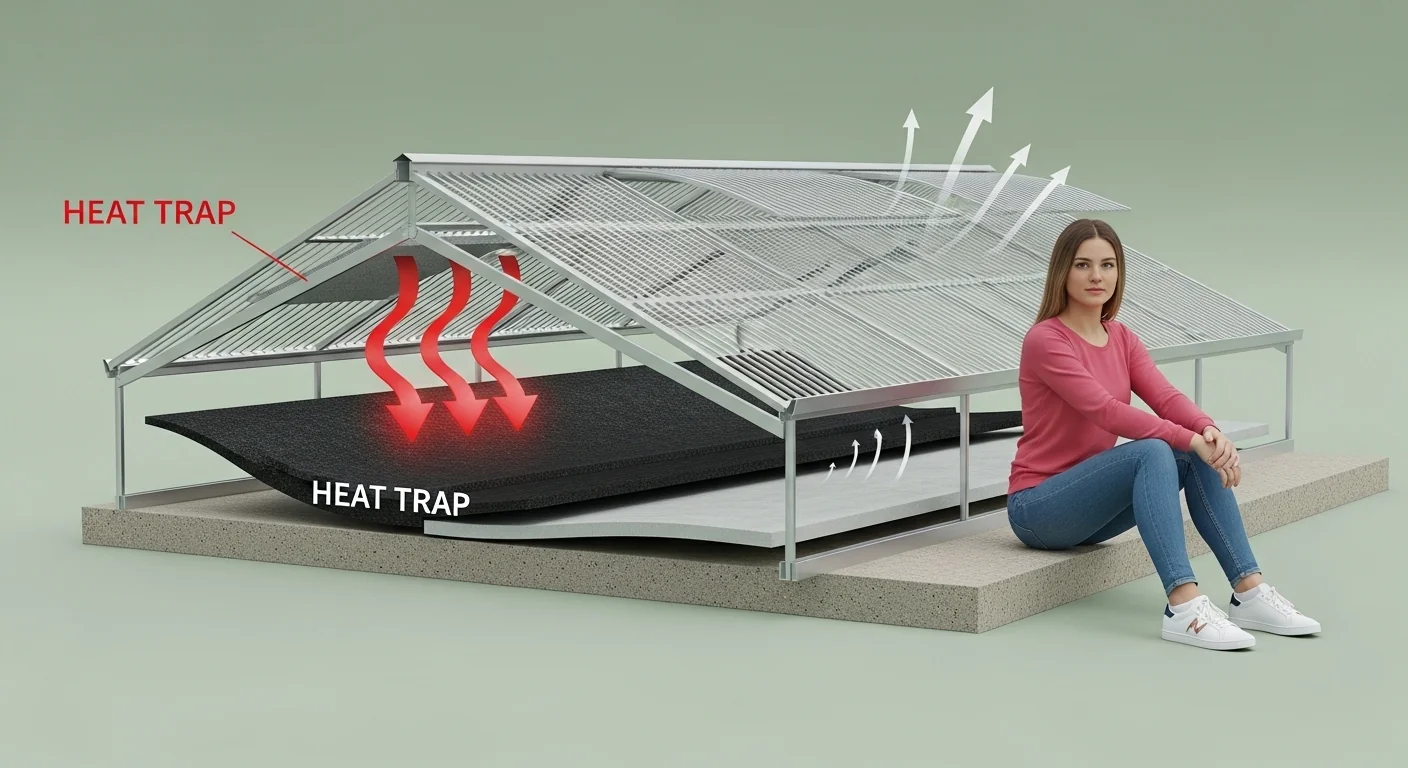
- Black poly shade cloth placed inside the greenhouse roof becomes a radiant heater, not a shade device. Black polyethylene absorbs incoming solar radiation by design. When the cloth is installed inside the glazing, that absorbed energy is re-radiated as thermal infrared directly into the trapped interior air. The greenhouse glazing then prevents that heat from escaping. Interior temperatures under this configuration can exceed 120 degrees Fahrenheit within one to two hours of peak sun exposure, killing crops that would have survived in unshaded conditions. The fix is not to choose a different density. The fix is to relocate the cloth to outside the glazing where absorbed heat dissipates into open air above the structure.
- Orchid photobleaching is not reversible and occurs faster than most growers expect. When leaf surface temperature and light intensity both exceed orchid tolerance thresholds simultaneously, chloroplast membranes fail permanently. The white or silver patching that results does not recover. The 70% minimum shade rating is not a conservative recommendation; it is the floor below which light-bleach damage becomes probable for most tropical orchid genera.
- Shade cloth density and color are independent variables. Black cloth is available at 30, 40, 50, 60, 70, and 80 percent densities. Assuming that black equals high-density or that a dark color implies aggressive shading is a purchasing error that leads to both over-shading in cooler months and misplacement heat traps.
- High shade density does not eliminate the need for ventilation. Even at 70% shading, a commercial greenhouse under peak summer sun can carry tens of thousands of BTU/hr of remaining radiant load in addition to equipment heat, crop respiration, and infiltration. Shade cloth reduces the problem; it does not solve it in isolation. The VPD calculator shows how residual heat shifts humidity dynamics even after aggressive shading is applied, and light transmission data for common glazing materials gives context for how much irradiance enters before the shade cloth intercepts it.
Minimum Standards
- Orchids (Phalaenopsis, Oncidium, Dendrobium, and most tropical genera): 70% shade minimum during peak summer months.
- Shade-adapted seedlings and transplants: 40 to 50% shade during the first two weeks after transplanting, regardless of crop species.
- Reflective Aluminet cloth should be installed with the reflective face oriented toward the sun. Reverse installation reduces performance significantly.
- Shade cloth should be positioned with an air gap of at least 6 to 12 inches above the glazing surface when used outside. Contact with glazing reduces convective heat dissipation from the cloth surface.
Competitor Trap: Most shade cloth content online focuses entirely on density selection and says nothing about placement thermodynamics. The critical variable is where the cloth sits relative to the glazing boundary. A grower can follow every density recommendation correctly and still create an oven by hanging black poly inside the ceiling rather than outside it. This failure mode is common precisely because garden centers and online retailers display and sell shade cloth without placement instructions, and because the negative outcome (heat spike) happens days or weeks after installation when conditions align to produce peak sun and limited ventilation simultaneously.
Common Mistakes and Fixes
Mistake: Hanging Black Poly Inside the Greenhouse Ceiling
This is the most consequential shade cloth error in hobby and small commercial greenhouse growing. Black polyethylene absorbs solar radiation, converts it to heat, and radiates that heat as long-wave infrared into the surrounding air. Inside a greenhouse, there is nowhere for that heat to go. The space functions as a sealed absorber cavity rather than a shaded environment. Growers typically notice the problem as an inexplicable temperature increase shortly after installing what they were told was a “cooling” product.
Fix: Relocate the cloth to outside the glazing, or switch to Aluminet reflective cloth, which reflects incoming radiation before absorption can occur and can be used inside with substantially less risk.
Mistake: Assuming All 50% Shade Cloth Performs the Same
Knitted and woven shade cloth at the same nominal density do not perform identically under all sun angles. Woven cloth is more directionally dependent; performance drops as the sun angle becomes oblique relative to the weave direction. Knitted cloth with randomized openings is generally more consistent across sun angles. At peak noon sun both may behave similarly, but early morning and late afternoon performance diverges.
Fix: For year-round or spring and fall use, knitted cloth provides more consistent performance across variable sun angles. Check the product spec sheet for photometric test conditions.
Mistake: Sizing Shade for the Greenhouse Area but Not the Heat Source
Shade cloth calculations based on floor area are accurate for solar radiant gain through a horizontal roof. Growers with east or west-facing glazed gable walls, or with grow lights generating significant BTU loads, are adding heat sources that the shade cloth cannot address. A common scenario is a grower who correctly sizes and installs 50% Aluminet and is confused when afternoon temperatures remain high because the western gable wall receives direct afternoon sun that the overhead shade cloth does not intercept. The grow room BTU calculator handles total heat load from all sources and pairs well with this shade cloth calculation for comprehensive thermal sizing. If you also run supplemental heat in winter, the greenhouse heater sizing tool accounts for the same structure geometry from the heating side.
Fix: After calculating solar radiant gain, sum all BTU inputs (lights, heaters, solar through all surfaces) before sizing your ventilation or cooling system.
Mistake: Not Adjusting Shade Density Seasonally
A 70% shade cloth appropriate for July and August in a tomato greenhouse will cut light levels so severely in October that plant growth nearly stops. Photoperiod shortens, sun angle drops, and ambient irradiance falls by 30 to 50% in most temperate locations between summer peak and early fall. Growers who leave high-density shade cloth in place through autumn are unintentionally creating a chronic DLI deficit that suppresses fruit development and delays maturity.
Fix: Plan for at least two shade cloth densities and a seasonal swap schedule. Remove or replace high-density cloth by late August or early September in most temperate climates.
Mistake: Treating the Shade Cloth Percentage as a Temperature Reduction Percentage
A 50% shade cloth does not reduce interior air temperature by 50%. It reduces peak solar heat gain by 50%. The resulting temperature change depends on ventilation rate, thermal mass, outdoor ambient temperature, humidity, and the convective properties of the structure. Growers who calculate “half the heat, half the temperature rise” and then under-ventilate are relying on math that the underlying physics does not support.
Fix: Use the blocked BTU/hr figure from this tool as an input to a ventilation sizing calculation, not as a direct proxy for temperature reduction.
Next Steps in Your Workflow
Once you have confirmed your shade cloth density, type, and placement will produce a viable remaining heat load, the next constraint is moving that residual heat out of the structure. Shade cloth and ventilation are complementary tools, not alternatives. The specific remaining BTU/hr figure this calculator outputs can feed directly into fan CFM sizing, where you convert BTU/hr to CFM using the thermal properties of air. If you are working with seedlings or cuttings under high-density shade and notice growth stalling outside of summer, it may be worth reviewing your supplemental lighting strategy, since high shade cloth densities in spring and fall frequently create DLI deficits that limit early-season production. For greenhouse operations that also run active misting systems to assist evaporative cooling, the greenhouse misting calculator sizes nozzle output to match the remaining heat load alongside shade.
Consider recording your shade cloth configuration, installation date, and seasonal performance observations so you can refine density selection in subsequent years. Solar gain is not constant across the growing calendar. A setup that works well in June may be overcorrecting by September and undercorrecting the following April. Structured seasonal notes on temperature peaks, crop performance, and shade cloth condition give you the data to move from guesswork to deliberate calibration over two or three seasons.
FAQ
What is the difference between Aluminet and black poly shade cloth?
Aluminet is a knitted fabric with a metalized surface that reflects incoming solar radiation away from the structure. Black polyethylene absorbs solar radiation rather than reflecting it. When placed correctly outside the glazing, both materials block similar percentages of light. The critical difference is what happens to the absorbed energy: Aluminet dissipates it into open air via reflection; black poly converts it to heat that it must radiate somewhere, which becomes dangerous in enclosed inside placements.
Can I use two layers of shade cloth to double the blocking percentage?
Two layers do not simply add their percentages. A 50% cloth over another 50% cloth passes 25% of incoming light (each layer blocks half of what reaches it), producing an effective blocking of 75%, not 100%. For precise layered calculations you multiply transmittance values: (1 – density1) x (1 – density2). This relationship means double-layering is inefficient at very high densities and creates attachment and airflow complications that usually make a single higher-density cloth a better solution.
How do I know if my shade cloth percentage is correct for my orchids?
Most tropical orchid genera require a minimum of 70% shading during peak summer sun exposure. Below that threshold, leaf surface temperatures can exceed safe limits even when air temperature is managed. Symptoms of insufficient shading include white or silver patching on leaf surfaces, reddening of foliage, and wilting despite adequate watering. These are signs of photoinhibition and chloroplast damage, and the affected tissue does not recover. Verify your cloth density from the label rather than estimating by color.
Does this calculator account for the greenhouse glazing material?
The calculator uses your entered irradiance value as the starting point and does not apply a glazing transmittance factor automatically. If you want to model the actual solar load entering through a specific glazing material, reduce your irradiance input by the glazing’s transmittance reduction. For example, if your twin-wall polycarbonate transmits 80% of solar radiation, multiply your local peak irradiance by 0.80 before entering it into the calculator.
Is a 70% shade cloth going to block too much light for my vegetable garden in fall?
Almost certainly yes. A 70% shade cloth appropriate for orchids or mid-summer seedling protection will reduce light levels below the productive threshold for fruiting vegetables outside of peak summer. Most fruiting vegetables require DLI values of 20 to 30 mol/m2/day to produce well. High-density shade cloth applied in fall, when ambient DLI is already declining, typically reduces productive light levels below 10 mol/m2/day in many temperate climates. Plan for seasonal cloth changes or adjustable shading systems.
Why does the calculator ask for plant type if the formula only uses area and shade percentage?
The plant type field activates the mandatory minimum-shade enforcement checks derived from established horticultural standards for specific crop categories. The core BTU/hr formula does not use it, but the safety warning system does. Selecting the wrong plant category means you will not receive warnings about undersized shade density for sensitive crops like orchids or seedlings even if your cloth is genuinely insufficient for that specific application.
Conclusion
Shade cloth percentage selection is a decision with direct thermodynamic consequences inside an enclosed structure. The numbers this calculator produces are not rough approximations; they reflect the actual physics of radiant heat gain scaled to your specific floor area and solar conditions. The most important thing the tool communicates is that placement matters as much as density. A 70% black poly cloth hung inside a greenhouse ceiling does not create 70% less heat. It creates more heat than doing nothing, in the worst cases dramatically more, because the absorption and re-radiation dynamic operates in a closed loop with no exit path for the converted energy.
If there is one number to remember from running this tool, it is the remaining heat load after shading. That figure is what your ventilation system, evaporative cooling, or active HVAC must handle at peak solar noon. Shade cloth is the first intervention; ventilation is the second. Neither works well without the other, and neither calculation should happen in isolation. For the complete picture of your greenhouse thermal environment, the dew point calculator gives context for how residual heat interacts with humidity as temperatures climb and fall through the day.