
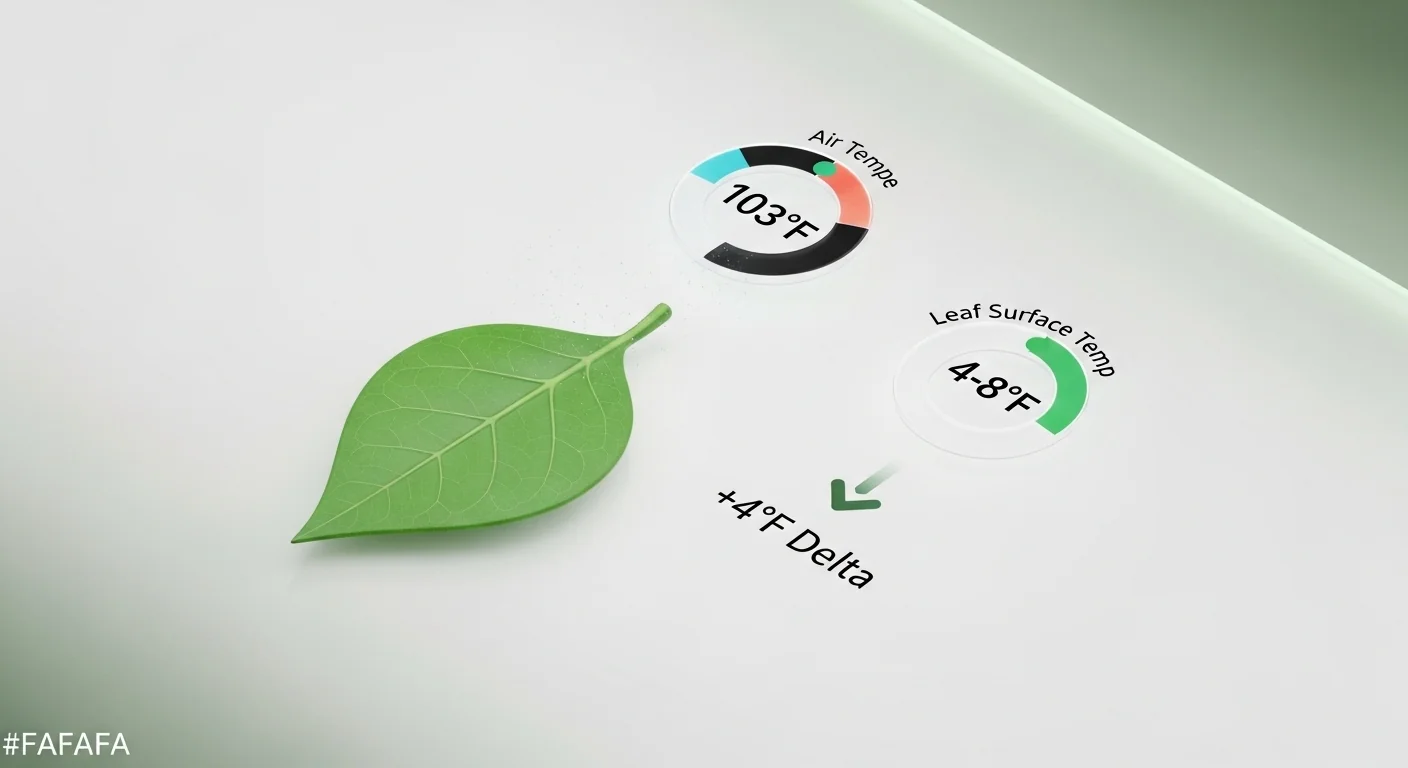
A wall-mounted thermometer reading 80°F and 60% RH looks like a perfectly dialed environment. Run those numbers through a standard VPD calculator and you get a reassuring 1.04 kPa. But if your LED fixtures are doing their job, the leaf surface those stomata actually live on is probably running 74°F or cooler. True VPD at that surface? A stomata-slamming 0.77 kPa. That gap between the number growers see and the number that governs plant physiology is the central problem this tool solves.
This calculator uses the Buck equation to compute Saturation Vapor Pressure at the actual leaf surface temperature you measure with an IR thermometer, then subtracts the Actual Vapor Pressure derived from your room air. The result is the real transpiration driving force, not the approximation you get when leaf temp is assumed equal to air temp. It does not model substrate moisture tension, canopy microclimate gradients, or CO2 enrichment effects on stomatal conductance. For a complementary atmospheric measurement, the dew point calculator helps contextualize how close ambient air is to saturation before you adjust anything.
After running this tool, you will know whether to raise temperature, lower humidity, or do nothing at all, because you will be working from a leaf-referenced VPD rather than an air-referenced guess.
Use the Tool
VPD & Leaf Temp Calculator
True vapor pressure deficit using actual leaf surface temperature
| Stage | Min kPa | Ideal kPa | Max kPa | Risk |
|---|---|---|---|---|
| Clone / Seedling | 0.4 | 0.4–0.8 | 0.8 | Mold if > 80%RH |
| Vegetative | 0.8 | 0.8–1.2 | 1.2 | Low if managed |
| Flower / Bloom | 1.0 | 1.0–1.5 | 1.6 | Bud Rot < 1.0 kPa |
How This Calculator Works — Formula & Assumptions
Uses the Buck equation for biological accuracy:
SVP = 0.61121 × e(18.729 − T/227.3) × T/(257.87 + T) kPa
where T = Leaf Surface Temperature in °C. This is the maximum moisture the air can hold at the leaf’s exact temperature.
SVPair = 0.61121 × e(18.729 − Tair/227.3) × Tair/(257.87 + Tair)
AVP = SVPair × (RH / 100)
This is the moisture currently in the room air.
VPD = SVPleaf − AVP
This is the “pulling force” the air exerts on your plant — how hard the plant must transpire. Measured in kilopascals (kPa).
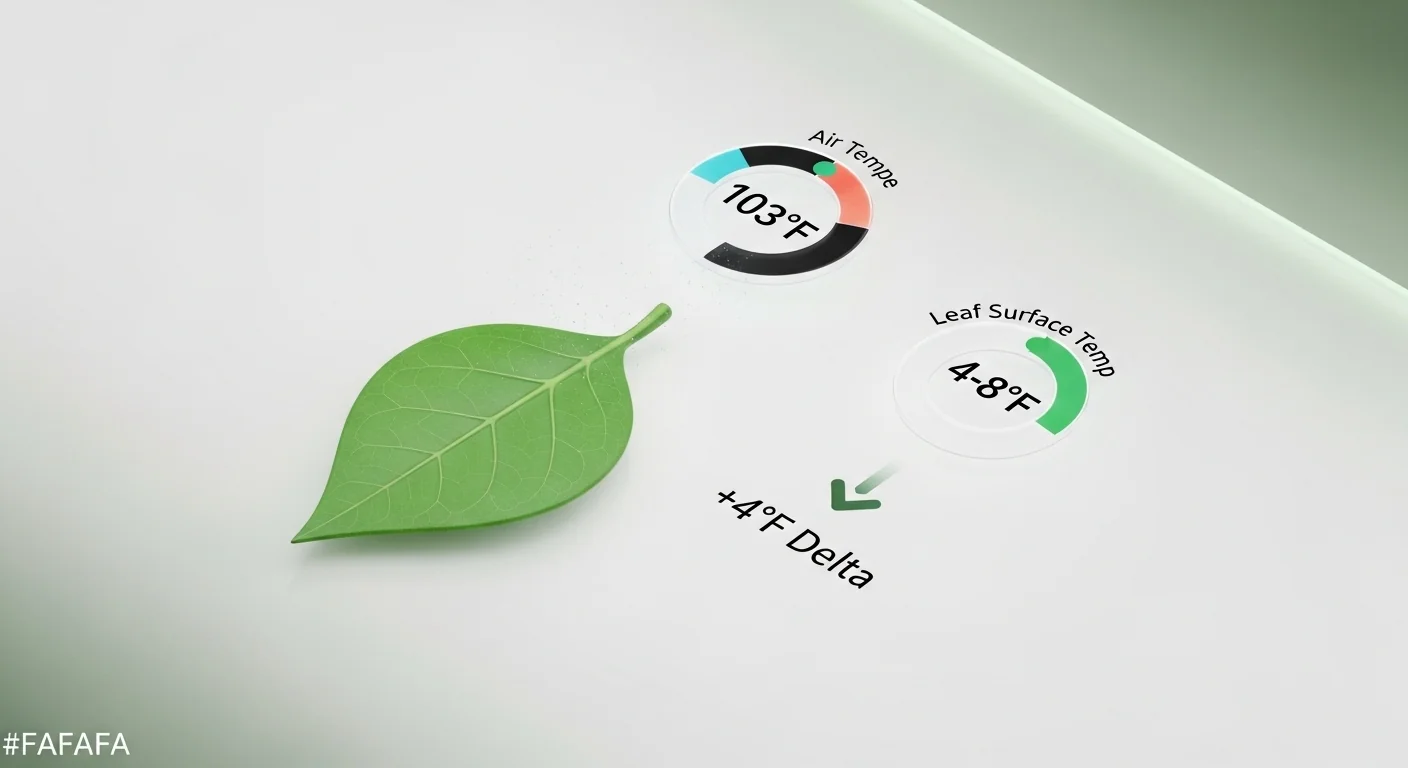
Modern LED grow lights emit almost no infrared heat. Leaves under LED can run 4–8°F cooler than ambient air. Because SVP changes exponentially with temperature, a 6°F leaf temp difference can shift VPD by 0.4–0.6 kPa — enough to completely misrepresent your grow environment if you only use air temp.
- Uses the Buck equation (ASCE-corrected) — valid from 0°C to 50°C (32°F–122°F).
- VPD values outside 0.0–3.0 kPa are biologically extreme; tool warns if exceeded.
- Assumes a closed indoor growing environment (greenhouse, grow tent, indoor facility).
- Does not account for CO₂ enrichment, light intensity (PPFD), or substrate VPD — add these for elite-level accuracy.
- Relative humidity measured at canopy level, not at room height.
- Target ranges based on widely-cited HVAC standards for commercial cannabis production (Quest, Pulse, TrolMaster guidelines).
Before you start, have three measurements ready: ambient air temperature from a calibrated thermometer at canopy height (not ceiling level), relative humidity from a hygrometer also positioned at the canopy, and a leaf surface reading from an IR thermometer aimed at the top surface of a mid-canopy leaf. Select the growth stage that matches your current cycle. All temperature inputs can be entered in either Fahrenheit or Celsius using the toggle at the top of the calculator. If you run multiple tent environments at different stages, run a separate calculation for each. For context on whether your air exchange rate is keeping temperature uniform across the canopy, the grow tent fan size calculator pairs directly with this workflow.
Quick Start (60 Seconds)
- Toggle your unit first. Select °F or °C before entering any values. Switching units after entry clears validation states and requires re-entry.
- Air temp at canopy, not ceiling. Thermal stratification in a sealed room can mean a 3–5°F spread from floor to ceiling. Measure where the leaves are.
- RH at canopy level. A sensor mounted near the intake fan or exhaust port reads exhaust air, not the plant microclimate. Position it 6–12 inches above the canopy.
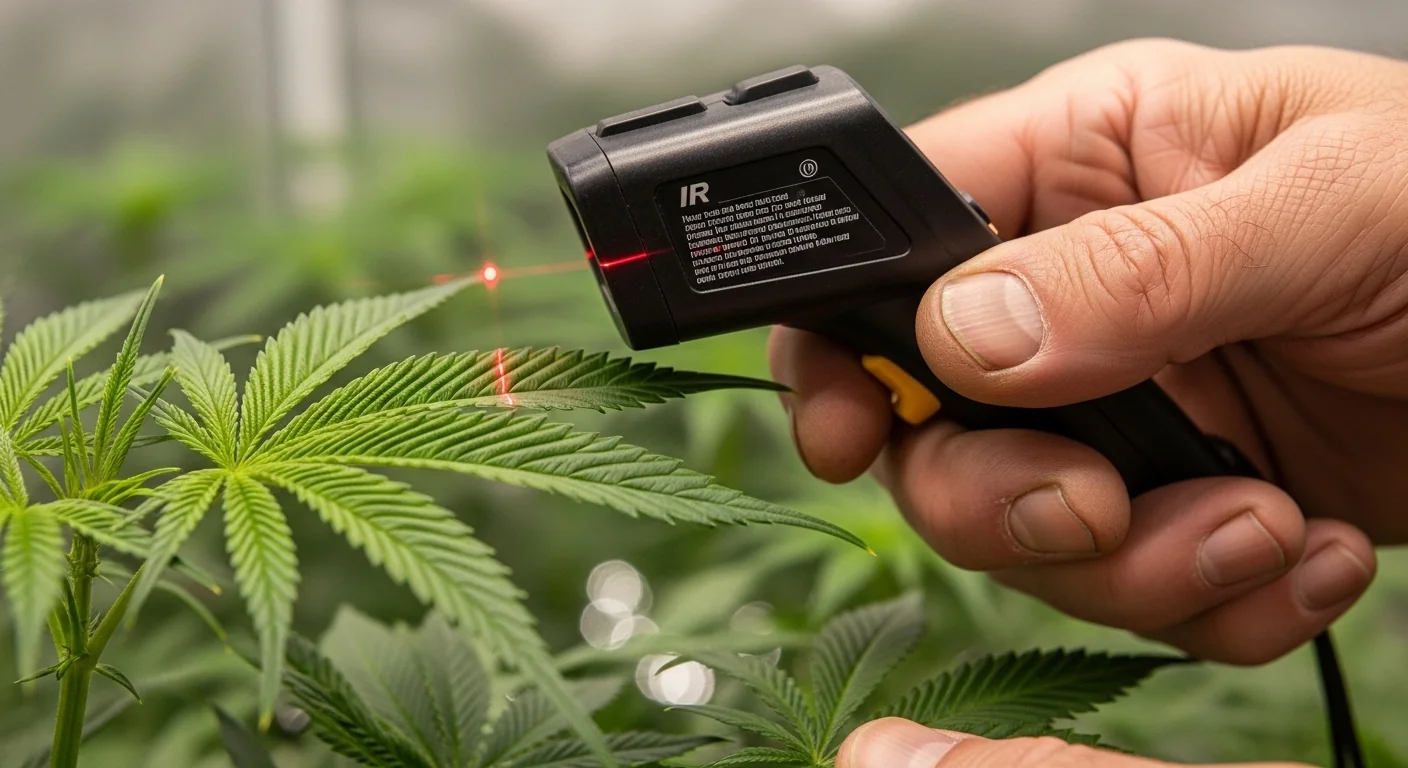
- Leaf temp requires an IR thermometer aimed correctly. Hold the device 6–10 inches from the leaf surface, perpendicular to the top of the blade. Avoid the midrib; the blade surface is what matters.
- Match the growth stage to today, not your schedule. A plant in its first week of flower is still physiologically different from week six. Use the stage that reflects current trichome and structure development.
- Do not enter temperatures at the extreme ends of the range. Values at 50°F or 110°F are physically possible in greenhouses but are outside typical cultivation ranges where the formula is most useful.
- Click Calculate only after all four fields are filled. The tool validates before computing; partial entries show inline errors rather than running an incomplete result.
Inputs and Outputs (What Each Field Means)
| Field | Unit | What It Represents | Common Mistake | Safe Entry Guidance |
|---|---|---|---|---|
| Ambient Air Temp | °F or °C | Dry-bulb temperature of the room air at canopy height; used to compute Actual Vapor Pressure (AVP) | Reading from a sensor mounted near the ceiling or at the intake duct | 50–110°F (10–43°C); typical indoor cultivation range is 65–90°F |
| Relative Humidity | % | The ratio of current water vapor in air to maximum possible; determines AVP when multiplied by SVP_air | Using the controller’s room-average reading instead of a canopy-level sensor | 1–99%; physiologically useful range is 35–80% depending on stage |
| Leaf Surface Temp | °F or °C | Actual temperature of the leaf blade measured by IR thermometer; determines SVP at the leaf where gas exchange occurs | Using air temp as a substitute, or measuring the stem or midrib instead of the blade | Same range as air temp; in LED environments, expect leaf temp to read 2–8°F below air temp |
| Growth Stage | Category | Determines the target VPD range and activates stage-specific safety checks (bud rot, clone stress, stomatal closure) | Selecting “Vegetative” during early flower because it “feels safer” for the humidity targets | Clone (unrooted), Veg (rooted vegetative growth), Flower (post light-flip through harvest) |
| VPD Result | kPa | The net vapor pressure difference between the leaf surface and surrounding air; the biological “pull” driving transpiration and nutrient uptake | Treating the kPa number without reference to its stage-specific target range | Read alongside the traffic-light gauge and stage checks, not as a standalone number |
Worked Examples (Real Numbers)
Scenario 1: The LED Flower Room Trap
- Air Temperature: 80°F (26.67°C)
- Relative Humidity: 60%
- Leaf Surface Temperature: 74°F (23.33°C)
- Growth Stage: Flower
Result: 0.77 kPa
A standard air-only calculation at 80°F / 60% RH would return approximately 1.04 kPa, which appears acceptable. The leaf surface reading of 74°F reduces SVP_leaf to 2.866 kPa. With an AVP of 2.099 kPa, true VPD sits at 0.77 kPa, well below the 1.0 kPa minimum for flower. Botrytis pressure is elevated at this value, particularly inside dense colas where internal humidity is even higher than the canopy measurement.
Scenario 2: Dialed Vegetative Environment
- Air Temperature: 75°F (23.89°C)
- Relative Humidity: 55%
- Leaf Surface Temperature: 73°F (22.78°C)
- Growth Stage: Vegetative
Result: 1.14 kPa
SVP_leaf computes to 2.773 kPa at 22.78°C, and AVP is 1.631 kPa (2.966 × 0.55). The 1.14 kPa result sits squarely in the 0.8–1.2 kPa target window for vegetative growth, with stomata open and transpiration stream supporting active nutrient uptake. The 2°F leaf-to-air differential is small enough that an air-only calculation would have given a similar answer; the discrepancy grows as light intensity increases.
Scenario 3: Clone Propagation Under a Dome
- Air Temperature: 78°F (25.56°C)
- Relative Humidity: 72%
- Leaf Surface Temperature: 76°F (24.44°C)
- Growth Stage: Clone
Result: 0.71 kPa
SVP_leaf at 24.44°C is 3.064 kPa. AVP is 2.359 kPa (3.277 × 0.72). At 0.71 kPa, this environment sits within the 0.4–0.8 kPa range for unrooted clones, keeping transpiration low enough that rootless stems are not desiccating while still maintaining enough VPD to resist fungal surface condensation. Raising RH above 80% in this configuration would push VPD below 0.4 kPa and risk surface mold.
Reference Table (Fast Lookup)
| Stage | Air Temp | RH% | Leaf Temp | Leaf-Air Delta | True VPD (kPa) | Status |
|---|---|---|---|---|---|---|
| Clone | 75°F / 23.9°C | 75% | 73°F / 22.8°C | -2°F | 0.55 | Acceptable |
| Clone | 78°F / 25.6°C | 72% | 76°F / 24.4°C | -2°F | 0.71 | Ideal |
| Clone | 78°F / 25.6°C | 60% | 72°F / 22.2°C | -6°F | 0.93 | High for Clone |
| Veg | 75°F / 23.9°C | 55% | 73°F / 22.8°C | -2°F | 1.14 | Ideal |
| Veg | 80°F / 26.7°C | 60% | 78°F / 25.6°C | -2°F | 1.18 | Ideal |
| Veg | 82°F / 27.8°C | 65% | 79°F / 26.1°C | -3°F | 0.96 | Low-Acceptable |
| Flower | 80°F / 26.7°C | 60% | 74°F / 23.3°C | -6°F | 0.77 | Bud Rot Risk |
| Flower | 80°F / 26.7°C | 50% | 74°F / 23.3°C | -6°F | 1.12 | Ideal |
| Flower | 78°F / 25.6°C | 55% | 75°F / 23.9°C | -3°F | 1.16 | Ideal |
| Flower | 82°F / 27.8°C | 45% | 78°F / 25.6°C | -4°F | 1.60 | Near Maximum |
The “Leaf-Air Delta” column is the derived value. It represents how many degrees cooler the leaf is running compared to the ambient air, the exact number that shifts true VPD away from what a wall sensor would suggest. Every row where the delta is -4°F or greater shows a meaningful divergence between air-only and leaf-referenced VPD calculations.
How the Calculation Works (Formula + Assumptions)
Show the calculation steps
Step 1: Saturation Vapor Pressure at the Leaf (SVP_leaf)
The Buck equation is applied to the leaf surface temperature converted to Celsius:
SVP = 0.61121 × e^((18.729 − T/227.3) × T/(257.87 + T))
where T is leaf surface temperature in °C. This gives the maximum vapor pressure the air could hold at the leaf’s exact temperature, expressed in kilopascals. Rounding rule: intermediate SVP values are carried to 4 decimal places; the final VPD result is rounded to 2 decimal places.
Step 2: Actual Vapor Pressure in Room Air (AVP)
The same Buck equation is applied to ambient air temperature to get SVP_air. Then:
AVP = SVP_air × (RH / 100)
This represents how much water vapor is actually present in the room air. The distinction between SVP_leaf and SVP_air is why leaf temperature, not just air temperature, is the correct input for the VPD formula.
Step 3: True VPD
VPD = SVP_leaf − AVP
A positive result is the net vapor pressure gradient pulling moisture out of the leaf through open stomata. A result near zero means the air is nearly saturated relative to the leaf surface and transpiration stalls. A negative result would mean condensation, which is physically unreachable in a functioning grow environment but can appear in the formula if leaf temp is entered higher than physically possible.
Unit Conversion
Fahrenheit inputs are converted to Celsius internally using (°F − 32) × 5/9 before any formula computation. Display and output remain in the unit selected at input time. VPD is always reported in kPa regardless of temperature unit selection.
Assumptions and Limits
- The Buck equation (ASCE-corrected form) is valid between 0°C and 50°C (32°F to 122°F). Inputs outside this range produce extrapolated, unreliable results.
- The tool assumes a well-mixed air environment at canopy level. In rooms with poor circulation, horizontal and vertical humidity gradients mean a single RH reading is not representative of all plant surfaces.
- Leaf temperature is assumed uniform across the measured leaf. In practice, leaf margins, shaded undersides, and newly emerged tissue can vary by 1–3°F from the reading location.
- The formula does not account for CO2 enrichment effects on stomatal conductance, which can alter transpiration rates at the same VPD.
- Substrate moisture tension (root zone vapor pressure) is not incorporated. A VPD that is physiologically ideal assumes adequate root zone water availability.
- Output VPD below 0.0 kPa is clipped to 0.0 in the display. This occurs only if leaf temp is entered below air temp in an extreme configuration and does not represent a physically achievable grow state.
- The target ranges for each growth stage (clone 0.4–0.8, veg 0.8–1.2, flower 1.0–1.5 kPa) are based on published commercial cannabis HVAC guidelines. Species outside cannabis may have different optimal ranges.
Standards, Safety Checks, and “Secret Sauce” Warnings
Critical Warnings
- Bud Rot Threshold: Any VPD reading below 1.0 kPa during the flowering stage constitutes a meaningful Botrytis risk condition. At sub-1.0 kPa, the vapor pressure gradient is insufficient to pull moisture away from bud surfaces quickly enough to prevent fungal colonization, particularly in high-density colas where internal airflow is limited. This is not a marginal risk; commercial dehumidification protocols built around this threshold exist specifically because of how rapidly Botrytis spreads once established. The grow room dehumidifier calculator helps size the equipment needed to hold RH at the level required to keep VPD above 1.0 kPa through late flower.
- Stomatal Closure Below 0.4 kPa: When VPD drops below 0.4 kPa at any growth stage, stomata close as a regulatory response. Closed stomata halt both transpiration and CO2 uptake, effectively pausing photosynthetic carbon fixation. Growth visibly stalls and the risk of powdery mildew and other surface pathogens increases because the leaf surface remains wet longer.
- Heat Stress Above 1.6 kPa in Flower: Exceeding 1.6 kPa pushes flowering plants into active drought stress signaling. Leaf margins curl upward, resin production can slow, and in severe cases trichome heads may desiccate prematurely. The fix is not simply adding humidity; temperature reduction is usually more effective and more stable.
- Clone Transpiration Limit: Unrooted cuttings have no functional root system for water uptake. VPD above 0.8 kPa causes irreversible desiccation of cutting tissue before callus formation can support rooting. Humidity domes are used specifically to keep VPD in the 0.4–0.8 kPa window mechanically, without requiring stomatal control from the plant.
Minimum Standards
- Flower stage: maintain VPD between 1.0 and 1.6 kPa, with 1.0–1.5 kPa representing the commercially accepted ideal band referenced by major HVAC vendors including Quest and TrolMaster.
- Vegetative stage: target 0.8–1.2 kPa. Movement toward the upper end of this range during late veg (pre-flip) is used as a transitional strategy in crop-steering protocols. For advanced transition planning, the crop steering calculator models how VPD manipulation influences generative and vegetative growth patterns.
- Leaf surface temperature must be measured directly. Assuming leaf temp equals air temp introduces systematic error that increases proportionally with light intensity. LED environments without this measurement are operating on inaccurate VPD data by design.
Competitor Trap: Most VPD charts and calculators found online use a fixed leaf temperature offset, typically subtracting 2°F or 3°F from air temperature as a blanket correction. This appears rigorous but is a hardcoded assumption that ignores the actual physics of the grow environment. Leaf temperature under modern high-efficiency LEDs varies with fixture intensity, distance, ambient airflow, and canopy density. A 2°F correction is frequently wrong by a factor of two or three. Using a tool that bakes in a fixed offset means the displayed VPD still misrepresents reality, just with a slightly different consistent error. The only correct approach is a direct IR thermometer measurement at the leaf surface, which this calculator is specifically designed to receive.
Common Mistakes and Fixes
Mistake: Measuring Temperature and RH Near the Exhaust Port
Exhaust sensors capture air that has already absorbed moisture and heat from the canopy on its way out. That reading is systematically different from the canopy microclimate where stomatal exchange is happening. A space running 72% RH at the exhaust might be 65% at the leaf surface, which shifts computed VPD by more than 0.2 kPa. Fix: mount a dedicated canopy-level sensor within 8 inches of the top of the tallest plant.
Mistake: Using the IR Thermometer at the Wrong Angle or Distance
IR thermometers have a specified distance-to-spot ratio. At the wrong distance or angle, the reading averages the leaf surface with surrounding air, substrate, or adjacent leaves, none of which have the same temperature as the blade surface. The midrib also runs warmer than the blade. Fix: aim perpendicular to the top center of a leaf blade from 6 to 10 inches, avoiding the stem and midrib.
Mistake: Applying a Single VPD Number Across an Entire Room
A large canopy with significant height variation between the lowest leaves and the canopy top can have measurably different VPD conditions at each level. Upper leaves receive more intense light and may be warmer; lower leaves sit in more humid, stagnant air. Growers who take a single reading and apply it to all plants frequently have problems in one canopy zone while assuming the entire room is fine. Fix: take leaf temp and RH readings at multiple canopy heights, especially in rooms taller than four feet. Poor horizontal airflow between dense plants amplifies this effect; the greenhouse fan calculator can help verify that your circulation is adequate to minimize gradients.
Mistake: Adjusting Humidity Independently Without Re-Checking Temperature
VPD is a function of both variables simultaneously. Growers sometimes raise temperature to stay within a target humidity range without recalculating VPD after the change. A temperature increase at fixed RH raises VPD; the same temperature increase while also increasing RH can result in almost no VPD change at all, or even a decrease. Fix: re-run the calculator after any environmental adjustment before assuming the result improved. Adjusting one variable without the other is incomplete. If temperature adjustments are significant, checking the sizing implications with the greenhouse heater size calculator ensures the equipment can actually reach and hold the target setpoint.
Mistake: Treating VPD Targets as Stage Thresholds Rather Than Continuous Inputs
The growth stage selector loads a target range, but plant physiology does not reset on a schedule. A plant entering the sixth week of flower has different water demand than one in week two, and late-stage plants with dense bud structure are more vulnerable to Botrytis than younger plants at the same VPD. Using the correct stage is necessary but not sufficient; treat the result as a floor-and-ceiling constraint that should be re-evaluated weekly, not a setting that remains valid for a full cycle. Fix: recalculate VPD weekly and particularly after any canopy manipulation, density change, or equipment adjustment.
Next Steps in Your Workflow
Once you have a true VPD number, the immediate decision tree is straightforward: if VPD is below the stage minimum, you need less humidity or more temperature (or both); if it is above the stage maximum, you need more humidity or less temperature. The less obvious next step is validating whether your control equipment can actually achieve and hold the corrected setpoint. A dehumidifier that is undersized for your room volume will never get RH to the level your target VPD requires, regardless of what the controller is set to. Similarly, a heating or cooling system that cycles rather than holds a stable setpoint will create VPD variance that no single reading captures. Verifying that your light delivery aligns with your growth stage is equally relevant: the DLI calculator helps confirm that your photoperiod and intensity match the photosynthetic demand the plant is being asked to meet at your target VPD.
The environmental variables in a grow room are coupled. Fixing VPD without checking CO2 concentration means potentially optimizing gas exchange pathways for an atmosphere that cannot support the resulting carbon fixation rate. Open stomata at ideal VPD, surrounded by CO2-depleted air, still results in suboptimal photosynthesis. The CO2 calculator pairs naturally with this tool for growers running enriched atmospheres to verify that CO2 concentration is adequate for the transpiration and photosynthetic rate implied by your VPD target.
FAQ
What is VPD and why does it matter more than just humidity?
Vapor Pressure Deficit (VPD) is the difference between the maximum moisture air can hold at a given temperature and the moisture currently present. It directly controls the rate at which plants transpire and uptake nutrients. Relative humidity alone does not tell you the driving force at the leaf surface, because that force depends on both temperature and humidity simultaneously. VPD unifies both variables into a single physiologically meaningful number.
What is a good VPD for cannabis during flower?
The widely cited target range for cannabis during flowering is 1.0 to 1.5 kPa when measured at the leaf surface. Values below 1.0 kPa create Botrytis risk conditions. Values above 1.6 kPa begin to induce drought stress responses. These ranges assume adequate root zone moisture and CO2 at ambient or enriched concentrations.
Why does leaf temperature differ from air temperature under LED lights?
Traditional HPS fixtures emit a significant portion of their energy as infrared radiation, which directly heats leaf tissue. Modern full-spectrum LED fixtures are far more efficient and emit very little infrared. As a result, leaf surfaces are not passively heated by the light source and instead cool through transpiration and natural convection. The leaf can run 4 to 8°F cooler than the surrounding air, particularly at high light intensities.
How do I measure leaf surface temperature accurately?
Use a handheld IR thermometer with an emissivity setting appropriate for plant tissue (typically 0.95 to 0.97). Hold it 6 to 10 inches from the leaf, aimed perpendicular at the upper surface of the blade, away from the midrib. Take several readings from different leaves at similar canopy positions and average them. Avoid newly emerged or recently stressed leaves, which often have different temperatures from the representative canopy.
Can VPD be too low for plants?
Yes. Below approximately 0.4 kPa, stomata close as a regulatory response because the vapor pressure gradient is insufficient to drive active transpiration. Closed stomata also block CO2 entry, halting photosynthesis. Additionally, leaf surfaces remain wetter for longer at very low VPD, increasing the risk of powdery mildew and Botrytis surface colonization even without visible free moisture.
Does VPD apply to greenhouses and outdoor growing, or just indoor cultivation?
VPD applies anywhere stomatal gas exchange matters, which includes greenhouses, polytunnels, and controlled outdoor environments. In fully outdoor conditions, VPD varies continuously with changing temperature and humidity throughout the day, making it a less controllable parameter. In greenhouse cultivation with some environmental control capability, VPD management through ventilation and misting is both feasible and commonly practiced in commercial vegetable and flower production.
Conclusion
A VPD calculator is only as accurate as the temperature it uses. For growers under LED lighting, that means the leaf surface temperature, not the number on a wall sensor. The distinction between 80°F air and a 74°F leaf surface is the difference between thinking VPD is 1.04 kPa and discovering it is 0.77 kPa. That 0.27 kPa gap, invisible to air-only calculations, is wide enough to push a flowering plant below the bud rot threshold without any visible sign of environmental failure. Using an IR thermometer as part of a routine environmental check is the single most impactful change a grower using LED fixtures can make to their monitoring practice.
The most persistent error this tool is designed to correct is the assumption that leaf temperature equals air temperature. Every fixed-offset VPD chart and every calculator that substitutes air temp for leaf temp embeds that assumption. In HPS environments, the assumption holds reasonably well. In modern high-efficiency LED environments, it fails consistently and in a direction that masks dangerously low true VPD. For growers managing CO2 enrichment alongside humidity control, the greenhouse CO2 calculator provides the complementary atmospheric analysis needed to confirm the full gas exchange picture once VPD is dialed in.