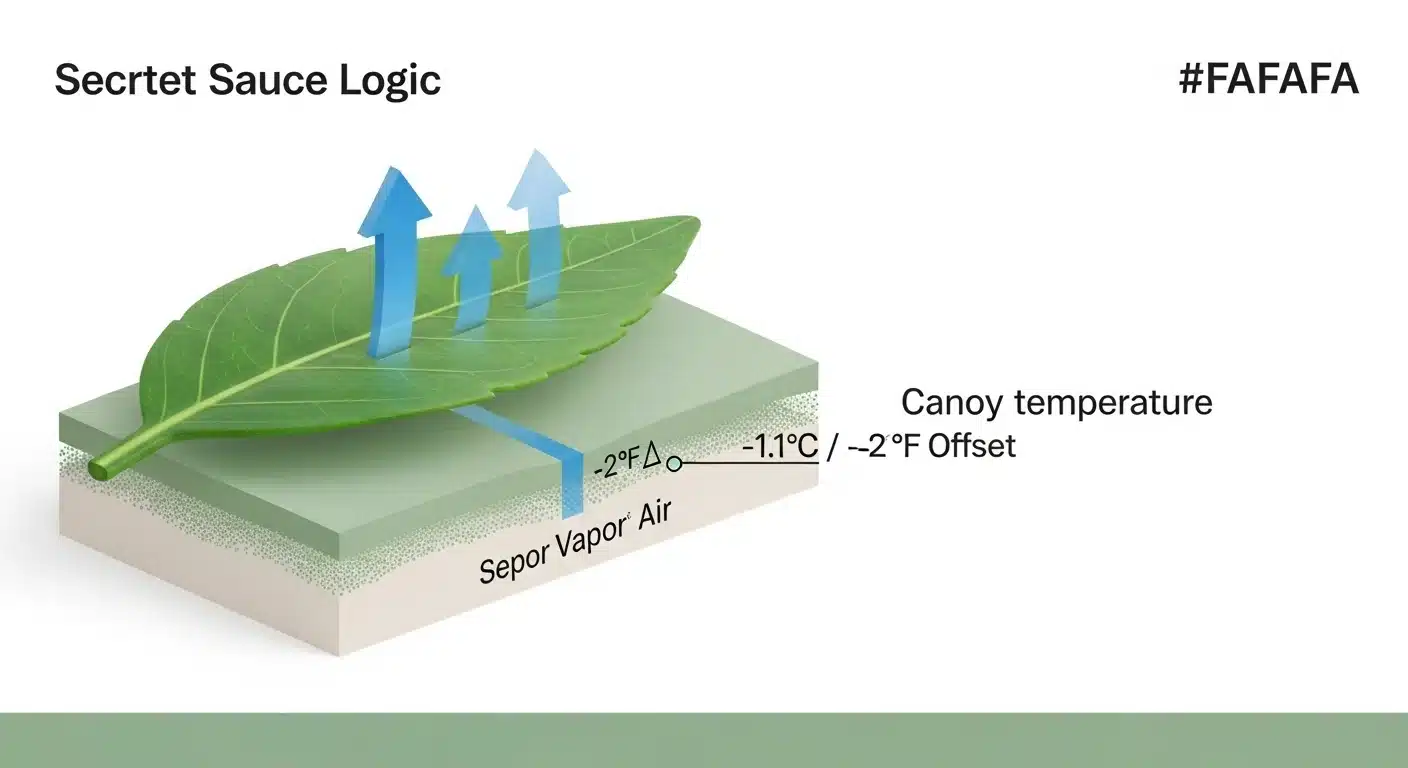
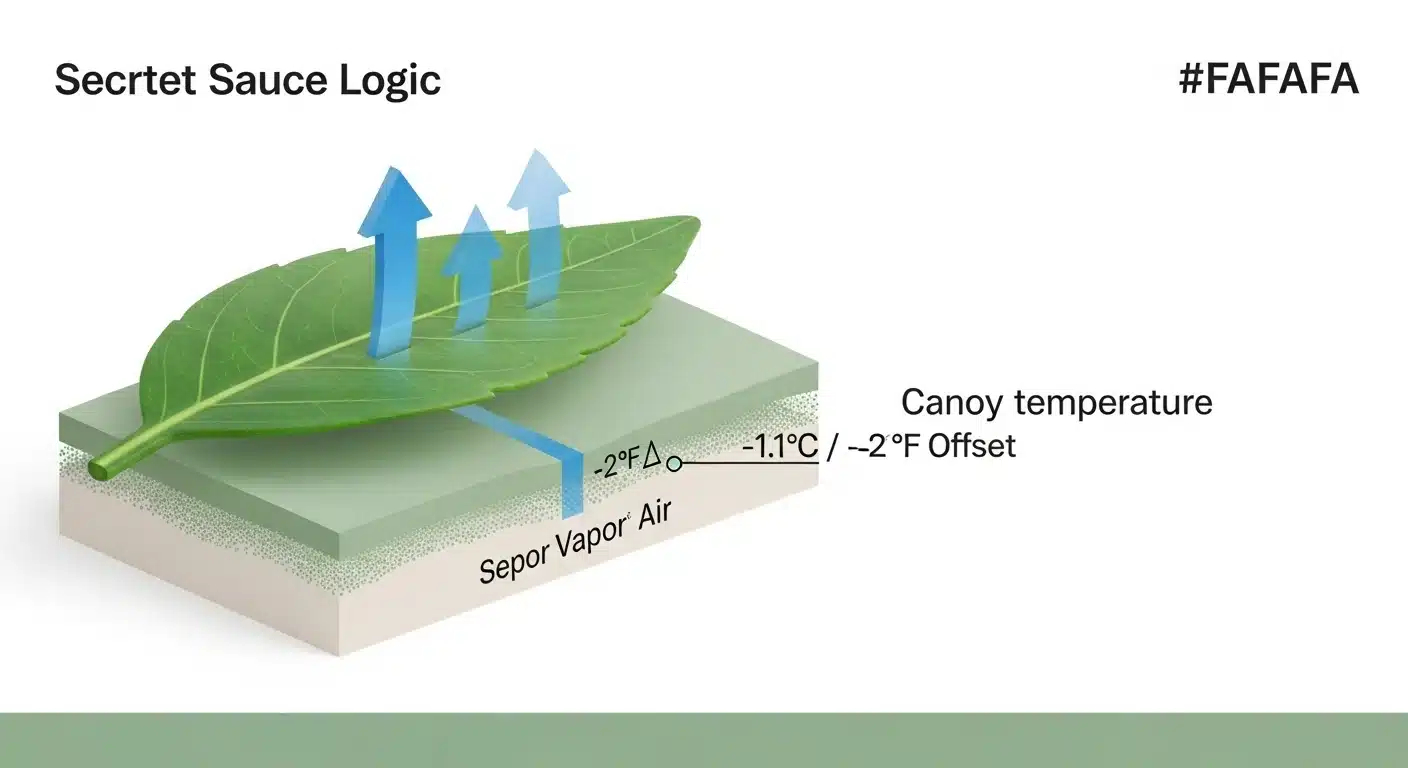

Vapor pressure deficit is not a humidity reading. It is the driving force behind plant transpiration, and it is calculated from two separate temperatures: the air and the leaf surface. Most growers measure one and ignore the other, which is why their VPD numbers look right on paper but their plants still struggle. The difference between air temperature and canopy temperature is small in absolute terms, but because SVP follows an exponential curve, even a 2°F gap shifts the result enough to move a plant from the optimal zone into the stress zone.
This calculator computes saturation vapor pressure at the canopy leaf surface, subtracts the actual vapor pressure derived from your ambient relative humidity, and returns the true vapor pressure deficit in kilopascals. It does not predict yield, model transpiration rate, or account for species-specific stomatal conductance. What it does is give you the one number that connects temperature, humidity, and plant water movement in a single, actionable value. If you are also tracking dew point as a secondary moisture metric, The Yield Grid’s dew point calculator pairs naturally with this tool for a complete picture of your air moisture conditions.
After running this calculator, you will know whether to adjust your humidifier, heater, or both, and which growth stage zone you are currently operating in.
Use the Tool
| RH % | VPD (kPa) | Stage |
|---|
How This Calculator Works
SVP (kPa) = 0.6108 × e^(17.27 × T_c / (T_c + 237.3))
where T_c is temperature in °C.
AVP (kPa) = SVP × (RH / 100)
VPD (kPa) = SVP_canopy − AVP_air
The canopy temperature defaults to air temp −2°F (−1.1°C) if not entered, as leaf surfaces typically run cooler than ambient air.
▸ Assumptions & Limits
- Valid input ranges: Temperature −10°C to 60°C (14°F–140°F), RH 1%–99%.
- SVP uses the Tetens equation (Arrhenius approximation), accurate to ±0.1% between 0–50°C.
- Canopy temperature defaults to air temp −1.1°C (−2°F) when not provided — adjust for your specific environment (LEDs run cooler than HPS).
- VPD stages: Seedling/Clone <0.4 kPa; Veg 0.8–1.2 kPa; Flower/Late Veg 1.2–1.6 kPa; Flush/Ripen up to 2.0 kPa.
- Results are for guidance only. Always use a calibrated hygrometer and thermometer in your grow space.
- This calculator does not account for CO₂ enrichment, airflow, or transpiration rate differences between species.
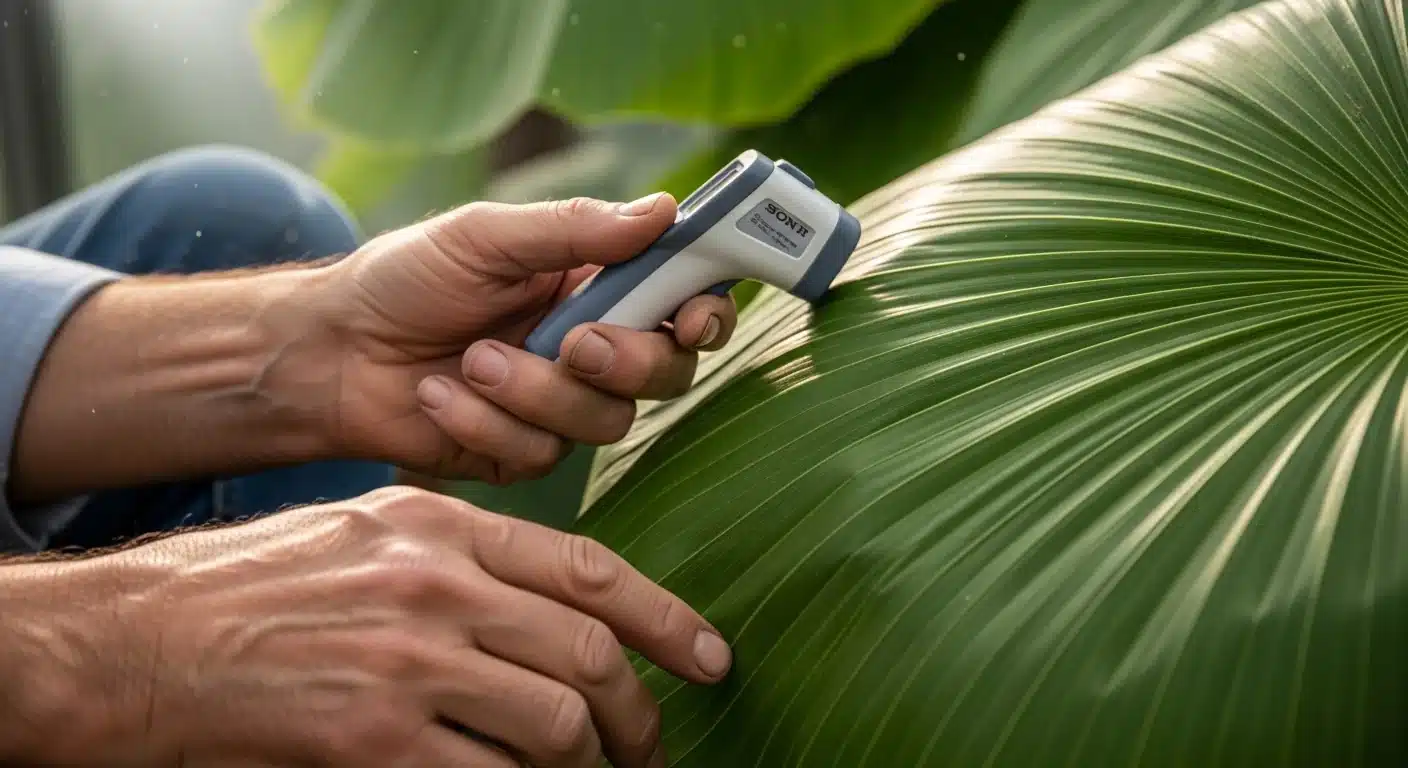
Before entering values, have a calibrated thermometer reading from canopy height, not from a wall-mounted unit at ceiling level. Your hygrometer should also be positioned at the plant canopy, ideally inside the leaf canopy for accuracy. If you have an infrared thermometer, measure the top surface of a representative leaf for canopy temperature. If you do not, leave that field blank and the calculator will apply the standard 2°F default offset. Degrees Fahrenheit and Celsius are both supported via the toggle above the temperature field.
Quick Start (60 Seconds)
- Air Temperature: Enter the reading from a thermometer placed at mid-canopy height. Use the °F/°C toggle to match your instrument. Ceiling-mounted probes read 3 to 8 degrees cooler than canopy-level, so avoid them.
- Relative Humidity: Enter a value between 1 and 99. Values at 0 or 100 are physically implausible in any real grow environment and will be rejected. Sensor placement at the canopy is critical; wall sensors near vents read differently than in-canopy conditions.
- Canopy Temperature (optional): If you have an IR thermometer, enter the leaf surface temperature. If this field is left blank, the calculator subtracts 2°F (1.1°C) from your air temperature automatically. LED fixtures tend to produce a smaller leaf-to-air temperature gap than HPS; with LEDs, consider measuring directly.
- Unit consistency: All three temperature fields interpret input using the same °F/°C selection. Do not toggle mid-entry.
- Click Calculate: The result appears only after all required fields pass validation. Fix any inline errors before proceeding.
- Reset between measurements: Use the Reset button when switching between grow zones or growth stages to avoid carrying stale values forward.
Inputs and Outputs (What Each Field Means)
| Field | Unit | What it means | Common mistake | Safe entry guidance |
|---|---|---|---|---|
| Air Temperature | °F or °C | Dry-bulb air temperature at canopy height, used to calculate actual vapor pressure (AVP) from RH | Reading from a sensor mounted above the canopy or near a HVAC return | Valid range: 14°F to 140°F (−10°C to 60°C). Place sensor at mid-canopy. |
| Relative Humidity | % | Ratio of actual water vapor in air to the maximum possible at that temperature, determines AVP | Using whole-room average RH instead of in-canopy measurement; canopy microclimate often differs by 5 to 15 points | Enter 1 to 99. Values outside this range will not compute. |
| Canopy Temperature | °F or °C (optional) | Leaf surface temperature, used for SVP at the canopy; this is where transpiration actually occurs | Assuming it equals air temperature; leaf surfaces run cooler under most lighting, especially LEDs | Measure with IR thermometer aimed at upper leaf surface. Leave blank to use the 2°F default offset. |
| SVP (output) | kPa | Saturation Vapor Pressure at air temperature; the ceiling for how much water vapor the air can hold | Confusing this with the canopy SVP, which is what drives VPD | Output only; used internally to compute AVP. |
| AVP (output) | kPa | Actual Vapor Pressure in the air; how much water is actually present, derived from SVP x (RH / 100) | Thinking a low AVP always means low VPD; low AVP with high canopy temp produces dangerous VPD | Output only. |
| VPD (output) | kPa | The deficit between water vapor at the leaf surface and water vapor in the air; the transpiration driver | Targeting a VPD number from a chart calibrated to a different temperature than your actual room | 0.8 to 1.2 kPa for veg; 1.2 to 1.6 kPa for flower. Numbers below 0.4 or above 2.0 require immediate action. |
For managing the temperature side of the VPD equation in a greenhouse or grow room, The Yield Grid's greenhouse heater sizing calculator helps you determine the heating capacity needed to hold your target air temperature range.
Worked Examples (Real Numbers)
Example 1: Vegetative Stage, Indoor LED Room
- Air Temperature: 77°F (25.0°C)
- Relative Humidity: 65%
- Canopy Temperature: 75°F (23.9°C) (measured with IR thermometer)
SVP at canopy (23.9°C) = 0.6108 x e^(17.27 x 23.9 / (23.9 + 237.3)) = 2.965 kPa
SVP at air (25.0°C) = 0.6108 x e^(17.27 x 25.0 / (25.0 + 237.3)) = 3.167 kPa
AVP = 3.167 x (65 / 100) = 2.059 kPa
VPD = 2.965 − 2.059 = 0.91 kPa
Result: 0.91 kPa (Optimal Veg Zone)
This environment sits cleanly in the vegetative optimal range. Stomata are open, transpiration is driving nutrient uptake, and there is no meaningful mold pressure. No adjustment needed.
Example 2: Flower Stage, Greenhouse Mid-Summer
- Air Temperature: 82°F (27.8°C)
- Relative Humidity: 55%
- Canopy Temperature: 80°F (26.7°C)
SVP at canopy (26.7°C) = 0.6108 x e^(17.27 x 26.7 / (26.7 + 237.3)) = 3.502 kPa
SVP at air (27.8°C) = 0.6108 x e^(17.27 x 27.8 / (27.8 + 237.3)) = 3.734 kPa
AVP = 3.734 x (55 / 100) = 2.054 kPa
VPD = 3.502 − 2.054 = 1.45 kPa
Result: 1.45 kPa (Optimal Flower Zone)
This is ideal for late-vegetative through mid-flower. The humidity is low enough to suppress botrytis and powdery mildew, and transpiration is brisk. Hold this range through weeks two through six of flower.
Example 3: Danger Zone, Hot Day with Low Humidity
- Air Temperature: 85°F (29.4°C)
- Relative Humidity: 45%
- Canopy Temperature: 83°F (28.3°C)
SVP at canopy (28.3°C) = 0.6108 x e^(17.27 x 28.3 / (28.3 + 237.3)) = 3.846 kPa
SVP at air (29.4°C) = 0.6108 x e^(17.27 x 29.4 / (29.4 + 237.3)) = 4.099 kPa
AVP = 4.099 x (45 / 100) = 1.845 kPa
VPD = 3.846 − 1.845 = 2.00 kPa
Result: 2.00 kPa (Danger High)
At this VPD, most crops will begin closing stomata defensively within the hour, halting CO2 uptake and nutrient transport. Adding humidity via a misting or humidification system is the fastest response; a longer-term fix requires cooling the space below 82°F.
Reference Table (Fast Lookup)
All VPD values below are computed using the Tetens equation with the standard 1.1°C (2°F) canopy offset applied. SVP column reflects air temperature; AVP is derived from SVP x RH.
| Air Temp | RH % | SVP at Air (kPa) | AVP (kPa) | VPD (kPa) | Stage Zone |
|---|---|---|---|---|---|
| 64°F / 18°C | 50 | 2.064 | 1.032 | 0.89 | Veg Optimal |
| 68°F / 20°C | 40 | 2.337 | 0.935 | 1.25 | Flower Optimal |
| 68°F / 20°C | 60 | 2.337 | 1.402 | 0.78 | Borderline Low |
| 72°F / 22°C | 55 | 2.644 | 1.454 | 1.02 | Veg Optimal |
| 75°F / 24°C | 50 | 2.982 | 1.491 | 1.30 | Flower Optimal |
| 77°F / 25°C | 65 | 3.167 | 2.059 | 0.91 | Veg Optimal |
| 81°F / 27°C | 55 | 3.564 | 1.960 | 1.38 | Flower Optimal |
| 81°F / 27°C | 45 | 3.564 | 1.604 | 1.74 | High (Late Flower) |
| 84°F / 29°C | 45 | 4.005 | 1.802 | 1.96 | High (Stress Risk) |
| 86°F / 30°C | 40 | 4.241 | 1.696 | 2.28 | Danger (Immediate Action) |
How the Calculation Works (Formula + Assumptions)
Show the calculation steps
Step 1: Saturation Vapor Pressure (SVP)
SVP is the maximum pressure water vapor can exert at a given temperature. It is computed using the Tetens approximation of the Arrhenius equation:
SVP (kPa) = 0.6108 x e^( 17.27 x T_c / (T_c + 237.3) )
T_c is temperature in degrees Celsius. If you enter Fahrenheit, the calculator converts using T_c = (T_f − 32) x 5 / 9 before applying the formula. This SVP is calculated twice: once at air temperature (for AVP) and once at canopy temperature (for the VPD numerator).
Step 2: Actual Vapor Pressure (AVP)
AVP represents the water vapor actually present in the air:
AVP (kPa) = SVP_air x (RH / 100)
Relative humidity is conceptually the ratio of AVP to SVP, so rearranging gives AVP directly. RH must be entered as a whole or decimal percentage (not as a decimal fraction).
Step 3: Vapor Pressure Deficit (VPD)
VPD is the difference between the water vapor pressure the leaf surface can sustain and the water vapor pressure actually in the surrounding air:
VPD (kPa) = SVP_canopy − AVP_air
A positive result means air is drier than the leaf surface, which drives transpiration. If the result were zero or negative (saturation), transpiration would stop entirely and condensation risk rises sharply.
Rounding rules: All intermediate values are carried to full floating-point precision. The final VPD output is rounded to two decimal places. SVP and AVP sub-outputs are shown to three decimal places for diagnostic use.
Unit conversion: Fahrenheit is converted to Celsius before any formula computation. Output is always in kPa. One kPa equals 10 millibars or approximately 0.145 psi.
Assumptions and Limits
- The Tetens equation is accurate to within 0.1% for temperatures between 0°C and 50°C. Outside this range (particularly above 45°C) small errors accumulate; at the validator cutoff of 60°C, results should be treated as approximate.
- The 2°F (1.1°C) canopy offset is a widely cited horticultural default. Under high-intensity LEDs with strong airflow, leaf-to-air temperature differentials of 1°F or less are possible; under HPS or in stagnant air, differentials of 3 to 5°F are more common. Direct IR measurement removes this assumption entirely.
- This formula treats air as a homogeneous gas. In practice, humidity stratifies: canopy microclimates, wall boundaries, and near-vent zones all vary. A single sensor reading is a sample, not a room average.
- CO2 enrichment changes stomatal behavior independently of VPD. At elevated CO2 concentrations (above 800 ppm), plants can tolerate slightly higher VPD without fully closing stomata, but the calculator does not model this interaction.
- The tool does not apply species-specific corrections. Different crops (tomato, cannabis, lettuce, cucumber) have different stomatal sensitivities and optimal VPD targets. The zones shown (Veg 0.8 to 1.2 kPa, Flower 1.2 to 1.6 kPa) are broadly applicable but are not substitutes for crop-specific data.
- This calculator is not validated against psychrometric charts for use above 50°C or below −10°C. Inputs outside the accepted range are rejected with an inline validation error.
Standards, Safety Checks, and "Secret Sauce" Warnings
Critical Warnings
- VPD above 2.0 kPa triggers stomatal shutdown. Plants close stomata to prevent wilting, which also locks out CO2 and halts nutrient uptake via the transpiration stream. This is not a gradual decline; many crops show observable stress (leaf cupping, bleaching at margins) within one to two hours. Immediate humidity addition is required. The Yield Grid's dehumidifier sizing calculator is designed for the opposite problem (excess humidity), but knowing your dehumidifier's range helps you understand why humidity sometimes drops too fast in air-conditioned rooms.
- VPD below 0.4 kPa is a mold incubator. Near-saturated air collapses the humidity gradient that drives transpiration, leaving free moisture on leaf surfaces and suppressing the plant's own defense response against pathogens. Botrytis and powdery mildew both have optimal infection thresholds at humidity levels that correspond to VPD under 0.4 kPa.
- Using air temperature only, without a canopy offset, systematically undercalculates VPD. If canopy temperature is actually 3°F below air temperature and you use air temperature for both, you overstate SVP_canopy and understate the real deficit. The error is usually 0.05 to 0.15 kPa, which is enough to place a Borderline result in the Safe zone visually.
- RH swings with temperature even if absolute humidity stays constant. Heating a room drops RH without removing any moisture, which spikes VPD. This is a common early-morning spike in greenhouses when heating activates at dawn. High VPD during the first two hours of the light cycle stresses plants during their most active transpiration window.
Minimum Standards
- Veg stage target: 0.8 to 1.2 kPa. Below 0.8 kPa, reduce humidity or raise temperature. Above 1.2 kPa, add humidity before entering flower.
- Flower stage target: 1.2 to 1.6 kPa. Below 1.2 kPa for extended periods during flower increases botrytis risk. Above 1.6 kPa increases tip burn risk on sensitive crops and signals the room needs cooling or humidification.
- Sensors must be calibrated and positioned at canopy level. A sensor more than 1 meter above the canopy in a sealed room can read 10 to 20 points lower in RH than in-canopy conditions during peak transpiration hours.
Competitor Trap: Many online VPD charts plot vapor pressure deficit against a single ambient temperature, using that same temperature for both SVP and AVP. They present clean, symmetric tables, but they omit the canopy temperature correction entirely. The result is a chart that is accurate only if leaf temperature exactly equals air temperature, which is almost never true in a working grow environment. These charts are useful as a rough guide but routinely misplace growers by 0.1 to 0.2 kPa relative to actual canopy conditions.
If you enrich with CO2, your climate targets interact with CO2 saturation rates. The Yield Grid's CO2 calculator helps you quantify CO2 input requirements, which pairs with VPD targets when tuning your full environmental control strategy.
Common Mistakes and Fixes
Mistake: Placing the RH sensor near an air inlet or exhaust port
Sensors near inlet ports sample incoming conditioned air, not the canopy microclimate. During peak plant transpiration, in-canopy RH can run 10 to 20 points higher than near an active supply vent, which means VPD at the leaf surface is much lower than the sensor suggests. This error masks a genuine mold risk. Place sensors horizontally within the canopy at mid-plant height, away from direct airflow. Mounting them on a stake at canopy level rather than hanging them from above gets the reading into the actual plant environment.
Mistake: Targeting a fixed RH number rather than a VPD range
Because SVP changes exponentially with temperature, the same RH value produces very different VPD at different temperatures. At 68°F and 60% RH, VPD is approximately 0.78 kPa. At 81°F and 60% RH, VPD climbs to roughly 1.10 kPa. A grower who holds 60% RH as a fixed target is inadvertently shifting VPD zones every time room temperature changes. The fix is to track VPD directly and adjust RH dynamically based on temperature, which is exactly what this calculator supports.
Mistake: Ignoring airflow as a VPD control mechanism
Still air allows a saturated boundary layer to form on the leaf surface. This boundary layer effectively raises local RH at the leaf surface above room-level RH, lowering actual transpiration-driving VPD below what the sensor reports. Adequate airflow keeps the boundary layer thin and keeps VPD at the leaf closer to what the room measurements indicate. If your VPD looks right but plants still show slow growth or moisture stress symptoms, check airflow coverage before adjusting temperature or humidity. The Yield Grid's greenhouse fan sizing calculator provides a useful starting point for air circulation requirements in enclosed grow spaces.
Mistake: Running the same VPD target from seedling through harvest
Seedlings and clones with limited root systems cannot sustain the transpiration rate that a 1.2 kPa VPD demands. Running flowering-stage VPD on young plants causes wilting even when roots and soil moisture are adequate, because the leaves cannot pull water fast enough against the vapor pressure gradient. Keep VPD below 0.8 kPa for the first two to three weeks, then transition upward as root mass develops. The growth-stage zone indicators in the results panel flag this boundary explicitly.
Mistake: Measuring canopy temperature under lights that are off
An IR thermometer reading taken just after lights come on, or during a lights-off period, reflects equilibrated air temperature rather than the warmer leaf surface temperature that develops under active lighting and radiation loading. This leads to an assumed canopy offset that does not represent actual conditions during the transpiration-active light period. Always measure canopy temperature mid-way through the light cycle, when thermal equilibrium under the fixture has been established for at least 30 minutes.
Next Steps in Your Workflow
Once you have confirmed your VPD is within the target zone, the next control variable to verify is light intensity. VPD and daily light integral are co-dependent: plants running optimal VPD but receiving too little light will still underperform because photosynthesis, not transpiration, is the limiting factor. The Yield Grid's DLI calculator lets you compute daily light integral from your PPFD measurement and photoperiod, which is the natural companion check once climate is dialed in.
For growers using a data-driven approach to vegetative and generative steering, VPD is one of several integrated environmental targets that shift week by week through the crop cycle. Logging your VPD readings alongside irrigation timing, EC, and plant response observations gives you the dataset needed to identify which variable is actually limiting at any given moment. The Yield Grid's crop steering calculator is designed to help structure that kind of multi-variable thinking into a usable workflow.
FAQ
What is a good VPD for vegetative growth?
The widely accepted target for vegetative growth is 0.8 to 1.2 kPa. Below 0.8 kPa, transpiration slows and nutrient uptake suffers. Above 1.2 kPa, the plant begins diverting energy toward water conservation rather than growth. Both temperature and humidity interact to produce this number, so a single RH target without a temperature reference is not sufficient guidance.
What is a good VPD for flowering plants?
The flowering stage target is typically 1.2 to 1.6 kPa. This higher deficit keeps humidity low enough to reduce botrytis and powdery mildew risk while still driving strong transpiration for resin and terpene production. Some cultivars tolerate up to 1.8 kPa in the final two weeks before harvest without visible stress, but this varies by variety and should be tested cautiously.
Does VPD use air temperature or leaf temperature?
Technically, both. The saturation vapor pressure that drives transpiration is calculated at the leaf surface (canopy temperature), while the actual vapor pressure in the air is derived from air temperature and relative humidity. Most simplified VPD calculators use air temperature for both steps, which introduces a systematic underestimate of the true vapor pressure deficit. This calculator separates the two temperatures.
What unit is VPD measured in?
VPD is measured in kilopascals (kPa) in horticultural applications. Older scientific literature sometimes uses millibar (1 kPa = 10 mbar) or hectopascal. The growth-stage zones commonly cited in controlled environment agriculture (0.8 to 1.2 kPa, 1.2 to 1.6 kPa) are expressed in kPa. Do not confuse VPD in kPa with dew point temperature or absolute humidity, which are different moisture metrics.
Can VPD be too low even if humidity is not high?
Yes. VPD depends on the balance between temperature and humidity. A cold room at moderate humidity can produce a very low VPD because cold air holds little moisture, so even 60% RH at 60°F yields a lower vapor pressure than 60% RH at 80°F. This is why heating a grow space during cool nights raises VPD without any change to the moisture content of the air, and why temperature management is as important as humidity management.
How often should I check VPD?
At minimum, check at the start of the lights-on period and mid-way through the light cycle, since temperature and humidity both drift as lights heat the space and plants transpire. In a well-controlled sealed room, once per shift is often adequate. In a greenhouse with outdoor weather exposure, checking every two to four hours during high-demand days gives you the data needed to prevent dangerous spikes during heat events.
Conclusion
Vapor pressure deficit is a more complete climate metric than relative humidity alone because it accounts for both temperature and the specific location where gas exchange actually happens: the leaf surface, not the room air. The single most impactful upgrade most growers can make to their VPD practice is adding a canopy temperature measurement rather than assuming leaf equals air. That one data point shifts the calculation from an approximation to an accurate representation of the transpiration gradient your plants are actually experiencing.
The number one mistake to avoid is using a fixed RH target without temperature reference. RH means nothing in isolation; the same 60% can represent an optimal veg environment at one temperature and a dangerous low-VPD situation at another. Once your VPD is confirmed and you are ready to optimize further, The Yield Grid's grow room AC sizing calculator helps you verify that your cooling capacity is sufficient to hold the target temperature range during peak lighting hours, which is the single largest driver of VPD swings in sealed indoor environments.