
Peat Moss Coverage Calculator
Soil, Fertilizer & Amendments — Bag quantity estimator
| Area (sq ft) | Depth (in) | Volume (cu ft) | Bags Needed |
|---|
How this calculator works
Formula steps:
1. Calculate raw volume: Volume (cu ft) = Area (sq ft) × Depth (in) ÷ 12
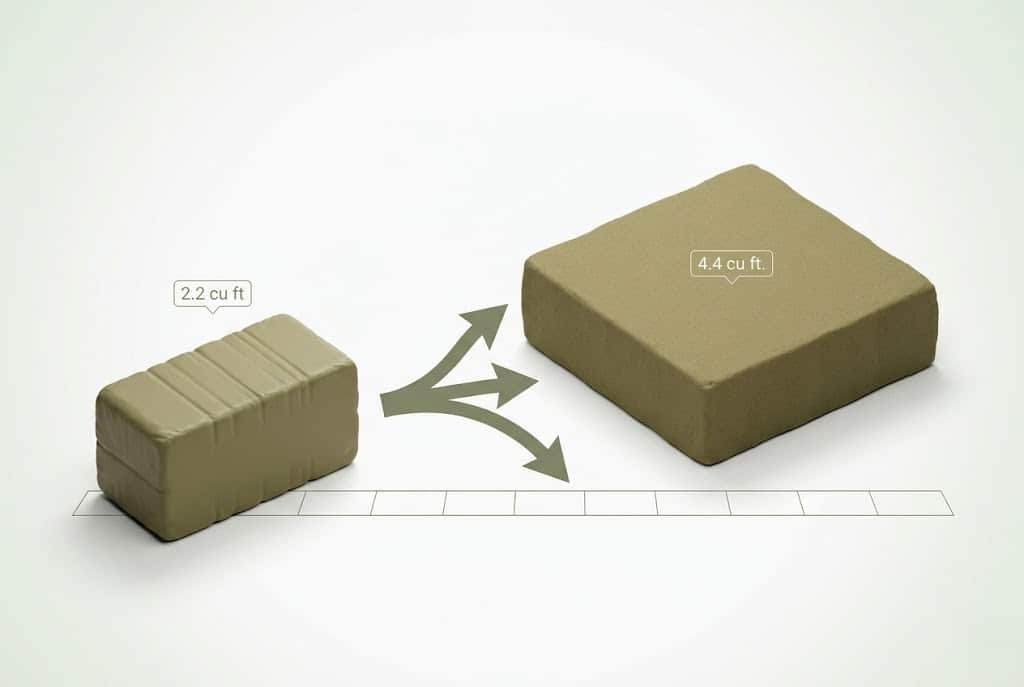
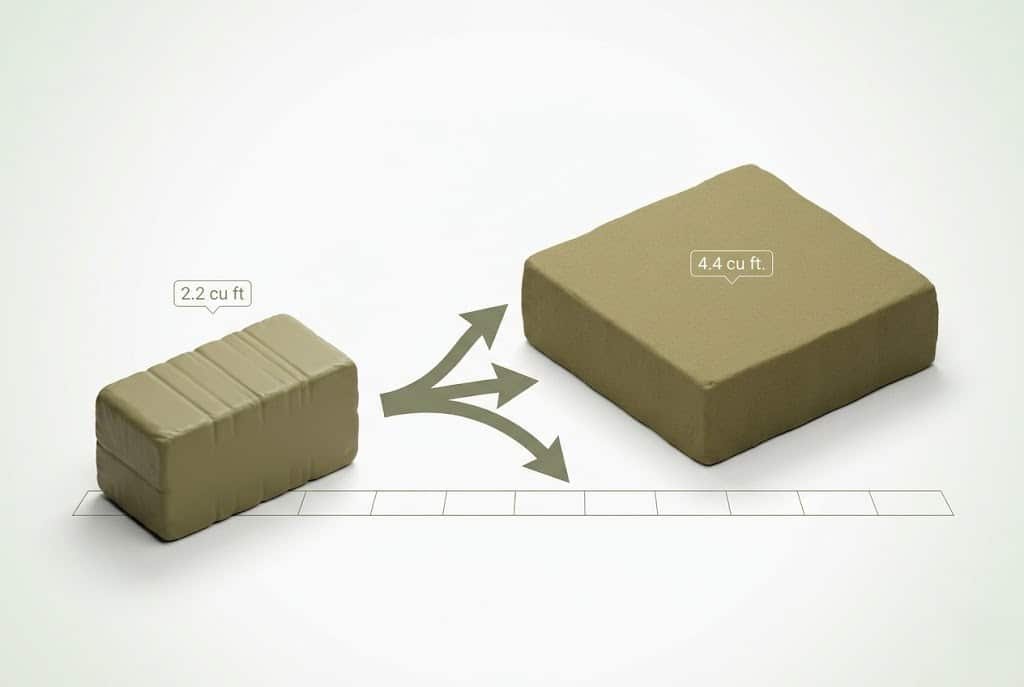
2. Apply compression factor (2:1): Peat moss is sold compressed. One standard bale is 2.2 cu ft compressed and expands to ~4.4 cu ft when applied. We use the expanded volume (4.4 cu ft) per bale:
Bags = Volume ÷ 4.4
3. Round up to the nearest whole bale (you can’t buy a fraction of a bale).
Assumptions & limits:
• Standard bale = 2.2 cu ft compressed / 4.4 cu ft expanded | Area: 1–100,000 sq ft | Depth: 0.25–12 inches
• Results assume uniform application. Actual coverage may vary with settling and moisture content.
• Always purchase 5–10% extra for uneven terrain or re-application.
Peat moss sold in bales is compressed before packaging, which means the volume printed on the label is not the volume you spread across your beds. A 2.2 cubic foot bale expands to roughly 4.4 cubic feet once opened and loosened, a 2:1 expansion ratio that most coverage guides simply ignore. Skipping that factor produces a bag estimate that is half what you actually need, leading to either a second unplanned trip to the nursery or a project left half-finished.
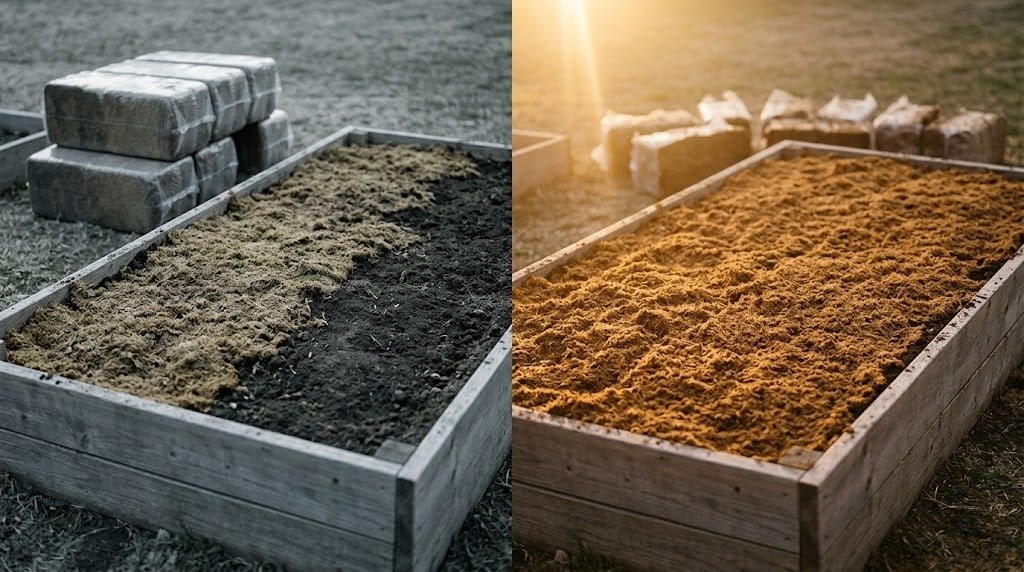
This peat moss calculator takes your target area in square feet and your intended layer depth in inches, converts that to expanded cubic feet of coverage, and divides by the actual yield of one standard compressed bale. It returns the number of whole bales to purchase. It does not account for variable moisture content in aged or reclaimed peat, material lost to wind during application, or differences between fine and coarse peat grades. Those factors are real but not deterministic, so the result here is a minimum-quantity baseline, not a guarantee of perfect coverage.
After running the calculator, add one bale to the total as a working buffer, especially on sloped or uneven terrain where application depth varies across the bed.
Use the Tool
Before entering values, measure your area in square feet and decide on a target application depth in inches. Typical topdressing runs 1 to 2 inches; soil amendment for a new bed often calls for 2 to 3 inches. Have both numbers written down before you start so you do not estimate mid-entry. If your project spans multiple beds, run a separate calculation per bed, then sum the results.
Planning a raised bed build alongside your peat amendment? The raised bed soil calculator can help you size the full soil volume before you decide how much of that mix should be peat.
Quick Start (60 Seconds)
- Area (sq ft): Length times width of the zone you are amending. For irregular beds, break the shape into rectangles, calculate each, and add them. Do not enter square yards or square meters.
- Layer Depth (in): How thick the peat layer will be after spreading, not after watering in. Enter decimals, not fractions: 1.5 inches, not 1-1/2.
- Minimum depth entry: The calculator accepts values down to 0.25 inches. Below 1 inch, the tool will flag a warning; peat applied at less than 1 inch tends to dry out and blow before it integrates with the soil surface.
- Maximum depth entry: The field accepts up to 12 inches, but layers above 4 inches carry a separate warning. Thick peat applications can become water-repellent when dry, creating a hydrophobic barrier above the root zone.
- The bag count rounds up: You cannot buy a fraction of a bale, so the result is always the next whole number above the raw calculation. This is intentional.
- Do not use the compressed volume: The formula is built around expanded volume. If you enter depth already adjusted for compression, you will significantly overestimate your purchase.
- Add a buffer: The result is a minimum. For projects over 500 sq ft or with uneven terrain, purchasing one or two additional bales prevents a shortfall on the final rows.
Inputs and Outputs (What Each Field Means)
| Field | Unit | What it means | Common mistake | Safe entry guidance |
|---|---|---|---|---|
| Coverage Area | sq ft | The ground surface area receiving the peat application | Entering the perimeter instead of the area | Measure length and width separately; multiply. Use 1 to 100,000 sq ft. |
| Layer Depth | inches | The intended finished thickness of the peat layer after spreading | Confusing “depth of bag” with depth of application layer | Enter 0.25 to 12. Use 1 to 3 for most garden and topdressing uses. |
| Bags Needed (output) | standard bales | Number of 2.2 cu ft compressed bales (expanding to 4.4 cu ft each) required to cover the area at the specified depth | Treating the output as compressed cubic feet rather than whole bale count | Always round up at the store; never round down on a landscape purchase. |
Worked Examples (Real Numbers)
Example 1: Raised Vegetable Bed Amendment (150 sq ft, 2-inch layer)
- Area: 150 sq ft
- Depth: 2 inches
- Raw volume: 150 x 2 / 12 = 25.0 cu ft
- Raw bale count: 25.0 / 4.4 = 5.68
Result: 6 standard bales
A modest raised bed amendment at 2 inches deep sits at the lower end of the recommended range. Six bales is the minimum; buying seven provides a workable reserve if the bed has elevated corners or settled low spots.
Example 2: Lawn Topdressing (800 sq ft, 1-inch layer)
- Area: 800 sq ft
- Depth: 1 inch
- Raw volume: 800 x 1 / 12 = 66.67 cu ft
- Raw bale count: 66.67 / 4.4 = 15.15
Result: 16 standard bales
Topdressing at 1 inch is the minimum effective depth for peat-based applications on turf. Sixteen bales covers 800 sq ft cleanly; anything shallower on a lawn this size risks an inconsistent layer that dries unevenly and introduces patchy germination if overseeding is involved.
Example 3: New Garden Bed Preparation (400 sq ft, 3-inch layer)
- Area: 400 sq ft
- Depth: 3 inches
- Raw volume: 400 x 3 / 12 = 100.0 cu ft
- Raw bale count: 100.0 / 4.4 = 22.73
Result: 23 standard bales
A 3-inch incorporation depth is typical for converting hard or clay-dominated soil before planting. At this volume, confirm bale weight (approximately 40 lbs per compressed bale) with your supplier before delivery scheduling, as 23 bales represent roughly 920 lbs of material to move.
Reference Table (Fast Lookup)
| Area (sq ft) | Depth (in) | Expanded Volume (cu ft) | Raw Bale Count | Bales to Buy | +10% Buffer (bales) |
|---|---|---|---|---|---|
| 100 | 1 | 8.3 | 1.89 | 2 | 3 |
| 100 | 2 | 16.7 | 3.79 | 4 | 5 |
| 250 | 1 | 20.8 | 4.73 | 5 | 6 |
| 250 | 2 | 41.7 | 9.47 | 10 | 11 |
| 500 | 1 | 41.7 | 9.47 | 10 | 11 |
| 500 | 2 | 83.3 | 18.93 | 19 | 21 |
| 500 | 3 | 125.0 | 28.41 | 29 | 32 |
| 1,000 | 1 | 83.3 | 18.93 | 19 | 21 |
| 1,000 | 2 | 166.7 | 37.88 | 38 | 42 |
| 2,000 | 2 | 333.3 | 75.76 | 76 | 84 |
The “+10% Buffer” column adds one bale for small projects and scales proportionally for larger orders. Use this column, not the minimum, for any bed where re-leveling or double-passes are likely.
How the Calculation Works (Formula and Assumptions)
Show the calculation steps
Step 1: Convert area and depth to cubic feet
Volume (cu ft) = Area (sq ft) x Depth (in) / 12
Dividing by 12 converts inches to feet so the units are consistent.
Step 2: Divide by expanded bale volume
Raw bales = Volume / 4.4
One standard compressed bale of peat moss is rated at 2.2 cu ft. The 2:1 compression factor means the usable expanded volume per bale is 4.4 cu ft. The formula uses 4.4, not 2.2.
Step 3: Round up to the nearest whole bale
Bales to buy = ceiling(Raw bales)
Ceiling rounding ensures you always have enough. A result of 5.01 rounds to 6, not 5.
Assumptions and Limits
- The formula assumes the standard North American compressed bale of 2.2 cu ft. Compressed bales sold in some markets (UK, EU) may differ in volume; verify the label before using this calculator.
- Expansion ratio is fixed at 2:1. Peat that has partially dried in storage, been re-wetted, or is sold pre-loosened may expand differently. The tool cannot account for storage condition variation.
- Application depth is assumed uniform across the entire area. In practice, beds with irregular surfaces, slopes, or raised edges will require more material in low spots.
- The calculator does not model settling. Peat moss compresses after watering in; if you need 2 inches of finished, settled depth, apply closer to 2.5 inches initially.
- Results apply to sphagnum peat moss in compressed bale form. Loose peat, peat pellets, or peat-based potting blends have different bulk densities and should not use this calculator as-is.
- The maximum accepted area is 100,000 sq ft and maximum depth is 12 inches. Projects outside those ranges may require bulk material sourcing, where cubic yards rather than bale counts are the appropriate unit.
Standards, Safety Checks, and “Secret Sauce” Warnings
Critical Warnings
- The 2:1 compression factor is non-negotiable. Any peat moss coverage guide that calculates bags using the compressed volume printed on the bale label will underestimate your need by a factor of two. This tool applies the expansion ratio before dividing. If a competing calculator gives you a bag count that is roughly half of what this tool produces, compression was not accounted for.
- Layers deeper than 4 inches introduce hydrophobicity risk. Thick peat applications, particularly with fine-grade sphagnum, can dry into a water-repellent mat during summer heat. The tool flags this threshold. If your project requires more than 4 inches of organic amendment, consider replacing a portion of that volume with compost to reduce the hydrophobic risk. The compost calculator can help size that portion of the mix.
Minimum Standards
- Apply peat moss at a minimum of 1 inch for it to function as a meaningful surface amendment. Thinner layers dry out before the material integrates with the soil and provide negligible water retention benefit.
- Standard bale specification: 2.2 cu ft compressed, yielding 4.4 cu ft expanded, at approximately 40 lbs per bale. Verify your supplier’s bale spec matches this before ordering in large quantities.
Competitor Trap
Several coverage guides and nursery bag calculators online divide your target volume directly by 2.2 (the compressed bale volume) rather than 4.4 (the expanded yield). This produces a result that is exactly double the correct bag count, and it is the single most common reason gardeners show up with far more peat than needed. This calculator uses the expanded volume, which is what you actually spread. If you have used another tool and the result looks much higher than what this calculator shows, check whether that tool applied a compression factor at all.
If your project involves adjusting soil pH as part of the amendment process, note that peat moss is naturally acidic and can reduce pH slightly over time. For sites where pH management is part of the plan, the lower soil pH calculator provides a more direct estimate of how much amendment is needed to hit a target pH, separate from coverage math.
Common Mistakes and Fixes
Mistake: Using Compressed Volume Instead of Expanded Volume
The bale label reads “2.2 cu ft” and that number sticks in mind during planning. Dividing your target volume by 2.2 instead of 4.4 produces a bag count twice as large as necessary. The material sitting in the garage after a job finished is almost always traceable to this error.
Fix: Always divide your required expanded volume by 4.4, or use this calculator, which applies the correct expansion automatically.
Mistake: Measuring Perimeter Instead of Area
Wrapping a tape measure around a bed returns its perimeter in linear feet, not its area in square feet. Entering 60 feet of perimeter for a 10 x 10 bed produces a wildly incorrect volume calculation. Area must be length times width.
Fix: For rectangular beds, multiply the two side lengths. For irregular shapes, break the area into smaller rectangles, calculate each, and sum the results before entering the total.
Mistake: Applying the Settled Depth as the Input Depth
Peat moss compresses after the first irrigation cycle. A freshly spread 2-inch layer may settle to 1.5 inches within a few weeks. Entering the desired settled depth as the application depth results in under-purchasing.
Fix: Add 20 to 25 additional depth to the planned application layer to account for settling. If you want 2 inches settled, enter 2.4 to 2.5 inches in the depth field.
Mistake: Running One Calculation for a Multi-Bed Project
Gardens with multiple distinct beds at different depths cannot be averaged into a single area entry without error. A front bed at 1 inch and a side bed at 3 inches represent very different material needs per square foot, and blending them into one average depth introduces cumulative error across the order.
Fix: Run separate calculations for each bed or zone, then add the individual bale counts. The total is more accurate than any weighted average approach.
Mistake: Ignoring the Hydrophobicity Threshold at Deep Applications
Applications above 4 inches of peat can produce a layer that sheds water rather than absorbing it once the material dries. This defeats the primary purpose of the amendment. The risk is highest during dry summer periods when the peat surface dries faster than the layer below can equilibrate moisture.
Fix: For applications requiring more than 4 inches of organic matter, substitute compost for the increment above 4 inches. This maintains soil structure benefit while reducing hydrophobic risk at the surface interface.
Related Tools and Next Steps
Sizing the full soil volume for a new raised bed before deciding how much peat to include: raised bed soil calculator.
Designing a custom soil blend where peat is one of several components: soil mix calculator.
Calculating how much compost to combine with peat for a balanced amendment approach: compost calculator.
Estimating coco coir quantities as a renewable peat alternative with different expansion behavior: coco coir calculator.
Sizing potting soil volume for container projects where peat-based mixes are common: potting soil calculator.
Balancing carbon and nitrogen ratios in compost piles that include peat as a carbon source: compost ratio calculator.
Modeling how organic matter in amended soil releases nitrogen over time after peat incorporation: soil organic matter nitrogen release calculator.
Checking soil bulk density before and after peat amendment to quantify structural change: soil bulk density calculator.
FAQ
How many square feet does one bale of peat moss cover?
At a 1-inch application depth, one standard 2.2 cu ft compressed bale covers approximately 52.8 square feet after expansion to 4.4 cu ft. At 2 inches deep, that drops to about 26 sq ft per bale. At 3 inches, approximately 17.6 sq ft. Coverage shrinks proportionally as depth increases, which is why depth selection has a larger effect on bag count than most gardeners expect.
What is the difference between compressed and expanded peat moss volume?
Peat moss is compressed approximately 2:1 before packaging to reduce shipping volume. A bale labeled 2.2 cu ft contains material that, when loosened and spread, fills roughly 4.4 cu ft of space. Calculations that use the label volume instead of the expanded volume will produce a bag estimate that overestimates your need by approximately a factor of two.
Can I use this calculator for peat-based potting mixes or bagged garden soil?
No. Pre-blended potting mixes and bagged garden soils contain peat at varying ratios mixed with perlite, bark, or compost. Their effective expansion and coverage rates differ from pure peat bales. This calculator applies only to standard compressed sphagnum peat moss bales sold as a single-material amendment product.
Does peat moss lower soil pH, and should that affect how much I use?
Sphagnum peat moss is naturally acidic, with a pH typically in the 3.5 to 4.5 range. Incorporating it into alkaline or neutral soil will tend to reduce pH gradually over time. However, this calculator is a coverage quantity tool; it does not model pH outcomes. If pH adjustment is a goal, use a dedicated soil pH calculator alongside this one to plan the amendment strategy separately.
What depth should I use for topdressing a lawn versus amending a new garden bed?
Lawn topdressing typically runs 0.5 to 1 inch, thin enough to work through the grass canopy without smothering it. New garden bed amendment, where the goal is soil structure improvement before planting, commonly uses 2 to 3 inches tilled into the top 6 to 8 inches of soil. The two use cases have very different depth inputs and will produce very different bale counts for the same area.
Why does the calculator round up instead of rounding to the nearest whole bale?
Coverage calculations involve material you cannot split at the point of purchase. A shortfall on the last row of a bed means either stopping the project or returning to the store. The ceiling rounding rule ensures the purchased quantity is always sufficient. Any leftover material from a small remainder can be stored in a sealed bag for patch applications, seeding prep, or potting mix blending later.
Conclusion
The single most avoidable error in any peat amendment project remains using the compressed label volume in coverage math instead of the expanded working volume. Every calculation in this tool, every row in the reference table, and every worked example uses 4.4 cu ft per bale. Keep that number as your baseline, and the bag estimates will be accurate within the natural variation of field application. For projects where peat is just one ingredient in a broader amendment strategy, the soil pH sulfur calculator can help plan any acidification steps that accompany heavy peat incorporation.