
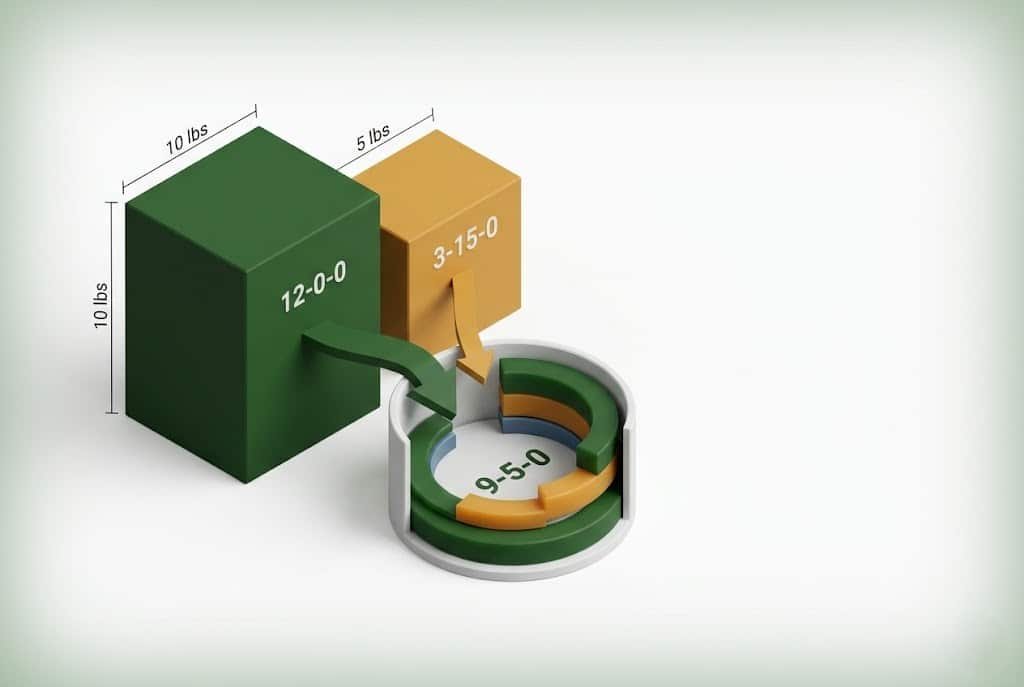
Mixing two fertilizers in a bag or bucket does not produce a simple average of their labels. The final nutrient ratio shifts based on how much of each product is present by weight. A 12-0-0 blood meal blended with a 3-15-0 bone meal at a 2:1 ratio does not land at 7.5-7.5-0; it lands closer to 9-5-0. That distinction matters for plant health, and most growers get it wrong the first time.
| Blend Scenario | Final N% | Final P% | Final K% |
|---|
| Fertilizer | N% | P% | K% | Best For |
|---|---|---|---|---|
| Blood Meal | 12 | 0 | 0 | Nitrogen boost |
| Bone Meal | 3 | 15 | 0 | Root & bloom |
| Kelp Meal | 1 | 0.5 | 2 | Micronutrients |
| Fish Meal | 10 | 6 | 0 | Vegetative |
| Greensand | 0 | 0 | 3 | Potassium |
| Compost | 1.5 | 1 | 1 | General use |
| Feather Meal | 12 | 0 | 0 | Slow-release N |
How This Calculator Works
Formula Used
This NPK calculator uses a weighted-average approach. Each nutrient in the final blend is calculated by multiplying each fertilizer’s nutrient percentage by its weight, summing both fertilizers, then dividing by total weight:
Final P = (Pa × Wa + Pb × Wb) / (Wa + Wb)
Final K = (Ka × Wa + Kb × Wb) / (Wa + Wb)
Where: Na, Pa, Ka = N, P, K % of Fertilizer A | Nb, Pb, Kb = N, P, K % of Fertilizer B | Wa, Wb = weights of each
Step-by-Step Example (Blood Meal + Bone Meal)
Blood Meal = 12-0-0 @ 10 lbs | Bone Meal = 3-15-0 @ 5 lbs | Total Weight = 15 lbs
P = (0×10 + 15×5) / 15 = (0 + 75) / 15 = 5.00%
K = (0×10 + 0×5) / 15 = 0.00%
Result: Final blend ratio ≈ 9-5-0
Assumptions & Limits
- This calculator assumes uniform mixing of both fertilizers.
- NPK values must be entered as percentages (0–100). The sum of N+P+K does not need to equal 100 — real fertilizers include filler materials.
- Weights must be in the same unit (both lbs or both kg); the calculator does not convert units.
- This tool covers macronutrients only (N, P, K). Secondary nutrients (Ca, Mg, S) and micronutrients are not accounted for.
- Results represent the weighted average NPK of the physical blend, not bioavailability after soil interaction.
- Maximum supported NPK value per nutrient is 100%. Entering values above 100% is considered invalid.
This NPK calculator computes the weighted-average nitrogen, phosphorus, and potassium percentages of a two-fertilizer blend using actual weights and label values as inputs. It calculates what percentage of each macronutrient exists in the final physical mixture. It does not predict soil uptake, decomposition timing, bioavailability after microbial activity, or plant response. Those variables depend on soil biology, pH, temperature, and moisture that no blend calculator can capture.
After running this calculator, you will know the precise N-P-K ratio of your mixed fertilizer and whether that ratio triggers any application-safety warnings before a single pound touches your soil.
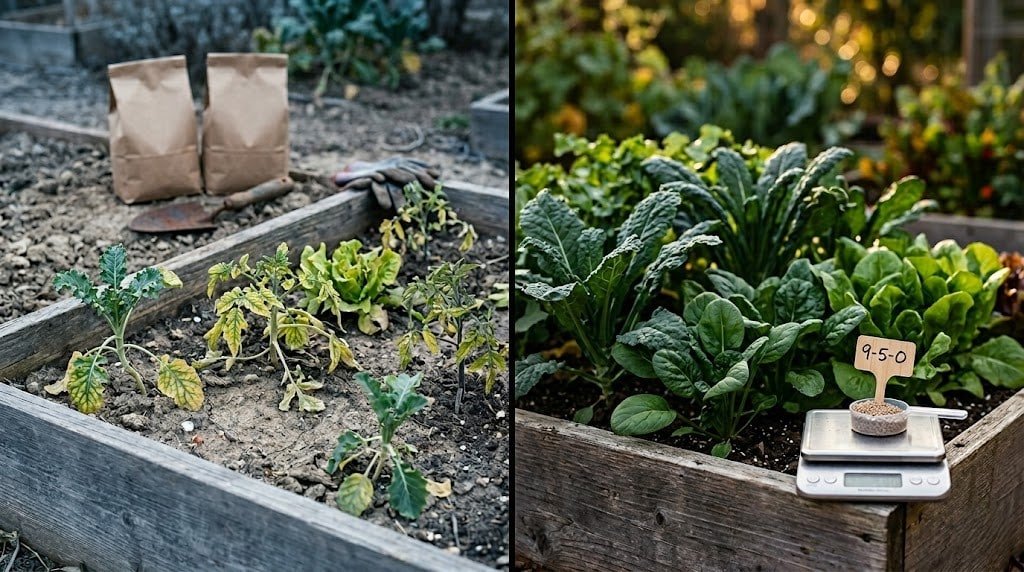
Use the Tool
Before filling in the fields, have the following information ready: the N-P-K label values for both fertilizers (printed on the bag or product spec sheet as three hyphenated numbers), and the weight of each product you plan to mix. Weights can be in pounds, kilograms, or any consistent unit, but both fertilizers must use the same unit. The calculator does not convert between units.
If you are sourcing organic inputs whose exact N-P-K is unlisted, use the values from the nitrogen calculator reference data or your supplier’s lab analysis sheet as the starting point.
Quick Start (60 Seconds)
- Fertilizer A N-P-K: Enter the three numbers from the label separated by fields. A product labeled “12-0-0” means 12 in the N field, 0 in P, 0 in K. Do not convert; enter the label percentage directly.
- Fertilizer B N-P-K: Same format for the second product. Common mistake: entering the guaranteed analysis minimum instead of the actual label value when two numbers appear.
- Weight A: The amount of Fertilizer A you will physically include in the blend. Use the same unit (oz, lb, kg) as Weight B.
- Weight B: The amount of Fertilizer B. A value of zero is not valid; if you are only using one product, no blending calculation is needed.
- Units consistency: Pounds and kilograms cannot be mixed. Entering 10 lbs for A and 5 kg for B will produce a mathematically valid but agronomically meaningless result.
- NPK range: Each nutrient value must fall between 0 and 100. Values like 120 or negative numbers will trigger an error and block the calculation.
- Click Calculate: The result does not update on keystroke. Click the button after all fields are complete.
Inputs and Outputs (What Each Field Means)
| Field | Unit | What It Represents | Common Mistake | Safe Entry Guidance |
|---|---|---|---|---|
| Fertilizer A – N% | Percent (%) | Nitrogen content by weight of Fertilizer A, as stated on the product label | Confusing guaranteed analysis (minimum) with typical analysis (actual) | Use the first number from the three-number NPK code on the bag |
| Fertilizer A – P% | Percent (%) | Phosphate (P2O5) content by weight, representing available phosphorus | Entering elemental phosphorus instead of the label’s P2O5 equivalent | Use the middle number from the NPK code; do not convert |
| Fertilizer A – K% | Percent (%) | Potash (K2O) content by weight, representing available potassium | Leaving blank when zero; zero must be entered explicitly or the field fails validation | Use the third number; if the label shows 0, type 0 |
| Weight A | Any (lbs, kg, oz) | The physical mass of Fertilizer A included in the blend | Entering volume (cups, gallons) instead of weight | Use a scale; dry fertilizers vary significantly in bulk density |
| Fertilizer B – N% | Percent (%) | Nitrogen content by weight of Fertilizer B | Swapping Fertilizer A and B values when rearranging the blend | Double-check which label matches which weight before entering |
| Fertilizer B – P% | Percent (%) | Phosphate content by weight of Fertilizer B | Same as A: P2O5 vs. elemental P confusion | Use the middle number from the B product label |
| Fertilizer B – K% | Percent (%) | Potash content by weight of Fertilizer B | Omitting when zero because it seems unnecessary | Always enter 0 explicitly for zero-potassium products |
| Weight B | Any (lbs, kg, oz) | The physical mass of Fertilizer B included in the blend | Using the same weight as A when the actual ratio differs | Weigh both products separately before mixing |
| Final N% | Percent (%) | Weighted-average nitrogen in the finished blend | Treating this as a soil application rate rather than a product ratio | This is a label-equivalent value, not a per-acre recommendation |
| Final P% | Percent (%) | Weighted-average phosphorus in the finished blend | Assuming P availability equals P content; soil pH governs actual availability | Cross-reference with a soil test report; soil pH governs how much label P actually becomes plant-available |
| Final K% | Percent (%) | Weighted-average potassium in the finished blend | Expecting K to behave like N; K binds to clay and moves slowly | Use result to compare blend to crop K requirements, not as an application amount |
| Total Weight | Same as inputs | Sum of Weight A plus Weight B; confirms denominator used in calculation | Assuming partial mix equals full blend ratio | Verify this matches the actual batch size you intend to produce |
Worked Examples (Real Numbers)
Example 1: Blood Meal and Bone Meal Blend (2:1 by Weight)
- Fertilizer A: Blood Meal, N-P-K = 12-0-0
- Fertilizer B: Bone Meal, N-P-K = 3-15-0
- Weight A: 10 lbs
- Weight B: 5 lbs
- Total Weight: 15 lbs
Result: Final N = (12 x 10 + 3 x 5) / 15 = 135 / 15 = 9.00%. Final P = (0 x 10 + 15 x 5) / 15 = 75 / 15 = 5.00%. Final K = 0.00%. Blend ratio: 9-5-0.
This high-nitrogen blend is suited for vegetative growth phases. The nitrogen content at 9% warrants measured application to avoid root-tip burn on sensitive crops.
Example 2: Fish Meal and Greensand for Fruiting Crops
- Fertilizer A: Fish Meal, N-P-K = 10-6-0
- Fertilizer B: Greensand, N-P-K = 0-0-3
- Weight A: 8 lbs
- Weight B: 4 lbs
- Total Weight: 12 lbs
Result: Final N = (10 x 8 + 0 x 4) / 12 = 80 / 12 = 6.67%. Final P = (6 x 8 + 0 x 4) / 12 = 48 / 12 = 4.00%. Final K = (0 x 8 + 3 x 4) / 12 = 12 / 12 = 1.00%. Blend ratio: 6.67-4-1.
Adding greensand introduces slow-release potassium while keeping the nitrogen-phosphorus balance of fish meal largely intact. The K level remains low; for fruiting crops with high potassium needs, increasing the greensand fraction or substituting a higher-K amendment would shift the ratio further.
Example 3: Low-Impact Soil Builder (Kelp Meal and Compost)
- Fertilizer A: Kelp Meal, N-P-K = 1-0.5-2
- Fertilizer B: Compost, N-P-K = 1.5-1-1
- Weight A: 20 lbs
- Weight B: 20 lbs
- Total Weight: 40 lbs
Result: Final N = (1 x 20 + 1.5 x 20) / 40 = 50 / 40 = 1.25%. Final P = (0.5 x 20 + 1 x 20) / 40 = 30 / 40 = 0.75%. Final K = (2 x 20 + 1 x 20) / 40 = 60 / 40 = 1.50%. Blend ratio: 1.25-0.75-1.5.
This is a broad-spectrum, low-intensity soil amendment appropriate for topdressing established beds or preparing planting areas where soil structure and micronutrient diversity matter more than rapid macronutrient delivery.
Reference Table (Fast Lookup)
| Fertilizer A | Fertilizer B | Mix Ratio (A:B) | Final N% | Final P% | Final K% | Dominant Nutrient | Primary Use Case |
|---|---|---|---|---|---|---|---|
| Blood Meal (12-0-0) | Bone Meal (3-15-0) | 2:1 | 9.00 | 5.00 | 0.00 | Nitrogen | Leafy crops, vegetative stage |
| Blood Meal (12-0-0) | Bone Meal (3-15-0) | 1:1 | 7.50 | 7.50 | 0.00 | Balanced N+P | Transition from veg to flower |
| Blood Meal (12-0-0) | Kelp Meal (1-0.5-2) | 1:1 | 6.50 | 0.25 | 1.00 | Nitrogen | Nitrogen-focused with trace K |
| Fish Meal (10-6-0) | Greensand (0-0-3) | 2:1 | 6.67 | 4.00 | 1.00 | Nitrogen | General vegetable production |
| Fish Meal (10-6-0) | Kelp Meal (1-0.5-2) | 1:1 | 5.50 | 3.25 | 1.00 | Nitrogen | Balanced organic program |
| Feather Meal (12-0-0) | Bone Meal (3-15-0) | 3:1 | 9.75 | 3.75 | 0.00 | Nitrogen | Slow-release N with P support |
| Compost (1.5-1-1) | Bone Meal (3-15-0) | 3:1 | 1.88 | 4.50 | 0.75 | Phosphorus | Transplant and root establishment |
| Kelp Meal (1-0.5-2) | Greensand (0-0-3) | 1:1 | 0.50 | 0.25 | 2.50 | Potassium | Fruiting stage K supplementation |
| Fish Meal (10-6-0) | Compost (1.5-1-1) | 1:2 | 4.33 | 2.67 | 0.67 | Nitrogen | Moderate fertility soil prep |
| Blood Meal (12-0-0) | Compost (1.5-1-1) | 1:3 | 4.13 | 0.75 | 0.75 | Nitrogen | Diluted N amendment for established beds |
All Final N%, P%, and K% values in this table are derived from the formula Final X = (Xa x Wa + Xb x Wb) / (Wa + Wb) using the stated input NPK values and ratios. Rounded to two decimal places.
How the Calculation Works (Formula + Assumptions)
Show the calculation steps
The calculator applies a weighted-average formula independently to each of the three macronutrients. The same mathematical structure is used for nitrogen, phosphorus, and potassium.
Step 1: Multiply each fertilizer’s nutrient percentage by its weight
For Fertilizer A: Nutrient contribution A = (N% of A) x (Weight of A). This gives the raw nutrient mass from that product, expressed in the same unit as the weight. For Fertilizer B: Nutrient contribution B = (N% of B) x (Weight of B).
Step 2: Sum both contributions
Combined N contribution = Contribution A + Contribution B. This step is repeated separately for P and for K.
Step 3: Divide by total weight
Final N% = Combined N contribution / (Weight A + Weight B). Dividing by total weight normalizes back to a percentage of the final blend. Final P% and Final K% follow the same division.
Rounding rule
Results are rounded to two decimal places. The intermediate calculations are carried to full floating-point precision before rounding, so no compounding rounding error occurs mid-formula.
Unit note
No unit conversion is performed. Weight A and Weight B must be in the same unit. The percentage output is dimensionless; it does not change whether the weights are in pounds or kilograms.
Assumptions and Limits
- The formula assumes physical blending only. It does not account for chemical reactions between fertilizers, such as nitrogen volatilization when ammonium-based products contact alkaline pH materials.
- NPK label values represent the stated guaranteed analysis, which may differ from actual batch composition. Lab-analyzed values will yield more precise results than label values.
- This tool handles exactly two fertilizers. Blends of three or more products require sequential calculation: first blend two, then treat the result as one input for the next product.
- The N-P-K values as stated on labels represent N (elemental nitrogen), P2O5 (phosphate), and K2O (potash). They are not elemental phosphorus or elemental potassium. The calculator does not convert between P2O5 and elemental P or between K2O and elemental K.
- Bioavailability is outside this tool’s scope. Organic fertilizers release nutrients through microbial breakdown. The calculated N% is the total N in the blend, not the fraction available to plants in a given season.
- The calculator does not account for moisture content in fertilizers. Wet compost or fresh manure will have lower dry-weight NPK than stated values for dried products.
- Secondary nutrients (calcium, magnesium, sulfur) and micronutrients are not included in the output. Blends designed to correct specific deficiencies may need analysis beyond N-P-K.
- Values above 100% for any single nutrient are mathematically invalid for fertilizer labels and are blocked by the validator.
Standards, Safety Checks, and “Secret Sauce” Warnings
Critical Warnings
- Nitrogen burn threshold at 20%: When the calculated Final N% exceeds 20%, the blend carries a meaningful risk of root-tip burn and foliage damage, particularly in direct soil contact applications and at normal fertilizer loading rates. Dilute the blend before applying, or reduce the nitrogen-heavy component fraction.
- Phosphorus lockout above 15%: A Final P% above 15% in alkaline soils (pH above 7.0) can precipitate zinc and iron into unavailable forms. High-phosphorus blends applied to soils with already-adequate P levels also accelerate phosphorus saturation, which affects soil water quality. The fertilizer salt index calculator can help assess application safety before field use.
- Zero potassium in high-nitrogen blends: A blend with Final K% of 0 used through an entire growing cycle will deplete soil K reserves relative to crop uptake. This is especially consequential for fruiting crops, where potassium governs cell turgor, sugar transport, and disease resistance. Zero-K results signal that a supplemental potassium source should be planned separately.
- Nitrogen-dominant blends in the fruiting stage: When N comprises more than 75% of the total NPK value and the blend is used during flowering or fruiting, excess nitrogen delays maturity, reduces flower set, and lowers fruit quality. Stage-matched nutrient ratios matter as much as absolute percentages.
Minimum Standards
- Both weight inputs must be measured by mass on a scale, not estimated by volume. Organic fertilizers vary in bulk density; a cup of blood meal and a cup of bone meal do not weigh the same.
- Label NPK values should be verified against a current bag or spec sheet. Reformulated products and inconsistent sourcing can shift actual values from historical references.
- Blends destined for edible crops should be soil-tested before application to confirm the calculated ratio addresses a documented deficiency rather than layering nutrients onto an already-adequate soil.
- When mixing fertilizers with very different particle sizes (fine powder and coarse granule), physical uniformity of the finished blend should be confirmed before application to avoid hot spots.
Competitor Trap
Most online fertilizer mixing calculators present a simple arithmetic average of two products, implicitly assuming equal weights. That is only accurate when exactly the same mass of each fertilizer is used. Change the weight ratio even slightly, and the arithmetic-average result becomes incorrect. The weighted-average formula used here,
(Na x Wa + Nb x Wb) / (Wa + Wb), is the only mathematically valid approach for calculating blended NPK across unequal weights. Always verify that any fertilizer blend tool you use is applying weights to the calculation, not just averaging the percentages. For understanding how nutrient concentrations interact with soil chemistry after application, see the soil phosphorus availability reference tool.
Common Mistakes and Fixes
Mistake: Entering N-P-K in the Wrong Order
Some fertilizer labels in certain markets or older product literature list nutrients as N-K-P or P-N-K rather than the standard N-P-K sequence. Entering potassium into the phosphorus field produces a blend ratio that looks plausible but is incorrect. Always confirm the label explicitly labels each number as N, P (or P2O5), and K (or K2O).
Fix: Check the label for explicit element notation next to each number, not just the order.
Mistake: Treating the Result as an Application Rate
The final N%, P%, and K% values describe the nutrient concentration in the physical blend, analogous to what appears on a fertilizer bag label. They are not pounds per acre, grams per square foot, or any application rate. Applying 5 lbs of a 9-5-0 blend per 100 square feet is a separate agronomic decision based on crop requirements and soil test results.
Fix: Use the blend ratio output as an input to an application rate calculation based on your crop’s documented nitrogen, phosphorus, and potassium requirements per square foot or per acre.
Mistake: Mixing in Volume Instead of Weight
Measuring fertilizers by cups, tablespoons, or scoops introduces significant error. Blood meal, bone meal, kelp meal, and rock dusts have different bulk densities. Two cups of blood meal and two cups of bone meal do not weigh the same, so the volume ratio does not equal the weight ratio the formula requires.
Fix: Use a kitchen scale or postal scale for all fertilizer measuring before blending. A $15 digital scale eliminates this error entirely.
Mistake: Ignoring the Filler Fraction
Fertilizer N-P-K percentages do not sum to 100%. A 12-0-0 blood meal contains 12% nitrogen; the remaining 88% is protein matrix, inert material, and moisture. Growers sometimes assume the percentages should add up to 100 and re-enter values that force that sum, which corrupts the calculation. The formula works correctly with the label values as printed.
Fix: Enter label values exactly as stated. Do not adjust percentages to make them sum to 100.
Mistake: Blending Products with Antagonistic Chemistry
Some fertilizer pairs react chemically when mixed. Lime (calcium carbonate) combined with ammonium sulfate accelerates nitrogen volatilization as ammonia gas. Superphosphate mixed with basic slag can reduce phosphorus availability. This calculator handles math, not chemistry; it cannot flag reactive pairs.
Fix: Research fertilizer compatibility before blending. Consult supplier data sheets or soil amendment guides, particularly for any product with a strong pH-modifying character. The soil pH lime calculator is a useful companion when working with calcium-containing amendments.
Related Tools and Next Steps
Once you have your blend ratio, calculating how much of that blend to apply per lawn area is the logical next step: the lawn fertilizer calculator converts blend NPK and area into application amounts.
For garden beds and raised-bed soil preparation, understanding how much amendment volume your mix requires complements the ratio work done here: raised bed soil calculator.
Compost is one of the most common “Fertilizer B” inputs for organic growers. Knowing how much compost your site needs before mixing it into a custom blend is addressed by the compost volume calculator.
When the nitrogen fraction of your blend comes from manure rather than dry organic meals, the nitrogen availability percentage changes over time. The manure nitrogen availability calculator accounts for first-year and subsequent-year N release rates.
For growers building compost from raw materials to use as one input in this mixer, the carbon-to-nitrogen ratio of the raw pile affects the finished compost NPK: compost C:N ratio calculator.
Diluting liquid fertilizers to the correct concentration before application is a separate but related task: fertilizer dilution calculator.
If the soil receiving your blend has a documented pH problem, lime or sulfur amendments may be needed alongside the NPK correction: soil pH sulfur calculator.
FAQ
Can I use this NPK calculator for more than two fertilizers?
Not directly, but you can run it in sequence. Calculate the blend of two fertilizers first. Then use the resulting NPK values as one input (Fertilizer A) in a second calculation, with your third product as Fertilizer B. Use the total weight of the first blend as Weight A. Repeat for each additional product added to the mix.
Does the calculator work for liquid fertilizers?
Yes, as long as you enter weights rather than volumes. Liquid fertilizers have NPK values stated by weight percentage on their labels, and the weighted-average formula applies identically. Convert volume to weight using the product’s specific gravity if you are measuring by volume. Most liquid fertilizer labels state weight per gallon, which enables the conversion.
What does the N-P-K ratio actually mean on a fertilizer label?
The three numbers represent nitrogen (N) as elemental N, phosphorus as P2O5 (phosphate equivalent), and potassium as K2O (potash equivalent), each expressed as a percentage of the product’s total weight. A 50-lb bag rated 10-6-4 contains 5 lbs of elemental nitrogen, and proportional amounts of phosphate and potash, with the remaining weight in inert carriers, fillers, or moisture.
Is it safe to mix blood meal and bone meal directly in the same bag?
Dry blending blood meal and bone meal is generally stable and commonly practiced in organic gardening. Neither product has strong pH-shifting or volatile chemical properties that react with the other under typical storage conditions. The blend ratio in this calculator corresponds directly to that physical mixture. Store the finished blend in a dry, sealed container to preserve nutrient integrity.
Why does the calculator not produce a single “NPK ratio” number?
The output shows three separate percentages rather than a simplified ratio like 9:5:0 because percentages carry more information. A ratio of 9:5:0 says the same thing as 18:10:0, which is a double-strength version of the same ratio but a completely different product in terms of actual application rates and burn risk. Percentages preserve the concentration information that ratios discard.
How do I know if my blend has too much nitrogen for the crop I am growing?
Compare the Final N% output against the crop’s nitrogen requirement and your planned application rate. Most vegetable crops tolerate blends up to 10 to 12% N at typical organic loading rates. Sensitive seedlings and root crops prefer lower-nitrogen blends. The calculator flags blends above 20% N as a burn-risk warning. For precise rate matching, a soil test result and crop nitrogen uptake table for your specific variety provide the most reliable guidance.
Conclusion
The most common and consequential error in fertilizer blending is assuming that mixing equal volumes of two products produces equal weights and therefore an equal-weighted blend ratio. It does not. Measuring by weight eliminates that error entirely. If you are refining your soil amendment program beyond NPK and want to understand how your blend interacts with the existing soil mineral profile, the soil mix calculator is a practical next tool in that workflow.