
The most common reason an electric fence fails to hold livestock has nothing to do with the energizer’s joule rating on the box. It has to do with the return path: the underground circuit electrons must travel from the animal’s hooves, through the soil, and back to the ground rod. When that path is broken by dry soil, sparse grounding, or undersized wire coverage, a 15-joule energizer produces roughly the same effective shock as a 0.5-joule unit. The joule number is only half the equation.
This electric fence joule calculator computes two things simultaneously: the minimum output joules your energizer must deliver based on total electrified wire length and vegetation load, and the minimum number of ground rods required for your specific soil conductivity. It does not account for energizer brand efficiency curves, fence charger age, or highly variable soil moisture that changes week to week. Those factors require on-site testing with a digital fault finder.
After running this calculator, you will know which joule class of energizer to buy and how many 6-foot galvanized ground rods to drive before your fence can deliver a reliable deterrent shock. Once your containment system is sized correctly, your next infrastructure decision is how many animals that pasture can actually support; our cattle water requirement calculator can help you plan that side of the operation in parallel.
Use the Tool
Electric Fence Joule Rating & Ground Rod Sizer
Calculate your energizer output and grounding requirements — The Yield Grid
Poultry 3J
Cattle 8J
Bison 15J+
Max
| Scenario | Miles Wire | Joules Needed | Ground Rods (Loam) |
|---|
Recommended Equipment
- Gallagher Solar Energizer
- Parmak Solar Fence Charger
- 6-ft Galvanized Ground Rods
- Brass Ground Clamps
- Digital Fence Fault Finder
- Heavy-Duty Gate Handles
Assumptions & Limits
This calculator is designed for livestock containment fencing. Key assumptions:
- Wire miles = Fence length × number of strands. Each strand carries current independently.
- Base joule rule: 1 joule per 3 wire-miles is the industry minimum. Heavy vegetation doubles that requirement due to energy bleed from weed contact.
- Ground rod scaling by soil: Wet loam / moist clay = 1 rod per joule; dry loam = 1.5 rods; dry sand = 3 rods per joule (sand acts as an insulator — electron return-path resistance skyrockets).
- The Dry Sand Rule: A massive energizer with a single ground rod in dry sand will barely shock. Grounding is half the system — invest equally in both energizer and ground array.
- Minimum 3 rods always recommended regardless of calculation result.
- Formula range: 0.1–500 fence miles, 1–12 strands.
- Always comply with local regulations for fence voltage and energizer certification (UL, CSA, CE).
How This Calculator Works
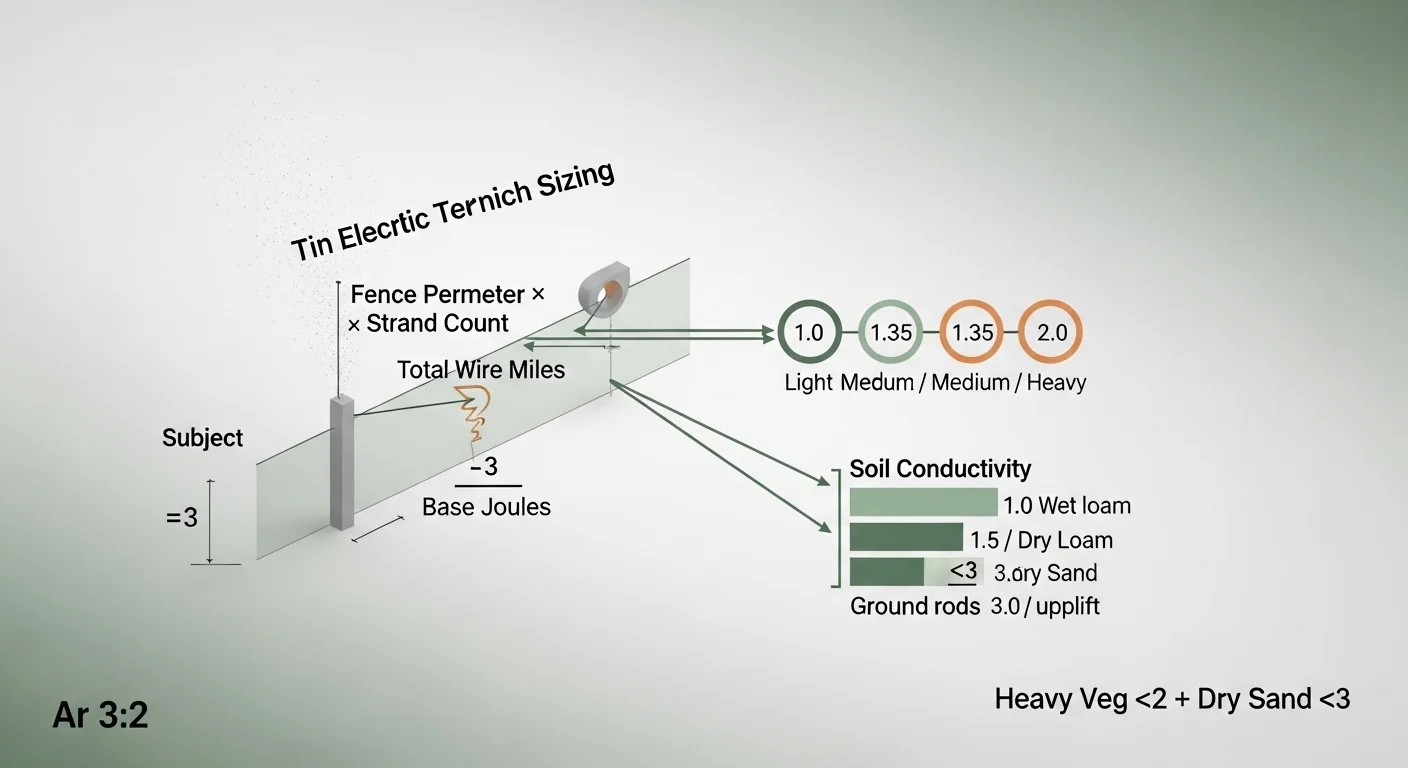
- Wire Miles = Fence Length (miles) × Number of Electrified Strands
Each strand of hot wire must be energized along its full length. - Base Joules = Wire Miles ÷ 3
Industry standard: 1 joule covers 3 wire-miles under ideal conditions. - Vegetation Multiplier: Heavy weeds touch the wire and bleed current to ground. Heavy = ×2.0; Medium = ×1.35; Light = ×1.0
- Ground Rods = Joules × Soil Lookup Factor
Wet Loam / Moist Clay → 1 rod/joule
Dry Loam → 1.5 rods/joule
Dry Sand → 3 rods/joule (3× uplift — poor conductivity) - Always round up to a whole rod. Minimum 3 rods enforced.
Before entering values, have your fence plan or existing fence map available. You need the total perimeter length in miles (not feet), the number of hot wires that run the full length of the fence, a realistic assessment of weed and grass contact along the fence corridor, and knowledge of your general soil type. If you are planning a multi-paddock system, calculate each section separately and select an energizer rated for the highest result. For fence structure planning alongside this tool, the H-brace fence calculator handles corner and gate post sizing for the same fence.
Quick Start (60 Seconds)
- Total Fence Length (Miles): Enter the full perimeter of the fenced area in miles. Convert feet by dividing by 5,280. A 2,640-foot paddock = 0.5 miles. Do not multiply by the number of strands here; that happens inside the formula.
- Number of Electrified Strands: Count only the wires that will be connected to the energizer output terminal. Ground wires in alternating-strand systems are not hot strands. Typical cattle fences use 3 strands; hog and predator fences often use 5 or more.
- Vegetation Interference: Select “Light” only if the fence corridor is mowed or bare. If tall grass or weeds routinely touch any wire, select “Medium” at minimum. Do not underestimate this field; it is the most common input error.
- Soil Moisture / Type: Select the condition that describes your soil during the driest part of the season, not after rain. Ground conductivity during drought determines your worst-case grounding requirement. Overestimating conductivity leads to undersized ground arrays.
- Read both outputs: The joule result sizes your energizer; the ground rod result is equally critical. Installing the correct energizer on an undersized ground system produces almost no effective voltage across the fence.
- Round up on rods: The calculator enforces a minimum of 3 rods. Always purchase one extra beyond the calculated number to account for installation defects or future dry spells.
- Use the gauge band: The power band bar shows where your fence falls across livestock tiers (poultry, cattle, bison range). If your result lands below the cattle threshold for a cattle operation, reconsider strand count or vegetation management before buying a larger energizer.
Inputs and Outputs (What Each Field Means)
| Field | Unit | What It Means | Common Mistake | Safe Entry Guidance |
|---|---|---|---|---|
| Total Fence Length | Miles | The linear perimeter of the entire fenced area, measured once regardless of strand count | Entering total wire length instead of fence perimeter (e.g., entering 9 miles for a 3-mile fence with 3 strands) | Measure or estimate the perimeter only; the strand multiplier is applied by the formula |
| Number of Electrified Strands | Count (1-12) | The number of individual wires connected to the hot terminal of the energizer | Counting ground wires in an alternating-strand system as hot strands | Only count wires run from the energizer’s positive/output terminal |
| Vegetation Interference | Category | The degree of weed and grass contact with the hot wire, which drains joules to ground continuously | Selecting “Light” for a fence that is only mowed twice a season; mid-summer contact is the correct test condition | Assess during peak growing season; default to one level higher if uncertain |
| Soil Moisture / Type | Category | The conductivity class of the soil where ground rods will be installed, which controls electron return-path resistance | Selecting “Wet Loam” based on spring conditions when the fence must function in late summer dry conditions | Use the driest seasonal condition, not average or best-case moisture |
| Joules (Output) | Joules (J) | Minimum stored energy the energizer must deliver to maintain deterrent voltage across the full wire load | Buying an energizer rated at the calculated number exactly, leaving no safety margin | Select an energizer rated at least 20-25% above the calculated result |
| Total Wire Miles | Miles | The combined length of all electrified strands (Fence Length x Strands); the actual load on the energizer | Treating this as the same as fence perimeter when sizing wire purchases | Use this figure when calculating total wire material needed for installation |
| Ground Rods Required | Count | Minimum number of 6-foot galvanized steel rods needed to provide a low-resistance earth connection for the system | Installing rods in a cluster rather than spaced 10 feet apart in a line, which dramatically reduces effective surface area | Space rods 10 feet apart in a straight line; drive to full depth; connect with 12.5-gauge galvanized wire |
Wire tension changes with temperature and affects long-term insulator pressure against posts. If your fence spans terrain with significant temperature swings, the fence tension temperature calculator addresses that mechanical side of fence performance separately from the electrical sizing here.
Worked Examples (Real Numbers)
Example 1: Small Horse Paddock
- Fence Length: 0.5 miles
- Electrified Strands: 3
- Vegetation: Light (mowed grass)
- Soil: Wet Loam
Wire Miles: 0.5 x 3 = 1.5 miles
Base Joules: 1.5 / 3 = 0.5J
Vegetation multiplier (Light): 0.5 x 1.0 = 0.5J
Ground rods: max(3, ceil(0.5 x 1.0)) = 3 rods
Result: 0.5 Joules, 3 ground rods
A small plug-in energizer in the 0.5 to 1.0 joule class covers this paddock comfortably. Three rods is the enforced minimum; on wet loam this is sufficient, but installing a fourth rod adds negligible cost and improves dry-season reliability.
Example 2: Cattle Pasture with Medium Vegetation
- Fence Length: 2 miles
- Electrified Strands: 3
- Vegetation: Medium (occasional grass contact)
- Soil: Wet Loam
Wire Miles: 2 x 3 = 6 miles
Base Joules: 6 / 3 = 2.0J
Vegetation multiplier (Medium): 2.0 x 1.35 = 2.7J
Ground rods: max(3, ceil(2.7 x 1.0)) = 3 rods
Result: 2.7 Joules, 3 ground rods
A 3-joule energizer is the practical selection here, providing the calculated 2.7J plus a small margin. Three rods remain sufficient on wet loam for this load. Walking the fence line in midsummer and cutting weed contact points can prevent the vegetation load from pushing into the “heavy” multiplier range and requiring a larger unit.
Example 3: Large Ranch Perimeter on Dry Sand
- Fence Length: 5 miles
- Electrified Strands: 4
- Vegetation: Heavy (dense weeds touching wire)
- Soil: Dry Sand
Wire Miles: 5 x 4 = 20 miles
Base Joules: 20 / 3 = 6.67J
Vegetation multiplier (Heavy): 6.67 x 2.0 = 13.33J
Ground rods: max(3, ceil(13.33 x 3.0)) = ceil(40) = 40 rods
Result: 13.33 Joules, 40 ground rods
This result is not unusual for large dryland operations. The 40-rod requirement is driven entirely by dry sand conductivity, not energizer size. The practical response is either to invest in a deep well-point ground system, use moisture-retaining ground rod gel, or relocate the ground array to a shaded or lower-lying area where soil holds more moisture year-round. Cutting heavy vegetation to medium would reduce the energizer requirement to 6.67J but would not significantly change the ground rod count since soil type drives that calculation.
Reference Table (Fast Lookup)
All joule values computed using the formula: Wire Miles / 3, then multiplied by vegetation factor. Ground rod counts use soil lookup factors and enforce a minimum of 3. Derived columns show calculated joule requirement and rod counts, not manufacturer marketing claims.
| Application | Fence Miles | Strands | Wire Miles | Joules (Light Veg) | Joules (Heavy Veg) | Rods (Wet Loam) | Rods (Dry Sand) |
|---|---|---|---|---|---|---|---|
| Poultry / Small Garden | 0.25 | 2 | 0.5 | 0.17 | 0.33 | 3 | 3 |
| Horse Paddock (small) | 0.5 | 3 | 1.5 | 0.50 | 1.00 | 3 | 3 |
| Sheep / Goat Field (1 mi) | 1.0 | 3 | 3.0 | 1.00 | 2.00 | 3 | 3 |
| Multi-Strand Hog Pen | 1.0 | 4 | 4.0 | 1.33 | 2.67 | 3 | 8 |
| Cattle Pasture (2 mi) | 2.0 | 3 | 6.0 | 2.00 | 4.00 | 3 | 12 |
| Cattle / Hog Combo Fence | 2.0 | 5 | 10.0 | 3.33 | 6.67 | 4 | 20 |
| Large Cattle Pasture (5 mi) | 5.0 | 3 | 15.0 | 5.00 | 10.00 | 5 | 30 |
| Bison / High-Strand Ranch | 5.0 | 4 | 20.0 | 6.67 | 13.33 | 7 | 40 |
| Large Ranch Perimeter (10 mi) | 10.0 | 3 | 30.0 | 10.00 | 20.00 | 10 | 60 |
How the Calculation Works (Formula + Assumptions)
Show the calculation steps
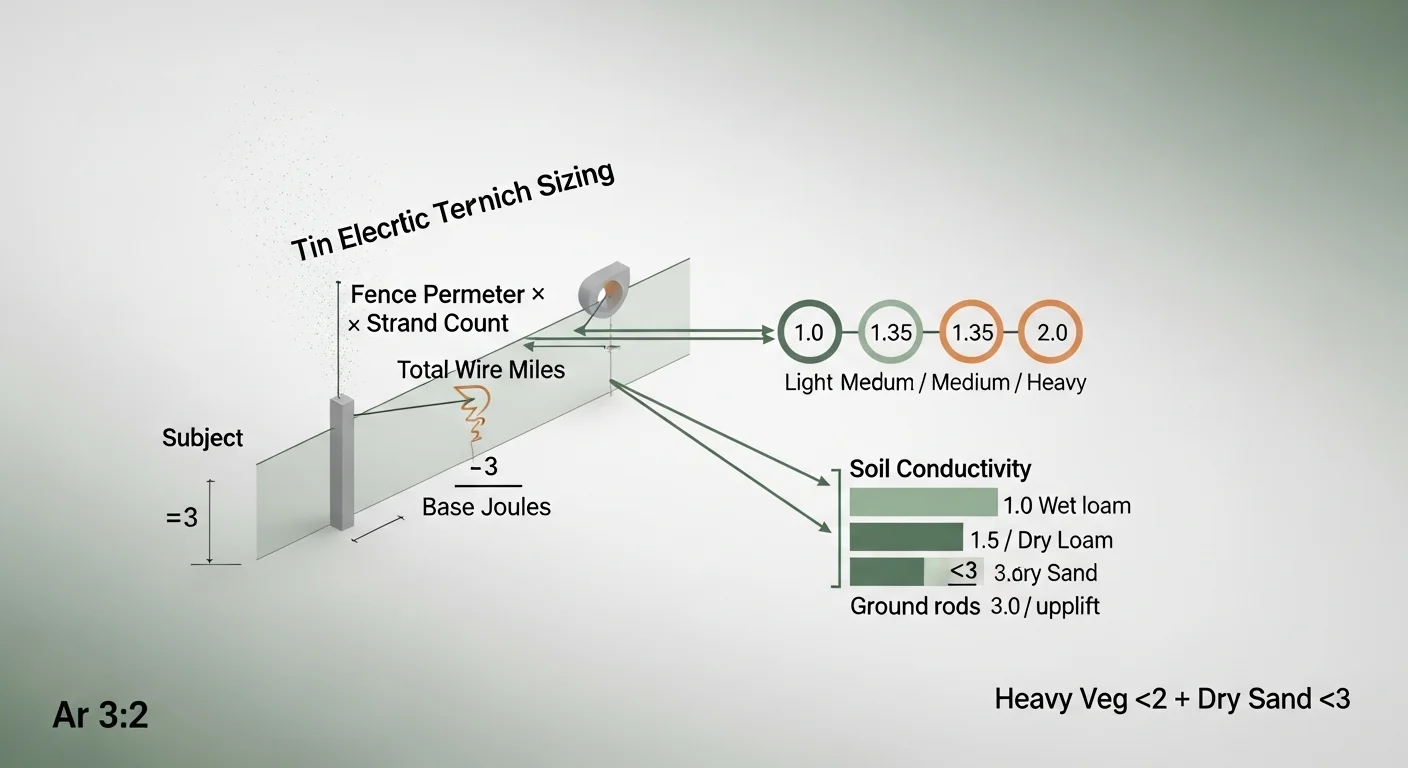
Step 1: Wire Miles
Multiply total fence perimeter (miles) by the number of electrified strands. Each strand runs the full perimeter and must be energized across its full length, so strand count is a direct multiplier on energizer load.
Wire Miles = Fence Length (mi) x Number of Strands
Step 2: Base Joules
Divide wire miles by 3. This is the industry-standard starting point: 1 joule of stored output energy is sufficient to drive approximately 3 miles of clean, unloaded electrified wire. The denominator of 3 is a conservative rule used by major energizer manufacturers for sizing guidance.
Base Joules = Wire Miles / 3
Step 3: Vegetation Multiplier
Multiply base joules by the vegetation factor. Light contact (mowed corridor): x 1.0. Medium contact (occasional tall grass): x 1.35. Heavy contact (dense weeds continuously touching wire): x 2.0. This multiplier reflects the parasitic current drain from vegetation creating a partial ground path along the fence.
Adjusted Joules = Base Joules x Vegetation Factor
Step 4: Ground Rods
Multiply adjusted joules by the soil lookup factor. Wet loam or moist clay: 1.0 rod per joule. Dry loam: 1.5 rods per joule. Dry sand: 3.0 rods per joule. The result is rounded up to the nearest whole rod, and a minimum of 3 rods is enforced regardless of calculated result.
Ground Rods = max(3, ceil(Adjusted Joules x Soil Factor))
Rounding rule: Always round up (ceiling) for ground rod counts. There is no engineering benefit to rounding down on grounding.
Assumptions and Limits
- This formula uses a fixed denominator of 3 wire-miles per joule. Premium energizers with higher output efficiency may require fewer joules than calculated; lower-quality units may require more.
- The vegetation multipliers (1.0, 1.35, 2.0) represent typical seasonal averages, not peak instantaneous drain. During extreme overgrowth events, even “medium” vegetation may behave as heavy load.
- Soil lookup factors assume uniformly distributed soil type across the entire ground rod installation zone. Mixed soils (e.g., loam above, sand below 18 inches) may behave between categories.
- The 3-rod minimum is a practical safety floor, not a soil-physics derivation. Even a 0.1-joule system requires adequate grounding to complete the shock circuit.
- This calculator does not account for fence age, corroded connections, cracked insulators, or wire resistance changes from strand type (e.g., polywire vs. 12.5-gauge high-tensile). These factors should be checked with a digital fault finder.
- The formula range is 0.1 to 500 fence miles and 1 to 12 strands. Inputs outside these ranges are rejected by the tool. For extremely large or high-strand installations, consult a fencing contractor and an energizer manufacturer’s engineering guide.
- Wet loam and moist clay are assigned the same lookup factor (1.0) in this model. Local clay composition and mineral content can shift this; heavy kaolin clays may conduct differently than illite-rich clays.
Standards, Safety Checks, and “Secret Sauce” Warnings
Critical Warnings
- The Dry Sand Ground Trap: A high-joule energizer with an undersized ground array in dry or sandy soil will produce nearly no effective shock. The shock circuit is open-loop: energy must travel from the energizer through the hot wire, through the animal’s body, through the hooves into soil, and return via the ground rod array back to the energizer. In dry sand, the soil resistance is so high that very little current completes this path. The voltage reading at the fence may appear acceptable on a no-load test but drops to ineffective levels the moment an animal touches the wire. This is why cattle escape despite a correctly sized energizer: the ground system was never built for the soil type. Cutting the fence corridor vegetation also reduces this effect, since vegetation that contacts both hot and ground wires provides an alternate return path that partially compensates for poor soil grounding. For weed management strategy alongside fence maintenance, a pasture-specific program can help; the pasture weed killer calculator addresses chemical application rates for fence corridors.
- Strand Count Drives Load Faster Than Fence Length: Adding a fourth strand to a 3-strand, 2-mile fence increases wire miles from 6 to 8, requiring a proportionally larger energizer. Many operators size energizers by perimeter mileage alone and ignore strand multiplication, then wonder why a correctly rated energizer cannot hold a high-strand predator fence.
- High-Joule Systems Require Certified Warning Signs: Energizers above 12 stored joules fall into a category that can cause serious injury to humans, children, and non-target animals. All publicly accessible fence sections must carry certified warning signs. ANSI Z535 and regional equivalents (CSA in Canada, CE in Europe) define sign placement intervals. Failing to post signs does not reduce the electrical output; it increases liability.
- Aluminum Connections Cause Galvanic Corrosion: Ground rod clamps and lead wire connections must be solid copper or brass. Aluminum-to-steel connections at the rod head create galvanic corrosion that progressively increases resistance at the ground connection point, quietly degrading fence performance without visible failure.
Minimum Standards
- Ground rods: 6-foot minimum galvanized steel, driven to full depth, spaced at least 10 feet apart in a straight line away from the energizer. Closer spacing reduces the effective soil contact area below the theoretical sum of individual rods.
- Ground lead wire: 12.5-gauge galvanized steel minimum between rods and from the last rod to the energizer ground terminal. Lighter wire adds resistance in the return path.
- System voltage under load: 3,000 volts minimum measured with a digital fence fault finder when an animal is simulated as the load. Readings below this threshold at the far end of a fence line indicate a grounding, connection, or energizer problem.
- Insulator condition: All insulators must be rated for the energizer’s output voltage. Insulators designed for low-voltage garden fences are not suitable for high-joule livestock systems and may arc or crack over time.
Competitor Trap: Most online energizer sizing guides tell you to divide fence miles by a fixed number and buy the next size up. That advice works only if you have one strand, zero vegetation, and perfect wet soil. The moment you add strands, weeds, or work in a dryland environment, a single-variable rule produces a critically undersized system. The two-variable output of this calculator (joules plus ground rods for your specific soil) reflects how an electric fence actually works as a complete circuit, not just how the energizer spec sheet is written. Buying a larger energizer without fixing a deficient ground array is a common and expensive mistake that no energizer manufacturer will highlight in their sizing chart. For a complete fence materials picture, the woven wire fence calculator handles perimeter material quantities for the non-electric portions of mixed fencing systems.
Common Mistakes and Fixes
Mistake: Measuring Total Wire Length Instead of Fence Perimeter
Operators who have already measured total wire used on a fence (or are looking at a spool order) enter that total wire figure as “fence length.” If a 1-mile perimeter fence has 4 strands, total wire is 4 miles, but fence length is 1 mile. Entering 4 miles produces a joule recommendation four times too high. The calculator multiplies fence length by strand count internally; entering pre-multiplied wire totals doubles the calculation error.
Fix: Always enter the perimeter distance of the fenced area in miles, not the total spool footage consumed.
Mistake: Choosing Soil Type Based on Best-Case Seasonal Conditions
Selecting “Wet Loam” because the soil holds moisture in spring and early summer leads to an undersized ground array that fails during the driest weeks of the year, which is precisely when cattle are under maximum heat stress and most likely to test the fence. A ground system adequate for wet conditions may have three to four times too few rods for the same soil during drought.
Fix: Select soil type based on your driest seasonal condition, not average or spring conditions. When uncertain, default to the next drier category.
Mistake: Clustering Ground Rods Together
Driving three or four rods in a tight cluster near the energizer creates overlapping zones of electrical influence in the soil, reducing the total effective ground contact area below what a single long rod would achieve. The rods interfere with each other’s current dispersal patterns.
Fix: Space rods at least 10 feet apart in a straight line. If space is limited, angle rods outward from a central point rather than grouping them vertically. The fence tension calculator can help with overall post and wire spacing layout as part of the same planning session.
Mistake: Testing Fence Voltage Without a Load
A digital voltmeter placed across the fence wire with no ground contact reads the open-circuit voltage of the energizer, which is always much higher than the voltage an animal actually experiences. A fence can show 8,000 volts on a no-load test and deliver less than 1,500 volts under a real animal load due to poor grounding.
Fix: Test with a digital fault finder designed for loaded fence testing, or use a resistive load rod pressed into the soil at the far end of the fence line. Target 3,000 volts minimum under load.
Mistake: Assuming Vegetation Multiplier Is Static Through the Season
A fence corridor assessed as “light” in May may become “medium” or “heavy” by late July without any physical change to the fence itself. Vegetation grows into the wire from below, and the energizer that handled spring conditions adequately may no longer hold voltage as summer vegetation peaks. Some operators notice their cattle becoming “resistant” to the fence and assume the animals have built a tolerance, when the fence voltage has actually dropped due to increased weed load.
Fix: Walk and assess the fence line at least monthly during the growing season. Re-run the calculator using the current vegetation condition, not the installation-time assessment. Consider whether vegetation management along the corridor is a more cost-effective solution than buying a larger energizer.
Next Steps in Your Workflow

Once you have your joule rating and ground rod count, the practical sequence is: purchase and install the ground array first, before connecting the energizer. Drive all rods to full depth, connect them in series with 12.5-gauge galvanized wire, and verify the array resistance with a multimeter before the energizer goes live. This step is skipped more often than any other and is responsible for a disproportionate share of “the fence doesn’t work” complaints in the first season. After the ground system passes, connect the energizer, run a loaded voltage test at the far end of the fence, and confirm you are above 3,000 volts before introducing livestock.
After the fence is running correctly, the next infrastructure question is usually carrying capacity: how many animals can the enclosed pasture support without overgrazing, and how should paddock rotation be structured to protect soil health. The pasture stocking rate calculator handles that sizing independently of the fence, while the rotational grazing calculator helps you structure paddock rotation timing based on forage recovery data for your region.
FAQ
How many joules do I need for a cattle electric fence?
The answer depends on wire miles (perimeter times strand count) and vegetation load, not perimeter length alone. As a general reference, a 2-mile, 3-strand cattle fence with medium vegetation on wet loam requires approximately 2.7 joules. Add dry soil or more strands and that number climbs quickly. Use the calculator above with your actual inputs rather than relying on a generic joule-per-mile figure.
Why does my electric fence not shock even with a new energizer?
In most cases, the ground system is the cause. An insufficient number of ground rods, rods that are too short, rods installed in dry or sandy soil without enough surface area, or corroded connections between rods and lead wire all break the return circuit. Test the ground system in isolation by connecting the voltmeter between the energizer’s ground terminal and a separate rod driven 50 feet away from the main ground array. A reading above 300 volts indicates inadequate grounding.
What is the rule for ground rod spacing on an electric fence?
The standard is a minimum of 10 feet between each rod, driven in a straight line. Rods installed closer together overlap their soil contact zones, reducing the effective surface area below the theoretical total. Each rod should be 6 feet long minimum and driven to full depth. Connect all rods in series using 12.5-gauge or heavier galvanized steel wire with brass or copper clamps at each connection point.
Does soil type really affect electric fence performance that much?
Dry or sandy soil can require three times as many ground rods as wet loam for the same energizer output. This is not a minor adjustment; it is the single largest variable in ground system sizing. The shock an animal experiences depends entirely on how much current can return through the soil to the ground rod. In high-resistance soil, very little current flows and the shock is negligible even with a large energizer.
How much does vegetation on the fence line reduce voltage?
The calculator models heavy vegetation as requiring twice the joule output of a clean fence because weeds and grass touching the hot wire create continuous parasitic paths to ground, draining stored energy before it reaches the end of the line. This is not a fringe case; a heavily overgrown 5-mile fence can drain an undersized energizer to the point where voltage at the far end drops below a deterrent threshold. Regular mowing or herbicide treatment of the fence corridor directly reduces energizer load requirements.
Can I use multiple smaller energizers instead of one large one?
Multiple energizers on the same fence line are possible but require careful wiring to avoid phase conflict between units. The standard method is to divide the fence into isolated sections, each with its own energizer and ground array. The two systems must not share hot wire or ground connections. This approach can be practical for very large or irregular properties where running a single fence line from one energizer location is logistically difficult.
Conclusion
The electric fence joule calculator on this page treats fence energizer sizing as the two-variable problem it actually is: output joules scaled to total wire miles and vegetation load, plus ground rods scaled to soil conductivity. These two numbers must be solved together. A correctly sized energizer on a deficient ground system performs no better than an undersized unit, and that reality is rarely communicated clearly in the product literature for either energizers or ground hardware.
The single most important mistake to avoid is assessing your soil type under optimal conditions and then building a ground array sized for those conditions. Sandy or dry soils demand ground rod counts that look extreme on paper but are physically required by the resistance of the return path. Walk the fence line, test voltage under load, and treat the ground array as a first-class component of your fence system rather than an afterthought after the energizer is already mounted. For the structural side of your fence project, the hay cost calculator and broader livestock planning tools on The Yield Grid can help you size the feeding and forage side of the operation once your containment infrastructure is confirmed.