
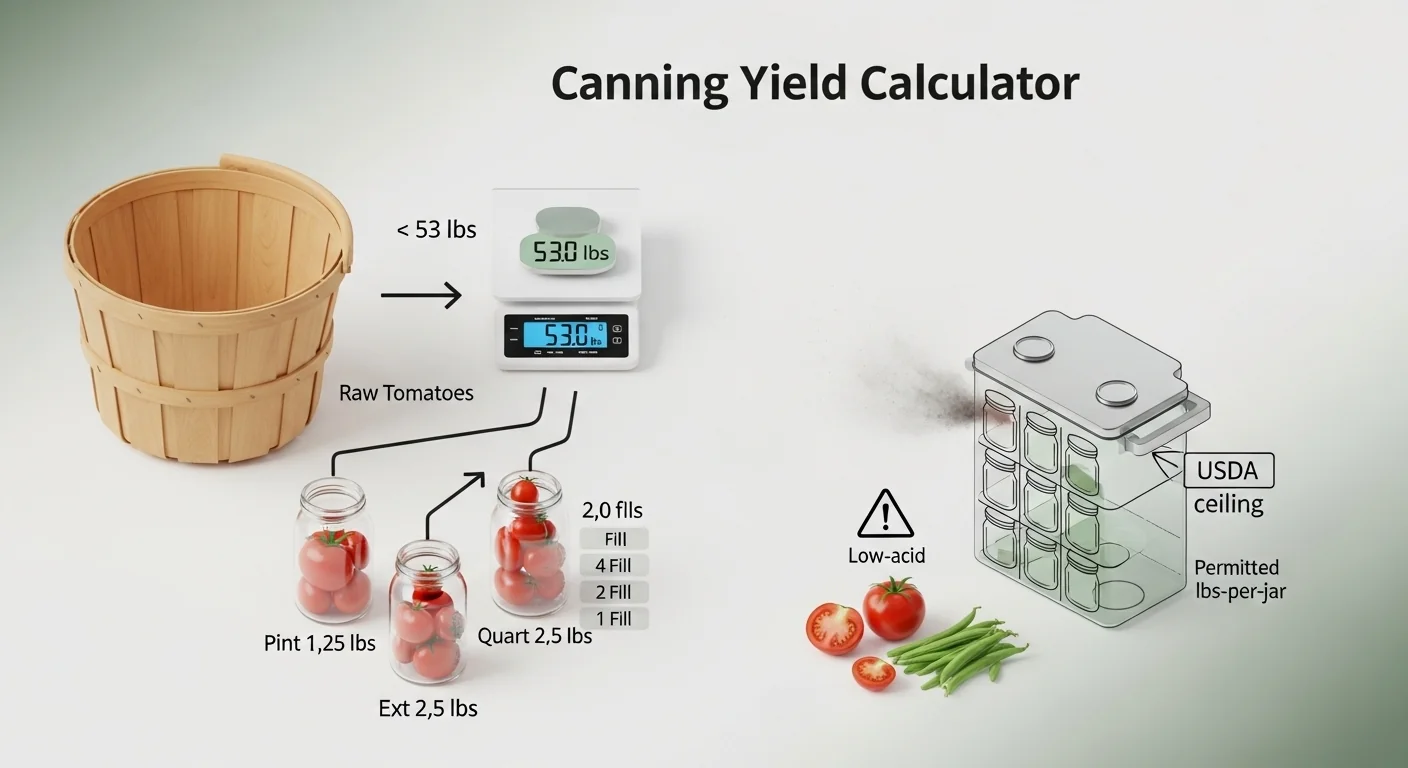
Estimating how many jars you will fill from a flat of tomatoes or a bushel of green beans is not guesswork — it is arithmetic applied to USDA lbs-per-jar averages. The problem is that most canners do that math on paper, skip the unit conversion step entirely, and only realize the error when they run out of jars halfway through a batch. Produce weight, jar size, and canner capacity are three variables that interact in a specific order, and collapsing them into a single rough estimate is what causes wasted produce and underloaded canners.
This canning calculator takes your produce type, total weight (in pounds or bushels), and jar size to compute the estimated jar count, number of canner batches at standard capacity of 7 jars, and the lbs-per-jar rate for your selected produce. It does not predict trim loss from cutting, peeling, or pitting; it does not account for altitude-adjusted processing times; and it does not replace USDA-tested recipes for specific produce varieties. What it does provide is a reliable planning baseline before you start prepping your harvest.
After running your numbers, you will know exactly how many mason jars to sterilize, whether you need one canner load or four, and — critically — whether your selected produce requires acidification before water bath canning.
Use the Tool
Canning Yield Calculator
The Yield Grid — Homesteading & Livestock Tools
| Produce | Pint (lbs) | Quart (lbs) | Jars / 25 lbs (qt) | Batches / 25 lbs |
|---|
How this calculator works
Step 1 — Convert to lbs (if you entered bushels):
Step 2 — Calculate jars from raw weight and produce-specific lbs-per-jar:
Lbs-per-jar values come from USDA Complete Guide to Home Canning (e.g. Tomatoes ≈ 1.25 lbs/pint, 2.5 lbs/quart).
Step 3 — Calculate canner batches:
Fractional jars are displayed as decimals and rounded up for batch count. Results reflect raw produce weight; trim loss is not accounted for.
Assumptions & Limits:
- Yields are estimates based on USDA averages; actual results vary by variety and ripeness.
- 1 bushel = 53 lbs (USDA standard approximation).
- Standard canner capacity = 7 jars.
- Lbs-per-jar values assume ripe, fresh produce with no waste factored in.
- Low-acid produce (pH > 4.6) requires pressure canning or verified acidification — water bath alone is not safe.
- Maximum supported weight: 10,000 lbs / ~188 bushels.
Before entering values, have your total produce weight on hand. Weigh your produce on a kitchen or produce scale, or use the bushel converter built into the tool if you purchased by the bushel. Select the produce type from the list, choose your jar size, and click Calculate. If you are planning to put up both pints and quarts, run the calculation twice — once per jar size — to compare yields. For brined vegetables like cucumbers, note that your brine volume will also need planning; the brine calculator can handle that alongside your jar count.
Quick Start (60 Seconds)
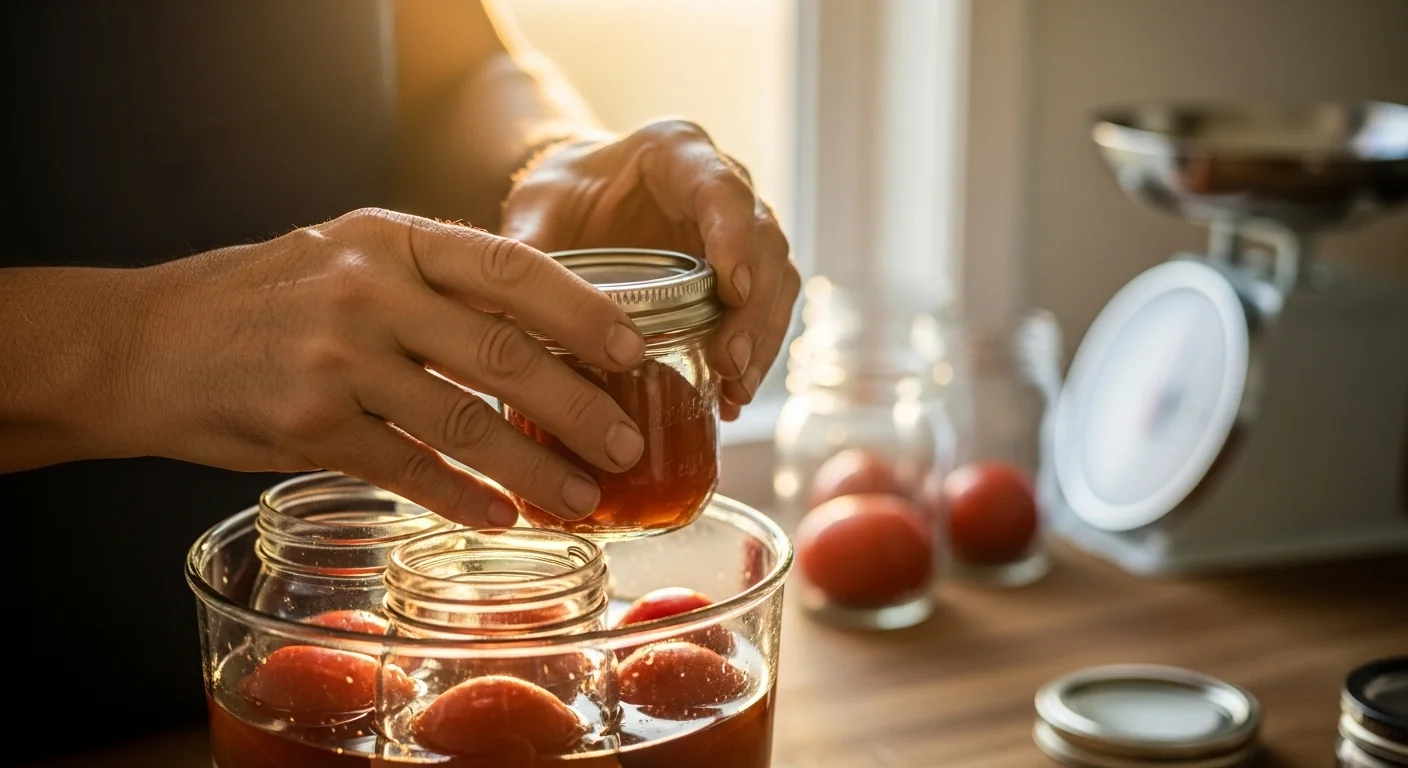
- Produce type: Select the crop you are canning. The lbs-per-jar rate changes with every produce type — do not assume a number from memory or from a different crop.
- Amount: Enter the total weight of raw, uncleaned produce as it came from the garden or market. Do not subtract trim waste; the formula uses raw weight.
- Unit (lbs or bushels): If you purchased by the bushel, select Bushels. The calculator converts at the USDA rate of 53 lbs per bushel. If you weighed your harvest, select Pounds.
- Jar size: Pint and quart are the two standard sizes for water bath and pressure canning. Lbs-per-jar rates differ significantly between them — tomatoes, for example, take 1.25 lbs per pint versus 2.5 lbs per quart.
- Run the calculation: All three fields are required. The tool will not calculate until produce type, amount, and jar size are all filled in.
- Check the safety notice: If your selected produce is low-acid (pH above 4.6), a warning appears automatically. Do not dismiss it. Read the acidification guidance before you begin canning.
- Use the batch count: Each batch assumes a standard 7-jar canner capacity. If your canner holds 9 pints, the batch count shown is conservative — which is the safer planning assumption.
Inputs and Outputs (What Each Field Means)
| Field | Unit | What It Means | Common Mistake | Safe Entry Guidance |
|---|---|---|---|---|
| Produce Type | Select | Determines the lbs-per-jar rate used in the yield formula | Selecting a generic “vegetable” proxy for a crop not listed | Choose the closest listed match; use the reference table to compare lbs-per-jar rates |
| Amount of Produce | lbs or bushels | Total raw weight of the produce before any cleaning or trimming | Entering trimmed or prepped weight, which understates the real yield | Weigh before washing or cutting; enter the gross weight |
| Unit Toggle | lbs / bushels | Switches between direct pound entry and bushel-to-pound conversion (1 bushel = 53 lbs) | Leaving the unit on Pounds when the quantity was purchased by the bushel | Check the unit on your receipt or harvest record before selecting |
| Jar Size | Pint / Quart | The jar volume used for processing, which directly affects how many jars the batch fills | Mixing up pint and quart rates, producing an estimate that is off by roughly a factor of two | Confirm the jars physically in front of you before selecting |
| Estimated Jars (output) | Jars | Total number of jars the entered weight should fill, rounded up to the nearest whole jar | Treating this as a precise count rather than a planning estimate | Prepare 10-15% more jars than the estimate to accommodate density variation |
| Canner Batches (output) | Batches | Number of full canner loads required at 7 jars per load | Not accounting for partial batches when scheduling processing time | Count a partial load as a full batch for time-planning purposes |
| Lbs per Jar (output) | lbs | The USDA-standard weight of raw produce required to fill one jar of the selected size | Using this figure to reverse-calculate trimmed weight, which the formula does not support | Use this value only as a benchmark against other recipes you are cross-referencing |
Worked Examples (Real Numbers)
Scenario 1: A Half-Bushel of Tomatoes in Quarts
- Produce: Tomatoes
- Amount: 0.5 bushels
- Unit: Bushels
- Jar size: Quart
Calculation: 0.5 x 53 = 26.5 lbs. 26.5 / 2.5 = 10.6, rounded up to 11 jars. 11 / 7 = 1.57, rounded up to 2 batches.
Result: 11 quart jars across 2 canner batches.
A half-bushel of tomatoes fills slightly more than a single standard canner load in quart jars, making two batches necessary. Because tomatoes are low-acid, each quart requires 2 tablespoons of bottled lemon juice before sealing.
Scenario 2: One Full Bushel of Green Beans in Pints
- Produce: Green Beans
- Amount: 1 bushel
- Unit: Bushels
- Jar size: Pint
Calculation: 1 x 53 = 53 lbs. 53 / 0.75 = 70.67, rounded up to 71 jars. 71 / 7 = 10.14, rounded up to 11 batches.
Result: 71 pint jars across 11 canner batches.
A full bushel of green beans in pints is a significant undertaking: 11 full canner loads at roughly 30 minutes of processing time each in a pressure canner. Green beans are low-acid and cannot be safely processed in a water bath canner without verified acidification.
Scenario 3: 10 Pounds of Peaches in Pints
- Produce: Peaches
- Amount: 10 lbs
- Unit: Pounds
- Jar size: Pint
Calculation: 10 / 1.0 = 10 jars. 10 / 7 = 1.43, rounded up to 2 batches.
Result: 10 pint jars across 2 canner batches.
Peaches are high-acid fruit, so water bath canning applies with no acidification required. Ten pounds fills one full canner load plus three extra jars, making a second partial load necessary.
Reference Table (Fast Lookup)
| Produce | Lbs / Pint | Lbs / Quart | Jars per 25 lbs (Pint) | Jars per 25 lbs (Quart) | Batches per 25 lbs (Quart) | Low-Acid? |
|---|---|---|---|---|---|---|
| Tomatoes | 1.25 | 2.50 | 20 | 10 | 2 | Yes — acidify |
| Cucumbers / Pickles | 1.00 | 2.00 | 25 | 13 | 2 | No (when pickled) |
| Green Beans | 0.75 | 1.50 | 34 | 17 | 3 | Yes — pressure can |
| Peaches | 1.00 | 2.00 | 25 | 13 | 2 | No |
| Sweet Corn | 1.00 | 2.00 | 25 | 13 | 2 | Yes — pressure can |
| Beets | 1.00 | 2.00 | 25 | 13 | 2 | Yes — pressure can |
| Apples / Applesauce | 1.00 | 1.75 | 25 | 15 | 3 | No |
| Strawberries / Jam | 0.90 | 1.75 | 28 | 15 | 3 | No |
| Source: USDA Complete Guide to Home Canning averages. Batch count uses 7 jars per canner load. Jars per 25 lbs rounded up to the nearest whole jar. | ||||||
How the Calculation Works (Formula + Assumptions)
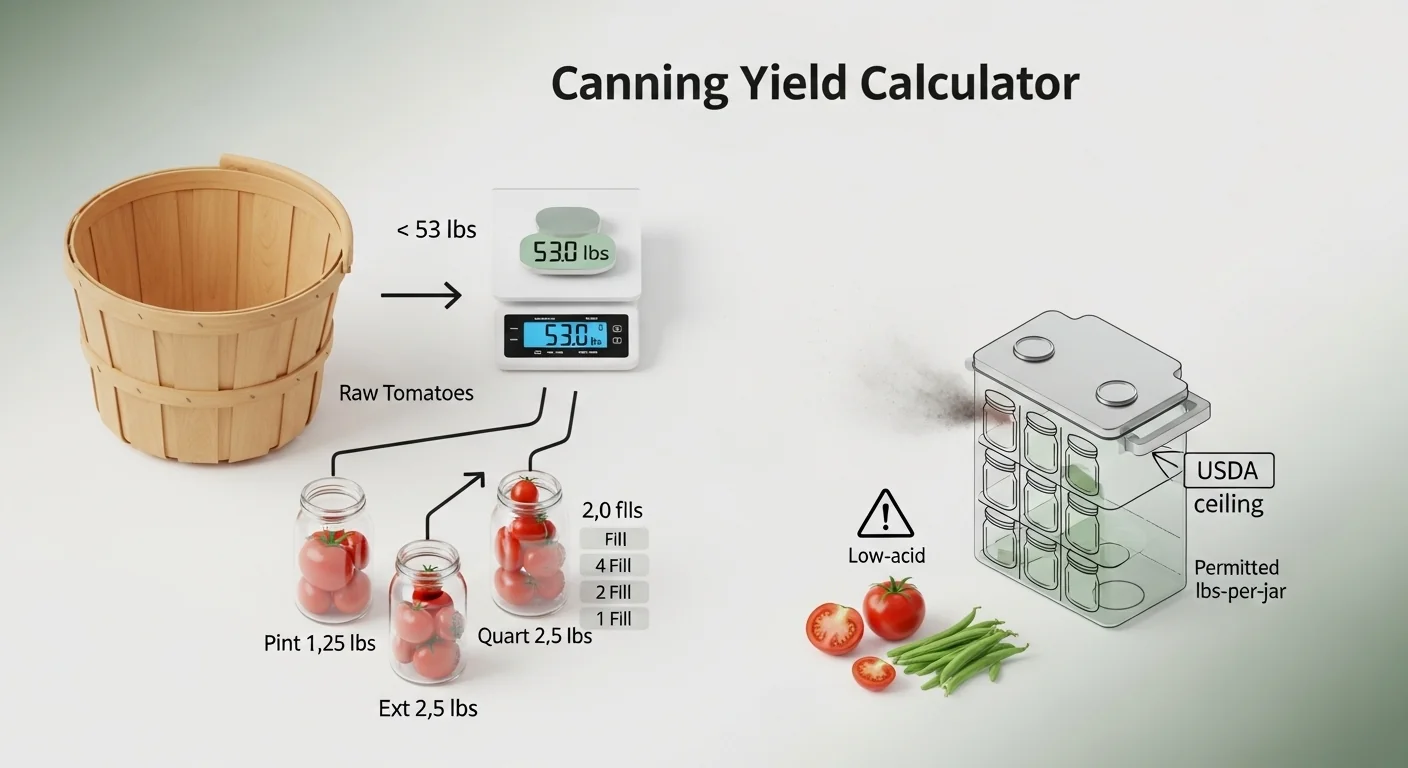
Show the calculation steps
Step 1: Unit conversion (if bushels are entered)
Weight (lbs) = Bushels x 53
The 53 lbs/bushel figure is the USDA standard approximation for general field crops. Actual bushel weights vary by produce variety and moisture content.
Step 2: Jar yield calculation
Jars = Weight (lbs) / Lbs-per-Jar
Lbs-per-Jar is a produce-specific constant derived from USDA Complete Guide to Home Canning. Tomatoes = 1.25 lbs/pint, 2.50 lbs/quart. Green Beans = 0.75 lbs/pint, 1.50 lbs/quart. A full table of rates is shown above.
The raw jar count is divided using the exact weight. Fractional jars are displayed as decimals; the final jar count displayed to the user is rounded up (ceiling function) so planning always accounts for the partial jar.
Step 3: Canner batch calculation
Batches = Jars / 7, rounded up to the nearest whole batch
Seven jars is the standard quart-jar capacity of a Ball or Presto All American pressure canner. The calculator uses 7 universally across both jar sizes as a conservative baseline.
Assumptions and Limits
- Lbs-per-jar figures represent raw, unprepared produce. Trimming, peeling, or pitting reduces usable weight and will reduce actual jar yield below the estimate.
- The 53 lbs/bushel conversion is a USDA-standard approximation; actual bushel weights for specific cultivars can range from 48 to 56 lbs depending on moisture and variety.
- Canner capacity is fixed at 7 jars per batch. Canners holding 9 pints or 7 quarts will process faster than the batch count implies.
- The tool does not calculate headspace, liquid volume, or brine concentration. For pickled vegetables, those must be computed separately.
- Produce density varies by ripeness, variety, and pack style (raw pack vs. hot pack). Hot-pack methods typically reduce void space and may yield slightly more jars per pound.
- No altitude correction is applied. Processing times at elevations above 1,000 feet require adjustment per USDA guidelines; the calculator does not account for this.
- Maximum supported input is 10,000 lbs (approximately 188 bushels). Inputs outside this range are flagged as invalid.
Standards, Safety Checks, and “Secret Sauce” Warnings
Critical Warnings
- Low-acid foods require acidification or pressure canning. Any produce with a pH above 4.6 — including tomatoes, green beans, corn, and beets — cannot be safely processed in a water bath canner without acidification. Clostridium botulinum spores survive boiling-water temperatures and will germinate in a sealed, anaerobic, low-acid environment. For tomatoes, the USDA standard is 2 tablespoons of bottled lemon juice per quart (1 tablespoon per pint) or 0.5 teaspoons of citric acid per quart before filling.
- Bushel weight is an approximation, not a guarantee. Entering bushels converts at 53 lbs per bushel. If your actual bushel weighs significantly less — which is common with dry-season or small-variety harvests — the jar estimate will be higher than your real yield. Always weigh in pounds when precision matters.
- Jar count is a planning figure, not a fill guarantee. Produce density and pack method shift yield by 10 to 20 jars per 100 lbs compared to the USDA averages used here. Prepare more jars than the estimate suggests and have a refrigerator plan for any overflow that does not fill a jar completely.
- Do not can in jars not designed for pressure canning. Commercial pickle jars, pasta sauce jars, and similar single-use glass containers are not rated for repeated canning and may shatter under pressure or fail to seal reliably.
Minimum Standards
- Use only USDA-tested processing times for the produce, jar size, and pack method you are using. The yield calculator does not provide or imply processing times.
- Verify lid seals within 24 hours of processing. A flex or “give” in the center of the lid indicates a failed seal; refrigerate and consume within 2 weeks.
- For low-acid vegetables, a pressure canner maintaining at least 10 PSI (at sea level) is the minimum standard for safe sterilization of Clostridium botulinum spores.
Competitor Trap: Many online canning calculators report jar yield without flagging produce acidity at all. A tool that tells you “you will fill 40 jars of green beans” without surfacing a pressure canning requirement is not a safety-neutral tool — it is an incomplete one. The acidification check in this calculator is not a disclaimer; it is a deterministic output based on the USDA’s published pH classifications, generated every time you run a low-acid produce type through the formula. For additional ways to preserve low-moisture produce that falls outside the canning window, the dehydrator time estimator covers an alternative preservation method worth knowing.
Common Mistakes and Fixes
Mistake: Using Water Bath Canning for Green Beans Without
Acidification
Green beans are a low-acid vegetable with a pH well above 4.6. Water bath canning reaches only 212 degrees Fahrenheit at sea level, which is insufficient to destroy Clostridium botulinum spores. Home canners who rely on their grandmother’s water bath method for green beans are repeating a practice that predates the USDA’s botulism research. The fix: use a pressure canner at 10 PSI for the time specified in a current USDA-tested recipe, or add verified acid and process following a tested acidified green bean recipe.
Mistake: Entering Trimmed Weight Instead of Raw Weight
The lbs-per-jar figures in this calculator — and in the USDA guide — reference raw, field-run produce weight. If you trim, peel, and core your tomatoes before weighing and entering that weight, your estimated jar count will be lower than it should be. The actual jars you fill will be fewer still. Weigh produce before any prep work, enter that gross weight, and expect your actual yield to come in slightly below the estimate due to waste.
Mistake: Confusing Pint and Quart Lbs-per-Jar Rates
Because quarts hold twice the volume, they also require roughly twice the produce weight. A canner running on the assumption that tomatoes need 1.25 lbs per jar — when that figure applies to pints, not quarts — will underestimate total produce needed by a factor of two. The reference table above separates all rates by jar size; check it before finalizing your shopping or harvest estimate.
Mistake: Planning for Exact Jar Counts Without a Buffer
The calculator rounds up to the nearest whole jar, but produce packs differently run to run. Tomatoes at peak ripeness are denser and juicier than late-season ones; a pack that fills 12 jars in August might yield 14 jars in September from the same raw weight. If you sterilize exactly the number of jars the calculator returns, you will frequently be scrambling for one more jar mid-process. Prepare at least 15 more jars than the estimate for any run over 30 lbs.
Mistake: Treating One Batch Count as One Day’s Work
Each canner batch requires full load time, heat-up, processing, and cool-down — often 90 minutes or more per batch for pressure canning. A calculation that returns 11 batches for one bushel of green beans represents a multi-day project, not a single afternoon. Plan your harvesting and prepping schedule against a realistic batch-per-day capacity before committing to a large-volume run. The freeze dryer calculator can help you evaluate whether freeze drying is a better fit for high-volume harvests where canning time becomes the bottleneck.
Next Steps in Your Workflow
Once you have your jar count and batch total, the next step is sourcing and organizing your lids, rings, and jars before processing day. Lids are single-use; rings can be reused if undamaged. Match your jar size to your selected canner rack and confirm the rack fits your jar count per batch. If you are canning fruit or fruit spreads and the recipe calls for pectin, calculate your pectin quantity in advance using the pectin calculator so you are not mid-batch when you discover the measurement.
After canning, log your batch date, produce lot, and lid seal status in a paper or digital record. The USDA recommends using home-canned goods within one to two years for peak quality, though shelf life extends beyond that for properly sealed jars. For homesteaders tracking total preserved food output across multiple methods — canning, dehydrating, and freezing — the honey yield calculator and other harvest tools on this site are designed to work alongside each other so you can plan your full pantry inventory by season.
FAQ
How many pounds of tomatoes do I need per quart jar?
The USDA standard average is 2.5 pounds of raw tomatoes per quart jar. This figure reflects whole, uncleaned field tomatoes. Varieties with high water content or very large cores may produce slightly fewer usable jars per pound. Use this figure as a planning baseline, not a guarantee, and prepare extra jars for any run over 25 pounds.
What does 1 bushel of tomatoes weigh?
A USDA bushel of tomatoes weighs approximately 53 pounds. This is the standard conversion used in agricultural commodity pricing and food preservation guides. Actual bushel weight depends on tomato variety, ripeness stage, and how tightly the container is packed. For precision planning, weigh your produce directly on a scale and enter pounds instead of bushels.
Can I use this calculator for water bath canning only?
Yes, but the calculator’s safety check will flag low-acid produce that is not safe for water bath canning without acidification. You can use the jar yield and batch count outputs for any canning method. The processing method — water bath versus pressure canning — is determined by your produce’s acidity, not by the yield calculation itself. Always cross-reference your method against a current USDA-tested recipe.
Why does the tool round up instead of rounding to the nearest jar?
Rounding up ensures you always have enough jars and headspace material prepared. A fractional jar result of 9.2 jars means you have produce for 9 full jars plus a partial; that partial needs a container too. Rounding down to 9 would mean wasting produce. The ceiling rounding rule errs toward over-preparation rather than waste.
What is the standard canner batch size used in the calculation?
The calculator uses 7 jars per batch, which reflects the standard quart-jar capacity of most home pressure canners. Some pressure canners hold 9 pints on the bottom rack. Using 7 as the universal constant is a conservative approach that slightly overstates batch count, meaning your actual run may finish faster than the estimate suggests.
Does this calculator account for hot pack versus raw pack methods?
No. The lbs-per-jar rates used in the calculation are general USDA averages that do not differentiate between raw pack and hot pack. Hot pack methods typically produce a denser fill because the produce softens and compresses, which can increase jar yield slightly. Raw pack produces more air gaps. Treat the calculator output as a planning average that applies reasonably well to both methods.
Conclusion
The single most avoidable mistake in home canning is processing low-acid vegetables in a water bath canner without verified acidification — a failure mode that is invisible until someone is harmed. The acidification warning in this tool is not optional reading. Run your produce type through the calculator, check the safety panel, and plan your method accordingly before prep day. For homesteaders who preserve across multiple formats, the firewood cord calculator and other seasonal planning tools on The Yield Grid are built on the same principle: precision inputs before you commit labor and resources to a project.