
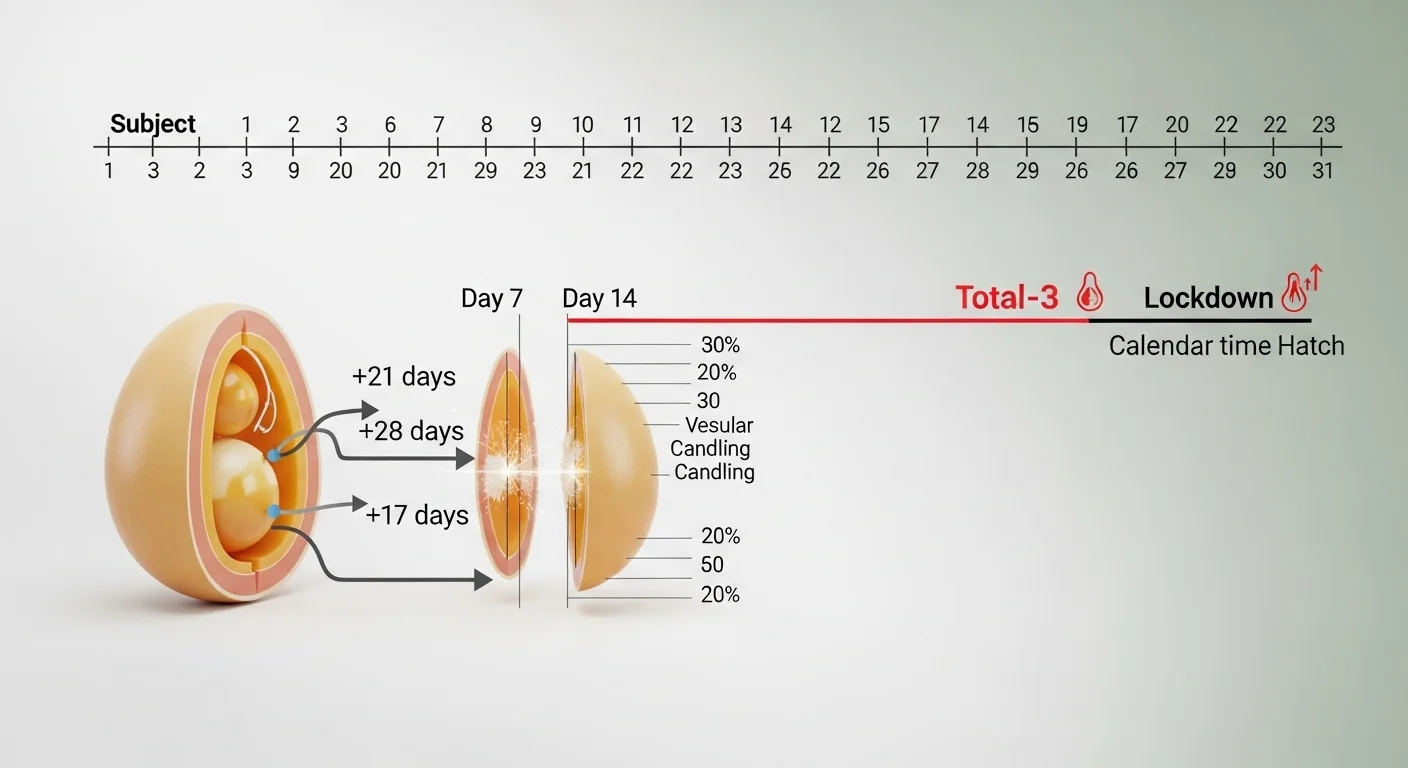
Egg incubation is not a passive waiting game. The hatch date is the fixed endpoint of a biological countdown that begins the moment you set eggs in a warm incubator, and every critical action between Day 1 and hatch day is anchored to that date. Knowing the expected hatch date tells you exactly when to candle for fertility, when to stop turning the eggs, when to raise humidity, and when to have the brooder ready. Without that date calculated precisely, every management decision that follows becomes guesswork.
This hatch date calculator takes two inputs, your incubation start date and time, and the species of egg you are incubating, and returns the projected hatch date, the lockdown date (when egg turning must stop), and the Day 7 and Day 14 candling dates. It does not account for temperature deviations, egg age, infertility rates, or incubator malfunctions. It calculates calendar-day timelines based on established incubation periods for each supported species. Actual hatch timing can vary by one to two days in either direction depending on conditions.
After using this tool, you will know three specific dates to mark on your calendar before you walk away from the incubator: the first candling check, the lockdown date, and the expected hatch window. Those three dates drive every other decision in the incubation process.
Use the Tool
Egg Incubation Calculator
Calculate your hatch date, candling schedule & lockdown date
| Species | Days | Lockdown (Day) | Candle Day 1 | Candle Day 2 |
|---|
How this calculator works
Formula: Hatch Date = Start Date + Incubation Days
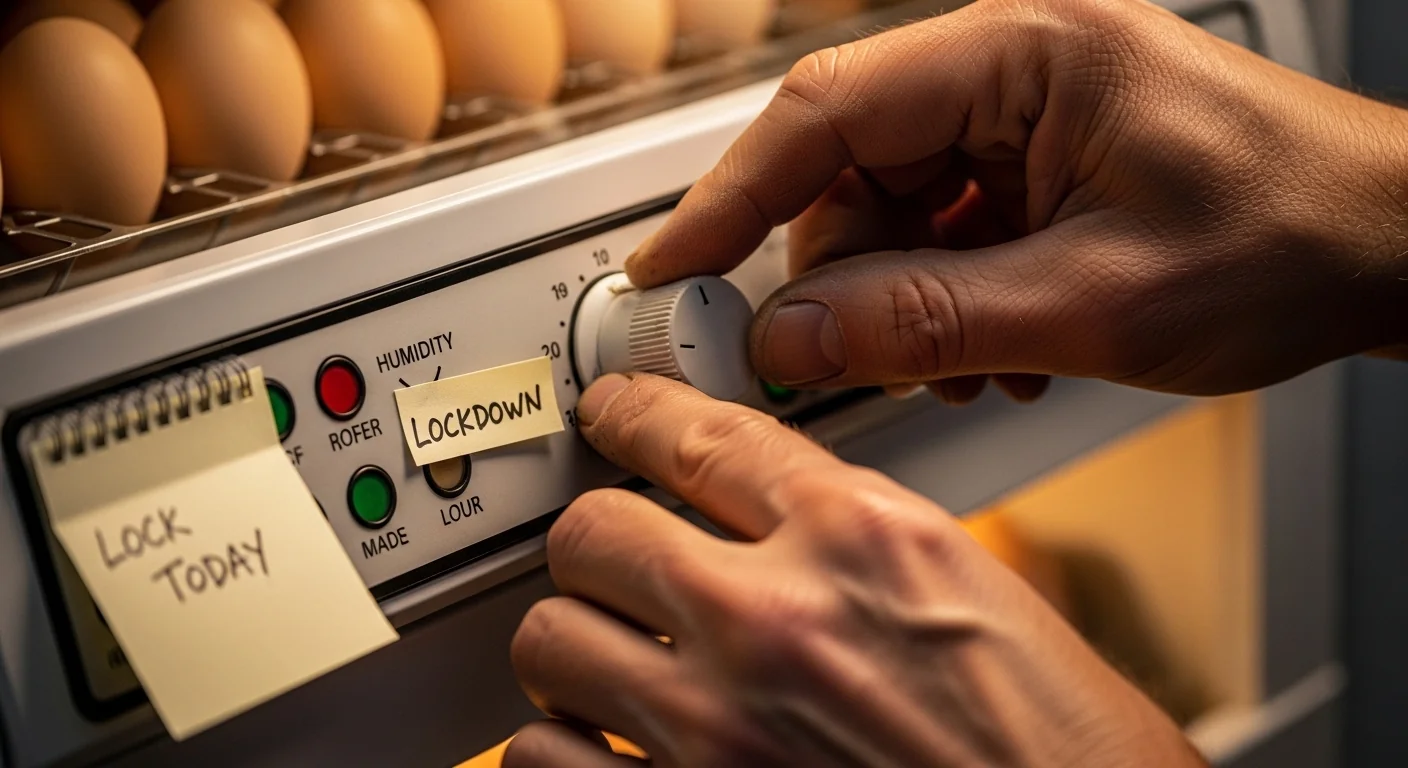
Lockdown Date: Hatch Date − 3 days — Stop turning eggs and raise humidity 3 days before the expected hatch.
Candling Schedule: Candle on Day 7 and Day 14 from the start date to check fertility and development progress.
Incubation Days by Species: Chicken 21 · Duck 28 · Quail 17 · Turkey 28 · Goose 30.
Assumptions & Limits: Days are calendar days (24 h each). Results assume a stable incubator temperature (99–100 °F / 37.5–37.8 °C for forced-air). Hatch dates are estimates; humidity, egg age, and temperature fluctuations can shift the actual hatch by 1–2 days. Quail candling at Day 14 may show advanced development — adjust based on visual inspection. Always consult species-specific guidelines for humidity targets.
Before you calculate, have two pieces of information ready: the exact date and time you placed the eggs in the incubator (or plan to), and the species of egg. If you set eggs across multiple species in the same batch, run the calculator once for each species since incubation periods differ significantly. The time of day matters because lockdown and hatch windows are time-sensitive; rounding to the nearest hour is sufficient for most home incubators.
Quick Start (60 Seconds)
- Start Date and Time: Enter the date and hour you set eggs into the incubator. If you have not started yet, enter your planned start date and time to work out future milestone dates in advance.
- Species: Select from Chicken (21 days), Duck (28 days), Quail (17 days), Turkey (28 days), or Goose (30 days). Do not estimate or round; the lockdown date shifts by a full day if you use the wrong species period.
- Both fields are required: The calculator will not run with either field blank. Fill in both before clicking Calculate.
- Read the Lockdown Date first: This is the most time-sensitive output. The lockdown date is three days before the projected hatch date. Missing it by even one day can cause late-stage chick mortality.
- Note both candling dates: Day 7 and Day 14 from the start date are your fertility check windows. Schedule them in advance so you are not pulling eggs out too early or too late.
- Use Reset if re-entering a new batch: The Reset button clears all inputs and output so you start fresh with no carry-over from a previous calculation.
Inputs and Outputs (What Each Field Means)
| Field | Type / Unit | What It Means | Common Mistake | Safe Entry Guidance |
|---|---|---|---|---|
| Start Date and Time (input) | Date and time (datetime-local) | The moment incubation begins, used as Day 0 for all milestone calculations | Entering tomorrow’s date instead of the actual set date, shifting every milestone by 24 hours | Use the exact time eggs went into the incubator; rounding to the nearest hour is fine |
| Species (input) | Select (Chicken, Duck, Quail, Turkey, Goose) | Determines the incubation period in calendar days, which drives all output dates | Selecting Chicken for Muscovy duck eggs, which incubate for 35 days rather than 21 | Confirm the breed before selecting; Muscovy ducks are not supported and require manual adjustment |
| Hatch Date (output) | Date and time | Projected date eggs will begin external pipping; add up to 48 hours for full hatch completion | Treating this as an exact hour rather than a 24- to 48-hour window | Plan to have the brooder ready at least two days before this date |
| Lockdown Date (output) | Date and time | Three days before hatch; stop all turning, raise humidity, and stop opening the incubator lid | Continuing to turn eggs past this date, causing chick malposition in the shell | Set a phone alarm for the lockdown date so it does not pass unnoticed |
| Day 7 Candling Date (output) | Date | First candling window; check for visible blood vessels or a clear egg indicating infertility | Removing eggs at Day 7 that appear unclear; dark-shelled eggs are hard to read this early | Keep eggs out of the incubator for less than 30 minutes during candling |
| Day 14 Candling Date (output) | Date | Second candling window; developed embryos show a dark mass and visible movement; clear eggs are now confirmed infertile | Skipping the Day 14 check and leaving rotting eggs in the incubator until hatch day | For quail, Day 14 and lockdown fall on the same date; candle briefly before initiating lockdown protocol |
Worked Examples (Real Numbers)
Example 1: Chicken Eggs Set on April 1
- Species: Chicken (21-day incubation period)
- Start date and time: April 1, 6:00 PM
- Incubation period: 21 days
- Lockdown: Start + 18 days = April 19, 6:00 PM
- Day 7 candling: April 8, 6:00 PM
- Day 14 candling: April 15, 6:00 PM
Result: Hatch Date = April 22, 6:00 PM (plus up to 48 hours for full hatch completion by April 24).
This is the most common batch scenario for backyard flocks. The 21-day window means lockdown falls on a Saturday if you set eggs the previous Saturday, making it easy to manage weekend humidity checks without disrupting a work schedule.
Example 2: Duck Eggs Set on March 15
- Species: Duck (28-day incubation period)
- Start date and time: March 15, 8:00 AM
- Incubation period: 28 days
- Lockdown: Start + 25 days = April 9, 8:00 AM
- Day 7 candling: March 22, 8:00 AM
- Day 14 candling: March 29, 8:00 AM
Result: Hatch Date = April 12, 8:00 AM.
Duck eggs require higher humidity throughout incubation than chicken eggs. The 28-day timeline means the lockdown window stretches into early April for a mid-March start, which may require monitoring incubator performance if ambient temperatures fluctuate significantly during that period.
Example 3: Quail Eggs Set on May 10
- Species: Quail (17-day incubation period)
- Start date and time: May 10, 12:00 PM (noon)
- Incubation period: 17 days
- Lockdown: Start + 14 days = May 24, 12:00 PM
- Day 7 candling: May 17, 12:00 PM
- Day 14 candling: May 24, 12:00 PM (same date as lockdown)
Result: Hatch Date = May 27, 12:00 PM.
Quail is the only species in this calculator where the Day 14 candling date and the lockdown date fall on the same day. Complete your candling session first, remove any clear or compromised eggs, then immediately raise humidity and stop turning for lockdown. Do not delay lockdown to candle later.
Reference Table (Fast Lookup)
All lockdown days are calculated as: Incubation Days minus 3. Temperature figures are for forced-air incubators. Humidity targets listed are incubation humidity followed by lockdown humidity (assumption: no hygrometer calibration offset).
| Species | Incubation Days | Lockdown Day | Candle 1 | Candle 2 | Temp (forced-air, F) | Humidity: Incubation / Lockdown |
|---|---|---|---|---|---|---|
| Chicken | 21 | Day 18 | Day 7 | Day 14 | 99.5 | 50-55 WB / 65 WB |
| Duck (domestic) | 28 | Day 25 | Day 7 | Day 14 | 99.5 | 55 WB / 70 WB |
| Muscovy Duck | 35 | Day 32 | Day 7 | Day 14 | 99.5 | 55 WB / 70 WB |
| Quail (Coturnix) | 17 | Day 14 | Day 7 | Day 14* | 99.5 | 45-50 WB / 65 WB |
| Turkey | 28 | Day 25 | Day 7 | Day 14 | 99.5 | 55 WB / 70 WB |
| Goose | 30 | Day 27 | Day 7 | Day 14 | 99.5 | 55-60 WB / 75 WB |
| Guinea Fowl | 26 | Day 23 | Day 7 | Day 14 | 99.5 | 45 WB / 65 WB |
| Pekin Duck | 28 | Day 25 | Day 7 | Day 14 | 99.5 | 55 WB / 70 WB |
* Quail Day 14 candling and lockdown coincide. Candle first, then initiate lockdown immediately after. WB = wet bulb reading. Guinea Fowl and Muscovy Duck are reference-only; they are not selectable in the calculator above. Still-air incubators require approximately 1 degree F higher than the forced-air figures listed.
If you are planning the physical space for your growing flock after hatch, the chicken coop calculator can help you size the enclosure before the birds arrive.
How the Calculation Works (Formula and Assumptions)
Show the calculation steps
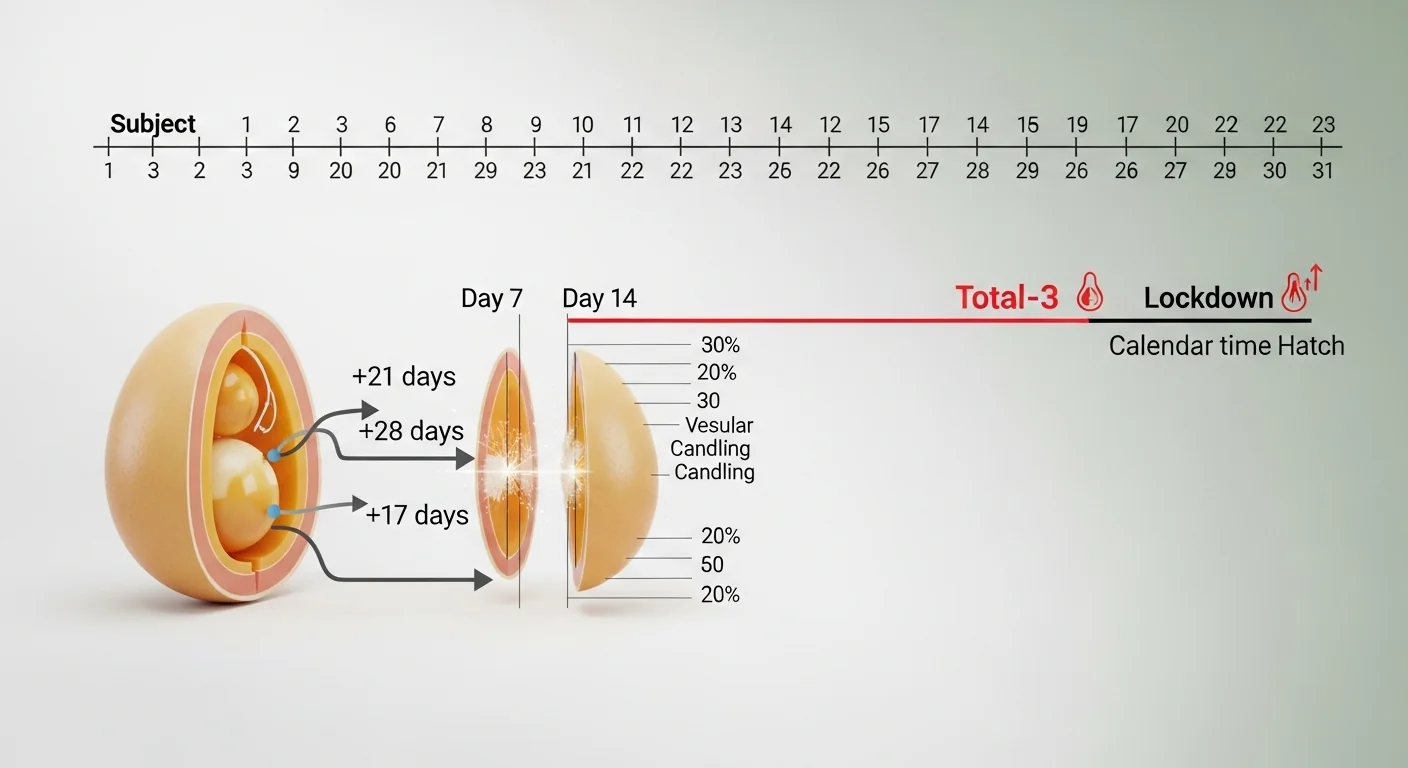
Core formula:
- Identify the incubation period in whole calendar days for the selected species (Chicken = 21, Duck = 28, Quail = 17, Turkey = 28, Goose = 30).
- Hatch Date = Start Date and Time + Incubation Days (each day is exactly 24 hours; no half-days or fractional adjustments).
- Lockdown Date = Hatch Date minus 3 calendar days.
- Candling Date A = Start Date and Time + 7 days.
- Candling Date B = Start Date and Time + 14 days.
Rounding rule: No rounding is applied. The calculator preserves the exact time-of-day entered. If you set eggs at 6:00 PM, every milestone output also reflects 6:00 PM on the respective date.
No unit conversions: All inputs and outputs are in calendar days and local date-time format. The calculator does not convert between incubator temperature units or humidity scales.
Assumptions and Limits
- Incubation periods used (Chicken 21, Duck 28, Quail 17, Turkey 28, Goose 30) are standard textbook figures for forced-air incubators maintained at 99 to 99.5 degrees F. Actual hatch timing can shift by one to two days.
- Muscovy ducks incubate for approximately 35 days, not 28. Selecting “Duck” for Muscovy eggs will produce an incorrect lockdown date.
- The calculator assumes incubation begins at the entered start time. If eggs were stored cold for several days before being set, the first 24 hours of incubation may be slower while eggs warm to incubation temperature; this is not accounted for in the formula.
- Still-air incubators typically require approximately one degree F higher than forced-air setpoints. Temperature management affects actual hatch timing; the calculator does not model this variation.
- Egg age at the time of setting affects hatchability but does not shift the incubation period calculation. The formula treats Day 0 as the moment the egg enters the incubator regardless of pre-incubation storage duration.
- The Day 7 and Day 14 candling dates are fixed reference points based on species averages. Dark-shelled eggs (certain breeds of chicken and duck) may be harder to assess on Day 7; visual clarity improves by Day 14.
- Hatch completion is a window, not a moment. External pipping typically begins near the calculated hatch date, but full hatch of a clutch can take 24 to 48 hours beyond that point. Do not intervene to assist pipping unless more than 24 hours have passed since internal pipping was observed.
Standards, Safety Checks, and “Secret Sauce” Warnings
Critical Warnings
- Missing the lockdown date is the single most preventable cause of late-stage hatch failure. When eggs are turned after lockdown, the developing chick cannot orient correctly for internal pipping. The three-day window is not a recommendation; it is a developmental requirement. Set the lockdown date alert before you set the eggs.
- Day 14 candling removes the greatest risk of incubator contamination. Eggs that have not developed by Day 14 are confirmed clears or quitters. Leaving them in the incubator through lockdown and hatch day creates a bacterial explosion risk that can kill developing embryos in adjacent eggs. Remove confirmed infertile or dead eggs promptly after Day 14 inspection.
- Humidity management at lockdown is species-dependent. Raising humidity too early collapses the air cell, and raising it too late can cause chicks to stick to the membrane during hatch. The lockdown date output from this calculator is the trigger point; consult species-specific humidity targets in the reference table above before adjusting your incubator.
- Do not open the incubator during the hatch window. From lockdown until the last chick has dried and been removed, each lid opening drops humidity rapidly and can cause membrane shrink-wrapping around chicks that have internally pipped but not yet externally pipped.
Minimum Standards
- Lockdown must begin no later than three full days before the projected hatch date. Earlier is acceptable only if the air cell appears fully developed during Day 14 candling.
- Candling sessions should not exceed 30 minutes of total out-of-incubator time for the clutch. Prolonged chilling at any stage depresses embryo metabolism and can stall development.
- At Day 7, do not remove eggs based on unclear candling results alone. Re-candle at Day 14 before making a removal decision on any egg that shows uncertain signs. False negatives at Day 7 are common with dark shells and beginner candling technique.
Competitor Trap: Many online egg incubation calculators display only the hatch date and nothing else. That single output creates a false sense of preparation. Without the lockdown date prominently flagged, first-time incubators routinely continue turning eggs through Days 19 and 20, directly causing chick malposition. The lockdown date is not a secondary detail. It is the most actionable output of any hatch date calculator, and a tool that buries it or omits it is failing the user at the most critical juncture of the process.
For managing the environmental conditions around your incubator setup, particularly in enclosed barn or outbuilding spaces, the barn ventilation calculator can help size airflow to prevent heat and humidity accumulation near your incubation area.
Common Mistakes and Fixes
Mistake: Selecting the Wrong Species
Using “Duck” for Muscovy duck eggs or “Chicken” for a mixed-breed bird produces an incubation period that is off by several days. Since the lockdown date is derived from the hatch date, an incorrect species selection cascades into every milestone output. Verify the exact breed and its documented incubation period before entering the calculator. Muscovy ducks (35 days) require a manual calculation until the calculator is extended to include them.
Fix: Confirm species and breed before setting eggs, not after. If unsure, contact your hatchery or breeder.
Mistake: Using the Egg Collection Date Instead of the Set Date
Eggs stored in a cool room for several days before being set in the incubator have not yet begun the incubation process. Using the collection date as the start date shortens the apparent incubation timeline, producing a lockdown date that arrives too early. The incubation clock starts the moment eggs reach incubation temperature in the incubator, not when they were laid or collected.
Fix: Enter the date and time the eggs physically went into the warm incubator. If you pre-warmed eggs on the counter for a few hours first, use the time they entered the incubator, not the counter.
Mistake: Skipping the Day 7 Candle Because Eggs “Look Fine”
Early-stage infertile eggs and early quitters look identical to developing eggs from the outside. Day 7 candling gives the first view of vasculature, which is the definitive sign of development. Operators who skip Day 7 often discover dead or exploded eggs during lockdown cleanup, by which point the contamination has already affected neighboring eggs. The feed cost calculator is a reminder that every resource put into a batch has a direct cost; treating each candling date as non-optional protects that investment.
Fix: Mark Day 7 on your calendar when you run this calculator. Treat it as a hard commitment, not an optional task.
Mistake: Treating the Hatch Date as an Exact Hour
The projected hatch date output is the beginning of the hatch window, not the moment every egg will crack. External pipping typically starts within 12 to 24 hours of the projected date, and full clutch hatch can take an additional 24 to 48 hours. Operators who begin intervening because nothing has hatched at the exact output time cause far more harm than hatching delays do on their own.
Fix: Plan brooder preparation for two days before the calculated hatch date. Do not open the incubator or assist pipping until at least 24 hours after internal pipping is confirmed.
Mistake: Running Lockdown Humidity Too Early
Raising humidity when eggs enter the incubator on Day 1 because you know lockdown is coming mismanages the air cell throughout the entire incubation period. The air cell must grow progressively to provide the chick with the internal oxygen pocket it needs for internal pipping. Elevated humidity from the start suppresses air cell development and is associated with chicks drowning in fluid near hatch.
Fix: Maintain standard incubation humidity from Day 1 until the specific lockdown date this calculator provides. Switch to lockdown humidity only on that date.
Next Steps in Your Workflow
Once you have your three dates, the immediate next action is brooder preparation. Chicks that hatch successfully need a warm, dry brooder environment within hours of drying off in the incubator. Most first-time hatchery failures occur not during incubation but in the transition from incubator to brooder, where temperature management becomes the critical variable. The chick brooder temperature calculator helps you dial in the correct heat source height and zone temperature for the first days and weeks after hatch, by species and week of age.
Beyond the immediate hatch event, calculating ongoing feed costs for your growing flock is a natural next step in livestock planning. The gestation calculator for cattle is one example of how the same milestone-tracking approach applies across different livestock species and breeding cycles. Whether you are managing a poultry flock or a mixed homestead operation, the principle of anchoring all management decisions to a fixed, calculated date is consistent across species and is the foundation of productive livestock planning.
FAQ
What happens if I do not know the exact time I set the eggs?
Use the closest hour you can estimate. For most home incubators, being off by one to two hours on the start time does not materially change the lockdown date or hatch window. The lockdown date is a three-day buffer, so a two-hour error at the start does not collapse that margin. Enter your best estimate and treat all milestone dates as approximate to the nearest half-day.
Can I incubate chicken and duck eggs in the same batch?
Technically yes, but the different incubation periods make management complicated. Chicken eggs hit lockdown at Day 18 while duck eggs need seven more days of turning. You would need to manage turning for duck eggs while keeping the incubator closed for hatching chicks. Most experienced incubators run separate batches by species to avoid this conflict. Use this calculator once for each species to see how far apart the lockdown dates fall.
Why does the calculator show the same lockdown day for both duck and turkey eggs?
Both domestic duck and turkey eggs have a 28-day incubation period. Since lockdown is always three days before the projected hatch, the lockdown day number (Day 25) is identical for both species. The actual calendar date of lockdown will differ based on when you set the eggs. The underlying biology and humidity requirements between turkey and duck during lockdown are different, even though the day count is the same.
What does the Day 7 candling check actually show?
At Day 7, a developing egg shows a visible network of blood vessels radiating from a small dark embryo mass, sometimes described as a spider-web pattern against the light source. An infertile egg appears uniformly clear or shows only the yolk shadow. A early-death quitter may show a blood ring. Dark-shelled eggs from breeds like Black Copper Marans are notoriously difficult to read at Day 7; wait until Day 14 before making removal decisions on those breeds.
Is the hatch date the same as the day chicks fully dry and are ready to move?
No. The hatch date output marks the beginning of the hatch window, when external pipping is expected to begin. From first external pip to a fully hatched, dried chick can take 12 to 24 hours per individual bird. The full clutch may take another full day to complete after the first chick hatches. Chicks should not be moved to the brooder until they are dry and standing steadily, which typically adds 12 to 24 hours to the hatch date for the last birds in a batch.
How does a still-air incubator change the incubation period?
Still-air incubators do not change the incubation period in calendar days, but they require a temperature setpoint approximately one degree F higher than forced-air models to achieve the same effective egg temperature. If the still-air temperature runs slightly low throughout incubation, the hatch may occur one to two days later than calculated. The incubation day counts in this calculator are validated for correctly maintained forced-air units and serve as reliable targets for still-air units when temperature is properly managed.
Conclusion
The single most important action this tool enables is getting the lockdown date onto your calendar before the eggs go into the incubator. More late-stage hatch failures trace back to missed or delayed lockdown than to any other single cause. Run the calculator before Day 1, not on Day 17 when you are scrambling to remember when you started. If you are scaling up your operation and thinking about the broader livestock management picture, the pasture stocking rate calculator can help you plan carrying capacity as your flock grows beyond what the incubator alone can accommodate.