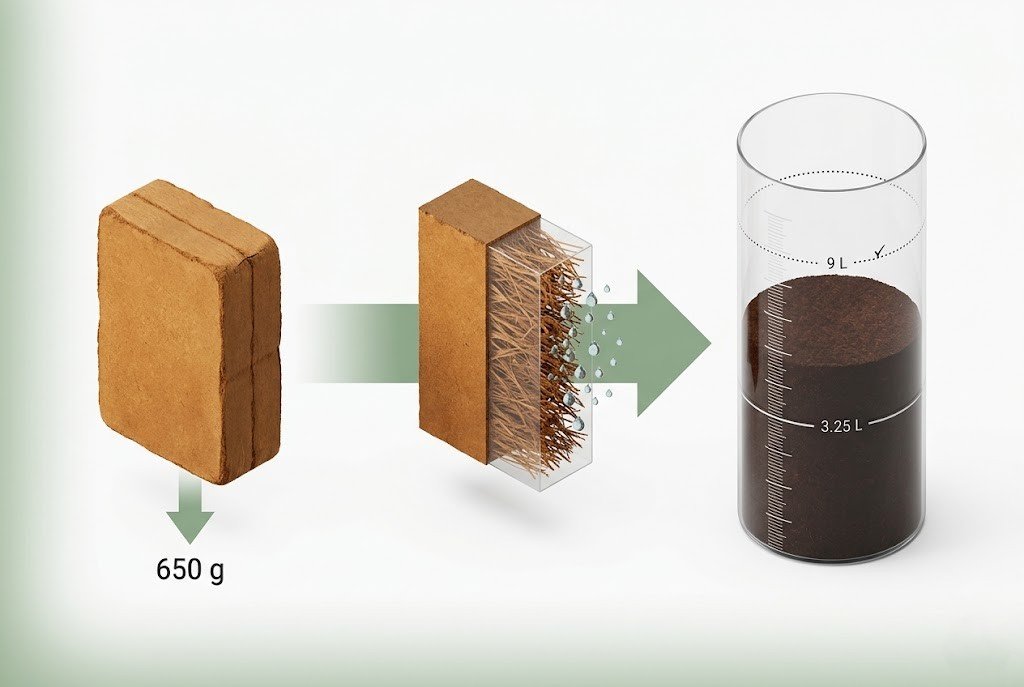
Compressed coco coir presents a planning problem that raw weight cannot solve on its own.
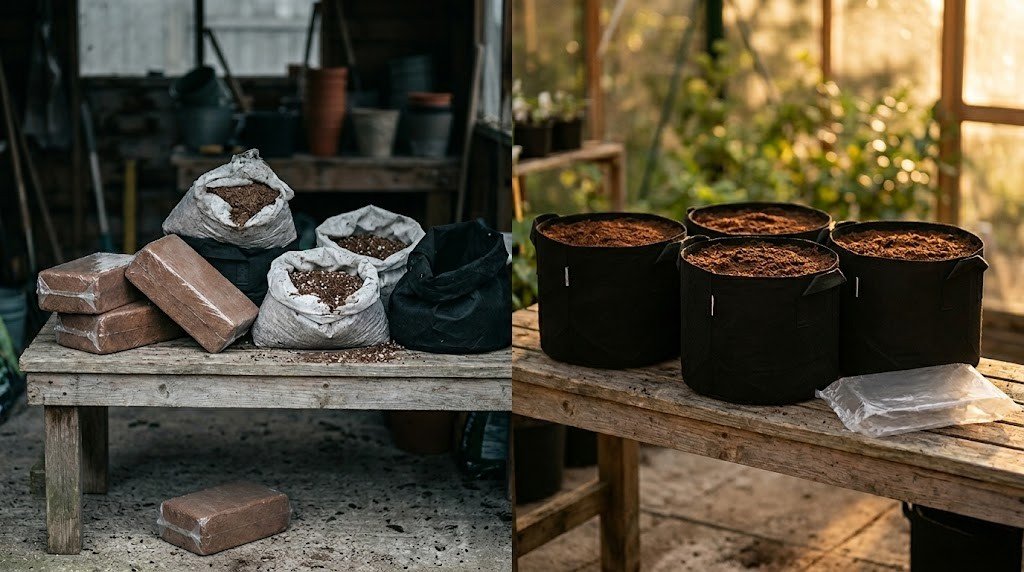
A 650 g brick sitting sealed in its packaging gives no visual indication of the liters of growing medium it will become once fully rehydrated. Growers who skip the conversion and estimate by eye routinely miscalculate how many containers they can fill, how many bricks to order, or how much substrate a raised bed project actually requires.
This coco coir calculator converts the dry weight of any compressed brick, block, or bag into its estimated expanded volume across four unit systems: liters, US gallons, US quarts, and cubic feet. The formula applied is Vol(L) = Weight(g) x 5 / 1000, representing a 5 L per kilogram baseline expansion rate. The tool does not predict nutrient content, adjust for brand-specific compression grades above the baseline, or estimate rehydration water volume.
After entering your brick weight, you will know the estimated expanded volume in the unit system your project uses, giving you the specific number needed to match brick quantities to container sizes, bed fills, or bulk substrate orders before purchasing.
Use the Tool
Before calculating, locate the dry weight printed on the sealed packaging of your coco coir product. This value appears before any water contact and is typically listed in grams (g) or kilograms (kg). If the label shows kilograms only, multiply by 1,000 to get grams (5 kg = 5,000 g). If the packaging uses pounds, select the lbs toggle in the calculator and enter the imperial value directly.
Coco Coir Expansion Calculator
Instantly calculate how much growing medium volume your coco coir brick or block will yield after full rehydration.
Enter Brick / Block Weight
How this calculator works
Formula: Volume (L) = Weight (g) × 5 ÷ 1000
This applies the industry-standard 5 L per kg expansion ratio for compressed coco coir peat. 1 kg dry = ~5 liters hydrated.
- Enter dry weight in grams or lbs.
- If lbs: convert →
g = lbs × 453.592 - Apply formula:
L = g × 5 ÷ 1000 - Convert: Quarts (×1.05669), Gallons (×0.264172), Cu ft (×0.0353147)
Assumptions & Limits: The 5 L/kg ratio is an industry average. Actual expansion can vary ±10–15% based on compression, brand, coarseness, and water temperature. Use warm water and soak 15–30 minutes for best results.
| Description | Weight (g) | Weight (lbs) | Liters | US Gallons |
|---|
If your project combines coco coir with perlite, bark fines, or compost into a blended potting substrate, calculate your coco volume here first, then use the Potting Soil Calculator to proportion the total mix by component.
Quick Start (60 Seconds)
- Read the dry weight from the sealed package. This is the only reliable weight to enter. Post-rehydration weight includes absorbed water mass and will produce an inflated, unusable estimate.
- Select grams (g) or pounds (lbs). Grams is the default. Toggle to lbs only if your packaging explicitly labels in pounds. Do not mix units (entering a kg value in a grams field is a 1,000x error).
- Type a number only. Enter “650” not “650g.” The field accepts decimal values (e.g., “1.5” for 1.5 lbs).
- Click “Calculate Volume” or press Enter. Results appear immediately in four unit formats simultaneously.
- Compare against the reference table further down this page. If your result is far outside the expected range for your weight class, check whether the unit toggle matches the unit on your label.
- Use Reset to clear and start over. The Reset button clears the weight field, removes all results, and returns the unit toggle to grams.
Inputs and Outputs (What Each Field Means)
| Field | Unit | What It Represents | Common Mistake | Safe Entry Guidance |
|---|---|---|---|---|
| Weight Input | g or lbs | Dry weight of the compressed coco coir brick or block as printed on the label before any water is added | Entering post-rehydration weight, which can be 8x to 12x higher due to water absorption | Read the label before opening. Standard retail bricks are near 650 g; commercial blocks are typically 5 kg or 10 kg |
| Unit Toggle (g / lbs) | n/a | Specifies whether the entered weight is in grams or pounds before the calculation runs | Entering a kilogram value while the toggle is set to grams (e.g., typing “5” for a 5 kg block in grams mode) | If label shows kg, multiply by 1,000 and keep toggle on g. Or convert to lbs and switch toggle accordingly |
| Volume (Liters) | L | Primary output: estimated expanded volume in liters after complete rehydration | Treating this as a guaranteed fill volume rather than a baseline estimate | Use liters for comparing against pot sizes labeled in liters, common in European and horticultural product catalogs |
| Volume (US Quarts) | qt | Expanded volume converted to US quarts for comparison with North American potting bag labels | Confusing US quarts (0.946 L) with UK quarts (1.136 L) | North American potting products are typically labeled in US quarts; use this output for direct comparison shopping |
| Volume (US Gallons) | gal | Expanded volume in US gallons, useful for cross-referencing large container sizes | Using gallon volume to fill a container rated by nominal gallon size; pot “gallon” ratings are loose fill, not liquid volume | A nominal 5-gallon container holds approximately 15 to 17 liters of loose substrate; use the liter output for precision |
| Volume (Cubic Feet) | cu ft | Expanded volume in cubic feet, directly comparable to raised bed fill volumes and bulk bag sizing | Confusing cubic feet (volume) with square feet (area) when estimating raised bed fills | Multiply bed length x width x depth in feet to get required cubic feet, then compare to this output directly |
Worked Examples (Real Numbers)
Example 1: Standard 650 g Retail Brick for Seedling Trays
- Weight entered: 650
- Unit selected: grams
- Calculation: 650 x 5 / 1,000 = 3.25 L
- Secondary conversions: 3.25 x 1.05669 = 3.43 qt | 3.25 x 0.264172 = 0.86 gal | 3.25 x 0.0353147 = 0.115 cu ft
Result: 3.25 liters | 3.43 US quarts | 0.86 US gallons | 0.115 cubic feet
A single 650 g brick at the 5 L/kg baseline fills roughly three 1-liter seedling cells or one 3-liter container with a small amount remaining.
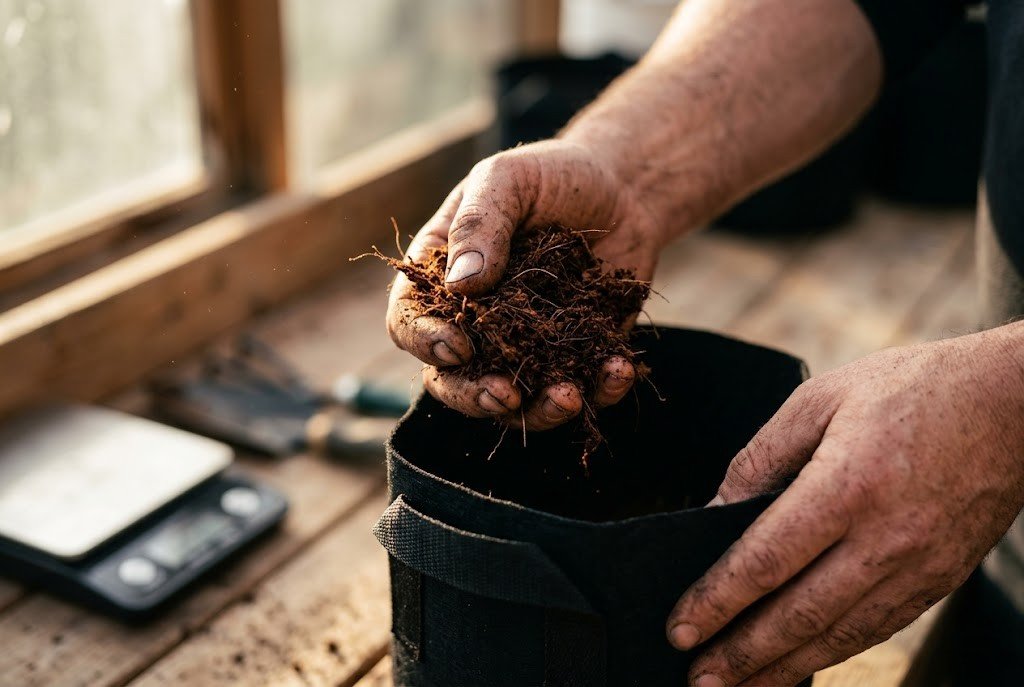
This format is not suited for raised bed or grow-bag fills without stacking multiple units.
Example 2: 5 kg Hydroponic Block for Grow Bags
- Weight entered: 5,000
- Unit selected: grams
- Calculation: 5,000 x 5 / 1,000 = 25.00 L
- Secondary conversions: 25.00 x 1.05669 = 26.42 qt | 25.00 x 0.264172 = 6.60 gal | 25.00 x 0.0353147 = 0.883 cu ft
Result: 25.00 liters | 26.42 US quarts | 6.60 US gallons | 0.883 cubic feet
At the 5 L/kg baseline, a single 5 kg block provides enough medium for five standard 5-liter grow bags. This block size is the most common format in commercial soilless and hydroponic operations where substrate volume consistency across planting rows is critical.
Example 3: 1 lb Mini Brick from North American Retail Packaging
- Weight entered: 1
- Unit selected: lbs
- Internal conversion: 1 x 453.592 = 453.59 g
- Calculation: 453.59 x 5 / 1,000 = 2.27 L
- Secondary conversions: 2.27 x 1.05669 = 2.40 qt | 2.27 x 0.264172 = 0.60 gal | 2.27 x 0.0353147 = 0.080 cu ft
Result: 2.27 liters | 2.40 US quarts | 0.60 US gallons | 0.080 cubic feet
The 1 lb format is a common entry-level retail size in North American garden centers. The output confirms this brick fills a single 2-liter container at capacity and is not practical for any project requiring more than 2 to 3 liters without purchasing multiple units.
Reference Table (Fast Lookup)
All volume values are computed from the formula Vol(L) = Weight(g) x 5 / 1,000.
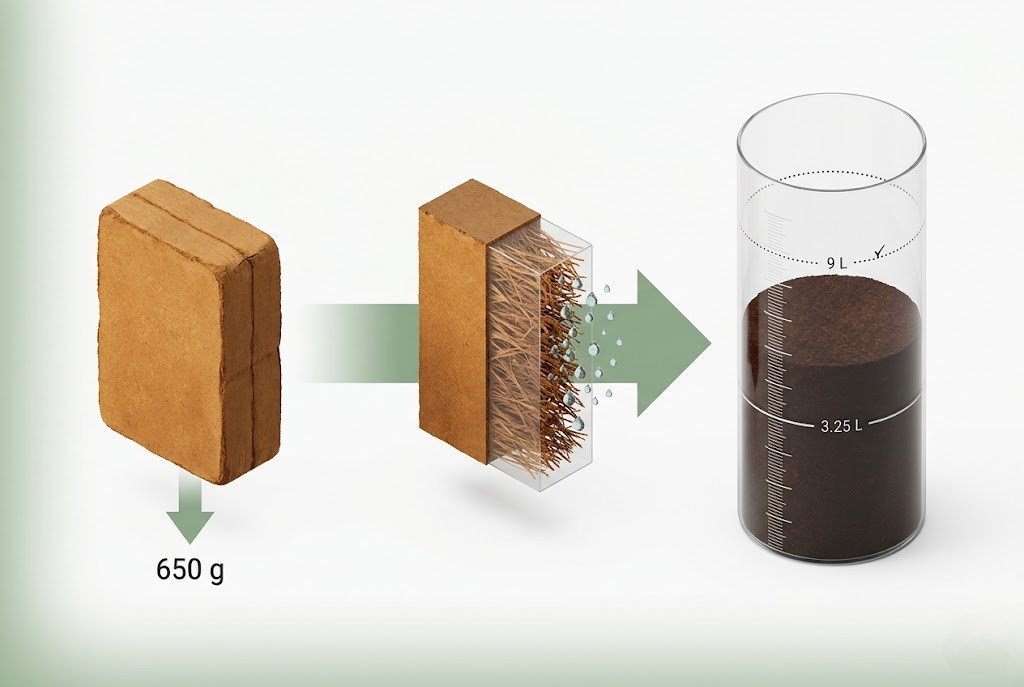
The final column, “5 L Containers Filled,” is a derived planning figure showing how many standard 5-liter pots the expanded volume can fill at capacity. Values below 1.0 indicate a partial fill of a single 5-liter container. For substrate density context, see the Soil Bulk Density Calculator.
| Product Type | Dry Weight (g) | Dry Weight (lbs) | Volume (L) | Volume (US Gal) | Volume (qt) | Volume (cu ft) | 5 L Containers Filled |
|---|---|---|---|---|---|---|---|
| Mini brick | 150 | 0.33 | 0.75 | 0.20 | 0.79 | 0.026 | 0.15 |
| Small brick | 250 | 0.55 | 1.25 | 0.33 | 1.32 | 0.044 | 0.25 |
| Standard brick | 650 | 1.43 | 3.25 | 0.86 | 3.44 | 0.115 | 0.65 |
| Large brick | 1,000 | 2.20 | 5.00 | 1.32 | 5.28 | 0.177 | 1.00 |
| 2 kg block | 2,000 | 4.41 | 10.00 | 2.64 | 10.57 | 0.353 | 2.00 |
| 5 kg block | 5,000 | 11.02 | 25.00 | 6.60 | 26.42 | 0.883 | 5.00 |
| 10 kg block | 10,000 | 22.05 | 50.00 | 13.21 | 52.83 | 1.766 | 10.00 |
| 20 kg bag | 20,000 | 44.09 | 100.00 | 26.42 | 105.67 | 3.531 | 20.00 |
| 25 kg bag | 25,000 | 55.12 | 125.00 | 33.02 | 132.09 | 4.414 | 25.00 |
How the Calculation Works (Formula + Assumptions)
Show the calculation steps
Core formula: Vol(L) = Weight(g) x 5 / 1,000
This represents an expansion rate of 5 liters per kilogram of dry compressed coco coir. The full calculation sequence:
- Accept the input weight in grams. If lbs is selected, convert first: Weight(g) = Weight(lbs) x 453.592
- Multiply gram weight by 5 to produce volume in milliliters: mL = Weight(g) x 5
- Divide milliliters by 1,000 to convert to liters: L = mL / 1,000
- Apply unit conversions for secondary outputs:
US Quarts = L x 1.05669
US Gallons = L x 0.264172
Cubic Feet = L x 0.0353147
Rounding rule: All volume outputs are rounded to 2 decimal places. The lbs-to-grams conversion uses 3 decimal places internally before volume is computed.
Assumptions and Limits
- The 5 L/kg ratio is a commonly cited baseline. Premium compressed-peat style coco coir bricks are documented to yield significantly higher volumes at full expansion, with industry reference values for a 650 g brick reaching approximately 9 liters and a 5 kg block reaching approximately 70 liters. These figures imply an expansion ratio closer to 13 to 14 L/kg. The calculator produces a conservative lower-bound estimate for these products.
- The formula assumes complete rehydration. Soaking for fewer than 15 to 20 minutes in insufficient water produces less than the calculated volume.
- Compressed density varies across manufacturers and product lines. Two 650 g bricks with different compression densities may yield different actual volumes under identical rehydration conditions.
- Coarseness grade affects bulk density of the final expanded medium. Fine-grade coco packs more tightly than chunky husk chip grades at the same measured volume.
- Some branded products include pre-blended amendments (perlite, worm castings, buffering agents). A blended brick expands differently than pure coco coir.
- Water temperature influences expansion speed but not final volume under fully saturated conditions. Warm water (20 to 35 degrees C) accelerates the process.
- The tool flags weights below 100 g with a warning. At very small scales, measurement precision in a home or field environment becomes a limiting factor in accuracy.
Standards, Safety Checks, and “Secret Sauce” Warnings
Critical Warnings
- Wet weight produces an invalid result. A fully rehydrated 650 g brick absorbs several liters of water and can weigh 5x to 10x its dry label mass. Entering that post-rehydration weight generates an inflated volume estimate that is not usable for purchasing or container planning. Always enter the dry weight from the sealed label.
- The baseline estimate can understate actual yield for premium products. Documented industry reference values place the yield of a standard 650 g compressed brick at approximately 9 liters, and a 5 kg block at approximately 70 liters, under complete rehydration conditions. Growers who plan purchases based solely on the 5 L/kg baseline risk overbuying by a substantial margin. Cross-check against the manufacturer’s stated yield on the product data sheet whenever available.
Minimum Standards
- A 650 g standard compressed brick should yield a minimum of 3.25 liters at the 5 L/kg baseline. Well-produced compressed-peat style bricks from established suppliers are documented to reach approximately 9 liters under full rehydration.
- A 5 kg commercial block should yield at least 25 liters at baseline. Industry reference performance for this block size reaches approximately 70 liters for high-expansion grade products.
- Any result that falls substantially below the calculator baseline for a given weight suggests either an inaccurate weight entry, a kg-in-grams unit error, or an unusually low-expansion product type.
Competitor Trap: The majority of coco coir content online cites the 5 L/kg figure as though it is the ceiling, not the floor. High-expansion compressed bricks are documented to produce 9 liters from a 650 g unit, which corresponds to an expansion ratio of approximately 13.85 L/kg. Growers who plan container fills or purchase quantities using only the 5 L/kg assumption will systematically underestimate how much substrate a single brick provides, often resulting in overordering by nearly a factor of three for the standard brick format. Always locate the manufacturer’s stated expansion yield on the packaging or technical data sheet before scaling a purchase.
For planning raised bed fills that blend coco coir with other substrate components, the Raised Bed Soil Calculator supports multi-layer and multi-component volume planning by bed dimensions. For a side-by-side comparison with sphagnum peat-based substrates, the Peat Moss Calculator performs the same dry-weight-to-volume conversion for peat products.
Common Mistakes and Fixes
Mistake: Entering Kilogram Values Without Converting to Grams
A product labeled “5 kg” entered as “5” with the gram toggle selected tells the calculator you have a 5-gram brick, yielding an output of 0.025 liters. The validation accepts 5 g as a valid entry, so no error message appears, but the result is 1,000x below the correct figure. This is one of the most common data entry errors in volume planning.
Fix: Convert kilograms to grams before entry by multiplying by 1,000. A 5 kg block = 5,000 g. Compare your output to the reference table above to sanity-check the result before acting on it.
Mistake: Weighing the Brick After Partial Rehydration
Coco coir begins absorbing water within seconds of contact. A brick weighed after unwrapping, or after a few minutes of soaking, already contains water mass that inflates the weight significantly. Entering this figure into a dry-weight formula produces a volume estimate with no reliable relationship to actual expanded substrate.
Fix: Read the printed dry weight directly from the label on the sealed, unopened package. This figure is the only one that maps consistently to a known expansion ratio.
Mistake: Planning Container Counts Using Gallon Output While Pots Are Rated in Liters
The US gallon output and the nominal gallon rating on a pot are not the same thing. A pot marketed as a “5-gallon container” holds approximately 18.9 liters of liquid volume, but is filled with only 15 to 17 liters of loose growing medium due to headspace and substrate settling. Direct comparison of the calculator’s gallon output to the pot’s gallon rating introduces consistent underfill.
Fix: Use the liter output from this calculator and compare it to the actual substrate capacity of the container, typically listed in liters on the manufacturer’s product page.
Mistake: Assuming All Bricks of the Same Weight Perform Identically
The 650 g format is a shared weight class used by dozens of manufacturers, but compression grade, coarseness (fine, medium, chunky, husk chips), and buffering agent content vary substantially between brands. Two 650 g bricks from different producers will generate the same calculator output but may expand to meaningfully different textures, water retention profiles, and accessible volumes.
Fix: Use the calculator output for volume and purchasing quantity planning, but review product grade specifications separately when drainage performance or water-holding capacity matters for a specific crop or system.
Mistake: Treating Calculated Volume as the Exact Fill Depth in a Tall Container
The volume output represents total expanded medium assuming complete and uniform expansion in open air. When loaded into a tall container, gravitational compression and particle settling during initial watering cycles can reduce apparent fill height below what a pure volume comparison would predict. This effect is more pronounced in containers deeper than 30 cm.
Fix: When precision fill depth matters, add a buffer of one additional small brick per five containers, or purchase a slightly larger block format to ensure adequate volume without a supplemental order.
Related Tools and Next Steps
After calculating your coco coir expanded volume, the natural next step for most projects is proportioning it within a complete substrate blend. The Soil Mix Calculator lets you combine coco coir volume with perlite, bark, compost, and other components to hit a target ratio for a custom growing medium.
For projects amending garden beds alongside coco coir, the Compost Calculator sizes how much finished compost is needed by bed or container volume, proportioned relative to your coco coir output.
Coco coir is inherently low in plant-available nutrients and requires active fertilization from transplant onward. The NPK Calculator helps build a nutrient application plan once substrate volume is established.
Hydroponic and container growers using diluted liquid fertilizer programs can use the Fertilizer Dilution Calculator to work out the correct concentrate-to-water ratio for the solution volume their substrate quantity requires.
When sourcing amendments to blend with coco coir, understanding particle size distribution matters for drainage and aeration performance. The Soil Texture Calculator supports analysis of substrate composition by particle fraction for blended media planning.
FAQ
How many liters does a standard 650 g coco coir brick yield?
At the 5 L/kg expansion baseline used in this calculator, a 650 g brick yields approximately 3.25 liters. Industry reference documentation for premium compressed-peat style bricks places the yield closer to 9 liters for this weight class under complete rehydration. The actual volume depends on the product’s compression grade and how thoroughly it is soaked. Check the product label or technical data sheet for the manufacturer’s stated expansion yield.
Can this tool be used for coco peat and coco husk chip formats?
Yes. Coco peat and coco coir refer to the same base material: compressed fibrous coconut husk pith. The weight-to-volume conversion applies to any dry-compressed format, including fine peat, mixed grade, chunky husk chips, and slab forms. Enter the dry weight printed on the sealed package and the calculator handles the rest regardless of grade label.
What is the actual expansion ratio for coco coir?
This calculator applies a 5 L/kg baseline. Documented industry values for compressed brick products show higher performance: a 650 g brick reaching approximately 9 liters implies a ratio of roughly 13.85 L/kg, and a 5 kg block reaching approximately 70 liters implies roughly 14 L/kg. The range varies significantly by brand, compression method, and grade. Use manufacturer-stated yields for precision planning and this tool’s output as a conservative planning floor.
How much water is needed to fully rehydrate a coco coir brick?
This calculator estimates expanded volume but does not calculate water requirements. As a general working figure, coco coir absorbs roughly 8 to 9 times its dry weight in water at full saturation. For a 650 g brick, that points toward approximately 5 to 6 liters of water for complete expansion. Pour incrementally and allow 15 to 30 minutes for the core to absorb moisture before breaking apart the mass.
Does this calculator work for hydroponic coco coir slabs and grow bags?
Yes. Hydroponic slabs are compressed coco coir in a sealed slab or bag form. Enter the dry weight from the product label and the volume output tells you the total expanded substrate volume contained in the slab. This is useful for calculating planting density per slab and for sizing drip irrigation emitters relative to substrate volume. The volume figure applies to medium quantity planning regardless of the slab format.
Why does my expanded brick look larger than the calculator result suggests?
The calculator uses a conservative 5 L/kg baseline. Many branded compressed bricks are specifically engineered for high-expansion performance, producing 13 to 14 liters per kilogram under full rehydration, which is roughly 2.7 times the baseline estimate. If your brick expands more than expected, you have a higher-expansion product. Adjust future quantity planning to use the manufacturer’s stated yield for that specific product.
Conclusion
The practical value of a coco coir calculator is the direct translation between what is printed on a sealed package and the container volume that package actually fills. The tool covers four unit systems in a single calculation, removing the manual conversion step that introduces most planning errors. The 5 L/kg baseline produces a reliable lower-bound volume estimate; products that meet the documented industry reference values of 9 liters per 650 g brick or 70 liters per 5 kg block will deliver substrate volumes well above this baseline.
The one error that undermines the usefulness of any expansion calculator is entering the wrong weight: either a post-rehydration measurement or a kilogram value entered into a grams field. Both create results that are off by a large enough factor to miscalculate an entire order or fill plan. Read the dry weight from the sealed package, verify the unit toggle matches, and cross-reference the output against the reference table above to confirm the result is in the expected range. From there, the NPK Fertilizer Calculator is a logical next step for growers who need to build a nutrient program scaled to the substrate volume they have just calculated.

Lead Data Architect
Umer Hayiat
Founder & Lead Data Architect at TheYieldGrid. I bridge the gap between complex agronomic data and practical growing, transforming verified agricultural science into accessible, mathematically precise tools and guides for serious growers.
View all tools & guides by Umer Hayiat →