
| Ground Speed (mph) | In / Stroke | Flakes / Bale | Bale Quality |
|---|
How This Calculator Works — Formula & Assumptions
Step 1: Distance Per Stroke
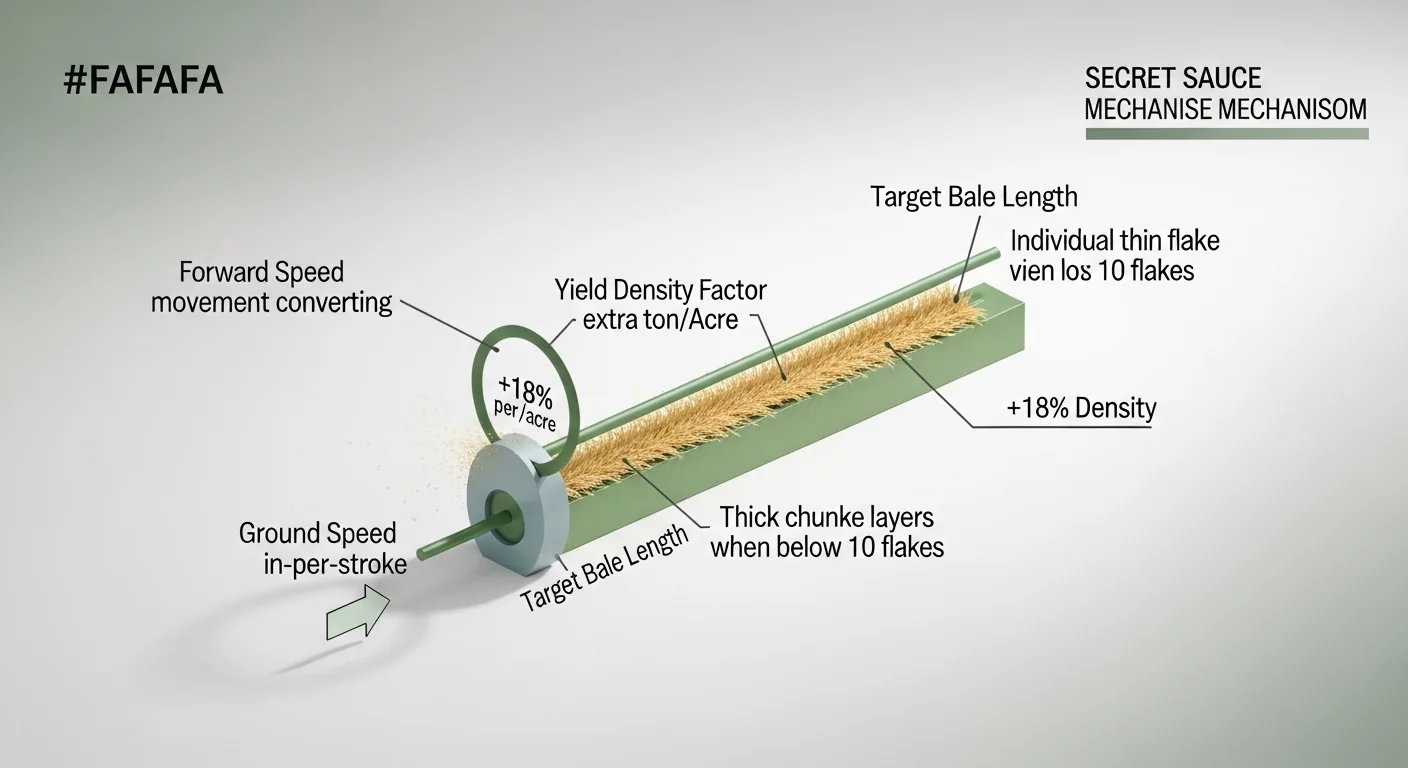
The tractor’s ground speed (mph) is converted to inches per minute, then divided by the plunger speed (strokes/min) to find how far the tractor travels between each plunger stroke.
88 is the conversion factor: 1 mph = 88 feet/minute. We then multiply by 12 to get inches.
Step 2: Yield Factor (Density Correction)
A heavier windrow packs more hay per inch. The yield factor scales how many flakes fit into the bale length relative to a baseline 1 ton/acre windrow.
This reflects that a 2 ton/acre windrow is 18% denser per linear foot than a 1 ton/acre windrow, compressing more material into fewer, thicker flakes.
Step 3: Flakes Per Bale
Each “flake” is one slice of hay deposited by a single plunger stroke. Optimal bale quality is 12–16 flakes. Fewer than 10 triggers the Banana Bale warning.
Step 4: Bales Per Minute & Hour
Assumptions & Limits
- Plunger speed is assumed constant at the entered RPM (no slip or PTO variation).
- Windrow is assumed uniform; field variation is not modeled.
- Yield factor is a linear approximation; actual bale density varies with crop type, moisture, and cutter bar settings.
- Valid range: Plunger 40–200 SPM, Speed 0.5–15 mph, Yield 0.1–10 tons/acre, Length 12–72 inches.
- This calculator is a field planning tool. Always verify bale weights and twine tension on the first few bales of each field.

A square baler's plunger operates at a fixed mechanical rate regardless of how fast the tractor moves. That single constraint is the root cause of nearly every sloppy, collapsing bale produced in the field. When ground speed climbs faster than the plunger can slice incoming hay into uniform layers, the result is a bale built from a handful of massive, loosely bonded chunks rather than a stack of tight, consistent flakes. The structural failure mode has a name: the banana bale.
This tool calculates the number of flakes your baler produces per bale based on four inputs: plunger speed, tractor ground speed, windrow yield, and target bale length. It applies a yield-density correction to account for heavier windrows that pack more material per linear foot. It does not account for hay moisture content, cutter bar variation, pickup reel speed, or field terrain changes. Those variables affect bale density but are outside the scope of plunger timing math.
After running this calculator, you will know whether your current ground speed is mechanically compatible with your baler's plunger rate. If the flake count falls below 10, slow down before starting the next windrow. If it lands between 12 and 16, your timing is dialed in.
Use the Tool
Before you calculate, pull three numbers from your tractor and baler: the PTO speed your baler runs at (typically 540 RPM, which translates to roughly 90 plunger strokes per minute), your actual GPS-confirmed ground speed in mph, and your estimated windrow yield in tons per acre. If you are unsure of your ground speed, check your tractor's speedometer against a GPS reading rather than relying on the transmission gear estimate. Accuracy here matters because a 1 mph error at high speeds can push flake count below the danger threshold. For help getting a precise tractor speed reading, this ground speed calculator can help you verify your figures before entering them here.
Quick Start (60 Seconds)
- Plunger Speed (SPM): Enter strokes per minute, not PTO RPM. At 540 PTO RPM, most square balers run near 90 SPM. Check your operator manual if you are unsure. Do not enter 540 here.
- Tractor Ground Speed (mph): Use actual field speed, not the speed you set in the cab. Wet ground or heavy windrows reduce effective ground speed below the display reading.
- Windrow Yield (tons/acre): Light-cutting grass hay typically runs 0.8 to 1.2 tons per acre. Heavy alfalfa or thick orchard grass can exceed 2.5. When in doubt, use a conservative (higher) number to avoid underestimating density.
- Target Bale Length (inches): This is the bale chamber setting, not the finished bale measurement after it drops. Common settings: 36 inches and 48 inches. Do not convert to feet.
- Read the flake count: 12 to 16 is the optimal window. Below 10 triggers the banana bale warning. Above 16 indicates twine and knotter stress risk.
- Check the recommended max speed: The tool outputs a safe ground speed ceiling. Note it before re-entering the field.
- Use the reference table: The automatically generated speed-vs-flake table lets you evaluate 7 different ground speed scenarios without re-entering data.
Inputs and Outputs (What Each Field Means)
| Field | Unit | What It Means | Common Mistake | Safe Entry Range |
|---|---|---|---|---|
| Plunger Speed | Strokes per minute (SPM) | The mechanical rate at which the plunger cycles inside the bale chamber. Fixed by PTO speed and gearbox ratio. | Entering PTO RPM (540) instead of SPM (90) | 40 to 200 SPM |
| Tractor Ground Speed | Miles per hour (mph) | How fast the tractor is physically moving across the field. Determines how much windrow enters the chamber per plunger stroke. | Using cab-display speed instead of GPS-verified field speed | 0.5 to 15 mph |
| Windrow Yield | Tons per acre (TPA) | The mass of hay per acre. Heavier windrows mean more material enters the chamber per linear foot, compressing more material per flake. | Using the field's total yield estimate rather than the first-cutting or specific cutting yield | 0.1 to 10 TPA |
| Target Bale Length | Inches | The bale chamber length setting that triggers the knotter and ejection cycle. This is set on the baler, not measured from the dropped bale. | Measuring a finished bale after drop (bales settle and shorten by 1 to 3 inches) | 12 to 72 inches |
| Flakes per Bale (output) | Count | The number of individual hay slices the plunger deposits into the bale chamber before the knotter fires. More flakes mean tighter, more stable bales. | Confusing flake count with bale weight (heavier does not equal more flakes) | Optimal: 12 to 16 |
| Inches per Stroke (output) | Inches | How far the tractor travels between consecutive plunger strikes. Represents the "raw slice thickness" before yield-density correction. | Assuming a lower number always means better quality regardless of windrow density | Informational only |
| Recommended Max Speed (output) | mph | The highest ground speed at which your specific baler-windrow combination produces a 13-flake bale. Your personal safe ceiling for this field. | Treating this as a fixed number across all fields. Re-calculate for every different windrow density. | Informational only |
If you are also calibrating your tractor's PTO output before baling season, the PTO shaft sizing calculator helps confirm your driveline is matched to the baler's input requirements before you engage the PTO at speed.
Worked Examples (Real Numbers)
Scenario 1: The Storm-Chaser (Banana Bale Failure)
- Plunger Speed: 90 SPM
- Tractor Ground Speed: 5.5 mph
- Windrow Yield: 2.2 tons per acre (heavy first-cut alfalfa)
- Target Bale Length: 36 inches
Result: Flake count falls into the banana bale zone. The plunger is cycling at 90 strokes per minute while the tractor covers enough ground to push a massive volume of heavy alfalfa into the chamber between each stroke. Each slice is too thick, too dense, and too few to form a structurally sound bale. The bale will eject with loose ends and a curved profile because the outer layers cannot bind properly against such large interior chunks.
The fix is not to run a lighter PTO. The fix is to reduce ground speed until the flake count climbs back into the 12-to-16 range for this yield density.
Scenario 2: Optimal Timing on Light Grass Hay
- Plunger Speed: 90 SPM
- Tractor Ground Speed: 3.5 mph
- Windrow Yield: 1.0 ton per acre (first-cut ryegrass, thin windrow)
- Target Bale Length: 36 inches
Result: Flake count lands in the optimal 12-to-16 range. At this ground speed and windrow density, the plunger slices incoming hay into thin, consistent layers that stack and compress uniformly. The bale will be tight, rectangular, and shed rain off its flat faces when stored on a pallet or stacked in a barn.
This speed-yield combination represents the "calibrated" sweet spot most operator manuals aim for: enough forward momentum to maintain fieldwork efficiency without outrunning the mechanical timing.
Scenario 3: Long Bale at Moderate Speed
- Plunger Speed: 90 SPM
- Tractor Ground Speed: 4.0 mph
- Windrow Yield: 1.5 tons per acre (second-cut orchard grass)
- Target Bale Length: 48 inches
Result: The longer bale length allows more plunger strokes to accumulate before the knotter fires, which drives the flake count into the optimal zone even at moderate speed. Operators running 48-inch bale settings gain a natural buffer against banana bale risk at typical field speeds. The trade-off is heavier bales per unit, which can stress older knotters if twine tension is not re-checked after switching bale lengths.
Reference Table (Fast Lookup)
This table is computed using the same formula as the calculator: 90 SPM plunger speed, 36-inch target bale length, windrow yield of 1.5 tons per acre (yield factor 1.09). Use it as a quick field guide when you cannot run the full calculator. The "Effective Flake Thickness" column is the derived compression metric: it represents the uncompressed field distance (inches) that the plunger consolidates into a single bale layer, corrected for windrow density.
| Ground Speed (mph) | Inches / Stroke | Effective Flake Thickness (in) | Flakes / Bale | Bale Quality | Action |
|---|---|---|---|---|---|
| 1.5 | 17.6 | 19.2 | 1.9 | Banana Bale | Do not bale at this speed |
| 2.5 | 29.3 | 31.9 | 1.1 | Banana Bale | Reduce speed immediately |
| 3.5 | 41.1 | 44.8 | 0.8 | Marginal | Reduce speed or use longer bale length |
| 4.0 | 47.0 | 51.2 | 0.7 | Optimal | Maintain this speed |
| 4.5 | 52.8 | 57.5 | 0.6 | Optimal | Maintain this speed |
| 5.0 | 58.7 | 64.0 | 0.6 | Marginal | Monitor bale profiles on output |
| 5.5 | 64.5 | 70.3 | 0.5 | Banana Bale | Reduce ground speed |
| 6.0 | 70.4 | 76.7 | 0.5 | Banana Bale | Stop, re-evaluate field conditions |
How the Calculation Works (Formula + Assumptions)
Show the calculation steps
Step 1: Convert ground speed to field distance per plunger stroke
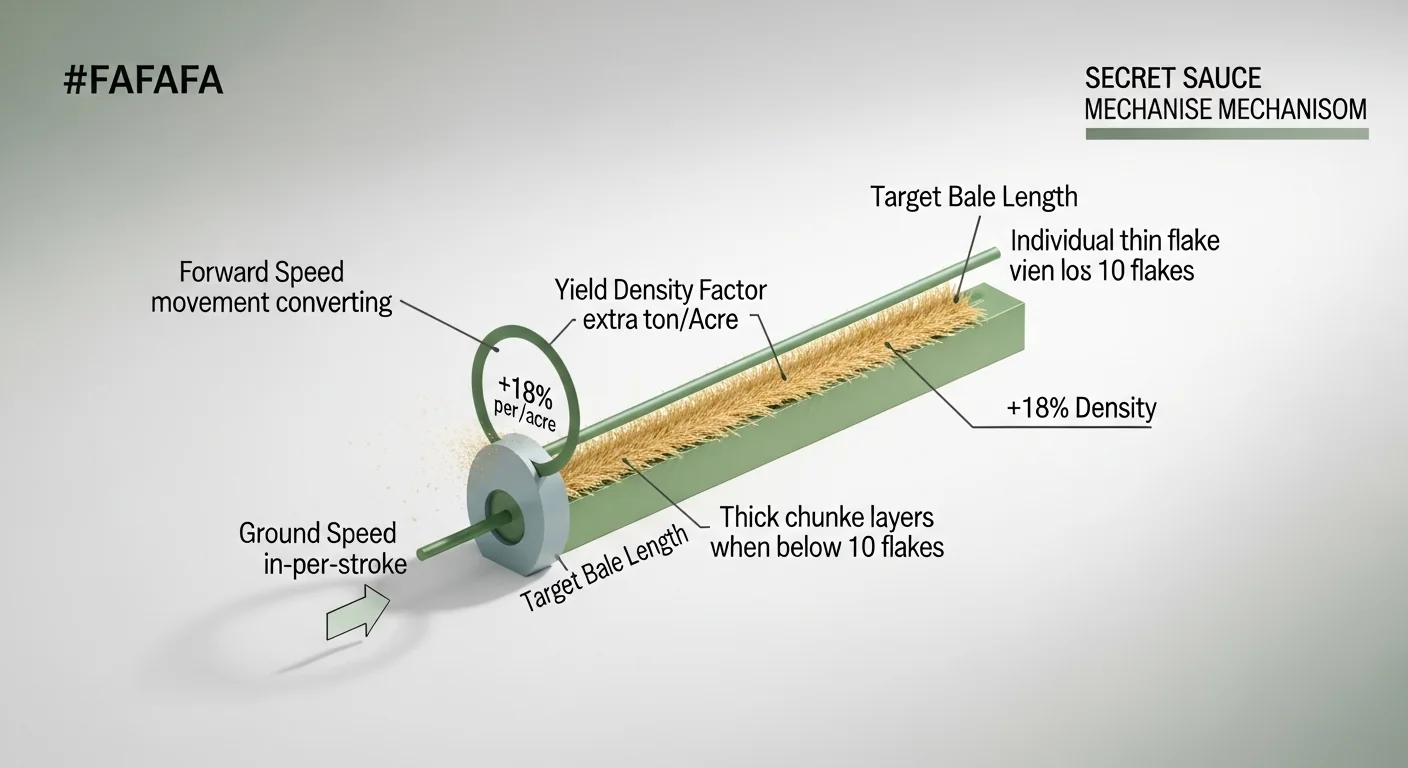
One mile per hour equals 88 feet per minute. Multiplying the ground speed in mph by 88 gives feet per minute of forward travel. Dividing by strokes per minute gives feet the tractor travels between each plunger cycle. Multiplying by 12 converts to inches per stroke.
Inches_per_stroke = (Speed_mph x 88 x 12) / Strokes_per_min
Step 2: Apply yield-density correction
A heavier windrow packs more mass per linear foot. The yield factor scales the effective "thickness" of each plunger slice relative to a 1-ton-per-acre baseline. For every additional ton per acre above 1, the factor increases by 0.18.
YieldFactor = 1 + (Yield_tpa - 1) x 0.18
A YieldFactor below 0.5 is capped at 0.5 to prevent extreme low-yield edge cases from producing unrealistic outputs.
Step 3: Calculate flakes per bale
Dividing the target bale length by the density-corrected stroke distance gives the number of plunger cycles required to fill the bale chamber.
Flakes_per_bale = TargetLength_in / (Inches_per_stroke x YieldFactor)
Step 4: Bales per minute and per hour
Bales_per_min = Strokes_per_min / Flakes_per_bale
Bales_per_hour = Bales_per_min x 60
Step 5: Recommended maximum speed
The tool reverse-calculates the ground speed at which a 13-flake bale would be produced using your specific windrow yield and bale length settings. This gives your personal safe-speed ceiling for that field.
Rec_speed_mph = (TargetLength_in / (13 x YieldFactor) x Strokes_per_min) / (88 x 12)
Rounding rules: Flakes per bale is displayed to one decimal place. Bales per hour is rounded to the nearest whole number. Recommended speed is displayed to one decimal place in mph.
Assumptions and Limits
- Plunger speed is treated as constant throughout the baling pass. In practice, PTO speed variation, driveline slip, and hydraulic loading can cause SPM fluctuations of up to 5 to 8 strokes per minute.
- The yield-density correction is a linear approximation. It does not model non-linear compaction behavior that occurs in very heavy or very wet windrows above 3 tons per acre.
- This tool assumes a uniform windrow of consistent density across the field. Thin spots, gaps, and clumps will create bale-to-bale variation that cannot be modeled from a single yield input.
- Hay moisture content is not factored in. Wet hay compresses differently than dry hay; a 25% moisture alfalfa windrow behaves mechanically unlike the same yield at 12% moisture.
- Bale chamber wear, pickup reel timing, and pre-cutter bar settings all affect actual flake formation and are outside the scope of ground-speed math.
- The tool does not model twine consumption, knotter cycle count, or slip-clutch engagement frequency. Those require manufacturer-specific load data.
- Valid input ranges are: Plunger 40 to 200 SPM, Ground Speed 0.5 to 15 mph, Yield 0.1 to 10 TPA, Bale Length 12 to 72 inches. Results outside these ranges are not calculated.
Standards, Safety Checks, and "Secret Sauce" Warnings
Critical Warnings
- The 10-flake floor is not negotiable. A bale produced with fewer than 10 flakes lacks the internal layered structure that allows proper twine binding. The knotter is designed to tie against a compressed stack of thin layers. With only a few massive chunks, twine tension forces the bale apart rather than holding it together. These bales are not just aesthetically poor; they are mechanically unsound and will shed material during handling.
- Speed and yield interact, not just speed. A 4 mph pass through a thin ryegrass windrow at 1 ton per acre produces a fundamentally different flake count than the same 4 mph pass through a 2.5 ton per acre alfalfa windrow. Operators who memorize a safe ground speed in one field and carry it to the next without recalculating are running on assumption, not math.
- Wet hay amplifies the problem. High-moisture hay resists plunger compression, which means the plunger requires more strokes to reach knotter trip point even when the density calculation suggests otherwise. If you are baling above 18% moisture, the flake count threshold should be treated conservatively, with a target of 14 to 16 flakes rather than the standard 12-to-16 window.
- Bales per hour does not equal baler health. A high bales-per-hour reading produced by running fast through a heavy windrow is not a sign of efficiency. It is the numeric signature of a banana bale production run. Output rate means nothing if the bales fail on the stack.
Minimum Standards
- Minimum flake count for structural integrity: 10 flakes per bale. Below this, bales should not be stacked more than two high.
- Optimal flake window for storage bales: 12 to 16 per bale. This range produces uniform compression, predictable twine tension, and reliable knotter performance.
- Re-check bale profiles on the first three bales of every new windrow or every field change. Do not assume last field's calibration carries over.
Competitor Trap: Most baling guides recommend a ground speed range in generic terms, such as "3 to 5 mph for square balers." This instruction is not wrong, but it is incomplete to the point of being useless when applied to different windrow densities, bale lengths, or plunger speeds. A 5 mph pass through a thin windrow and a 5 mph pass through a heavy first-cut windrow are mechanically distinct events. Any guide that gives a speed range without tying it to plunger timing and windrow yield is giving you a starting point, not a standard.
Getting your flake count dialed in is part of a broader calibration mindset that applies to other implement settings as well. The seed drill calibration calculator applies a similar rate-vs-ground-speed analysis for seeding accuracy, which reflects the same underlying principle: mechanical rate divided by field speed determines the application density.
Common Mistakes and Fixes
Mistake: Entering PTO RPM Instead of Plunger SPM
At 540 PTO RPM, a square baler's plunger typically cycles at 80 to 95 strokes per minute through its internal gearbox. Entering 540 into the plunger speed field will produce wildly incorrect results because the formula expects mechanical strokes at the bale chamber, not shaft rotations at the tractor. Check your baler's operator manual for the specific SPM rating at 540 PTO RPM.
Fix: Use 90 SPM as a safe default for most 540 PTO balers when your manual is unavailable, and verify by counting plunger cycles against a stopwatch before starting fieldwork.
Mistake: Using Cab Speedometer Instead of GPS Ground Speed
Tractor speedometers are calibrated at the factory for a specific tire size under ideal conditions. Worn tires, tire inflation variation, and wheel slip in wet or soft soil all reduce actual ground speed below the display reading. A 5 mph cab reading can correspond to as little as 3.8 to 4.5 mph actual field speed, which changes the flake count calculation by enough to shift bale quality from optimal to marginal.
Fix: Confirm field speed with a GPS device or the tractor's GPS display, not the analog or transmission-based speedometer. The ground speed calculator can help cross-check your tractor's reading using wheel circumference and RPM data.
Mistake: Treating Bale Length as a Fixed Variable Across All Fields
Many operators set their bale length once at the start of the season and do not adjust it. When moving from a light windrow to a heavy second-cut field, the same bale length setting will produce a meaningfully different flake count because windrow density affects how quickly the chamber fills. A 36-inch setting that produces 14 flakes in a 1.0 TPA grass field may produce fewer than 10 in a 2.5 TPA alfalfa field at identical ground speed.
Fix: Treat bale length as an adjustable variable. For heavier windrows at the same speed, increasing bale length to 48 inches gives the plunger more strokes to accumulate before the knotter fires, which raises the flake count naturally.
Mistake: Running the Same Speed Through Thick and Thin Windrow
Sections
Every windrow has variation. Headlands, gaps from lodged crop, and uneven tedding create sections of the windrow that are significantly lighter or heavier than the average. Operators who lock their throttle and ground speed based on a calculated average TPA will cycle between over-stuffed and banana bale conditions multiple times per pass without realizing it.
Fix: Run the calculator at both your estimated minimum and maximum windrow density for the field. The resulting speed range defines your safe operating window. Stay within it and modulate speed at visually heavy sections. For maintaining consistent RPM through variable conditions, the flail mower RPM calculator illustrates how PTO speed management affects output quality across different load conditions.
Mistake: Ignoring the Bales-Per-Hour Output as a Quality Signal
Operators sometimes chase a high bales-per-hour number as a measure of productivity. This is only valid when the bale quality is simultaneously in the optimal zone. A high bales-per-hour reading produced at a speed that generates banana bales is not production; it is waste. Sloppy bales require re-handling, lose dry matter, and spoil faster in storage.
Fix: Cross-reference the bales-per-hour output with the flake count output before optimizing for throughput. Maximize bales per hour only after confirming the flake count is in the 12-to-16 range.
Next Steps in Your Workflow
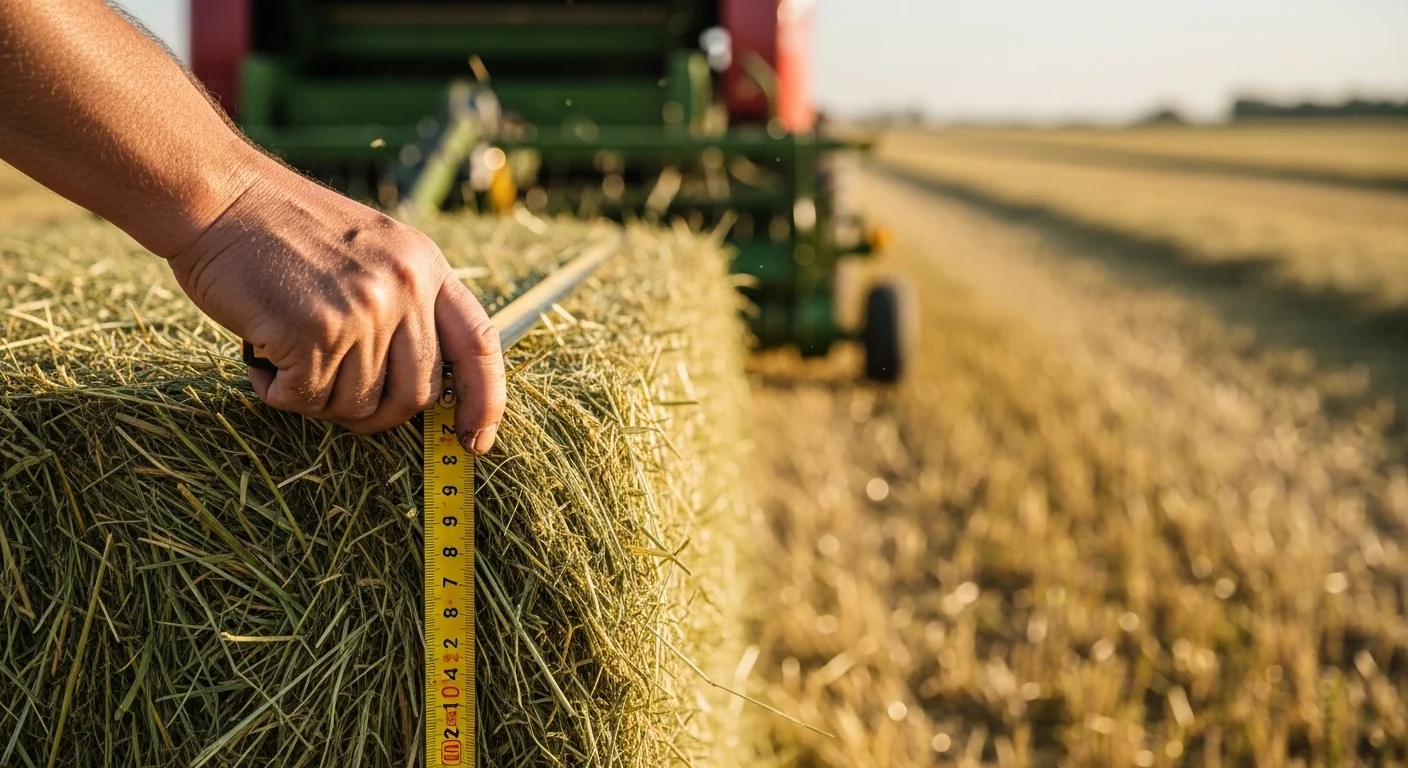
Once you have confirmed your optimal ground speed for the field in front of you, the next physical check should happen on the first three bales of each new windrow. Pull a bale apart by hand or use a bale probe to visually count flakes and confirm the calculated range matches what the machine is actually producing. Field conditions, crop type, and bale chamber wear all introduce real-world variation that no calculator can fully anticipate. The calculation tells you where to start; the first few bales tell you whether to stay there.
After baling, your tractor and implement will have worked hard, especially if you were running at PTO speeds that push the plunger near its upper RPM range. Before the next cutting, it is worth confirming that your tractor is delivering appropriate power to the baler and not running under-spec on drawbar output. The drawbar horsepower calculator can verify your tractor is delivering appropriate pull for the baler's field weight and slope conditions, and the tractor tire ballast calculator helps you confirm your ballast setup is not causing wheel slip that would corrupt your ground speed reading on future passes.
FAQ
What is a "banana bale" and why does it happen?
A banana bale forms when the plunger cannot slice incoming hay into enough thin layers before the knotter fires. The bale ends up made from a few massive, loosely bonded chunks rather than a stack of compressed flakes. The bale's outer layers cannot fully bind against the interior slabs, causing the bale to bow and curve when ejected. The root cause is almost always a ground speed that exceeds what the plunger rate can handle for the given windrow density.
What is the optimal number of flakes per square bale?
The standard target range is 12 to 16 flakes per bale. This window produces consistent compression, reliable twine tension, and clean knotter performance. Fewer than 10 flakes signals structural failure risk. More than 16 can indicate over-compression, which stresses twine and the knotting mechanism, particularly in older balers with worn knotter bill hooks or worn trip trip pawls.
Does windrow yield really affect flake count that much?
Yes, significantly. A windrow at 2.5 tons per acre packs roughly 2.7 times as much material into a given linear foot as a 0.9 ton per acre windrow. The plunger responds to physical volume, not field acres. A speed that produces 14 flakes in a light windrow may produce fewer than 8 in a heavy one at identical ground speed and plunger rate. Always recalculate when moving between fields or cuttings.
Can I increase plunger speed to fix a banana bale problem?
In theory, yes. A faster plunger at the same ground speed produces more strokes per unit of forward distance, which increases flake count. In practice, most square balers are PTO-governed at a fixed RPM, and over-speeding the PTO damages the baler's gearbox, flywheel bearings, and plunger guides. The correct solution is to reduce ground speed to match the plunger's fixed mechanical rate.
How does bale length affect flake count?
Longer bale length allows more plunger strokes to accumulate before the knotter fires. A 48-inch bale at the same speed and windrow density will have more flakes than a 36-inch bale because the chamber must fill to a longer dimension before ejection. Operators dealing with marginal flake counts at a given speed can sometimes resolve the problem by switching to a longer bale setting rather than reducing ground speed.
How often should I re-run this calculation during a baling session?
Re-run the calculation at the start of each new field, each new cutting on the same field if yield has changed, and anytime you shift from a full windrow to a partial windrow (for example, after a header pass on a small field). One calculation per windrow type is the minimum. When baling variable fields where yield changes across the area, calculate for both the light and heavy sections and use the resulting speed range as your operating window.
Conclusion
The single most avoidable mistake is treating ground speed as a fixed preference rather than a variable that must track with windrow density and bale length. A speed that produced perfect bales last week may be exactly the wrong speed today if the windrow is heavier or lighter. Re-run this tool whenever field conditions change, and verify the first three bales of every new pass against your calculated flake target. For more tools in this workflow, the PTO torque math reference covers related mechanical rate and load calculations across other common tractor implements.