
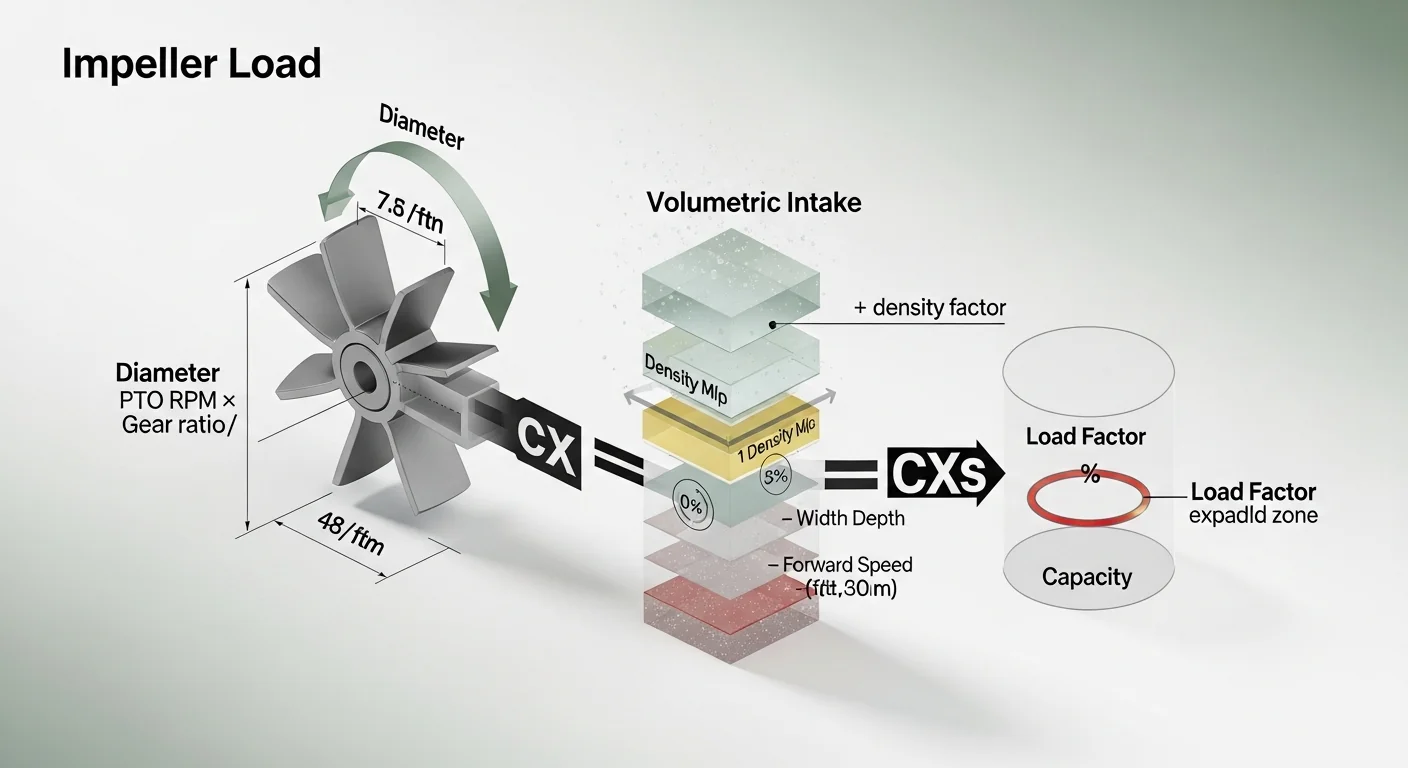
Running a tractor-mounted snow blower feels straightforward until physics disagrees. The auger feeds snow into the impeller at a rate determined by how fast you drive, how wide the blower cuts, and how deep the snow is. The impeller can only discharge that snow at a rate determined by its tip speed, which is locked to your PTO RPM and gear ratio. When the intake rate exceeds the discharge rate, the chute backs up, the auger stalls, and the shear pins snap. This is not a mechanical defect; it is the system working exactly as designed.
This tractor snow blower calculator computes four values: impeller tip speed in feet per minute, volumetric intake rate in cubic feet per minute, effective impeller capacity adjusted for snow density, and a load factor that tells you how close you are to shear pin failure. It also checks for PTO speed mismatches between your tractor and your blower’s design requirements, which is a separate failure mode that no forward speed reduction can fix. The tool does not account for gearbox wear, implement warm-up time, or slope, and it does not replace reading your implement manual.
After entering your PTO speed, fan diameter, gear ratio, working width, travel speed, snow depth, and snow type, the calculator returns a load factor and a traffic-light status. If your load factor is above 1.0, you have two options: reduce forward speed or reduce snow depth per pass. If a PTO mismatch is flagged, no amount of speed adjustment will prevent chute clogging. Knowing this before you start is the reason to use the tool. For a related sizing question about your PTO shaft itself, the PTO shaft sizing calculator covers shaft series, torque ratings, and connection standards separately.
Use the Tool

Snow Blower Auger & PTO RPM Calculator
Match your tractor’s PTO output to snow blower intake capacity — prevent shear pin breaks & chute clogs
| Scenario | PTO | Speed | Depth | Load Factor | Risk |
|---|
How This Calculator Works
Step 1 — Impeller Tip Speed (FPM)
Units: (RPM × unitless × in) ÷ (in/ft) = ft/min (FPM)
This tells us how fast the outer edge of the impeller fan is moving. Higher tip speed = more throwing power and greater effective capacity. A 540 RPM PTO with a 1:1 gear ratio spinning a 24-inch fan produces about 3,393 FPM. The same blower at 1000 RPM produces 6,283 FPM — nearly double the capacity.
Step 2 — Snow Intake Rate (cu ft/min)
= Width_ft × Depth_ft × Speed_fpm
× Density_Factor
Converts your cutting width, snow depth, and travel speed into a volumetric flow rate. Multiplying by the density factor (0.6 for powder, 2.2 for slush) gives the effective mass-equivalent intake — because wet slush requires 2.2× more power to move than dry powder of the same volume.
Step 3 — Effective Impeller Capacity (cu ft/min)
Calibration constant 0.018 derived from real-world tractor snow blower performance data
Converts tip speed and impeller swept area into a volumetric throughput estimate. This is the maximum rate at which the impeller can eject snow before backing up into the auger.
Step 4 — Load Factor & Risk Assessment
LoadFactor < 0.7 → Safe (green)
0.7 ≤ LoadFactor < 1.0 → Caution (orange)
LoadFactor ≥ 1.0 → Overload — Shear Pin Risk (red)
PTO mismatch (540 used on 1000 RPM blower) → Clog Risk (red)
Assumptions & Limits
- Gear ratio assumed constant (no slip or power loss in gearbox).
- Snow density factors are representative averages — actual conditions vary by temperature and moisture content.
- Capacity constant (0.018) calibrated for typical 2-stage tractor snow blowers. Single-stage walk-behinds behave differently.
- Results are guidance only. Always follow the manufacturer’s tractor and implement operating manual.
- PTO mismatch detection assumes the blower is designed strictly for one speed. Some newer blowers accept both 540 and 1000 RPM — verify with your manual.
- Calculator does not account for slope, turning, or implement warm-up time.
Before entering values, have the following ready: your tractor’s operating manual listing the PTO speed at the selected gear lever position (540 RPM vs. 1000 RPM), your snow blower’s spec sheet confirming the required PTO input speed, the fan or impeller diameter in inches (not the blower’s cutting width), and the gear ratio from the PTO shaft to the impeller (often listed as the gearbox ratio in the blower’s parts manual). Forward travel speed is your ground speed in the blowing gear, not your maximum road speed. If you are uncertain of your actual ground speed, use the tractor ground speed calculator to derive it from engine RPM, transmission gear, and tire size before returning here.
Quick Start (60 Seconds)
- Tractor PTO Speed: Select 540 or 1000 RPM. This is the shaft speed at the tractor’s PTO outlet when the lever is engaged. Do not guess; tractors with economy PTO can deliver different speeds at different throttle settings.
- Snow Blower Required PTO: Select the speed your blower’s manufacturer specifies. This is usually stamped on a decal near the PTO input shaft or listed on the first page of the operator’s manual. A 540 RPM blower run at 1000 RPM will overspeed and can destroy the impeller shaft.
- Fan/Impeller Diameter: Measure the spinning fan disc, not the auger housing width. This is often 18 to 30 inches on tractor-mounted 2-stage units. Enter the value in inches.
- PTO-to-Impeller Gear Ratio: Find this in the gearbox specification section of your blower’s manual. A ratio of 1.0 means the impeller spins at the same speed as the PTO shaft. A ratio of 1.5 means the impeller spins 1.5 times faster than the PTO shaft. Most tractor blowers run between 1.0 and 2.0.
- Working Width: Enter the cutting width of your blower in inches, not the overall machine width. This is typically 48, 60, or 72 inches for sub-compact to utility tractors.
- Forward Speed: Enter your actual working speed in mph. Be conservative. Most experienced operators clear deep snow at 1 to 2 mph. Faster passes feel efficient but the intake rate increases proportionally with speed.
- Snow Depth and Density: Enter depth in inches off the ground surface. For density, choose honestly: spring snow that holds a footprint and looks gray is wet slush, not average packed snow. The difference in effective load between dry powder and wet slush is a factor of 3.7 at identical depth and speed.
Inputs and Outputs (What Each Field Means)
| Field | Unit | What It Means | Common Mistake | Safe Entry Guidance |
|---|---|---|---|---|
| Tractor PTO Speed | RPM (540 or 1000) | Rotational speed of the tractor’s power take-off shaft at the implement connection point | Confusing engine RPM with PTO RPM; they are not the same | Use the value from the tractor manual’s PTO specification table, not the tachometer reading |
| Snow Blower Required PTO | RPM (540 or 1000) | The PTO speed for which the snow blower’s gearbox was designed | Assuming any blower works on any tractor without checking the spec sheet | Verify from the implement operator’s manual; some newer units accept dual speeds but most do not |
| Fan/Impeller Diameter | Inches (12 to 48) | Diameter of the rotating impeller disc that throws snow into the chute | Entering the auger housing width instead of the fan disc diameter | Measure the spinning disc directly, or find the value in the blower’s parts diagram |
| Gear Ratio | Ratio, unitless (0.5 to 5.0) | Multiplication factor from PTO shaft speed to impeller shaft speed | Leaving the default of 1.0 without checking; many blowers step up speed to increase tip speed | Look in the gearbox or drivetrain section of the parts manual; a ratio above 1.0 increases impeller speed |
| Working Width | Inches (36 to 84) | Width of the snow volume the auger intakes per forward pass | Confusing the blower’s overall frame width with its actual cutting width | Use the cutting width listed on the blower’s spec sheet, typically 6 to 12 inches less than the total housing width |
| Forward Speed | mph (0.5 to 5) | Actual travel speed of the tractor while clearing snow | Entering road speed or maximum speed instead of working gear speed | Select the gear you actually use for snow clearing and measure or calculate the actual ground speed |
| Snow Depth | Inches (1 to 30) | Height of snow above the cleared surface that the auger will intake | Measuring at the deepest drift rather than the average representative depth | Use the average depth across the path, not the worst-case drift point |
| Snow Density | Factor (0.6 to 2.2) | A multiplier representing how much harder wet or dense snow is to move compared to dry powder of the same volume | Selecting “average packed” for heavy spring wet snow that is actually closer to slush | If the snow is gray, saturated, and heavy to shovel by hand, select the wet slush option |
| Impeller Tip Speed (output) | FPM | Velocity of the outer edge of the impeller disc; determines throwing power and discharge rate | N/A (output field) | Higher tip speed increases capacity; this is why 1000 RPM blowers throw farther than 540 RPM units of the same diameter |
| Load Factor (output) | Ratio (x) | Intake rate divided by impeller capacity; values above 1.0 indicate the impeller cannot keep up with incoming snow | N/A (output field) | Target below 0.7 for a reliable operating margin; values between 0.7 and 1.0 are marginal; above 1.0 is shear pin territory |
Worked Examples (Real Numbers)
Example 1: Dry Powder, 540 RPM, Operating Safely
- Tractor PTO: 540 RPM | Blower Required PTO: 540 RPM
- Fan Diameter: 24 in | Gear Ratio: 1.0
- Working Width: 48 in | Forward Speed: 1.5 mph | Snow Depth: 4 in | Snow Type: Dry Powder (density factor 0.6)
Result: Tip Speed 3,393 FPM | Effective Intake 105.6 cu ft/min | Impeller Capacity 191.9 cu ft/min | Load Factor 0.55 (SAFE)
Dry powder at a restrained travel speed leaves a 45-unit margin of safety. The operator can increase forward speed modestly or handle somewhat deeper snow without approaching the shear pin threshold.
Example 2: PTO Mismatch With Overload (The Clog Scenario)
- Tractor PTO: 540 RPM | Blower Required PTO: 1000 RPM
- Fan Diameter: 24 in | Gear Ratio: 1.0
- Working Width: 60 in | Forward Speed: 2.0 mph | Snow Depth: 6 in | Snow Type: Average Packed (density factor 1.0)
Result: Tip Speed 3,393 FPM | Effective Intake 440.0 cu ft/min | Impeller Capacity 191.9 cu ft/min | Load Factor 2.29 (DANGER) + PTO MISMATCH FLAG
Two compounding failures appear simultaneously. Running a 1000 RPM blower at 540 RPM produces inadequate tip speed regardless of forward speed; the chute will back up and pack. Even if the speed mismatch were corrected, the load factor at 2.0 mph in 6-inch packed snow still exceeds capacity, requiring a speed reduction below 0.9 mph to enter the safe zone at 540 RPM.
Example 3: The Wet Slush Shear Pin Snap
- Tractor PTO: 540 RPM | Blower Required PTO: 540 RPM
- Fan Diameter: 24 in | Gear Ratio: 1.0
- Working Width: 60 in | Forward Speed: 3.0 mph | Snow Depth: 12 in | Snow Type: Wet Slush (density factor 2.2)
Result: Tip Speed 3,393 FPM | Effective Intake 2,904 cu ft/min | Impeller Capacity 191.9 cu ft/min | Load Factor 15.14 (EXTREME DANGER)
This is the scenario that accounts for the majority of mid-season shear pin failures. Twelve inches of wet slush at 3 mph represents a volumetric load more than 15 times what the impeller can discharge. The shear pins snap within seconds. The fix is not stronger bolts; it is reducing forward speed to below 0.3 mph or, more practically, limiting depth per pass to 4 to 5 inches when clearing saturated spring snow.
Reference Table (Fast Lookup)
The table below shows impeller tip speed and effective capacity for common PTO and fan size combinations. The load factor column is derived for a standard test condition: 60-inch working width, 6-inch average depth of packed snow (density factor 1.0), at a forward speed of 1.5 mph. This produces a fixed intake of 330 cu ft/min. Compare your own calculated intake against the capacity column to gauge your actual load factor.
| PTO (RPM) | Fan Dia (in) | Gear Ratio | Tip Speed (FPM) | Impeller Capacity (cu ft/min) | Load Factor at Std. Condition | Status |
|---|---|---|---|---|---|---|
| 540 | 18 | 1.0 | 2,545 | 80.9 | 4.08 | DANGER |
| 540 | 24 | 1.0 | 3,393 | 191.9 | 1.72 | DANGER |
| 540 | 24 | 1.5 | 5,089 | 287.8 | 1.15 | DANGER |
| 540 | 30 | 1.0 | 4,241 | 374.7 | 0.88 | CAUTION |
| 1000 | 18 | 1.0 | 4,712 | 149.9 | 2.20 | DANGER |
| 1000 | 24 | 1.0 | 6,283 | 355.3 | 0.93 | CAUTION |
| 1000 | 24 | 1.5 | 9,425 | 533.0 | 0.62 | SAFE |
| 1000 | 30 | 1.0 | 7,854 | 694.0 | 0.48 | SAFE |
Key pattern: a small-diameter fan on a 1000 RPM PTO (row 5) produces more tip speed than a large-diameter fan on 540 RPM (row 4) but less total capacity because the swept area is smaller. Capacity scales with both tip speed and fan area simultaneously, which is why blower size selection and PTO speed selection interact.
How the Calculation Works (Formula + Assumptions)
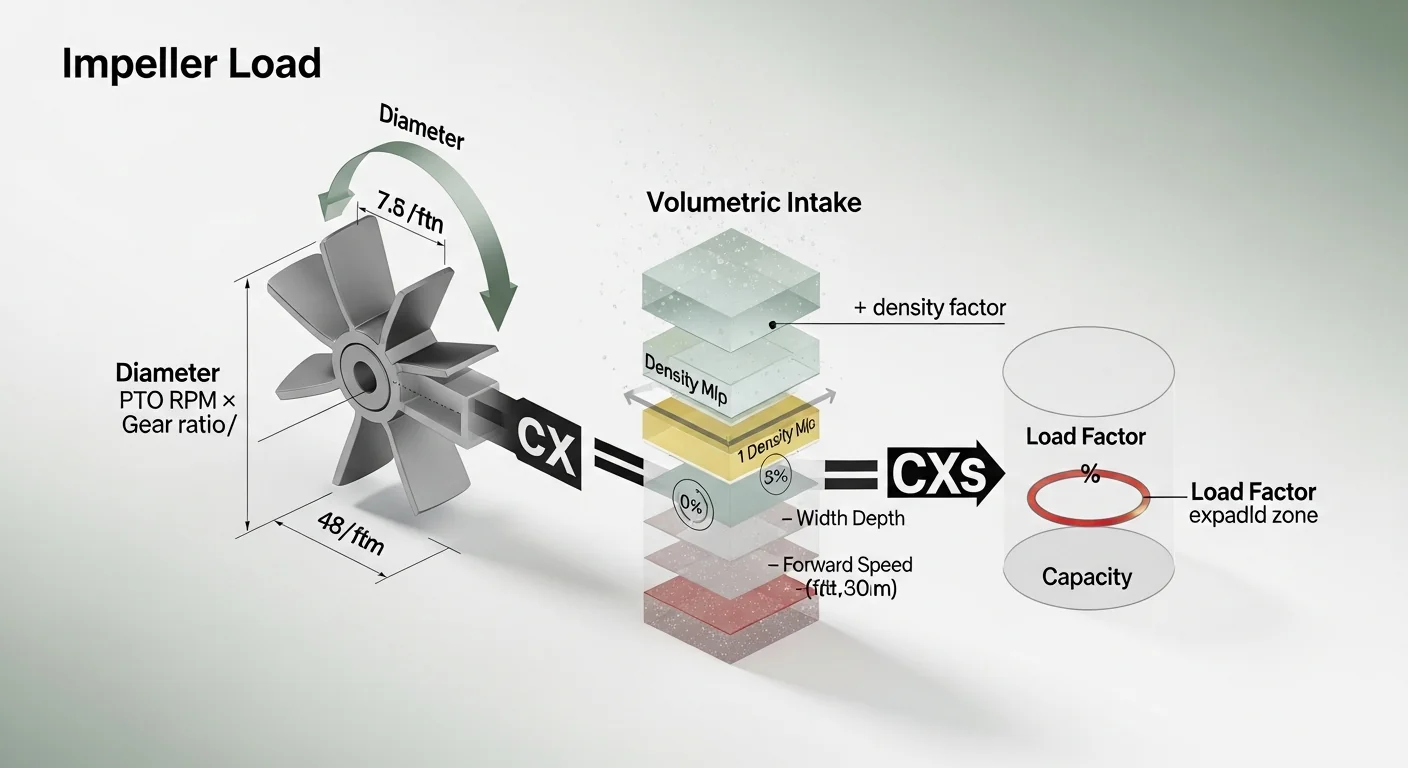
Show the calculation steps
Step 1 – Impeller Tip Speed
Tip Speed (FPM) = PTO_RPM × Gear_Ratio × π × Fan_Diameter_inches ÷ 12
The division by 12 converts the result from inches per minute to feet per minute. This is the velocity of the outermost point of the impeller disc. A higher tip speed means greater discharge momentum and higher effective capacity. At 540 RPM with a 24-inch fan and a 1.0 gear ratio, tip speed is approximately 3,393 FPM. At 1000 RPM with the same fan, it reaches approximately 6,283 FPM.
Step 2 – Volumetric Snow Intake Rate
Intake (cu ft/min) = (Width_inches ÷ 12) × (Depth_inches ÷ 12) × (Forward_Speed_mph × 88) × Density_Factor
The factor of 88 converts miles per hour to feet per minute (1 mph = 88 fpm). Width and depth are converted from inches to feet. Density factor is applied as a multiplier: 0.6 for dry powder, 1.0 for average packed, 1.5 for heavy wet, and 2.2 for wet slush. The density factor represents the proportional increase in mechanical resistance relative to average packed snow, not literal mass per cubic foot.
Step 3 – Effective Impeller Capacity
Capacity (cu ft/min) = π × (Fan_Radius_feet)² × Tip_Speed_FPM × 0.018
Fan radius in feet is (Fan_Diameter_inches ÷ 2) ÷ 12. The area term represents the impeller’s swept face. The calibration constant 0.018 is derived to reflect real-world throughput of typical 2-stage tractor snow blowers where discharge is constrained by chute geometry and impeller housing clearances, not just pure rotational speed.
Step 4 – Load Factor and Thresholds
Load Factor = Effective_Intake ÷ Impeller_Capacity
Values below 0.7 are flagged safe. Values from 0.7 to 0.99 are flagged as caution. Values at 1.0 or above indicate that intake exceeds discharge capacity, which is the mechanical condition that causes shear pin failure. PTO mismatch is a separate binary check: if tractor PTO RPM does not equal the blower’s required PTO RPM, a clog risk warning fires regardless of the load factor value.
Rounding Rules
Tip speed is rounded to the nearest whole FPM. Intake and capacity values are rounded to one decimal place. Load factor is displayed to two decimal places. All intermediate calculations use full floating-point precision before rounding is applied to displayed values.
Assumptions and Limits
- The gear ratio is assumed constant with no slip, heat loss, or power reduction through the gearbox. Real gearboxes lose a small amount of torque to friction.
- Snow density factors (0.6 to 2.2) are representative field averages. Temperature, humidity, and time since snowfall all affect actual resistance. The same 6-inch depth can behave very differently at 28 degrees Fahrenheit versus 34 degrees Fahrenheit.
- The capacity constant (0.018) is calibrated for typical 2-stage tractor-mounted snow blowers. Walk-behind single-stage units and purpose-built snow removal machines will have different throughput characteristics.
- The calculator does not model slope. Clearing on an uphill grade reduces effective traction and ground speed, which reduces intake rate. Downhill grades increase ground speed and intake rate in lower gears.
- Implement warm-up time and cold-temperature lubricant behavior are not modeled. In very cold conditions (below 0 degrees Fahrenheit), gearbox oil viscosity increases and effective capacity may be lower than calculated until operating temperature is reached.
- The PTO mismatch check assumes the blower is designed for a single PTO speed. A small number of modern blowers accept both 540 and 1000 RPM through a dual-speed gearbox; in those cases, a mismatch flag may be a false positive. Always confirm with the specific implement manual.
- The tool does not account for partial auger fills (e.g., clearing a half-width pass at a windrow), discharge chute restrictions from ice buildup, or hydraulic chute rotation that reduces effective discharge area.
Standards, Safety Checks, and “Secret Sauce” Warnings
Critical Warnings
- The PTO mismatch failure mode is non-negotiable. A snow blower designed for 1000 RPM attached to a 540 RPM tractor will always clog, regardless of snow conditions or forward speed. The impeller cannot develop the tip speed required to eject snow before the chute packs. No gear selection corrects this; matching PTO speeds is a prerequisite before any other calculation matters.
- Wet slush behaves like wet concrete. The density factor of 2.2 versus 0.6 for dry powder means that wet slush at the same depth and speed presents 3.7 times the effective load on the impeller. This is why operators who clear 12-inch dry snowfalls without incident snap a shear pin at 6 inches of spring slush. The slush scenario from worked example 3 above shows a load factor above 15, meaning the shear pins break within seconds, not minutes.
- Never increase forward speed to compensate for chute packing. Chute packing is caused by the load factor exceeding 1.0. Increasing forward speed raises the load factor further. The correct response to a clogged chute is to stop, clear the blockage, reduce speed, and if necessary reduce the depth per pass by raising the blower slightly.
- Cold starts and gearbox warm-up matter. After extended periods below 10 degrees Fahrenheit, start the blower at low PTO RPM and light snow loads for the first few minutes. Cold gearbox oil increases internal resistance and can cause shear pin failure even at load factors below 0.7.
Minimum Standards
- Keep load factor below 0.70 for routine operation. Values between 0.70 and 1.0 are marginally functional but leave no buffer for sudden depth increases at windrows or drifts.
- PTO shaft speed tolerance: most blowers allow plus or minus 10 RPM from their rated speed. Running significantly outside this range stresses the gearbox even if it does not immediately snap a shear pin.
- Only Grade 2 (soft) shear bolts should be used as replacements. Grade 5 or Grade 8 bolts will not shear at the designed load; they transfer the failure force directly into the gearbox, auger shaft, or impeller housing.
Competitor Trap
Most online guides for tractor snow blowers address shear pin replacement and chute clearing as if they are isolated problems. They rarely explain that a shear pin failure and a chute clog are often the same root cause: load factor exceeding impeller capacity. A guide that says “slow down in wet snow” is correct but incomplete if it does not explain how much to slow down or how snow density compounds with depth and speed simultaneously. The physics here are multiplicative, not additive. Cutting forward speed in half cuts the intake rate in half, but switching from wet slush to dry powder at the same speed and depth reduces effective load by a factor of 3.7. Understanding which variable to adjust, and by how much, is what separates a stopped tractor from a productive one.
Related implement power context: if you are unsure whether your tractor has adequate horsepower for the blower’s demand at 1000 RPM, the drawbar horsepower calculator provides a tractor-side power check. For comparing how PTO speed requirements differ across implement families, the rotary cutter sizing guide covers an analogous set of PTO-speed and blade-diameter tradeoffs in a different implement category.
Common Mistakes and Fixes
Mistake: Using the Blower’s Frame Width Instead of the Impeller Fan Diameter
The fan diameter and the overall blower frame width are different measurements. On a 72-inch cutting-width blower, the impeller disc may be only 24 or 28 inches across. Entering 72 inches as the fan diameter will inflate the calculated capacity dramatically and produce a falsely safe load factor. The fan diameter is found on the parts diagram, usually in the impeller or fan housing section, and it is the measurement across the rotating disc, not the auger housing.
Fix: Find the impeller diameter in the blower’s parts manual or measure the spinning disc directly with the machine off and the PTO disengaged.
Mistake: Not Accounting for Tire Traction When Choosing Forward Speed
Forward speed in the calculator is an input, but achieving and maintaining that speed in heavy snow depends on tire traction. A tractor on smooth turf tires in wet snow may spin out at 1.5 mph even if the blower load factor at that speed is within range. The practical maximum forward speed is the lower of the blower’s load capacity limit and the tractor’s traction limit. On slippery surfaces, the useful operating speed may be well below what the load factor calculation would theoretically allow. Tire ballast and chains affect traction substantially. The tractor tire ballast calculator can help determine whether your tire loading is adequate for winter operation.
Fix: Test actual achievable ground speed on your clearing surface before entering a speed that assumes ideal traction.
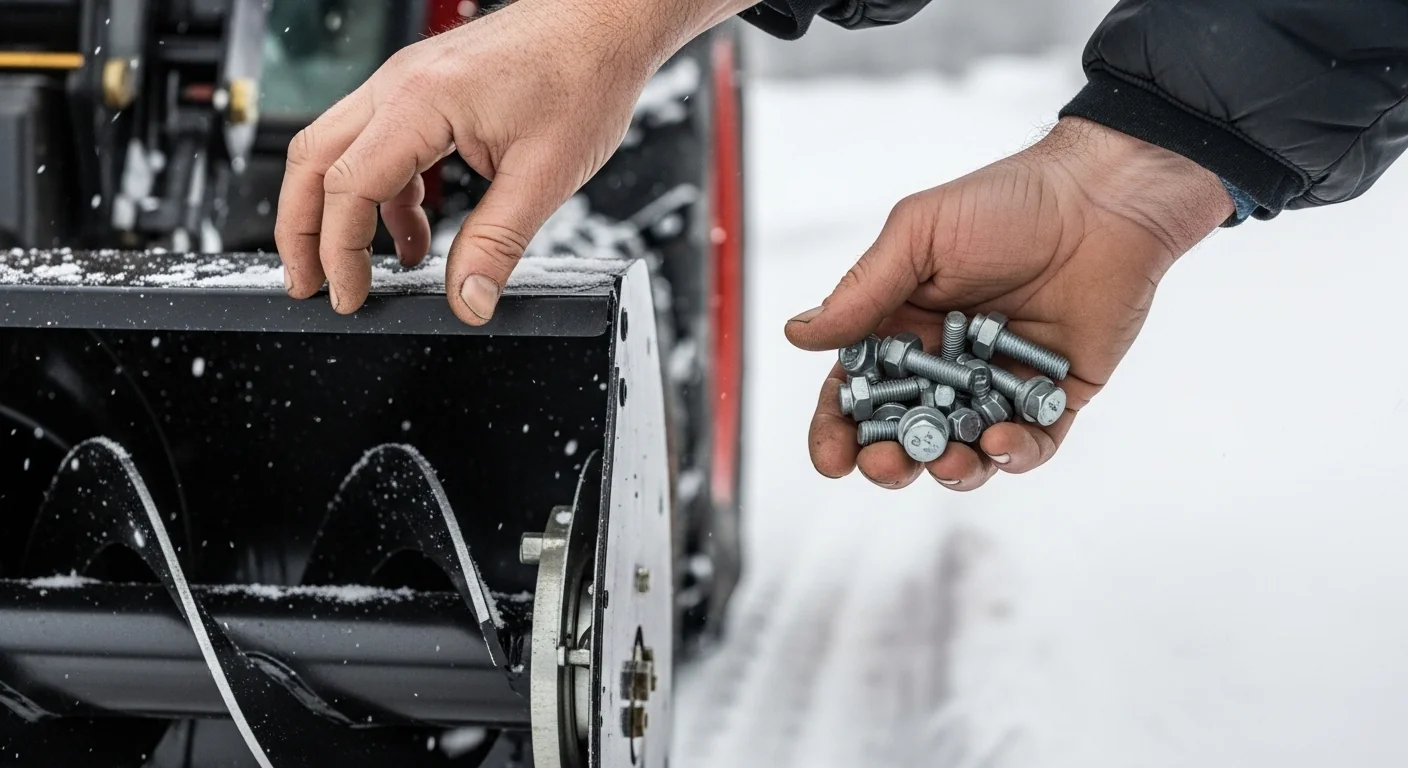
Mistake: Substituting Grade 5 or Grade 8 Bolts for Shear Pins
This is the single most damaging field improvisation in snow blower operation. Shear pins are designed to fracture at a specific load to protect the gearbox, auger shaft, and impeller from overload damage. Grade 5 and Grade 8 bolts have tensile strength far above the shear design point. When the load factor exceeds 1.0 with a hardened bolt in place, the bolt does not shear; the auger shaft bends, the gearbox housing cracks, or the impeller keyway strips. Any of these failures costs significantly more to repair than keeping a supply of Grade 2 bolts in the cab.
Fix: Purchase a bulk supply of the correct Grade 2 shear bolts specified in your blower’s manual and carry a set whenever operating.
Mistake: Ignoring the PTO Speed Decal on the Blower
Many operators who buy a used tractor-mounted snow blower skip the operator’s manual entirely and simply run the machine. A 540 RPM blower looks mechanically identical to a 1000 RPM blower at a glance. The only reliable differentiator is the PTO speed requirement decal near the input shaft or the specification in the manual. Running the wrong speed is not always immediately catastrophic; some blowers at the wrong speed will underperform rather than fail instantly. But persistent overspeed or underspeed operation accelerates gearbox wear and eventually causes shaft seal and bearing failure. Other PTO-driven implements require the same diligence around speed matching. The flail mower RPM guide is one example where the same PTO speed-to-blade-tip-speed relationship applies across a different implement type.
Fix: Before running any PTO implement, locate the required PTO speed specification and verify your tractor’s PTO output matches it.
Mistake: Using Maximum Rated Speed as the Working Speed Input
The calculator’s forward speed input should reflect actual clearing speed, not the gear’s top speed or the tractor’s maximum field speed. Operators frequently use “about 2 mph” as a mental estimate when actual working pace in wet snow is closer to 0.8 mph. Overestimating forward speed produces a load factor calculation that is accurate for the estimated speed but dangerously optimistic for conditions where the tractor is actually being pushed harder because the operator is compensating by driving faster to finish the job sooner.
Fix: Time your travel over a known distance in the working gear before the season begins to establish your actual clearing speed, then use that verified number as the calculator input.
Next Steps in Your Workflow
Once the calculator confirms your load factor and PTO match, the next practical check is the physical connection between tractor and implement. Verify that the 3-point hitch is set to the correct category for your blower’s hitch frame, that the top link angle keeps the blower level to the ground surface, and that the skid shoes are adjusted for your surface type. Snow clearing height affects actual intake depth: if the skids are set too low, the blower intakes packed ice at the base of the snowpack, which has a density factor closer to slush than powder even if the top layer appears light. For quick-attach and hydraulic considerations on your 3-point hitch, the 3-point lift capacity calculator helps verify that the hitch is not being overloaded by a heavy implement. Similarly, if you operate other PTO attachments throughout the year, the PTO post hole digger torque reference provides a useful comparison for how peak-demand PTO implements differ from continuous-duty ones like snow blowers.
After clearing, inspect the shear pin condition before storing the blower. A shear pin that has been subjected to repeated near-failure loading (load factor above 0.85 for extended periods) may show deformation at the shear groove even if it has not fully fractured. Replace deformed pins before the next use. Apply non-stick chute spray to the inside of the discharge chute and auger housing to reduce packing adhesion on the next run, especially if the season forecast includes wet snow. Store the blower with the PTO shaft and implement input shaft lightly greased to prevent corrosion at the connection point over summer.
FAQ
What is the difference between 540 RPM and 1000 RPM PTO for snow blowers?
540 RPM is the traditional standard and is found on most older and compact tractors. 1000 RPM is a higher-speed option on larger utility and sub-compact tractors, producing nearly double the impeller tip speed with the same fan diameter. A 1000 RPM blower of identical size throws snow farther and handles greater intake rates. The two speeds are not interchangeable; the blower’s gearbox is designed for one speed, and operating at the other will cause either underperformance or overspeed damage.
Why do shear pins keep breaking even at low forward speeds?
Snow density is the most underestimated variable. Heavy wet snow or slush presents a load factor 3 to 4 times higher than dry powder at the same speed and depth. Even at 1 mph, a 60-inch blower clearing 10 inches of wet slush can exceed impeller capacity by a large margin. A PTO mismatch compounds this further. Persistent shear pin failure at low speeds is almost always a density or PTO speed problem, not a bolt quality problem.
Can I convert a 540 RPM snow blower to 1000 RPM operation?
Not without replacing the gearbox. The input shaft, internal gearing, and often the impeller shaft bearing ratings are all designed for one input speed. Running a 540 RPM blower at 1000 RPM risks catastrophic gearbox failure and possible impeller overspeed. Speed reducer adapters exist that allow a 1000 RPM tractor to power a 540 RPM implement by reducing shaft speed at the connection point. These adapters are the correct solution when the tractor and implement are mismatched.
What gear ratio should I expect on a typical tractor snow blower?
Most 2-stage tractor-mounted snow blowers have a gear ratio between 1.0 and 2.0 from the PTO shaft to the impeller. A ratio of 1.0 means the impeller spins at PTO speed. A ratio of 1.5 means the impeller spins 1.5 times faster, which increases tip speed and capacity without requiring a higher PTO output. Higher gear ratios increase capacity but also increase stress on the gearbox under heavy loads. The correct ratio for your blower is specified in the manual and is not adjustable in the field.
How does the load factor translate to real operating decisions?
A load factor of 0.55 means the impeller has nearly half its capacity unused and the operator can increase speed, handle deeper snow, or clear denser snow without risk. A factor of 0.90 means the system is near its limit and a brief encounter with a deeper drift or heavier wet patch at a windrow will push it to failure. A factor above 1.0 means current conditions guarantee shear pin failure; reducing speed proportionally reduces the factor, so halving speed from 2 mph to 1 mph halves the load factor.
Is it safe to apply non-stick chute spray before every use?
Non-stick or silicone-based snow chute sprays are safe for metal discharge chutes and auger housings. They reduce the adhesion of wet snow to the chute walls, which slows the buildup that eventually restricts discharge and increases back-pressure on the impeller. In wet snow conditions, applying spray before each use is a standard maintenance practice that extends time between clog events. Avoid petroleum-based lubricants in areas that contact vegetation or drainage, as runoff from fields treated with fuel-based products can cause environmental issues.
Conclusion
The tractor snow blower calculator reframes two common winter frustrations as physics problems with measurable solutions. A shear pin failure is not random; it is the result of intake rate exceeding impeller capacity by a specific amount that the load factor makes visible before the pass starts. A chute clog is not bad luck; it is either a PTO speed mismatch or the same load overrun, often compounded by wet snow packing on insufficiently sprayed chute walls. The calculator does not guarantee a trouble-free season, but it does give operators a concrete number to check before every significantly different snow event, especially when transitioning from dry early-season powder to the heavy spring slush that causes the majority of field failures.
The single most important mistake to avoid is substituting high-grade bolts for shear pins after a break. That decision converts a 5-minute roadside fix into a gearbox or auger shaft repair that sidelines the machine for the remainder of the storm. Keep a supply of the correct Grade 2 bolts, run the load factor calculation when conditions change, and match PTO speeds before attaching any implement. For additional winter equipment decisions on your tractor, including how turning radius affects clearing efficiency in tight lanes or around structures, the tractor turning radius reference covers the geometry of working in constrained spaces.