
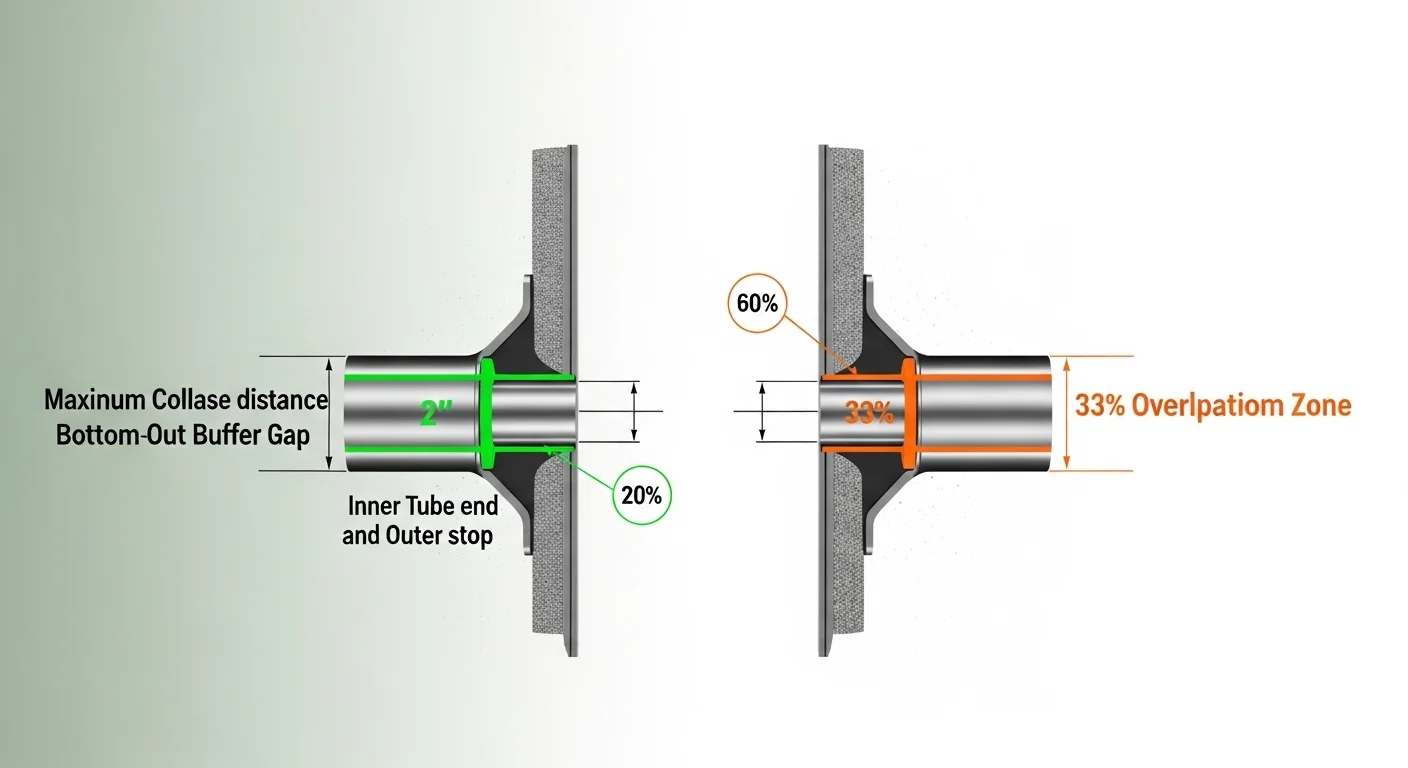
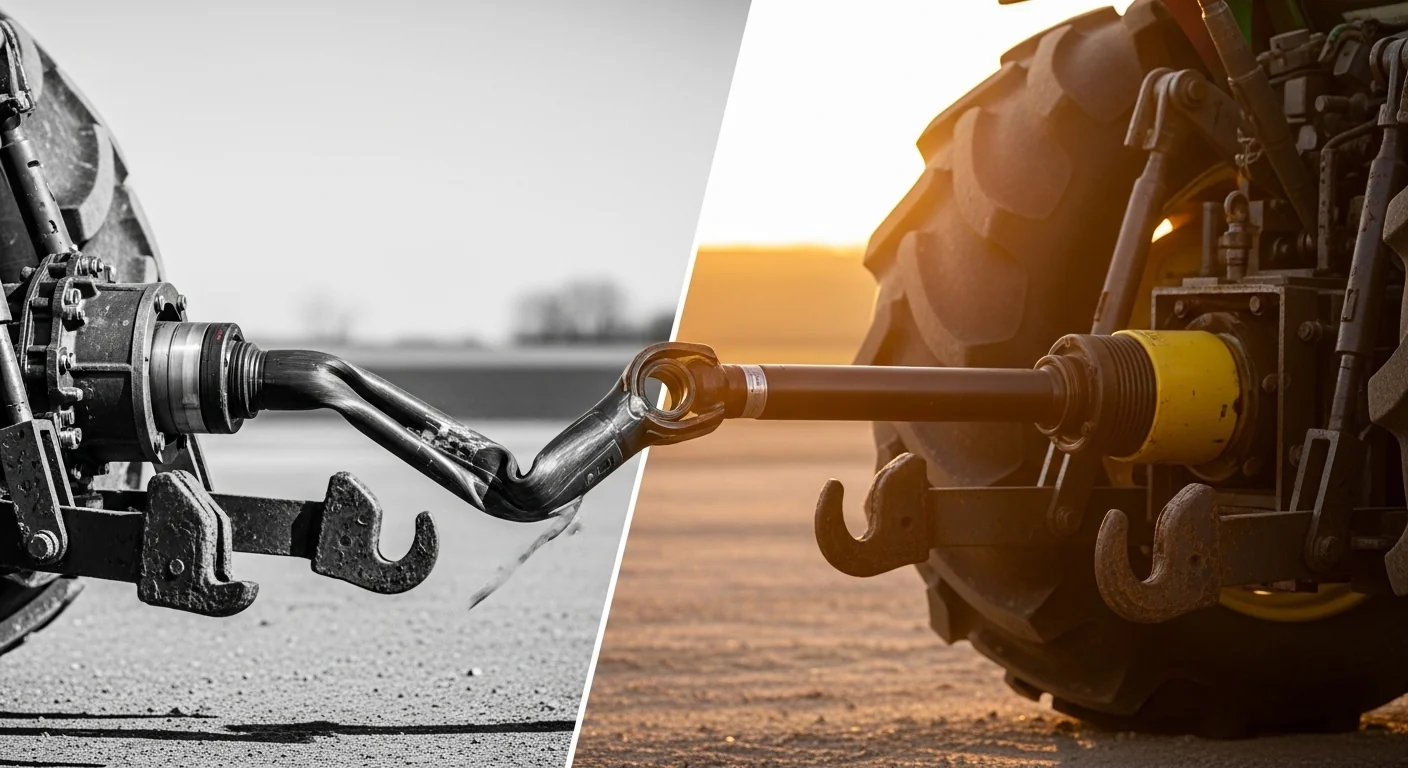
The standard advice for cutting a PTO shaft is straightforward: measure the distance, cut the shaft to fit, and go to work. That advice has destroyed gearboxes, bent tractor frames, and sent heavy shafts spinning through the air at 540 RPM. The geometry of a 3-point hitch is dynamic. The distance between your tractor’s PTO output and your implement’s input changes continuously as the hitch rises and drops, and a shaft that fits perfectly at one position can be lethal at another.
PTO Shaft Length Sizer & Bottom-Out Prevention
Safely size your PTO driveline for any tractor-implement combination — prevents grenade failures and separation whip
| Scenario | Distance (in) | Cut Length (in) | Status |
|---|
How This Calculator Works
Step 1 — Find Your Extremes
MaxExtension (longest distance) = maximum of [Level, MaxLift, MaxDrop]
Measure shaft-to-shaft from tractor PTO yoke face to implement input yoke face at three hitch positions. The shortest reading = maximum collapse; the longest = maximum extension.
Step 2 — Calculate the Safe Cut Length
The 2-inch buffer prevents the inner tube from slamming into the outer tube end (“bottoming out”) when the hitch rises. This buffer absorbs geometric compression without transmitting it to tractor hydraulics or the gearbox. Never skip this buffer.
Step 3 — Verify Overlap at Full Extension
Overlap % = (Overlap ÷ CutLength) × 100
Minimum safe overlap = 1/3 of cut length (≥ 33%)
At maximum extension, the inner and outer tubes must still overlap by at least one-third of the total shaft length. If overlap falls below this, the shaft can pull apart entirely at speed — a catastrophic “whipping” event.
Assumptions & Limits
• Measurements must be taken with the PTO shaft connected and the tractor on level ground.
• This calculator assumes a standard telescoping 2-tube PTO shaft (male/female square or splined tubes). It does not apply to constant-velocity (CV) shafts without checking their specific collapse allowances.
• Always account for angle: excessive operating angles >15° accelerate U-joint wear and require additional clearance.
• Always cut BOTH tubes (outer and inner) equally so balance is maintained — cut the same length from each.
• After cutting, deburr all edges and re-grease the telescoping section.
• Input range: 1–300 inches for each distance measurement.
This PTO shaft sizing calculator takes three distance measurements across your hitch’s full range of travel, applies the two-inch bottom-out buffer formula, and checks the resulting cut length against the one-third overlap standard at maximum extension. It tells you whether your configuration is safe to operate, borderline, or a separation hazard. It does not factor in U-joint operating angles, shaft torque ratings, or horsepower capacity. Those are separate engineering considerations. If you need to verify the power delivery side of your driveline, the drawbar horsepower calculator covers the tractor output half of that equation.
After running this calculator, you will know exactly what length to cut each tube, whether your shaft will stay connected at maximum hitch drop, and whether the two-inch buffer is achievable with your current geometry.
Use the Tool
Before you start, have three measurements ready: shaft-to-shaft distance with the implement resting level on the ground, the same measurement with the hitch raised to its absolute maximum height, and the measurement at the deepest working position (for example, a tiller cutting into soil or a subsoiler at full penetration depth). All measurements should be taken from the face of the tractor PTO output yoke to the face of the implement input yoke, not from any guard or collar. Measure in inches. Know your shaft’s profile series (stamped on the outer tube or listed in the implement manual) before selecting from the series dropdown. If you are also evaluating whether your tractor’s hitch can physically support the implement weight at those positions, the 3-point lift capacity calculator is the right companion tool.
Quick Start (60 Seconds)
- Level Distance (inches): Implement resting flat on ground, hitch in neutral. Measure yoke face to yoke face. Do not measure to the guard tube or plastic shield.
- Maximum Lift Distance (inches): Hitch fully raised to its mechanical stop. This is typically the shortest of your three measurements and determines your cut length.
- Maximum Drop Distance (inches): Hitch at its deepest working position, not just free-floating. A tiller dropped into soil will read differently than the same tiller hovering above ground.
- PTO Shaft Series: The series number controls torque capacity and tube dimensions. Common mistake: selecting Series 4 when the implement manual specifies Series 6. Check the stamp on the outer tube before entering a value.
- Enter all three distances as decimal inches, not fractions. Use 28.5, not 28 1/2.
- Take each measurement with the PTO shaft disconnected so the tubes do not force the geometry. Shaft stiffness at an angle can give a false reading.
- Re-measure at maximum drop under load if possible. An implement that sinks deeper during operation extends the shaft further than a static ground measurement shows.
Inputs and Outputs (What Each Field Means)
| Field | Unit | What It Means | Common Mistake | Safe Entry Guidance |
|---|---|---|---|---|
| Level Distance | inches | Yoke-to-yoke shaft span with implement on flat ground, hitch neutral | Measuring to the guard or collar instead of the yoke face | 1 to 300 inches; use a tape measure pulled taut in a straight line |
| Maximum Lift Distance | inches | Shortest shaft span achieved when hitch is at its highest mechanical position | Not raising the hitch all the way to its stop; recording a mid-position value | Must be less than Level Distance for most implements; if not, re-measure at true max lift |
| Maximum Drop Distance | inches | Longest shaft span when hitch is lowered to deepest working depth | Using free-drop distance rather than under-load working depth | For tillers and subsoilers, simulate soil penetration depth; use the deepest expected working position |
| PTO Shaft Series | series number | Profile size determining tube diameter, torque rating, and required overlap dimensions | Guessing based on tractor size; Series 4 and Series 6 look similar but have different collapse travel | Check stamp on outer tube or verify in implement parts manual before selecting |
| Cut Length (output) | inches | The length to cut each tube to after applying the two-inch bottom-out buffer | Cutting only one tube instead of both equally | Cut both inner and outer tubes to this length; trim equal amounts from each end for balance |
| Min Collapsed Distance (output) | inches | The smallest of the three input distances; this is the geometry that drives the cut calculation | Assuming it is always at max lift | Verify which hitch position produces this distance; on some implements, level position collapses most |
| Max Extended Distance (output) | inches | The largest of the three input distances; the configuration that stresses tube overlap most | Not measuring at true operating depth | Extension is where separation failures occur; this distance must stay below your cut length for safety |
| Overlap at Extension (output) | inches and percentage | How much the inner tube remains inside the outer tube at maximum extension; must stay above one-third of cut length | Assuming any overlap is sufficient; the one-third rule is a minimum, not a target | If overlap percentage is below 33, the configuration requires a different shaft or implement geometry adjustment |
Worked Examples (Real Numbers)
Example 1: Compact Utility Tractor with a New Finish Mower (The
Typical Beginner Trap)
- Level Distance: 36 inches
- Maximum Lift Distance: 29 inches
- Maximum Drop Distance: 38 inches
- PTO Shaft Series: Series 4
Result: MaxCollapse = 29 in. Cut Length = 29 – 2 = 27 inches. MaxExtension = 38 in. Overlap = 27 – 38 = -11 inches. The shaft will separate at maximum drop.
This is the configuration that destroys equipment. The shaft fits fine when the mower rests on the ground (36 inches). The operator raises the hitch to transport, the shaft collapses to 29 inches and fits. But when the mower dips into a low spot or the operator works on uneven ground, the 38-inch extension exceeds the cut length entirely. The tool returns a Danger status and the separation/whip warning. The fix is either a longer-travel shaft, a shorter implement, or restricting operational hitch drop to no more than 25 inches.
Example 2: Mid-Size Tractor with a Rotary Tiller, Modest Hitch Travel
- Level Distance: 42 inches
- Maximum Lift Distance: 37 inches
- Maximum Drop Distance: 44 inches
- PTO Shaft Series: Series 6
Result: MaxCollapse = 37 in. Cut Length = 37 – 2 = 35 inches. MaxExtension = 44 in. Overlap = 35 – 44 = -9 inches. Danger status: shaft extends beyond cut length at max drop.
Even with a more modest 7-inch range of travel between positions, the formula produces a separation condition. This example shows why measuring all three positions matters. The 2-inch difference between level (42 in) and max drop (44 in) is easy to dismiss, but it is enough to push the shaft past a safe working range given the collapse constraint. Restricting the tiller to no more than 35-inch shaft span at its deepest pass resolves the condition.
Example 3: Working Backwards to Find a Safe Configuration
- Level Distance: 58 inches
- Maximum Lift Distance: 55 inches
- Maximum Drop Distance: 56 inches
- PTO Shaft Series: Series 6
Result: MaxCollapse = 55 in. Cut Length = 55 – 2 = 53 inches. MaxExtension = 58 in. Overlap = 53 – 58 = -5 inches. Overlap percentage: -9.4%. Danger status.
This example illustrates a critical insight: even a tight hitch geometry with only 3 inches of total travel range cannot produce a passing overlap when the extension exceeds the cut length. Safe PTO shaft sizing fundamentally requires that your maximum extension distance be smaller than your cut length. Real-world configurations that pass the overlap check involve implements with very limited hitch travel, purpose-built CV shafts with engineered constant-length mechanisms, or adjusted mounting points. Use this calculator to identify the problem early rather than discovering it in the field.
Reference Table (Fast Lookup)
The table below shows how cut length and overlap status change as MaxCollapse and MaxExtension values vary. The “Overlap Reserve” column is computed as (Cut Length – MaxExtension). A positive value indicates the shaft can span the extension distance with room remaining. Negative values indicate the shaft cannot safely reach maximum extension.
| MaxCollapse (in) | MaxExtension (in) | Travel Range (in) | Cut Length (in) | Overlap Reserve (in) | Status |
|---|---|---|---|---|---|
| 24 | 30 | 6 | 22 | -8 | Danger |
| 28 | 34 | 6 | 26 | -8 | Danger |
| 32 | 36 | 4 | 30 | -6 | Danger |
| 36 | 40 | 4 | 34 | -6 | Danger |
| 40 | 42 | 2 | 38 | -4 | Danger |
| 44 | 46 | 2 | 42 | -4 | Danger |
| 52 | 54 | 2 | 50 | -4 | Danger |
| 60 | 60 | 0 | 58 | -2 | Danger (borderline) |
| 36 | 30 | -6 (collapse > extend) | 34 | +4 | Safe (specialized mount) |
| 48 | 38 | -10 (collapse > extend) | 46 | +8 | Safe (specialized mount) |
Key takeaway from the table: Standard 3-point hitch geometry causes maximum collapse to always be less than maximum extension. Configurations where MaxCollapse exceeds MaxExtension (last two rows) occur on implements with pivoting drawbar mounts or rear-offset hitch arrangements. For the vast majority of standard tractor-implement combinations, this calculator will return a Danger status, which is the correct diagnosis. The tool’s value is making that danger visible before you operate, not confirming a safe setup that standard geometry rarely produces.
How the Calculation Works (Formula + Assumptions)
Show the calculation steps
Step 1: Identify the Extremes
From the three distance inputs (Level, MaxLift, MaxDrop), the calculator finds:
- MaxCollapse = the smallest of the three values. This is the geometry that forces the shaft to compress most. If the shaft bottoms out here, the hydraulic lift acts as a press against the implement gearbox.
- MaxExtension = the largest of the three values. This is where the shaft tubes must span their farthest distance without pulling apart.
Step 2: Apply the Two-Inch Bottom-Out Buffer
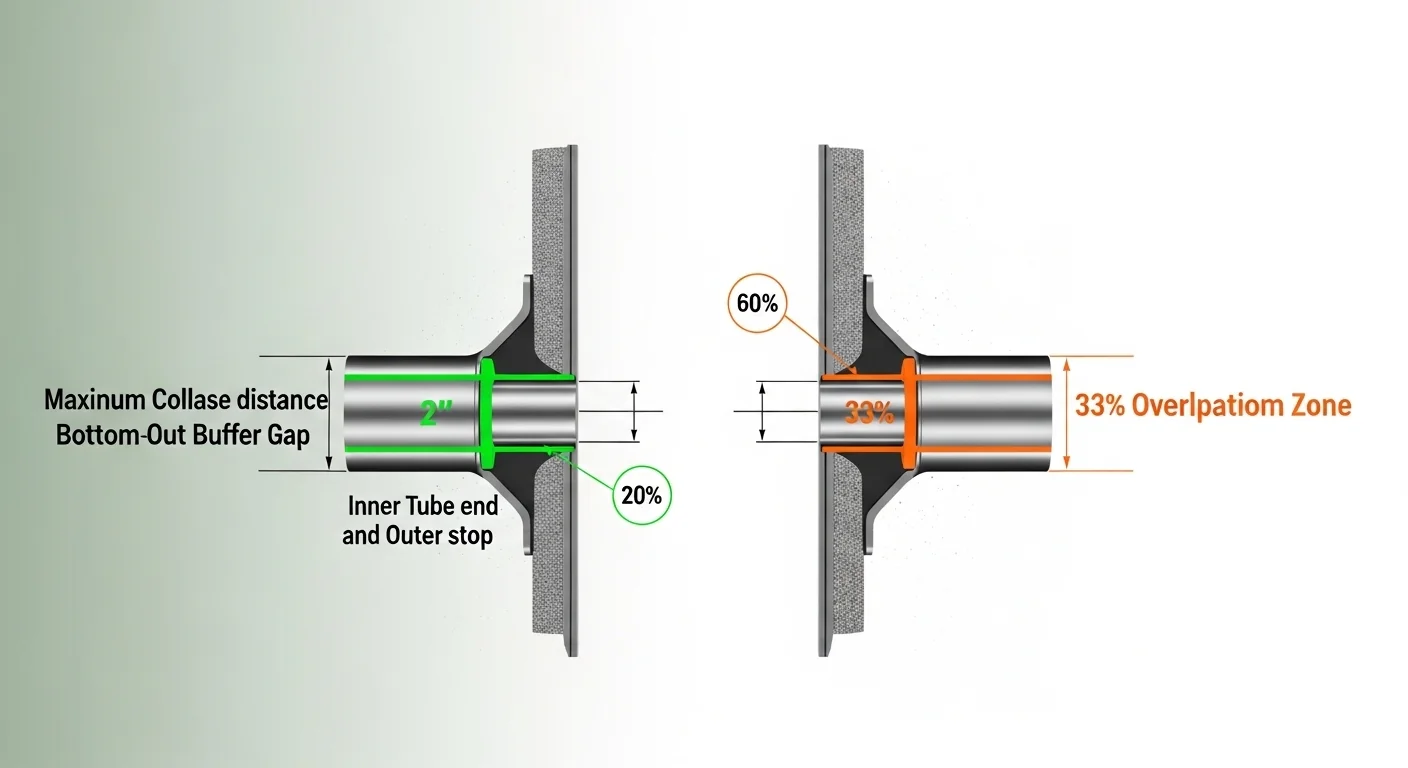
Cut Length = MaxCollapse – 2 inches
The two-inch buffer is not a suggestion. It is the minimum mechanical clearance required to prevent the inner tube end from contacting the stop surface of the outer tube when the hitch reaches maximum collapse. Without it, hydraulic lift pressure transfers directly into the shaft assembly. Rounding rule: always round DOWN to the nearest 0.25 inch. A shaft cut 0.1 inches too long still bottoms out.
Step 3: Check Overlap at Full Extension
Overlap (inches) = Cut Length – MaxExtension
Overlap Percentage = (Overlap / Cut Length) x 100
Minimum safe overlap: 33% of cut length (one-third rule). Below 33%, vibration, shaft angle, or any momentary extension beyond the measured maximum can complete a separation event. The overlap must exist across the entire operating range, not just at static measurements.
Assumptions and Limits
- This formula applies to standard two-tube telescoping PTO shafts only. Constant-velocity (CV) shafts, wide-angle joints, and friction clutch shafts have manufacturer-specific collapse and extension specifications that override this general formula.
- All three distances must be measured with the PTO shaft disconnected. Connected shaft resistance at angles can cause false distance readings of 1 to 4 inches on stiff shafts.
- The formula does not account for operating angle. Every degree of hitch angle above 15 degrees reduces effective shaft travel and accelerates U-joint wear. Steep hillside operations require additional collapse clearance beyond the standard two-inch buffer.
- The calculator assumes cuts are made equally to both inner and outer tubes. Cutting only one tube shifts shaft weight balance and induces vibration at operating speed.
- This tool does not verify torque capacity for the selected series. Series selection affects only reference context in this calculator. Verify shaft torque rating independently against your implement’s peak PTO demand.
- The input range is limited to 1 to 300 inches. Measurements outside this range indicate measurement error or a non-standard implement mount that requires manufacturer consultation.
- Dynamic shaft extension under load (soil resistance, vibration, implement oscillation) can exceed static measurements. The deepest static drop reading should be treated as a minimum, not a maximum, for the MaxDrop input.
Standards, Safety Checks, and “Secret Sauce” Warnings
Critical Warnings
- The Bottom-Out Grenade: When a shaft bottoms out under hitch lift, the hydraulic cylinder does not stop pushing. A tractor’s 3-point lift can generate thousands of pounds of force. That force has nowhere to go except through the shaft’s end cap, which blows off violently. The cap and fragments travel at speeds comparable to the shaft rotation. This failure is not theoretical; it is the most common cause of PTO driveline destruction on new implement installations.
- The Separation Whip Event: A shaft that pulls apart at extension does not fall to the ground. At 540 RPM, an unrestrained spinning tube follows ballistic physics with rotational energy added. Even with safety guards, the inner tube can eject from the outer in a fraction of a second. The one-third overlap rule exists because empirical failure data showed that less overlap leaves too little resistance to separation forces generated by angular misalignment and vibration.
- The Transport Height Trap: Most shaft damage happens during transport, not field operation. Raising the hitch to road transport height collapses the shaft to its minimum. An uncut shaft that fit at level position will bottom out at transport height, often before the operator notices resistance from the 3-point system.
- Un-cut “Out of Box” Shafts: Replacement PTO shafts are sold at maximum length. Every new shaft shipped for use on a 3-point implement requires cutting before operation. Using an uncut shaft is not safer than a cut shaft; it is more dangerous because the collapse geometry was never verified.
Minimum Standards
- Two-inch minimum bottom-out buffer at maximum hitch height. This is the industry-accepted minimum, not a conservative recommendation.
- One-third overlap minimum at maximum hitch drop or maximum extension distance. Below this threshold, no guard system provides adequate protection from a separation event.
- Equal cuts on both tubes. Cutting only the inner tube introduces a weight imbalance that causes measurable vibration at 540 RPM and can crack U-joint bearing cups within a single operating season.
- Deburr all cut tube ends and repack the telescoping section with a heavy-duty grease rated for sliding metal contact before assembly. Ungreased telescoping sections seize under field vibration and eliminate the collapse travel the cut was designed to provide.
Competitor Trap: Most PTO shaft length guides tell you to measure the distance at level, cut the shaft so it fits with a few inches of overlap, and call it done. None of them walk through the hitch travel geometry. The level distance measurement is the least important of the three inputs because it rarely represents either the maximum collapse or the maximum extension. An operator who follows level-only advice and owns a tractor with 12 inches of hitch travel above and below level has a shaft that is almost certainly either already at risk of bottoming out on the way up or separating on the way down. The PTO shaft sizing calculator on this page uses all three positions specifically because single-position measurement is the most common source of shaft failure on new implement installations.
PTO-driven implements vary widely in how aggressively they alter driveline geometry. A rotary cutter runs relatively flat throughout its operating range; use the rotary cutter size calculator to verify that the implement’s power requirements are matched before sizing the shaft. Post hole diggers are among the worst offenders for shaft extension variance because the operator often raises the unit fully between holes, creating rapid collapse-to-extension cycling; the PTO post hole digger torque calculator covers the power side of that operation and should be run alongside shaft sizing.
Common Mistakes and Fixes
Mistake: Measuring Only at the Level Position
Level distance is the measurement most operators take because it is the easiest. The implement is on the ground, the shaft is roughly horizontal, and the tape measure reads a clean number. But level distance rarely equals the minimum collapse distance, and it never captures the maximum extension distance. Both extremes occur at the hitch limits, not at neutral.
Fix: Take all three measurements before making any cut. The level position reading can be used as a reference check, but it should not be the input that determines cut length.
Mistake: Ignoring the Working Depth Position
Operators measure hitch drop from ground level with the implement hovering. Tillers, subsoilers, and cultivators descend further under working conditions as cutting tools enter the soil. The static drop measurement can be 3 to 6 inches shallower than the actual working extension. This gap is enough to push an already-marginal configuration into a separation event once the implement enters the ground.
Fix: Measure the drop distance either by simulating soil engagement (driving the implement into a soft area) or by adding a 4-inch working-depth correction to the static drop measurement as a conservative baseline. Flail mowers are particularly subject to this problem on uneven terrain; the flail mower RPM calculator can help verify that the shaft speed and implement geometry are coordinated correctly.
Mistake: Cutting Only the Inner Tube
Because the inner tube is the easier piece to access and cut, some operators shorten only that component to achieve the desired fit. The outer tube remains at factory length. This shifts the shaft’s rotational center of mass and creates a vibration imbalance that worsens as RPM increases. The imbalance puts cyclical stress on both U-joints at every revolution.
Fix: Cut the same length from both tubes. If cut length is 28 inches and the original tubes are 36 inches, remove 8 inches from each tube. Mark both tubes with the same cutline before making any cuts.
Mistake: Using the Guard as the Measurement Reference
The plastic or metal guard tube that covers the shaft yokes is wider than the internal driveline and extends several inches beyond the actual yoke face. Measuring to the guard edge rather than the yoke face produces a distance reading that is consistently shorter than the true shaft span, leading to a cut that is too short and a shaft that cannot properly engage at the shorter measurement positions.
Fix: Insert a thin rod or tape measure through the guard to the yoke face for both measurement points. The guard is a safety shield, not a measurement datum.
Mistake: Treating the Two-Inch Buffer as Negotiable
Under time pressure or parts availability constraints, some operators reason that 1.25 inches of clearance is “close enough” and will work for light-duty applications. The bottom-out failure mode is not sensitive to duty cycle. A light-duty implement attached to a tractor with a sharp hitch raise response produces the same hydraulic force as a heavy implement. The two-inch buffer does not exist to protect the shaft against normal operation; it exists to absorb the geometry error that appears when the lift system moves faster or further than the operator intends.
Fix: Round the cut length down to the nearest 0.25 inch and apply the full two-inch buffer without modification. If the resulting cut length does not pass the overlap check, the solution is a different shaft or hitch geometry, not a reduced buffer.
Next Steps in Your Workflow
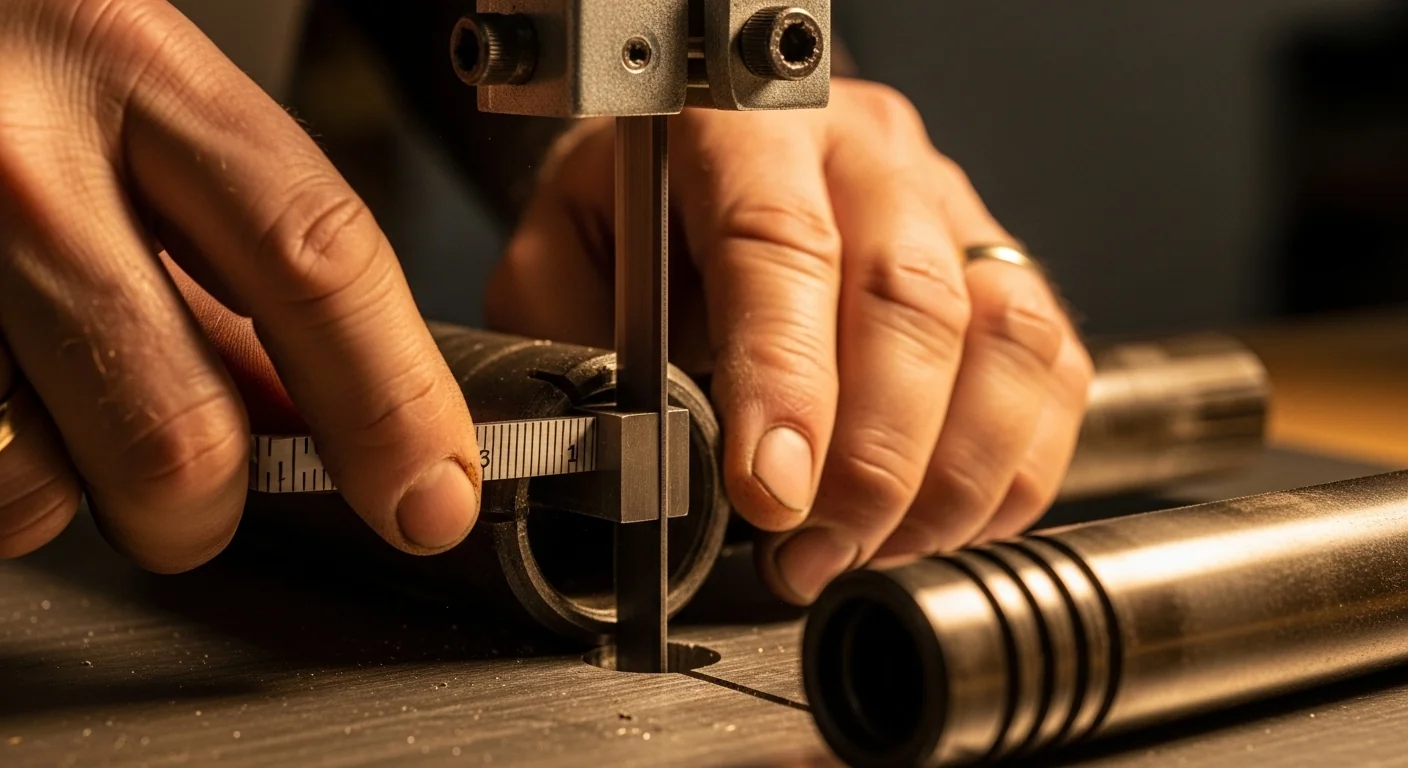
Once the cut length is confirmed, the physical work begins. Mark both tubes at the cut line using a scribe or permanent marker, then cut with a metal cutting bandsaw or reciprocating saw with a metal blade. File or grind all cut edges until the tube ends are flat and burr-free; any raised metal on the tube end will score the inside of the opposite tube when the shaft cycles under load. Clean the telescoping section of all cutting debris and repack it with a marine-grade or waterproof grease before final assembly. Spin the assembled shaft by hand through its full range of travel before connecting it to either yoke. It should move smoothly through the full collapse and extension without binding. Any stiffness under hand pressure indicates a cut that is not square or a burr that needs additional filing.
With the shaft verified, check whether the rest of the implement’s connection to the tractor is correctly sized for the load. If you are connecting a high-draft implement such as a subsoiler, verify your tractor’s horsepower delivery against the implement’s requirements using the subsoiler HP requirements calculator before running at depth. For implements involving soil engagement width and overlap between passes, the cultivator sweep overlap calculator handles the coverage geometry that runs parallel to driveline sizing in your setup workflow.
FAQ
What happens if I do not cut the PTO shaft at all?
An uncut shaft is sold at maximum catalog length. This length assumes no particular tractor-implement combination. When you raise a 3-point hitch with an uncut shaft attached, the distance between the two connection points shrinks. If that distance reaches the shaft’s fully collapsed position, the tubes bottom out and hydraulic lift force transfers directly through the end cap. The cap ejects. The shaft does not shorten; the force does.
Why does the one-third overlap rule exist specifically?
Empirical testing and field failure data established that less than one-third overlap leaves too little resistance to the combined forces of shaft rotation imbalance, U-joint angular loads, and vibration-induced axial movement. At one-third overlap, the telescoping section retains enough bearing surface to prevent lateral wobble that would otherwise walk the inner tube out of the outer tube during operation.
Can I use this calculator for a PTO shaft with a friction clutch or CV joint?
No. Friction clutch assemblies and constant-velocity joint shafts have specific engineered collapse and extension limits set by their manufacturers. Those limits may differ from the general two-inch buffer and one-third overlap standards used in this calculator. Always consult the shaft manufacturer’s specification sheet for clutch and CV shaft installations. Use this tool as a screening check, then verify against the specific shaft specification.
Does shaft series selection change the cut calculation?
In this calculator, the series selection provides reference context for the results and the recommendation table but does not alter the cut length formula. The cut length formula depends only on the collapse and extension distances. Series selection affects torque capacity, tube outer diameter, and recommended minimum overlap in manufacturer-specific documentation. A Series 2 shaft and a Series 10 shaft installed at the same distances would receive the same cut length output from this formula.
What should I do if the calculator returns a Danger result for my
configuration?
A Danger result means the geometry of your tractor-implement combination cannot produce a safely functioning PTO shaft with standard two-tube telescoping design. The options are: restrict the hitch’s operating range mechanically so the extension distance stays below the cut length, source a longer-travel shaft from the implement manufacturer, consult a dealer about a rear-offset hitch adapter that changes the mounting geometry, or verify whether a constant-velocity shaft with a different collapse envelope resolves the conflict.
How do I measure if the implement is too large to hold by myself during
measurement?
Chock the implement wheels or rest the implement on a stable surface at each of the three hitch positions. A magnetic base ruler or a pair of locking pliers clamped to the implement input shaft housing can serve as a reference point for the tape measure’s far end. The measurement does not require a helper if the implement can be held stationary at each position. Take all three measurements before moving the tractor.
Conclusion
PTO shaft sizing is not difficult, but single-point measurement makes it dangerous. The core principle this calculator enforces is simple: the shortest distance your hitch geometry creates determines how long the shaft can be, and that length must then be verified against the longest distance your geometry creates to confirm the shaft will not separate. Most standard tractor-implement configurations produce a result that requires either a geometry adjustment or a manufacturer-specific shaft rather than a straight cut-and-go installation. That is not a failure of the tool; it is the accurate diagnosis that prevents field failures.
The mistake to avoid is skipping the maximum-drop measurement under real working conditions. Static hover measurements are consistently optimistic. The shaft extension that appears during field operation on uneven ground or at working depth is the measurement that determines whether your configuration is genuinely safe. Take the time to simulate operating conditions before cutting. Once the cut is made correctly and the overlap is verified, the driveline requires no further sizing work until the implement or tractor changes. For tractor setup questions beyond the driveline, the tractor tire ballast calculator covers the stability side of the same setup workflow for rear-mounted implements.