
Spacing decisions made at planting time are permanent. Adjusting them later means digging up established root systems, disturbing mycorrhizal networks, and in dense shrub plantings, risking the kind of branch tearing that opens wounds to secondary infection. The center-to-center distance you choose today determines whether mature canopies breathe freely or lock together into a humidity trap.
This plant spacing calculator computes the number of plants needed for a rectangular planting area using either a square grid or an equilateral triangle (offset-row) grid pattern. It calculates based on area geometry and your target spacing in inches. It does not account for soil type, slope, irrigation zoning, or irregular bed shapes. Results are whole-plant counts rounded up to ensure complete coverage within the stated boundary.
After running the calculation, you will know exactly how many plants to order for your bed dimensions and grid choice, and whether your target spacing clears the 18-inch airflow threshold that separates safe hedging density from conditions that encourage fungal disease.
Use the Tool
Plant Spacing Calculator
Triangular vs square grid · canopy yield · crowding safety
| Spacing (in) | Square Grid | Triangle Grid | Gain |
|---|
How this calculator works
Step 1 — Convert area to square inches:
Area (sq in) = Length (ft) × 12 × Width (ft) × 12
Step 2 — Apply the grid formula:
- Square grid: Plants = Area ÷ Spacing²
Each plant occupies a Spacing × Spacing square cell. - Equilateral triangle grid: Plants = Area ÷ (Spacing² × 0.866)
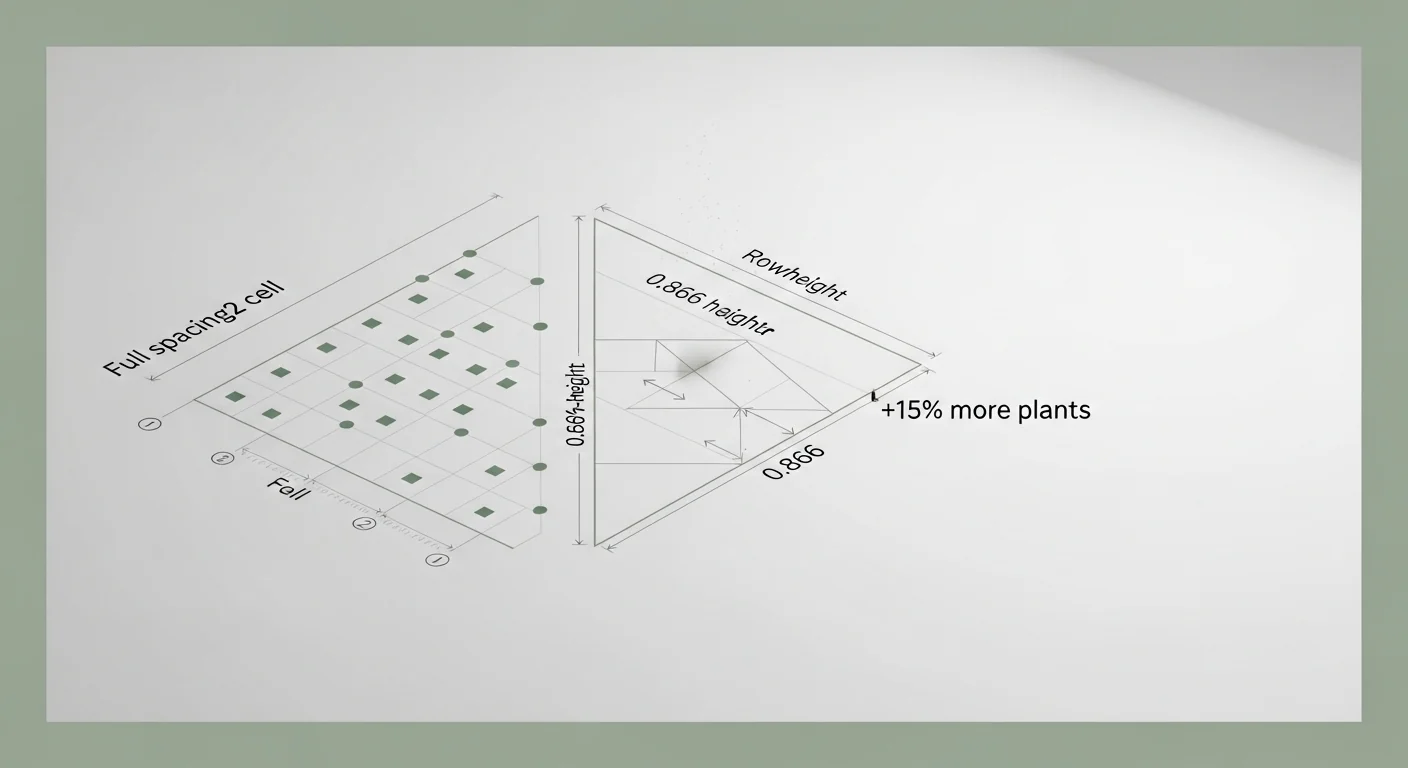
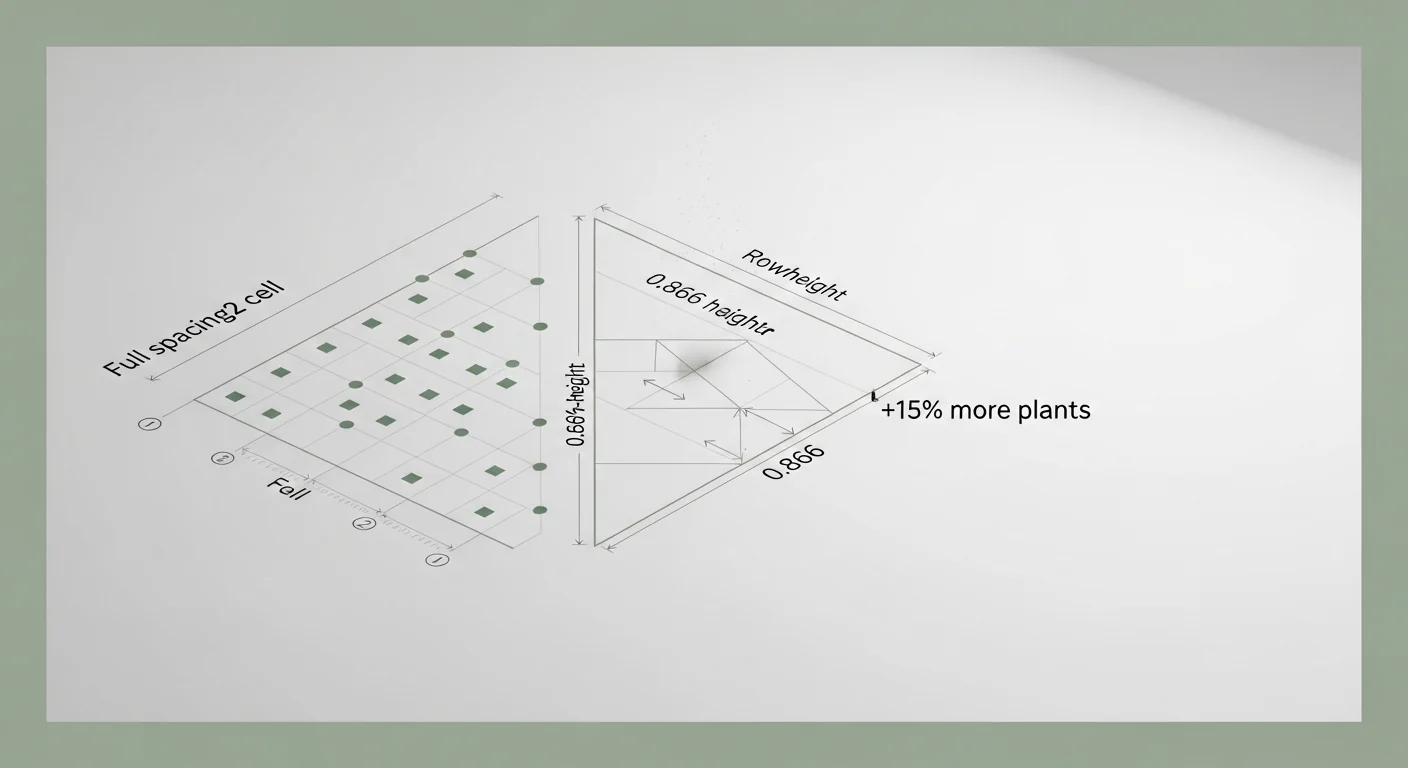
Rows are offset by half a spacing. The factor 0.866 = sin(60°), the height of an equilateral triangle with side = Spacing. This tighter packing yields ~15.5% more plants.
Result is rounded up to the nearest whole plant to ensure full coverage.
Units: Length & Width in feet · Spacing in inches · Output in whole plants
Assumptions & Limits
- Assumes a flat, rectangular planting area with no obstructions.
- Center-to-center spacing reflects mature canopy spread, not plug size at time of planting.
- Triangle formula uses the equilateral offset row (brick-pattern) approximation.
- Edge plants are counted if center falls within the boundary (no partial-plant deduction).
- This tool does not account for soil type, slope, sun exposure, or irrigation zoning.
- Boxwood Blight risk threshold: spacings under 18 in on square grid in humid climates significantly elevate fungal risk.
- Minimum spacing supported: 2 in · Maximum: 240 in (20 ft).
- This calculator assumes no border buffer. Add 6–12 in clearance from walls or structures manually.
Before entering values, have your tape measure handy. You need the length and width of the planting area in feet (not meters, not yards), and your target center-to-center spacing in inches from the plant tag or nursery specification sheet. That spacing should reflect the plant’s mature canopy spread, not the container size it ships in. If you are planning a more complex multi-zone layout, the square foot gardening planner handles irregular zoned grids and companion groupings that go beyond what a single-spacing calculator covers.
Quick Start (60 Seconds)
- Planting Area Length (ft): Measure the longest dimension of your bed. Enter feet only. A 7.5 ft bed is entered as 7.5, not as 7 ft 6 in.
- Planting Area Width (ft): Measure the perpendicular dimension. For narrow borders under 2 ft wide, results will be low-count but still accurate.
- Center-to-Center Spacing (in): Read the mature spread from the plant label, not the pot diameter. Enter inches. A 24-inch spacing goes in as 24, not 2.
- Grid Pattern: Square means plants align in a standard row-and-column grid. Triangle means each alternate row offsets by half a spacing, placing each plant between the two above it. Triangle yields approximately 15% more plants in the same area.
- Calculate Yield: Click the button. Results do not appear until all three numeric fields are complete and valid.
- Review the warnings box: If your spacing is under 18 inches on a square grid, the tool will flag a crowding and blight risk. Read it before placing your plant order.
- Reset: Clears all fields and results. Use this between scenarios if you are comparing different spacing options.
Inputs and Outputs (What Each Field Means)
| Field | Unit | What it represents | Common mistake | Safe entry guidance |
|---|---|---|---|---|
| Planting Area Length | feet (ft) | The longer horizontal dimension of the planting bed | Entering meters or mixing feet and inches in the same field | Use a retractable tape; record to one decimal place (e.g., 12.5) |
| Planting Area Width | feet (ft) | The perpendicular dimension across the bed | Using the walkway width instead of the actual planted area | Measure inside any edging or border restraint, not outside |
| Center-to-Center Spacing | inches (in) | Target distance from the center of one plant to the center of the next at maturity | Using pot diameter at purchase instead of mature canopy spread | Check the grower tag. If no spread is listed, use the midpoint of the stated height range as a proxy for round-habit shrubs |
| Grid Pattern | selection (Square / Triangle) | The geometric arrangement of plant centers across the bed | Defaulting to square without considering canopy closure speed or disease exposure | Use triangle for disease-prone shrubs (Boxwood, Holly), ground covers, and mass plantings where fast canopy closure suppresses weeds |
| Plants Needed (output) | whole plants | Total plant count rounded up to the nearest whole plant, sufficient to fill the bed at the chosen spacing and grid | Ordering the exact output count without a buffer for transplant loss or irregular edge cuts | Add 5 to 10 plants as a buffer for any bed with irregular edges or slopes |
Spacing decisions interact directly with your seed sourcing and timing plan. If you are also calculating how many seed packets to purchase for plugs grown from seed, the seed packet calculator accounts for germination rates and tray fill quantities that this tool does not.
Worked Examples (Real Numbers)
Example 1: Boxwood Hedge on a Square Grid
- Length: 40 ft
- Width: 4 ft
- Spacing: 18 in
- Grid: Square
Area in square inches = (40 x 12) x (4 x 12) = 480 x 48 = 23,040 sq in.
Plants = 23,040 / (18 x 18) = 23,040 / 324 = 71.1, rounded up to 72.
Result: 72 plants.
At exactly 18 inches on a square grid, this arrangement sits at the minimum safe airflow threshold for Boxwood. Going to 15 inches would yield more plants but push the canopy into a crowding zone where Boxwood Blight pressure increases significantly in humid climates.
Example 2: Liriope Ground Cover on a Triangle Grid
- Length: 20 ft
- Width: 8 ft
- Spacing: 12 in
- Grid: Triangle
Area in square inches = (20 x 12) x (8 x 12) = 240 x 96 = 23,040 sq in.
Plants = 23,040 / (12 x 12 x 0.866) = 23,040 / 124.7 = 184.8, rounded up to 185.
Result: 185 plants.
A square grid at the same 12-inch spacing would yield 160 plants for the same area. The offset triangle pattern delivers 25 additional plants, closing canopy faster and reducing the window during which bare soil requires active weed suppression.
Example 3: Ornamental Grass Mass Planting on a Triangle Grid
- Length: 15 ft
- Width: 6 ft
- Spacing: 24 in
- Grid: Triangle
Area in square inches = (15 x 12) x (6 x 12) = 180 x 72 = 12,960 sq in.
Plants = 12,960 / (24 x 24 x 0.866) = 12,960 / 498.8 = 25.98, rounded up to 26.
Result: 26 plants.
At 24 inches, an ornamental grass like Pennisetum or Schizachyrium will reach full canopy closure within two growing seasons on a triangle grid. The same bed on a square grid would take a third season to fill because of the diagonal gaps left at cell corners.
Reference Table (Fast Lookup)
All counts below are calculated for a 100 sq ft planting area (1,440 sq in x 10 = 14,400 sq in). The “Triangle gain” column shows the additional plant capacity derived from the formula difference. Use this for quick budget and order estimation before entering your exact dimensions above.
| Spacing (in) | Square grid plants / 100 sq ft | Triangle grid plants / 100 sq ft | Triangle gain (plants) | Typical use case | Airflow status (square grid) |
|---|---|---|---|---|---|
| 6 | 400 | 462 | +62 | Creeping Phlox plugs, small succulents | Risk: extreme density |
| 9 | 178 | 206 | +28 | Elfin Thyme, small sedums, plug groundcovers | Risk: dense canopy, monitor humidity |
| 12 | 100 | 116 | +16 | Liriope, Mondo Grass, small ornamental grasses | Risk: tight on disease-prone species |
| 15 | 64 | 74 | +10 | Boxwood (minimum spacing, marginal airflow) | Caution: below recommended threshold |
| 18 | 45 | 52 | +7 | Boxwood, Inkberry, compact hollies | Safe: minimum airflow threshold met |
| 24 | 25 | 29 | +4 | Dwarf conifers, large perennials, mid-size shrubs | Safe: good airflow and canopy separation |
| 36 | 12 | 13 | +1 | Large shrubs, specimen hedging plants | Safe: low density, weed management required |
| 48 | 7 | 8 | +1 | Large specimen shrubs, small trees in mass planting | Safe: sparse coverage until year 3-4 |
How the Calculation Works (Formula and Assumptions)
Show the calculation steps
Step 1: Convert bed area to square inches.
Both length and width are entered in feet. The formula multiplies each by 12 to convert to inches, then multiplies the two converted values together.
Area (sq in) = (Length x 12) x (Width x 12)
Step 2: Calculate plant count for the chosen grid.
Square grid: each plant occupies a cell exactly Spacing x Spacing inches. The formula divides total area by one cell area.
Plants = Area (sq in) / (Spacing x Spacing)
Triangle grid: rows are offset so each plant is positioned at the apex of an equilateral triangle formed by two plants in the adjacent row. The effective cell area is reduced by the factor sin(60 degrees), which is 0.866. This is what compresses the spacing without changing the center-to-center distance between any two adjacent plants.
Plants = Area (sq in) / (Spacing x Spacing x 0.866)
Step 3: Round up.
Results are always rounded up to the nearest whole plant. Rounding down would leave uncovered area at one edge of the bed.
Unit summary: Length and Width in feet, converted internally to inches. Spacing entered directly in inches. Output is whole plants, dimensionless.
Assumptions and Limits
- The planting area is assumed to be a flat rectangle with no obstructions, cutouts, or curved edges.
- Center-to-center spacing is assumed to reflect mature canopy spread, not the diameter of the plant at purchase.
- The tool counts any plant whose center falls within the stated bed boundary. No partial-plant deduction is applied at the edges.
- The equilateral triangle formula uses sin(60 degrees) = 0.866 as the row-offset factor. This is an approximation of an infinite plane; real-world bed edges will truncate some rows, so actual count may be 1 to 4 plants fewer on very small beds.
- No buffer is added for transplant mortality, irregular edges, or soil-preparation exclusion zones near walls or structures.
- This calculator does not adjust for slope. On grades above 15 degrees, runoff can shift small plugs; physical layout spacing may need to be reduced by 10 to 15% of row width to maintain effective coverage.
- Minimum supported spacing is 2 inches; maximum is 240 inches (20 ft). Entries outside that range trigger inline validation errors and block calculation.
Standards, Safety Checks, and “Secret Sauce” Warnings
Critical Warnings
- The 18-inch square-grid threshold for disease-susceptible shrubs: Square grids at spacings under 18 inches leave diagonal corner voids between plant cells. As shrubs mature, branches grow into those voids and begin to physically interlock. Interlocked branches eliminate air movement through the canopy interior. In Boxwood, Inkberry, and Holly plantings, this stagnant air layer creates sustained high humidity around stems and foliage, which is the primary environmental trigger for Boxwood Blight (caused by Cylindrocladium pseudonaviculatum). A triangle grid at the same spacing or higher does not produce the same diagonal void geometry and is therefore the safer pattern for these species.
- Plug size versus mature spread confusion: Entering the pot diameter at purchase instead of the plant’s mature spread produces an artificially low spacing number. Low spacing numbers yield high plant counts. High plant counts lead to orders that result in overcrowded plantings within three to five years, requiring costly removal and replanting. Always source spacing from the mature spread listed on grower documentation, not the tag that describes the current container.
- Spacings under 8 inches on any grid pattern: Below 8 inches, the tool flags extreme crowding. This range is appropriate only for specific groundcover plug species (Creeping Phlox, Elfin Thyme, Mazus) where the mature spread is naturally under 8 inches. Applying this range to any woody shrub or ornamental grass will result in complete canopy failure within two seasons.
- Spacings above 60 inches: Very wide spacings leave large bare-soil windows for three to five years. The tool will flag this as a sparse-coverage condition. In these cases, temporary annual fillers or a thick organic mulch layer (3 to 4 inches) is essential to prevent weed colonization of the uncovered zones.
Minimum Standards
- 18 inches center-to-center is the minimum recommended spacing on a square grid for any Buxus (Boxwood) cultivar in humid climates.
- Triangle pattern is the preferred grid for any species susceptible to foliar fungal disease, because the offset geometry does not produce the same canopy-locking corner voids as a square grid.
- For formal hedges where the intent is canopy fusion (plants growing together into a solid wall), spacing should be set to the mature canopy radius rather than the full mature spread. Calculate both scenarios and choose based on the target hedge timeline.
Competitor Trap: Most plant spacing guides published online simply divide area by spacing squared and stop there. They do not distinguish between square and triangle grids, and they never address what happens to the geometry at maturity. A 12-inch square-grid Boxwood planting looks perfectly reasonable on paper and will appear healthy for the first two to three years. Then, as canopies merge, the diagonal voids disappear into a locked mass of branches with zero interior airflow. By the time Boxbox Blight appears, it has already moved through root contact and airborne spores to neighboring plants. The calculation is not wrong; the grid selection and spacing standard were simply never applied. This tool surfaces that distinction before the order is placed.
If a fungal outbreak does occur after planting, treatment decisions depend on the specific pathogen and its resistance class. The fungicide FRAC code calculator helps identify active ingredient rotation strategies to prevent resistance buildup in repeated-spray programs. For copper-based preventive programs on Boxwood, timing and dilution are also critical; the neem oil and fungicide mixing ratio tool provides the dilution math for common organic and systemic spray products.
Common Mistakes and Fixes
Mistake: Using the wrong measurement unit for spacing
The spacing field requires inches. Entering 1.5 when the target spacing is 18 inches (meaning 1.5 feet) will produce a wildly inflated plant count and a crowding warning. Unit confusion between feet and inches is the single most common data-entry error on any spacing calculator.
Fix: Convert all spacing values to inches before entering them. 1 foot = 12 inches. 1.5 feet = 18 inches.
Mistake: Treating the plant count as the order quantity
The calculator produces the minimum number of plants needed to fill the bed at the stated spacing. It does not account for transplant failure, irregular bed edges, or the 10 to 15% of stock that nurseries often ship slightly undersized. Ordering exactly the calculated count is a margin-of-error problem waiting to happen.
Fix: Add a buffer. For beds under 50 plants, add 5 extras. For larger orders, add 8 to 10 plants as a loss cushion.
Mistake: Choosing square grid by default without considering disease history
Square grid is the familiar default, but familiarity is not a botanical standard. For Boxwood, Holly, and other shrubs with documented canopy-density disease risk, defaulting to square grid at spacings under 18 inches creates conditions that predictably lead to fungal problems within three to five years.
Fix: For any disease-susceptible species, run the calculation twice: once on square grid and once on triangle grid. Compare the plant counts and the warnings the tool generates, then select based on spacing safety, not habit. The vegetable yield calculator applies a similar species-specific logic to high-density vegetable beds where spacing and airflow also affect disease pressure.
Mistake: Applying a single spacing value to a mixed-species planting
Mixed borders and foundation plantings often combine species with very different mature spreads. Running a single spacing value through the calculator when plants range from 12-inch groundcovers to 48-inch shrubs produces a single-number result that misrepresents the actual layout.
Fix: Run a separate calculation for each species group in the bed. Add the results. Zone the bed by species before marking plant centers.
Mistake: Forgetting to account for edge clearance from structures
The calculator assumes the entire stated area is plantable. In practice, beds adjacent to walls, fences, or paved surfaces need a 6 to 12-inch structural clearance buffer on at least one edge. Omitting this means plants near the wall will be crowded against a surface that restricts airflow from one entire side of the canopy, which is the same humidity trap created by improper grid spacing.
Fix: Subtract the clearance buffer distance from the relevant dimension before entering it into the calculator. For a bed that is 8 feet wide with a wall on one side requiring a 6-inch buffer, enter 7.5 feet as the width.
Next Steps in Your Workflow
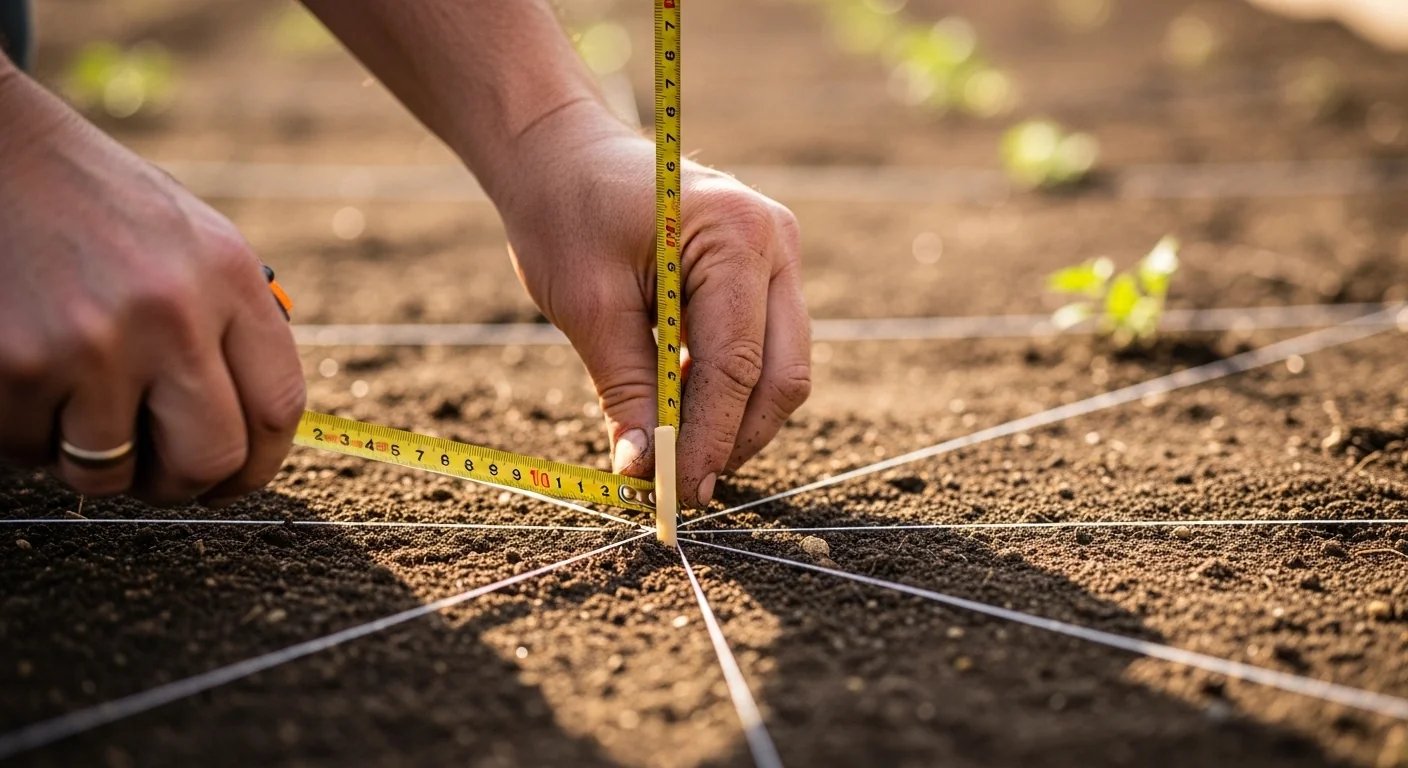
Once you have your plant count, the next step is to mark the plant centers in the ground before any soil preparation or mulching. For a triangle grid, stretch a string line along the first row, mark centers at your target spacing, then shift the string by half a spacing and repeat for the second row. A marking flag or bamboo stake at each center point before digging lets you check visual distribution and catch any measurement drift early. At this stage, compare your layout against your succession planting schedule if you are mixing annuals with perennials, because the annual placements will affect where perennials are positioned in subsequent seasons.
If you are also planning containers as part of the same project, note that container plant counts follow different density logic because root volume constrains canopy growth in ways that in-ground spacing does not. The pot size calculator handles the container side of mixed indoor-outdoor or patio plantings where in-ground spacing rules do not apply. After your plant count, order confirmation, and ground marking are complete, your primary quality gate before planting day is verifying that the spacing you calculated matches the mature spread on the actual plant tags delivered by the nursery. If the delivered stock has a different mature size than what you planned for, rerun the calculator with the corrected spacing before placing plants in the ground.
FAQ
What is the difference between square and triangular planting grids?
In a square grid, plants are arranged in parallel rows and columns with equal spacing in both directions. In an equilateral triangle grid, each alternate row is offset by half the spacing, so every plant is positioned between two plants in the adjacent row. The triangle arrangement uses space more efficiently, fitting approximately 15% more plants in the same area at the same center-to-center distance.
Why does the tool flag a warning at spacings under 18 inches on a square grid?
Square grids under 18 inches leave diagonal corner voids between cell boundaries. As shrubs grow, branches fill those voids and physically intertwine. That interlocking removes interior airflow from the canopy, creating sustained high humidity conditions. For species like Boxwood, that moisture environment is the primary precondition for Cylindrocladium blight. The 18-inch threshold is the point where square-grid geometry stops producing corner-locking voids in typical shrub canopy profiles.
Should I use spacing based on the plant’s size now or its size at maturity?
Always use the mature canopy spread. Using the current container size produces a spacing that looks fine at planting and creates an overcrowded, disease-prone thicket in three to five years. Mature spread is listed on nursery grower tags or in the plant species specification sheets from wholesale suppliers. If only a height range is provided, the midpoint of that range is a reasonable spread proxy for round-habit shrubs.
Can this calculator handle irregular or L-shaped beds?
No. The calculator assumes a single rectangular area. For L-shaped or irregular beds, split the bed into two or more rectangles, run a separate calculation for each section, and add the results together. This approach slightly overcounts plants at the corner junction but produces a conservative estimate, which is preferable to undercounting.
How accurate is the 15% yield gain from the triangle grid?
The 15% figure is derived directly from the geometric formula. The triangle grid divides the same area by Spacing squared times 0.866 rather than Spacing squared alone. Because 1 divided by 0.866 equals approximately 1.155, the triangle grid produces about 15.5% more plant positions than the square grid at any given spacing. The percentage is consistent across all spacing values; it is a function of geometry, not estimation.
Does the plant count include the edges of the bed?
Yes. The calculator counts any plant whose center falls within the stated boundary. Edge plants are included in the total. However, in practice, edge plants near walls or pavement may need to be shifted inward by 4 to 6 inches to maintain structural clearance, which is why a small order buffer is always recommended on top of the calculated count.
Conclusion
A plant spacing calculator is a straightforward area-division tool, but the grid pattern selection underneath it is a disease management decision masquerading as a geometry problem. The same plant count at 12 inches on a square grid and 12 inches on a triangle grid looks identical in a spreadsheet and produces two fundamentally different canopy outcomes five years into growth. The triangle geometry does not create the diagonal corner voids that fuse into humidity-trapping branch locks. That distinction is the functional core of this tool, and it is the piece that most spacing resources published online omit entirely.
The single most common preventable mistake in mass plantings is using purchase-size spacing instead of mature-spread spacing. It consistently produces overcrowded beds that require costly remediation. Run your dimensions through the calculator, check the warnings for your grid and spacing combination, and confirm the mature spread on your plant tags before the order goes in. If you are also working with bulb depth calculations for a layered planting alongside your shrubs or groundcovers, the bulb planting depth chart covers the vertical spacing dimension that this calculator does not address.