
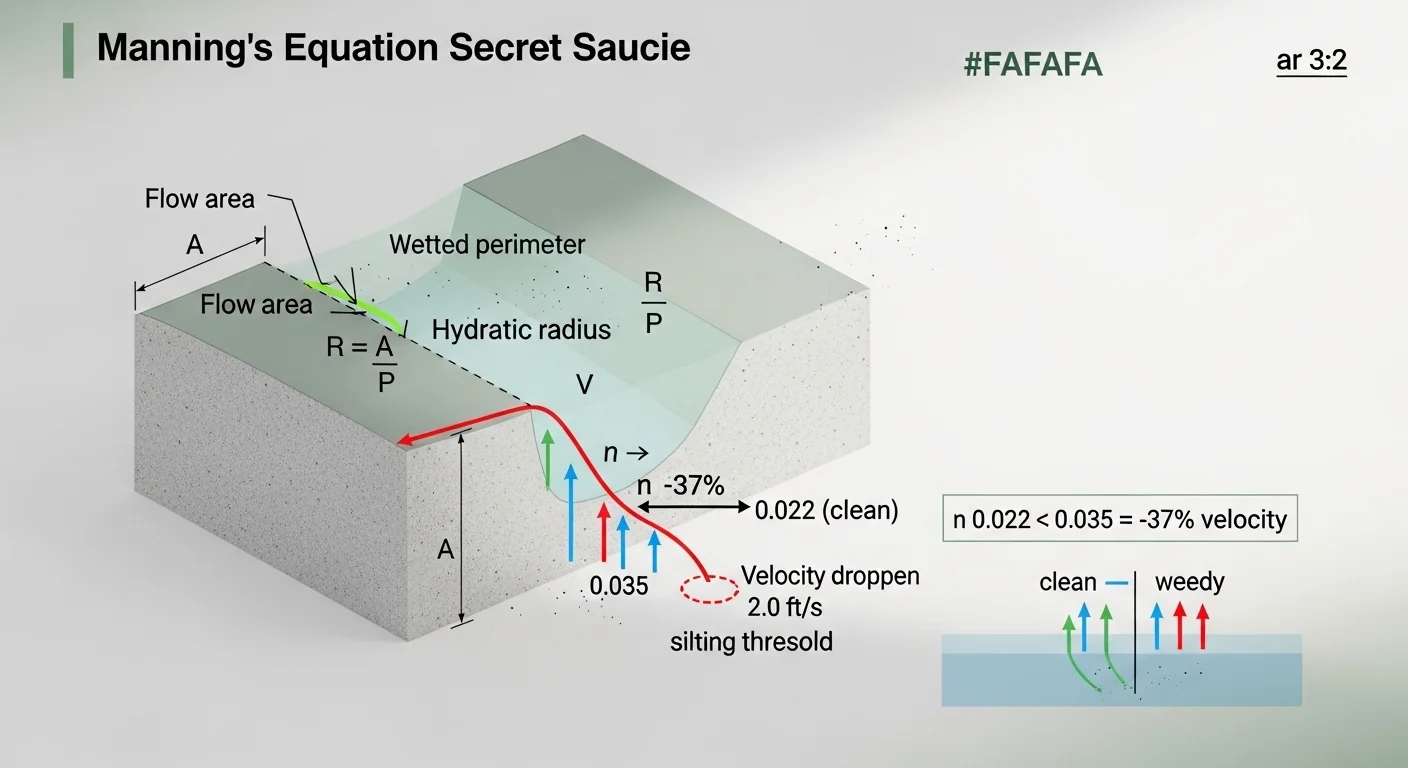
Trapezoidal earthen ditches fail not at construction, but gradually, invisibly, mid-season. The geometry is correct, the slope was surveyed, and the channel moved 10 CFS on opening day. By July, the same ditch is overflowing at 6 CFS. What changed is not the shape but the friction. Aquatic vegetation drives up the Manning’s roughness coefficient, which directly collapses average flow velocity. Once velocity drops below the critical sediment-transport threshold, suspended silt settles out and physically fills the channel bottom. The problem compounds itself. This is the failure mode that competing ditch calculators do not model explicitly.
This Manning’s equation calculator computes cross-sectional flow area, wetted perimeter, hydraulic radius, average velocity, and volumetric flow rate (Q in CFS) for a trapezoidal open channel using the US customary form of Manning’s uniform flow equation. It applies to earthen irrigation ditches, farm drainage laterals, roadside swales, and gravity-fed conveyance canals under steady, uniform flow conditions. It does not simulate transient flood pulses, sediment transport rates, or energy losses at bends and transitions. For culvert hydraulics under roadways, a separate approach is needed.
After running your numbers, compare the computed velocity against the 2.0 ft/s silting threshold and the 5.0 ft/s scouring threshold. Those two benchmarks tell you whether your design is functional, or whether it will silt up or erode before the season ends.
Use the Tool
Manning’s Equation Calculator
Open Channel & Ditch Flow Rate — Trapezoidal Cross-Section
<2.0 ft/s Optimal
2–5 ft/s Scour Risk
>5 ft/s
| Depth (ft) | Area (ft²) | Hyd. Radius (ft) | Velocity (ft/s) | Flow Q (CFS) | Status |
|---|
How This Calculator Works — Formula Steps
A = Depth × (BottomWidth + Depth × SideSlope)Units: ft² — The water-filled area the flow passes through.
P = BottomWidth + 2 × Depth × √(1 + SideSlope²)Units: ft — Longer perimeter = more friction = slower flow.
R = A / PUnits: ft — A larger hydraulic radius means more efficient flow (less friction per unit area).
V = (1.49 / n) × R^(2/3) × Slope^(1/2)Units: ft/s — The constant 1.49 is the US customary unit conversion factor (SI uses 1.0). n is the Manning’s roughness coefficient.
Q = V × AUnits: CFS (cubic feet per second) — Total volumetric flow delivered by the channel.
• Silting threshold: V < 2.0 ft/s → suspended sediment drops out, ditch fills. Critical in weedy conditions (n increases, V drops sharply).
• Scouring threshold: V > 5.0 ft/s in unlined earthen ditches → erosion begins. Reduce slope or add lining.
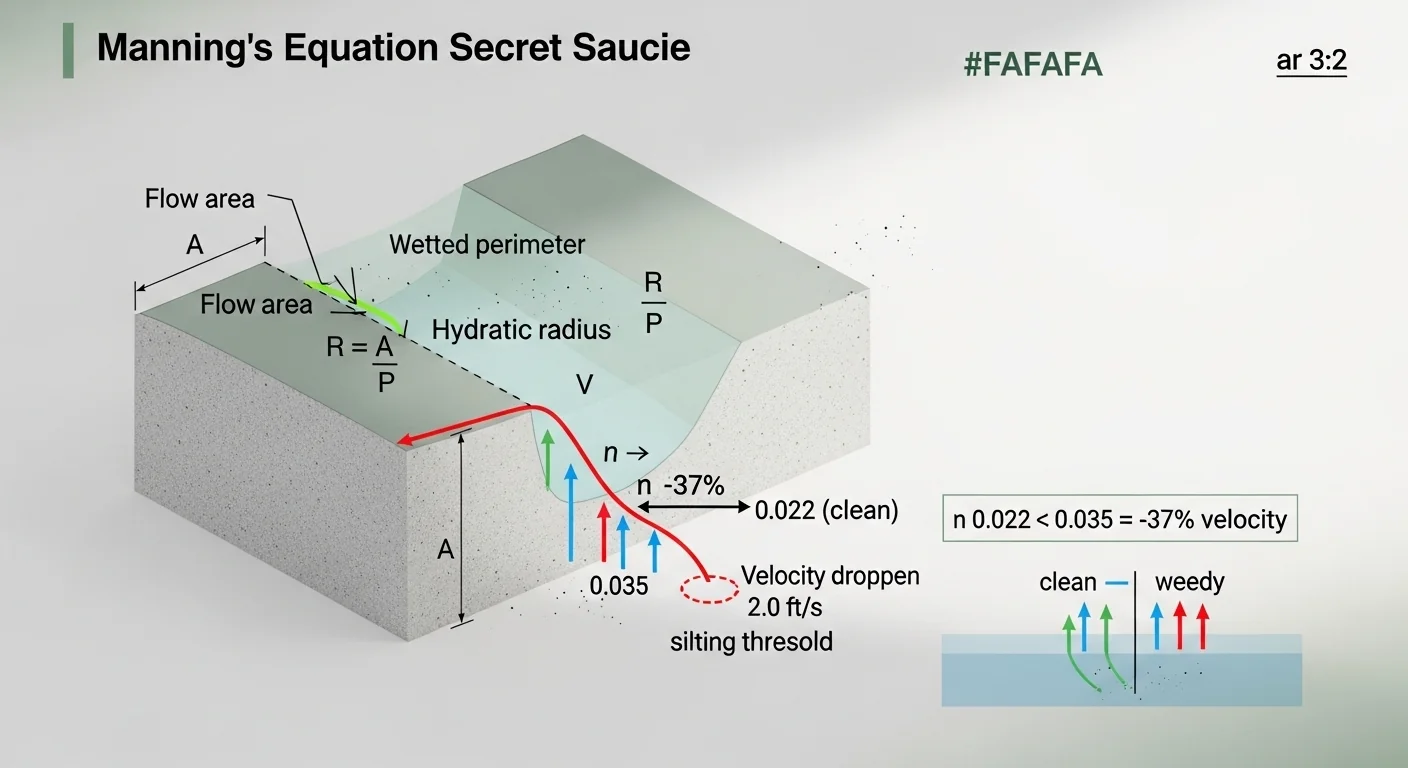
• “Weedy Factor”: Raising n from 0.022 (clean) to 0.035 (weedy) reduces velocity by ~37% and flow by the same ratio — a critical irrigation design failure mode.
Assumptions & Limits
- Assumes uniform, steady-state open channel flow — velocity and depth are constant along the ditch length.
- Cross-section is trapezoidal. Circular culverts or irregular channels require different hydraulic radius calculations.
- Manning’s equation applies to subcritical flow only (Froude number < 1). At steep slopes, flow may become supercritical and this formula underestimates actual behavior.
- The Manning’s n coefficient must be selected carefully. Seasonal vegetation dramatically increases n — always design for the worst-case (weediest, roughest) condition your ditch will experience.
- This calculator uses the US customary coefficient 1.49. For SI units (meters), use 1.0 and convert inputs/outputs accordingly.
- Sediment transport, fish passage requirements, freeboard, and erosion control standards are not computed here — consult a licensed civil or agricultural engineer for regulated channels.
- Silting threshold of 2.0 ft/s and scouring threshold of 5.0 ft/s apply to clean earthen ditches. Concrete-lined or rock-lined channels have higher scour resistance.
- Side slope input of 0 = vertical walls (e.g. concrete-formed channel). Do not enter negative values.
Before entering values, have the following ready: a surveyed bottom width and water depth at design flow, the side slope ratio from your ditch cross-section staking (expressed as horizontal run per 1 foot of rise), and a measured or GPS-derived channel fall over a known horizontal distance to establish slope in ft/ft. For Manning’s n, use the reference table inside the calculator, and always choose the value that matches the roughest expected condition your channel will reach during its operational life, not just its condition at installation.
If you are analyzing a pressurized system or a pipe network rather than an open channel, the hose flow rate calculator covers closed-conduit scenarios where Manning’s equation does not apply.
Quick Start (60 Seconds)
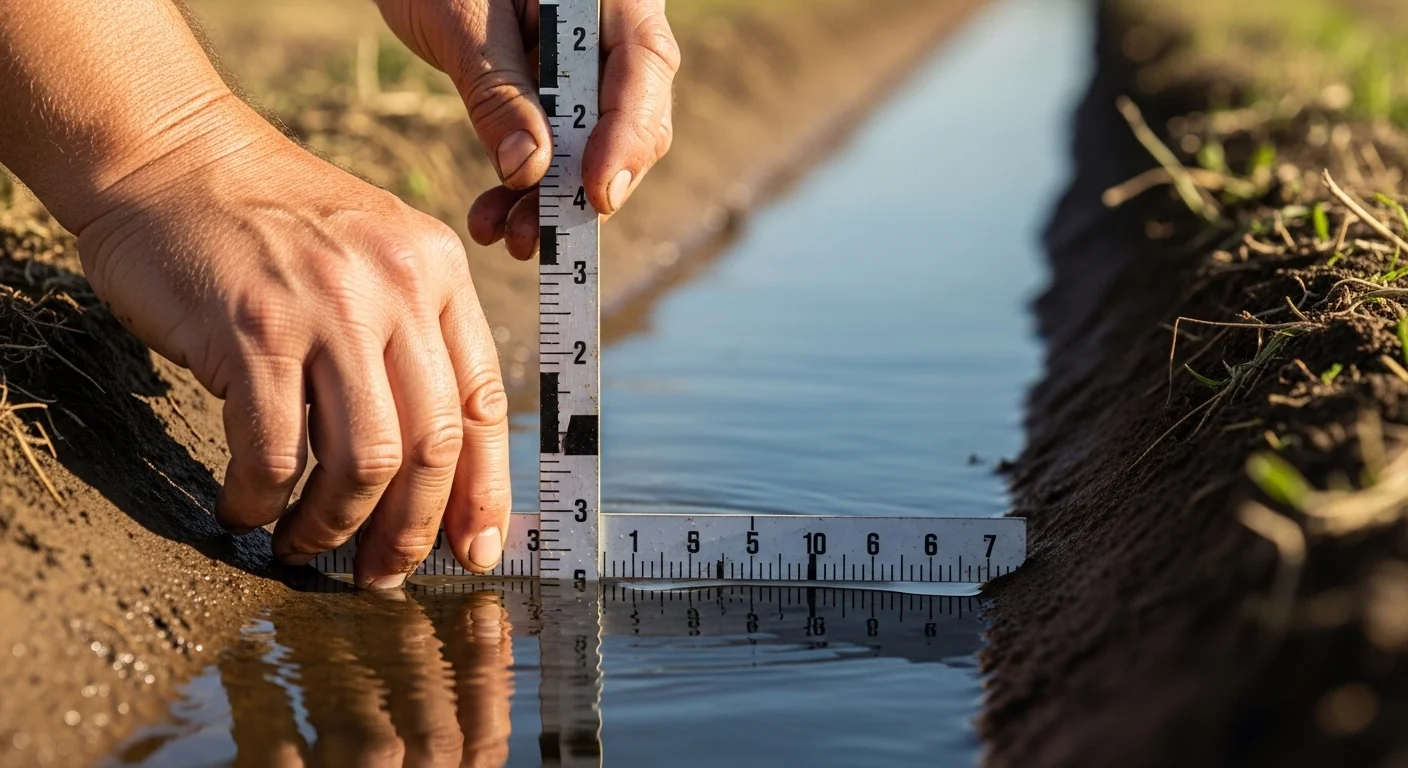
- Bottom Width (ft): Measure the flat floor of the ditch at the design cross-section. This is not the top width. For V-ditches with no flat bottom, enter 0 or a very small value (0.1). Entering the top width is the single most common input error on trapezoidal calculators.
- Side Slope Ratio (H:V): Enter the horizontal distance traveled per 1 foot of vertical rise. A 2:1 slope means 2 ft of horizontal run for every 1 ft of depth. Vertical walls are 0. Stable earthen banks in non-cohesive soils typically require 1.5:1 or flatter; steeper slopes erode. Do not enter the angle in degrees.
- Water Depth (ft): Enter the anticipated depth of flow at design conditions, not the total ditch depth. Running a ditch completely full eliminates freeboard. A design depth of 75 to 85 percent of total ditch capacity is a common field practice.
- Channel Slope (ft/ft): Divide total vertical fall by horizontal distance. A 2-foot drop over 1,000 feet is 0.002. Use a rotary laser level and grade rod to measure this in the field; map-derived elevations are often too coarse for low-gradient agricultural channels.
- Manning’s n: Use the in-calculator reference table. For a new, clean earthen channel use 0.022. For mid-season weed growth, use 0.030 to 0.035. Always run the calculation twice: once with your initial design n and once with the worst-case seasonal n. The difference in output is your risk margin.
- Unit consistency: All inputs must be in feet and feet-per-foot. Output Q is in cubic feet per second (CFS). To convert CFS to gallons per minute, multiply by 448.83.
- Click “Calculate Flow Rate” only after all five fields are filled. The tool validates each field on submission and will not run with missing or out-of-range values.
Inputs and Outputs (What Each Field Means)
| Field | Unit | What It Represents | Common Mistake | Safe Entry Guidance |
|---|---|---|---|---|
| Bottom Width | ft | Flat floor width of the trapezoidal cross-section at the base of the ditch | Entering top-of-bank width instead of bottom width | 0.1 to 500 ft; measure at the lowest point of the cross-section |
| Side Slope Ratio | H:V (dimensionless) | Horizontal run for every 1 foot of vertical rise on each bank | Entering slope angle in degrees rather than H:V ratio | 0 (vertical) to 10; earthen channels typically 1.5 to 3 |
| Water Depth | ft | Depth of water at the design flow condition, measured from channel floor | Using full ditch depth with no freeboard allowance | 0.01 to 50 ft; leave at least 10 to 15 percent freeboard below ditch top |
| Channel Slope | ft/ft | Longitudinal fall of the channel bed per unit horizontal distance | Confusing slope with grade percentage (divide grade by 100 to get ft/ft) | 0.000001 to 1; irrigation laterals commonly 0.0005 to 0.005 |
| Manning’s n | dimensionless | Resistance coefficient representing channel roughness from bed material and vegetation | Using clean-channel n for a channel that will experience seasonal weed growth | 0.005 to 0.2; use the highest n expected during operation, not at installation |
| Flow Area (A) | ft² | Cross-sectional area of water at the specified depth and channel geometry | Not applicable (computed output) | Output only; confirms geometry entry is reasonable |
| Wetted Perimeter (P) | ft | Total length of channel boundary in contact with flowing water | Not applicable (computed output) | Longer perimeter relative to area means higher friction and lower velocity |
| Hydraulic Radius (R) | ft | Ratio of flow area to wetted perimeter; efficiency metric of the cross-section | Not applicable (computed output) | Larger R means the channel shape is more hydraulically efficient |
| Velocity (V) | ft/s | Average cross-sectional velocity of flow computed from Manning’s uniform flow formula | Treating average velocity as a maximum; actual surface velocity is higher | Compare to 2.0 ft/s (silt) and 5.0 ft/s (scour) benchmarks shown in results |
| Flow Rate (Q) | CFS | Volumetric flow rate: the volume of water passing the cross-section per second | Not applicable (primary computed output) | Multiply by 448.83 to convert to gallons per minute (GPM) |
Worked Examples (Real Numbers)
Example 1: Farm Irrigation Lateral at Design Condition
- Bottom width: 3 ft
- Side slope: 2:1 (H:V)
- Water depth: 1.0 ft
- Channel slope: 0.002 ft/ft
- Manning’s n: 0.022 (clean earthen channel)
Flow area = 1.0 x (3 + 1.0 x 2) = 5.000 ft². Wetted perimeter = 3 + 2 x 1.0 x 2.236 = 7.472 ft. Hydraulic radius = 5.000 / 7.472 = 0.669 ft. Velocity = (1.49 / 0.022) x (0.669)^0.667 x (0.002)^0.5 = 67.73 x 0.762 x 0.04472 = 2.309 ft/s.
Result: Q = 11.54 CFS, velocity = 2.309 ft/s
Velocity clears the 2.0 ft/s silting threshold and stays well below 5.0 ft/s. This channel design is hydraulically sound for clean-channel conditions at this slope and depth.
Example 2: The Same Lateral in Mid-Summer Weed Conditions
- Bottom width: 3 ft
- Side slope: 2:1 (H:V)
- Water depth: 1.0 ft
- Channel slope: 0.002 ft/ft
- Manning’s n: 0.035 (earthen channel with dense weed growth)
Geometry is identical to Example 1. The only change is n from 0.022 to 0.035. Velocity = (1.49 / 0.035) x 0.762 x 0.04472 = 42.57 x 0.762 x 0.04472 = 1.452 ft/s.
Result: Q = 7.26 CFS, velocity = 1.452 ft/s
Velocity has dropped below the 2.0 ft/s silting minimum. Suspended sediment in the water supply will now begin depositing on the channel floor. Over weeks, this sediment layer reduces effective cross-sectional area, raising velocity slightly, then additional deposition occurs at the next irrigation event. The channel physically fills from the bottom up.
Example 3: Main Gravity Conveyance Canal
- Bottom width: 8 ft
- Side slope: 1.5:1 (H:V)
- Water depth: 2.0 ft
- Channel slope: 0.001 ft/ft
- Manning’s n: 0.022 (clean earthen canal)
Flow area = 2.0 x (8 + 2.0 x 1.5) = 22.0 ft². Wetted perimeter = 8 + 2 x 2.0 x 1.803 = 15.211 ft. Hydraulic radius = 22.0 / 15.211 = 1.446 ft. Velocity = (1.49 / 0.022) x (1.446)^0.667 x (0.001)^0.5 = 67.73 x 1.279 x 0.03162 = 2.739 ft/s.
Result: Q = 60.26 CFS, velocity = 2.739 ft/s
This larger cross-section achieves adequate velocity even at the shallower 0.001 ft/ft slope because the higher hydraulic radius compensates for the lower gradient. Widening a channel can maintain velocity without increasing slope, which matters on flat terrain where slope is constrained by topography.
Reference Table (Fast Lookup)
The table below uses a fixed geometry (bottom width 4 ft, side slope 2:1, Manning’s n 0.022, channel slope 0.002 ft/ft) and varies water depth. The Velocity Status column is a derived safety classification based on the 2.0 ft/s and 5.0 ft/s thresholds.
| Depth (ft) | Area (ft²) | Wetted Perimeter (ft) | Hydraulic Radius (ft) | Velocity (ft/s) | Flow Q (CFS) | Velocity Status |
|---|---|---|---|---|---|---|
| 0.25 | 1.125 | 5.118 | 0.220 | 1.101 | 1.24 | Silting Risk |
| 0.50 | 2.500 | 6.236 | 0.401 | 1.645 | 4.11 | Silting Risk |
| 0.75 | 4.125 | 7.354 | 0.561 | 2.071 | 8.54 | Acceptable |
| 1.00 | 6.000 | 8.472 | 0.708 | 2.405 | 14.43 | Acceptable |
| 1.25 | 8.125 | 9.590 | 0.847 | 2.711 | 22.03 | Acceptable |
| 1.50 | 10.500 | 10.708 | 0.980 | 2.989 | 31.38 | Acceptable |
| 2.00 | 16.000 | 12.944 | 1.236 | 3.489 | 55.82 | Acceptable |
| 2.50 | 22.500 | 15.180 | 1.482 | 3.935 | 88.54 | Acceptable |
| 3.00 | 30.000 | 17.416 | 1.723 | 4.337 | 130.1 | Acceptable |
Observation: at shallow depths (below 0.75 ft) this channel geometry and slope combination produces silting-risk velocities regardless of the roughness coefficient. Increasing slope or reducing bottom width would raise velocity at low flows.
How the Calculation Works (Formula + Assumptions)
Show the calculation steps
Step 1: Flow Area (A)
Formula: A = Depth x (Bottom Width + Depth x Side Slope)
Units: ft². This is the water-filled cross-sectional area. For a trapezoidal section, the area expands with depth because the sloped banks add width as depth increases. Rounding: carry 4 significant figures through intermediate steps; round the final area to 3 decimal places for display.
Step 2: Wetted Perimeter (P)
Formula: P = Bottom Width + 2 x Depth x sqrt(1 + Side Slope squared)
Units: ft. The square root term is the true slant length of one bank face per unit depth. A 2:1 slope has a slant factor of sqrt(5) = 2.236 ft of bank length per foot of depth.
Step 3: Hydraulic Radius (R)
Formula: R = A / P
Units: ft. This ratio describes how efficiently the cross-section conveys flow. Wider, shallower sections have lower R and more friction per unit of area; deeper, narrower sections have higher R.
Step 4: Velocity (V)
Formula: V = (1.49 / n) x R^(2/3) x S^(1/2)
Units: ft/s. The coefficient 1.49 is the US customary conversion factor (the SI version uses 1.0 with metric inputs). S is the channel slope in ft/ft. Manning’s n is the roughness coefficient. Raising n reduces velocity proportionally.
Step 5: Flow Rate (Q)
Formula: Q = V x A
Units: CFS (cubic feet per second). This is the continuity equation for uniform flow.
Assumptions and Limits
- The formula assumes steady, uniform flow: depth and velocity are constant along the channel length. In reality, most ditches have varying cross-sections, grade changes, and inlet/outlet losses that this formula does not capture.
- Manning’s equation applies reliably to subcritical flow (Froude number below 1.0). At steep slopes, flow transitions to supercritical and the equation underestimates actual energy and wave behavior.
- The Manning’s n value must reflect actual field conditions at the roughest point in the operating season. Selecting n from a table is a professional judgment, not a precise measurement; n values for vegetated channels span a wide range even within the same channel on different dates.
- The calculator does not account for head losses at bends, transitions, inlet structures, or check dams. Real canal systems lose head at every structure, reducing effective capacity below what Manning’s equation predicts for a straight uniform reach.
- Side slope stability is not evaluated. The calculator accepts any slope ratio without checking whether the bank material can stand at that angle. Bank failure in non-cohesive sands can occur at slopes steeper than 1.5:1 to 2:1.
- The silting threshold of 2.0 ft/s and the scouring threshold of 5.0 ft/s are general guidelines for clean earthen channels carrying typical irrigation water. Channels conveying high-sediment water may silt at higher velocities; concrete-lined channels resist scouring at much higher velocities.
- This tool does not calculate freeboard, bank overflow risk, or regulatory compliance. Any channel intended to convey stormwater or that crosses property boundaries should be reviewed by a licensed civil or agricultural engineer.
Standards, Safety Checks, and “Secret Sauce” Warnings
Critical Warnings
- The weedy ditch trap: A channel designed for n = 0.022 (clean earthen, new construction) and passing all velocity checks will fail the 2.0 ft/s silting threshold when seasonal weed growth drives n to 0.030 or higher. Velocity collapses, silt deposits, and the effective cross-section decreases over successive irrigation events. Design for the worst-case n, not the best-case n.
- The velocity-silt feedback loop: Once velocity drops below the transport threshold, silt accumulates on the ditch floor. The accumulated silt decreases hydraulic depth slightly, which increases the wetted perimeter-to-area ratio, which further reduces hydraulic radius and velocity. The process accelerates until the channel overtops its banks or is mechanically cleaned. This is not a gradual linear decline; it can become a failure event within a single irrigation season.
- Scour at the opposite extreme: Earthen channels with velocities above 5.0 ft/s will erode banks and bed material, increasing the cross-sectional area over time and eventually causing slope failure. Steep-slope channels with clean water and low n values are most at risk. Riprap lining or step-pool grade control structures are the standard engineering response.
- Low-flow silting at partial depth: A channel correctly sized for peak irrigation flow may run at 20 to 30 percent of design depth during early and late season. At low depths, hydraulic radius drops sharply and velocity may fall below 2.0 ft/s even in a clean channel. The reference table inside the calculator shows this behavior explicitly: check your minimum expected flow depth, not only your design flow depth.
Minimum Standards
- Minimum average velocity for earthen open channels carrying sediment-laden water: 2.0 ft/s
- Maximum average velocity for unlined earthen channels in non-cohesive soils: 2.5 to 3.0 ft/s (conservative) or up to 5.0 ft/s for well-compacted cohesive soils; rock-lined channels tolerate higher velocities
- Manning’s n for design purposes should represent the channel at its roughest expected operational condition, not at installation
- Freeboard (unused depth above design water surface) should be at least 10 to 15 percent of design depth for irrigation laterals; 20 to 25 percent for main canals conveying water from external sources
Competitor Trap: Most online Manning’s equation calculators display a single flow rate and velocity output and stop there. They omit the n sensitivity analysis that reveals whether a design is one bad weed season away from failure. A ditch that flows 10 CFS at n = 0.022 but only 6.3 CFS at n = 0.035 has a 37-percent capacity margin consumed entirely by vegetation, with no capacity margin left for any other variable. A competent ditch design requires running the calculation at both the clean-channel n and the maximum expected seasonal n and confirming that both results pass the velocity thresholds. Anything less is a partial calculation.
Subsurface drainage design follows related hydraulic principles. If your system includes both surface and subsurface components, the farm tile drainage calculator handles the subsurface portion where Manning’s equation does not apply. For evaluating how water enters the soil before it reaches a surface channel, the soil infiltration rate calculator completes the runoff side of the water budget.
Common Mistakes and Fixes
Mistake: Entering the Top-of-Bank Width as Bottom Width
In a trapezoidal cross-section, the top width is always wider than the bottom width. Entering the top of bank measurement inflates the flow area calculation, overstates the hydraulic radius, and produces a flow rate that the real channel cannot achieve. The error is especially large in wide, shallow ditches with steep side slopes.
Fix: Measure bottom width at the channel invert (floor), not at the bank tops. Use a tape across the channel floor, not across the water surface or the graded shoulders.
Mistake: Using Design-Day n Values for Seasonal Operation
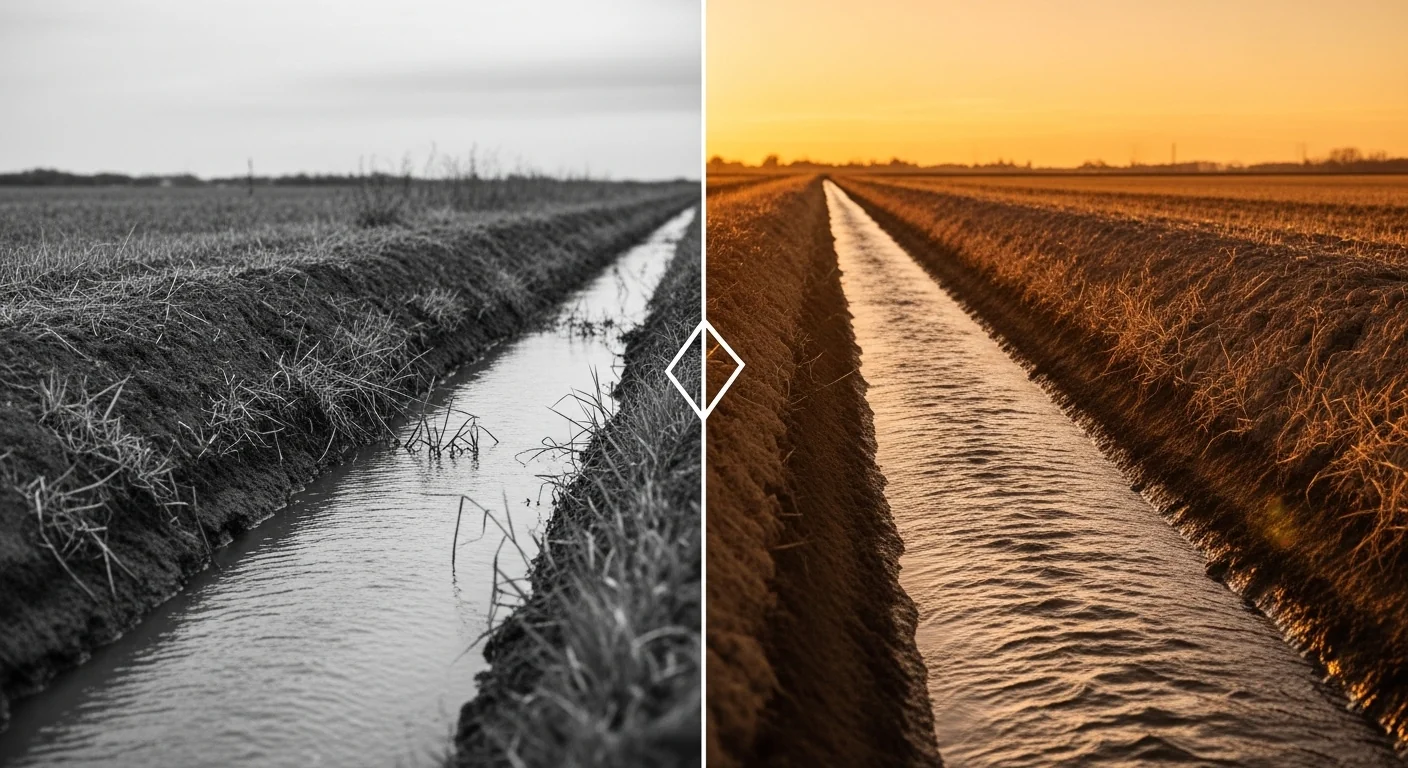
A freshly excavated earthen ditch with smooth walls has n values in the 0.020 to 0.025 range. Within one growing season, aquatic grasses, cattails, and rooted weeds can raise n to 0.035 or higher in the wetted zone. Calculations run against the clean-channel n produce optimistic velocity and flow rate outputs that do not reflect mid-season conditions. When velocity falls below 2.0 ft/s, the silting cycle begins regardless of what the calculator showed at design stage.
Fix: Run every calculation twice: once at n = 0.022 and once at the worst-case seasonal n (0.030 to 0.050 depending on weed pressure in your region). Only accept the design if both runs pass the velocity threshold.
Mistake: Ignoring Velocity at Minimum Flow Depth
Engineers and irrigators typically check velocity only at the design flow condition. However, early-season turnouts, tail-end users, and partial-delivery days create low-depth flow conditions where hydraulic radius drops sharply. A channel that moves 2.3 ft/s at 1.5 ft of depth may only produce 1.1 ft/s at 0.25 ft of depth with identical n and slope. Silting occurs during these partial-flow periods and remains after full flow resumes. Consider reviewing your surface drainage holistically; for surface water collection before it enters the channel, the French drain calculator addresses interceptor drain sizing upstream of open channels.
Fix: Use the reference table generated by the calculator to check velocity at your minimum expected operating depth. If velocity falls below 2.0 ft/s at partial flow, consider a channel liner in the invert or a pilot channel narrower section to concentrate low flows.
Mistake: Conflating Grade Percentage with Slope in ft/ft
A surveyor may report a channel grade as “0.2%” or “two-tenths of a percent.” In Manning’s equation, slope must be entered as a dimensionless ratio: 0.2 percent grade is 0.002 ft/ft. Entering 0.2 instead of 0.002 inflates velocity by a factor of approximately 10.5, producing wildly incorrect results that may not be immediately obvious without checking against the physical context of the site.
Fix: Always convert grade percentage to decimal by dividing by 100 before entering. A quick sanity check: most agricultural irrigation laterals have slopes between 0.0005 and 0.003 ft/ft. If your slope entry exceeds 0.01 on flat to gently rolling farmland, recheck the conversion.
Mistake: Treating Average Velocity as Maximum Velocity
Manning’s equation computes the average cross-sectional velocity. The actual velocity distribution across the cross-section is parabolic: the surface center of the channel moves significantly faster than the average, and the zone near the bank toe moves slower. In scouring assessments, the local maximum velocity near the surface center can exceed the computed average by 10 to 25 percent. The computed average velocity staying below 5.0 ft/s does not guarantee zero erosion at the most exposed bank surfaces.
Fix: For channels where scour is a concern, target an average velocity no higher than 3.5 to 4.0 ft/s in earthen channels, or add riprap protection to the bank toes where surface velocity is expected to peak.
Next Steps in Your Workflow
Once you have a confirmed flow rate and velocity result that passes both the silting and scouring thresholds, the next question is whether the delivery volume matches the demand. CFS is a rate, not a volume. To convert: multiply CFS by 3,600 to get cubic feet per hour, then multiply by run time in hours to get total cubic feet, then divide by 43,560 to convert to acre-feet. If you are sizing a pump to fill the channel from a well or surface intake, the irrigation pump sizing calculator translates your required CFS into pump specifications.
Manning’s equation is the design tool; regular measurement is the quality control. Carry a calibrated flow meter or use the float-timing method at a straight reach seasonally to verify that the actual channel is performing within 15 to 20 percent of the calculated value. If measured flow falls significantly below calculated flow, the most likely culprits are a higher-than-assumed n value, localized obstructions, or silt accumulation reducing effective depth. For sizing buried conveyance infrastructure downstream of your open channel, the pipe volume calculator handles closed-conduit capacity and storage volume.
FAQ
What units does Manning’s equation use in this calculator?
All inputs are in feet and feet-per-foot (slope). Output velocity is in feet per second, flow area in square feet, wetted perimeter in feet, hydraulic radius in feet, and volumetric flow rate in cubic feet per second (CFS). The US customary coefficient 1.49 is built into the formula. If you are working in metric units, inputs and the formula coefficient differ; do not mix unit systems.
How do I find the Manning’s n value for my channel?
The in-calculator reference table lists common values from 0.013 (smooth concrete) to 0.050 (overgrown brushy ditch). Published references such as Chow’s “Open Channel Hydraulics” contain extended tables. The critical principle: select the value representing the roughest anticipated condition the channel will experience during operation, typically peak weed season, not the condition at construction.
What is the silting velocity threshold and why does it matter?
A generally accepted minimum velocity for earthen channels conveying sediment-bearing irrigation water is 2.0 ft/s. Below this threshold, the turbulent energy of the flow is insufficient to keep fine particles (silt, clay) in suspension. Those particles settle on the channel floor, progressively reducing cross-sectional area. This is not a theoretical concern; it is the most common reason earthen ditches require annual cleanout.
Can this calculator be used for circular culverts or pipe flow?
No. Manning’s equation in this form assumes a trapezoidal open channel with a free water surface. For partially filled circular culverts under roadways, hydraulic radius must be calculated using the arc length of the wetted pipe perimeter, which differs from the trapezoidal formula used here. Culvert design also requires inlet and outlet control analysis not addressed in open channel Manning’s calculations.
Why does my flow rate drop so much when I increase Manning’s n by a small amount?
Manning’s equation is inversely proportional to n in a direct 1:1 relationship: doubling n halves velocity and therefore halves Q. Moving from n = 0.022 to n = 0.035 reduces velocity by approximately 37 percent because 0.022 / 0.035 = 0.629. This sensitivity is the central reason that ditch design requires n values representing worst-case roughness, not best-case or average roughness.
What slope is too flat for an earthen ditch?
There is no universal minimum slope; the acceptable slope depends on the cross-section geometry, Manning’s n, and required flow rate. However, slopes below 0.0003 ft/ft (0.03 percent grade) typically produce velocities below the silting threshold in most earthen channel geometries unless the cross-section is very large with a high hydraulic radius. On extremely flat terrain, lined channels, drop structures, or pumped conveyance may be more practical than relying solely on gravity-driven Manning’s flow.
Conclusion
Manning’s equation is not a one-time design check; it is a seasonal diagnostic tool. The geometry you enter at construction gives you one data point. Entering the same geometry with an n value that reflects mid-summer weed conditions gives you the more honest picture of how your ditch will perform when the irrigation season is at its most demanding. The gap between those two calculations is your risk exposure.
The single most consequential mistake in earthen ditch design is selecting a Manning’s n value that reflects what the channel looks like when it is clean and new rather than what it looks like when it is neglected, weedy, and carrying 100 percent of design flow in August. Avoid that mistake, run the dual-n analysis, and your ditch design will remain accurate across its working life. For stormwater collection infrastructure connected to your drainage network, the yard drainage catch basin calculator addresses the inlet sizing side of the water management system.