
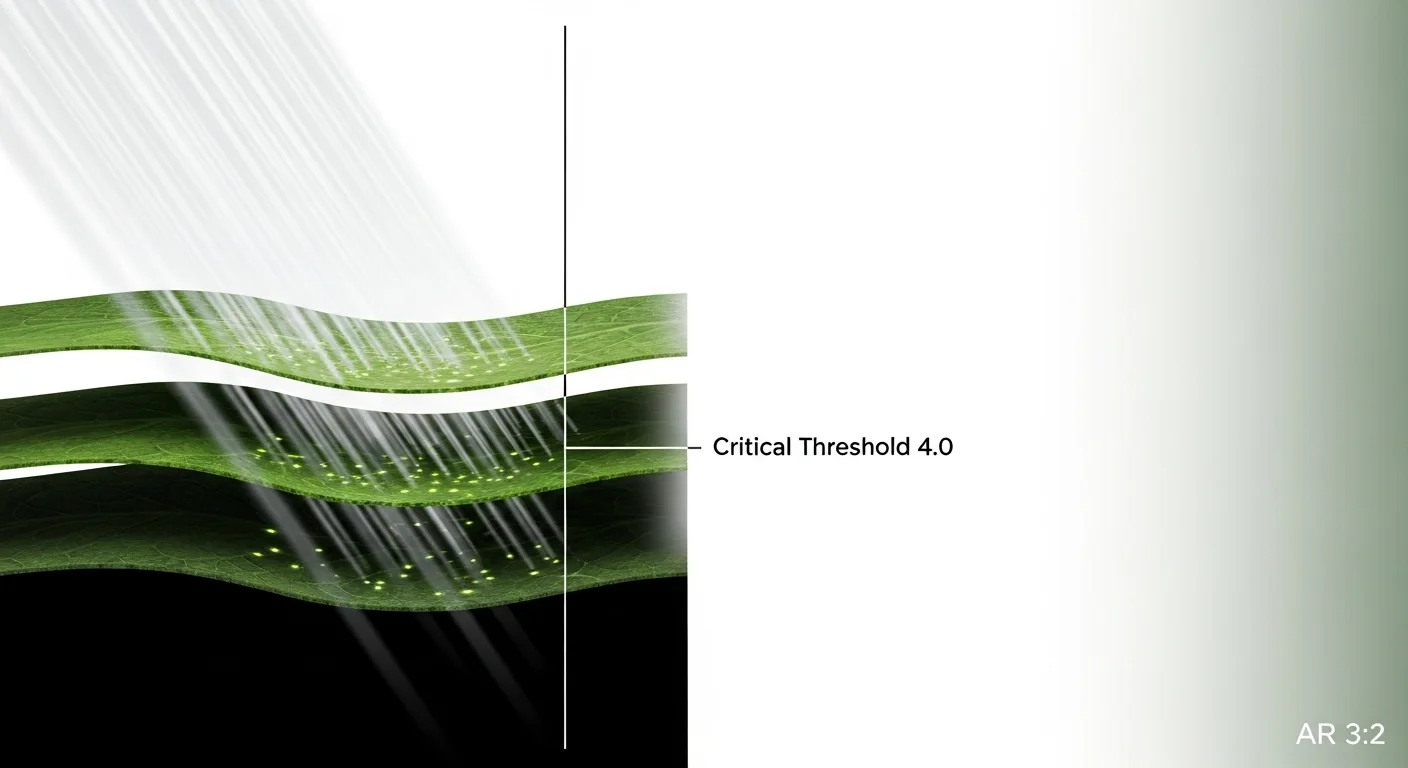
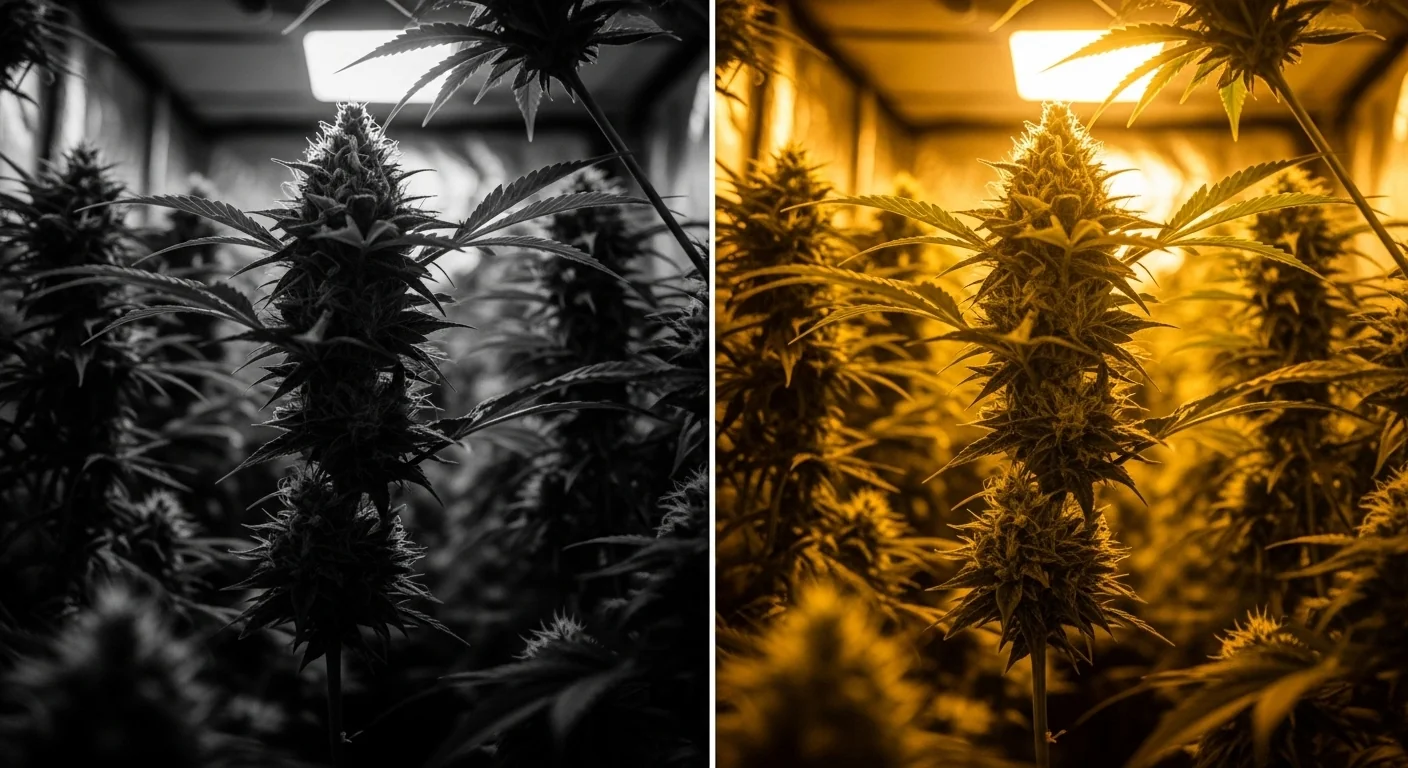
Canopy management decisions are usually made by eye. A grower walks the row, eyeballs the density, and pulls a few fan leaves. That heuristic fails at a specific, measurable threshold: when the Leaf Area Index of a canopy exceeds 4.0, the Beer-Lambert law of light attenuation means the bottom half of the plant is receiving less than 14% of surface PPFD under LED and less than 8% under HPS. That is not a minor reduction. It is a physiological light blackout for the lower bud sites, and it happens invisibly, inside a canopy that looks productive from above. Understanding your leaf area index calculator output is the first step to diagnosing why lower branches produce popcorn rather than harvestable colas.
This tool calculates two things: the ground area of your canopy (length times width), and the fraction of surface light reaching the bottom of that canopy using the Beer-Lambert exponential attenuation model. It applies the correct extinction coefficient for your light type (LED: k = 0.50; HPS: k = 0.65), then flags whether your current LAI puts lower bud sites into darkness. What it does not do: it does not measure your actual LAI from leaf samples or imagery, it does not account for vertical side lighting or inter-canopy supplementation, and it does not predict yield weight from LAI alone. Those calculations require additional tools and data outside this model. For total photon dose planning, the DLI calculator addresses the cumulative light exposure side of the equation.
after running this calculator, you will know whether your current canopy density has crossed the larf threshold and whether selective defoliation, schwazzing, or SCROG adjustment is warranted before the next stage of growth.
Use the Tool
The Yield Grid — Greenhouse & Hydroponics
Canopy LAI & Defoliation Yield Calculator
Optimize light penetration and defoliation timing using canopy physics
LAI Reference Table (LED, k=0.50)
| LAI | Canopy Status | Light at Bottom (LED) | Light at Bottom (HPS) | Action |
|---|
Recommended Tools for Defoliation
How This Calculator Works — Formula & Assumptions
Step 1 — Ground Area
The footprint of your canopy is simply length times width:
Step 2 — Leaf Area Index (LAI)
LAI is defined as total leaf surface area divided by the ground area it covers. You provide the LAI directly (estimated visually or by measurement). It is dimensionless — an LAI of 3.0 means 3 ft² of leaf area sits above every 1 ft² of ground.
Step 3 — Beer-Lambert Light Attenuation
Light penetration through a plant canopy follows an exponential decay law (Beer-Lambert). The fraction of light reaching the bottom of the canopy is:
Where:
- k = light extinction coefficient (LED: 0.50 — directional, deep; HPS: 0.65 — diffuse, shallower)
- LAI = your entered Leaf Area Index
- e = Euler’s number (≈2.718)
Light_Top is normalized to 100%, so the result is a percentage of surface light reaching lower branches.
Step 4 — Critical Threshold: LAI > 4.0
When LAI exceeds 4.0, less than 14% of surface light (LED) reaches lower branches. At LAI 5.0+, lower branches are effectively in darkness (<5%). The plant continues to metabolize sugar to maintain these lower branches, draining energy from top colas — resulting in larfy, underdeveloped popcorn buds.
Assumptions & Limits
- LAI is assumed uniform across the canopy (no hotspots modeled)
- k values (0.50 LED, 0.65 HPS) are representative midpoints; actual values vary by cultivar and spectrum
- Model assumes a flat, horizontal canopy layer — vertical walls and side lighting are not included
- LAI range is bounded 1.0–6.0 per standard greenhouse practice; values outside this range are not typical
- Plant height is informational and used for context — it does not affect light penetration calculation in this model
- Light-at-bottom percentage is relative to the light level at the top of the canopy, not the fixture output
Before entering values, have the following ready: a tape measure for canopy length and width in feet, an average plant height reading in inches (tip to substrate), and knowledge of your light type (LED or HPS). For LAI, use a visual estimate based on leaf layer density above each square foot of ground surface. A value of 1.0 represents a sparse, single-layer canopy; 6.0 represents a canopy so dense that stacking leaves on a square foot would require six layers. Growers unfamiliar with SCROG canopy geometry may find the sea of green calculator useful context for thinking about canopy coverage and plant density before entering LAI values.
Quick Start (60 Seconds)
- Canopy Length (ft): Measure the longest horizontal dimension of your grow area, not the tent or room perimeter. Enter in decimal feet (e.g., 8.5 for 8 feet 6 inches). Minimum accepted value is 0.1 ft.
- Canopy Width (ft): Measure the perpendicular horizontal dimension. For rectangular tents or beds, this is typically the shorter side. Do not include walkway space outside the plant zone.
- Average Plant Height (in): Measure from the substrate surface to the highest canopy tip, then average across your plants. Enter in whole inches. Range is 1 to 240 inches.
- Light Source Type: Select LED if using any solid-state grow light. Select HPS if using high-pressure sodium. Mixed rooms: use HPS to obtain a conservative (lower) light penetration estimate.
- Current Estimated LAI (1.0 to 6.0): This is the most judgment-dependent input. A fully trained, lightly defoliated SCROG at mid-veg typically reads around 2.0 to 3.0. A dense, unmanaged canopy going into flower often sits between 3.5 and 5.0. When in doubt, estimate high rather than low.
Inputs and Outputs (What Each Field Means)
| Field | Unit | What It Means | Common Mistake | Safe Entry Guidance |
|---|---|---|---|---|
| Canopy Length | ft | Horizontal length of the active grow canopy | Measuring room or tent dimensions instead of actual plant canopy footprint | Measure only the area covered by plant material. Enter decimals (e.g., 7.5). |
| Canopy Width | ft | Horizontal width of the active grow canopy | Including walkway or aisle space in the measurement | Keep to the plant zone boundary. Verify both dimensions with a tape measure. |
| Average Plant Height | in | Mean tip-to-substrate height across all plants in the canopy | Using max plant height rather than the average, which inflates the apparent canopy volume | Measure 3 to 5 representative plants and average. Use whole inches. |
| Light Source Type | N/A | Determines the extinction coefficient k used in the Beer-Lambert calculation (LED k=0.50, HPS k=0.65) | Selecting LED for a DE HPS room to get a "better" result; this produces an optimistic and incorrect output | Select the dominant light type. If unsure, choose HPS for a conservative result. |
| Estimated LAI | dimensionless | Leaf Area Index: total leaf area divided by ground area. Visually assessed here as layers of leaf coverage per square foot of ground | Underestimating LAI by assessing only the top canopy layer and ignoring the dense mid-canopy | When uncertain, round up to the nearest 0.5. The cost of overestimating is a false positive for defoliation; the cost of underestimating is missed larf prevention. |
| Ground Area (output) | ft² | Calculated footprint of the canopy (Length x Width) | N/A (computed) | Verify this matches your expected grow area before interpreting the LAI result. |
| Light at Bottom (output) | % | Fraction of surface PPFD reaching the lowest canopy layer, derived from Beer-Lambert: e^(-k x LAI) x 100 | Assuming this is an absolute PPFD reading; it is a relative fraction of whatever light hits the top of the canopy | Values below 20% indicate meaningful lower-canopy shading. Values below 10% indicate near-blackout conditions. |
| Canopy Status (output) | text | Deterministic classification based on LAI thresholds: Healthy, Defoliation Advised, Larf Risk, or Light Blackout | Treating "Defoliation Advised" as optional; at LAI 3.5 to 4.0 it should be acted on before flower flip | Use this status with the light penetration percentage to decide defoliation intensity. |
Worked Examples (Real Numbers)
Scenario 1: Healthy 4x4 LED Tent at Mid-Veg
- Canopy Length: 4 ft
- Canopy Width: 4 ft
- Average Plant Height: 28 in
- Light Source: LED (k = 0.50)
- Estimated LAI: 2.5
Result: Ground Area = 16 ft². Light at Bottom = e^(-0.50 x 2.5) = e^(-1.25) = 0.2865 = 28.7% of surface light reaching the lower canopy. Canopy Status: Moderate.
At 28.7%, lower bud sites are receiving meaningful light and the canopy is not yet energy-draining. Light selective defoliation to open airflow is reasonable but not urgent at this LAI.
Scenario 2: Dense 8x4 HPS Room at the Larf Threshold
- Canopy Length: 8 ft
- Canopy Width: 4 ft
- Average Plant Height: 42 in
- Light Source: HPS (k = 0.65)
- Estimated LAI: 4.0
Result: Ground Area = 32 ft². Light at Bottom = e^(-0.65 x 4.0) = e^(-2.60) = 0.0743 = 7.4% of surface light reaching the lower canopy. Canopy Status: Larf Risk.
Under HPS at LAI 4.0, only 7.4% of surface light penetrates to the bottom. The lower third of this canopy will produce nothing of commercial value. Immediate defoliation of fan leaves blocking the middle canopy is warranted before the first week of flower is complete.
Scenario 3: Over-Dense LED Greenhouse at Flower Week 2
- Canopy Length: 10 ft
- Canopy Width: 6 ft
- Average Plant Height: 58 in
- Light Source: LED (k = 0.50)
- Estimated LAI: 5.5
Result: Ground Area = 60 ft². Light at Bottom = e^(-0.50 x 5.5) = e^(-2.75) = 0.0639 = 6.4% of surface light. Canopy Status: Light Blackout.
Even with LEDs, an LAI of 5.5 produces a near-total blackout at the canopy floor. Lower bud sites are metabolic liabilities at this point. Aggressive schwazzing during early flower, combined with SCROG adjustment to redistribute canopy horizontally, is the appropriate response.
Reference Table (Fast Lookup)
| LAI | LED Light at Bottom (%) | HPS Light at Bottom (%) | LED vs HPS Difference (pp) | Canopy Status | Recommended Action |
|---|---|---|---|---|---|
| 1.0 | 60.7% | 52.2% | 8.5 | Sparse | No action; monitor growth rate |
| 1.5 | 47.2% | 37.7% | 9.5 | Light | No action; consider low-stress training |
| 2.0 | 36.8% | 27.3% | 9.5 | Moderate | Light defoliation acceptable |
| 2.5 | 28.7% | 19.7% | 9.0 | Moderate | Selective fan leaf removal if airflow restricted |
| 3.0 | 22.3% | 14.2% | 8.1 | Dense | Selective defoliation; open canopy layers |
| 3.5 | 17.4% | 10.3% | 7.1 | Dense | Defoliation required before flower flip |
| 4.0 | 13.5% | 7.4% | 6.1 | Critical Threshold | Heavy defoliation now; SCROG adjustment |
| 4.5 | 10.5% | 5.4% | 5.1 | Larf Risk | Schwazze; remove all non-productive lower growth |
| 5.0 | 8.2% | 3.9% | 4.3 | Larf Risk | Immediate schwazzing; reassess canopy strategy |
| 5.5 | 6.4% | 2.8% | 3.6 | Light Blackout | Aggressive schwazze; consider lollipop technique |
| 6.0 | 5.0% | 2.0% | 3.0 | Light Blackout | Emergency defoliation; re-train canopy immediately |
The "LED vs HPS Difference" column shows how many percentage points more light penetrates with LED over HPS at the same LAI. The advantage narrows at high LAI values because exponential attenuation compresses both curves toward zero -- meaning switching from HPS to LED does not rescue an over-dense canopy.
How the Calculation Works (Formula + Assumptions)
Show the calculation steps
Step 1: Ground Area
The canopy footprint is calculated as a simple rectangle:
Ground Area (ft²) = Canopy Length (ft) x Canopy Width (ft)
No unit conversion is required. Both inputs are in feet; the output is in square feet. Non-rectangular grows should approximate the area of the dominant light-receiving zone and enter that as the product of length and width.
Step 2: Beer-Lambert Light Attenuation
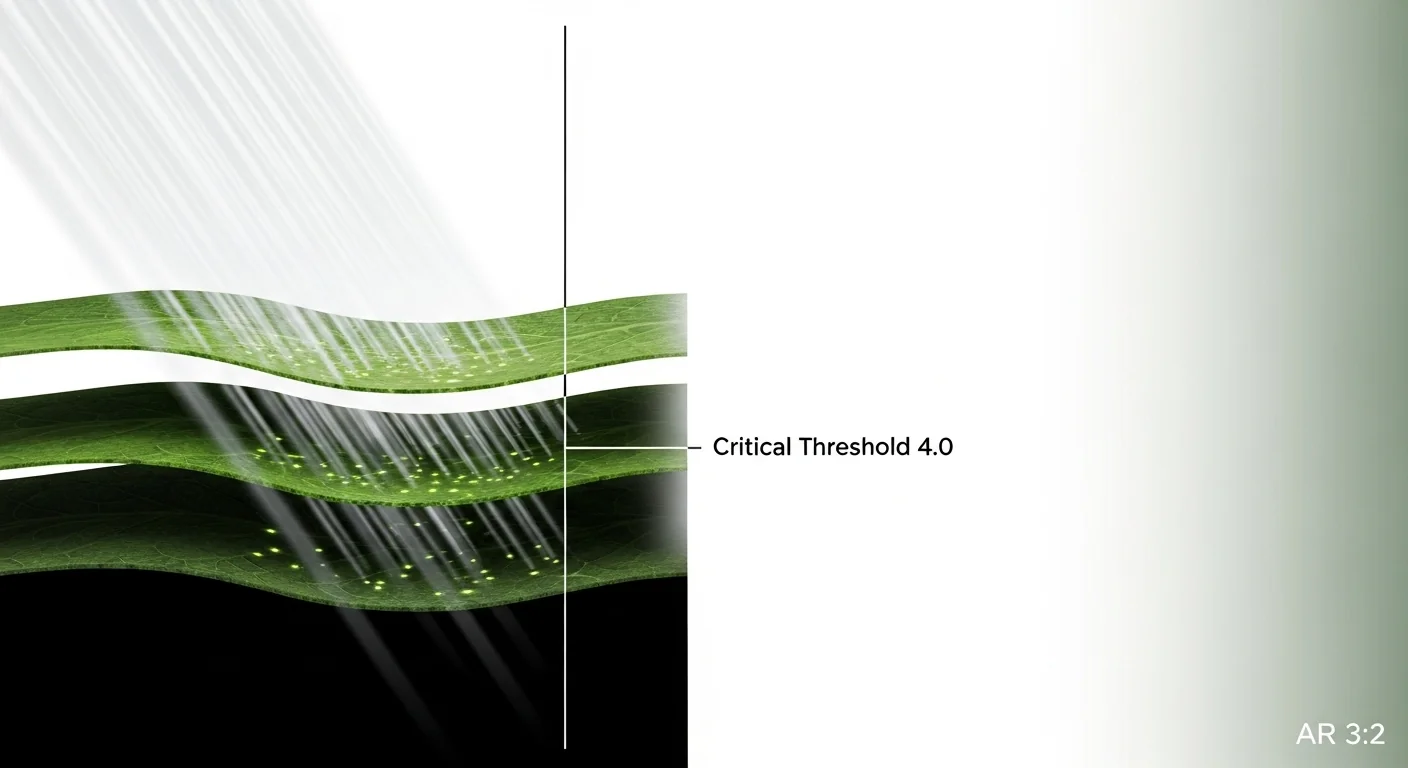
Light passing through a layered canopy follows an exponential decay. The fraction of incident light at the top of the canopy that reaches the bottom is:
Light at Bottom = e^(-k x LAI)
Multiplied by 100 to express as a percentage of surface light. Where:
- e is Euler's number, approximately 2.71828
- k is the light extinction coefficient: 0.50 for LED, 0.65 for HPS
- LAI is the Leaf Area Index entered by the user
Rounding: all outputs are displayed to one decimal place. No rounding occurs during the calculation itself; rounding is applied only at display time.
Step 3: Threshold Classification
The result is classified using fixed LAI breakpoints: below 3.0 = healthy to moderate, 3.0 to 4.0 = defoliation advised, above 4.0 to 5.0 = larf risk, above 5.0 = light blackout. These breakpoints are derived from the LAI thresholds described in the original tool specification and are consistent with published canopy management standards for high-density indoor horticulture.
Assumptions and Limits
- LAI is assumed to be spatially uniform across the entire canopy footprint. Real canopies have hotspots, edges, and gaps that the model cannot capture without spatial measurement tools.
- The extinction coefficients (k = 0.50 for LED, k = 0.65 for HPS) are representative midpoints. Actual values vary with leaf angle distribution, cultivar morphology, and the spectral composition of the light source.
- The model uses a flat horizontal canopy plane. Vertical or angled leaf distributions, tiered grow systems, and inter-canopy supplemental lighting are not represented.
- Plant height is collected as contextual information and does not affect the light attenuation calculation in this model. It is available for reference and for future workflow integration.
- LAI is bounded between 1.0 and 6.0 per the accepted range for standard indoor canopy management. Canopies below 1.0 or above 6.0 exist but fall outside the validated operating range of this tool.
- The "Light at Bottom" output is a relative fraction of whatever PPFD intensity exists at the top of the canopy -- not an absolute PPFD reading. If surface PPFD is low, even high bottom-penetration percentages represent low absolute photon flux.
- The model does not account for light reflected off walls, floors, or neighboring plants. Reflective surfaces (Mylar, white poly, white paint) can meaningfully increase effective PPFD at lower canopy levels beyond what this model predicts.
Standards, Safety Checks, and "Secret Sauce" Warnings
Critical Warnings
- The LAI 4.0 blackout threshold is a physics result, not a guideline. At LAI 4.0 under LED, 86.5% of surface light is blocked before reaching the bottom of the canopy. The plant continues to allocate carbohydrate and water to the lower branches -- branches that are now producing popcorn buds at best and costing net energy at worst. Defoliation is not cosmetic at this threshold; it is a yield-protection intervention.
- Switching from HPS to LED does not solve a density problem. At LAI 5.0, LED delivers 8.2% of surface light to the bottom while HPS delivers 3.9%. Both are effectively zero for productive photosynthesis. The canopy physics dominate over the light source advantage at high LAI values.
- Larf formation begins before the threshold is visible from above. The canopy top looks full and productive while the lower bud sites are already in darkness. Growers who do not measure or estimate LAI regularly will miss the intervention window -- which is at or before flower flip, not during week four.
- Underestimating LAI is a directionally dangerous error. A grower who estimates 3.0 when the actual LAI is 4.2 receives a "selective defoliation" recommendation rather than a "heavy defoliation" flag. The consequence is a full flowering cycle with energy-draining lower growth intact.
Minimum Standards
- Canopy LAI should be estimated at each major growth transition: before the vegetative stretch, at the flower flip, and during the first two weeks of flowering when the stretch can push LAI up rapidly.
- Any defoliation session should use sterilized cutting tools. Cross-contamination between plants via unsterilized shears is a primary vector for pathogen spread in dense canopies. Isopropyl alcohol applied between plants is the standard protocol.
- After defoliation that removes more than 20% of leaf area in a single session (as in schwazzing), allow 3 to 5 days before applying heavy fertigation or environmental stress. Recovery time affects the plant's ability to redirect energy to remaining bud sites.
Competitor Trap: Most canopy management content teaches that "more leaves equal more photosynthesis" and frames defoliation as a risk. This framing is correct at low LAI and becomes actively wrong above LAI 3.5. The leaves being removed in heavy defoliation are not contributing positive net photosynthesis -- they are shaded below their light compensation point, meaning they consume more energy in respiration than they fix through photosynthesis. The grower who believes they are "losing energy" by defoliating a LAI 4.5 canopy is making the opposite error: they are preserving a metabolic drain and calling it caution.
Airflow is directly affected by canopy density, and managing it matters as much after defoliation as before. The grow tent fan size calculator can help you reassess ventilation requirements after a major defoliation session that changes the resistance profile of your canopy. Similarly, light management above the canopy interacts with LAI decisions: the shade cloth percentage calculator is relevant for greenhouse growers trying to reduce surface PPFD to a range compatible with their target LAI without triggering heat stress.
Common Mistakes and Fixes
Mistake: Estimating LAI by Looking at the Top of the Canopy Only
The top canopy surface is always the most visible and the most leafy. Estimating LAI from the top view systematically underestimates the density of mid-canopy layers that are invisible from above but fully present in the light path. A canopy that looks moderately dense from a standing position often has two or three additional leaf layers compressed in the middle zone. Fix: part the canopy vertically and count the number of leaf layers intersecting a vertical line drawn from the top to the substrate. That count approximates the LAI more accurately than a top-down assessment.
Mistake: Defoliating Only at Late Flower When Larf Is Already Formed
By weeks four and five of flower, the lower bud sites have already committed to a popcorn morphology. Removing the fan leaves at that stage stops further energy drain but does not convert the existing larf into harvestable buds. The intervention window is during veg and the first two weeks of flower. Fix: estimate LAI at the flower flip and act immediately if it exceeds 3.5 to 4.0. Schwazzing is established specifically as an early-flower technique for this reason.
Mistake: Applying the Same Defoliation Intensity Regardless of Light Source
A grower running HPS at LAI 3.5 has only 10.3% of surface light reaching the lower canopy. The same grower running LED at LAI 3.5 has 17.4%. These are meaningfully different situations that call for different intervention intensity. Using a flat defoliation rule without adjusting for light type underserves HPS users who need to act earlier and more aggressively. Fix: use the tool's light source selector to see your actual penetration percentage rather than applying a generic LAI threshold rule. The VPD calculator is a useful companion check after defoliation, since removing leaf mass changes transpiration surface area and can shift your canopy VPD away from target.
Mistake: Measuring Tent or Room Dimensions Instead of Canopy Footprint
A 4x4 tent does not have a 16 ft² canopy if the plants only cover 12 ft² of that space. Entering room dimensions overstates the ground area, which does not affect the light calculation (LAI is entered directly) but produces an inflated and misleading ground area output. Fix: measure the actual outer boundary of the plant zone with a tape measure, not the tent wall perimeter.
Mistake: Treating the "Light at Bottom" Output as an Absolute PPFD Reading
The tool outputs a percentage of surface light, not a micromole reading. A grower running 200 umol/m²/s at canopy top with 20% penetration has 40 umol at the bottom -- below the light compensation point for most cannabis cultivars. A grower running 1,000 umol at the top with the same 20% penetration has 200 umol at the bottom, which is marginal but non-zero. The penetration percentage is meaningless without knowing the surface intensity. Fix: combine this tool's output with your measured surface PPFD to determine the actual lower-canopy light dose. The DLI calculator can convert that intensity and photoperiod into a daily light integral for the lower bud sites.
Next Steps in Your Workflow
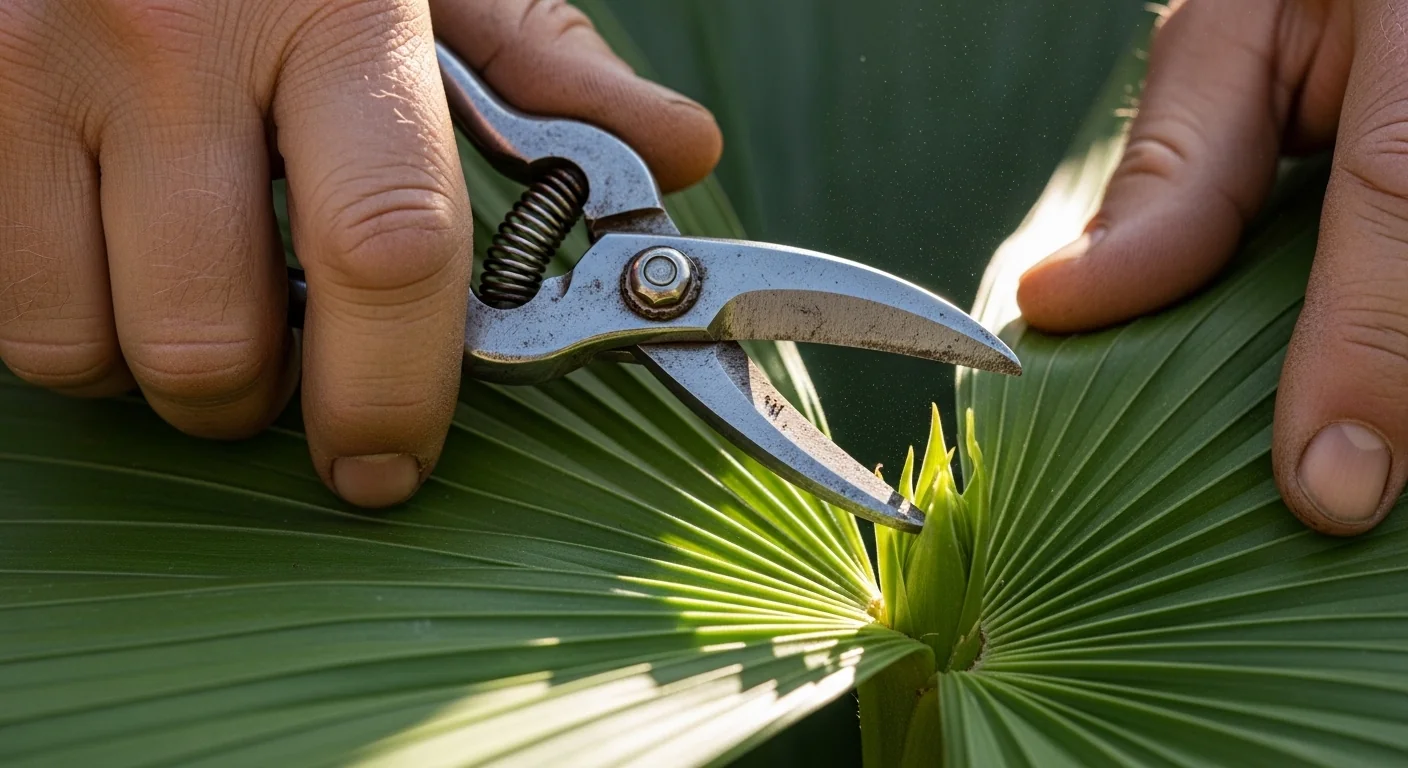
After getting your LAI and light penetration result, the immediate decision tree is straightforward. If your canopy status is "Healthy" or "Defoliation Advised," continue monitoring through the remaining vegetative growth and plan a defoliation session at or before the flip to flower. If your status is "Larf Risk" or "Light Blackout," defoliation is not optional -- it is time-critical. Begin with the largest fan leaves that are blocking mid-canopy bud sites, sterilize between plants, and reassess the canopy after three to five days of recovery before the next heavy session. Growers who use crop steering protocols alongside defoliation can consult the crop steering calculator to time irrigation and environment shifts to match the plant's post-defoliation recovery state.
Once the canopy has been thinned to a productive LAI, the next efficiency question is usually whether your current light fixture is delivering enough PPFD to the now-exposed lower canopy. Supplemental lighting positioned inside or below the canopy can dramatically change the effective photon dose for middle and lower bud sites. The greenhouse supplemental lighting calculator addresses fixture placement and intensity requirements for exactly this scenario, particularly relevant in taller greenhouse canopies where lower bud site access was the original problem driving LAI concerns.
FAQ
What is a good Leaf Area Index for indoor cannabis or tomato production?
For most high-intensity indoor crops, a target LAI of 2.0 to 3.5 at flower flip balances photosynthetic capacity with adequate light penetration. Values below 2.0 indicate under-utilized canopy space. Values above 4.0 indicate a canopy density that is actively limiting yield by blocking light from lower bud sites or fruit clusters.
Does LAI change during the grow cycle?
Yes, continuously. During the vegetative stage, LAI rises as new leaves emerge. The post-flip stretch can double canopy density within two weeks. Growers should re-estimate LAI at each major growth transition rather than measuring once and assuming it remains constant through flowering.
How do I measure LAI without specialized equipment?
The visual estimation method used in this tool is the practical standard for small to medium grows. Count the number of leaf layers visible when looking vertically through the canopy from the top. Each identifiable layer approximates 1.0 LAI unit. Sparse spacing between layers suggests the true value is toward the lower bound; compressed, overlapping layers suggest the higher bound.
Why does HPS produce lower light penetration than LED at the same LAI?
HPS is an omnidirectional, diffuse light source with a higher extinction coefficient (k = 0.65 in this model) because the light strikes leaves at a wider range of angles, increasing the effective path length through each leaf layer. LED fixtures with directional optics deliver more collimated light that passes through leaf gaps more efficiently, yielding a lower extinction coefficient (k = 0.50).
What is schwazzing and when should it be used?
Schwazzing is an aggressive fan leaf removal technique applied at the start of flower (typically day one and day twenty of flowering). It removes most or all large fan leaves in a single session to expose lower bud sites to direct light. It is most appropriate when LAI is above 4.0 at the flower flip and the lower canopy is receiving less than 15% of surface light.
Can a too-low LAI hurt yield?
Yes. LAI below 1.5 indicates that the canopy is not intercepting available light efficiently. Each square foot of ground is receiving more photons than the leaf area above it can process. In that scenario, yield is limited by insufficient leaf area rather than by light penetration. The solution is canopy training and denser planting, not defoliation.
Conclusion
The core insight this leaf area index calculator delivers is not a number -- it is a reframe. Larf and popcorn buds are not random outcomes or genetic inevitabilities. They are the predictable result of a canopy that has passed a measurable physical threshold where the exponential decay of the Beer-Lambert law removes useful light from the lower plant before it can drive productive photosynthesis. The threshold is LAI 4.0. The model is simple. The consequence of ignoring it is a full flower cycle of wasted metabolic energy in branches that will produce nothing worth harvesting.
The most important mistake to avoid is treating defoliation as a cosmetic or optional practice reserved for late flower cleanup. By that stage, the larf is already formed. The intervention that protects yield is timed to the flower flip or before, when LAI can still be corrected before bud differentiation locks in the morphology of lower sites. Use this tool at each growth transition, act on the output before the critical window closes, and pair the result with your grow light cost calculator data to confirm that your current fixture intensity is sufficient to justify the canopy area you are managing.